Key takeaways
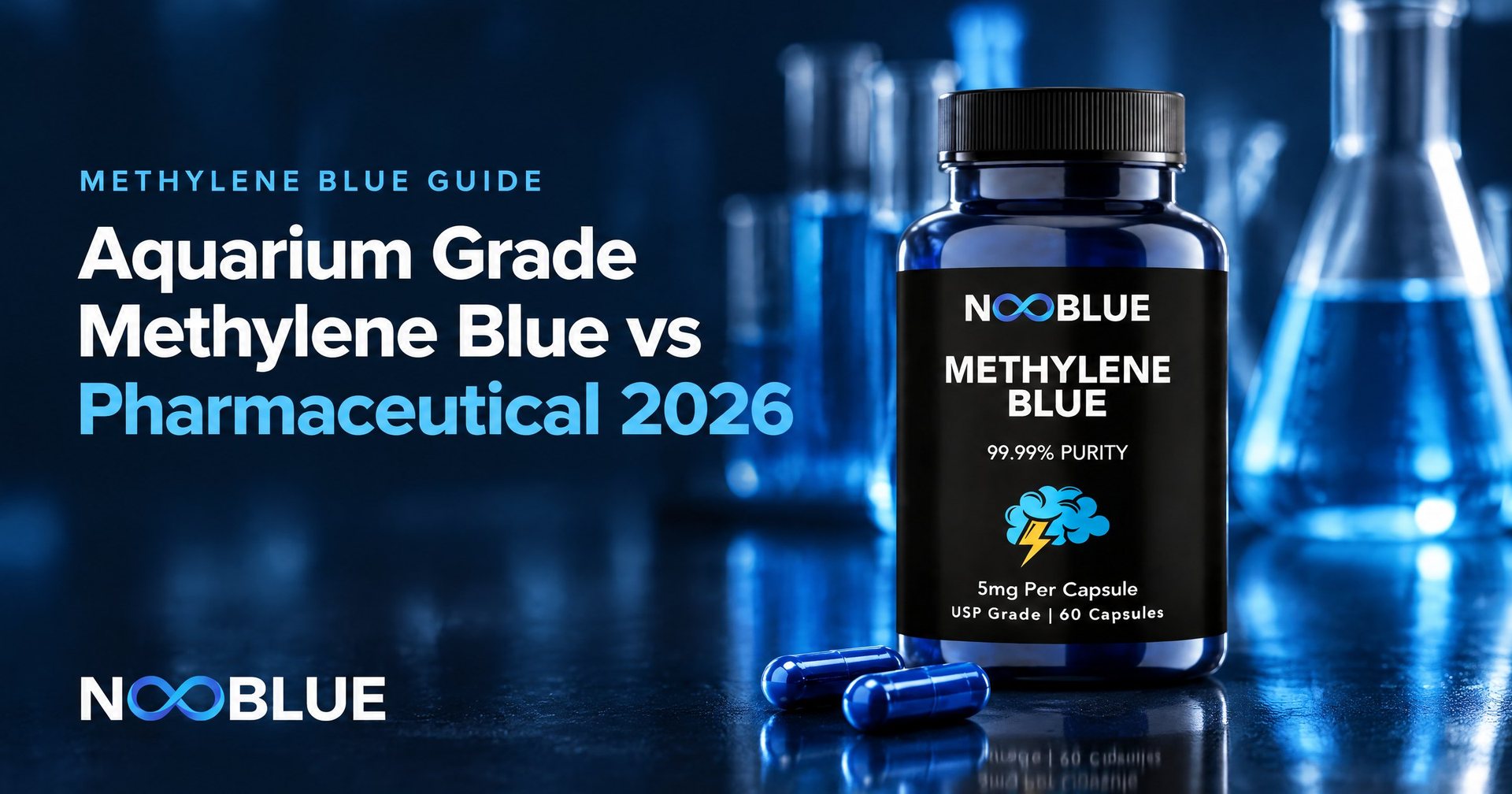
- Aquarium and pharmaceutical methylene blue are the same molecule, methylthioninium chloride. What differs is the standard each is made to, the concentration, the paperwork and who it is meant for.
- Aquarium products are made to be added to tank water. Kordon’s aquarium methylene blue, for example, is a 2.303% solution whose maker states it is not intended for human consumption.
- Pharmaceutical (USP) grade must contain 97.0% to 103.0% methylene blue on the dried basis. It is the grade to look for in anything you swallow.
- For fish, use a product labelled for aquarium use. For yourself, use a USP-grade supplement and read what its lab report actually covers.
- Whatever the grade, do not take methylene blue with SSRIs, SNRIs, MAOIs or other serotonergic medicines (serotonin syndrome risk), with G6PD deficiency, while pregnant or breastfeeding, or if you are under 18. It can turn urine blue or green. If you take any prescription medicine, talk to your doctor first.
What’s the difference between pharmaceutical and aquarium methylene blue? The molecule is the same. The product is not. Aquarium methylene blue is a water additive for fish, sold at a concentration and with directions meant for a tank, and its makers do not intend it for people. Pharmaceutical methylene blue is made to the USP standard, which sets how much real methylene blue the material must contain, and it is the grade used in hospitals and in supplements you swallow. This guide explains both, how to check which one you are buying, why a fish-tank bottle is the wrong thing to take, and whether a human product belongs in your aquarium.
NooBlue sells USP-grade methylene blue capsules, gummies and drops for people. We do not make an aquarium product. Written by the NooBlue editorial team.
Table of contents
- 1. Aquarium vs Pharmaceutical Methylene Blue at a Glance
- 2. What Is Aquarium Grade Methylene Blue?
- 3. What Makes Methylene Blue Pharmaceutical Grade?
- 4. Lab, Reagent, Food and Industrial Grades
- 5. Why the Grade Matters for Anything You Swallow
- 6. How to Confirm You’re Buying Pharmaceutical Grade Methylene Blue
- 7. Who Should Not Take Methylene Blue (Any Grade)
- 8. Which Form of Methylene Blue Is Best for People?
- 9. Can You Use Human-Grade Methylene Blue in a Fish Tank?
- 10. Does Methylene Blue Expire?
- 11. Frequently Asked Questions
- 11.1. What’s the difference between pharmaceutical and aquarium methylene blue?
- 11.2. Is aquarium grade methylene blue safe to take?
- 11.3. Can you drink aquarium methylene blue?
- 11.4. Does aquarium methylene blue contain heavy metals?
- 11.5. Which form of methylene blue is best?
- 11.6. Which methylene blue should I use for fish?
- 11.7. How do I tell if my methylene blue is real?
- 11.8. Does methylene blue expire?
- 11.9. Why don’t doctors recommend methylene blue?
- 12. The Bottom Line
- 13. Sources
Aquarium vs Pharmaceutical Methylene Blue at a Glance
| Factor | Aquarium grade | Pharmaceutical (USP) grade |
|---|---|---|
| Made for | Fish and fish eggs in tank water | Human use, from hospital injections to oral supplements |
| Standard | The aquarium maker’s own specification | USP monograph: 97.0% to 103.0% methylene blue, dried basis |
| Typical strength | Kordon: 2.303% solution | Supplements vary: NooBlue drops are 1%, capsules 5 mg each |
| Directions | Dose per gallon of water | Serving per person, with safety warnings |
| What the label says about people | Kordon: “not intended for human consumption” | Made to be taken, with contraindications listed |
| Should you swallow it? | No | Only if none of the safety warnings applies to you |
What Is Aquarium Grade Methylene Blue?
Aquarium methylene blue is a traditional fish medication. The aquarium brand Kordon describes its product as fungus control for fertile fish eggs and for superficial fungal infections of fish, with secondary uses against some external protozoans such as Ich, Chilodonella and Costia. Because methylene blue converts methemoglobin back to working hemoglobin in fish blood too, Kordon also lists it for nitrite and cyanide poisoning of aquarium fish (Kordon).
The product details show how different it is from a supplement:
- Concentration. Kordon supplies the zinc-free chloride salt of methylene blue as a 2.303% water solution. That is more than twice the strength of a 1% supplement solution.
- Directions. One teaspoon per 10 gallons of water gives 3 ppm. A 4 fl oz (118 ml) bottle is enough for 240 gallons.
- Intended use. The page states plainly that the product is not intended for human consumption.
None of this makes the aquarium product bad. It is made for a job, and it does that job. It simply is not made, labelled or documented for people, and its makers say so.
What Makes Methylene Blue Pharmaceutical Grade?
In the US, “pharmaceutical grade” for methylene blue usually means USP grade: material that meets the United States Pharmacopeia monograph. The monograph requires not less than 97.0% and not more than 103.0% methylene blue (C16H18ClN3S), calculated on the dried basis, and lists reference standards for methylene blue and for azure B, a closely related dye (USP). The full test methods sit behind the USP subscription, so the public preview confirms the purity range but not every impurity limit.
This is the grade used in medicine. A review of 185 cases reported to the New York City Poison Center between 2000 and 2024 found that pharmaceutical methylene blue given for methemoglobinemia, usually at 1 mg/kg, was followed by improvement in 98% of cases. Adverse effects attributed to it were reported in nine cases (4.9%), including one case of hemolysis (Rothenberg et al., 2025). That record comes from pharmaceutical material given at measured doses under medical care. It tells you nothing about a fish-tank product.
Harvard Health Publishing is blunt about the other grades: industrial or chemical-grade methylene blue, like the kind sold as a stain or dye, should not be used in humans or animals, and people shopping online have bought aquarium disinfectant by mistake (Harvard Health, 2025). Our guides to USP-grade methylene blue and pharmaceutical grade methylene blue capsules go further into the standard.
Lab, Reagent, Food and Industrial Grades
Aquarium and USP are not the only labels you will see. Methylene blue is also sold as a laboratory stain, as a reagent, and under loose terms such as “food grade”. Some supplement-style listings on large marketplaces sit in lab chemical categories or carry “for research purposes only” in their descriptions. Those words matter. A product described as a lab reagent or research chemical is not being offered as something to take, whatever the photos suggest.
For a product you plan to swallow, look for USP grade stated on the label or product page, then check the paperwork behind it. Our explainers on lab grade vs pharmaceutical grade methylene blue and food grade methylene blue cover those labels one by one.
Why the Grade Matters for Anything You Swallow
Three differences make an aquarium bottle the wrong thing to take, even though the molecule is the same.
- No purity promise for people. An aquarium label tells you what the product does in a tank. It does not tell you how much of the bottle is methylene blue by the USP measure, or what else is in it, because it was never meant to be swallowed.
- The wrong concentration and directions. A 2.303% solution delivers about 2.3 times as much methylene blue per drop as a 1% solution. The directions are written per gallon of water, not per person, so there is no sensible way to work out a human serving from them.
- No human safety information. A supplement label lists who should not take it. Methylene blue has serious interactions, so that matters. An aquarium label has no reason to include them.
Dose control matters more with methylene blue than with most compounds, because its effects follow a hormetic curve: responses rise at low doses and fall below normal at high ones (Bruchey and Gonzalez-Lima, 2008). Clinical references also list toxicity at cumulative intravenous doses of 7 mg/kg or more (StatPearls, 2026). A product with the wrong strength and no human directions makes it easy to land somewhere you did not intend.
How to Confirm You’re Buying Pharmaceutical Grade Methylene Blue
Anyone can print “pure” on a label. Use this checklist before you buy methylene blue to take:
- Look for “USP” on the label or product page. Walk away from “aquarium”, “lab”, “reagent”, “technical” or “for research purposes only”.
- Find the lab report and read its scope. Check which lab ran it, which lot it covers, and whether it tested the raw ingredient or the finished product. Check which tests were run: identity, an assay that measures how much methylene blue is present, heavy metals and microbes. A report can be real and still cover less than the marketing implies.
- Check the strength and serving. A supplement should tell you how many mg are in each capsule, gummy or drop.
- Check for safety warnings. A product meant for people should warn against serotonergic medicines, G6PD deficiency, pregnancy and breastfeeding. A missing warning list is a red flag in itself.
- Ask the seller. A brand that sells for human use should be able to tell you its grade and show you its documents.
Here is what NooBlue publishes, so you can apply the same checklist to us. All three NooBlue products use USP-grade methylene blue. NooBlue publishes a report from Contract Testing Laboratories of America (CTLA) on its methylene blue ingredient, with identity and heavy metal results for one ingredient lot. It covers the raw ingredient, not each finished batch, and it does not state a purity percentage. Our product pages give the mg per serving and carry a full safety section.
Our guides to reading a methylene blue certificate of analysis, methylene blue purity, the purest methylene blue, real vs fake methylene blue and how to test if methylene blue is real go through each step. If you are still choosing a product, start with our best methylene blue capsules comparison, the best methylene blue supplements roundup, our guide to choosing a methylene blue supplement, or the beginner’s guide. Our page on finding methylene blue in health stores and pharmacies covers where it is sold.
Who Should Not Take Methylene Blue (Any Grade)
Pharmaceutical grade makes methylene blue fit to swallow. It does not make it right for everyone. Do not take it if any of these applies to you:
- You take an SSRI, SNRI, MAOI or any other serotonergic medicine, including many antidepressants. Methylene blue is a potent MAO-A inhibitor (Ramsay et al., 2007), and the combination can cause serotonin syndrome. A review of reported cases found severe serotonin toxicity at an intravenous dose of only 1 mg/kg (Gillman, 2011).
- You have G6PD deficiency. Clinical references list it as a contraindication (StatPearls, 2026).
- You are pregnant or breastfeeding. Methylene blue may cause fetal harm when given during pregnancy (StatPearls, 2026).
- You are under 18.
If you take any prescription medicine, talk to your doctor first. Methylene blue can turn urine blue or green, which is expected and harmless (StatPearls, 2026). The same warnings are in the Safety: read before use section of every NooBlue product page, and our guides to who should not take methylene blue and what not to take with methylene blue cover them in full.
If none of these applies to you, NooBlue makes USP-grade methylene blue in three formats for people.
Which Form of Methylene Blue Is Best for People?
Once the grade is right, the choice is about how you want to take it:
- Capsules hold 5 mg of methylene blue with 10 mg of vitamin C, 60 per bottle, one a day with food. Nothing to measure and no taste. This is our pick for most first-time buyers.
- Gummies hold 10 mg with 25 mg of vitamin C, 60 per bottle. They avoid the blue mouth and tongue that drops cause.
- Drops are a 1% solution in a 50 ml bottle, 0.5 mg per drop, for anyone who wants to set the amount in small steps. They can stain the mouth and tongue, so mix them into water or juice.
Our comparisons of methylene blue capsules vs liquid, a 1% solution vs 5 mg capsules and NooBlue capsules vs liquid solutions help you decide.
Can You Use Human-Grade Methylene Blue in a Fish Tank?
The molecule is the same, but it is a poor idea in practice. Aquarium products come with directions for a known strength in a known volume of water. Kordon’s, for example, gives teaspoons per 10 gallons of its 2.303% solution, warns that activated carbon removes methylene blue from the water, and tells you to take the carbon out of the filter while you dose (Kordon). A supplement comes with directions for a person. Converting a 1% supplement or a 5 mg capsule into a tank dose means doing the maths yourself, with fillers from capsules or gummies ending up in the water.
You would also be paying for a product made for people that your fish gain nothing from. NooBlue’s products are not labelled or intended for aquarium use. For a tank, buy a product made for a tank and follow its directions.
Does Methylene Blue Expire?
Methylene blue itself is a stable compound. Kordon says its 2.303% aquarium solution is stable indefinitely and that water solutions show very little decomposition even in sunlight (Kordon). A supplement is a different case, because capsules, gummies and drops contain other ingredients and are made for people. Follow any date on the label and the storage directions. NooBlue’s drops, for example, should be kept tightly closed, away from heat and sunlight. If a solution changes color, grows cloudy or smells odd, do not take it. Our guides to methylene blue shelf life and methylene blue that has turned brown explain what to look for.
Frequently Asked Questions
What’s the difference between pharmaceutical and aquarium methylene blue?
Both are methylthioninium chloride. Pharmaceutical (USP) grade must contain 97.0% to 103.0% methylene blue on the dried basis and is made for human use. Aquarium grade is made to its maker’s own specification for use in fish tanks, often at a different strength (Kordon’s is 2.303%), with directions per gallon and no promise of fitness for people.
Is aquarium grade methylene blue safe to take?
No. It is not made, tested or labelled for people, and makers such as Kordon state it is not intended for human consumption. Harvard Health warns that industrial or chemical-grade methylene blue should not be used in humans or animals. If you want to take methylene blue, use a USP-grade supplement and check the safety warnings first.
Can you drink aquarium methylene blue?
You should not. Beyond the purity question, the strength is wrong for people and the label has no human serving or safety warnings. The hospital safety record for methylene blue comes from pharmaceutical material given at measured doses.
Does aquarium methylene blue contain heavy metals?
The label will not tell you, and that is the problem. Aquarium products are not sold with heavy metal results for people because they are not meant to be swallowed. A supplement should have a lab report that lists heavy metal results, and you should check whether it covers the raw ingredient or the finished product.
Which form of methylene blue is best?
For people, USP grade in a measured format. Our pick for most first-time buyers is NooBlue’s 5 mg capsules, because there is nothing to measure. Gummies suit people who want a chew without the blue mouth, and 1% drops suit anyone who wants to set the amount in 0.5 mg steps.
Which methylene blue should I use for fish?
A product made and labelled for aquarium use, dosed by its own directions. Kordon’s 2.303% solution is one example, with directions per gallon for fish eggs, fungus and some parasites. NooBlue does not make an aquarium product, and human supplements are not designed for tanks.
How do I tell if my methylene blue is real?
Home checks can catch an obviously wrong product, but they cannot measure purity or heavy metals. For that you need a lab report. Check the lab’s name, the lot number, whether it covers the ingredient or the finished product, and which tests were run. Our guide to testing whether methylene blue is real walks through it.
Does methylene blue expire?
The compound is stable, and Kordon describes its aquarium solution as stable indefinitely. For a supplement, follow the label date and storage directions, keep it closed and away from heat and sunlight, and do not use a solution that has changed color or clarity.
Why don’t doctors recommend methylene blue?
Mainly because of its MAO-A interaction with common medicines, and because human evidence for everyday use is limited to small, short studies. Our article on why doctors rarely prescribe methylene blue sets out the full reasoning.
The Bottom Line
Aquarium and pharmaceutical methylene blue share a molecule and nothing else that matters to a buyer. The aquarium bottle is a fish medication at a tank strength, with tank directions and a note that it is not for people. USP grade is made to a published purity standard for human use. Buy the aquarium product for your fish. If you want to take methylene blue yourself and none of the safety warnings applies to you, choose USP grade, read what its lab report covers, and start with the smallest measured serving. You can compare NooBlue’s three formats in the shop, and our guide to methylene blue benefits covers what the research shows.
Sources
- Kordon. Methylene Blue (product information, directions and specifications). kordon.com
- United States Pharmacopeia. Methylene Blue monograph. doi.usp.org
- Rothenberg R, Biary R, Hoffman RS. Effectiveness and tolerability of methylthioninium chloride (methylene blue) for the treatment of methemoglobinemia: twenty-four years of experience at a single poison center. Clinical Toxicology. 2025;63(4):284-291. PubMed 40062661
- Goldman L. What to know about methylene blue. Harvard Health Publishing. April 24, 2025. health.harvard.edu
- Bruchey AK, Gonzalez-Lima F. Behavioral, physiological and biochemical hormetic responses to the autoxidizable dye methylene blue. American Journal of Pharmacology and Toxicology. 2008;3(1):72-79. PubMed 20463863
- Ostrovsky A, Afzal M. Methylene Blue. StatPearls. Updated January 2, 2026. NCBI Bookshelf NBK557593
- Ramsay RR, Dunford C, Gillman PK. Methylene blue and serotonin toxicity: inhibition of monoamine oxidase A (MAO A) confirms a theoretical prediction. British Journal of Pharmacology. 2007;152(6):946-951. PMC2078225
- Gillman PK. CNS toxicity involving methylene blue: the exemplar for understanding and predicting drug interactions that precipitate serotonin toxicity. Journal of Psychopharmacology. 2011;25(3):429-436. PubMed 20142303