Key takeaways
- The side effect nearly everyone gets is blue or green urine. It is expected and harmless, and it happens with every format, including capsules and gummies.
- Clinical references list headache, nausea, diarrhea and dizziness among its adverse effects. In oral studies at much higher doses than supplements, burning when urinating and mild vomiting were the complaints researchers linked to methylene blue.
- The serious risks are serotonin syndrome with serotonergic medicines, red blood cell breakdown in G6PD deficiency, and methemoglobinemia and other toxicity at high doses (cumulative doses of 7 mg/kg or more).
- Drops can stain the mouth and tongue. Capsules are swallowed, and NooBlue gummies avoid the blue mouth that drops cause.
- Do not take methylene blue with SSRIs, SNRIs, MAOIs or other serotonergic medicines, with G6PD deficiency, while pregnant or breastfeeding, or if you are under 18. If you take any prescription medicine, talk to your doctor first.
Methylene blue side effects range from the harmless to the life-threatening, and the difference almost always comes down to three things: the dose, the medicines you already take, and whether you have G6PD deficiency. This guide covers what methylene blue does in the body, the common side effects at supplement servings, the serious risks and the doses where they appear, which drugs and supplements to avoid, who should not take it, how side effects differ between capsules, gummies and drops, what is known about daily and long-term use, and the warning signs that mean you should stop.
NooBlue sells methylene blue capsules, gummies and drops, so we have an interest in the subject. We have tried to write the page we would want to read before taking it, with every claim linked to its source. Written by the NooBlue editorial team. This page is general information, not medical advice.
Table of contents
- 1. Methylene Blue Side Effects at a Glance
- 2. What Methylene Blue Does in Your Body
- 3. Common Side Effects at Supplement Servings
- 4. Serious Risks of Methylene Blue
- 5. Why the Dose Decides the Risk
- 6. Drugs and Supplements to Avoid With Methylene Blue
- 7. Who Should Not Take Methylene Blue
- 8. How to Take Methylene Blue Safely, Step by Step
- 9. Side Effects by Format and Dose
- 10. Methylene Blue Gummies Side Effects
- 11. Taking Methylene Blue Every Day: What We Know
- 12. Are There Methylene Blue Withdrawal Symptoms?
- 13. Side Effect or Die-Off?
- 14. How Long Do Methylene Blue Side Effects Last?
- 15. Warning Signs That Mean Stop Now
- 16. Benefits and Side Effects in Perspective
- 17. Frequently Asked Questions
- 17.1. What are the most common side effects of methylene blue?
- 17.2. Is it okay to take methylene blue every day?
- 17.3. What happens if you take methylene blue every day?
- 17.4. Why do I feel weird after taking methylene blue?
- 17.5. Can methylene blue cause diarrhea?
- 17.6. Can methylene blue cause headaches?
- 17.7. Does methylene blue stain your teeth?
- 17.8. What are the side effects of methylene blue on the skin?
- 17.9. Is methylene blue hard on the liver?
- 17.10. What should you not mix methylene blue with?
- 17.11. Who shouldn’t use methylene blue?
- 17.12. Are methylene blue gummies safer than drops?
- 17.13. Is there a methylene blue withdrawal?
- 17.14. Why don’t doctors recommend methylene blue?
- 18. The Bottom Line
- 19. Sources
Methylene Blue Side Effects at a Glance
| Side effect | When it happens | What to do |
|---|---|---|
| Blue or green urine | Almost always, with any format | Nothing. It is expected and harmless |
| Blue mouth and tongue | With drops held in the mouth | Mix drops into water or juice, or use capsules or gummies |
| Nausea, diarrhea, vomiting | More likely at higher doses | Take it with food and keep to the label serving |
| Headache, dizziness | Listed among its adverse effects | Lower the amount or stop. See a doctor if it persists |
| Burning when urinating | Reported in oral studies at high doses | Stop. See a doctor if it persists |
| Serotonin syndrome | With SSRIs, SNRIs, MAOIs and other serotonergic drugs | Never combine. Emergency care if symptoms appear |
| Red blood cell breakdown | In people with G6PD deficiency | Do not take it if you have G6PD deficiency |
| Methemoglobinemia and toxicity | Cumulative doses of 7 mg/kg or more | Stay at label servings, far below this |
What Methylene Blue Does in Your Body
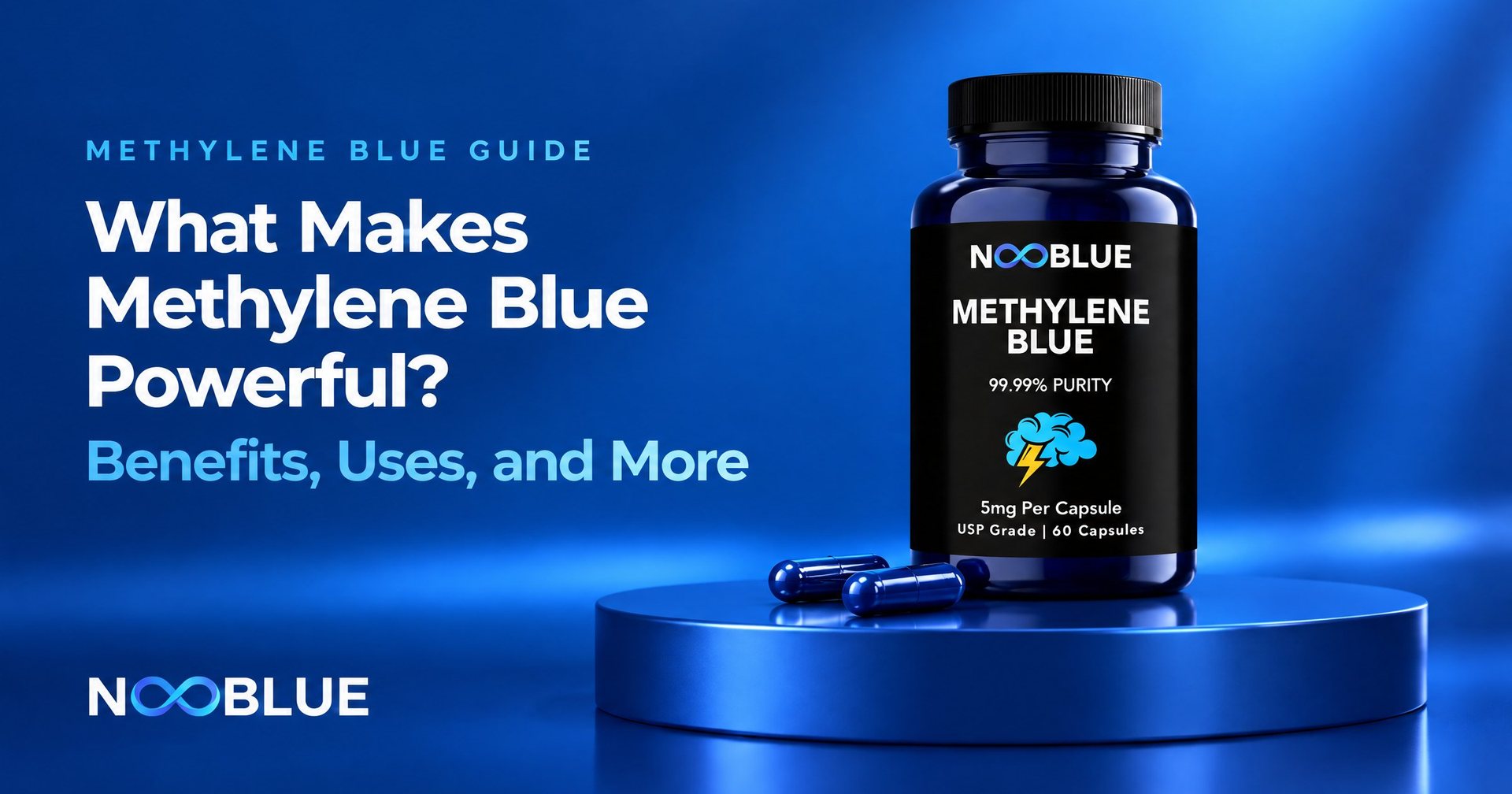
Methylene blue is a synthetic dye with a long medical history. Hospitals give it intravenously for methemoglobinemia, a blood problem in which hemoglobin cannot carry oxygen properly, at a standard dose of 1 mg/kg (StatPearls, 2026). As a supplement it is taken by mouth in far smaller amounts. One NooBlue capsule holds 5 mg.
Two properties explain nearly all of its effects, good and bad:
- It is a redox cycler. Cell enzymes use NADH or NADPH to turn methylene blue into a colorless form, leucomethylene blue, and cytochrome c turns it blue again. Because it cycles like this, small amounts can keep electrons moving in the mitochondrial energy chain (Atamna et al., 2008). At high doses the same chemistry works against the body and can oxidize hemoglobin.
- It blocks MAO-A. Methylene blue is a potent, reversible inhibitor of monoamine oxidase A, the enzyme that breaks down serotonin and norepinephrine (Ramsay et al., 2007). This is the source of its most dangerous interaction.
It is absorbed from the gut, crosses into the brain and is excreted in the urine, which is why urine turns blue or green (StatPearls, 2026). In a study of seven volunteers, methylene blue had an estimated terminal half-life of 5.25 hours after an intravenous dose, and 18% of an oral 100 mg dose left in the urine as methylene blue and its colorless form (Peter et al., 2000). Our explainers on how methylene blue works and what makes methylene blue powerful cover the chemistry in more depth.
Common Side Effects at Supplement Servings
No controlled trial has recorded side effects at daily supplement servings of 5 to 10 mg. What we have is the clinical reference list, studies that used much larger oral doses, and the imaging trials in healthy adults. Read the list below with that in mind: at label servings, effects should be at the mild end or absent, but nobody has measured exactly how often each one happens.
Blue or green urine
This is the one effect you can count on. Methylene blue is excreted in the urine, and the resulting blue-green color is expected and benign (StatPearls, 2026). In a 2016 trial, every volunteer who took a single 280 mg dose reported blue urine after leaving the imaging center, and the researchers used it as a marker that the dose had been taken (Rodriguez et al., 2016). It happens with every format, because it comes from methylene blue leaving your body, not from contact in the mouth. Our guide to methylene blue and urine color explains which shades are normal.
Nausea, vomiting and diarrhea
Nausea and diarrhea are on the clinical list of adverse effects (StatPearls, 2026). In a trial of 180 children aged 6 to 10 in Burkina Faso, regimens that included oral methylene blue alongside malaria drugs were associated with mild vomiting (Zoungrana et al., 2008). Those were therapeutic doses, far above a supplement serving. If your stomach is upset, take methylene blue with food, as the NooBlue capsule label directs, and do not go above the label serving.
Headache and dizziness
Headache is listed among methylene blue’s adverse effects, and dizziness and confusion among its neurologic effects (StatPearls, 2026). A mild headache after a dose is a reason to drop back or stop. A headache that comes with agitation, sweating, a racing heart or confusion is different: those are warning signs of serotonin toxicity and need medical help, especially if you take any other medicine.
Burning or discomfort when urinating
In a study of 60 adults in Burkina Faso given 390 mg of methylene blue twice a day, self-limiting dysuria (burning or discomfort when urinating) was the most frequent adverse event (Bountogo et al., 2010). The children’s trial above also recorded dysuria with methylene blue regimens (Zoungrana et al., 2008). Each of those doses is 78 times a 5 mg capsule. If you notice urinary discomfort at a supplement serving, stop and see a doctor to rule out another cause.
Blue mouth, tongue and teeth
Methylene blue is a strong dye. Drops held in the mouth can tint the tongue, gums and teeth for a while. Mixing drops into water or juice cuts the contact, as NooBlue’s drops directions suggest. Capsules are swallowed, so they bypass the mouth, and NooBlue gummies avoid the blue mouth and tongue that drops cause. Urine can still turn blue or green with all three.
Skin discoloration
Drops that spill on the skin leave a blue mark that washes off over time. Blue skin as a systemic effect is described in clinical references for newborns exposed to intravenous methylene blue before birth (StatPearls, 2026), not for supplement servings in adults. A blue or gray tint to the lips or skin that is not surface dye is a warning sign (see below). Our guide to methylene blue side effects on the skin covers topical contact in detail.
Feeling wired or sleeping badly
Nobody has studied methylene blue and sleep at supplement servings. Some people prefer to take it in the morning for that reason, and with a half-life of around five hours, a morning serving has the whole day to clear (Peter et al., 2000). Feeling restless or jittery is a reason to lower the amount. Feeling agitated, sweaty or shaky alongside another medicine is a reason to get medical help.
Serious Risks of Methylene Blue
The serious reactions are rare at supplement servings in healthy adults who take no interacting medicine. Each has a known cause, and each is the reason for a rule in the safety list further down.
Serotonin syndrome
This is the risk that matters most for supplement users, because it does not need a high dose. Methylene blue blocks MAO-A, so serotonin is not cleared normally. Add a drug that raises serotonin, such as an SSRI or SNRI, and serotonin can build to dangerous levels. A review of reported cases found that 13 of 14 cases of central nervous system toxicity involving methylene blue were serotonin toxicity, and that severe toxicity has occurred at an intravenous dose of only 1 mg/kg (Gillman, 2011). Nobody has measured how much MAO-A a small oral serving blocks, so there is no known safe amount to combine.
Symptoms can include agitation, confusion, a rapid heart rate, raised blood pressure, dilated pupils, muscle rigidity, tremor, sweating and diarrhea (Badar, 2024). In severe cases it can cause high fever, seizures and death (University of South Carolina, 2025). It usually starts within 6 to 24 hours of a change in a serotonergic drug (Simon et al., StatPearls). It is a medical emergency. Our guide to methylene blue and serotonin syndrome covers it in full.
Red blood cell breakdown in G6PD deficiency
Methylene blue’s action in red blood cells depends on NADPH, which those cells make through the enzyme G6PD. People with G6PD deficiency cannot make enough, and methylene blue can cause further oxidative damage, hemolysis and even death. Giving it to anyone known or suspected to have the deficiency is contraindicated (Mak and Shah, StatPearls, 2025). G6PD deficiency affects roughly 400 million people worldwide, most often with roots in sub-Saharan Africa, the Mediterranean, the Middle East and South and Southeast Asia. If it runs in your family or your ancestry puts you at higher risk, ask your doctor for a test first. See our guide to methylene blue and G6PD deficiency.
Methemoglobinemia and high-dose toxicity
Methylene blue is the standard hospital antidote for methemoglobinemia, yet too much of it can cause the same problem. Clinical references give these thresholds for intravenous use (StatPearls, 2026):
- At single doses of 3 mg/kg or more: low blood pressure, wheezing and reduced oxygen levels.
- At cumulative doses of 7 mg/kg or more: significant toxicity, including mild methemoglobinemia of up to 7%.
- At a single dose of 20 mg/kg or more: severe breakdown of red blood cells, a buildup of bilirubin, and death.
For a 70 kg adult, 7 mg/kg is 490 mg, the methylene blue in 98 NooBlue capsules. Supplement servings sit far below these levels. That gap is why the label serving matters and why a measured format helps.
Allergic reactions
Methylene blue is contraindicated in anyone with a history of anaphylaxis or other severe hypersensitivity reactions to it (StatPearls, 2026). The 2016 imaging trial also excluded people with hypersensitivity to methylene blue, thiazide diuretics or phenothiazines (Rodriguez et al., 2016). Rash, hives, swelling of the face or throat, or trouble breathing mean stop and get help immediately.
Heart rate and blood pressure
Palpitations, a fast heart rate and raised blood pressure are among its listed adverse effects (StatPearls, 2026), and University of South Carolina pharmacologist Lorne Hofseth notes that high doses may raise blood pressure or cause heart problems (University of South Carolina, 2025). Clinical references also advise caution in people with kidney impairment, because methylene blue may reduce blood flow to the kidneys (StatPearls, 2026). Our guide on methylene blue and blood pressure covers the research.
Why the Dose Decides the Risk
Methylene blue follows a hormetic dose response. A review by Bruchey and Gonzalez-Lima found that across its hormetic zone, methylene blue raised a range of responses to 130 to 160% of control, and that past the zone, responses fell to control and then below it (Bruchey and Gonzalez-Lima, 2008). The side effect picture follows the same shape. Supplement servings sit at the bottom of the range, the hospital dose of 1 mg/kg sits higher, and the toxic thresholds above are higher again.
Two practical points follow. First, taking more than the label serving does not buy more benefit, and it moves you toward the doses where side effects become more likely. Second, the easiest way to take too much is to misjudge a liquid. With NooBlue’s 1% drops, one drop is 0.5 mg, ten drops are 5 mg and a full dropper of about 20 drops is 10 mg. Count drops rather than guess. Our guide to how many mg of methylene blue per day sets out servings by format, and our page of methylene blue research statistics collects the dose data from the studies.
Drugs and Supplements to Avoid With Methylene Blue
Because methylene blue blocks MAO-A, its interaction list is dominated by anything that raises serotonin. Clinical references name SSRIs, SNRIs, MAOIs, certain opioids and dextromethorphan in the serotonin syndrome warning (StatPearls, 2026). Reviews of serotonin syndrome add these common classes (Badar, 2024; Simon et al., StatPearls):
- SSRIs and SNRIs, for example fluoxetine and duloxetine (Harvard Health, 2025).
- MAOIs and tricyclic antidepressants.
- Opioids such as tramadol, and the cough suppressant dextromethorphan.
- Triptans used for migraine, lithium and buspirone.
- Stimulants such as amphetamines, and recreational drugs such as MDMA.
- Herbal supplements such as St. John’s wort.
This is not a complete list. If you take any prescription medicine, or have recently stopped one, ask your doctor or pharmacist before starting methylene blue. Some medicines stay in the body for weeks after the last dose. For context, the 2016 imaging trial excluded anyone who had taken psychiatric medicines within the previous 5 weeks (Rodriguez et al., 2016). Our guides to what not to take with methylene blue, the methylene blue interactions reference and methylene blue and Adderall go through the details, and our articles on methylene blue and coffee and methylene blue and alcohol cover everyday drinks.
Who Should Not Take Methylene Blue
Do not take methylene blue if any of these applies to you:
- You take an SSRI, SNRI, MAOI or any other serotonergic medicine, including many antidepressants. The combination can cause serotonin syndrome.
- You have G6PD deficiency, or might have it and have not been tested.
- You are pregnant or breastfeeding. Clinical references warn that methylene blue may cause fetal harm when given during pregnancy (StatPearls, 2026).
- You are under 18.
- You have had a severe allergic reaction to methylene blue.
Talk to your doctor before use if you take any prescription medicine or have a kidney or liver condition, as the Safety: read before use section on every NooBlue product page says. Methylene blue can turn urine blue or green, which is expected. Our full guide to who should not take methylene blue covers each group, and our methylene blue liver safety article covers the liver question.
If none of these applies to you, NooBlue makes methylene blue in three measured formats.
How to Take Methylene Blue Safely, Step by Step
- Check the safety list first. If you take a serotonergic medicine, have or might have G6PD deficiency, are pregnant or breastfeeding, or are under 18, stop here. If you take any prescription medicine, talk to your doctor.
- Use USP-grade methylene blue only. Harvard Health warns that industrial or chemical-grade methylene blue, like the kind sold as a stain or dye, should not be used in humans or animals, and that people have bought aquarium products by mistake online (Harvard Health, 2025). The USP monograph requires 97.0% to 103.0% methylene blue on the dried basis (USP).
- Start with the smallest fixed serving. One 5 mg capsule a day with food, or 10 drops (5 mg) of the 1% solution, or fewer drops if you want to start lower.
- Measure liquids precisely. Count drops. Do not pour or guess.
- Take it in the morning, with food. Food helps with nausea, and a morning serving has the day to clear.
- Change one thing at a time. Do not start methylene blue in the same week as another new supplement or medicine, so you can tell what caused any effect.
- Stay at the label serving. More is not better on a hormetic curve.
- Know the warning signs listed below, and stop if any appear.
NooBlue publishes a report from Contract Testing Laboratories of America (CTLA) on its methylene blue ingredient, with identity and heavy metal results for one ingredient lot. It covers the raw ingredient, not each finished batch. Our guides to how to test if methylene blue is real, methylene blue shelf life and what it means if methylene blue turns brown help you check a bottle before you use it.
Side Effects by Format and Dose
| Format | Methylene blue per serving | Mouth and tongue | Urine | Main thing to watch |
|---|---|---|---|---|
| NooBlue capsules | 5 mg, with 10 mg vitamin C | No contact, swallowed | Blue or green | Take with food if your stomach is sensitive |
| NooBlue gummies | 10 mg, with 25 mg vitamin C | No blue mouth | Blue or green | The serving is twice a capsule |
| NooBlue 1% drops | 0.5 mg per drop, 5 mg in 10 drops | Can stain | Blue or green | Count drops and mix into water or juice |
| Intravenous (hospital) | 1 mg/kg standard dose | Not applicable | Blue or green | Medical use only, not comparable to supplements |
For a first try, capsules remove the main source of error, which is misjudging a liquid. Drops give finer control for people who want to start below 5 mg. Our guides to how to take methylene blue drops, methylene blue drops and methylene blue powder vs liquid cover liquid use, and our best methylene blue supplements roundup compares products.
Methylene Blue Gummies Side Effects
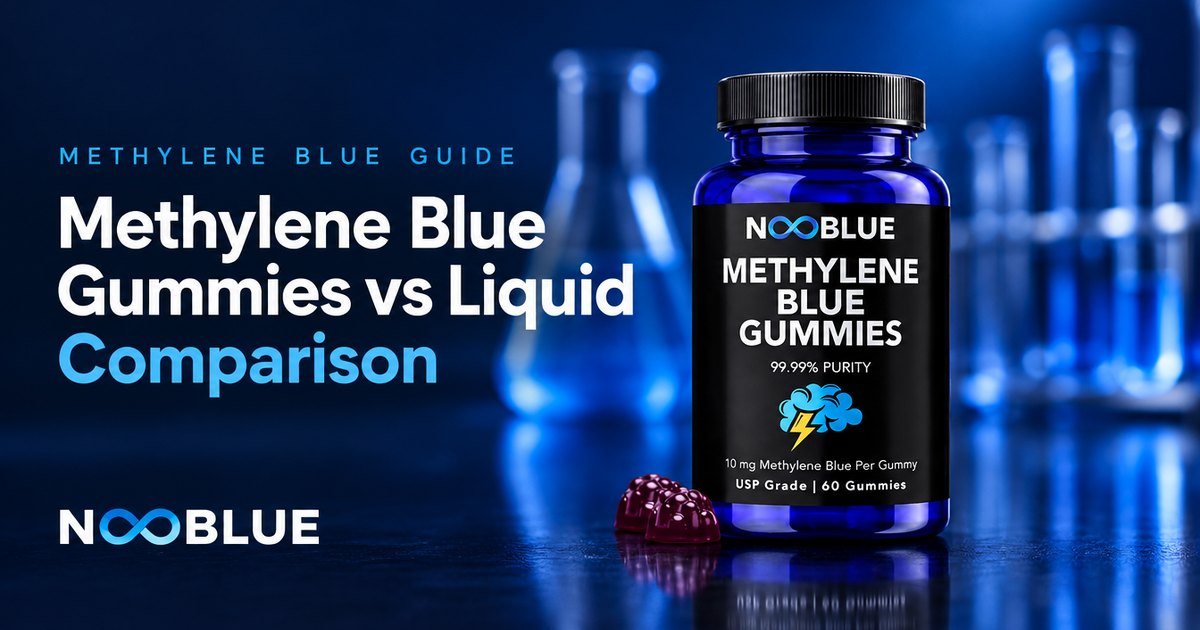
Gummies contain the same active compound, so the core side effects and every safety rule are the same as for capsules and drops. Urine can still turn blue or green, and gummies are just as unsuitable for anyone taking a serotonergic medicine or with G6PD deficiency. Three points are specific to gummies:
- No blue mouth. NooBlue gummies avoid the blue mouth and tongue that drops cause.
- The serving is larger. Each NooBlue gummy holds 10 mg of methylene blue, twice the 5 mg in a capsule. If you are new to methylene blue and want the smallest start, a capsule or a few drops is lower.
- Check the other ingredients. NooBlue gummies contain 25 mg of vitamin C and 0 g of total sugars per gummy. Other brands differ widely in dose and ingredients, so read the label.
Keep gummies away from children, who may mistake them for sweets. Our guide to methylene blue gummies side effects covers them in more depth.
Taking Methylene Blue Every Day: What We Know
The honest answer is that daily use at supplement servings has not been tested in controlled trials. The human studies we have are single doses (the 2016 imaging trial), short courses at therapeutic doses (the Burkina Faso studies), and hospital use. None of them followed people taking 5 or 10 mg a day for months. University of South Carolina pharmacologist Lorne Hofseth says much larger, longer trials are needed to know if it works, what the right dose is and how safe it is over time (University of South Carolina, 2025).
If you take it daily, a few habits keep the known risks low: stay at the label serving, recheck the interaction list every time a medicine changes (MAO-A inhibition does not become safer with time), and take a break if you notice any persistent side effect. Our guide on whether methylene blue is safe to take daily goes through the trade-offs.
Are There Methylene Blue Withdrawal Symptoms?
We found no study describing withdrawal symptoms after stopping methylene blue at any dose. Its MAO-A inhibition is reversible (Ramsay et al., 2007), and with a half-life of around five hours (Peter et al., 2000) it leaves the body within a day or two of the last serving.
The more important point runs the other way. If you have stopped a serotonergic medicine in order to try methylene blue, or want to start one after taking methylene blue, do not decide the gap yourself. Ask the doctor who prescribes it.
Side Effect or Die-Off?
Some online protocols describe feeling worse at first as a die-off or healing reaction. We found no research showing that methylene blue causes a die-off reaction at supplement servings. A headache, nausea or feeling unwell after a dose is far more likely to be an ordinary side effect, a dose that is too high for you, or an interaction. The safe response is to lower the amount or stop, not to push through. Anything strong or worsening, or any of the warning signs below, means stop and get medical advice. Our article on methylene blue die-off symptoms looks at the claims in detail.
How Long Do Methylene Blue Side Effects Last?
The mild effects follow the compound out of the body. With a half-life of around five hours, most of a single serving has cleared within a day, and blue urine usually fades over a similar period. A blue stain in the mouth from drops wears off with brushing and time. Nausea or a headache linked to a dose should settle within hours.
Serious reactions do not follow that timetable. Serotonin syndrome, hemolysis and methemoglobinemia need medical care, not waiting. If a side effect is getting worse rather than better, or keeps coming back with every dose, stop taking methylene blue and see a doctor.
Warning Signs That Mean Stop Now
Stop taking methylene blue and get medical help if you notice:
- Agitation, confusion, a racing heart, sweating, tremor, muscle stiffness or fever, especially if you take any other medicine. These can be signs of serotonin syndrome.
- Dark urine (not blue-green), yellow skin or eyes, paleness or unusual tiredness. These can be signs of red blood cell breakdown, which clinical references describe as pallor, jaundice, fatigue and dark urine (Mak and Shah, StatPearls, 2025).
- A blue or gray tint to the lips or skin that is not surface dye, shortness of breath or a pounding headache. These need urgent assessment.
- Swelling of the face or throat, hives or trouble breathing. These can be signs of an allergic reaction.
Benefits and Side Effects in Perspective
People take methylene blue for focus and mental energy. The human evidence for those uses is thin: small, short studies, most at doses far above a supplement serving. The side effect evidence is also thin at supplement servings, but the serious risks are well documented and tied to situations you can identify in advance: a serotonergic medicine, G6PD deficiency, pregnancy, or a dose far above the label. For a healthy adult with none of those, at a label serving, the realistic day-to-day effects are blue urine and, for some, mild nausea or a headache. If you cannot rule out the high-risk situations, the balance tips against taking it. Our guides to methylene blue benefits and side effects and methylene blue benefits cover the other side of the scale.
Frequently Asked Questions
What are the most common side effects of methylene blue?
Blue or green urine is almost universal and harmless. Clinical references also list headache, nausea, diarrhea and dizziness among its adverse effects (StatPearls, 2026), and oral studies at high therapeutic doses recorded burning when urinating and mild vomiting. Drops can tint the mouth and tongue.
Is it okay to take methylene blue every day?
Many people take one serving a day, and NooBlue’s labels give one capsule, one gummy or a measured number of drops daily. Daily use over months has not been tested in controlled trials, though. Keep to the label, recheck your medicines whenever they change, and stop if you notice persistent side effects. Never take it daily alongside a serotonergic medicine.
What happens if you take methylene blue every day?
Your urine will stay blue or green while you take it. Beyond that, nobody has measured what daily supplement servings do over months. The known risks, serotonin syndrome, G6PD-related hemolysis and high-dose toxicity, do not fade with regular use, so the safety rules apply every day you take it.
Why do I feel weird after taking methylene blue?
Headache, nausea and dizziness are listed side effects (StatPearls, 2026), and taking more than the label serving makes them more likely. Taking it without food can add nausea. Agitation, sweating, tremor, confusion or a racing heart are warning signs of serotonin toxicity and need medical attention, especially if you take any other medicine. If something feels off, stop and talk to your doctor.
Can methylene blue cause diarrhea?
Yes. Diarrhea is on the clinical list of adverse effects (StatPearls, 2026), and it is also one of the symptoms of serotonin syndrome (Badar, 2024). Mild loose stools at a supplement serving usually point to the dose or an empty stomach. Diarrhea with agitation, sweating or a fast heart rate needs medical help.
Can methylene blue cause headaches?
Yes, headache is one of its listed adverse effects (StatPearls, 2026). If you get a headache after a serving, drop back to a smaller amount or stop. A headache together with confusion, agitation, sweating or a racing heart, or with a blue-gray tint to the lips, needs medical attention.
Does methylene blue stain your teeth?
Drops held in the mouth can tint the teeth, tongue and gums for a while. Mixing drops into water or juice cuts the contact. Capsules are swallowed, and NooBlue gummies avoid the blue mouth and tongue that drops cause. A tint to the lips or skin that is not surface dye is a different matter and a warning sign.
What are the side effects of methylene blue on the skin?
Drops that touch the skin leave a temporary blue mark. As a systemic effect, blue skin is described in newborns exposed to intravenous methylene blue before birth (StatPearls, 2026), not in adults at supplement servings. Our guide to methylene blue skin side effects covers topical contact.
Is methylene blue hard on the liver?
Clinical references for methylene blue focus on the kidneys, blood and serotonin rather than the liver, and there are no trials of long-term supplement use. NooBlue’s product pages advise talking to your doctor before use if you have a kidney or liver condition. Our liver safety article reviews the research.
What should you not mix methylene blue with?
Anything that raises serotonin: SSRIs, SNRIs, MAOIs, tricyclic antidepressants, certain opioids such as tramadol, dextromethorphan, triptans, lithium, stimulants such as amphetamines, MDMA and St. John’s wort. Our guide to what not to take with methylene blue has the full list. Ask your doctor or pharmacist about anything else you take.
Who shouldn’t use methylene blue?
Anyone taking an SSRI, SNRI, MAOI or other serotonergic medicine, anyone with G6PD deficiency, anyone pregnant or breastfeeding, anyone under 18, and anyone who has had a severe allergic reaction to it. People who take prescription medicines or have a kidney or liver condition should talk to their doctor first.
Are methylene blue gummies safer than drops?
They carry the same active compound, so the same safety rules apply. Gummies remove the measuring step and avoid the blue mouth that drops cause. A NooBlue gummy holds 10 mg, twice a capsule, so capsules or a few drops are the lower starting points.
Is there a methylene blue withdrawal?
We found no study describing withdrawal symptoms after stopping methylene blue. Its MAO-A inhibition is reversible, and a serving clears within a day or two. If you are switching to or from a serotonergic medicine, ask the prescribing doctor how long to wait.
Why don’t doctors recommend methylene blue?
Mainly because of its MAO-A interaction with common medicines, and because human evidence for everyday use is limited to small, short studies. Our article on why doctors rarely prescribe methylene blue sets out the full reasoning.
The Bottom Line
At supplement servings, most healthy adults who take no interacting medicine can expect blue urine and, at most, mild nausea or a headache. The serious risks are real and specific: serotonin syndrome with serotonergic medicines, hemolysis in G6PD deficiency, harm in pregnancy, and toxicity at doses far above the label. Check the safety list, choose a USP-grade product, start with the smallest measured serving and learn the warning signs. If you take any prescription medicine, talk to your doctor first. You can compare all three formats in the NooBlue shop.
Sources
- Ostrovsky A, Afzal M. Methylene Blue. StatPearls. Updated January 2, 2026. NCBI Bookshelf NBK557593
- Atamna H, Nguyen A, Schultz C, et al. Methylene blue delays cellular senescence and enhances key mitochondrial biochemical pathways. FASEB Journal. 2008;22(3):703-712. PubMed 17928358
- Ramsay RR, Dunford C, Gillman PK. Methylene blue and serotonin toxicity: inhibition of monoamine oxidase A (MAO A) confirms a theoretical prediction. British Journal of Pharmacology. 2007;152(6):946-951. PMC2078225
- Peter C, Hongwan D, Küpfer A, Lauterburg BH. Pharmacokinetics and organ distribution of intravenous and oral methylene blue. European Journal of Clinical Pharmacology. 2000;56(3):247-250. PubMed 10952480
- Rodriguez P, Zhou W, Barrett DW, et al. Multimodal randomized functional MR imaging of the effects of methylene blue in the human brain. Radiology. 2016;281(2):516-526. PMC5084971
- Zoungrana A, Coulibaly B, Sié A, et al. Safety and efficacy of methylene blue combined with artesunate or amodiaquine for uncomplicated falciparum malaria: a randomized controlled trial from Burkina Faso. PLoS One. 2008;3(2):e1630. PubMed 18286187
- Bountogo M, Zoungrana A, Coulibaly B, et al. Efficacy of methylene blue monotherapy in semi-immune adults with uncomplicated falciparum malaria: a controlled trial in Burkina Faso. Tropical Medicine and International Health. 2010;15(6):713-717. PubMed 20374561
- Gillman PK. CNS toxicity involving methylene blue: the exemplar for understanding and predicting drug interactions that precipitate serotonin toxicity. Journal of Psychopharmacology. 2011;25(3):429-436. PubMed 20142303
- Badar A. Serotonin syndrome: an often-neglected medical emergency. Journal of Family and Community Medicine. 2024;31(1):1-8. PubMed 38406216
- University of South Carolina. Is methylene blue really a brain booster? (conversation with Lorne Hofseth). June 2025. sc.edu
- Simon LV, Torrico TJ, Keenaghan M. Serotonin Syndrome. StatPearls. Updated March 2, 2024. NCBI Bookshelf NBK482377
- Mak GK, Shah M. Glucose-6-Phosphate Dehydrogenase Deficiency. StatPearls. Updated November 30, 2025. NCBI Bookshelf NBK470315
- Bruchey AK, Gonzalez-Lima F. Behavioral, physiological and biochemical hormetic responses to the autoxidizable dye methylene blue. American Journal of Pharmacology and Toxicology. 2008;3(1):72-79. PubMed 20463863
- Goldman L. What to know about methylene blue. Harvard Health Publishing. April 24, 2025. health.harvard.edu
- United States Pharmacopeia. Methylene Blue monograph. doi.usp.org