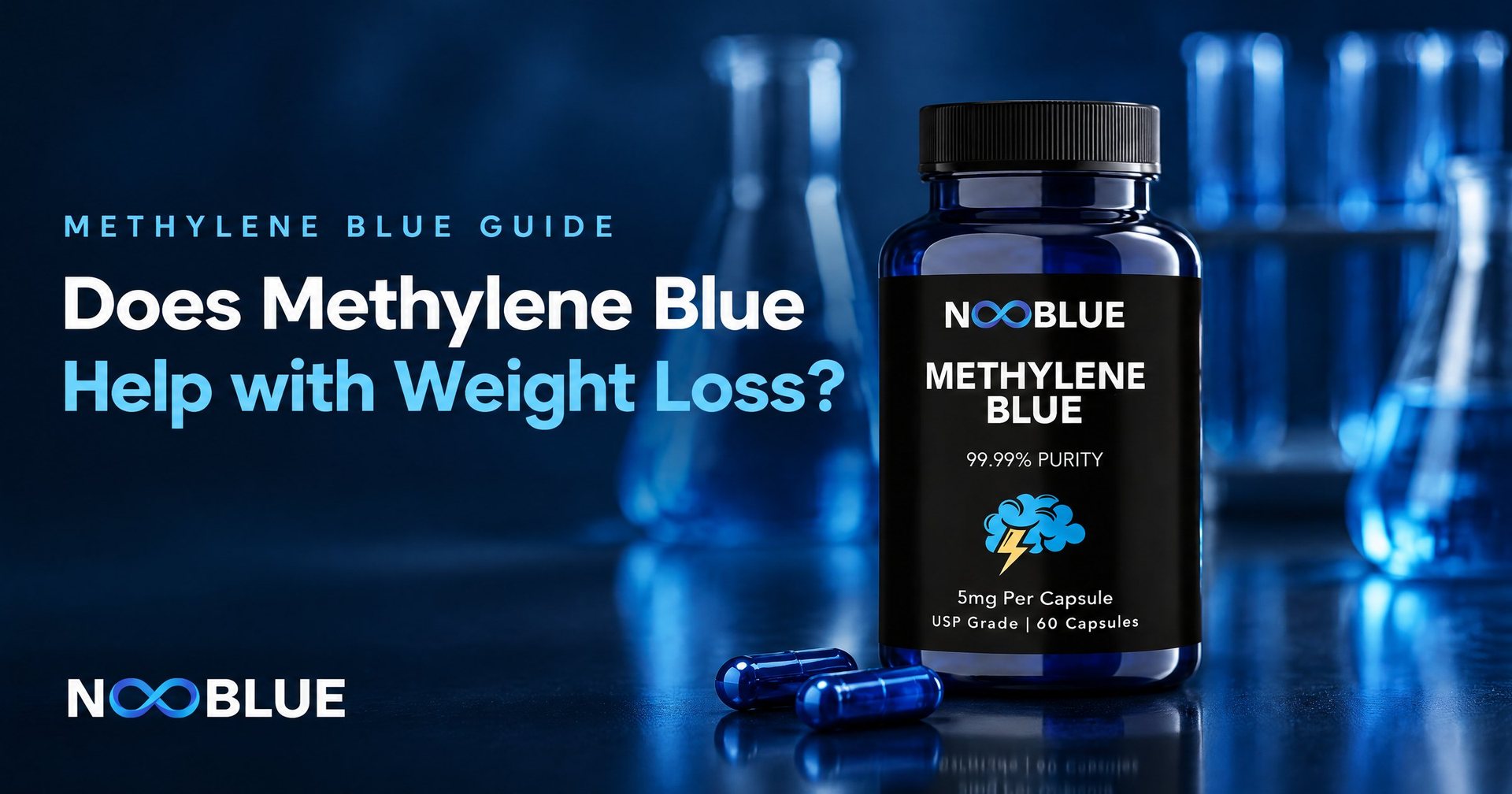
Does methylene blue help with weight loss? There is no human evidence that it does. We found no clinical trial that tested methylene blue for weight loss in people, and the research behind the “fat burner” claims comes from cell cultures and animals. The methylene blue weight loss idea rests on a real mechanism: methylene blue carries electrons inside mitochondria, and in lab studies it raises how much oxygen cells use. That is a long way from losing body fat. This guide covers what the studies measured, what they did not, why some weight-loss medicines must never be mixed with methylene blue, and how to spot products that oversell it.
NooBlue makes methylene blue capsules, gummies and drops, so we have a commercial interest in this topic. We do not sell any of them for weight loss, and every study below is linked so you can check it yourself.
Table of contents
- 1. Methylene Blue for Weight Loss: The Short Answer
- 2. Where the Weight-Loss Claims Come From
- 3. What Methylene Blue Does Inside Cells
- 4. What the Animal Studies Show
- 5. Human Evidence: What We Know and What We Don’t
- 6. Weight-Loss Medicines and Methylene Blue: Read This First
- 7. Red Flags in “Fat Burner” Methylene Blue Products
- 8. Methylene Blue and Fasting
- 9. If You Take Methylene Blue Anyway
- 10. Key Takeaways
- 11. Frequently Asked Questions
- 11.1. Does methylene blue help with weight loss?
- 11.2. Will methylene blue help me lose belly fat?
- 11.3. Does methylene blue speed up metabolism?
- 11.4. Does methylene blue suppress appetite?
- 11.5. Is methylene blue a thermogenic?
- 11.6. Can I take methylene blue with weight-loss medicines?
- 11.7. Can I take methylene blue with other weight-loss supplements?
- 11.8. What does methylene blue do to your gut?
- 11.9. Why do I feel so good on methylene blue?
- 11.10. Why don’t doctors prescribe methylene blue for weight loss?
- 12. The Bottom Line
- 13. Sources
Methylene Blue for Weight Loss: The Short Answer
- No human weight-loss trial. The human research on methylene blue covers the brain, hospital uses and safety, not body weight or fat.
- The mechanism is real but indirect. Methylene blue can pass electrons from NADH to cytochrome c in the mitochondrial chain, and it raised oxygen use in cultured nerve cells. Nobody has shown that this makes people burn more calories.
- The animal data are about the liver, not the scale. In mice on a high-fat diet, methylene blue limited fat build-up in the liver. That is a mouse result, not weight loss in people.
- It is not a stimulant. Blends sold for fat loss usually add caffeine sources such as guarana, and the caffeine is doing the stimulating.
- Serious interaction warning. Methylene blue inhibits MAO-A. The labels for phentermine and for naltrexone-bupropion forbid use with MAO inhibitors, and the naltrexone-bupropion label names intravenous methylene blue. Never combine them without your prescriber’s approval.
Where the Weight-Loss Claims Come From
The claims follow a chain of reasoning. Mitochondria turn food into ATP, the cell’s energy currency. Methylene blue supports the mitochondrial electron transport chain. So, the argument goes, it must speed up metabolism and help you burn fat. Each step sounds plausible, but the last one has never been tested in people.
Three things keep the idea circulating. Fasting and “biohacking” videos present methylene blue as a fasting accelerator, usually stirred into water or coffee. Retail pages for blended products promise fat oxidation and thermogenesis. And people who start methylene blue at the same time as a new diet often credit the supplement for results that came from the diet. Appetite is a related but separate question, covered in our breakdown of whether methylene blue suppresses appetite.
What Methylene Blue Does Inside Cells
Methylene blue is a redox compound. It can accept electrons and pass them on, switching between its blue form and a colorless reduced form. In the mitochondria it can take electrons from NADH and hand them directly to cytochrome c, bypassing the first stages of the chain (Tucker et al., 2018).
A 2011 study in the Journal of Biological Chemistry showed the practical result in cultured nerve cells: methylene blue raised cellular oxygen consumption and reduced anaerobic glycolysis, the less efficient way of making energy (Wen et al., 2011). The researchers also made a version of methylene blue with its redox center disabled, and it had no effect on the mitochondrial complexes. So the redox cycling is the active part.
Higher oxygen use in a dish of cells is the strongest version of the “speeds up metabolism” claim. It tells you methylene blue changes how cells handle fuel. It does not tell you how many calories a person burns in a day, where that energy comes from, or whether body fat changes. Those have not been measured.
What the Animal Studies Show
The most relevant animal study looked at the liver. Researchers at Seoul National University found that methylene blue activated SIRT1 and AMPK, two proteins involved in energy balance, raised oxygen use in liver cells, and increased mitochondrial DNA content. In mice fed a high-fat diet for eight weeks, methylene blue limited excess fat build-up in the liver (Shin et al., 2014). The paper reports liver fat. It does not report weight loss in the animals.
A rat imaging study adds a detail that matters for the “fat burner” framing. A single 0.5 mg/kg intravenous dose of methylene blue increased the brain’s oxygen use during stimulation, most clearly under low-oxygen conditions, but it did not change heart rate or blood oxygen saturation (Huang et al., 2013). In other words, it did not act on the heart the way a stimulant does.
Animal findings are a reason to study something in people, not proof that it works in people. Rodent metabolism differs from ours, research doses are chosen per kilogram of body weight, and routes such as injection do not match a daily capsule.
Human Evidence: What We Know and What We Don’t
The best-known human trial measured the brain. In a randomized, double-blind, placebo-controlled study, 26 healthy adults had brain scans before and one hour after a single dose of methylene blue or placebo. Methylene blue increased brain activity during attention and short-term memory tasks and gave 7% more correct answers during memory retrieval (Rodriguez et al., 2016). Nobody weighed the participants or measured calories.
We searched the published literature for human trials of methylene blue and body weight, fat mass, appetite or metabolic rate, and found none. So the accurate description of methylene blue is a supplement that supports the mitochondrial pathways behind cellular energy. Calling it a weight-loss supplement goes beyond the evidence.
| Claim you will see | What the evidence shows |
|---|---|
| Burns body fat | No human study. Mouse work shows less fat build-up in the liver on a high-fat diet |
| Speeds up metabolism | Raises oxygen use in cultured cells and in the stimulated rat brain. Never measured as calories burned in people |
| Suppresses appetite | No controlled study |
| Thermogenic | No evidence. Blends sold as thermogenic add caffeine sources |
| Makes fasting easier | No study of methylene blue during a fast |
| Supports cellular energy | Supported by cell and animal mechanism studies. Small human data on brain activity |
For the research beyond weight, see our guide to methylene blue benefits. Skin-cell work is covered separately in our article on methylene blue for skin.
Weight-Loss Medicines and Methylene Blue: Read This First
Methylene blue is a potent reversible inhibitor of MAO-A (Ramsay et al., 2007). That matters for anyone using prescription weight-loss medicine.
- Phentermine. The prescribing information lists use “during or within 14 days following the administration of monoamine oxidase inhibitors” as a contraindication. The phentermine and topiramate combination carries the same rule and warns of a higher risk of a dangerous rise in blood pressure.
- Naltrexone and bupropion. The label for this combination says starting it in someone treated with reversible MAO inhibitors “such as linezolid or intravenous methylene blue” is contraindicated.
These labels were written about prescription drugs, and no study has tested a supplement-sized dose of methylene blue with these medicines. That is not a reason to experiment. If you take any prescription weight-loss medicine, including injectable ones, do not add methylene blue unless your prescriber agrees.
Who should not take methylene blue
These rules match the safety box on every NooBlue product page:
- Do not take methylene blue if you take an SSRI, SNRI, MAOI or any other serotonergic medicine, including many antidepressants. The combination can cause serotonin syndrome.
- Do not take it if you have G6PD deficiency.
- Not for use during pregnancy or while breastfeeding.
- Not for anyone under 18.
- Talk to your doctor first if you take any prescription medicine, or if you have a kidney or liver condition.
- Methylene blue can turn urine blue or green. This is expected.
Our guides to who should not take methylene blue and what not to take with methylene blue have the full lists.
Red Flags in “Fat Burner” Methylene Blue Products
When a methylene blue product is sold mainly for fat loss, read the ingredient list before the claims. One example in the search results for this topic is Metabolism Plus by Best365Labs, sold by WLS Products for €39.00 for 60 tablets. According to the retailer’s page, each 2-tablet dose contains 5 mg methylene blue, 114 mg guarana, 150 mg green tea and 200 mg L-theanine, and the directions say to take 1 to 4 tablets in the morning. The page says the formula “stimulates fat burning, enhances insulin sensitivity, and promotes thermogenesis”, and credits caffeine-rich guarana and green tea catechins for that part. It does carry warnings on pregnancy, breastfeeding, G6PD and SSRIs.
That pattern is common: the stimulating ingredients are caffeine sources, not the methylene blue. Watch for three things:
- Stimulant blends. Caffeine, guarana, green tea extract, synephrine or yohimbine added to methylene blue. Nobody has tested these combinations with an MAO-A inhibitor for safety.
- Serotonin-active add-ins. Supplements such as 5-HTP or St. John’s wort act on serotonin. Ask a pharmacist before combining anything like that with methylene blue.
- Open-ended directions. “Take 1 to 4 tablets and adjust” leaves you to find your own ceiling. A fixed, stated serving is easier to follow safely.
A single-ingredient product with a stated dose per serving, clear directions and full medication warnings is the safer choice. Our roundup of the best methylene blue supplements compares labels and prices across brands, and our methylene blue side effects guide covers what to expect.
Methylene Blue and Fasting
Fat-loss videos often present methylene blue as a way to make a fast feel easier, on the theory that mitochondria running on fat and ketones benefit from smoother electron flow. We found no study of methylene blue during fasting. Any weight lost on a fast comes from eating less, whether or not methylene blue is added.
If you fast, check the label directions of your format. The NooBlue capsule label says to take one capsule daily with food, so the capsules belong with your first meal. The drops label says to mix them with water or juice. Methylene blue in the evening can affect sleep for some people, so take it early in your eating window. If you also drink coffee on a fast, our guide to methylene blue and coffee covers timing.
If You Take Methylene Blue Anyway
Choose methylene blue for what the research actually covers: support for the mitochondrial pathways behind cellular energy. Keep weight management where the evidence is, with your diet, activity, sleep and your doctor’s advice. Then use the label serving. Our guide to how many mg of methylene blue per day explains why supplement servings sit far below study doses. Prices as of Sep 2026.
| NooBlue format | Dose | Label directions | Price per serving |
|---|---|---|---|
| Methylene blue capsules | 5 mg + 10 mg vitamin C, 60 per bottle | One capsule daily with food | $0.63 |
| Methylene blue gummies | 10 mg + 25 mg vitamin C, 60 per bottle | Chew one gummy daily. No blue mouth | $0.83 |
| 1% methylene blue drops | 0.5 mg per drop, 50 mL, about 100 servings at 5 mg | 10 drops (5 mg) in water or juice. Can stain mouth and tongue | $0.30 |
None of these contains a stimulant. The capsule is our pick for most people: one fixed 5 mg dose with food and nothing to measure. The drops cost least per serving and suit people who want to adjust in 0.5 mg steps.
Key Takeaways
- No human trial has tested methylene blue for weight loss.
- In cells it raises oxygen use, and in mice on a high-fat diet it limited fat build-up in the liver. Neither shows fat loss in people.
- Products sold as methylene blue fat burners usually rely on added caffeine sources.
- Do not combine methylene blue with phentermine, naltrexone-bupropion or any serotonergic medicine unless your prescriber agrees.
- If you take methylene blue, take it for cellular energy support, at the label serving.
Frequently Asked Questions
Does methylene blue help with weight loss?
There is no human evidence that it does. No clinical trial has tested methylene blue for weight loss. Cell studies show it raises oxygen use, and a mouse study found less fat build-up in the liver on a high-fat diet, but neither measured weight loss in people. Treat weight-loss claims for methylene blue as unproven.
Will methylene blue help me lose belly fat?
No study has shown that methylene blue reduces belly fat or any other body fat in people. Fat loss comes from an overall energy deficit sustained over time, supported by activity and sleep. Methylene blue does not replace any of those.
Does methylene blue speed up metabolism?
Not in any way that has been measured in people. In cultured nerve cells it raised oxygen consumption, and in rats it increased the brain’s oxygen use during stimulation without changing heart rate. No study has measured resting metabolic rate or calories burned in humans taking methylene blue.
Does methylene blue suppress appetite?
There is no controlled study showing that it does. Some people report fewer cravings, but that has not been tested against a placebo. Our article on methylene blue and appetite looks at the question in more detail.
Is methylene blue a thermogenic?
No. Thermogenic products typically rely on stimulants such as caffeine. Methylene blue is not a stimulant, and products marketed as thermogenic methylene blue blends add caffeine sources such as guarana or green tea.
Can I take methylene blue with weight-loss medicines?
Not without your prescriber’s approval. Phentermine’s label rules out use with MAO inhibitors or within 14 days of them, and the naltrexone-bupropion label names intravenous methylene blue among the MAO inhibitors it must not be started with. Methylene blue inhibits MAO-A. For any other prescription weight-loss medicine, including injectables, ask your prescriber first.
Can I take methylene blue with other weight-loss supplements?
Be careful. Stimulant blends with caffeine, guarana, synephrine or yohimbine have not been tested with methylene blue, and supplements that act on serotonin, such as 5-HTP or St. John’s wort, raise the same concern as serotonergic medicines. Ask a pharmacist before combining them.
What does methylene blue do to your gut?
Nausea and diarrhea are among the side effects listed for the injectable drug at clinical doses. Taken by mouth, methylene blue also inhibits MAO-A in the gut, which affects how dietary amines such as tyramine are handled. The NooBlue capsule label says to take it with food. Blue or green urine is expected.
Why do I feel so good on methylene blue?
No trial of daily supplement servings has measured wellbeing. The best human data show more brain activity during attention and memory tasks one hour after a single dose, in 26 healthy adults. Starting a supplement alongside a new routine can also change how you feel. If you notice a mood lift, remember that methylene blue’s MAO-A inhibition is the same property behind its serotonergic drug interaction.
Why don’t doctors prescribe methylene blue for weight loss?
Because no trial has shown that it reduces body weight. The prescription form is an injection used in hospitals for specific acute problems, not a daily tablet for weight. A doctor would also rule it out for anyone on serotonergic medicines or MAO-sensitive weight-loss drugs such as phentermine.
The Bottom Line
Methylene blue is not a weight-loss supplement. It supports the mitochondrial pathways behind cellular energy, and lab studies show it changes how cells use oxygen, but no human study has linked it to fat loss. Be wary of products that promise fat burning, especially blends with stimulants, and never combine methylene blue with phentermine, naltrexone-bupropion or serotonergic medicines without your prescriber’s approval. If you want methylene blue for daily energy support and the safety rules do not rule you out, one 5 mg capsule with breakfast is a simple start. You can compare all three formats below or browse the NooBlue shop.
Sources
- Tucker D, Lu Y, Zhang Q. From mitochondrial function to neuroprotection: an emerging role for methylene blue. Molecular Neurobiology. 2018;55(6):5137-5153. PubMed 28840449
- Wen Y, Li W, Poteet EC, et al. Alternative mitochondrial electron transfer as a novel strategy for neuroprotection. Journal of Biological Chemistry. 2011;286(18):16504-16515. PubMed 21454572
- Shin SY, Kim TH, Wu H, Choi YH, Kim SG. SIRT1 activation by methylene blue, a repurposed drug, leads to AMPK-mediated inhibition of steatosis and steatohepatitis. European Journal of Pharmacology. 2014;727:115-124. PubMed 24486702
- Huang S, Du F, Shih YY, et al. Methylene blue potentiates stimulus-evoked fMRI responses and cerebral oxygen consumption during normoxia and hypoxia. NeuroImage. 2013;72:237-242. PubMed 23357077
- Rodriguez P, Zhou W, Barrett DW, et al. Multimodal randomized functional MR imaging of the effects of methylene blue in the human brain. Radiology. 2016;281(2):516-526. PubMed 27351678
- Ramsay RR, Dunford C, Gillman PK. Methylene blue and serotonin toxicity: inhibition of monoamine oxidase A (MAO A) confirms a theoretical prediction. British Journal of Pharmacology. 2007;152(6):946-951. PubMed 17721552
- Phentermine hydrochloride tablets, prescribing information. DailyMed, National Library of Medicine. DailyMed
- Phentermine and topiramate extended-release capsules, prescribing information. DailyMed, National Library of Medicine. DailyMed
- Contrave (naltrexone and bupropion) extended-release tablets, prescribing information. DailyMed, National Library of Medicine. DailyMed
- ProvayBlue (methylene blue) injection, prescribing information. DailyMed, National Library of Medicine. DailyMed
- WLS Products. Methylene Blue Tablets – Metabolism Plus (product page, read Sep 2026). wlsproducts.com