Key takeaways
- Methylene blue drops are methylene blue dissolved in water. At the common 1% strength, 1 mL holds 10 mg and one drop holds about 0.5 mg, so 10 drops equal 5 mg.
- Read the strength before you count. Drops marketed for daily use range from 0.5% to 5%, so the same 10 drops can mean 2.5 mg or 25 mg.
- The NooBlue drops serving is 10 drops (5 mg) once a day, about 100 servings per 50 mL bottle. A full dropper is 10 mg, twice that serving.
- Swallowed methylene blue is well absorbed: an oral water-based solution reached 72.3% absolute bioavailability in 16 healthy adults (Walter-Sack 2009). No published human study shows that holding drops under the tongue does better.
- Do not take methylene blue with SSRIs, SNRIs, MAOIs or other serotonergic medicines, if you have G6PD deficiency, if you are pregnant or breastfeeding, or if you are under 18. Expect blue or green urine.
Methylene blue drops are the liquid form of methylene blue, usually sold as a 1% solution in a dropper bottle. You count drops into water or juice, which lets you set your amount in 0.5 mg steps and makes drops the cheapest way to buy methylene blue by the milligram in our range. The trade-offs are that you have to measure, the liquid stains, and strengths differ from brand to brand. Our pick is NooBlue Methylene Blue Drops: a 1% USP-grade solution of methylene blue and distilled water, 0.5 mg per drop, with about 100 servings of 5 mg in a $29.99 bottle.
NooBlue makes the drops, capsules and gummies named in this guide, so we have a stake in the topic. Competitor details come from each brand’s own product page or Amazon listing, checked in September 2026, and every study is linked in the sources at the end.
Table of contents
- 1. What Are Methylene Blue Drops?
- 2. Methylene Blue Drops Dosage: How Many Drops Equal How Many mg
- 3. Not All Drops Are 1%: Check the Strength Before You Count
- 4. How to Take Methylene Blue Drops Orally
- 5. What Do Methylene Blue Drops Do for You?
- 6. Quality Checks Before You Buy Methylene Blue Drops
- 7. Methylene Blue Drops vs Capsules vs Gummies
- 8. Methylene Blue Drops Safety: Who Should Not Take Them
- 9. Storing Methylene Blue Drops
- 10. Frequently Asked Questions
- 10.1. How many drops of methylene blue should I take per day?
- 10.2. How much methylene blue is in one drop?
- 10.3. Can you take methylene blue drops under the tongue?
- 10.4. Why do I feel weird after taking methylene blue?
- 10.5. Why don’t doctors prescribe methylene blue?
- 10.6. Are methylene blue drops better than capsules?
- 10.7. Is it safe to take methylene blue drops every day?
- 10.8. Do methylene blue drops expire?
- 11. The Bottom Line on Methylene Blue Drops
- 12. Sources
What Are Methylene Blue Drops?
Methylene blue (methylthioninium chloride) is a dark blue compound that has been used in medicine and as a laboratory stain for more than a century. Drops are simply methylene blue dissolved in water. A “1%” label means about 1 gram per 100 mL, which is 10 mg in every milliliter. A standard dropper releases about 20 drops per milliliter, so each drop of a 1% solution carries about 0.5 mg.
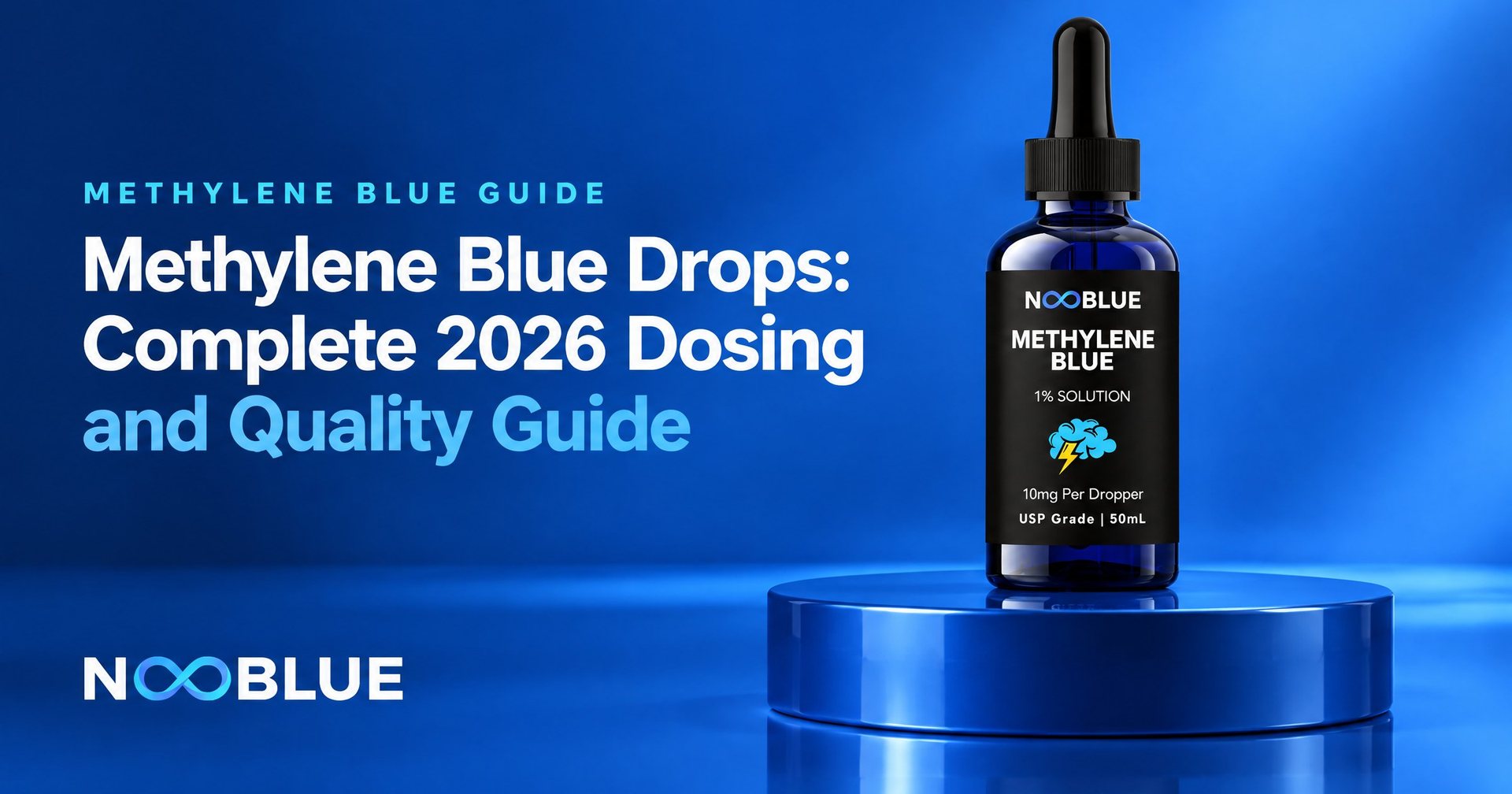
NooBlue’s drops contain two ingredients, methylene blue USP at 1% and distilled water, in a 50 mL bottle with a glass dropper. That is 500 mg of methylene blue per bottle. The full dropper holds 10 mg, and 10 drops give the 5 mg serving the product page is built around.
The grade on the label matters more than the format. USP grade means the methylene blue meets the United States Pharmacopeia monograph, which requires 97.0% to 103.0% methylene blue calculated on the dried basis. Methylene blue is also sold for fish tanks and as a lab stain. Those products are made for a different job and are often labeled as not for people, which is why our guides to USP-grade methylene blue and aquarium-grade methylene blue spend so much time on the difference.
Methylene Blue Drops Dosage: How Many Drops Equal How Many mg
For a 1% solution, the math is fixed. Every figure below assumes 10 mg per mL and about 0.5 mg per drop, which is what NooBlue’s drops deliver.
| Drops of a 1% solution | Methylene blue | What it matches |
|---|---|---|
| 1 drop | 0.5 mg | The smallest step you can take |
| 2 to 4 drops | 1 to 2 mg | A cautious first week |
| 10 drops | 5 mg | The NooBlue drops serving, the same as one NooBlue capsule |
| 20 drops (one full dropper) | 10 mg | Twice the drops serving, the same as one NooBlue gummy |
| One 50 mL bottle | 500 mg | About 100 servings of 5 mg |
The serving. NooBlue’s drops page gives about 100 servings of 5 mg (10 drops) per bottle, and the safety box on the same page says not to exceed the suggested serving. If you are new to methylene blue, you can start below that, with 2 to 4 drops, and move up to 10 drops over a week or two if it sits well with you. The one mistake to avoid is squeezing in a full dropper. That is 10 mg, double the serving.
Timing. Take it once a day at the same time. Breakfast is the easiest habit to keep, and it lets you notice how methylene blue feels across your day. Methylene blue clears slowly (the prescribing information for the injectable form gives a half-life of about 24 hours in humans), so splitting 10 drops into several tiny doses mostly adds measuring. At least one drops brand, Nutricel, warns that taking it in the evening may affect sleep, so morning is the safer default.
Research doses are a different scale. Studies dose methylene blue by body weight, and their amounts are far above a drop serving. In Rodriguez 2016, 26 healthy adults were randomized 13 to methylene blue and 13 to placebo, and the methylene blue group took a single 280 mg dose in capsules, about 4 mg/kg. That is 56 times a 10-drop serving, or 28 mL of a 1% solution. Even 1 mg/kg for a 70 kg adult comes to 70 mg, which would be 140 drops. Those doses were given once, under study supervision, and they are not a guide for home use. Our guide to how many mg of methylene blue per day walks through weight-based numbers and why supplement servings sit so far below them.
Not All Drops Are 1%: Check the Strength Before You Count
Every drop count above assumes a 1% solution. Many products are, but not all of them, and a drop count copied from the wrong guide can put you at five times the amount you meant to take. Here is what the brands themselves state, checked in September 2026.
| Product | Strength on the label | Methylene blue per drop (brand’s figure) | Drops for 5 mg | Bottle |
|---|---|---|---|---|
| NooBlue Methylene Blue Drops | 1% (10 mg/mL) | 0.5 mg | 10 | 50 mL, glass dropper |
| Biopharm Methylene Blue 1% USP | 1% | 0.5 mg | 10 | 50 mL glass or 60 mL plastic, plus larger sizes |
| Nutricel Blue Liquid | 1% | About 0.5 mg | 10 | 118 mL amber glass |
| Chemist Labs Methylene Blue 2% Liquid | 2% | Not stated (10 mg per 0.5 mL) | 0.25 mL | 4 oz |
| Meraki Blu | 150 mg in 30 mL (Amazon title says “1% Formula”) | About 0.25 mg | 20 | 30 mL |
| Nootlyn Methylene Blue Drops 5% | 5% | About 2.5 mg | 2 | 120 mL |
| Kordon Methylene Blue (aquarium) | 2.303% | Not for people | Do not use | 4 fl oz |
Three rows deserve a closer look. Meraki Blu’s Amazon title says “1% Formula”, but the same listing gives 5 mg per full dropper and about 250 mcg per drop, and the brand page lists 150 mg in a 30 mL bottle with a 1 mL dropper and about 0.25 mg per drop. That is 5 mg per mL, which works out to 0.5%, so you need twice as many drops as a 1% guide suggests. Nootlyn goes the other way: a 5% solution at about 2.5 mg per drop, with a dropper that deliberately has no printed markings. Follow a 10-drop routine from a 1% guide with that bottle and you take 25 mg. Kordon’s methylene blue is a 2.303% solution for aquarium use, and Kordon states that it is not intended for human consumption.
The fix is the same for every bottle. Find the mg per mL on the label, divide by about 20 to get the mg per drop, and check that it matches the brand’s own per-drop figure. A 1% product is forgiving because a miscount of one or two drops moves you by about a milligram. That margin is why NooBlue’s solution is made at 1%. For a side-by-side of liquid brands, see our best methylene blue drops guide, and our reviews of Biopharm and Meraki Blu go into those two products in detail.
How to Take Methylene Blue Drops Orally
Drops take a minute more than a capsule, and most of that minute is measuring. This is the routine we suggest for a 1% solution:
- Check the strength. Confirm the label says 1% or 10 mg/mL before you use any drop count from this page.
- Measure the same way each time. Hold the dropper upright and count drops into a glass of water or juice, as our product page suggests. Drop size changes with the angle of the dropper, so keep your technique consistent.
- Drink it, then rinse. Taken straight from the dropper, methylene blue stains the tongue, lips and teeth blue for a while. A glass of water afterward helps clear your mouth.
- Pick a fixed time. Once a day with breakfast is simple and keeps you from doubling up by accident.
- Write down your drop count for the first couple of weeks, especially if you are starting below the 10-drop serving.
What about under the tongue? Some people hold drops under the tongue for 60 to 90 seconds, expecting a faster effect. We found no published human study comparing sublingual and swallowed methylene blue, so that expectation is untested. Swallowing already works well. In Walter-Sack 2009, 16 healthy adults took a 500 mg oral water-based solution and, in a separate session, a 50 mg intravenous dose, and the oral solution reached 72.3% absolute bioavailability. Holding it under the tongue also guarantees a blue tongue. Our step-by-step guide on how to take methylene blue drops covers mixing, taste and travel, and methylene blue bioavailability in liquid vs capsules looks at absorption in more depth. If the taste bothers you, read what methylene blue tastes like, and for staining see does methylene blue stain teeth.
What Do Methylene Blue Drops Do for You?
Inside cells, methylene blue can accept electrons and pass them on in the mitochondrial electron transport chain, the process that produces ATP, the molecule cells use for energy. A 2018 review by Tucker and colleagues in Molecular Neurobiology describes methylene blue rerouting electrons from NADH to cytochrome c. Most of that work comes from cell and animal studies, and it tells you how methylene blue behaves, not what a daily supplement serving does in a healthy person.
The best-known human study is Rodriguez 2016 in Radiology. In a randomized, double-blind, placebo-controlled trial, 26 healthy adults had brain MRI scans before and one hour after a single 280 mg capsule dose of USP methylene blue or placebo. The methylene blue group showed more brain activity during sustained attention and short-term memory tasks and gave 7% more correct answers during memory retrieval (P = .01). Every participant who took methylene blue reported blue urine afterward.
What has not been shown matters just as much. That study used one dose, about 56 times a 10-drop serving, and measured its effects about an hour later. We know of no published trial that has tested a daily 5 mg serving of drops for focus or energy in healthy adults. So the honest summary is that methylene blue supports the mitochondrial pathways behind cellular energy, the research on healthy people is small, and anyone promising instant clarity from a few drops is getting ahead of the evidence. Our guides to whether methylene blue works, how methylene blue works and how long it takes to work go further.
Quality Checks Before You Buy Methylene Blue Drops
Drops are easy to bottle, so the market is crowded. Six checks separate a product you can dose from one you are guessing with:
- A stated strength and a per-drop figure. The label should give mg per mL, and the brand’s per-drop number should match it. If the two disagree, trust the mg per mL and do the math yourself.
- USP grade. The USP monograph sets 97.0% to 103.0% methylene blue on the dried basis. Claims such as “99.9% pure” or “99.99% pure” are the brand’s own statements, so ask which document backs them.
- A lab report you can read, and its scope. Look at what was tested and on what. NooBlue’s published report is from Contract Testing Laboratories of America (CTLA), report 135621, on the methylene blue ingredient, lot 2025022801. It records an HPLC identity result of “Conforms” and results for arsenic, cadmium, mercury and lead. It covers the raw ingredient only. It does not give a purity percentage, and it is not a test of every finished batch, which is how we describe it on the product page. Some brands, Nutricel for example, print a QR code on the label that links to a certificate for that lot.
- Made and labeled for people. Look for directions and a serving size. Wording such as “for research purposes only” or “not intended for human consumption”, or a listing in a lab-chemicals category, tells you the seller is not standing behind oral use.
- Medication warnings on the page. A careful brand names serotonergic medicines, G6PD deficiency and pregnancy. Biopharm’s product description, for example, gives a per-drop figure but no suggested serving and no medication warnings.
- A glass dropper bottle you can store well. Methylene blue should be kept closed and away from heat and sunlight.
For a practical walk-through of spotting fakes and mislabeled bottles, read how to test if methylene blue is real and our explainer on what methylene blue purity figures mean.
Methylene Blue Drops vs Capsules vs Gummies
Drops, capsules and gummies deliver the same molecule. What changes is how you measure it, what it costs per serving and what it does to your mouth. NooBlue prices as of Sep 2026:
| NooBlue format | Methylene blue | Label serving | Price | Cost per serving | Mouth staining |
|---|---|---|---|---|---|
| Drops, 1% solution | 0.5 mg per drop | 10 drops (5 mg) | $29.99 for 50 mL | $0.30 | Can stain the mouth and tongue |
| Capsules | 5 mg per capsule | 1 capsule (5 mg) daily | $37.99 for 60 | $0.63 | None, swallowed whole |
| Gummies | 10 mg per gummy | 1 gummy (10 mg) daily | $49.99 for 60 | $0.83 | No blue mouth |
Choose drops if you want the lowest cost per serving in our range, want to start below 5 mg, or like adjusting in 0.5 mg steps. Choose capsules if you want a fixed 5 mg with no measuring, no taste and nothing to spill. Choose gummies if you want a chewable once-a-day serving without the blue mouth and tongue that drops cause. Urine can still turn blue or green with any format, because that comes from the methylene blue your body clears, not from contact in your mouth.
Buying two, three or five bottles of any format takes 10%, 15% or 20% off, and orders of $100 or more ship free worldwide. Our comparisons of methylene blue capsules vs liquid, a 1% solution vs 5 mg capsules and gummies vs liquid go deeper, or you can see all three formats in the NooBlue shop.
Methylene Blue Drops Safety: Who Should Not Take Them
These rules apply to every brand of drops and to every format. They are the same warnings printed in the “Safety: read before use” box on the NooBlue drops product page.
- Not with serotonergic medicines. Do not take methylene blue if you take an SSRI, SNRI, MAOI or any other serotonergic medicine, including many antidepressants. Methylene blue is a potent reversible inhibitor of the enzyme MAO-A (Ramsay 2007), and the combination can cause serotonin syndrome.
- Not with G6PD deficiency. People with G6PD deficiency are at markedly higher risk of red blood cell damage from methylene blue.
- Not in pregnancy or while breastfeeding.
- Not for anyone under 18. Keep the bottle out of reach of children.
- Talk to your doctor first if you take any prescription medicine or have a kidney or liver condition.
- Expect color. Methylene blue can turn urine blue or green, which is expected. Drops can also stain the mouth, skin, fabric and countertops.
- Stay at the serving. Do not exceed the suggested serving, and remember that a full dropper is twice the 10-drop serving.
Serotonin syndrome is a medical emergency. Signs include agitation or confusion, tremor, muscle jerks or stiffness, heavy sweating, flushed skin and dilated pupils. If any of these appear after taking methylene blue, stop and get urgent medical help. Our guides to what not to take with methylene blue, who should not take methylene blue, methylene blue and serotonin syndrome and methylene blue and G6PD deficiency cover each warning in detail, and methylene blue side effects explains what else to expect.
Storing Methylene Blue Drops
Keep the bottle tightly closed in a cool, dry place away from direct heat and sunlight, and use it by the date printed on the bottle. Put the dropper straight back after each use so the liquid is not left open to air and light. Replace the bottle if the solution turns cloudy, shows particles, or the seal was broken when it arrived. Our methylene blue shelf life guide covers storage in more detail.
Frequently Asked Questions
How many drops of methylene blue should I take per day?
For a 1% solution (10 mg per mL), the NooBlue serving is 10 drops, which is 5 mg, once a day. You can start lower, with 2 to 4 drops, and build up to 10 drops if it suits you. Do not exceed the suggested serving. Check the strength first, because a 0.5% product needs 20 drops for 5 mg and a 5% product needs only 2.
How much methylene blue is in one drop?
About 0.5 mg in a 1% solution, because 1 mL holds 10 mg and a standard dropper gives about 20 drops per mL. A full dropper of NooBlue drops is 10 mg. Other strengths change the number: about 0.25 mg per drop at 0.5% and about 2.5 mg per drop at 5%.
Can you take methylene blue drops under the tongue?
You can, but it stains your tongue and there is no published human study showing it works better than swallowing. Swallowed methylene blue is already well absorbed, with 72.3% absolute bioavailability for an oral solution in Walter-Sack 2009. Mixing your drops into water or juice is simpler and kinder to your mouth.
Why do I feel weird after taking methylene blue?
Some people notice a headache or nausea, which are among the reactions listed in the prescribing information for injectable methylene blue, at doses far above a drop serving. A common cause is taking more than intended, such as a full dropper instead of 10 drops, or using a stronger solution with a 1% drop count. If you take any serotonergic medicine and feel agitated, confused, shaky or sweaty, stop and get urgent medical help, because those can be signs of serotonin syndrome. Our guide on why you might feel weird after methylene blue covers the other causes.
Why don’t doctors prescribe methylene blue?
In medicine, methylene blue is mainly a hospital drug, given by injection under monitoring for specific acute problems. For everyday focus and energy there are no large long-term trials in healthy people, so there is no standard dose for a doctor to prescribe. It also interacts with many common antidepressants, which makes doctors cautious. Read more in why don’t doctors prescribe methylene blue and do you need a prescription for methylene blue.
Are methylene blue drops better than capsules?
Neither is better for everyone. NooBlue drops cost $0.30 per 5 mg serving against $0.63 for a capsule and let you adjust in 0.5 mg steps. Capsules give a fixed 5 mg with no measuring, taste or staining. If the blue mouth is what puts you off drops, the gummies avoid it.
Is it safe to take methylene blue drops every day?
The NooBlue drops serving is written as a daily amount, 10 drops (5 mg) once a day, for healthy adults. Daily use is not for anyone taking SSRIs, SNRIs, MAOIs or other serotonergic medicines, anyone with G6PD deficiency, anyone pregnant or breastfeeding, or anyone under 18. Talk to your doctor first if you take any prescription medicine. Our guide to whether methylene blue is safe to take daily goes through the evidence.
Do methylene blue drops expire?
Yes. Use the bottle by its printed date, keep it tightly closed, and store it somewhere cool and dry away from heat and sunlight. Replace it if the liquid looks cloudy or has particles in it.
The Bottom Line on Methylene Blue Drops
Methylene blue drops are the most flexible way to take methylene blue, and in our range the cheapest per serving, provided you read the strength and count carefully. At 1%, 10 drops are 5 mg and a full dropper is 10 mg. Stay at the serving, keep the safety rules in view, and choose a product that is labeled for people and says what its lab report covers. If you want drops, NooBlue’s 1% solution gives 0.5 mg per drop and about 100 servings per bottle. If measuring or the blue mouth puts you off, the capsules and gummies deliver the same ingredient in a fixed amount.
Sources
- Walter-Sack I, Rengelshausen J, Oberwittler H, Burhenne J, Mueller O, Meissner P, Mikus G. High absolute bioavailability of methylene blue given as an aqueous oral formulation. European Journal of Clinical Pharmacology. 2009;65(2):179-189. PubMed 18810398
- Rodriguez P, Zhou W, Barrett DW, Altmeyer W, Gutierrez JE, Li J, Lancaster JL, Gonzalez-Lima F, Duong TQ. Multimodal randomized functional MR imaging of the effects of methylene blue in the human brain. Radiology. 2016;281(2):516-526. PMC5084971
- Tucker D, Lu Y, Zhang Q. From mitochondrial function to neuroprotection: an emerging role for methylene blue. Molecular Neurobiology. 2018;55(6):5137-5153. PubMed 28840449
- Ramsay RR, Dunford C, Gillman PK. Methylene blue and serotonin toxicity: inhibition of monoamine oxidase A (MAO A) confirms a theoretical prediction. British Journal of Pharmacology. 2007;152(6):946-951. PubMed 17721552
- Ostrovsky A, Afzal M. Methylene Blue. StatPearls. Updated January 2, 2026. NCBI Bookshelf NBK557593
- Simon LV, Torrico TJ, Keenaghan M. Serotonin Syndrome. StatPearls. Updated March 2, 2024. NCBI Bookshelf NBK482377
- ProvayBlue (methylene blue) injection prescribing information, DailyMed. dailymed.nlm.nih.gov
- USP-NF. Methylene Blue monograph (definition and assay). doi.usp.org
- Meraki Blu product page and Amazon listing (checked September 2026). merakimedicinal.com, amazon.com
- Nootlyn Methylene Blue Drops 5% Amazon listing (checked September 2026). amazon.com
- Biopharm Methylene Blue 1% USP product page (checked September 2026). bphchem.com
- Nutricel Blue Liquid 1% product page (checked September 2026). nutricel.store
- Chemist Labs Methylene Blue 2% Liquid product page (checked September 2026). thechemistlabs.com
- Kordon Methylene Blue product page (checked September 2026). kordon.com