By NooBlue Editorial · About our editorial standards
Key takeaways
- A methylene blue drug test worry is usually about color, not chemistry. Methylene blue is not on standard urine drug panels, and it is not a masking agent.
- The practical risk is blue or green urine. US federal workplace testing rules tell collectors to look for unusual color, including blue dye, and to redo the collection under direct observation if tampering looks likely.
- A 2026 report described two cases of false-positive amphetamine screens linked to methylene blue. Screening results are presumptive, and a confirmatory test identifies the actual drug.
- In studies of 100 to 200 mg oral doses, methylene blue was still being measured in urine up to 60 hours later. Supplement servings are far smaller, but a few days’ pause before a scheduled screen is the cautious option.
- Methylene blue is not for anyone taking SSRIs, SNRIs, MAOIs or other serotonergic medicines, anyone with G6PD deficiency, anyone pregnant or breastfeeding, or anyone under 18.
Short answer: methylene blue is not something a standard drug test looks for, and it will not hide anything that is. What it can do is color your urine blue or green, which a collector may treat as possible tampering, and in rare cases it has been linked to a presumptive amphetamine flag that confirmatory testing is designed to sort out. Tell the collector you take it, and consider pausing a few days before a scheduled screen.
If you take methylene blue and have a screen coming up, the methylene blue drug test question is a fair one. This guide covers what urine drug panels test for, why a blue sample causes trouble at the collection site, the rare false-positive reports, how long methylene blue stays in your system, other tests it can affect, and what to do before a scheduled screen. NooBlue sells methylene blue capsules, gummies and drops, and every one of them can change urine color.
Table of contents
- 1. Does Methylene Blue Show Up on a Drug Test?
- 2. The Real Issue: Blue or Green Urine at the Collection Site
- 3. False-Positive Amphetamine Screens: The Rare Exception
- 4. How Long Methylene Blue Stays in Your System
- 5. Other Tests Methylene Blue Can Affect
- 6. Before a Scheduled Screen: What to Do
- 7. Safety Before You Take Methylene Blue
- 8. Choosing a NooBlue Format
- 9. Frequently Asked Questions
- 9.1. Will methylene blue make me fail a drug test?
- 9.2. Can methylene blue cause a false positive?
- 9.3. How long does methylene blue keep your urine blue?
- 9.4. How long before methylene blue gets out of your system?
- 9.5. Should I tell the collector I take methylene blue?
- 9.6. What class of drug is methylene blue?
- 9.7. Why don’t doctors recommend methylene blue?
- 9.8. Does methylene blue affect a sports drug test?
- 10. Sources
Does Methylene Blue Show Up on a Drug Test?
Not as a target. Urine drug panels are built around a fixed list of drug classes and their metabolites, such as amphetamines, cannabis, cocaine, opioids and PCP, with extended panels adding prescription classes like benzodiazepines. Methylene blue is a thiazine dye and redox agent (Ostrovsky and Afzal, StatPearls, 2026). It is not chemically related to any of those classes, and labs do not screen for it.
It does not hide other drugs either. A German anti-doping laboratory that received a bright green urine sample found methylene blue in it and noted that the dye is not considered relevant for doping control because it has no known masking or manipulative effect (Thevis and colleagues, Journal of Pharmaceutical and Biomedical Analysis, 2012). In other words, it neither causes a confirmed positive for a drug of abuse nor helps anyone avoid one.
Our guides to methylene blue’s half-life and why methylene blue turns urine blue or green go deeper on the pharmacology behind both points.
The Real Issue: Blue or Green Urine at the Collection Site
Methylene blue leaves the body in urine, and a clinical reference describes the resulting blue-green color as expected and benign (StatPearls, 2026). The problem is that blue is exactly what collectors are trained to watch for.
US federal workplace drug-testing procedures (49 CFR Part 40, which covers transport workers such as commercial drivers) tell collection sites to make sure the water in the toilet is blue, so that anyone who tops up a sample from the bowl gives themselves away. The same rules tell collectors to inspect every specimen for unusual color and list “blue dye in the specimen” as an example of a sign of tampering. When tampering is apparent, the collector must immediately conduct a new collection under direct observation or take an oral fluid sample instead.
So a blue or green sample from a methylene blue supplement can look like tampering, even though it isn’t. The fix is simple: tell the collector before you give the sample that you take a methylene blue supplement, and have the product name ready. A heads-up turns a suspicious sample into a documented one. Many employers use the same collection practices outside the federal program, so assume the same scrutiny anywhere.
NooBlue gummies do not leave a blue mouth or tongue the way drops can, but urine can turn blue or green with any format, gummies and capsules included.
False-Positive Amphetamine Screens: The Rare Exception
In 2026, pharmacists at Radboud University Medical Center in the Netherlands published two case reports of methylene blue-induced false-positive amphetamine results on urine drug screening (Leegwater and Jager, Therapeutic Drug Monitoring, 2026). That is a small signal, but it is real enough to know about.
It matters how drug testing is structured. Under the federal procedures, the initial drug test is the first test used to separate negative specimens from those that need further testing, and a confirmatory drug test is a second analysis on a different portion of the original specimen that identifies and quantifies the specific drug. A screening flag is therefore not the final word. If you are ever flagged, say that you take methylene blue and ask that the result go to confirmatory testing.
How Long Methylene Blue Stays in Your System
Two pharmacology studies give the clearest numbers, both at doses far above a supplement serving.
- Swiss study, 7 volunteers, 100 mg. After an IV dose, methylene blue in whole blood had an estimated terminal half-life of 5.25 hours. Urinary excretion of methylene blue and its colorless form was 18% of the dose after oral use and 28% after IV use (Peter and colleagues, European Journal of Clinical Pharmacology, 2000).
- Healthy volunteers, 100 or 200 mg delayed-release tablets. These were special tablets designed to release the dye in the colon for colonoscopy, so they absorb more slowly than an ordinary capsule. Half-life ranged from 9 to 22 hours after 100 mg and 6 to 26 hours after 200 mg, and about 28% and 39% of the dose was recovered in urine over the 60 hours measured (Di Stefano and colleagues, Contemporary Clinical Trials, 2018).
What that means in practice: methylene blue clears over hours to a few days, not weeks, and it can still be measurable in urine two days or more after a large dose. A NooBlue capsule is 5 mg and a gummy is 10 mg, so there is far less dye to clear, and the visible color usually fades faster. Hydration, kidney function and dose all shift the timeline. Our page on methylene blue urine color covers what is normal.
Other Tests Methylene Blue Can Affect
Drug screens are not the only tests to think about. Methylene blue in the bloodstream can make pulse oximetry significantly underestimate true oxygen saturation, because it interferes with the wavelengths the device uses, and because it is blue and passes into urine it may interfere with urinalysis methods (StatPearls, 2026). Those effects are best documented after hospital IV doses, but it costs nothing to mention recent use before a procedure, a urine test at your doctor’s office or anything that relies on a finger sensor.
Before a Scheduled Screen: What to Do
- Consider a short pause. Methylene blue is a supplement, not a medicine you need daily, so stopping a few days before a scheduled screen gives the color time to clear. If you take any prescription medicine, do not stop that without your doctor.
- Tell the collector. Say you take a methylene blue supplement before you give the sample, the same way you would mention any supplement.
- Drink normally. Do not try to flush it out with large amounts of water. A very dilute sample raises its own questions.
- Keep the label. A photo of the bottle and its supplement facts makes any follow-up question easy to answer.
- Ask for confirmation if flagged. A presumptive screen result is not a confirmed positive.
None of this is about beating a test. Adding anything to a sample to change it is tampering, and methylene blue does not mask drugs in any case. The aim is simply to avoid a harmless supplement being mistaken for something else. People in safety-sensitive jobs, tested sport and monitored programs are the ones most likely to run into this, and a quick heads-up solves most of it. For daily routines, see whether methylene blue is safe to take daily.
Safety Before You Take Methylene Blue
Safety: read before use
- Do not take methylene blue with SSRIs, SNRIs, MAOIs or any other serotonergic medicine, including many antidepressants. The combination can cause serotonin syndrome.
- Do not take it if you have G6PD deficiency.
- Not for use during pregnancy or while breastfeeding.
- Not for anyone under 18.
- It can color urine blue or green. This is expected.
- Talk to your doctor before use if you take any prescription medicine or have a kidney or liver condition.
The serotonin risk is the one that matters most, and our guides to methylene blue and serotonin syndrome, methylene blue drug and supplement interactions and what not to take with methylene blue explain it. Our full methylene blue side effects guide covers the rest.
Choosing a NooBlue Format
All three NooBlue formats can color urine. They differ in dose and in whether they stain the mouth.
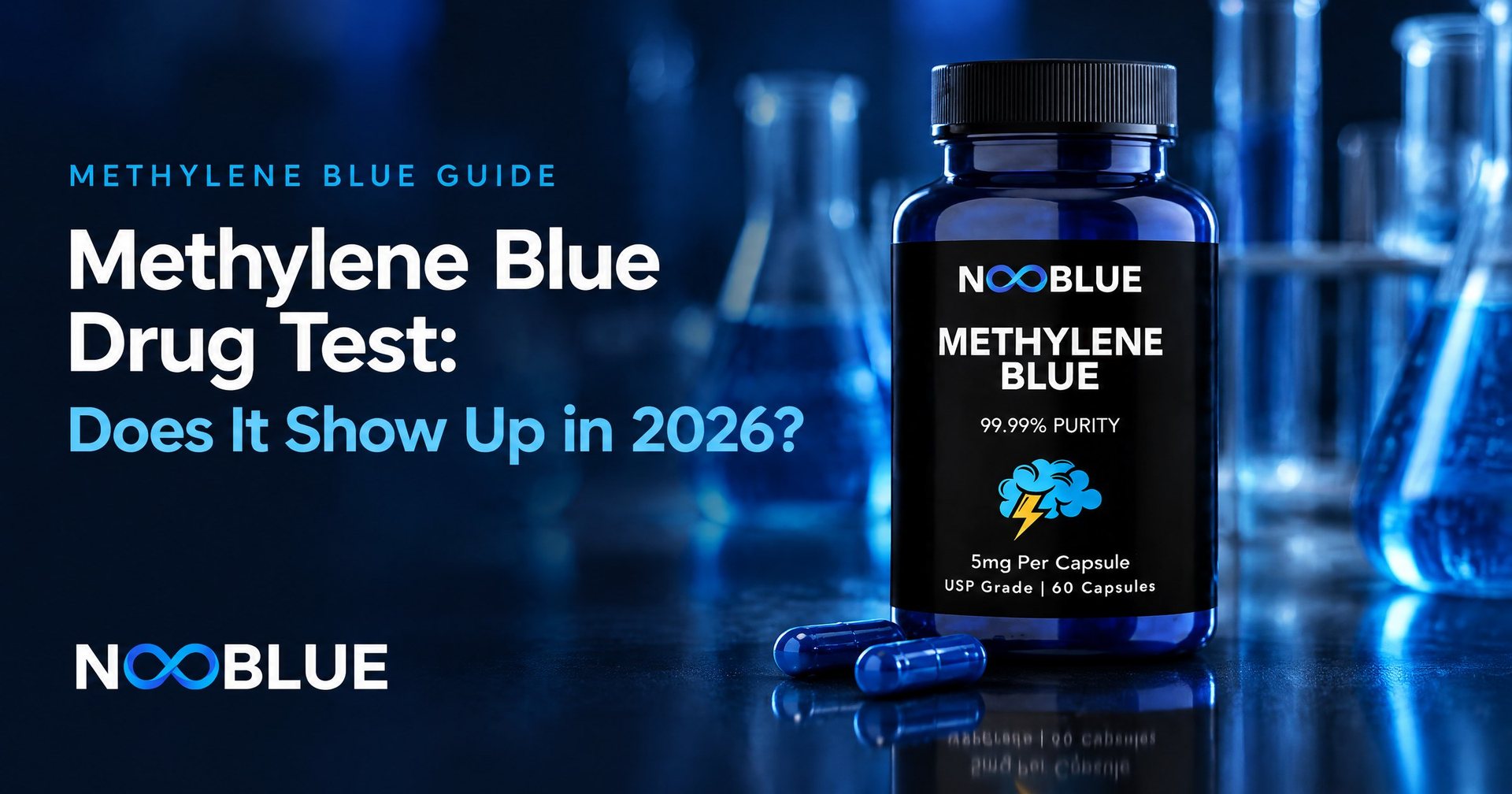
- NooBlue Methylene Blue Capsules: 5 mg methylene blue USP and 10 mg vitamin C per capsule, 60 capsules, $37.99. The lowest fixed dose in our range, one a day with food.
- NooBlue Methylene Blue Gummies: 10 mg methylene blue USP and 25 mg vitamin C per gummy, 60 gummies, $49.99. No blue mouth.
- NooBlue Methylene Blue Drops: 1% solution in distilled water, 0.5 mg per drop, 50 mL, $29.99. Adjustable, but drops can stain the mouth.
Contract Testing Laboratories of America (CTLA) analyzed the methylene blue ingredient lot we use and recorded an HPLC identity result and individual results for arsenic, cadmium, mercury and lead. That is ingredient-level evidence. It does not give a purity percentage or certify every finished batch. Our guide on how to check if your methylene blue is real explains how to read reports like this. Orders over $100 ship free worldwide, or browse the full NooBlue range.
Frequently Asked Questions
Will methylene blue make me fail a drug test?
Methylene blue is not a target on standard urine drug panels, and it does not mask other drugs. The practical risks are a blue or green sample that a collector may treat as possible tampering, which can mean a new collection under direct observation, and a rare presumptive amphetamine flag that confirmatory testing is designed to resolve. Tell the collector you take it.
Can methylene blue cause a false positive?
Rarely. A 2026 report from the Netherlands described two cases of false-positive amphetamine results on urine drug screening linked to methylene blue. Screening tests are presumptive, and a confirmatory test identifies the specific drug, so ask for confirmation and mention your supplement if you are flagged.
How long does methylene blue keep your urine blue?
It depends on dose and hydration. In studies of 100 to 200 mg doses, methylene blue was still recovered in urine up to 60 hours later. At a 5 or 10 mg supplement serving there is far less dye, and visible color usually fades sooner. Our urine color guide covers what is normal.
How long before methylene blue gets out of your system?
Hours to a few days. After a 100 mg IV dose the estimated terminal half-life in blood was 5.25 hours. With slow-release 100 mg tablets, half-life ranged from 9 to 22 hours. Smaller supplement doses leave less to clear.
Should I tell the collector I take methylene blue?
Yes. Tell them before you give the sample. Collectors are required to watch for unusual color, including blue, so a heads-up explains a colored sample straight away.
What class of drug is methylene blue?
It is a thiazine dye and a redox agent that can act as an alternative electron carrier in cells. It also inhibits monoamine oxidase A, which is why it must never be combined with SSRIs, SNRIs, MAOIs or other serotonergic medicines. In hospitals it is a prescription medicine given by IV, at doses far above a supplement.
Why don’t doctors recommend methylene blue?
Many doctors are cautious because the evidence for everyday supplement use is limited to small, short studies, and because the risks are serious for some people: serotonin syndrome with serotonergic medicines, red blood cell damage in G6PD deficiency, and pregnancy. It also affects some tests, such as pulse oximetry. If you are considering it, talk to your doctor, especially if you take any prescription medicine.
Does methylene blue affect a sports drug test?
A German anti-doping laboratory reported that methylene blue is not considered relevant for doping control because it has no known masking or manipulative effect. A green or blue sample may still draw questions, so declare it on your doping control form and check your sport’s own rules.
Sources
- Peter C, Hongwan D, Küpfer A, Lauterburg BH. Pharmacokinetics and organ distribution of intravenous and oral methylene blue. European Journal of Clinical Pharmacology. 2000;56(3):247-250. PubMed 10952480
- Di Stefano AFD, Radicioni MM, Vaccani A, et al. Methylene blue MMX tablets for chromoendoscopy. Bioavailability, colon staining and safety in healthy volunteers undergoing a full colonoscopy. Contemporary Clinical Trials. 2018;71:96-102. PubMed 29864547
- Leegwater E, Jager NGL. Methylene blue-induced false-positive amphetamine results in urine drug screening: two case reports. Therapeutic Drug Monitoring. 2026;48(2):280-281. PubMed 41058025
- Thevis M, Geyer H, Sigmund G, Schänzer W. Sports drug testing: analytical aspects of selected cases of suspected, purported, and proven urine manipulation. Journal of Pharmaceutical and Biomedical Analysis. 2012;57:26-32. PubMed 21955645
- Ostrovsky A, Afzal M. Methylene Blue. StatPearls. Updated January 2026. NCBI Bookshelf NBK557593
- Code of Federal Regulations, Title 49, Part 40: sections 40.3 (definitions), 40.43 (collection site preparation) and 40.65 (checking specimen temperature and signs of tampering). ecfr.gov
This article is for educational purposes only and is not medical or legal advice. Follow your employer’s or sport’s testing rules, and talk to your doctor before starting methylene blue, especially if you take any prescription medicine.