Key takeaways
- Chemistry: methylene blue is a synthetic compound, methylthioninium chloride (C16H18ClN3S).
- Manufacturing: it is built in a chemical plant from aniline-type starting materials and a sulfur source.
- Origins: Heinrich Caro first made it in 1876, and BASF patented it in 1877. It began as a textile dye.
- The “coal tar” label is historical. Early aniline dyes were made from coal-tar benzene, while today benzene comes mainly from petrochemical processes.
- Grade matters more than origin. The USP monograph requires 97.0% to 103.0% methylene blue on the dried basis. A common lab stain is sold at a dye content of 82% or more and is not meant to be swallowed.
- Ask any brand what its lab report covers. NooBlue’s CTLA report covers identity and heavy metals for the methylene blue ingredient lot, not each finished batch.
Short answer: what is methylene blue made from? It is made from chemicals, not from a plant, mineral or animal. Manufacturers oxidize an aniline-derived amine in the presence of a sulfur source (sodium thiosulfate), couple it with dimethylaniline, and close the rings to form a three-ring structure called a phenothiazinium. The result is methylthioninium chloride, the compound sold as methylene blue.
That answer raises the questions people actually care about. Is it really a coal-tar product? Is the methylene blue in a supplement the same as the one in an aquarium bottle or a lab stain? And how can you tell what is in the bottle you are holding? This guide explains the chemistry, the manufacturing steps, where the starting materials come from, the grades on the market, and how to read the evidence a brand gives you.
Table of contents
- 1. The molecule: a phenothiazinium dye
- 2. How methylene blue manufacturing works
- 3. Is it made from coal tar or petroleum?
- 4. Same molecule, very different grades
- 5. Origins: from textile dye to supplement
- 6. What makes methylene blue blue?
- 7. How to check what is in your bottle
- 8. Who should not take methylene blue
- 9. Frequently asked questions
- 9.1. Is methylene blue made from coal tar?
- 9.2. Is methylene blue made from petroleum?
- 9.3. Is methylene blue found in nature?
- 9.4. What is methylene blue derived from chemically?
- 9.5. Who manufactures pharmaceutical grade methylene blue?
- 9.6. Is methylene blue toxic?
- 9.7. Is supplement methylene blue the same as aquarium methylene blue?
- 9.8. Why does methylene blue turn colorless?
- 10. Sources
The molecule: a phenothiazinium dye
The chemical name is methylthioninium chloride, and the formal name is 3,7-bis(dimethylamino)phenothiazin-5-ium chloride. The formula is C16H18ClN3S, with a molar mass of 319.85 g/mol.
Take that name apart and you have the whole structure. The core is phenothiazine, three fused rings with a sulfur atom and a nitrogen atom linking two benzene rings. Two dimethylamino groups sit at positions 3 and 7, one on each outer ring. The ring system carries a positive charge, and a chloride ion balances it.
The ring system can take up two electrons and give them back. In its oxidized form it is blue. In its reduced form, leucomethylene blue, it is colorless. That switch is behind almost everything methylene blue is known for, from its use as a dye to the mitochondrial research. Tucker, Lu and Zhang (Molecular Neurobiology, 2018) describe how it can reroute electrons in the mitochondrial chain directly from NADH to cytochrome c, raising complex IV activity in lab studies. Our guide to how methylene blue works covers that mechanism step by step.
How methylene blue manufacturing works
The classic route has barely changed since the 1870s. In outline:
- Start with an aniline-type amine. 4-Aminodimethylaniline (also called N,N-dimethyl-p-phenylenediamine) is the usual starting material.
- Add the sulfur. It is oxidized in the presence of sodium thiosulfate, which supplies the sulfur atom that will bridge the rings. This gives an intermediate called quinonediiminothiosulfonic acid.
- Couple a second ring. That intermediate reacts with dimethylaniline, and further oxidation forms an indamine.
- Close the ring. Cyclization produces the thiazine ring system, and the product is isolated as the chloride salt.
- Purify and test. The crude dye is purified and then tested against whatever specification the buyer needs, whether that is a textile dye, a lab stain or a pharmacopeia monograph.
Chemists have also described a greener electrochemical route that uses only dimethyl-4-phenylenediamine and sulfide ions. Either way, every gram of methylene blue is synthetic. A label that calls it “natural” or “plant-based” is a warning sign.
Is it made from coal tar or petroleum?
Both labels have some history behind them, and neither describes what ends up in a bottle.
- The coal-tar era. Benzene was first isolated from coal tar in 1845, and because an early source of the benzene behind aniline was coal tar, aniline dyes like methylene blue became known as “coal tar dyes”. BASF’s original name, Badische Anilin- und Soda-Fabrik, still reflects that aniline dye industry.
- Today. Industrial aniline is made by hydrogenating nitrobenzene, which is made from benzene. Most benzene now comes from petrochemical processes such as catalytic reforming and steam cracking.
So the carbon in modern methylene blue usually traces back to oil rather than coal. For safety, though, the origin of the starting materials matters less than what a finished lot is tested for, and the grade on the label tells you which specification it was tested against.
Same molecule, very different grades
Methylene blue is sold for dyeing, lab staining, aquariums, medicine and supplements. The molecule is the same. The specification around it is not.
| Grade | Example | What the specification says | Meant to be swallowed? |
|---|---|---|---|
| USP (pharmacopeia) | USP-NF Methylene Blue monograph | 97.0% to 103.0% methylene blue, calculated on the dried basis, plus the monograph’s other tests | The grade used for medicines and supplements |
| Certified biological stain | Sigma-Aldrich M9140, certified by the Biological Stain Commission | Dye content of 82% or more, powder, hazard statement H302 (harmful if swallowed) | No. It is for microscopy and staining |
| Aquarium treatment | Kordon Methylene Blue | A 2.303% solution dosed into tank water | No. Kordon states it is not intended for human consumption |
Note what a stain’s “dye content” figure means: it measures how much of the powder is dye, which is what a microscopist cares about. It says nothing about the metals or other impurities that matter when something is swallowed daily. Our guides to lab grade vs pharmaceutical grade methylene blue and what USP grade and purity mean go further into this, and food grade methylene blue covers another label you will see.
Origins: from textile dye to supplement
- 1876: Heinrich Caro first prepared methylene blue. BASF was granted German patent no. 1886 for it on December 15, 1877. It was made to dye cotton.
- 1891: Paul Guttmann and Paul Ehrlich pioneered its use against malaria, which is why it is often described as the first fully synthetic drug used in medicine.
- The 20th century: it became a standard hospital medicine, a surgical marker and a lab stain, uses that continue today. The StatPearls chapter on methylene blue covers its current medical role.
- Recent decades: research on its electron-cycling behavior in mitochondria drew interest in low-dose use, which is where supplements come in.
For the full story, see our guide to methylene blue’s history and uses.
What makes methylene blue blue?
The positively charged ring system spreads its electrons across the whole molecule, and a system like that absorbs visible light strongly. Methylene blue’s absorption peaks near 670 nm, in the red part of the spectrum. Take red out of white light and what reaches your eye looks deep blue.
Add two electrons and the color disappears, because the reduced form, leucomethylene blue, no longer absorbs that light. The classroom “blue bottle” experiment shows it: an alkaline glucose solution turns methylene blue colorless as it stands, and shaking the bottle lets oxygen from the air turn it blue again. The same chemistry explains why methylene blue can turn urine blue or green, covered in our guide to methylene blue side effects.
How to check what is in your bottle
Knowing how it is made tells you what to ask a brand:
- Which grade is the ingredient? Look for USP on the label, not just “pharmaceutical grade” with no detail.
- What does the lab report actually cover? Identity, assay (how much methylene blue is present), heavy metals and microbes are different tests. Check which ones the report includes.
- Is the report for the raw ingredient or the finished product? An ingredient report says the powder was right. It doesn’t test the capsule, gummy or solution made from it.
- Which lot? A report should name a lot or batch and a date.
- What else is in the bottle? Read the other ingredients. A 1% solution needs little more than water.
Our guide to reading a methylene blue certificate of analysis has each line explained, and how to test if methylene blue is real covers simple checks at home.
What we publish about NooBlue
We hold ourselves to the same questions. Contract Testing Laboratories of America (CTLA) analyzed the methylene blue ingredient we use, identified by lot, and recorded an HPLC identity result of “Conforms” plus individual results for arsenic, cadmium, mercury and lead. That is ingredient-level evidence. It does not give a purity percentage, and it does not certify every finished batch. The report is linked from each product page.
| Product | What is in it | Serving | Price (as of Sep 2026) |
|---|---|---|---|
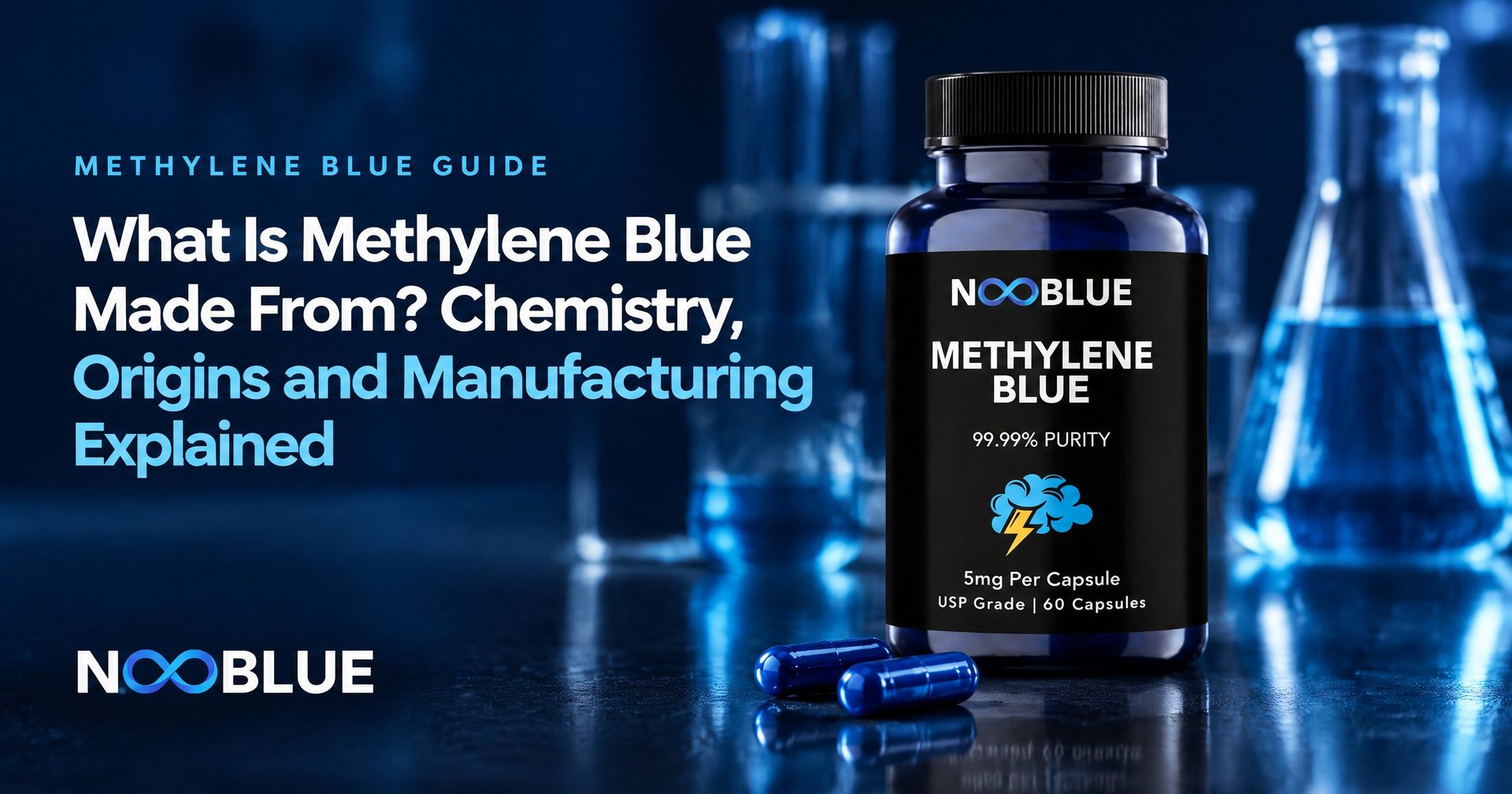
| NooBlue Capsules | Methylene blue USP 5 mg, vitamin C 10 mg, rice flour, cellulose capsule | One capsule a day with food | $37.99 for 60 ($0.63 a day) |
| NooBlue Gummies | Methylene blue USP 10 mg and vitamin C 25 mg in a zero-sugar pectin gummy | Chew one a day | $49.99 for 60 ($0.83 a day) |
| NooBlue Drops 1% | Methylene blue USP 1% in distilled water, about 0.5 mg per drop | 10 drops = 5 mg | $29.99 for 50 mL, about 100 servings |
The capsules suit anyone who wants a fixed 5 mg with nothing to measure. The gummies don’t leave the blue mouth or tongue that drops can. The drops give the finest control. For how the two main formats compare on absorption, see methylene blue bioavailability in liquid vs capsules. Free worldwide shipping starts at $100 on the NooBlue shop page.
Who should not take methylene blue
Safety first
- Do not take methylene blue with SSRIs, SNRIs, MAOIs or other serotonergic medicines. The combination carries a risk of serotonin syndrome.
- Do not take it if you have G6PD deficiency.
- Do not take it if you are pregnant or breastfeeding.
- Not for anyone under 18.
- It can turn urine blue or green. That is expected.
- Talk to your doctor before use if you take any prescription medicine or have a kidney or liver condition.
Never swallow aquarium or lab-stain methylene blue, whatever its purity claim. Our guide on who should not take methylene blue covers the safety rules in detail, and do you need a prescription for methylene blue? explains the difference between supplement and prescription products.
Frequently asked questions
Is methylene blue made from coal tar?
Not today. Early aniline dyes, methylene blue among them, were called coal tar dyes because the benzene behind them came from coal tar. Modern aniline is made from benzene that comes mainly from petrochemical processes.
Is methylene blue made from petroleum?
Its starting materials usually trace back to petroleum-derived benzene. The finished compound is a single defined chemical, methylthioninium chloride, and what matters for anything you swallow is the grade and what the lot was tested for.
Is methylene blue found in nature?
No. It is synthetic, first made by Heinrich Caro in 1876. A product calling methylene blue “natural” or “plant-based” is a warning sign.
What is methylene blue derived from chemically?
It is built from an aniline-type amine (4-aminodimethylaniline) and dimethylaniline, with sodium thiosulfate supplying the sulfur that bridges the rings. Oxidation and ring closure give methylthioninium chloride, C16H18ClN3S.
Who manufactures pharmaceutical grade methylene blue?
Chemical manufacturers make the raw ingredient to a pharmacopeia specification and sell it to drug makers, pharmacies and supplement brands, which turn it into capsules, gummies or solutions. The brand on the bottle is usually not the company that made the molecule, so ask for the lab report and check what it covers.
Is methylene blue toxic?
It depends on dose and on who is taking it. The StatPearls chapter notes it is generally well tolerated at medical doses below 2 mg/kg, while doses above 7 mg/kg carry a markedly higher risk. The serious risks at any dose are serotonin syndrome with serotonergic medicines and red blood cell damage in people with G6PD deficiency.
Is supplement methylene blue the same as aquarium methylene blue?
It is the same molecule, sold to a different specification. Aquarium products are made to be dosed into tank water, and Kordon, for one, states its product is not intended for human consumption. Only take methylene blue sold as a supplement, made from USP-grade ingredient, at the label serving.
Why does methylene blue turn colorless?
When it takes up two electrons it becomes leucomethylene blue, which doesn’t absorb visible light. Oxygen turns it back to blue. The blue bottle experiment shows this in a flask.
Sources
- Wikipedia. Methylene blue (chemical data, preparation, history). en.wikipedia.org
- Wikipedia. Aniline (industrial production, coal tar dyes). en.wikipedia.org
- Wikipedia. Benzene (production). en.wikipedia.org
- USP-NF. Methylene Blue monograph. doi.usp.org
- Sigma-Aldrich. Methylene blue, certified by the BSC (M9140). sigmaaldrich.com
- Kordon. Methylene Blue (aquarium product page). kordon.com
- Tucker D, Lu Y, Zhang Q. From mitochondrial function to neuroprotection: an emerging role for methylene blue. Mol Neurobiol. 2018;55(6):5137-5153. PubMed 28840449
- Ostrovsky A, Afzal M. Methylene Blue. StatPearls, updated January 2026. NCBI Bookshelf NBK557593
- Wikipedia. Blue bottle experiment. en.wikipedia.org