By NooBlue Editorial · About our editorial standards
Key takeaways
- Methylene blue and vitamin C can be taken together. Vitamin C (ascorbic acid) donates electrons to methylene blue and turns it into colorless leucomethylene blue, a reaction measured in lab studies.
- The reaction runs both ways. Oxygen and light can turn leucomethylene blue blue again.
- We found no human trial testing whether adding vitamin C changes what methylene blue does in the body. Treat the pairing as sound chemistry, not a proven upgrade.
- Vitamin C does not change the safety rules: no methylene blue with SSRIs, SNRIs, MAOIs or other serotonergic medicines, with G6PD deficiency, in pregnancy or breastfeeding, or under 18.
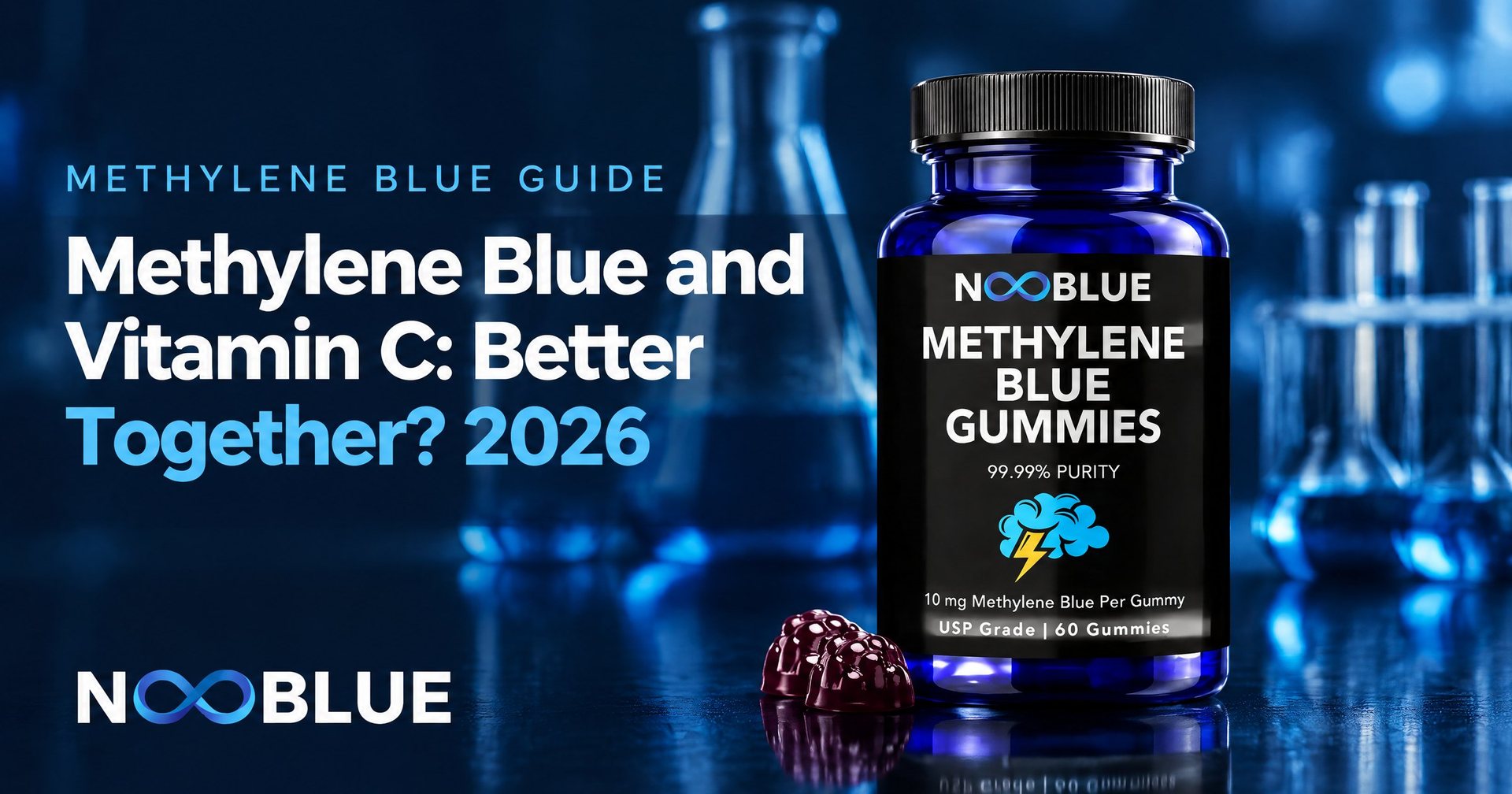
- NooBlue capsules pair 5 mg methylene blue with 10 mg vitamin C, and our gummies pair 10 mg with 25 mg. Our drops contain no vitamin C.
Short answer: yes, you can take methylene blue and vitamin C together, and many methylene blue supplements already include vitamin C. The reason is chemistry: vitamin C reduces methylene blue to its colorless leuco form. What nobody has shown yet is that the pair works better in people than methylene blue alone.
Methylene blue and vitamin C turn up together in capsule formulas, gummies and stack advice, usually with a line about “redox synergy”. This guide separates what is measured from what is assumed: what the reaction between the two actually is, what your body already does without vitamin C, what the research does and doesn’t show, how to combine them sensibly, and where the safety limits sit.
Table of contents
- 1. What Happens When Methylene Blue Meets Vitamin C
- 2. Your Body Already Does This Step
- 3. What the Research Does and Doesn’t Show
- 4. Can You Take Methylene Blue and Vitamin C Together?
- 5. Does Vitamin C Stop the Blue Mouth?
- 6. What Should You Not Take With Methylene Blue?
- 7. Can Vitamin C Spike Cortisol?
- 8. How NooBlue Uses Vitamin C
- 9. Frequently Asked Questions
- 9.1. Can you take methylene blue and vitamin C together?
- 9.2. Does vitamin C cancel out methylene blue?
- 9.3. Why do methylene blue supplements contain vitamin C?
- 9.4. Does vitamin C improve methylene blue absorption?
- 9.5. How much vitamin C should you take with methylene blue?
- 9.6. What should I not take with methylene blue?
- 9.7. Why do I feel so good on methylene blue?
- 9.8. Can vitamin C spike cortisol?
- 10. Sources
What Happens When Methylene Blue Meets Vitamin C
Methylene blue is a redox dye, which means it switches between two forms. The oxidized form is the familiar deep blue. When it accepts electrons it becomes leucomethylene blue, which is colorless. When leucomethylene blue gives those electrons up, it turns blue again.
Vitamin C, or ascorbic acid, is a reducing agent: it donates electrons. Mix it with methylene blue and it pushes the dye toward the colorless leuco form. Chemists at Stanford measured this reaction at very low dye concentrations and recorded the blue fading, along with a competing back reaction in which dissolved oxygen turned the dye blue again (Hallock and colleagues, 2003). A 2024 study from the Tokyo University of Science went further: leucomethylene blue made with vitamin C turned blue under blue-violet light, then faded back to colorless when left alone (Suzuki and colleagues, 2024).
So the reaction is real, and it is reversible. Oxygen, light and time can undo it, which is worth remembering whenever a product claims its methylene blue “stays” in the leuco form.
| Compound | Color | Role in the redox pair |
|---|---|---|
| Methylene blue (oxidized) | Deep blue | Accepts electrons |
| Leucomethylene blue (reduced) | Colorless | Gives electrons back and returns to blue |
| Vitamin C (ascorbic acid) | Colorless | Donates electrons, pushing methylene blue toward the leuco form |
For the wider picture of how this electron shuttling relates to cellular energy, see our explainer on how methylene blue works and our overview of methylene blue and brain and cellular health.
Your Body Already Does This Step
Methylene blue does not need vitamin C to be reduced. In the body, red blood cells reduce it to leucomethylene blue using an enzyme that runs on NADPH (Emadi and colleagues, 2025). Lab work on human red blood cells found that the cells reduce methylene blue and take it up, and that at higher concentrations its redox cycling used up the cells’ own glutathione and ascorbate, the body’s form of vitamin C (May and colleagues, 2004).
That second finding is worth sitting with. The relationship runs both ways: vitamin C can reduce methylene blue, and methylene blue cycling can consume vitamin C inside cells. It is one more reason to keep methylene blue at the low, measured amount on the label. How much of an oral dose reaches your blood is a separate question, covered in our guide to methylene blue absorption.
The NADPH step also explains one of the firm safety rules. People with G6PD deficiency make too little NADPH, and in them methylene blue raises the risk of damage to red blood cells. The 2025 paper suggests leucomethylene blue might be gentler, but that is an untested idea. Taking vitamin C with methylene blue does not make it safe with G6PD deficiency.
What the Research Does and Doesn’t Show
The evidence for the pairing is chemistry and cell work. We found no controlled trial in healthy people that tested methylene blue plus vitamin C as a supplement and measured energy, focus or anything else a buyer would care about.
The low-dose methylene blue research is a separate body of work. A 2012 review describes a hormetic dose response, with opposite effects at low and high doses, and describes methylene blue at low doses as an electron cycler in the mitochondrial respiratory chain (Rojas and colleagues, Progress in Neurobiology). That review is about methylene blue itself. It does not test vitamin C as a partner.
So what can you take from it? Vitamin C pushes methylene blue toward its colorless form in a glass or a gummy. Whether that changes anything after you swallow it is unknown. That is why we describe the vitamin C in our products as part of the formula, not as proof of a better result.
Can You Take Methylene Blue and Vitamin C Together?
Yes, for adults who can take methylene blue at all. Vitamin C is an everyday nutrient. The recommended intake is 90 mg a day for adult men and 75 mg for adult women, and the upper limit for adults is 2,000 mg a day (NIH Office of Dietary Supplements, vitamin C fact sheet). The amounts in methylene blue products are small by comparison.
- Keep methylene blue at the label dose. For NooBlue that is one 5 mg capsule or one 10 mg gummy a day. Do not exceed the suggested serving. Our guide to how many mg of methylene blue per day covers the numbers by format.
- Add vitamin C yourself only if your product lacks it. Our drops contain methylene blue and distilled water only. Food, juice or a standard vitamin C tablet taken in the same window all supply ascorbic acid.
- Don’t megadose vitamin C for this. Nothing suggests that more vitamin C improves the pairing, and above the upper limit it can cause diarrhea, nausea and stomach cramps.
- Move it earlier if sleep suffers. Some people find methylene blue affects their sleep when taken late. If you also drink coffee, our note on methylene blue and caffeine covers timing.
How much vitamin C methylene blue products contain
| Product (as listed, Sep 2026) | Methylene blue per unit | Vitamin C per unit |
|---|---|---|
| NooBlue Capsules | 5 mg | 10 mg (ascorbic acid) |
| NooBlue Gummies | 10 mg | 25 mg |
| NooBlue Drops 1% | 0.5 mg per drop | None |
| Nutricel Blue Boost capsules | 12 mg | 35 mg vitamin C ester (ascorbyl palmitate) |
| Best 365 Labs NeuroPro Plus tablets | 15 mg | 75 mg |
No study has compared these ratios, so none of them is proven better. NooBlue makes the three NooBlue products in this table, and the figures for the other two come from their own product pages.
Does Vitamin C Stop the Blue Mouth?
This is where most people notice the pairing. Drops and other liquids can stain your mouth and tongue blue for a while. NooBlue gummies don’t leave the blue mouth or tongue that drops can. They also contain vitamin C, which can shift methylene blue toward its colorless form. Capsules are swallowed whole, so they never touch your tongue.
Urine is a different matter. Any form of methylene blue can turn urine blue or green, with or without vitamin C, and that is expected. Our guides to methylene blue and urine color and whether methylene blue stains your teeth cover both.
Can you clear liquid methylene blue with vitamin C?
Adding ascorbic acid to a glass of diluted drops can fade the color, but how fast and how far depends on the amounts and conditions in the glass, and oxygen can bring the blue back. We don’t publish a mixing ratio because we haven’t tested one. If you want a fixed dose without a blue mouth, the gummies are the simpler route. Our comparison of methylene blue capsules versus liquid covers the other trade-offs between formats.
What Should You Not Take With Methylene Blue?
Vitamin C is not the concern. Medicines that affect serotonin are. Methylene blue is a potent, reversible inhibitor of MAO-A, the enzyme that breaks down serotonin (Ramsay and colleagues, 2007), and that is why the first line below matters most.
Safety: read before taking methylene blue
- Do not take it with SSRIs, SNRIs, MAOIs or any other serotonergic medicine, including many antidepressants. The combination can cause serotonin syndrome.
- Do not take it if you have G6PD deficiency.
- Not for use during pregnancy or while breastfeeding.
- Not for anyone under 18.
- It can turn urine blue or green.
- Talk to your doctor before use if you take any prescription medicine.
For the fuller list of side effects and what to watch for, see our guide to methylene blue side effects.
Can Vitamin C Spike Cortisol?
Not in the research we found. In a study of 45 ultramarathon runners, those assigned 1,500 mg of vitamin C a day, taken for seven days before the race, on race day and for two days after, had a lower cortisol level straight after the race than runners on 500 mg or placebo (Peters and colleagues, 2001). Only 29 runners completed the protocol, and it was a single race at a high dose, so it tells you little about a 10 or 25 mg serving. It points the other way from a spike, though.
How NooBlue Uses Vitamin C
NooBlue makes three formats, and two of them include vitamin C:
- Capsules: 5 mg methylene blue USP with 10 mg vitamin C (ascorbic acid) in a cellulose capsule, 60 per bottle at $37.99. Take one capsule daily with food.
- Gummies: 10 mg methylene blue with 25 mg vitamin C in a Wild Blueberry gummy with zero sugar, 60 per bottle at $49.99. One gummy a day.
- Drops: a 1% solution of methylene blue USP in distilled water, 50 mL at $29.99, 0.5 mg per drop and about 100 servings of 5 mg. Add your own vitamin C if you want the pairing.
Our testing is ingredient-level. Contract Testing Laboratories of America analyzed our methylene blue ingredient for identity and four heavy metals. That report covers the raw ingredient, not each finished batch, and it does not state a purity percentage. You can read it on our quality and testing page. Free worldwide shipping on orders $100+ · 30-day returns · Dispatch in 1–2 business days with tracking. Browse all three in the NooBlue shop, see where vitamin C fits in broader routines in our roundup of methylene blue stacks, or read whether NMN and methylene blue can be combined.
This guide is general information, not medical advice. Talk to your doctor before starting methylene blue if you take any prescription medicine.
Frequently Asked Questions
Can you take methylene blue and vitamin C together?
Yes, if you can take methylene blue at all. Vitamin C reduces methylene blue to its colorless leuco form, which is why many products include both. The safety rules for methylene blue still apply: not with serotonergic medicines, G6PD deficiency, pregnancy or breastfeeding, or under 18.
Does vitamin C cancel out methylene blue?
No. Vitamin C turns methylene blue into leucomethylene blue, and that reduced form turns blue again when it gives up its electrons. Your red blood cells make the same switch without vitamin C. Neither step removes the methylene blue.
Why do methylene blue supplements contain vitamin C?
Vitamin C is a reducing agent that pushes methylene blue toward its colorless form, and many brands add it as part of the formula. NooBlue capsules contain 10 mg vitamin C per 5 mg capsule and our gummies 25 mg per 10 mg gummy. No human study has shown that the addition changes the results people get.
Does vitamin C improve methylene blue absorption?
We found no human study that measured this. Methylene blue is already well absorbed by mouth: in 16 healthy volunteers, an oral solution had an absolute bioavailability of about 72% without any vitamin C (Walter-Sack and colleagues, 2009).
How much vitamin C should you take with methylene blue?
No study has set an amount. The 10 mg in our capsules and 25 mg in our gummies are well below the 75 to 90 mg recommended daily intake for adults, and there is no reason to go near the 2,000 mg upper limit for this purpose.
What should I not take with methylene blue?
Do not take methylene blue with SSRIs, SNRIs, MAOIs or other serotonergic medicines, because the combination can cause serotonin syndrome. Do not take it with G6PD deficiency, during pregnancy or breastfeeding, or under 18, and talk to your doctor first if you take any prescription medicine.
Why do I feel so good on methylene blue?
No controlled trial has measured mood at supplement doses, so nobody can say for sure. The best-known human brain study gave 26 healthy adults either a single 280 mg dose or a placebo, far above a 5 to 10 mg supplement serving, and recorded higher brain activity during attention and memory tasks plus a 7% increase in correct memory-retrieval responses (Rodriguez and colleagues, 2016). Methylene blue also inhibits MAO-A, the enzyme that breaks down serotonin, which is the reason it is unsafe with serotonergic medicines.
Can vitamin C spike cortisol?
Not in the research we found. In ultramarathon runners, 1,500 mg of vitamin C a day was linked with a lower cortisol level straight after the race than 500 mg or placebo. That was one small study at a high dose.
Sources
- Hallock AJ, Berman ES, Zare RN. Ultratrace kinetic measurements of the reduction of methylene blue. Journal of the American Chemical Society. 2003. PubMed 12553804
- Suzuki T, Nakamura F, Ie K, et al. Novel photochromic system using methylene blue reduction with l-ascorbic acid. RSC Advances. 2024. PubMed 39691228
- May JM, Qu ZC, Cobb CE. Reduction and uptake of methylene blue by human erythrocytes. American Journal of Physiology: Cell Physiology. 2004. PubMed 14973146
- Emadi E, Alamdari DH, Sahebkar A. The potential of leucomethylene blue in methemoglobinemia treatment: a new hope for patients with G6PD? Current Medicinal Chemistry. 2025. PubMed 37694789
- Rojas JC, Bruchey AK, Gonzalez-Lima F. Neurometabolic mechanisms for memory enhancement and neuroprotection of methylene blue. Progress in Neurobiology. 2012. PubMed 22067440
- Ramsay RR, Dunford C, Gillman PK. Methylene blue and serotonin toxicity: inhibition of monoamine oxidase A (MAO A) confirms a theoretical prediction. British Journal of Pharmacology. 2007. PubMed 17721552
- Walter-Sack I, Rengelshausen J, Oberwittler H, et al. High absolute bioavailability of methylene blue given as an aqueous oral formulation. European Journal of Clinical Pharmacology. 2009. PubMed 18810398
- Rodriguez P, Zhou W, Barrett DW, et al. Multimodal randomized functional MR imaging of the effects of methylene blue in the human brain. Radiology. 2016. PubMed 27351678
- Peters EM, Anderson R, Nieman DC, et al. Vitamin C supplementation attenuates the increases in circulating cortisol, adrenaline and anti-inflammatory polypeptides following ultramarathon running. International Journal of Sports Medicine. 2001. PubMed 11590482
- NIH Office of Dietary Supplements. Vitamin C fact sheet for consumers (ods.od.nih.gov), read September 2026.
- Competitor vitamin C and methylene blue amounts: each brand’s own product page, read September 2026.