Quick answer
Methylene blue and CoQ10 both work in the mitochondrial electron transport chain, but they do different jobs. CoQ10 is a nutrient your body makes. It is a built-in part of the chain, carrying electrons from complexes I and II to complex III. Methylene blue is a synthetic dye that, in lab studies, accepts electrons from NADH and hands them to cytochrome c, routing around blocked steps in the chain. It also inhibits the enzyme MAO-A, which is why it has strict safety rules.
As for which one “actually works”: neither has been shown to raise energy or mental performance in healthy people. In a 2026 trial, 400 mg of CoQ10 a day for 12 weeks raised blood levels in older adults but did not change CoQ10 levels or function inside their muscle mitochondria. Methylene blue’s human data are two brain-imaging trials of a single dose far larger than a supplement serving. CoQ10 has the longer safety record and fewer interactions.
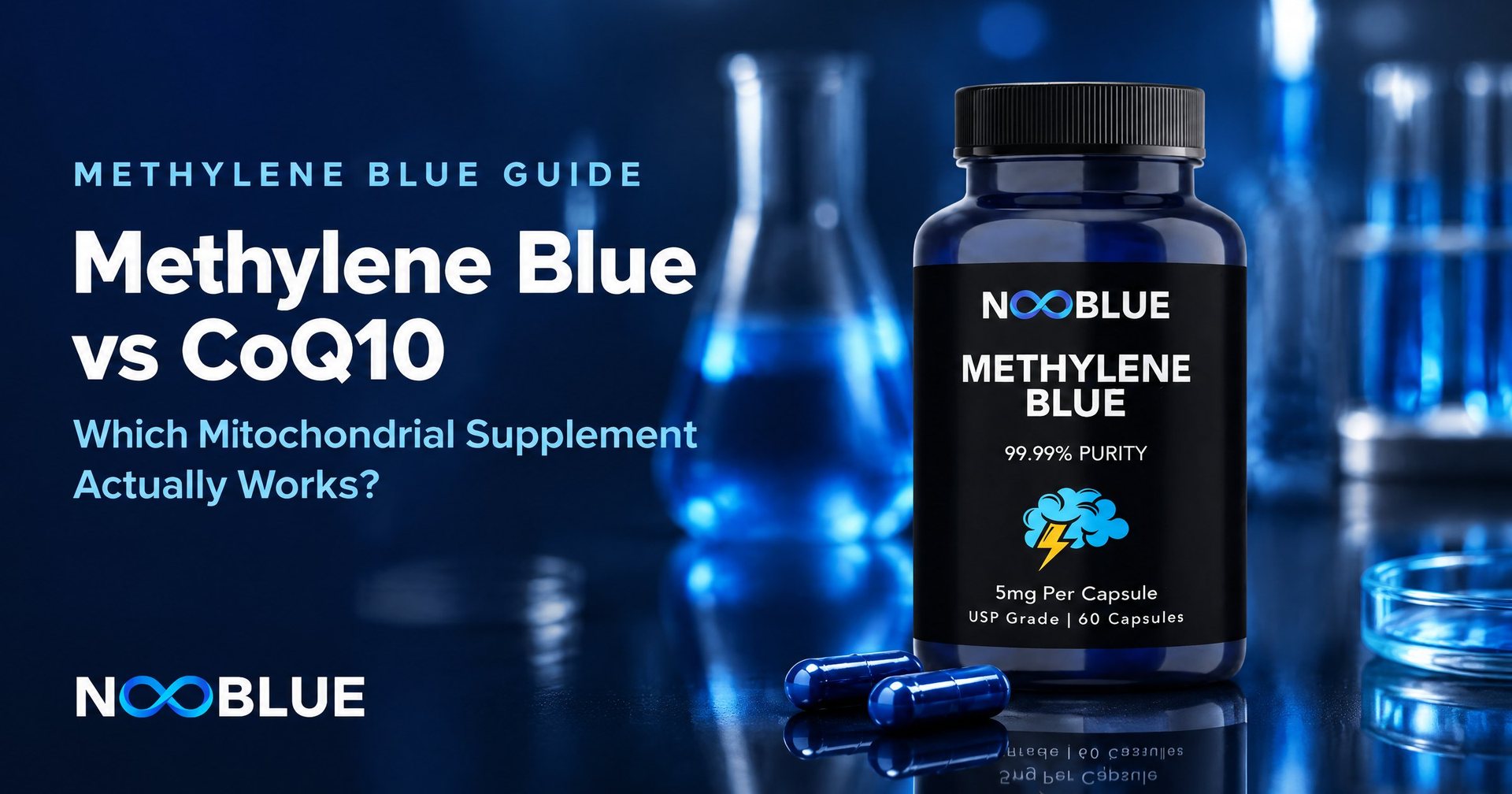
If methylene blue suits your situation, NooBlue’s 5 mg methylene blue capsules are our pick as a low, fixed place to start. NooBlue makes them, and we do not sell CoQ10.
Safety first: do not take methylene blue with SSRIs, SNRIs, MAOIs or other serotonergic medicines, or if you have G6PD deficiency or are pregnant or breastfeeding. Ask your doctor before CoQ10 if you take warfarin or insulin.
Written by the NooBlue editorial team. NooBlue sells methylene blue only. Every study below is listed in the sources at the end.
Methylene blue and CoQ10 are the two names that come up most when people talk about supplements for mitochondria, the parts of your cells that turn food and oxygen into usable energy. They are often sold with near-identical promises, and some brands now put both in one capsule. This guide compares them on how they work, dose and absorption, what the human trials show, safety, and whether you can take both.
The short version is that they are not substitutes. One is a nutrient that belongs in the chain. The other is an outside compound that can move electrons through it by a different route. Neither has strong evidence as an energy booster in healthy people, and the details below explain why.
Table of contents
- 1. Methylene blue vs CoQ10 at a glance
- 2. How each one works in the mitochondria
- 3. Dose and absorption
- 4. What the human evidence shows
- 5. Safety compared
- 6. Can you take methylene blue and CoQ10 together?
- 7. Which one fits your situation?
- 8. Other supplements people pair with methylene blue
- 9. Frequently asked questions
- 9.1. Can you take methylene blue and CoQ10 together?
- 9.2. Which is better for energy, methylene blue or CoQ10?
- 9.3. Does CoQ10 cancel out methylene blue?
- 9.4. Is CoQ10 a natural alternative to methylene blue?
- 9.5. Why don’t doctors recommend methylene blue?
- 9.6. Why do I feel so good on methylene blue?
- 9.7. What can I substitute for methylene blue?
- 9.8. What supplements cannot be taken with methylene blue?
- 9.9. What is the best methylene blue to start with?
- 10. Sources
Methylene blue vs CoQ10 at a glance
| Detail | Methylene blue | CoQ10 (coenzyme Q10) |
|---|---|---|
| What it is | A synthetic phenothiazine dye, sold as a low-dose supplement | A fat-soluble nutrient the body makes, also sold as a supplement |
| Role in the electron transport chain | An outside electron carrier. In lab studies it passes electrons from NADH to cytochrome c, around blocked complexes I and III | A native carrier that moves electrons from complexes I and II to complex III |
| Other actions | Potent reversible MAO-A inhibitor | Antioxidant in its reduced form, ubiquinol |
| Typical supplement amount | 5 mg capsule or 10 mg gummy (NooBlue labels) | 30 to 100 mg a day in standard supplements |
| Absorption by mouth | High: 72.3% absolute bioavailability in one study | Low: less than 5% of an oral dose is thought to reach the blood. Best taken with a meal containing fat |
| Human evidence in healthy people | Two imaging trials of one 280 mg dose. No trials at supplement amounts | A 2026 trial in 40 older adults found no change in muscle mitochondrial function |
| Main safety issues | Serotonergic medicines, G6PD deficiency, pregnancy, breastfeeding, under 18 | No serious side effects reported. Mild digestive upset or trouble sleeping |
| Drug interactions to check | SSRIs, SNRIs, MAOIs and other serotonergic drugs, ADHD stimulants | Warfarin, insulin, some cancer treatments |
| Price example (as of Sep 2026) | NooBlue capsules: $37.99 for 60, or $0.63 per 5 mg serving | Doctor’s Best Ubiquinol 200 mg: $34.99 for 30 softgels, about $1.17 each |
How each one works in the mitochondria
Inside each mitochondrion, a series of protein complexes passes electrons along like a bucket brigade. Electrons from the breakdown of food enter at complex I or complex II, move on to complex III, then to cytochrome c and complex IV, where oxygen accepts them. The energy released along the way drives the production of ATP, the molecule your cells spend as fuel.
CoQ10: a built-in part of the chain
CoQ10 sits in the inner mitochondrial membrane and carries electrons from complexes I and II to complex III. According to the Linus Pauling Institute’s review, it exists in an oxidized form (ubiquinone) and a reduced form (ubiquinol), and the reduced form also acts as an antioxidant in cell membranes. Your body makes CoQ10, and food adds a little: average dietary intake is about 3 to 6 mg a day. The same review notes that CoQ10 levels in tissues decline with age, although it is unclear whether that amounts to a true shortage.
Methylene blue: an outside carrier that can take a detour
Methylene blue is not part of the normal chain. In experiments on cultured cells and isolated mitochondria, Wen and colleagues (Journal of Biological Chemistry, 2011) showed that it accepts electrons from NADH and passes them to cytochrome c, bypassing complexes I and III when those are blocked. A version of the molecule with its redox center disabled had no effect, which ties the action to methylene blue’s ability to switch between its blue and colorless forms. It also raised oxygen use in cultured nerve cells and protected them in lab tests at very low concentrations.
A 2012 review by Rojas, Bruchey and Gonzalez-Lima in Progress in Neurobiology describes low-dose methylene blue as an electron cycler with a hormetic dose response, meaning low and high doses have opposite effects. Methylene blue also acts on an enzyme: Ramsay, Dunford and Gillman (British Journal of Pharmacology, 2007) found it to be a potent, reversible inhibitor of MAO-A, the enzyme that breaks down serotonin. CoQ10 has no such effect, and that difference drives most of the safety gap between the two. Our guides to methylene blue and cellular energy and methylene blue for energy explain the mechanism in more detail.
What the difference means
CoQ10 keeps a normal chain supplied with one of its own parts. Methylene blue adds a second route that can carry electrons past blocked steps, which is why researchers study it in models where the chain is damaged. Neither result tells you what happens when a healthy person with a working chain takes a supplement, and that is the question most buyers are asking.
Dose and absorption
CoQ10
Standard CoQ10 supplements provide 30 to 100 mg a day, and many products go higher. CoQ10 is fat-soluble and absorbed best with a meal that contains fat. Even then, the Linus Pauling Institute estimates that less than 5% of an oral dose reaches the circulation, and blood levels appear to plateau at around 2,400 mg a day. Getting CoQ10 from the blood into tissues is another hurdle, because almost every tissue makes its own. That is what the 2026 trial described below found: blood levels rose, muscle levels did not.
Methylene blue
Methylene blue is absorbed far more readily. In a crossover study of 16 healthy people, Walter-Sack and colleagues (European Journal of Clinical Pharmacology, 2009) measured an absolute oral bioavailability of 72.3%. An earlier study from Bern (Peter 2000) estimated a terminal half-life of 5.25 hours after an intravenous dose, and found methylene blue in rat brain tissue after gut dosing. Those studies used 500 mg and 100 mg doses, many times a supplement serving, so they show that methylene blue is absorbed, not how much to take.
Supplement amounts are small. NooBlue’s capsule holds 5 mg, the gummy 10 mg, and one drop of our 1% solution 0.5 mg. Because of the hormetic dose response, more is not better. Our guide to how many mg of methylene blue per day covers amounts, and our liquid vs capsule absorption comparison looks at formats.
What the human evidence shows
CoQ10
The most useful recent trial for this question was run in Copenhagen (Schmücker and colleagues, GeroScience, 2026). Forty older adults, average age 74, took 400 mg of CoQ10 or a placebo every day for 12 weeks, with muscle biopsies before and after. CoQ10 in the blood rose significantly. CoQ10 in muscle tissue and in isolated muscle mitochondria did not change, and neither did mitochondrial respiratory capacity, VO2max, blood sugar control or body composition. One author reports consulting for the supplement company Pharma Nord.
Across the wider research, the National Center for Complementary and Integrative Health describes the evidence for most uses of CoQ10 as inconclusive, and says the overall evidence does not support CoQ10 for muscle pain caused by statins. Many CoQ10 trials were run in people with specific medical conditions under a doctor’s care, and those results do not transfer to healthy buyers.
Methylene blue
The human evidence for methylene blue and the brain comes from two imaging trials at the University of Texas, both using a single 280 mg oral dose, about 4 mg per kg of body weight.
- Rodriguez and colleagues, 2016 (Radiology). In a randomized, placebo-controlled trial of 26 healthy adults, the dose increased brain activity on functional MRI during attention and short-term memory tasks, and was linked to a 7% increase in correct memory-retrieval responses one hour later.
- Rodriguez and colleagues, 2017 (Brain Imaging and Behavior). In 28 participants, the same dose changed blood flow in a task network and strengthened resting-state connections between regions linked to perception and memory.
Those are single doses measured for an hour, at 28 to 56 times a 5 or 10 mg supplement serving. We found no trial of supplement-sized doses for energy or focus, and no long-term trial of daily use in healthy people. Animal work does not always go methylene blue’s way either. In a 2024 study in Aging, Poudel and colleagues gave methylene blue to aging mice for up to 15 months, and it did not slow age-related bone loss.
The honest verdict
Neither supplement has been shown to make a healthy person feel or perform better. CoQ10 has more human trials and a clean safety record, and its best recent trial in healthy older adults was negative for mitochondrial function. Methylene blue has a distinctive mechanism, good absorption and early high-dose imaging data, with a list of people who must not take it. If you want to compare it with other options, our comparisons of methylene blue vs NMN and methylene blue vs NAD+ set out the same evidence questions.
Safety compared
CoQ10
The National Center for Complementary and Integrative Health reports no serious side effects of CoQ10, with mild trouble sleeping or digestive upset in some people. The Linus Pauling Institute notes digestive symptoms such as nausea, diarrhea and heartburn, especially at 200 mg a day or more. The interactions to check are with the blood thinner warfarin, where CoQ10 has been reported to reduce its effect, and with insulin. CoQ10 may also not be compatible with some types of cancer treatment, so anyone in treatment should talk to their oncologist first.
Methylene blue
- Serotonergic medicines. Do not combine methylene blue with SSRIs, SNRIs, MAOIs or other drugs that raise serotonin. A systematic review by Ng and Cameron (Psychosomatics, 2010) found 26 patients who developed an acute confusional state after methylene blue infusions, and 24 of them were taking a serotonin reuptake inhibitor. Those were hospital doses, but supplement brands, us included, carry the warning at every dose. See methylene blue and serotonin syndrome.
- G6PD deficiency. Methylene blue can break down red blood cells in people with G6PD deficiency. In pooled data from four trials in 1,005 children (Müller 2013), those with a full G6PD defect had lower hemoglobin on methylene blue. Do not take it if you have G6PD deficiency. Our G6PD guide explains why.
- Pregnancy, breastfeeding and under-18s. Avoid it. Our list of who should not take methylene blue covers every exclusion.
- Blue or green urine. Expected. It is the dye leaving your body.
Our guide to what not to take with methylene blue and our methylene blue interactions guide list the medicine classes to check with a pharmacist.
Can you take methylene blue and CoQ10 together?
No study has tested the combination. Interaction checkers such as Drugs.com list no interaction between CoQ10 and methylene blue, and the two act at different points in the chain. Some brands sell capsules that combine methylene blue with CoQ10 and other ingredients, so the pairing is common in the market even without trial data.
You will also read that CoQ10 “cancels out” or dulls methylene blue. That idea comes from forum reports and theory, not from any study, and there is no evidence either way. The practical approach is simple:
- Check each one against your medicines first. Methylene blue’s exclusions apply whatever else you take, and CoQ10 needs a doctor’s check if you take warfarin or insulin.
- Start one at a time, a couple of weeks apart, so you can tell which one causes any effect you notice.
- Keep methylene blue at a low supplement amount and CoQ10 within the range on its label.
Which one fits your situation?
- You take a statin. Statins can reduce the body’s own CoQ10 production. Ask your doctor whether CoQ10 is worth trying, knowing that the overall evidence does not support it for statin-related muscle pain.
- You take an SSRI, SNRI, MAOI or other serotonergic medicine. Methylene blue is off the table. CoQ10 is the one of the two to discuss with your doctor.
- You take warfarin or insulin. Talk to your doctor before starting CoQ10, and check methylene blue with them too.
- You want to try a mitochondrial supplement aimed at the brain, and you have no G6PD deficiency, are not pregnant or breastfeeding and take no serotonergic medicine. Methylene blue is the one studied for brain effects, with the limits above. NooBlue’s 5 mg capsules are our pick for a low, fixed start.
- You want the option with the longest safety record. That is CoQ10, as long as you accept that its benefit for healthy people has not been shown.
Methylene blue is not stocked by most mainstream stores. Our guide to finding methylene blue in health food stores and pharmacies explains where it is sold, and you can see all three NooBlue formats in the NooBlue shop.
Other supplements people pair with methylene blue
Searches for “what to take with methylene blue” usually mean magnesium, PQQ, NAC or vitamin C.
- Vitamin C can donate electrons to methylene blue and shift it toward its colorless reduced form. NooBlue’s capsules contain 10 mg of vitamin C and the gummies 25 mg, and the gummies don’t leave the blue mouth that drops can.
- Magnesium, PQQ and NAC: we know of no trial that has tested any of them together with methylene blue. If you add one, add it on its own and keep the same interaction checks.
- Supplements that raise serotonin are the ones to avoid. St John’s wort taken with drugs that affect serotonin may lead to serious serotonin-related side effects, and methylene blue’s MAO-A inhibition puts it in the same risk category.
For a wider view of what to use instead of, or alongside, methylene blue, our methylene blue alternatives guide and our list of supplements for energy and focus without stimulants cover the options.
Frequently asked questions
Can you take methylene blue and CoQ10 together?
No study has tested the pair, and interaction checkers list no interaction between them. If methylene blue is safe for you, start one supplement at a time so you can tell which does what, and keep methylene blue at a low supplement amount. Check CoQ10 with your doctor if you take warfarin or insulin.
Which is better for energy, methylene blue or CoQ10?
Neither has been shown to raise energy in healthy people. In the 2026 Copenhagen trial, 400 mg of CoQ10 a day for 12 weeks did not change mitochondrial function, VO2max or muscle CoQ10 in older adults. Methylene blue has a different mechanism and better absorption, but no trial of supplement-sized doses for energy. Our methylene blue for energy guide covers what the research does and does not show.
Does CoQ10 cancel out methylene blue?
There is no evidence that it does. The idea comes from forum reports and from theory about the two acting on the same chain. No study has measured it in either direction.
Is CoQ10 a natural alternative to methylene blue?
CoQ10 is natural and made by your body, but it does a different job. It supplies a normal part of the electron transport chain, while methylene blue adds a second route through it and inhibits MAO-A. If you cannot take methylene blue, for example because you take a serotonergic medicine, CoQ10 is the option to discuss with your doctor, but it is not a like-for-like swap.
Why don’t doctors recommend methylene blue?
Mostly because the evidence for low-dose daily use is thin, and because methylene blue needs a medication check first. The best-known human study gave 26 healthy adults a single 280 mg dose and measured them for one hour. It interacts with serotonergic medicines and is unsafe with G6PD deficiency. Our article on why doctors don’t prescribe methylene blue goes into more depth.
Why do I feel so good on methylene blue?
We cannot tell you for certain, and no trial has measured mood at supplement doses. Two known actions are candidates: its electron cycling in mitochondria, and its inhibition of MAO-A, the enzyme that breaks down serotonin. That second action is also why methylene blue is dangerous with serotonergic medicines. Expectation plays a part with any supplement, so judge it over a few weeks at a steady low amount.
What can I substitute for methylene blue?
It depends on why you take it. For general mitochondrial support without methylene blue’s interaction risks, CoQ10 is the closest option, though its benefit for healthy people is unproven. Our alternatives guide compares other compounds, and our methylene blue vs modafinil comparison covers the prescription route for alertness.
What supplements cannot be taken with methylene blue?
Supplements that raise serotonin, such as St John’s wort, fall in the same risk group as serotonergic medicines, because methylene blue inhibits MAO-A. Interaction checkers list no interaction with CoQ10. For anything else, ask a pharmacist and see our interactions guide.
What is the best methylene blue to start with?
NooBlue’s 5 mg capsules are our pick for a first bottle: a fixed, low amount of USP-grade methylene blue with 10 mg of vitamin C, 60 capsules for $37.99 (as of Sep 2026), one a day with food. NooBlue makes them, so compare other brands too. The lab report on our product pages covers the methylene blue ingredient (identity and heavy metals), not every finished batch. If you would rather not swallow capsules, our 10 mg methylene blue gummies ($49.99 for 60) and our 1% methylene blue drops (0.5 mg per drop, $29.99 for 50 mL) are the other two formats.
Sources
- Linus Pauling Institute, Oregon State University. Coenzyme Q10 (role in the electron transport chain, forms, dietary intake, absorption, doses, side effects, warfarin).
- National Center for Complementary and Integrative Health. Coenzyme Q10 (evidence summary, side effects, interactions).
- Schmücker M, Tranberg C, Borch J, et al. Coenzyme Q10 supplementation raises plasma levels without improving mitochondrial function in older adults. GeroScience. 2026. PubMed 41604113
- Wen Y, Li W, Poteet EC, et al. Alternative mitochondrial electron transfer as a novel strategy for neuroprotection. Journal of Biological Chemistry. 2011;286(18):16504-16515. PubMed 21454572
- Rojas JC, Bruchey AK, Gonzalez-Lima F. Neurometabolic mechanisms for memory enhancement and neuroprotection of methylene blue. Progress in Neurobiology. 2012;96(1):32-45. PubMed 22067440
- Ramsay RR, Dunford C, Gillman PK. Methylene blue and serotonin toxicity: inhibition of monoamine oxidase A (MAO A) confirms a theoretical prediction. British Journal of Pharmacology. 2007;152(6):946-951. PubMed 17721552
- Walter-Sack I, Rengelshausen J, Oberwittler H, et al. High absolute bioavailability of methylene blue given as an aqueous oral formulation. European Journal of Clinical Pharmacology. 2009;65(2):179-189. PubMed 18810398
- Peter C, Hongwan D, Küpfer A, Lauterburg BH. Pharmacokinetics and organ distribution of intravenous and oral methylene blue. European Journal of Clinical Pharmacology. 2000;56(3):247-250. PubMed 10952480
- Rodriguez P, Zhou W, Barrett DW, et al. Multimodal randomized functional MR imaging of the effects of methylene blue in the human brain. Radiology. 2016;281(2):516-526. PMC5084971
- Rodriguez P, Singh AP, Malloy KE, et al. Methylene blue modulates functional connectivity in the human brain. Brain Imaging and Behavior. 2017;11(3):640-648. PMC5018244
- Poudel SB, Frikha-Benayed D, Ruff RR, et al. Targeting mitochondrial dysfunction using methylene blue or mitoquinone to improve skeletal aging. Aging (Albany NY). 2024;16:4948-4964. PMC11006499
- Ng BK, Cameron AJ. The role of methylene blue in serotonin syndrome: a systematic review. Psychosomatics. 2010;51(3):194-200. PubMed 20484716
- Müller O, Mockenhaupt FP, Marks B, et al. Haemolysis risk in methylene blue treatment of G6PD-sufficient and G6PD-deficient West-African children with uncomplicated falciparum malaria: a synopsis of four RCTs. Pharmacoepidemiology and Drug Safety. 2013;22(4):376-385. PubMed 23135803
- National Center for Complementary and Integrative Health. St. John’s Wort (serotonin-related interactions).
- Drugs.com interaction checker: CoQ10 with methylene blue (no interaction listed, checked Sep 2026).
- Doctor’s Best. Ubiquinol with Kaneka, 200 mg, 30 softgels (price checked Sep 2026).
- NooBlue product pages for our label facts: capsules, gummies and drops.