Key takeaways
- Methylene blue bioavailability is high when you swallow it: one study measured 72.3% for an oral solution against an intravenous dose.
- Other studies came up with very different numbers, depending on what was measured (plasma or whole blood), the product and the dose. Treat any single figure as approximate.
- No human study has compared liquid with capsules at supplement doses. Any claim that one absorbs faster or more fully is a guess.
- No human study has tested holding drops under the tongue either. The “sublingual bypasses the liver” story is untested for methylene blue.
- The dose you take, and taking it the same way each day, matter more than the format. NooBlue capsules are one 5 mg capsule a day with food.
Short answer: methylene blue bioavailability is high by the standards of oral compounds. In the best-known human study, 72.3% of a swallowed solution reached the bloodstream compared with an intravenous dose. Does liquid absorb faster than capsules? Nobody has tested that head to head in people. The answer you’ll see on most supplement sites, that drops are faster and more complete, is an assumption.
That’s an unsatisfying answer, so this guide lays out what has actually been measured. It covers the four human pharmacokinetic studies we could find, why their numbers disagree, what a cell study says about gut transporters, what happens to methylene blue once it’s absorbed, and what really changes how much you get from a dose. NooBlue sells capsules, gummies and drops, so we have no reason to favor one format’s absorption story. Every study is linked so you can check our reading of it.
Table of contents
- 1. What bioavailability means for methylene blue
- 2. What the human studies measured
- 3. Does liquid absorb faster than capsules?
- 4. Is sublingual methylene blue better absorbed?
- 5. Gut transporters: what the P-glycoprotein study shows
- 6. What happens after methylene blue is absorbed
- 7. What actually changes how much methylene blue you get
- 8. Vitamin C and the gummies
- 9. How to read bioavailability claims on supplement pages
- 10. Choosing a format
- 11. Who should not take methylene blue
- 12. Frequently asked questions
- 12.1. What is the bioavailability of methylene blue?
- 12.2. Does methylene blue liquid absorb faster than capsules?
- 12.3. Is methylene blue better absorbed sublingually?
- 12.4. Does food affect methylene blue absorption?
- 12.5. Can I switch between drops and capsules without changing the dose?
- 12.6. Does liquid methylene blue stain your mouth?
- 12.7. Why do I feel so good on methylene blue?
- 12.8. Is it okay to take methylene blue every day?
- 12.9. Is methylene blue hard on the liver?
- 12.10. Is methylene blue killing parasites?
- 12.11. Should I take methylene blue with vitamin C?
- 13. Sources
What bioavailability means for methylene blue
Bioavailability is the share of a dose that reaches the general circulation. An intravenous dose counts as 100%, because it goes straight into the blood. Researchers measure the total amount in the blood over time after an intravenous dose and after an oral dose, correct for the difference in dose, and compare the two. That ratio is the absolute bioavailability.
Three things make methylene blue harder to measure than most compounds:
- It changes form. In the body it switches between blue methylene blue and colorless leucomethylene blue. Studies differ in which forms they measure.
- It moves into cells and tissues. Whole blood and plasma can give different answers, because red blood cells take it up.
- The products differ. Some studies used a plain solution, others used tablets built to release in the colon.
Keep those in mind when you see one percentage quoted as “the” bioavailability. Our broader guide to methylene blue absorption covers the same ground from the angle of what reaches tissues.
What the human studies measured
| Study | Who and what | Main finding |
|---|---|---|
| Walter-Sack et al., 2009 | 16 healthy adults. 500 mg as an aqueous oral solution vs 50 mg intravenous, a week apart | Absolute bioavailability 72.3% (plus or minus 23.9%) in plasma |
| Peter et al., 2000 | 7 volunteers. 100 mg by mouth and 100 mg intravenous, measured in whole blood | Oral exposure was much lower than intravenous. The authors blamed where the compound goes in the body, not poor absorption |
| Repici et al., 2012 | 22 healthy volunteers. Colon-release MMX tablets, 200 and 400 mg, taken with a bowel-prep laxative drink, vs 100 mg intravenous | Blood levels peaked at a median of 16 hours. Calculated bioavailability averaged about 139% |
| Di Stefano et al., 2018 | Healthy volunteers having a colonoscopy. MMX tablets, 100 and 200 mg | Median peak at 12 hours (100 mg) and 16 hours (200 mg). Half-life 6 to 26 hours across doses |
Why the numbers disagree
Walter-Sack’s 72.3% is the figure most sites quote, and it is the cleanest measurement: a solution, plasma, and the same people given both routes. Its spread is wide, though. Plus or minus 23.9% means some people absorbed far more than others.
Peter’s study measured whole blood, and after the same 100 mg dose the oral area under the curve was 9 against 137 nmol/min/mL for intravenous dosing. That looks like poor absorption, but the authors’ rat experiments suggested a different explanation. A dose delivered into the gut ended up in higher concentrations in the intestinal wall and liver, and lower concentrations in blood and brain, than the same dose given into a vein. In other words, a lot of a swallowed dose may be absorbed and then held in gut and liver tissue. Peter’s paper did not describe the oral dose as a capsule in its abstract, so claims that it proves capsules absorb poorly go beyond what it shows.
Repici’s average of about 139% can’t be literally true, since nothing absorbs more than the whole dose. The study used colon-release tablets after a bowel-prep laxative drink, compared different doses by different routes, and found blood levels did not rise in proportion to dose. A result above 100% is a sign of how much these estimates depend on method.
The fair reading across all four: oral methylene blue gets into the body well, the exact percentage depends on how you measure it, and none of these studies tested an ordinary supplement capsule, gummy or drop at 5 or 10 mg.
Does liquid absorb faster than capsules?
We found no published human study that gave people methylene blue as a liquid and as a capsule and compared absorption or timing. So any precise claim, such as “drops work in 30 minutes, capsules in two hours”, has no study behind it.
What can be said from first principles is modest. A capsule has to open before its contents can dissolve, so a liquid may start being absorbed a little sooner. Whether that difference is minutes or longer, and whether it changes how much you absorb in total, hasn’t been measured. For a once-a-day supplement taken with breakfast, it is unlikely to matter much.
The 12 to 16 hour peaks in the two MMX studies are sometimes quoted as proof that “tablets and capsules are slow”. Those tablets were engineered to hold the dye back until it reached the colon, so it could stain the bowel wall during colonoscopy. Ordinary capsules are not designed that way, and the MMX figures don’t describe them.
For a closer look at the practical trade-offs between formats, see our comparisons of methylene blue capsules vs liquid, 1% solution vs 5 mg capsules, gummies vs liquid, gummies vs capsules and powder vs liquid.
Is sublingual methylene blue better absorbed?
Many guides say that holding drops under your tongue lets methylene blue skip the gut and liver, so more of it reaches the blood. That works for some drugs. For methylene blue, we found no human study that measured it. Methylene blue in solution is a charged molecule, and how much crosses the lining of the mouth hasn’t been tested.
What is certain is that drops held in the mouth stain your mouth and tongue. If you like drops, you can take them straight or mixed into a glass of water or juice, as the NooBlue drops page describes. We wouldn’t hold them under your tongue expecting a measurable absorption gain, and we’d never raise the dose because a sublingual dose “felt sharper”.
Gut transporters: what the P-glycoprotein study shows
Senarathna, Page-Sharp and Crowe (PLoS One, 2016) tested several antimalarial drugs, methylene blue among them, on Caco-2 cells, a layer of human intestinal cells grown in the lab. Methylene blue passed through about three times faster in one direction than the other, which points to a pump pushing it back out. Blocking P-glycoprotein, one such pump, halved that difference. The authors concluded methylene blue is a partial P-glycoprotein substrate.
Two cautions. This was a cell model, not a person. And many drugs that block P-glycoprotein are prescription medicines with their own interactions, so this is not a reason to go looking for something to “boost” absorption. It mainly helps explain why oral absorption varies from person to person.
What happens after methylene blue is absorbed
- It cycles between forms. Inside cells it is reduced to leucomethylene blue and oxidized back again. That cycling is the basis for its mitochondrial research, covered in our guide to methylene blue for brain and cellular health.
- It reaches the brain. In the 2016 Radiology trial by Rodriguez and colleagues, 26 adults took placebo or a single 280 mg oral dose, and changes in brain activity during attention and memory tasks were measurable 60 minutes later. That shows an oral dose gets to the brain. It says nothing about which format gets there better.
- It leaves mainly through urine. In Peter’s study, 18% of an oral dose and 28% of an intravenous dose was recovered in urine as methylene blue and its colorless form. That is why urine can turn blue or green. It’s expected.
- It clears over hours. Peter’s study estimated a terminal half-life of 5.25 hours after an intravenous dose. The longer half-lives reported for MMX tablets reflect their slow release.
What actually changes how much methylene blue you get
If bioavailability between well-made formats is roughly similar, and nobody has shown otherwise, these are the variables that matter more:
- The dose. This is the biggest lever by far, and more is not better with methylene blue. Stick to the label serving. Our guide to how many mg of methylene blue per day covers the numbers.
- What is actually in the product. The USP monograph requires 97.0% to 103.0% methylene blue on the dried basis for the ingredient. Lab-stain and aquarium grades are made for other uses. See lab grade vs pharmaceutical grade methylene blue and what USP grade and purity mean.
- Consistency with meals. No study has compared methylene blue taken with and without food, so we can’t tell you which absorbs better. What we can say is that taking it the same way each day makes your experience more consistent. NooBlue capsules say to take one daily with food. More on timing in the best time to take methylene blue.
- Storage. Keep any format tightly closed in a cool, dry place away from heat and sunlight, as our product pages say. Our methylene blue shelf life guide has more.
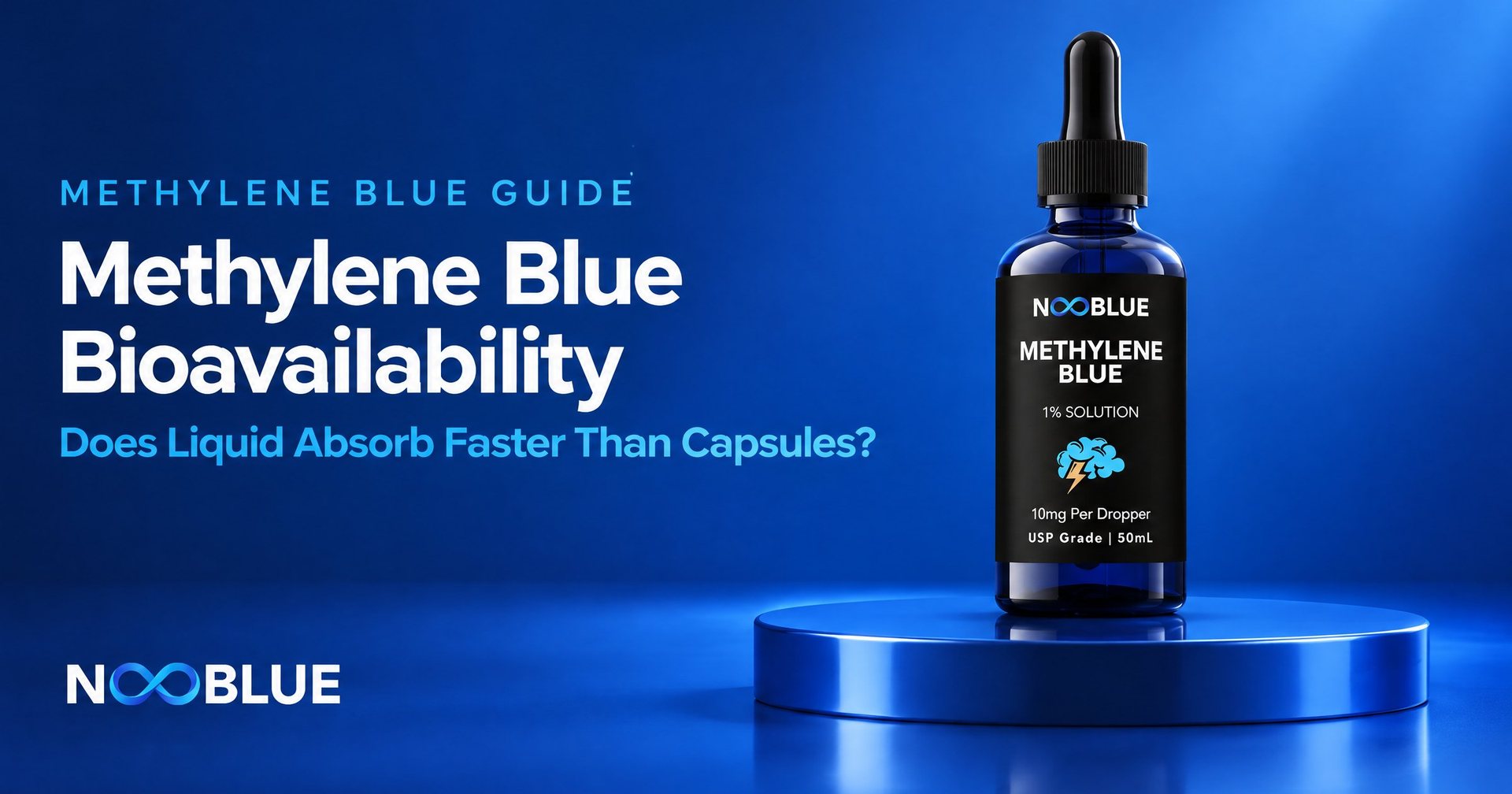
- Measuring accuracy. A capsule or gummy is a fixed amount. Drops depend on you counting correctly: about 0.5 mg per drop for a 1% solution, so 10 drops is 5 mg.
Vitamin C and the gummies
Vitamin C can donate electrons to methylene blue and shift it toward its colorless reduced form, leucomethylene blue. NooBlue gummies pair 10 mg of methylene blue with 25 mg of vitamin C, and our capsules include 10 mg of vitamin C with each 5 mg. The gummy page is explicit that the ingredient report does not measure the balance between the two forms in the finished gummy, and there is no human absorption data for the gummy format. So we don’t claim the gummies absorb better.
Separately, and for a practical reason: NooBlue gummies don’t leave the blue mouth or tongue that drops can. That is about living with the format, not about bioavailability.
How to read bioavailability claims on supplement pages
Absorption claims are easy to write and hard to check. When a product page says its format “absorbs faster”, “bypasses the liver” or has “superior bioavailability”, ask four questions:
- Is there a study of this product, or of methylene blue in general? Almost every figure you will see comes from the four studies above, none of which tested a supplement at 5 or 10 mg.
- Was it measured in people? Cell studies such as the P-glycoprotein work explain mechanisms. They don’t give you a percentage for your body.
- Which route and which form? An intravenous comparison, a plain solution and a colon-release tablet give different answers. A number from one doesn’t transfer to another.
- Does the claim change what you should do? Even if one format did absorb a little better, the right response would be the same label serving, taken consistently, not a bigger dose.
We apply the same test to our own pages. That’s why this article doesn’t claim that NooBlue capsules, gummies or drops absorb better than anything else.
Choosing a format
| Format | Serving | Suits | Price (as of Sep 2026) |
|---|---|---|---|
| NooBlue Capsules | One 5 mg capsule a day, with food (plus 10 mg vitamin C) | A fixed dose with no taste, measuring or staining | $37.99 for 60 ($0.63 a day) |
| NooBlue Gummies | One 10 mg gummy a day (plus 25 mg vitamin C) | An easy chewable routine with no blue mouth | $49.99 for 60 ($0.83 a day) |
| NooBlue Drops 1% | About 0.5 mg per drop, 10 drops = 5 mg | Fine control in 0.5 mg steps | $29.99 for 50 mL, about 100 servings ($0.30 each) |
Our pick for most people is the capsules. Absorption isn’t the reason, since nobody has shown a meaningful difference. The reason is that a fixed 5 mg taken with a meal is the easiest way to get the same dose every day. The drops cost the least per serving and give the finest control, and the gummies are the simplest habit. For how other brands compare, see our roundup of the best methylene blue supplements or whether NooBlue capsules beat liquid solutions. Free worldwide shipping starts at $100 on the NooBlue shop page.
Who should not take methylene blue
Safety first
- Do not take methylene blue with SSRIs, SNRIs, MAOIs or other serotonergic medicines. The combination carries a risk of serotonin syndrome.
- Do not take it if you have G6PD deficiency.
- Do not take it if you are pregnant or breastfeeding.
- Not for anyone under 18.
- It can turn urine blue or green. That is expected.
- Talk to your doctor before use if you take any prescription medicine or have a kidney or liver condition.
The serotonin risk comes from how methylene blue works: Ramsay, Dunford and Gillman (British Journal of Pharmacology, 2007) showed it is a potent reversible inhibitor of MAO-A, the enzyme that breaks down serotonin. Better absorption would make that interaction more important, not less. Our guide to who should not take methylene blue covers every item on the list, and what methylene blue is explains how a century-old dye became a supplement. For the research on longer-term use, see methylene blue for anti-aging.
Frequently asked questions
What is the bioavailability of methylene blue?
The best-known figure is 72.3% for an oral solution compared with an intravenous dose, from a study of 16 healthy adults. Other studies measured lower or higher figures depending on the product and on whether they measured plasma or whole blood.
Does methylene blue liquid absorb faster than capsules?
No human study has compared them. A liquid may start absorbing a little sooner because a capsule has to open first, but the size of that difference, and any difference in total absorption, hasn’t been measured.
Is methylene blue better absorbed sublingually?
There’s no human study showing that. Holding drops under your tongue stains your mouth, and the idea that it bypasses the liver hasn’t been tested for methylene blue.
Does food affect methylene blue absorption?
No study has compared methylene blue taken with and without food. NooBlue capsules say to take one daily with food. Taking it the same way each day matters more than chasing a small timing difference.
Can I switch between drops and capsules without changing the dose?
Match the milligrams, not the count. A 1% solution gives about 0.5 mg per drop, so 10 drops equals one 5 mg capsule. Never go above the label serving.
Does liquid methylene blue stain your mouth?
Yes, drops can stain your mouth and tongue. Capsules are swallowed, and NooBlue gummies don’t leave a blue mouth. Urine can turn blue or green with any format.
Why do I feel so good on methylene blue?
We can’t say for certain, and no study has looked at mood in healthy people at supplement doses. It inhibits MAO-A, the enzyme that breaks down serotonin, which is also why it is dangerous with antidepressants. Expectation plays a part with any new supplement.
Is it okay to take methylene blue every day?
The NooBlue label serving is one a day. Long-term studies at supplement doses are lacking, so keep to the label, follow the safety rules and talk to your doctor if you take any prescription medicine.
Is methylene blue hard on the liver?
We found no established pattern of liver problems at supplement doses, but it hasn’t been well studied. In one colonoscopy-tablet study at 200 and 400 mg, abnormal liver enzymes were among the reported side effects. The label says to talk to your doctor before use if you have a kidney or liver condition.
Is methylene blue killing parasites?
There’s no evidence that supplement doses kill parasites in people, and absorption has nothing to do with it. Aquarium methylene blue is made for fish tanks and is not intended for human consumption. If you suspect a parasite, see a doctor for testing.
Should I take methylene blue with vitamin C?
You don’t need to add any. Vitamin C can shift methylene blue toward its colorless form, and NooBlue capsules and gummies already contain some. No study shows that extra vitamin C improves absorption in people.
Sources
- Walter-Sack I, et al. High absolute bioavailability of methylene blue given as an aqueous oral formulation. Eur J Clin Pharmacol. 2009;65(2):179-189. PubMed 18810398
- Peter C, Hongwan D, Küpfer A, Lauterburg BH. Pharmacokinetics and organ distribution of intravenous and oral methylene blue. Eur J Clin Pharmacol. 2000;56(3):247-250. PubMed 10952480
- Repici A, et al. Methylene blue MMX tablets for chromoendoscopy: safety, tolerability and bioavailability in healthy volunteers. Contemp Clin Trials. 2012;33(2):260-267. PubMed 22101227
- Di Stefano AFD, et al. Methylene blue MMX tablets for chromoendoscopy: bioavailability, colon staining and safety in healthy volunteers undergoing a full colonoscopy. Contemp Clin Trials. 2018;71:96-102. PubMed 29864547
- Senarathna SM, Page-Sharp M, Crowe A. The interactions of P-glycoprotein with antimalarial drugs, including substrate affinity, inhibition and regulation. PLoS One. 2016;11(4):e0152677. PubMed 27045516
- Rodriguez P, et al. Multimodal randomized functional MR imaging of the effects of methylene blue in the human brain. Radiology. 2016;281(2):516-526. PubMed 27351678
- Ramsay RR, Dunford C, Gillman PK. Methylene blue and serotonin toxicity: inhibition of monoamine oxidase A (MAO A) confirms a theoretical prediction. Br J Pharmacol. 2007;152(6):946-951. PubMed 17721552
- USP-NF. Methylene Blue monograph. doi.usp.org