Quick answer
Methylfolate and methylene blue are unrelated compounds that happen to share a prefix. Methylfolate (5-MTHF) is the active form of vitamin B9, the form of folate your cells use to run the methylation cycle. Methylene blue is a blue dye that, at low doses, cycles electrons inside mitochondria and strongly inhibits the enzyme MAO-A. One is a vitamin, the other is not, and neither can stand in for the other.
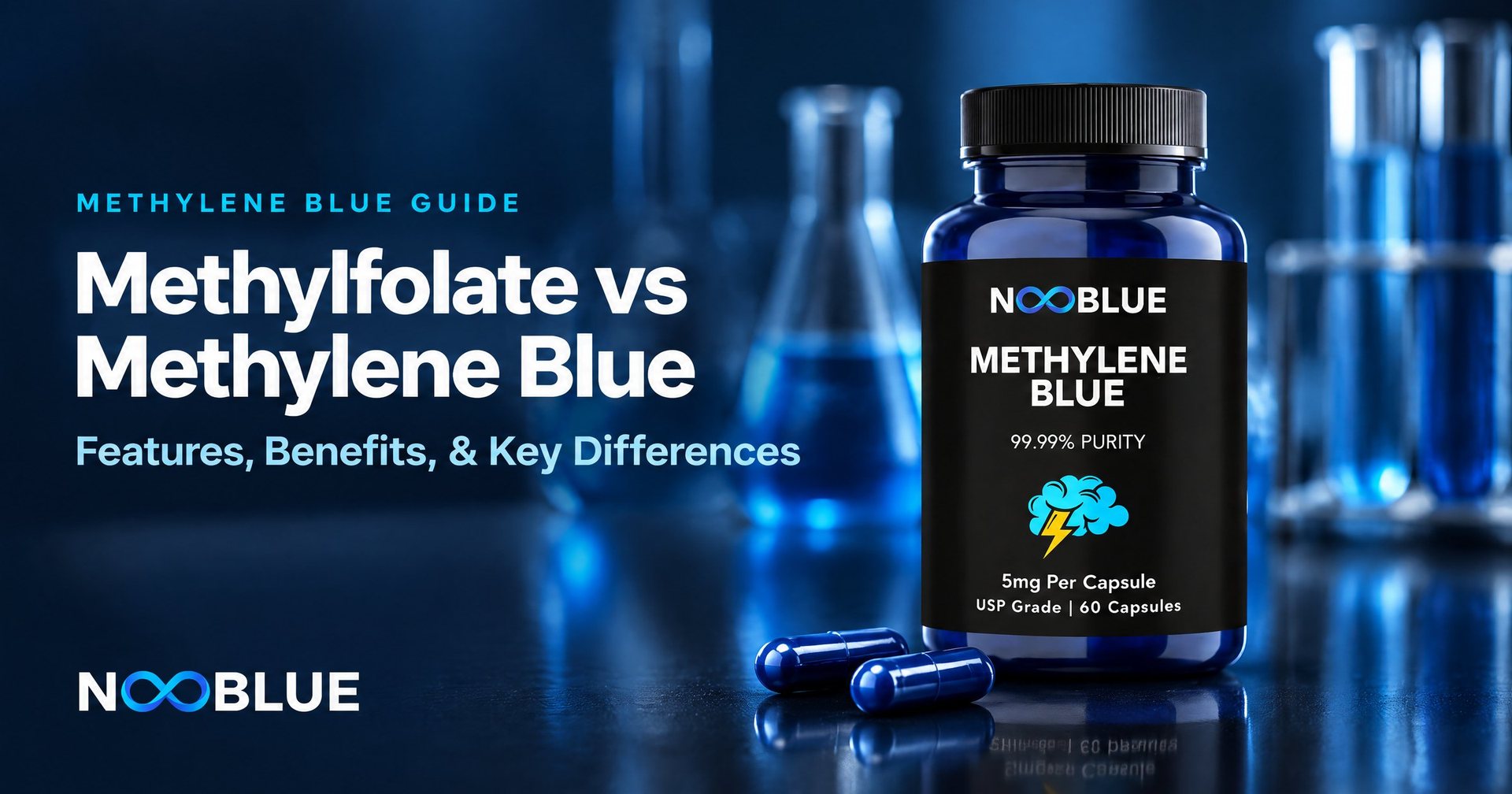
If your question is about folate, B12 or an MTHFR result, methylfolate is the relevant one, and your doctor is the right person to ask. If you want to try methylene blue for mitochondrial energy and focus, NooBlue’s 5 mg capsules are our pick as a low, exact place to start. NooBlue makes them, and we do not sell methylfolate.
Safety first: if you take methylfolate alongside an SSRI or any other serotonergic medicine, do not add methylene blue. Do not take methylene blue if you have G6PD deficiency or are pregnant or breastfeeding.
Written by the NooBlue editorial team. NooBlue sells methylene blue only. Every study and figure below is linked in the sources at the end.
People land on this comparison for two reasons. Some have read about both compounds in the same biohacking thread and want to know which one to take. Others typed “methyl vs methylene” and are not sure whether these are two spellings of the same thing. The short version is that they are not, and the difference matters for safety as much as for results.
This guide explains what each compound is, how each one works, what the research has actually tested, who should avoid each, and whether you can take both. It also untangles the chemistry names, because once “methyl” and “methylene” make sense, the rest of the comparison is easy to follow.
Table of contents
- 1. Methylfolate vs methylene blue at a glance
- 2. What is methylfolate?
- 3. What is methylene blue?
- 4. Methyl vs methylene: why the names confuse people
- 5. How they work: methylation vs mitochondria
- 6. What the research has tested
- 7. Who should not take each one
- 8. Dose and format
- 9. Can you take both together?
- 10. Which one fits your goal?
- 11. Frequently asked questions
- 11.1. Does methylene blue affect methylation?
- 11.2. Is methylene blue the same as methylfolate?
- 11.3. What is the difference between methyl and methylene?
- 11.4. I have an MTHFR variant. Should I take methylene blue instead of methylfolate?
- 11.5. Which is better for energy?
- 11.6. Can you take methylfolate and methylene blue together?
- 11.7. Who should not take methylfolate?
- 11.8. What is the methylfolate trap?
- 11.9. Why don’t doctors recommend methylene blue?
- 11.10. What should you not mix with methylene blue?
- 11.11. What is the best methylene blue to start with?
- 12. Sources
Methylfolate vs methylene blue at a glance
| Detail | Methylene blue | Methylfolate (5-MTHF) |
|---|---|---|
| What it is | A phenothiazine dye with redox activity | The active form of folate (vitamin B9) |
| Is it a nutrient? | No | Yes, a form of an essential vitamin |
| Main system | Mitochondrial electron transport | The folate and methylation cycle |
| Key enzyme effect | Potent reversible inhibitor of MAO-A | Hands a methyl group on via methionine synthase, which needs vitamin B12 |
| Typical supplement amounts | 5 mg or 10 mg per serving (NooBlue labels) | Adult folate RDA is 400 mcg DFE. Trials used up to 15 mg a day under medical supervision |
| Best-known human study | 26 healthy adults, single low dose, brain MRI one hour later | Two trials as an add-on for adults already taking an SSRI |
| Hard exclusions | Serotonergic medicines, G6PD deficiency, pregnancy, breastfeeding | Unchecked vitamin B12 status; ask first if you take methotrexate, antiepileptic drugs or sulfasalazine |
| Color | Deep blue, turns urine blue-green | No dye effect |
What is methylfolate?
Methylfolate is short for 5-methyltetrahydrofolate, often written 5-MTHF or L-methylfolate. It is the main active form of folate in the body. Folate from food and folic acid from supplements both have to be converted through several steps before they reach this form, and the last step depends on an enzyme called methylenetetrahydrofolate reductase, or MTHFR.
Some people carry a common variant of the MTHFR gene, known as 677C>T, that makes this enzyme work less efficiently. Being homozygous for it (two copies) is not rare. By one estimate, about 25% of Hispanic people, 10% of Caucasian and Asian people and 1% of African American people are homozygous for the variant. For some of them, a supplement that supplies 5-MTHF directly may be more useful than folic acid, because it skips the step the variant slows down. Its bioavailability is equal to or greater than that of folic acid.
Your body uses folate to make DNA, to make red blood cells, and to supply methyl groups for methylation, the process of attaching a small carbon unit to DNA, proteins and neurotransmitters. The adult recommended intake for folate is 400 mcg dietary folate equivalents (DFE) a day, rising to 600 mcg DFE in pregnancy and 500 mcg DFE while breastfeeding. The upper limit for folic acid from supplements and fortified foods is 1,000 mcg a day for adults.
So methylfolate is a vitamin. If your diet is short of folate or your body converts it poorly, methylfolate fills that gap. It does nothing to the mitochondrial pathway that methylene blue works on.
What is methylene blue?
Methylene blue (methylthioninium chloride) is a synthetic phenothiazine dye. It is used in hospitals as an intravenous medicine and in laboratories as a stain, and it is sold at much lower oral doses as a supplement. It is not a vitamin, and your body has no dietary need for it.
Its interest as a supplement comes from its redox chemistry. Methylene blue switches easily between a blue oxidized form and a colorless reduced form called leucomethylene blue. A review in Progress in Neurobiology (Rojas, Bruchey and Gonzalez-Lima, 2012) describes low-dose methylene blue acting as an electron cycler in the mitochondrial electron transport chain, with a hormetic dose response: low and high doses can have opposite effects. Our guide to methylene blue and cellular energy covers the mechanism in more detail.
Methylene blue also acts on an enzyme. In laboratory work on purified human enzyme published in the British Journal of Pharmacology (Ramsay, Dunford and Gillman, 2007), methylene blue was a potent, reversible inhibitor of monoamine oxidase A (MAO-A), the enzyme that breaks down serotonin. That finding explains the most important safety rule for methylene blue, covered below.
When you buy it as a supplement, the dose is small and stated on the label. NooBlue’s capsules contain 5 mg of USP grade methylene blue and 10 mg of vitamin C. The gummies contain 10 mg with 25 mg of vitamin C. The 1% drops give 0.5 mg per drop. If you are comparing brands, our checklist for finding safe, authentic methylene blue covers what to check on a label, and this is a different question from the methylene blue vs methyl blue mix-up, which is about two different dyes.
Methyl vs methylene: why the names confuse people
A large share of readers reach this page by searching “methyl vs methylene”. The shared prefix comes from organic chemistry naming, and it tells you nothing about what either supplement does.
- A methyl group is –CH3: one carbon with three hydrogens, attached to the rest of a molecule at one point.
- A methylene group is –CH2–: one carbon with two hydrogens, attached at two points, so it can bridge two other parts of a molecule.
- A methine (sometimes methenyl) group is =CH–: one carbon with one hydrogen and three bonds to the rest of the molecule.
- Methylidene is a =CH2 group attached by a double bond. Older texts used “methylene” for this too, which is where some of the confusion starts.
At the level of the group, the whole difference between methyl and methylene is one hydrogen and one bond. None of these groups is a supplement. They are fragments of larger molecules, and the words then travel into compound names that have nothing to do with each other.
| Term | What it refers to | Why it matters to you |
|---|---|---|
| Methyl group (–CH3) | A chemical fragment | Background only |
| Methylation | Attaching methyl groups to DNA, proteins and neurotransmitters | The process methylfolate supplies |
| Methylfolate (5-MTHF) | The active form of folate that carries a methyl group | A vitamin |
| MTHFR | Methylenetetrahydrofolate reductase, the enzyme that makes 5-MTHF | A common gene variant |
| Methylene blue | A phenothiazine dye that cycles electrons | A supplement compound, not a vitamin |
Notice the twist in the folate pathway itself: MTHFR converts methylenetetrahydrofolate into methyltetrahydrofolate. So “methylene” appears inside the folate cycle, but that methylene group belongs to a folate molecule. It has no link to methylene blue, whose name comes from its dye chemistry. People with an MTHFR variant sometimes buy methylene blue expecting a methylation effect, and it does not provide one.
How they work: methylation vs mitochondria
The two compounds act on separate systems, and the easiest way to see the difference is to follow what each one does inside a cell.
Methylfolate works in the folate and methylation cycle. It hands its methyl group to homocysteine, turning it into methionine. That reaction runs through an enzyme called methionine synthase, which needs vitamin B12. Methionine then feeds the methyl donor that cells use for methylating DNA, proteins and neurotransmitters. Folate also supplies the building blocks for DNA. If you are short of folate, or you convert it poorly, methylfolate supplies the finished product.
Methylene blue works in the mitochondrial electron transport chain. At low doses it accepts electrons and passes them on, cycling between its blue and colorless forms. Separately, it inhibits MAO-A, which slows the breakdown of serotonin. It plays no part in the methylation cycle, does not supply folate, and does not lower homocysteine.
The mechanisms do not overlap. Taking methylfolate will not change mitochondrial electron transport, and taking methylene blue will not correct a folate shortfall. If you want the mitochondrial side compared with a more familiar supplement, our methylene blue vs CoQ10 comparison looks at two compounds that do work on the same chain.
What the research has tested
The two compounds have been studied for different things, in different people, and neither body of evidence tells you much about the other.
Methylfolate. The best-known trials tested L-methylfolate as an add-on for adults who were already taking an SSRI and had not responded fully to it (Papakostas et al., American Journal of Psychiatry, 2012). The first trial, with 148 outpatients, started at 7.5 mg a day and found no significant difference between groups. The second trial, with 75 patients, used 15 mg a day and found a significantly better response than the SSRI plus placebo, with side-effect rates no different from placebo. Those doses are far above the adult folate RDA, and they were given under medical supervision to people on prescription medicine. They do not describe a general wellness dose.
Methylene blue. The best-known human study is small. In a randomized, double-blind, placebo-controlled trial published in Radiology (Rodriguez et al., 2016), 26 healthy adults aged 22 to 62 had functional MRI scans before and one hour after a single low oral dose of methylene blue or placebo. Methylene blue increased brain activity during sustained attention and short-term memory tasks and was linked to a 7% increase in correct responses during memory retrieval. That was one dose, in one small group, over one hour. There are no long-term trials of daily low-dose methylene blue supplements in healthy adults. Our summary of whether methylene blue works and our page on what the research shows about methylene blue cover the evidence in more detail.
The overlap in the research is the population, and it points to a safety problem rather than a benefit. The people in the methylfolate trials were taking SSRIs, which is exactly the group that should not take methylene blue.
Who should not take each one
The exclusion lists barely overlap, which is another sign that these are not interchangeable products.
Methylene blue. Do not take it with an SSRI, SNRI, MAOI or any other medicine that affects serotonin. A systematic review in Psychosomatics (Ng and Cameron, 2010) looked at nine case reports and two retrospective reviews: 26 patients developed an acute confusional state after receiving methylene blue by infusion, and 24 of them were taking a serotonin reuptake inhibitor. Those were hospital infusion doses, far above supplement amounts, but the MAO-A inhibition shown by Ramsay and colleagues is the reason methylene blue brands carry the warning. Also avoid methylene blue if you have G6PD deficiency, if you are pregnant or breastfeeding, or if you are under 18. Our guides to who should not take methylene blue, methylene blue and serotonin syndrome and methylene blue and G6PD deficiency go through each one, and our list of what not to take with methylene blue names the medicine classes to check.
Methylfolate. Get your vitamin B12 status checked first. Large amounts of folate can correct the anemia caused by B12 deficiency without fixing the nerve damage that B12 deficiency can also cause, so a folate supplement can hide the problem while it continues. Ask your doctor before taking folate if you take methotrexate or antiepileptic medicines, because folate and those drugs affect each other. Sulfasalazine reduces folate absorption and can cause folate deficiency, which is also worth raising with your prescriber.
If you are taking methylfolate because a doctor added it to an SSRI, the SSRI is the reason not to add methylene blue. That is not a close call.
Dose and format
Methylfolate doses in supplements vary widely. The adult folate RDA is 400 mcg DFE, and the upper limit for folic acid from supplements and fortified foods is 1,000 mcg a day. The 7.5 mg and 15 mg doses in the trials above were used under medical supervision. If you are thinking about a high-dose product, talk to your doctor first.
Methylene blue supplements sit in the low single-digit to low double-digit milligrams per serving, far below hospital intravenous doses. Because of the hormetic dose response described by Rojas and colleagues, more is not better, and a low, exact starting unit matters. The format decides how finely you can dose:
- Capsules give a fixed 5 mg with no measuring. NooBlue’s capsules are taken once a day with food, and 60 cost $37.99, or $0.63 per 5 mg.
- Gummies give a fixed 10 mg in a Wild Blueberry chew with 25 mg of vitamin C and 0 g of sugar. A bottle of 60 costs $49.99, or $0.42 per 5 mg. Vitamin C can shift methylene blue toward its colorless reduced form, and the gummies don’t leave the blue mouth that drops can.
- Drops give 0.5 mg per drop from a 1% solution, the finest control and the lowest cost at $0.30 per 5 mg. They stain skin, fabric and countertops, so mix them into water.
Our guide to how many mg of methylene blue per day works through dose ranges, our capsules vs liquid comparison covers the format choice, and our methylene blue gummies comparison ranks the chewable options.
Can you take both together?
No study has tested methylfolate and methylene blue together. On mechanism alone, they act on separate systems, and we are not aware of a direct interaction between the two compounds.
The practical risk comes from why you take methylfolate. If it was added to an SSRI or another serotonergic medicine, methylene blue is off the table because of that medicine, whatever else you take. If you take methylfolate for folate status alone and use no serotonergic medicines, check with your doctor, then introduce one product at a time at its normal dose so you can tell which one causes any effect you notice.
Which one fits your goal?
- You have a folate question (low folate on a blood test, raised homocysteine, an MTHFR result, pregnancy planning): methylfolate is the relevant compound, and your doctor should guide the dose and check B12 first.
- You want to try a mitochondrial supplement for energy and focus, you take no serotonergic medicine, and you do not have G6PD deficiency: methylene blue is the one studied for that, with the limits described above. NooBlue’s 5 mg capsules are our pick for a low, exact start. Our guide to methylene blue for beginners explains how to start.
- You take an SSRI, SNRI or MAOI: do not take methylene blue, whether or not you also take methylfolate.
If you settle on methylene blue and want to compare brands, our top methylene blue brands guide and our best methylene blue supplements comparison put the options side by side. You can see all three NooBlue formats in the NooBlue shop.
Frequently asked questions
Does methylene blue affect methylation?
No. Methylene blue does not take part in the methylation cycle, does not supply folate and does not donate methyl groups. The “methylene” in its name comes from its dye chemistry. If methylation support is the goal, methylfolate, or another methyl donor your doctor recommends, is the relevant choice.
Is methylene blue the same as methylfolate?
No. Methylfolate is 5-methyltetrahydrofolate, the active form of vitamin B9. Methylene blue is a phenothiazine dye that cycles electrons in mitochondria and inhibits MAO-A. They share part of a name and nothing else.
What is the difference between methyl and methylene?
A methyl group is –CH3, one carbon with three hydrogens attached at one point. A methylene group is –CH2–, one carbon with two hydrogens attached at two points. The words are chemistry labels for molecular fragments, and they say nothing about what methylfolate or methylene blue does.
I have an MTHFR variant. Should I take methylene blue instead of methylfolate?
They are not substitutes. An MTHFR variant slows the step that makes active folate, and a 5-MTHF supplement supplies that form directly. Methylene blue does nothing for folate metabolism. If you have an MTHFR variant and also want to try methylene blue for mitochondrial energy, it would be an addition to your folate plan, not a replacement, and only if you take no serotonergic medicines.
Which is better for energy?
It depends on the cause. If low energy comes from low folate or poor folate conversion, which a blood test can show, methylfolate addresses that. If your folate status is normal and you want to try a supplement aimed at mitochondrial energy, methylene blue is the one studied for that, although the human evidence is limited to small, short studies. Our page on methylene blue and cellular energy explains the mechanism.
Can you take methylfolate and methylene blue together?
No study has tested the combination, and we are not aware of a direct interaction between the two compounds. The real risk is the reason you take methylfolate: if it was added to an SSRI or other serotonergic medicine, do not take methylene blue. Otherwise, check with your doctor and start one product at a time.
Who should not take methylfolate?
Anyone whose vitamin B12 status has not been checked should do that first, because large amounts of folate can correct the anemia of B12 deficiency while the nerve damage continues. People taking methotrexate, antiepileptic medicines or sulfasalazine should ask their doctor before taking folate, because those drugs and folate affect each other.
What is the methylfolate trap?
The methylfolate trap describes what happens when vitamin B12 is low. Methylfolate passes its methyl group on through methionine synthase, an enzyme that needs B12. Without enough B12, folate builds up as 5-MTHF that the cell cannot use or convert back, so the cell behaves as if it were short of folate even when blood folate looks normal. A 2006 case report in the British Journal of Haematology (Smulders et al.) showed nearly all features of the trap in a person with B12 deficiency, which is why B12 is checked before starting methylfolate.
Why don’t doctors recommend methylene blue?
Mostly because the evidence for low-dose daily use is thin. The best-known human study gave 26 healthy adults a single dose and measured them for one hour, and there are no long-term trials of daily supplement doses. Methylene blue also interacts with serotonergic medicines and is unsafe with G6PD deficiency, so it needs a medication check. Our article on why doctors don’t prescribe methylene blue covers this in more depth.
What should you not mix with methylene blue?
Serotonergic medicines are the category that matters: SSRIs, SNRIs, MAOIs and other drugs that raise serotonin. Methylene blue inhibits MAO-A, so the combination can cause serotonin toxicity. Our methylene blue interactions guide lists other medicines to check.
What is the best methylene blue to start with?
NooBlue’s 5 mg capsules are our pick for a first bottle: a fixed, low dose of USP grade methylene blue with 10 mg of vitamin C, 60 capsules for $37.99, and a published lab report on the methylene blue ingredient. NooBlue makes them, so compare other brands too. If you would rather not swallow capsules, the 10 mg gummies or the 1% drops are the other two formats.
Sources
- Office of Dietary Supplements. Folate: Fact Sheet for Health Professionals (RDA, upper limit, MTHFR 677C>T prevalence, 5-MTHF, B12 masking, medication interactions).
- Papakostas GI, Shelton RC, Zajecka JM, et al. L-methylfolate as adjunctive therapy for SSRI-resistant major depression: results of two randomized, double-blind, parallel-sequential trials. American Journal of Psychiatry. 2012;169(12):1267-1274. PubMed 23212058
- Smulders YM, Smith DE, Kok RM, et al. Cellular folate vitamer distribution during and after correction of vitamin B12 deficiency: a case for the methylfolate trap. British Journal of Haematology. 2006;132(5):623-629. PubMed 16445837
- Rojas JC, Bruchey AK, Gonzalez-Lima F. Neurometabolic mechanisms for memory enhancement and neuroprotection of methylene blue. Progress in Neurobiology. 2012;96(1):32-45. PubMed 22067440
- Ramsay RR, Dunford C, Gillman PK. Methylene blue and serotonin toxicity: inhibition of monoamine oxidase A (MAO A) confirms a theoretical prediction. British Journal of Pharmacology. 2007;152(6):946-951. PubMed 17721552
- Rodriguez P, Zhou W, Barrett DW, et al. Multimodal randomized functional MR imaging of the effects of methylene blue in the human brain. Radiology. 2016;281(2):516-526. PubMed 27351678
- Ng BK, Cameron AJ. The role of methylene blue in serotonin syndrome: a systematic review. Psychosomatics. 2010;51(3):194-200. PubMed 20484716
- NooBlue product pages (ingredients, serving sizes and the CTLA ingredient report): capsules, gummies, drops