Key takeaways
- It carries electrons inside mitochondria. In human cells, tiny amounts raised the activity of the energy enzyme complex IV by 30% and oxygen use by 37% to 70%.
- It recycles. Methylene blue flips between a blue oxidized form and a colorless reduced form, so one molecule can take part in many reactions.
- It reaches the brain and blocks MAO-A. That is why it is studied for brain energy, and also why it must never be combined with SSRIs, SNRIs, MAO inhibitors or opioids.
- Its power has limits. The dose response is hormetic, so more is not better, and the anti-aging results come from cells and mice rather than human trials.
Most supplements work by supplying something the body uses, such as a vitamin, a cofactor or a building block. Methylene blue is different. It is a small synthetic dye that takes part in chemistry directly: it picks up electrons, hands them on, and returns to its starting form ready to do it again. That redox behavior, plus the fact that it reaches the brain and inhibits an enzyme that breaks down serotonin, is what makes methylene blue powerful. The same properties are what make it a compound to respect.
This guide explains each of those properties, what the research shows in cells, animals and people, and where the evidence stops. It is written by NooBlue, which sells methylene blue capsules, gummies and drops, so we also say plainly what our products contain and who should not take them.
Table of contents
- 1. It Carries Electrons Inside Mitochondria
- 2. It Recycles Instead of Being Used Up
- 3. It Reaches the Brain
- 4. It Slows Cellular Aging in the Lab
- 5. It Inhibits MAO-A
- 6. What “Powerful” Does Not Mean
- 7. How People Use Methylene Blue
- 8. The Flip Side of Potency: Side Effects and Who Should Skip It
- 9. Frequently Asked Questions
- 9.1. What are the benefits of ultra methylene blue?
- 9.2. What makes methylene blue different from CoQ10 or NAD+?
- 9.3. How long does it take to feel the effects of methylene blue?
- 9.4. Is methylene blue safe to take every day?
- 9.5. Why do some people feel weird after taking methylene blue?
- 9.6. Is methylene blue safe for humans?
- 9.7. What should you not take with methylene blue?
- 9.8. Is methylene blue a natural compound?
- 10. The Bottom Line
- 11. Sources
It Carries Electrons Inside Mitochondria
Your cells make most of their energy in mitochondria, through a chain of protein complexes called the electron transport chain. Electrons from food move down the chain, and the energy released drives the production of ATP, the cell’s energy currency. The last step is complex IV, also called cytochrome c oxidase.
Methylene blue can join that chain. Enzymes in the cell use NADH or NADPH to reduce methylene blue to its colorless form, leucomethylene blue, and cytochrome c then takes the electrons back, returning it to the blue form. In a 2008 study in human fibroblasts, nanomolar amounts of methylene blue increased complex IV activity by 30%, raised cellular oxygen consumption by 37% to 70% and increased heme synthesis (Atamna et al., 2008). A 2012 review in Progress in Neurobiology described methylene blue as an electron cycler at low doses and pointed to cytochrome oxidase as a major target (Rojas et al., 2012).
That is the core of the answer to “what makes methylene blue powerful”: it works on the energy chain itself rather than feeding it raw materials. CoQ10, by comparison, is the body’s own electron carrier in the same chain, and NAD+ precursors such as NMN and NR raise the supply of the coenzyme that carries electrons into it. Our comparisons of methylene blue and CoQ10 and of methylene blue and NMN go into those differences.
It Recycles Instead of Being Used Up
A typical dietary antioxidant, such as vitamin C, gives up an electron to neutralize a reactive molecule and then has to be regenerated or replaced. Methylene blue cycles. Because the cell keeps reducing it and cytochrome c keeps reoxidizing it, one molecule can pass through the cycle again and again. The 2008 fibroblast study proposed that this cycling between the two forms explains much of the effect, and that it may block oxidant production by mitochondria.
Cycling also explains why dose matters so much. Methylene blue has a hormetic dose response, in which low and high doses have opposite effects (Rojas et al., 2012). The helpful range is the low one. A bigger dose is not a stronger version of a small dose, and that is the main reason we sell fixed, low amounts rather than large ones.
It Reaches the Brain
Methylene blue can cross the blood-brain barrier at low doses, which is why researchers study it for brain energy (Rodriguez et al., 2016, full text). The best-known human study is a randomized, double-blind, placebo-controlled brain-imaging trial of 26 healthy adults. One hour after a single oral dose of 280 mg of USP-grade methylene blue, brain activity rose during sustained-attention and short-term-memory tasks, and correct responses during memory retrieval increased by 7% (Rodriguez et al., 2016). That dose is 56 times one of our 5 mg capsules.
The picture is not one-sided. In a 2023 study, intravenous methylene blue at 0.5 and 1 mg per kg lowered overall brain blood flow and brain oxygen use in healthy volunteers, the opposite of what the researchers expected. They suggested the doses may have fallen on the inhibitory side of the hormetic curve (Singh et al., 2023). Both studies used doses far above supplement servings, and neither tells you what 5 mg a day does over months. Our guide to methylene blue benefits for brain and cellular health goes through the research in more detail.
It Slows Cellular Aging in the Lab
The anti-aging interest comes from cell studies. In the 2008 study, methylene blue and related compounds extended the lifespan of human IMR90 fibroblasts in culture by more than 20 population doublings, and it counteracted premature senescence caused by hydrogen peroxide or cadmium (Atamna et al., 2008). A 2015 follow-up in the same cell line found that methylene blue briefly activated AMPK, an energy-sensing enzyme, which was followed by higher PGC1-alpha and SURF1, a more than doubling of complex IV activity, a 28% fall in cellular oxidants and slower telomere erosion (Atamna et al., 2015).
A 2017 study added a skin angle. In cultured human skin cells and a lab-grown 3D skin model, methylene blue delayed senescence better than several common antioxidants and raised expression of elastin and collagen 2A1 (Xiong et al., 2017).
Then comes the reality check. When the Interventions Testing Program gave methylene blue to genetically diverse mice for life, it did not change median lifespan in males or females, and it produced a small 6% increase in maximum lifespan in females (Harrison et al., 2014). No human trial has tested methylene blue for aging. Our article on methylene blue for anti-aging weighs that evidence.
It Inhibits MAO-A
Methylene blue is a potent reversible inhibitor of MAO-A, the enzyme that breaks down serotonin (Ramsay et al., 2007). Older articles, including an earlier version of this one, described that as a mood benefit. We no longer do. The MAO-A effect is best understood as a safety issue: it is the reason methylene blue can cause serotonin syndrome when combined with serotonergic medicines, and it has not been shown to support mood at supplement doses.
What “Powerful” Does Not Mean
Powerful chemistry is not the same as proven benefit. Harvard Health makes the point that a drug working in a specific clinical setting does not mean it can or should be used by the general population, and it warns that industrial or chemical-grade methylene blue sold as a stain or dye should not be used in people (Harvard Health, 2025).
Here is the fair summary. The mitochondrial and anti-senescence effects are well documented in cells. The human evidence is a handful of short studies at doses well above supplement servings, with mixed results. The anti-aging evidence in animals is neutral for median lifespan. None of that makes methylene blue useless. It means it is best taken as a low-dose support for normal cellular energy, not as a cure-all, and chosen on grade and dose rather than on marketing.
How People Use Methylene Blue
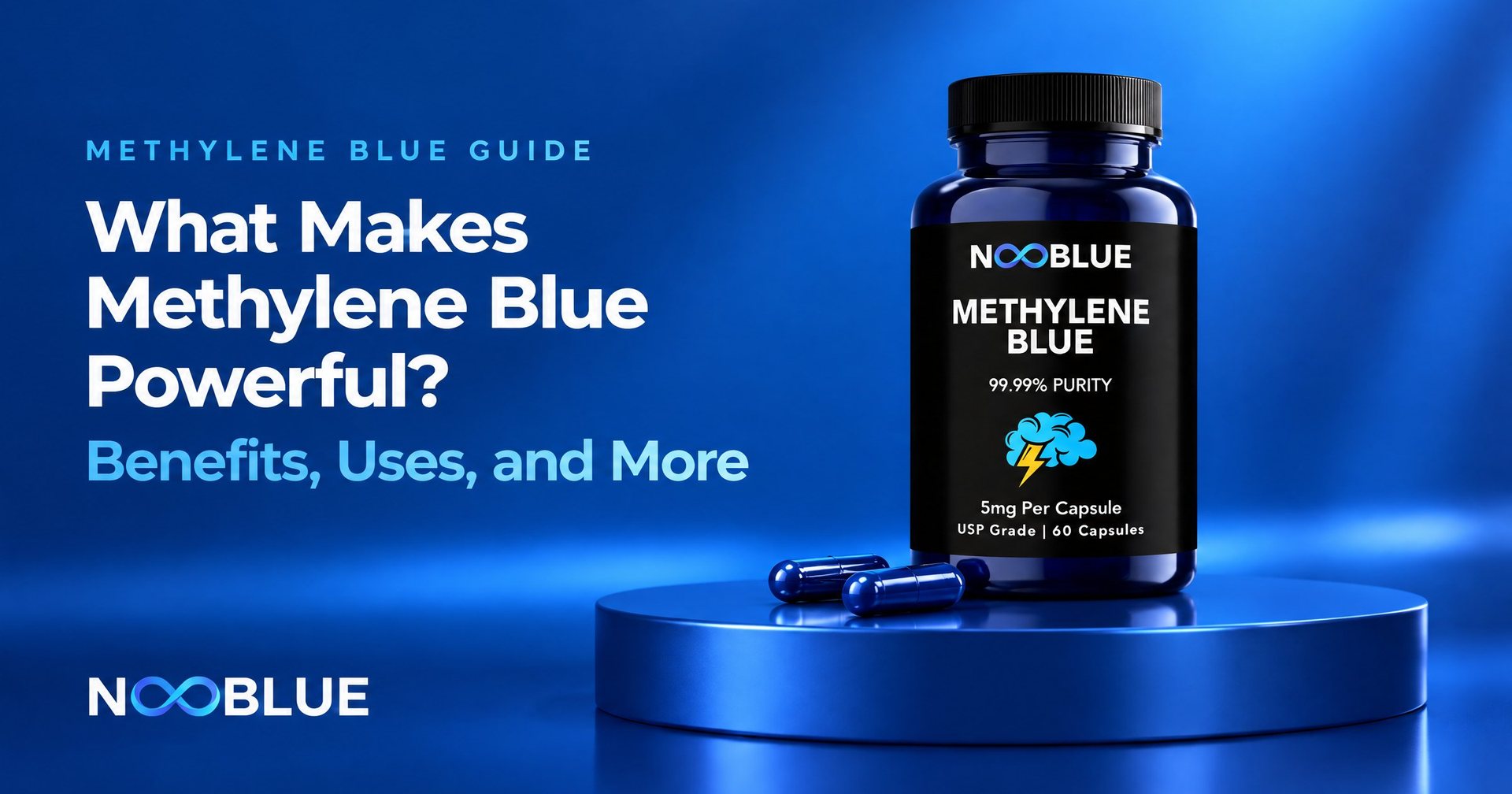
Because of the hormetic dose response, the practical rule is to start low and change one thing at a time. Our Ultimate Methylene Blue Capsules hold 5 mg of USP-grade methylene blue and 10 mg of vitamin C, and the label says to take one a day with food. A bottle of 60 costs $37.99, or $0.63 a day. The gummies hold 10 mg with 25 mg of vitamin C for $49.99, and the 1% drops give 0.5 mg per drop for $29.99, for people who want to adjust in small steps.
Many people take it in the morning. If you notice it affects your sleep, our guide to methylene blue and sleep quality explains how timing can help. Grade matters as much as dose: the research used purified material, and our explainer on lab grade vs pharmaceutical grade methylene blue shows why industrial dye is not a substitute. For the scope of our own lab report, see our quality and testing page. It covers the methylene blue ingredient lot rather than every finished batch, and it gives no purity percentage.
The Flip Side of Potency: Side Effects and Who Should Skip It
A compound that joins the energy chain and blocks MAO-A deserves more caution than a vitamin. At low doses the common effect is blue or green urine, because some methylene blue leaves the body unchanged in urine. The injection label lists headache, nausea and diarrhea among the more common side effects at hospital doses, which are far higher than supplement servings, and our guide to methylene blue side effects covers what to watch for.
The serious rules come from the injectable drug’s label. It carries a boxed warning for serotonin syndrome, which can be serious or fatal, when methylene blue is combined with SSRIs, SNRIs, MAO inhibitors or opioids. It lists G6PD deficiency as a contraindication because of the risk of hemolytic anemia, and it warns of possible harm in pregnancy (ProvayBlue label). Do not take methylene blue if any of those apply to you, or while breastfeeding. Our guide to who should not take methylene blue covers the full list. If you take prescription medicine, talk to your doctor or pharmacist first.
Frequently Asked Questions
What are the benefits of ultra methylene blue?
“Ultra” is a product name some brands use, not a grade or a stronger form. The molecule is the same methylene blue in every product, so the benefits and risks are the same ones described above. What differs between products is the grade, the dose per serving and the lab paperwork. Look for USP-grade methylene blue, a clear dose on the label and a certificate that names the lab and the lot. Our roundup of the best methylene blue supplements compares brands on those points.
What makes methylene blue different from CoQ10 or NAD+?
CoQ10 is the body’s own electron carrier in the mitochondrial chain, and NAD+ precursors raise the supply of a coenzyme that feeds electrons into it. Methylene blue is a synthetic compound that can accept electrons and pass them to cytochrome c, cycling between two forms as it does. In human cells, that raised complex IV activity and oxygen use.
How long does it take to feel the effects of methylene blue?
In the best-known imaging study, changes in brain activity showed up one hour after a single 280 mg dose, far more than a supplement serving. At 5 mg a day there is no published timeline. Some people notice nothing, which is normal, since cellular energy support is not something you necessarily feel.
Is methylene blue safe to take every day?
Our products are labeled for once-daily use at low doses. Daily use is not safe for everyone: anyone taking SSRIs, SNRIs, MAO inhibitors or opioids, anyone with G6PD deficiency, and anyone pregnant or breastfeeding should not take it. Talk to your doctor before starting if you take any prescription medication.
Why do some people feel weird after taking methylene blue?
If you feel off after a dose, check the amount and the timing first, and go back to the lowest dose, taken with food as the label says. A serious reason is an interaction with a serotonergic medicine. The injection label lists signs of serotonin syndrome such as agitation, a fast heart rate, sweating, fever, tremor and muscle rigidity. If that is possible, stop and get medical help straight away.
Is methylene blue safe for humans?
An injectable form is a prescription medicine used in hospitals, and low-dose oral methylene blue is sold as a supplement. Safety depends on the grade, the dose and the person. Use USP-grade products only, never industrial dye or aquarium products, and follow the serotonergic, G6PD and pregnancy rules above.
What should you not take with methylene blue?
Never combine it with SSRIs, SNRIs, MAO inhibitors or opioids, and check any other medicine that affects serotonin with a pharmacist. Do not take it with G6PD deficiency, and do not take it while pregnant or breastfeeding.
Is methylene blue a natural compound?
No. Methylene blue is fully synthetic, and a 2011 review described it as the first synthetic drug, with more than 120 years of use in medicine and as a stain (Schirmer et al., 2011). It does not occur in food. What matters for supplement use is grade: choose USP-grade material, not industrial dye.
The Bottom Line
Methylene blue is powerful because it works on cellular chemistry directly: it carries electrons in mitochondria, recycles between two forms, reaches the brain and inhibits MAO-A. In cells, that raises energy-enzyme activity and delays senescence. In people, the evidence is still thin and dose-dependent, and in mice it did not extend median lifespan. Used at a low, fixed dose by people who pass the safety checks, it is a reasonable way to support normal cellular energy. Anyone on serotonergic medicines, with G6PD deficiency, or pregnant or breastfeeding should not take it.
More from NooBlue: methylene blue benefits: what the research shows, our methylene blue dosage guide, and the NooBlue shop.
Sources
- Atamna H, Nguyen A, Schultz C, et al. Methylene blue delays cellular senescence and enhances key mitochondrial biochemical pathways. FASEB Journal. 2008;22(3):703-712. PubMed 17928358
- Atamna H, Atamna W, Al-Eyd G, Shanower G, Dhahbi JM. Combined activation of the energy and cellular-defense pathways may explain the potent anti-senescence activity of methylene blue. Redox Biology. 2015;6:426-435. PubMed 26386875
- Rojas JC, Bruchey AK, Gonzalez-Lima F. Neurometabolic mechanisms for memory enhancement and neuroprotection of methylene blue. Progress in Neurobiology. 2012;96(1):32-45. PubMed 22067440
- Rodriguez P, Zhou W, Barrett DW, et al. Multimodal randomized functional MR imaging of the effects of methylene blue in the human brain. Radiology. 2016;281(2):516-526. PubMed 27351678
- Singh N, MacNicol E, DiPasquale O, et al. The effects of acute methylene blue administration on cerebral blood flow and metabolism in humans and rats. Journal of Cerebral Blood Flow and Metabolism. 2023. PubMed 36803299
- Xiong ZM, O’Donovan M, Sun L, Choi JY, Ren M, Cao K. Anti-aging potentials of methylene blue for human skin longevity. Scientific Reports. 2017;7(1):2475. PubMed 28559565
- Harrison DE, Strong R, Allison DB, et al. Acarbose, 17-α-estradiol, and nordihydroguaiaretic acid extend mouse lifespan preferentially in males. Aging Cell. 2014;13(2):273-282. PubMed 24245565
- Ramsay RR, Dunford C, Gillman PK. Methylene blue and serotonin toxicity: inhibition of monoamine oxidase A (MAO A) confirms a theoretical prediction. British Journal of Pharmacology. 2007;152(6):946-951. PubMed 17721552
- Schirmer RH, Adler H, Pickhardt M, Mandelkow E. “Lest we forget you: methylene blue…”. Neurobiology of Aging. 2011;32(12):2325.e7-16. PubMed 21316815
- Goldman L. What to know about methylene blue. Harvard Health Publishing, April 2025. health.harvard.edu
- ProvayBlue (methylene blue) injection, prescribing information, American Regent. DailyMed
- NooBlue product pages and quality page (label amounts, prices and the scope of the CTLA ingredient report), read Sep 2026. nooblue.com/quality