Quick answer
To take methylene blue drops, first check the strength on the label. A 1% solution holds 10 mg per mL, which is about 0.5 mg per drop, so 10 drops give about 5 mg. Count your drops into a glass of water or juice, drink it, and rinse your mouth with plain water. Take it once a day in the morning or early afternoon, start at 5 mg or less, and wait two weeks before you change the dose. Blue or green urine afterwards is expected.
Safety first: do not take methylene blue if you take SSRIs, SNRIs, MAOIs or other serotonergic medicines, if you have G6PD deficiency, or if you are pregnant or breastfeeding.
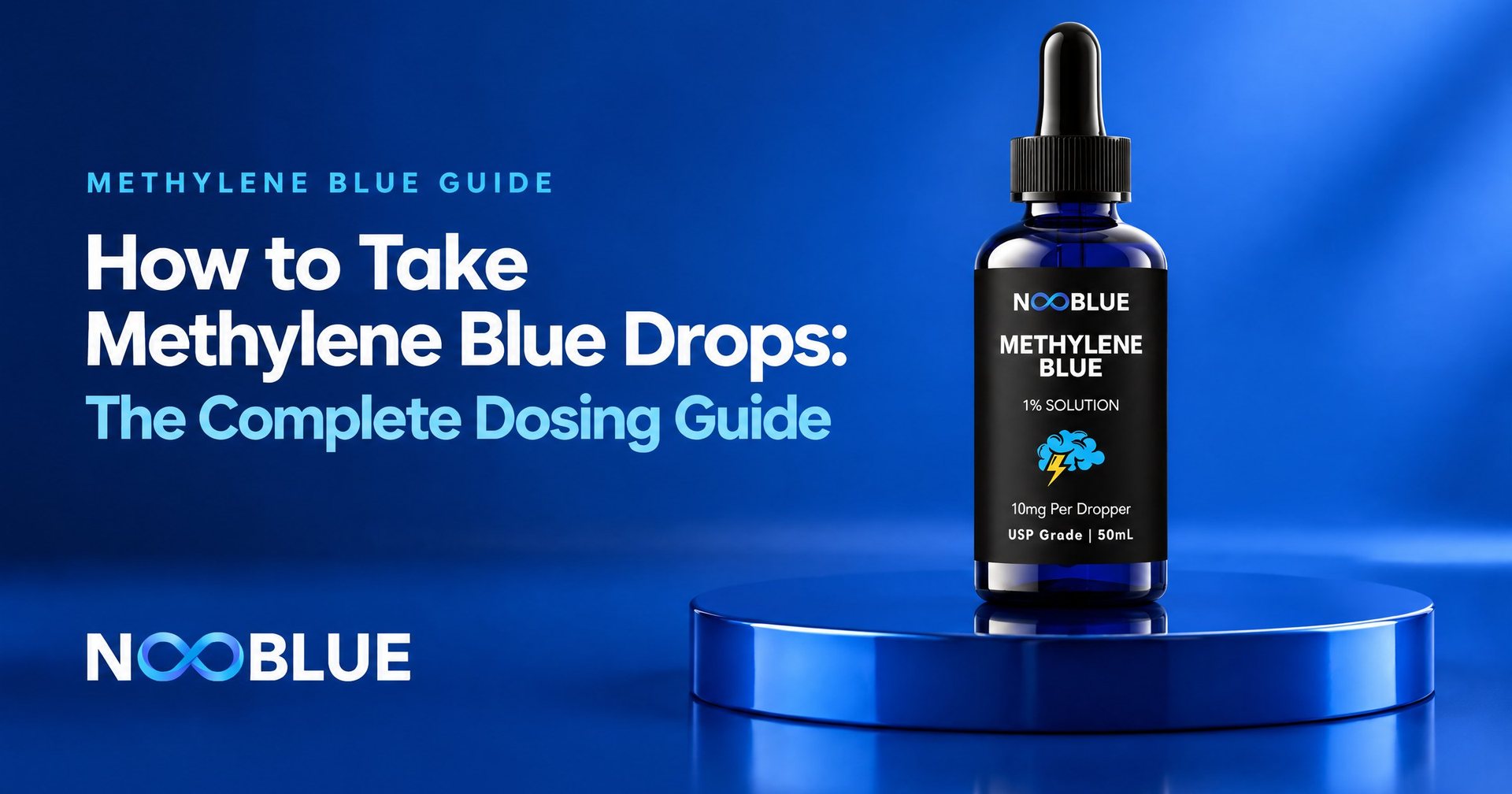
If you have not bought drops yet, our pick is NooBlue Methylene Blue Drops: a 1% USP grade solution in distilled water, 0.5 mg per drop and 10 mg per full dropper, with about 100 servings of 5 mg in a 50 mL bottle for $29.99.
NooBlue makes these drops. Every step below works the same with any brand once you know its strength.
Written by the NooBlue editorial team. We make and sell methylene blue drops, capsules and gummies at nooblue.com. Figures about other brands come from their own product pages, read in September 2026. Research and safety figures come from peer-reviewed studies and prescribing labels listed at the end.
Methylene blue drops are the most flexible way to take methylene blue and the easiest to get wrong. The bottle is small, the liquid is a strong dye, and the strength varies by brand, from 0.5% to 5%. A dose that is sensible from one bottle can be ten times too much from another. Most mistakes come from not knowing how much is in a drop.
This guide covers the arithmetic first, then the practical steps: how much to start with, how to measure and mix it, when to take it, what never to combine it with, and what to expect. It also answers the questions people ask most, including whether you can take drops every day and why some people feel odd after a dose.
Table of contents
- 1. Step Zero: Check the Strength of Your Bottle
- 2. How Many Drops Is One Dose?
- 3. Methylene Blue Drops Dosage Chart (1% Solution)
- 4. What Dose to Start With
- 5. How to Take Methylene Blue Drops, Step by Step
- 6. When to Take It
- 7. Under the Tongue or in Water?
- 8. What Not to Mix With Methylene Blue
- 9. Can You Take Methylene Blue Every Day?
- 10. Why Some People Feel Good, or Weird, After a Dose
- 11. Storage, Stains and Drug Tests
- 12. Drops, Capsules or Gummies
- 13. Frequently Asked Questions
- 13.1. How many drops of 1% methylene blue equal 1 mg?
- 13.2. How much methylene blue should I take as a beginner?
- 13.3. Can I take methylene blue drops every day?
- 13.4. Why does my tongue turn blue, and how do I stop it?
- 13.5. Will methylene blue show up on a drug test?
- 13.6. What should you not mix with methylene blue?
- 13.7. What should I do if I take too much?
- 13.8. Can you take methylene blue drops under the tongue?
- 13.9. How long does a bottle of methylene blue drops last?
- 14. Putting It Together
- 15. Sources
- 16. Explore this topic in depth
Step Zero: Check the Strength of Your Bottle
Methylene blue drops are methylene blue dissolved in water. The percentage on the label tells you how much is in each milliliter: a 1% solution contains 10 mg per mL. Most bottles sold as supplements are 1%, but not all of them, and the difference matters more than anything else in this guide.
| Example bottle | Strength | Methylene blue per drop (brand’s figure) | Drops for about 5 mg |
|---|---|---|---|
| Meraki Blu, 30 mL | 0.5% (150 mg in 30 mL) | About 0.25 mg | 20 |
| NooBlue Methylene Blue Drops, 50 mL | 1% | 0.5 mg | 10 |
| Nutricel Blue Liquid, 118 mL | 1% | About 0.5 mg | 10 |
| Nootlyn drops, 120 mL | 5% | About 2.5 mg | 2 |
Look at the last row. One drop of a 5% solution holds about as much as five drops of a 1% solution, and the same “start with 10 drops” advice would give 25 mg instead of 5 mg. If your label does not state the strength, or you cannot tell whether it is sold for people, do not use it.
Grade matters as much as strength. Methylene blue is also sold as an aquarium product and as a laboratory reagent. Kordon’s aquarium methylene blue, for example, says it is not intended for human consumption. Buy a product sold for people, labeled USP grade, with a certificate you can read. Our guides to methylene blue drops, food grade methylene blue and methylene blue purity explain what to look for.
How Many Drops Is One Dose?
A drop is not a fixed unit. Its size depends on the dropper tip, the liquid and the angle you hold the bottle. The usual convention is 20 drops to a milliliter, so each drop is about 0.05 mL. Nutricel’s own reference table puts one drop at about 50 microliters and says drop volume varies by about 10% with viscosity and dropper angle.
For a 1% solution, that convention gives these numbers, which match the figures on our drops page:
- 1 drop is about 0.5 mg
- 5 drops are about 2.5 mg
- 10 drops are about 5 mg
- 20 drops, or one full 1 mL dropper, are about 10 mg
If you want to check your own dropper, count how many drops it takes to fill 1 mL of an oral syringe. If it takes 20, the numbers above hold. If it takes 25, each drop is smaller, and you can adjust. Do it once and write the result on the box.
For a 0.5% solution, halve every figure above. For a 2% solution, double it. For 5%, multiply by five, and consider whether a bottle that strong is the right tool for small daily doses at all.
Methylene Blue Drops Dosage Chart (1% Solution)
Every row assumes a 1% solution and about 20 drops per mL. It covers the range most supplement users stay in.
| Methylene blue | Drops of 1% | Volume | Where it fits |
|---|---|---|---|
| 1 mg | 2 drops | 0.1 mL | A very cautious first day |
| 2.5 mg | 5 drops | 0.25 mL | A gentle first week |
| 5 mg | 10 drops | 0.5 mL | Our suggested starting dose, the same as one NooBlue capsule |
| 10 mg | 20 drops | 1 mL (one full dropper) | After two weeks at 5 mg, if you want to try more |
We stop the chart at 10 mg on purpose. Higher amounts exist in medicine and research, but they are given under supervision. Healthspan, a telehealth service that prescribes methylene blue, describes a typical plan that starts around 5 mg and rises gradually to a maximum of about 25 mg a day, with clinical support along the way. If you want to go beyond 10 mg, do it with a clinician.
What Dose to Start With
There is no official daily dose of methylene blue as a supplement. What we know comes from medical use, a few research studies and the way the compound behaves.
- Medical use. The injectable hospital form is given at 1 mg/kg into a vein for a blood disorder, which is about 70 mg for a 70 kg adult, under monitoring.
- Research use. The best-known human brain study, published in Radiology in 2016, gave 26 healthy adults a single oral dose of 280 mg, about 4 mg/kg, or a placebo. It found more brain activity during attention and memory tasks and a 7% increase in correct memory-retrieval responses. That one dose equals 560 drops of a 1% solution.
- Dose response. A 2012 review in Progress in Neurobiology by Rojas, Bruchey and Gonzalez-Lima described methylene blue’s dose response as hormetic, with opposite effects at low and high doses. More is not better.
Nobody has studied daily supplement doses of 5 to 10 mg in healthy adults, so the sensible approach is conservative. Start with 10 drops (5 mg) of a 1% solution once a day, or 5 drops (2.5 mg) if you want to be extra careful. Stay there for two weeks. If you notice nothing unwanted and want to try more, move to 20 drops (10 mg). Our guide to how many mg of methylene blue per day goes into the reasoning.
How to Take Methylene Blue Drops, Step by Step
- Read the label. Confirm the strength, the grade and the brand’s directions. If they differ from this guide, follow the label and ask a pharmacist about the difference.
- Get a glass of water or juice ready. Our drops page says the drops can be taken directly or mixed into water or juice, and mixing is the easier route for most people. A small glass is enough. The liquid will turn blue.
- Measure with the dropper held upright. Squeeze the bulb gently and let the drops fall one at a time into the glass, counting as you go. If you lose count, pour it away and start again rather than guessing.
- Drink it. Some people use a straw to keep the blue liquid off their front teeth. How much color the mouth picks up varies from person to person.
- Rinse your mouth with plain water. A quick rinse clears most of the dye that is left.
- Close the bottle and wipe the dropper. Our drops page warns that methylene blue can stain skin, fabric and surfaces, so handle the pipette with care and clean spills promptly.
- Expect blue or green urine. This is the dye leaving your body. In the 2016 trial, every participant who took methylene blue reported blue urine afterwards.
That is the whole routine. The only other habit worth keeping is a short note of the dose, the time and anything you noticed, so that you can judge the two-week trial fairly. Our page on whether methylene blue stains your teeth has more on keeping the color off your smile.
When to Take It
Take methylene blue drops in the morning or early afternoon. Nutricel’s product pages warn that taking methylene blue in the evening may affect sleep, and our own product pages suggest the morning or early afternoon for our capsules. A consistent time each day also makes it easier to judge whether it is doing anything.
With or without food is up to you. If a dose on an empty stomach leaves you queasy, take it with breakfast. Our guides to the best time to take methylene blue and morning or night dosing go into timing in more detail, and our page on methylene blue and coffee covers the morning cup.
Under the Tongue or in Water?
Some protocols tell you to hold the drops under your tongue for faster absorption. There is little reason to. Methylene blue swallowed in water is absorbed well: in a 2009 study in the European Journal of Clinical Pharmacology, Walter-Sack and colleagues gave 16 healthy volunteers an aqueous oral dose and an intravenous dose on separate occasions, and calculated an absolute oral bioavailability of 72.3%, which the authors called high. An earlier study by Peter and colleagues, published in the same journal in 2000, gave seven volunteers 100 mg by mouth and by vein and measured much lower whole-blood exposure after the oral dose, so estimates of oral absorption vary. Neither study tested holding drops under the tongue. Doing that gives concentrated dye the most contact with your mouth, which is where the staining happens.
Mixing the drops into water and swallowing them is simpler, cleaner and well supported. Our comparison of methylene blue bioavailability in liquid vs capsules looks at the absorption data side by side.
What Not to Mix With Methylene Blue
Methylene blue is a potent, reversible inhibitor of the enzyme MAO-A, which breaks down serotonin. Ramsay, Dunford and Gillman showed this with purified human enzyme in 2007. That property drives most of the rules below.
- Serotonergic medicines. The label for injectable methylene blue opens with a boxed warning about serious or fatal serotonin syndrome when it is used with serotonergic drugs and opioids, and tells prescribers to avoid SSRIs, SNRIs and MAOIs. A 2010 systematic review in Psychosomatics by Ng and Cameron found 26 patients who developed an acute confusional state after a methylene blue infusion, and 24 of them were taking a serotonin reuptake inhibitor.
- Serotonergic supplements. 5-HTP is a direct serotonin precursor, and the Adderall label names tryptophan and St. John’s wort among the serotonergic drugs in its serotonin syndrome warning. Keep all three away from methylene blue.
- Stimulant ADHD medicines and atomoxetine. The Adderall, Vyvanse and Strattera labels contraindicate MAO inhibitors and name intravenous methylene blue, and the Ritalin label contraindicates MAO inhibitors because of the risk of hypertensive crises. Do not add methylene blue to these medicines unless your prescriber approves it. Our guide to methylene blue vs Adderall explains the interaction.
- Some antihistamines. Nutricel’s pages warn that methylene blue interacts with common allergy medicines such as Benadryl (diphenhydramine). Ask a pharmacist before combining them.
The same injectable label lists G6PD deficiency as a contraindication because of the risk of hemolytic anemia, says methylene blue may cause fetal harm, and advises stopping breastfeeding for up to 8 days after treatment. Do not take methylene blue drops if any of these applies to you, and do not give them to children. Several brands, including Meraki and Nutricel, say their drops are not for anyone under 18 or not for children. Our guides to what not to take with methylene blue and who should not take methylene blue list every exclusion.
For pairings with other supplements, such as vitamin C, creatine or CoQ10, see our guide to the best methylene blue stacks, and our comparison of methylene blue vs CoQ10.
Can You Take Methylene Blue Every Day?
Many people take small doses daily, and the brands that sell drops describe daily use. What is missing is a long-term trial of daily supplement doses in healthy adults. The human studies mostly used single doses, so nobody can say from trial data what months of daily use at 5 or 10 mg does.
In practice, that argues for a few simple habits. Use the lowest dose that does something for you. Keep a note of how you feel. Take a break if you are unsure whether it is still helping, and tell your doctor you take it, especially before any new prescription. Online advice to cycle “five days on, two days off” is a guess; we found no study that tested it. Our guide to whether methylene blue is safe to take daily covers the question in more depth.
Why Some People Feel Good, or Weird, After a Dose
People describe methylene blue in very different ways, and the research cannot settle why. The controlled human trials measured brain scans and test scores after a large single dose, not mood or energy at supplement doses. At 5 or 10 mg, a good feeling may be a real effect, expectation, or a better night’s sleep that happened to coincide. A careful two-week trial is the only way to judge it for yourself.
Feeling odd has more common explanations. The first is dose: a strong bottle misread, or a jump straight to a high amount. Among the most common reactions reported with the injectable form are headache and nausea. The second is timing, since a late dose can cost you sleep. The third is the one to take seriously. If you feel agitated or confused, or notice a racing heart, sweating, tremor or a high temperature, the injectable label lists these among the signs of serotonin syndrome. Stop, check every medicine and supplement you take against the list above, and get medical help straight away. Our guide to methylene blue side effects covers the rest.
Storage, Stains and Drug Tests
Storage. Our drops page says to keep the bottle tightly closed, away from heat and sunlight. Keep it where children cannot reach it. Our guide to methylene blue shelf life explains how long a bottle keeps and what to check.
Stains. Methylene blue is a dye. It can stain skin, fabric, countertops and grout, so measure over a sink and wipe spills straight away.
Drug tests. Two 2026 case reports in Therapeutic Drug Monitoring described false-positive amphetamine results on urine drug screens after methylene blue. If you are tested at work or in a program, tell the testing service you take it, because confirmation testing can separate the two. The injectable label adds that the dye passes into urine and can interfere with urine tests that use a blue indicator, such as the dipstick test for leukocyte esterase. Our methylene blue drug test guide explains what to expect.
Drops, Capsules or Gummies
Drops are the right format if you want fine control over the dose. If measuring and staining put you off, the same methylene blue comes in fixed doses.
| NooBlue format (prices as of Sep 2026) | Methylene blue | Also contains | Price | Cost per serving |
|---|---|---|---|---|
| Methylene Blue Drops, 1%, 50 mL | 0.5 mg per drop | Distilled water, about 100 servings of 5 mg | $29.99 | $0.30 per 5 mg serving |
| Ultimate Methylene Blue Capsules, 60 | 5 mg per capsule | 10 mg vitamin C | $37.99 | $0.63 per capsule |
| Methylene Blue Gummies, 60 | 10 mg per gummy | 25 mg vitamin C, Wild Blueberry flavor | $49.99 | $0.83 per gummy |
Drops cost the least per milligram and let you move in half-milligram steps. Capsules give a fixed 5 mg with no taste and nothing to measure. Gummies give 10 mg in one chew and don’t leave the blue mouth that drops can. Our comparison of a 1% solution vs 5 mg capsules helps you choose, our guide on how to take methylene blue gummies covers the chewable format, and our roundup of the best methylene blue drops compares liquid brands. You can see all three formats in our shop.
Frequently Asked Questions
How many drops of 1% methylene blue equal 1 mg?
About 2 drops. A 1% solution holds 10 mg per mL, and at about 20 drops per mL each drop carries about 0.5 mg. So 10 drops give about 5 mg and a full 1 mL dropper gives about 10 mg. Drop size varies a little between droppers, so check yours once against a 1 mL oral syringe if you want to be exact.
How much methylene blue should I take as a beginner?
We suggest 10 drops of a 1% solution (about 5 mg) once a day in the morning, or 5 drops (about 2.5 mg) if you want to start even lower. Stay at that dose for two weeks before changing anything. There is no official supplement dose, and nobody has studied daily doses this small in healthy adults, so starting low is the sensible default.
Can I take methylene blue drops every day?
Many people do, but no long-term trial has tested daily supplement doses in healthy adults. Use the lowest dose that helps, keep a short log, take a break if you are unsure it is still doing anything, and tell your doctor you take it. We found no study behind the “five days on, two days off” cycling rules shared online.
Why does my tongue turn blue, and how do I stop it?
Methylene blue is a dye, and some of it sticks to your tongue and teeth while the liquid is in your mouth. Mixing the drops into a glass of water or juice, drinking it (a straw helps some people), and rinsing with plain water afterwards all reduce contact. How much color the mouth picks up varies from person to person. The staining is cosmetic and fades.
Will methylene blue show up on a drug test?
It can cause confusion. Two 2026 case reports described false-positive amphetamine results on urine drug screens after methylene blue, and the dye can also interfere with urine tests that rely on a blue indicator. Tell the testing service you take it, because confirmation testing can separate the two.
What should you not mix with methylene blue?
Do not combine it with SSRIs, SNRIs, MAOIs or other serotonergic medicines, with 5-HTP, tryptophan or St. John’s wort, or with stimulant ADHD medicines or atomoxetine unless your prescriber approves. Ask a pharmacist before combining it with antihistamines such as diphenhydramine. Do not use it with G6PD deficiency, during pregnancy or while breastfeeding.
What should I do if I take too much?
If you took more than you meant to and feel unwell, or if you take any serotonergic medicine, call Poison Control at 1-800-222-1222 or your doctor. Get emergency help for confusion, agitation, a racing heart, a high temperature, stiffness or seizures. If you feel fine, skip your next dose, go back to your usual amount afterwards, and recheck the strength on your label.
Can you take methylene blue drops under the tongue?
You can, but there is little reason to. A 2009 study of 16 healthy volunteers found an absolute oral bioavailability of 72.3% for methylene blue swallowed in water, although an earlier study measured much lower blood levels after an oral dose. No study has shown that holding drops under the tongue works better, and it mainly increases staining.
How long does a bottle of methylene blue drops last?
It depends on the bottle size and your dose. A 50 mL bottle of NooBlue’s 1% drops holds about 100 servings of 5 mg, so at 10 drops a day it lasts a little over three months. At 20 drops a day, it lasts about half that.
Putting It Together
Taking methylene blue drops well comes down to a few habits. Know the strength of your bottle. Count your drops into water or juice. Start at 5 mg or less, in the morning, and give it two weeks before you change anything. Keep it away from serotonergic medicines and supplements, and skip it entirely with G6PD deficiency, pregnancy or breastfeeding. The rest is handling a dye carefully.
If you want a bottle that makes the arithmetic easy, our pick is NooBlue Methylene Blue Drops, which we make: 1% USP grade methylene blue in distilled water, 0.5 mg per drop, $29.99 for 50 mL. For more on the subject, see our guides to how methylene blue works, methylene blue powder vs liquid and methylene blue interactions.
Sources
- Walter-Sack I, Rengelshausen J, Oberwittler H, et al. High absolute bioavailability of methylene blue given as an aqueous oral formulation. European Journal of Clinical Pharmacology. 2009;65(2):179-189. PubMed 18810398.
- Peter C, Hongwan D, Küpfer A, Lauterburg BH. Pharmacokinetics and organ distribution of intravenous and oral methylene blue. European Journal of Clinical Pharmacology. 2000;56(3):247-250. PubMed 10952480.
- Rodriguez P, Zhou W, Barrett DW, et al. Multimodal randomized functional MR imaging of the effects of methylene blue in the human brain. Radiology. 2016;281(2):516-526. PubMed 27351678; full text.
- Rojas JC, Bruchey AK, Gonzalez-Lima F. Neurometabolic mechanisms for memory enhancement and neuroprotection of methylene blue. Progress in Neurobiology. 2012;96(1):32-45. PubMed 22067440.
- Ramsay RR, Dunford C, Gillman PK. Methylene blue and serotonin toxicity: inhibition of monoamine oxidase A (MAO A) confirms a theoretical prediction. British Journal of Pharmacology. 2007;152(6):946-951. PubMed 17721552.
- Ng BK, Cameron AJ. The role of methylene blue in serotonin syndrome: a systematic review. Psychosomatics. 2010;51(3):194-200. PubMed 20484716.
- Leegwater E, Jager NGL. Methylene blue-induced false-positive amphetamine results in urine drug screening: two case reports. Therapeutic Drug Monitoring. 2026;48(2):280-281. PubMed 41058025.
- ProvayBlue (methylene blue injection) prescribing information. DailyMed.
- Prescribing information for Adderall, Vyvanse, Ritalin and Strattera (DailyMed).
- Product and service pages read in September 2026: Nutricel Blue Liquid, Meraki Blu, Nootlyn 5% drops, Kordon Methylene Blue, Healthspan; NooBlue drops, capsules and gummies.