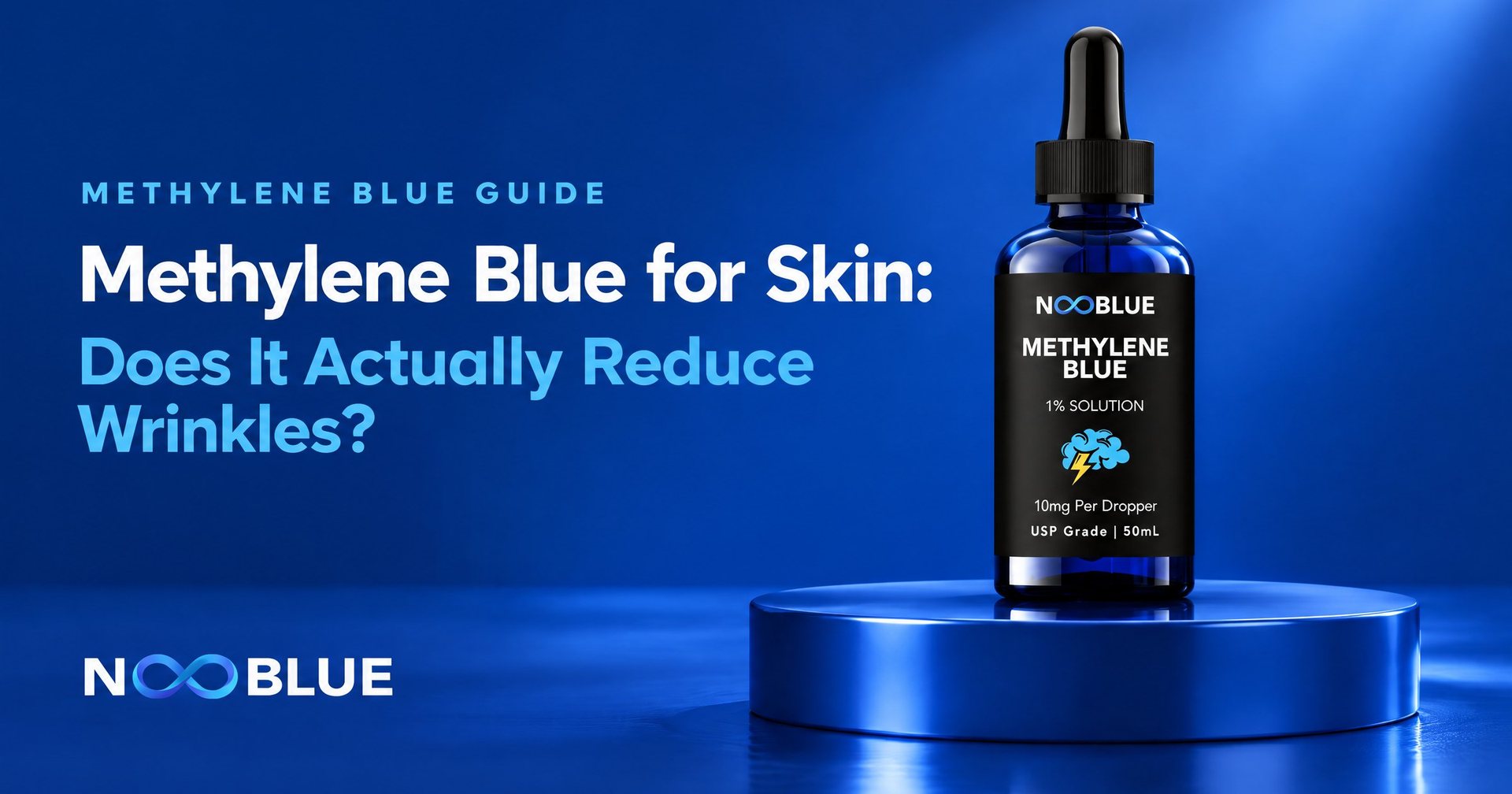
Methylene blue for skin is still a lab-stage idea. No human trial has measured whether methylene blue reduces wrinkles, whether it is applied as a cream or taken by mouth. What exists is a 2017 study on skin cells and lab-grown skin tissue, a 2021 follow-up on UV light, and skincare products built on that work. This guide explains what those studies found, what they cannot tell you, how methylene blue compares with retinol, and what to know before putting it on your skin or taking it as a supplement.
Table of contents
- 1. The short answer
- 2. What the 2017 skin study did
- 3. What this evidence can and cannot tell you
- 4. The UV light study
- 5. Topical vs oral methylene blue for skin
- 6. Methylene blue vs retinol
- 7. Safety if you take methylene blue by mouth
- 8. Frequently asked questions
- 8.1. Does methylene blue actually reduce wrinkles?
- 8.2. Can I put methylene blue on my skin?
- 8.3. Is methylene blue better than retinol?
- 8.4. Can methylene blue make you look younger?
- 8.5. Does taking methylene blue by mouth help your skin?
- 8.6. Will methylene blue stain my skin?
- 8.7. Why don’t doctors recommend methylene blue?
- 9. Sources
The short answer
- No wrinkle data in people. We found no published trial that measured wrinkles in humans using methylene blue, topical or oral.
- The evidence is from the lab. A 2017 University of Maryland study found that methylene blue lowered mitochondrial oxidative stress in cultured skin cells more than three other antioxidants, and thickened the dermis layer of lab-grown skin tissue.
- The researcher has a commercial interest. The senior author, Kan Cao, founded Mblue Labs, a skincare company, in 2018, and later papers from the lab declare it.
- It stains. In the same study, lab-grown skin turned blue within 3 days at the higher concentrations tested.
- Retinol has more proof. Topical retinol has a randomized, placebo-controlled human trial showing fewer fine wrinkles. Methylene blue does not.
- NooBlue products are oral supplements, not skin products. We make no skin or wrinkle claims for them.
NooBlue makes methylene blue in three oral formats for a daily routine. If that is what you came for, you can compare them here. If you came for skincare, the sections below cover what is known.
What the 2017 skin study did
Xiong and colleagues, working in Kan Cao’s lab at the University of Maryland, published “Anti-Aging Potentials of Methylene Blue for Human Skin Longevity” in Scientific Reports in 2017. It had two parts.
Skin cells in a dish
The team grew fibroblasts, the cells that make collagen and elastin, from a healthy middle-aged donor and from people with a rare premature-aging disorder. For four weeks they treated the cells with methylene blue at 100 nM or with one of three other antioxidants: N-acetylcysteine (NAC) at 100 µM, MitoQ at 100 nM and MitoTEMPO at 100 nM.
- Methylene blue lowered mitochondrial reactive oxygen species (ROS) the most of the four and helped the cells keep dividing.
- NAC showed no benefit over that long treatment period.
- MitoQ at 100 nM raised mitochondrial ROS instead of lowering it. The authors suggest the longer treatment time may explain why their result differs from earlier reports.
- In a scratch test, fibroblasts from a middle-aged donor and from an 84-year-old donor refilled the scratched area faster with methylene blue than without it.
Note that vitamin C was not one of the comparison antioxidants, despite claims you may see elsewhere.
Lab-grown skin tissue
The team then used two reconstructed human skin models from MatTek: an epidermis model for an irritation test and a full-thickness model with both epidermis and dermis.
- Short contact: methylene blue from 0.2 µM to 500 µM applied to the surface for 60 minutes did not significantly reduce tissue viability, so it passed the standard irritation test.
- Two weeks of exposure: when methylene blue was added to the culture medium for two weeks, tissue at 5.0 µM and above turned blue after 3 days, and viability dropped at 5.0 and 10.0 µM. Tissue at 0.1 to 2.5 µM did not change color.
- Thicker dermis and more water: at the lower concentrations the dermis layer was thicker than in untreated tissue, with the biggest increase at 0.5 µM, and the tissue held more water.
- Gene activity: methylene blue changed the expression of several skin-structure proteins, including higher elastin and collagen 2A1.
What this evidence can and cannot tell you
These are useful early findings, but they sit a long way from a visible change in a face.
- No people, no wrinkles. Every result came from cells or lab-grown tissue. Nobody measured wrinkle depth, elasticity or appearance in a volunteer.
- The delivery was not a cream. In the thickness and hydration experiments, methylene blue was mixed into the nutrient medium the tissue sat in, not rubbed onto the surface as a product would be.
- The useful range was narrow. The same study found staining and lower viability at concentrations only a few times higher than the ones that helped.
- One lab, with a commercial link. The 2017 paper declared no competing interests. Kan Cao founded Mblue Labs in 2018, and the lab’s 2021 review in Cells and its 2021 UV study both disclose that link.
The 2021 review describes how methylene blue can carry electrons around blocked points (Complex I and III) in the mitochondrial electron transport chain, which is the proposed reason it lowers oxidative stress. That mechanism is well described in cells. Whether a skincare product delivers enough methylene blue to the right skin layer to matter is the open question.
The UV light study
In 2021 the same group reported in Scientific Reports that methylene blue absorbed UVB light and reduced UVB-induced DNA damage in cultured human skin cells (keratinocytes) more than oxybenzone, a common sunscreen ingredient, at the same concentrations. Unlike oxybenzone, it did not affect the growth of a coral species in seawater tests. The paper discloses that the University of Maryland and Mblue Labs filed a joint patent application for methylene blue as a sunscreen ingredient.
This was cell and coral work only. Keep using the sunscreen you already trust. Methylene blue also interacts with light in the other direction: the prescribing information for the injectable hospital product warns that phototoxicity may occur after a dose and advises protection from light. That warning is about intravenous doses, but it is a reminder that methylene blue and light are not a simple story.
Topical vs oral methylene blue for skin
On the skin
Creams and serums containing methylene blue are sold for cosmetic use. NooBlue does not make them. If you try one:
- Patch test on a small area first.
- Expect possible blue tinting. The 2017 study showed that the gap between a helpful concentration and a staining one is small.
- Do not make your own skin product from oral drops, aquarium solution or powder. The concentration is uncontrolled, the staining can be heavy, and aquarium and lab products are not made for use on or in people.
Our 1% methylene blue drops are for oral use, mixed into water or juice. As the product page says, the liquid can stain skin, fabric and surfaces, so handle the dropper carefully.
By mouth
We found no study of oral methylene blue and skin. Nobody knows how much of a 5 or 10 mg oral serving reaches the dermis, or whether it changes how skin looks. Some articles say oral use supports skin through the mitochondria. That is a guess built on cell data, not a finding, and we do not make that claim for our methylene blue capsules or methylene blue gummies. For the wider picture on aging research, see what the evidence says about methylene blue and aging, and for how the formats differ in absorption, our comparison of methylene blue in liquid and capsule form.
Methylene blue vs retinol
They work differently, but on evidence retinol is well ahead. In a randomized, double-blind, vehicle-controlled trial published in the Archives of Dermatology in 2007, 36 older adults (mean age 87) had 0.4% retinol lotion applied to one arm and a plain lotion to the other, up to three times a week for 24 weeks. Fine wrinkling improved significantly on the retinol side, and biopsies showed more procollagen and glycosaminoglycans.
Methylene blue has no comparable trial. It may turn out to have a place in skincare, particularly for people who find retinoids irritating, but that has not been tested in people yet. If wrinkles are your main concern, a dermatologist can advise on options with human trial data behind them.
Safety if you take methylene blue by mouth
- Do not take it with an SSRI, SNRI, MAOI or any other serotonergic medicine, because of the risk of serotonin syndrome. Our guide to methylene blue and serotonin syndrome explains why.
- Do not take it if you have G6PD deficiency.
- It is not for use during pregnancy or while breastfeeding.
- It is not for anyone under 18.
Methylene blue can color urine blue or green. Talk to your doctor before use if you take any prescription medicine or have a kidney or liver condition. Our overview of methylene blue side effects and the list of what not to take with methylene blue cover the details.
If you do take it, follow the label: one 5 mg capsule daily with food, one 10 mg gummy daily, or the drops measured at 0.5 mg per drop. Do not exceed the suggested serving. Our guide to how many mg of methylene blue per day covers dose. For how our formats compare with other brands, see our methylene blue supplements comparison, or browse the NooBlue shop.
Frequently asked questions
Does methylene blue actually reduce wrinkles?
There is no human evidence that it does. The 2017 study found less oxidative stress in skin cells and a thicker dermis layer in lab-grown skin tissue, but nobody has measured wrinkles in people using methylene blue, whether applied to the skin or taken by mouth.
Can I put methylene blue on my skin?
Cosmetic products containing it are sold, and in the lab it passed a short irritation test. It can stain, though: lab-grown skin turned blue at higher concentrations within 3 days. Use a product made for skin, patch test first, and do not apply oral drops, aquarium solution or powder to your skin.
Is methylene blue better than retinol?
Not on current evidence. Retinol has a randomized human trial in which 0.4% retinol lotion improved fine wrinkles over 24 weeks. Methylene blue has only cell and lab-tissue data, so there is no basis for saying it works better.
Can methylene blue make you look younger?
That has not been shown. The skin findings come from cells and lab-grown tissue, from a lab whose senior author founded a skincare company. Treat product claims about visible results with caution until human trials are published.
Does taking methylene blue by mouth help your skin?
No study has looked at it. We do not know how much of an oral serving reaches the skin, and we make no skin claims for NooBlue capsules, gummies or drops.
Will methylene blue stain my skin?
Liquid methylene blue can stain skin, fabric and surfaces, and drops can tint the mouth and tongue. Capsules are swallowed whole, and NooBlue gummies don’t leave a blue mouth or tongue. Any format can turn urine blue or green.
Why don’t doctors recommend methylene blue?
Its established medical uses are in hospital settings. Harvard Health Publishing points out that a drug working in a specific clinical setting does not mean the general population should take it, and it warns about the dangerous interaction with antidepressants such as fluoxetine and duloxetine. For skin, there is also no human trial evidence yet.
Sources
- Xiong ZM, O’Donovan M, Sun L, Choi JY, Ren M, Cao K. Anti-Aging Potentials of Methylene Blue for Human Skin Longevity. Scientific Reports. 2017;7(1):2475. PubMed 28559565
- Xue H, Thaivalappil A, Cao K. The Potentials of Methylene Blue as an Anti-Aging Drug. Cells. 2021;10(12):3379. PubMed 34943887
- Xiong ZM, Mao X, Trappio M, Arya C, El Kordi J, Cao K. Ultraviolet radiation protection potentials of Methylene Blue for human skin and coral reef health. Scientific Reports. 2021;11(1):10871. PubMed 34050204
- Kafi R, Kwak HS, Schumacher WE, et al. Improvement of naturally aged skin with vitamin A (retinol). Archives of Dermatology. 2007;143(5):606-612. PubMed 17515510
- The Age of Skin. Terp magazine, University of Maryland, 2025. terp.umd.edu
- ProvayBlue (methylene blue) injection, prescribing information. DailyMed
- Goldman L. What to know about methylene blue. Harvard Health Publishing, 2025. health.harvard.edu