Methylene blue for energy is built on a real mechanism with thin human evidence behind it. In cells, methylene blue can carry electrons inside mitochondria, the structures that make ATP, the cell’s energy currency. In people, the published studies are small, used single doses far above supplement servings, and measured memory and brain activity rather than energy or fatigue. One 2023 study even found that intravenous methylene blue lowered brain blood flow and oxygen use in healthy volunteers. This guide explains how it works, what the research does and does not show, how it compares with stimulants, and how to take it safely at label servings.
Table of contents
- 1. The short answer
- 2. How methylene blue works in mitochondria
- 3. What the human research shows
- 4. Is methylene blue a stimulant?
- 5. How to take methylene blue if you want to try it
- 6. Side effects and safety
- 7. Frequently asked questions
- 7.1. Does methylene blue give you more energy?
- 7.2. Does methylene blue boost dopamine?
- 7.3. Does methylene blue act as a stimulant?
- 7.4. Is it true that methylene blue makes you look younger?
- 7.5. How quickly does methylene blue work for energy?
- 7.6. Can I take methylene blue every day?
- 7.7. What is the best form of methylene blue for energy?
- 7.8. Can I take methylene blue with coffee?
- 7.9. Why do I feel tired after taking methylene blue?
- 8. Sources
The short answer
- How it might work: methylene blue can pass electrons from NADH straight to cytochrome c, bypassing parts of the mitochondrial electron transport chain. That is well described in cells and animals.
- What human studies show: small trials with single large doses found better scores on memory tasks. No trial has measured energy or tiredness at 5 to 10 mg supplement servings.
- A result that cuts the other way: in 2023, researchers expected intravenous methylene blue to raise brain energy use in healthy adults and found it lowered it.
- It is not a stimulant, but it interacts with them. It is a potent MAO-A inhibitor, which is why it must never be combined with serotonergic medicines, and why the Adderall label warns against combining the two.
- If you try it: follow the label serving, take it in the morning, and give it a week at the same amount.
How methylene blue works in mitochondria
Inside mitochondria, electrons from food pass down a chain of protein complexes (I to IV). Each step helps pump protons that drive ATP synthase, the enzyme that makes ATP. When the chain slows, ATP output drops and more reactive oxygen species leak out.
Methylene blue can cycle between an oxidized form and a reduced form, leucomethylene blue. A 2018 review in Molecular Neurobiology by Tucker, Lu and Zhang describes how it can reroute electrons directly from NADH to cytochrome c, increasing complex IV activity and effectively bypassing complexes I and III. The 2017 University of Maryland skin study described the same cycle: methylene blue is reduced by complex I and reoxidized by cytochrome c. Gonzalez-Lima and colleagues, in a 2014 Biochemical Pharmacology review, described low-dose USP methylene blue as a pharmacological way to increase mitochondrial respiration.
That is the case for methylene blue and energy: a second route for electrons when the normal chain is struggling. Our article on how methylene blue works goes deeper into the chemistry, and our comparison of methylene blue and CoQ10 sets it beside another mitochondrial supplement.
What the human research shows
Most of the evidence comes from cells and animals. The human studies are few and small, and none measured energy or fatigue directly.
| Study | Who and what dose | What it found |
|---|---|---|
| Telch et al., 2014, American Journal of Psychiatry | 42 adults with a marked fear of enclosed spaces: 260 mg methylene blue (23) or placebo (19), once, after an exposure session | Better contextual memory a month later with methylene blue. Fear results depended on how the session went, and some people did worse. |
| Rodriguez et al., 2016, Radiology | 26 healthy adults aged 22 to 62, a single low oral dose or placebo, brain scan 1 hour later | More brain activity during attention and short-term memory tasks, and 7% more correct answers in memory retrieval. |
| Singh et al., 2023, Journal of Cerebral Blood Flow and Metabolism | Healthy volunteers and rats, two intravenous doses | Lower global brain blood flow and lower brain oxygen use, the opposite of what the researchers predicted. They suggested the doses may have been above the range where methylene blue helps. |
Harvard Health Publishing pointed to the 2023 result when it questioned claims about methylene blue for brainpower. The authors themselves noted that healthy brains with normal metabolism may leave little room to improve. Taken together, the studies show that methylene blue does change brain activity in people. They do not show that a 5 or 10 mg daily serving makes you feel more energetic, and nobody has run that trial yet.
A trial that could settle the question would give 5 or 10 mg a day for several weeks against a placebo and measure tiredness, sleep and task performance. Until one is published, treat energy claims for methylene blue, including any you read on supplement pages, as unproven.
Many people who take methylene blue describe steadier focus or less of an afternoon slump. Those are personal reports, not trial results, and expectation plays a large part in how any supplement feels.
Is methylene blue a stimulant?
It is not classed as a stimulant. Caffeine blocks adenosine receptors, and amphetamines push the release of dopamine and norepinephrine. Methylene blue works on the electron transport chain and, separately, inhibits monoamine oxidase A (MAO-A), an enzyme that breaks down serotonin and other monoamines. Lab work by Ramsay and colleagues in 2007 found it to be a potent, tight-binding inhibitor of MAO-A and a much weaker inhibitor of MAO-B.
That MAO effect is what makes combinations risky:
- Serotonergic medicines: SSRIs, SNRIs, MAOIs and others can cause serotonin syndrome with methylene blue. See methylene blue and serotonin syndrome.
- Prescription stimulants: the Adderall label lists intravenous methylene blue among the MAOIs it must not be combined with, or taken within 14 days of, because of the risk of a hypertensive crisis. Our comparison of methylene blue vs Adderall covers the differences.
- Caffeine: we found no study of caffeine with methylene blue. If you drink coffee, keep your usual amount steady while you try it, so you can tell the two apart.
Our overview of methylene blue interactions and the list of what not to take with methylene blue cover the rest. If you want energy support without a stimulant, our roundup of supplements for energy and focus without stimulants compares other options.
How to take methylene blue if you want to try it
Stick to the label serving
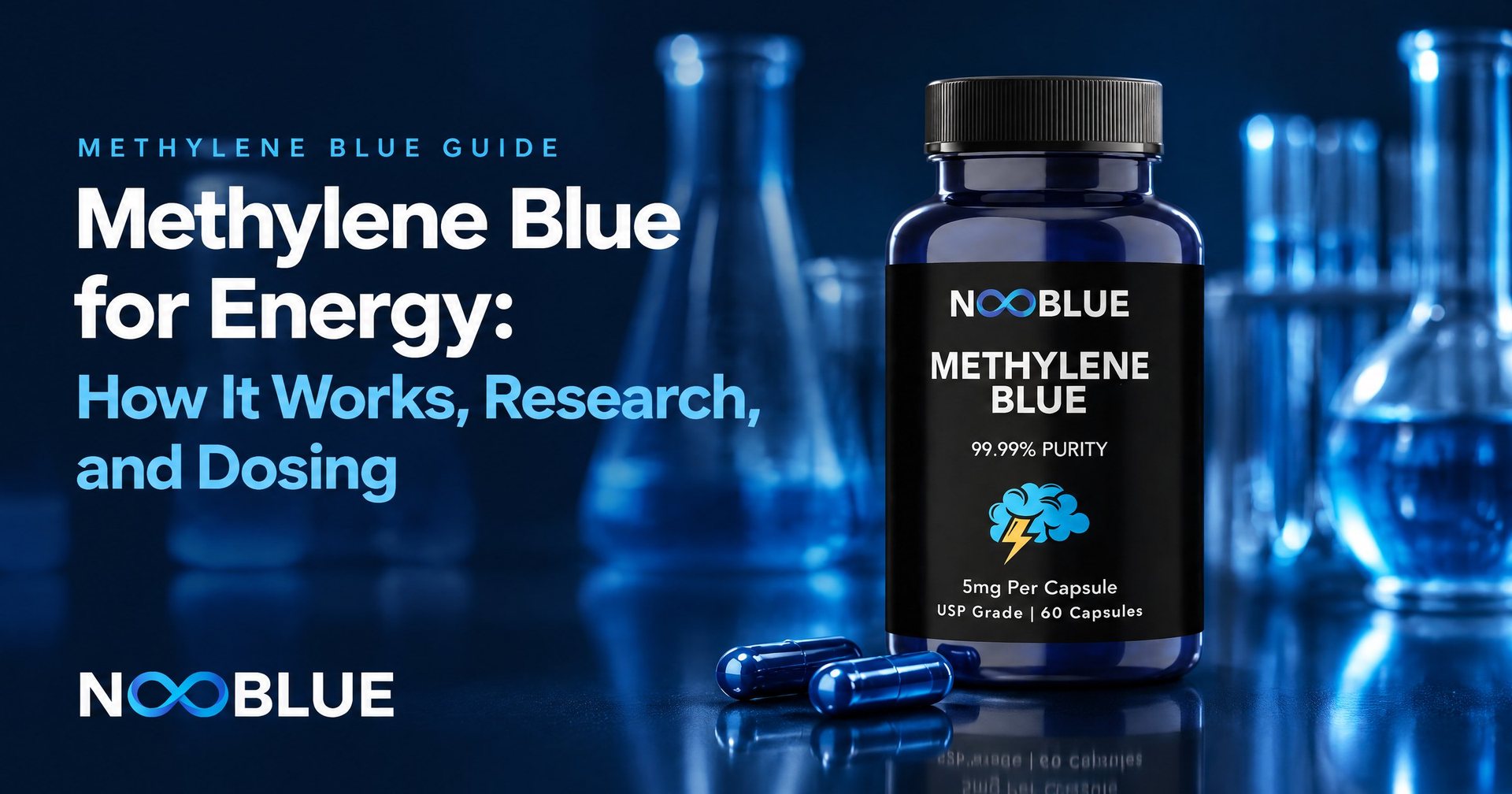
The NooBlue labels are one 5 mg capsule daily with food, one 10 mg gummy daily, or 1% drops measured at 0.5 mg per drop. Do not exceed the suggested serving. More is not better: the 2023 brain study suggests higher amounts can dampen rather than lift metabolism. Our guide to how many mg of methylene blue per day covers servings in more detail.
Take it in the morning
Methylene blue has a half-life of about a day (the injectable prescribing information gives roughly 24 hours), so a morning serving is still circulating in the evening. Taking it early keeps it away from bedtime. Our guide to the methylene blue half-life explains the numbers.
Give it a week
With a half-life near a day, daily servings build to a steady level over about three to five days. Judge it after a week at the same amount, with the same sleep, coffee and exercise habits, and keep brief notes on energy and focus each evening. Our article on how long methylene blue takes to work covers timing.
Pick the format that suits your routine
Capsules give a fixed serving with no taste. Gummies are a single chew and don’t leave a blue mouth. Drops let you measure in small steps but can stain the mouth, so mix them into water or juice. Absorption differences between formats have not been measured head to head at supplement servings. Our comparison of methylene blue in liquid and capsule form covers what is known.
Other things people pair it with
Some people combine methylene blue with light therapy. Gonzalez-Lima’s review describes near-infrared light as acting through similar mitochondrial mechanisms. See methylene blue and red light therapy, and for training, our guide to methylene blue supplements for athletes.
Side effects and safety
- Do not take it with an SSRI, SNRI, MAOI or any other serotonergic medicine, because of the risk of serotonin syndrome.
- Do not take it if you have G6PD deficiency.
- It is not for use during pregnancy or while breastfeeding.
- It is not for anyone under 18.
Methylene blue can color urine blue or green, and drops can stain the mouth. Talk to your doctor before use if you take any prescription medicine or have a kidney or liver condition. Our guides to methylene blue side effects and who should not take methylene blue cover the details. Purity matters too, but it does not change interactions: see our guide to reading a methylene blue certificate of analysis.
NooBlue makes all three formats. You can read more about NooBlue or compare them in the NooBlue shop.
Frequently asked questions
Does methylene blue give you more energy?
It has not been shown in a trial. Methylene blue can support electron flow in mitochondria in lab studies, and small human studies found changes in memory and brain activity after single large doses. No study has measured energy or tiredness at supplement servings, and one 2023 study found that intravenous doses lowered brain energy use in healthy adults.
Does methylene blue boost dopamine?
Not in any study at supplement servings that we found. Methylene blue strongly inhibits MAO-A and only weakly inhibits MAO-B, according to lab work on purified human enzyme. Whether small oral servings change dopamine levels in people has not been measured. The MAO effect is the reason it must not be combined with serotonergic medicines or prescription stimulants.
Does methylene blue act as a stimulant?
It is not classed as one. It works on mitochondria and inhibits MAO-A rather than acting like caffeine or amphetamine. It does interact with stimulants, though: the Adderall label warns against combining them because of the risk of a hypertensive crisis.
Is it true that methylene blue makes you look younger?
That has not been shown in people. The skin findings come from cell cultures and lab-grown skin tissue. Our article on methylene blue for skin covers what those studies found.
How quickly does methylene blue work for energy?
Oral methylene blue peaks in the blood about 2 hours after a dose, and daily servings reach a steady level after about three to five days. Nobody has measured how quickly energy changes at supplement servings, so judge it after a week at the same amount.
Can I take methylene blue every day?
The NooBlue labels are written for one serving a day. Long-term effects of daily supplement servings have not been studied in the papers we reviewed. Follow the label, do not exceed the suggested serving, and check with your doctor if you take any prescription medicine.
What is the best form of methylene blue for energy?
No format has been shown to work better for energy. Capsules give a fixed 5 mg serving with no taste, gummies are a 10 mg chew that doesn’t leave a blue mouth, and 1% drops let you measure in 0.5 mg steps. Choose the one you will take consistently at the label serving.
Can I take methylene blue with coffee?
We found no study of caffeine combined with methylene blue. If you drink coffee, keep your usual amount steady while you try methylene blue so you can tell the two apart, and stop if you feel jittery or your heart races. Prescription stimulants are a different matter: do not combine them with methylene blue without your prescriber’s advice.
Why do I feel tired after taking methylene blue?
There is no research explaining this at supplement servings. Check that you are taking the label serving in the morning and sleeping as usual. If the tiredness continues or you feel unwell, stop and talk to your doctor.
Sources
- Tucker D, Lu Y, Zhang Q. From Mitochondrial Function to Neuroprotection: an Emerging Role for Methylene Blue. Molecular Neurobiology. 2018;55(6):5137-5153. PubMed 28840449
- Gonzalez-Lima F, Barksdale BR, Rojas JC. Mitochondrial respiration as a target for neuroprotection and cognitive enhancement. Biochemical Pharmacology. 2014;88(4):584-593. PubMed 24316434
- Xiong ZM, O’Donovan M, Sun L, et al. Anti-Aging Potentials of Methylene Blue for Human Skin Longevity. Scientific Reports. 2017;7(1):2475. PubMed 28559565
- Telch MJ, Bruchey AK, Rosenfield D, et al. Effects of post-session administration of methylene blue on fear extinction and contextual memory in adults with claustrophobia. American Journal of Psychiatry. 2014;171(10):1091-1098. PubMed 25018057
- Rodriguez P, Zhou W, Barrett DW, et al. Multimodal Randomized Functional MR Imaging of the Effects of Methylene Blue in the Human Brain. Radiology. 2016;281(2):516-526. PubMed 27351678
- Singh N, MacNicol E, DiPasquale O, et al. The effects of acute Methylene Blue administration on cerebral blood flow and metabolism in humans and rats. Journal of Cerebral Blood Flow and Metabolism. 2023;43(2 suppl):95-105. PubMed 36803299
- Ramsay RR, Dunford C, Gillman PK. Methylene blue and serotonin toxicity: inhibition of monoamine oxidase A (MAO A) confirms a theoretical prediction. British Journal of Pharmacology. 2007;152(6):946-951. PubMed 17721552
- Walter-Sack I, Rengelshausen J, Oberwittler H, et al. High absolute bioavailability of methylene blue given as an aqueous oral formulation. European Journal of Clinical Pharmacology. 2009;65(2):179-189. PubMed 18810398
- Adderall (amphetamine mixed salts) prescribing information. DailyMed
- Goldman L. What to know about methylene blue. Harvard Health Publishing, 2025. health.harvard.edu