Key takeaways
- Blue or green urine is the side effect nearly everyone gets. All 13 volunteers given methylene blue in a 2016 brain imaging trial reported it, and none of the 13 on placebo did.
- Nausea, diarrhea, vomiting and headache are the other side effects reference sources list for methylene blue taken by mouth.
- The serious risks depend on your medicines and your blood: serotonin syndrome with SSRIs, SNRIs, MAOIs and other serotonergic medicines, and red blood cell breakdown in people with G6PD deficiency.
- Drops can stain the mouth and tongue. NooBlue gummies don’t leave that blue mouth, though urine can still turn blue or green.
- No published study has tested methylene blue gummies themselves. The human data come from capsules, tablets and IV doses many times larger than a 10 mg gummy.
Methylene blue gummies share the side effects of every other form of methylene blue, because the same molecule ends up in your blood. For most healthy adults that means blue or green urine and, less often, an upset stomach or a headache. The dangerous side effects are predictable: serotonin syndrome in people who take serotonergic medicines, and hemolysis (red blood cells breaking apart) in people with G6PD deficiency. The gummy format raises a few questions of its own, such as mouth staining, sugar and how easy it is to take more than one. This guide covers what the research shows, what study volunteers actually reported, and how to keep your risk low.
NooBlue makes methylene blue gummies, capsules and drops, so we have a stake in this topic. We have put the safety sections first and linked every study we cite. Written by the NooBlue editorial team. This article is general information and does not replace advice from your own doctor.
Table of contents
- 1. Methylene Blue Gummies Side Effects at a Glance
- 2. Who Should Not Take Methylene Blue Gummies
- 3. The Common Side Effects (Mild and Expected)
- 4. What Research and Real Users Report
- 5. The Serious Side Effects You Cannot Ignore
- 6. Side Effects Specific to the Gummy Format
- 7. The Drug Interaction List
- 8. Dosing That Reduces Side Effect Risk
- 9. Choosing a Format for the Cleanest Side Effect Profile
- 10. What to Do If You Experience a Side Effect
- 11. Why Medical Reference Sites List Different Side Effects
- 12. Frequently Asked Questions
- 12.1. Who shouldn’t take methylene blue gummies?
- 12.2. What happens if you take methylene blue every day?
- 12.3. Why do I feel weird after taking methylene blue?
- 12.4. What does methylene blue actually do to your body?
- 12.5. Do methylene blue gummies turn your tongue blue?
- 12.6. How long do side effects last after I stop?
- 12.7. Is blue or green stool dangerous?
- 12.8. Are methylene blue side effects a sign of die-off?
- 13. Sources
Methylene Blue Gummies Side Effects at a Glance
| Side effect | Who gets it | What to do |
|---|---|---|
| Blue or green urine | Nearly everyone, with any format | Nothing. It is expected and fades after you stop. |
| Green or blue stool | Common | Nothing, unless stool is black and tarry. Then see a doctor. |
| Nausea, stomach upset, diarrhea | Some people | Take the gummy with food. Stop if it continues. |
| Headache or dizziness | Some people | Skip a day, then restart with food. Stop if it returns. |
| Blue mouth or tongue | People using drops. NooBlue gummies don’t cause it. | Rinse after drops, or switch format. |
| Serotonin syndrome | People taking SSRIs, SNRIs, MAOIs or other serotonergic medicines | Never combine. Get emergency care if symptoms appear. |
| Hemolysis | People with G6PD deficiency | Do not take methylene blue. |
| Methemoglobinemia | Very high doses | Stay at one gummy a day. |
Who Should Not Take Methylene Blue Gummies
Start here, because these rules matter more than any side effect list. Do not take methylene blue gummies if any of the following applies to you:
- You take an SSRI, SNRI, MAOI or any other serotonergic medicine, including many antidepressants, certain opioid painkillers and the cough suppressant dextromethorphan. The combination can cause serotonin syndrome. Our guide to methylene blue and serotonin syndrome explains the mechanism.
- You have G6PD deficiency. Methylene blue can break down red blood cells in people with this inherited enzyme shortfall. See methylene blue and G6PD deficiency.
- You are pregnant or breastfeeding. StatPearls notes that methylene blue may cause fetal harm when given during pregnancy.
- You are under 18.
Talk to your doctor before you start if you take any prescription medicine, or if you have a kidney or liver condition. Methylene blue can turn urine blue or green with any format, and that is expected. These are the same warnings printed in the “Safety: read before use” box on the NooBlue gummies product page. Our guide to who should not take methylene blue covers each group in more detail.
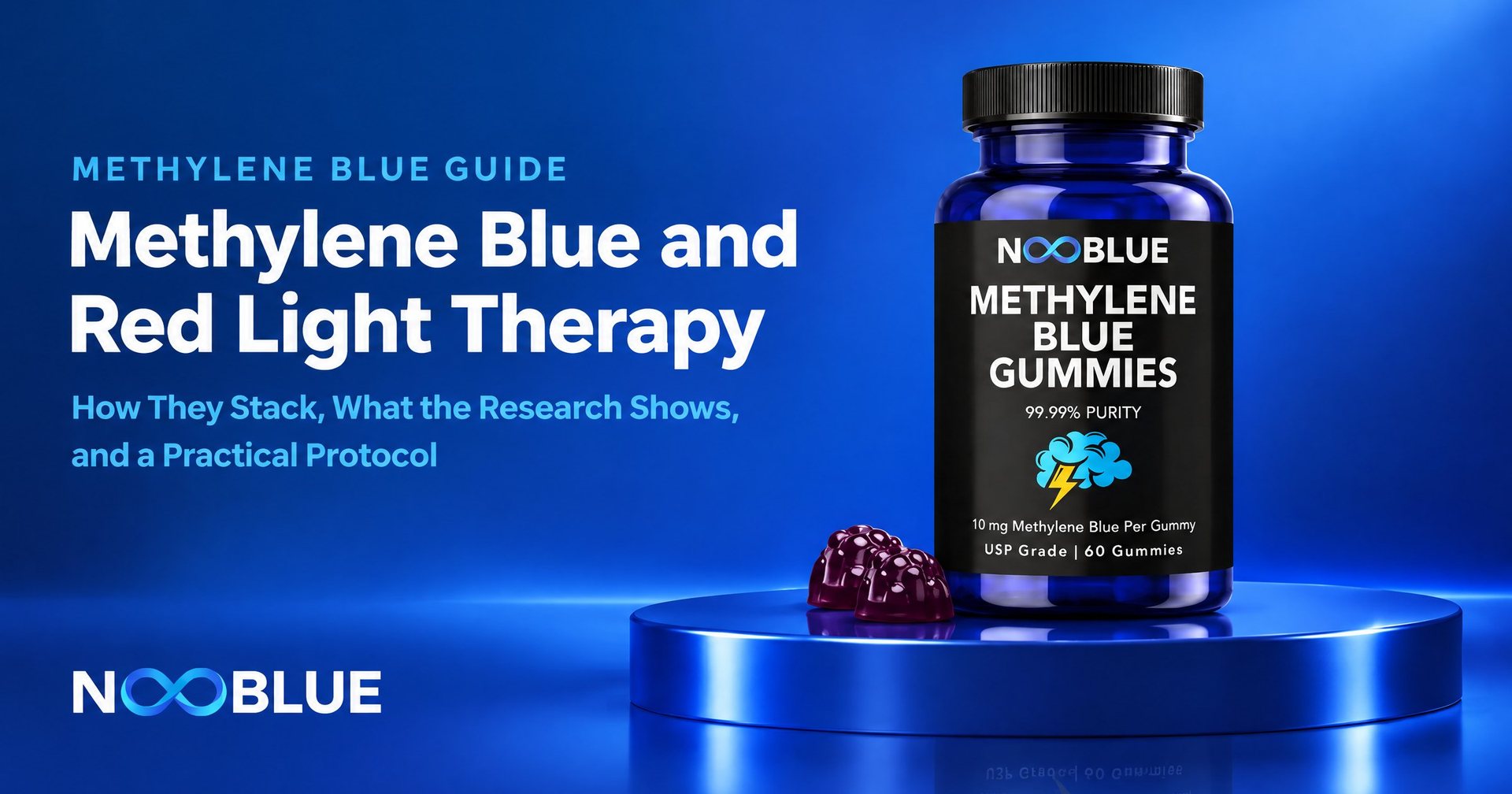
If none of these applies and your doctor is happy with your medicines, this is the gummy we make. Each one carries a fixed 10 mg of methylene blue, so you always know your dose.
The Common Side Effects (Mild and Expected)
At supplement servings, the side effects people notice are mostly cosmetic or digestive. WebMD lists blue urine, diarrhea, headache, nausea and vomiting for methylene blue taken by mouth. It also says there isn’t enough reliable information to know whether oral methylene blue is safe. That caveat is fair: most human data come from single, much larger doses given in clinical studies, not from months of daily gummies.
Blue or green urine
This is the most predictable effect. The body clears a large share of each dose through the kidneys, and the dye tints urine on its way out. In a 2016 imaging trial at the University of Texas, all 13 volunteers who swallowed a single 280 mg dose (about 4 mg/kg) reported blue urine after they left the scanner. None of the 13 placebo volunteers did (Rodriguez et al., 2016). In a later colonoscopy study, urine collected over the 60 hours after a single 200 mg dose held about 39% of that dose (Di Stefano et al., 2018).
Half-lives measured after oral doses of 200 to 400 mg ranged from 6 to 27 hours (Repici et al., 2012), so the color can take a day or two to fade once you stop. It is harmless. Dark brown or tea-colored urine is a different sign and needs a doctor.
Green or blue stool
Stool can turn green or blue-green as dye passes through the gut. MD Anderson’s patient article on methylene blue calls green urine and stool normal until the compound is out of your system. Black, tarry or bloody stool is a different sign and needs medical advice.
Nausea, stomach upset and diarrhea
These appear on every reference list for swallowed methylene blue. In a safety study of 22 healthy volunteers given single oral doses of 200 or 400 mg, 8 had side effects judged related to the drug. Most were mild and brief, and none were serious. Abnormal liver enzyme results, digestive complaints and painful urination each showed up in 13.6% of volunteers (Repici et al., 2012). Those doses were 20 to 40 times a 10 mg gummy. If a gummy bothers your stomach, take it with breakfast rather than on an empty stomach.
Headache and dizziness
StatPearls lists headache among methylene blue’s adverse effects, and the Mayo Clinic list for the IV form includes dizziness and lightheadedness. Neither has been measured at gummy servings. If one appears, skip a day and restart with food. If it keeps coming back, stop and talk to your doctor.
What Research and Real Users Report
We could not find a published study of methylene blue gummies themselves. What exists are studies of swallowed capsules and tablets at larger doses, plus case files from hospitals and poison centers. This is what the people in those studies reported.
- 26 healthy adults, one 280 mg capsule dose or placebo. The volunteers were aged 22 to 62 and took part in a randomized, double-blind trial. The paper does not report other side effects, but every volunteer on methylene blue reported blue urine (Rodriguez et al., 2016).
- 22 healthy adults, one 200 mg or 400 mg tablet dose. 8 had side effects judged related to methylene blue. Most were mild and short-lived, and only non-serious events occurred (Repici et al., 2012).
- Healthy adults given 100 mg or 200 mg before a full colonoscopy. The most frequent adverse event was a brief increase in urine output, in 17% of volunteers. Only one event, an abnormal liver enzyme result, was judged related to methylene blue (Di Stefano et al., 2018).
- 10 patients given 200 mg before colonoscopy. Biopsies taken before and after showed no detectable DNA damage, and no serious adverse events occurred (Repici et al., 2018).
- 185 hospital cases reported to the New York City Poison Center over 24 years. Patients received a median IV dose of 1 mg/kg for methemoglobinemia. Side effects attributed to methylene blue were reported in 9 cases (4.9%), including one case of hemolysis (Rothenberg et al., 2025).
Two patterns stand out. At single doses 10 to 40 times a gummy, healthy volunteers mostly reported blue urine and mild stomach or urinary complaints. The serious events in case reports center on two groups: people taking serotonergic medicines and people with G6PD deficiency.
What online reviews can and can’t tell you
Reviews on shops and forums add color, but not data. A review can’t tell you the dose, whether the product holds what its label says, or what else the reviewer was taking. That is why this guide leans on studies where someone recorded all three. If a review describes a racing heart, tremor, confusion or fever in someone who also takes an antidepressant, that points to the drug interaction described below.
The Serious Side Effects You Cannot Ignore
Serotonin syndrome
This is the most dangerous interaction. Methylene blue is a potent, reversible inhibitor of monoamine oxidase A (MAO-A), the enzyme that breaks down serotonin (Ramsay et al., 2007). Add a medicine that raises serotonin, such as an SSRI, and serotonin can build to toxic levels. A 2011 review of 14 reported cases of central nervous system toxicity after methylene blue found that 13 met the Hunter criteria for serotonin toxicity (Gillman, 2011). The same review noted that an IV dose of only 0.75 mg/kg produced a peak blood level of 500 ng/mL, enough to block MAO-A in the brain, and that severe toxicity has occurred at 1 mg/kg.
One published case shows how it looks. A 58-year-old woman taking paroxetine was given methylene blue during neck surgery. Afterward she developed a fast heart rate, agitation, involuntary muscle contractions and abnormal eye movements, which settled over 48 hours (Ng et al., 2008).
Those cases involved IV doses. A gummy is swallowed, but swallowed methylene blue is well absorbed: absolute bioavailability averaged 72.3% after a 500 mg oral dose in 16 healthy adults (Walter-Sack et al., 2009). No study has found a serving small enough to be safe alongside serotonergic medicines, so the rule is simple. Do not combine them.
Symptoms to know: fever, a fast heartbeat, sweating, tremor or twitching, muscle stiffness, agitation and confusion. MD Anderson’s patient article adds high blood pressure and seizures. If these appear in someone who takes both, get emergency care.
Hemolysis in G6PD deficiency
G6PD deficiency is the most common human enzyme defect, present in more than 400 million people worldwide (Cappellini and Fiorelli, 2008). Red blood cells short of G6PD can’t regenerate the glutathione they need to handle oxidative stress, and methylene blue adds exactly that kind of stress. StatPearls calls methylene blue contraindicated in G6PD deficiency. A blood test can tell you whether you have it, so if the condition runs in your family, ask your doctor for one before you try any methylene blue product.
Methemoglobinemia and overdose
Hospitals use methylene blue as the antidote for methemoglobinemia, a state in which hemoglobin can’t carry oxygen properly. At high cumulative doses it can cause mild methemoglobinemia itself (up to 7%). A severe overdose, a single dose of 20 mg/kg or more, has caused severe hemolysis and death (StatPearls). For a 70 kg adult, 20 mg/kg is 1,400 mg. A 10 mg gummy is far below that, which is why the practical rules are to stay at the label serving of one a day and to keep the bottle away from children.
Heart rate and blood pressure
StatPearls lists palpitations, a fast heart rate and high blood pressure among the cardiovascular effects of methylene blue in medical use. Part of the reason is that methylene blue blocks nitric oxide synthase and guanylate cyclase, which narrows blood vessels. That effect is why hospitals give it in vasoplegic shock, a dangerous drop in blood pressure. MD Anderson also advises people who take methylene blue to avoid tyramine-rich foods and drinks, such as aged and fermented cheeses and meats, red wine and draft beer, because the combination can push blood pressure up sharply. If you have heart problems or take blood pressure medicine, talk to your doctor first. Our article on whether methylene blue lowers blood pressure covers the research in more depth.
Side Effects Specific to the Gummy Format
Most side effects depend on the molecule and the dose, so they are the same for gummies, capsules and drops. Five things change with a gummy.
Mouth and tongue staining
Blue methylene blue that sits in your mouth stains it. That is why drops can leave the tongue, teeth and gums blue for a while, and why capsules, which you swallow, don’t. NooBlue gummies don’t leave the blue mouth or blue tongue that drops can. Each gummy pairs the methylene blue with vitamin C, which can donate electrons to methylene blue and shift it toward leucomethylene blue, its colorless reduced form. The deep purple color of the gummy comes from blueberry extract. Your urine can still turn blue or green, because that happens after the methylene blue is absorbed. For more on the two formats, see methylene blue gummies vs liquid and our guide on how to take methylene blue drops.
Sugar and sweeteners
Gummy recipes differ a lot. Some are made with sugar and glucose syrup like ordinary candy, and some contain no sugar at all. If you chew one every day, check the Supplement Facts panel. NooBlue gummies list 0 g total sugar and 6 calories per gummy, with a pectin base sweetened with stevia extract. The remaining ingredients are blueberry extract for flavor and color, plus sodium citrate and citric acid for a tart finish.
Vitamin C
Each NooBlue gummy adds 25 mg of vitamin C. The recommended intake for adults is 75 mg a day for women and 90 mg for men, and the tolerable upper intake level is 2,000 mg a day. Above that limit, the usual complaints are diarrhea, nausea and stomach cramps (NIH Office of Dietary Supplements). One gummy sits far below it.
They taste like candy
A gummy is easy to overdo. The label serving is one a day, and a second one because the first tasted good doubles your dose. Children are the bigger worry, because a bottle of fruit-flavored chews looks like sweets. Keep the bottle closed and out of children’s reach, as the label says.
A fixed dose in every piece
Every NooBlue gummy holds the same 10 mg, which is simple once you know 10 mg suits you. If you want to start lower, a 5 mg capsule gives you a smaller exact dose without cutting a gummy in half.
See the 5 mg capsules · $37.99The Drug Interaction List
StatPearls names the medicines behind reported cases of serotonin syndrome with methylene blue: SSRIs, SNRIs, MAOIs, certain opioids and dextromethorphan. In practice, that covers:
- SSRIs: sertraline, fluoxetine, escitalopram, citalopram and paroxetine
- SNRIs: venlafaxine, desvenlafaxine and duloxetine
- MAOIs: phenelzine, tranylcypromine and selegiline
- Certain opioids: tramadol, meperidine, methadone and fentanyl
- Dextromethorphan: the “DM” in many cough syrups
This list is not complete, because other antidepressants and some other medicines also affect serotonin. If you take anything on prescription, or any supplement sold for mood, show the label to your pharmacist or doctor before you start. Our guide to what not to take with methylene blue goes through each class, and methylene blue and alcohol covers drinks, including the tyramine question.
Dosing That Reduces Side Effect Risk
Mild side effects tend to rise with dose, so the simplest protections are about how much you take and what you take it with.
- Stay at the label serving. That is one gummy a day. A 10 mg gummy works out to about 0.14 mg/kg for a 70 kg adult, a small fraction of the single 280 mg dose (about 4 mg/kg) used in the 2016 imaging trial.
- Start lower with a capsule if you prefer. If you would rather begin below 10 mg, the 5 mg capsule gives you that step.
- Take it with food if it upsets your stomach.
- Change one thing at a time. If you add methylene blue, don’t add a new stimulant or a bigger coffee habit in the same week. If something feels off, you’ll know the cause. Our guide to methylene blue and caffeine covers that pairing.
- Treat cycling rules with caution. Schedules such as “five days on, two off” circulate online, but no study has tested them.
Choosing a Format for the Cleanest Side Effect Profile
The side effects that come from absorbed methylene blue are the same in every format. What differs is the size of each dose step, what touches your mouth, and how easy the routine is to keep. Prices are NooBlue’s own, as of Sep 2026.
| Format | Methylene blue per unit | Pack | Price | Per serving | Mouth staining |
|---|---|---|---|---|---|
| Gummies | 10 mg, plus 25 mg vitamin C | 60 gummies | $49.99 | $0.83 | No blue mouth |
| Capsules | 5 mg | 60 capsules | $37.99 | $0.63 | None, swallowed whole |
| Drops, 1% solution | 0.5 mg per drop | 50 ml | $29.99 | $0.30 per 5 mg serving | Can stain mouth and tongue |
Gummies suit people who want one fixed 10 mg dose with no measuring and no blue mouth. Capsules give the smallest fixed step, 5 mg, and nothing touches your mouth. Drops let you adjust in 0.5 mg steps at the lowest cost, but they can stain and need careful measuring. Buying 2, 3 or 5 bottles of any format saves 10%, 15% or 20%, and orders of $100 or more ship free worldwide. Our bioavailability guide compares how liquid and capsules are absorbed, and our roundup of the best methylene blue gummies compares gummy brands.
On testing: the lab report we publish covers the raw methylene blue ingredient. Contract Testing Laboratories of America (CTLA) checked identity by HPLC and tested heavy metals on one ingredient lot. It does not certify each finished batch or give a purity percentage, and you can read it on the gummies product page. Our guide to reading a methylene blue certificate of analysis explains what to look for in any brand’s report, and how to test if methylene blue is real covers simple checks at home.
What to Do If You Experience a Side Effect
For mild effects such as a light headache or an upset stomach, stop for a day or two, then restart with food. If the effect comes back, stop and talk to your doctor. Blue or green urine needs no action.
Stop and get medical help straight away for any of these: a fast or irregular heartbeat, fever, heavy sweating, muscle stiffness or twitching, confusion or agitation, shortness of breath, chest tightness, bluish lips or fingertips, or dark urine. In the US, Poison Control is available at 1-800-222-1222 or online at poison.org. If you also take an SSRI, SNRI, MAOI or other serotonergic medicine, treat those symptoms as a possible serotonin syndrome emergency and call 911.
Feeling unwell after a serving is not a sign of the compound “clearing” something. No die-off or detox reaction has been shown with methylene blue, and pushing through symptoms by taking more is the wrong move. Our article on methylene blue die-off symptoms explains where that idea comes from.
Why Medical Reference Sites List Different Side Effects
Search for methylene blue side effects and you will find long lists: arm or leg pain, changes in taste, changes in skin color, feeling hot or cold, heavy sweating and pain at the injection site. Those lists describe the IV hospital drug. Mayo Clinic’s page, for example, covers the intravenous route. Patients receiving it are usually in hospital, often during surgery or emergency care, and most people treated for methemoglobinemia get 1 to 2 mg/kg (Rothenberg et al., 2025). For a 70 kg adult that is 70 to 140 mg in one infusion, often alongside other drugs.
The serious risks carry across routes, because swallowed methylene blue reaches the blood. That is why serotonin syndrome, hemolysis in G6PD deficiency and overdose appear in this guide. Injection site pain and taste changes during an infusion are tied to the IV route and dose. For the full picture across all formats, see our complete guide to methylene blue side effects, plus our pages on skin side effects and liver safety.
Frequently Asked Questions
Who shouldn’t take methylene blue gummies?
Anyone who takes an SSRI, SNRI, MAOI or other serotonergic medicine, anyone with G6PD deficiency, anyone pregnant or breastfeeding, and anyone under 18. Talk to your doctor first if you take any prescription medicine or have a kidney or liver condition.
What happens if you take methylene blue every day?
For most people, daily use at the label serving means blue or green urine, and for some an occasional upset stomach or headache. We found no published trial that followed healthy adults on a 10 mg daily serving for months, so long-term safety at supplement servings is unknown. If you take it daily, stay at one gummy and mention it to your doctor at your next checkup.
Why do I feel weird after taking methylene blue?
Dizziness, headache and queasiness are listed side effects. Take the gummy with food, keep to one a day, and leave out other stimulants while you get used to it. If you also take a serotonergic medicine and feel agitated, sweaty, shaky or confused, or your heart is racing, get medical help now.
What does methylene blue actually do to your body?
Methylene blue is a redox compound, meaning it picks up and hands off electrons. In mitochondria it can carry electrons from NADH straight to cytochrome c, a route researchers study for cellular energy (Tucker et al., 2018). It also blocks MAO-A, which is behind the serotonin interaction, and nitric oxide signaling in blood vessels. Much of each dose leaves through the kidneys, which is why urine turns blue or green. Our guide to methylene blue benefits and side effects covers what the research shows.
Do methylene blue gummies turn your tongue blue?
NooBlue gummies don’t. Drops can stain the mouth and tongue because the blue liquid sits there, and capsules are swallowed. With any format, urine can still turn blue or green.
How long do side effects last after I stop?
Colored urine can take a day or two to fade, since measured half-lives after oral doses ranged from 6 to 27 hours. Mild stomach upset or headache should ease once you stop, and if it doesn’t, see a doctor. Serotonin syndrome, hemolysis and methemoglobinemia need medical care straight away.
Is blue or green stool dangerous?
No. It is dye passing out through the gut. Black, tarry or bloody stool is a different sign and needs medical attention.
Are methylene blue side effects a sign of die-off?
No. Nausea, headache or dizziness after a serving are direct effects of the compound, and no die-off reaction has been shown. Don’t push through by taking more. Drop to a 5 mg capsule or stop, and read our die-off symptoms guide.
The short version: expect blue or green urine, watch for an upset stomach, and treat the rules on serotonergic medicines and G6PD deficiency as absolute. See the full range in the NooBlue shop.
Sources
- Rodriguez P, Zhou W, Barrett DW, Altmeyer W, Gutierrez JE, Li J, Lancaster JL, Gonzalez-Lima F, Duong TQ. Multimodal randomized functional MR imaging of the effects of methylene blue in the human brain. Radiology. 2016;281(2):516-526. PMC5084971
- Repici A, Di Stefano AF, Radicioni MM, Jas V, Moro L, Danese S. Methylene blue MMX tablets for chromoendoscopy. Safety tolerability and bioavailability in healthy volunteers. Contemporary Clinical Trials. 2012;33(2):260-267. PubMed 22101227
- Di Stefano AFD, Radicioni MM, Vaccani A, Fransioli A, Longo L, Moro L, Repici A. Methylene blue MMX tablets for chromoendoscopy. Bioavailability, colon staining and safety in healthy volunteers undergoing a full colonoscopy. Contemporary Clinical Trials. 2018;71:96-102. PubMed 29864547
- Repici A, Ciscato C, Wallace M, Sharma P, Anderloni A, Carrara S, Di Leo M, Hassan C. Evaluation of genotoxicity related to oral methylene blue chromoendoscopy. Endoscopy. 2018;50(10):1027-1032. PubMed 29906809
- Rothenberg R, Biary R, Hoffman RS. Effectiveness and tolerability of methylthioninium chloride (methylene blue) for the treatment of methemoglobinemia: twenty-four years of experience at a single poison center. Clinical Toxicology. 2025;63(4):284-291. PubMed 40062661
- Ramsay RR, Dunford C, Gillman PK. Methylene blue and serotonin toxicity: inhibition of monoamine oxidase A (MAO A) confirms a theoretical prediction. British Journal of Pharmacology. 2007;152(6):946-951. PubMed 17721552
- Gillman PK. CNS toxicity involving methylene blue: the exemplar for understanding and predicting drug interactions that precipitate serotonin toxicity. Journal of Psychopharmacology. 2011;25(3):429-436. PubMed 20142303
- Ng BK, Cameron AJ, Liang R, Rahman H. Serotonin syndrome following methylene blue infusion during parathyroidectomy: a case report and literature review. Canadian Journal of Anaesthesia. 2008;55(1):36-41. PubMed 18166746
- Walter-Sack I, Rengelshausen J, Oberwittler H, Burhenne J, Mueller O, Meissner P, Mikus G. High absolute bioavailability of methylene blue given as an aqueous oral formulation. European Journal of Clinical Pharmacology. 2009;65(2):179-189. PubMed 18810398
- Cappellini MD, Fiorelli G. Glucose-6-phosphate dehydrogenase deficiency. Lancet. 2008;371(9606):64-74. PubMed 18177777
- Ostrovsky A, Afzal M. Methylene Blue. StatPearls. Updated January 2, 2026. NCBI Bookshelf NBK557593
- Tucker D, Lu Y, Zhang Q. From mitochondrial function to neuroprotection: an emerging role for methylene blue. Molecular Neurobiology. 2018;55(6):5137-5153. PubMed 28840449
- Roldan C. Methylene blue: Should you take it? MD Anderson Cancer Center, Cancerwise. March 3, 2026. mdanderson.org
- WebMD. Methylene blue: uses, side effects, and more (checked September 2026). webmd.com
- Mayo Clinic. Methylene blue (intravenous route): side effects (checked September 2026). mayoclinic.org
- NIH Office of Dietary Supplements. Vitamin C: fact sheet for health professionals (checked September 2026). ods.od.nih.gov
- NooBlue. Methylene Blue Gummies product page: Supplement Facts and “Safety: read before use” (checked September 2026). nooblue.com