By NooBlue Editorial · Published December 28, 2025
Key Takeaways
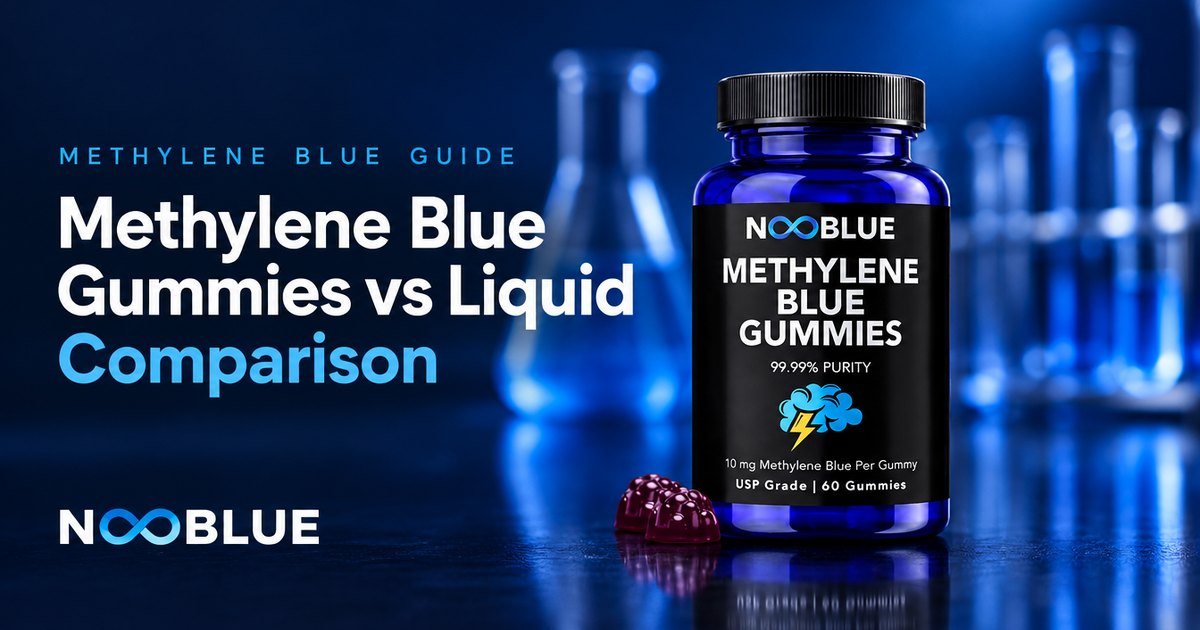
- NooBlue’s gummy delivers a fixed 10 mg of USP methylene blue plus 25 mg vitamin C per piece, zero sugar, in a Wild Blueberry pectin chew ($49.99 for 60). Vitamin C can shift methylene blue toward its colorless reduced form, and the gummy doesn’t leave the blue mouth that drops can.
- Liquid 1% solution (50 ml, 500 mg total, $29.99) still wins on drop-by-drop control and lowest cost per milligram, but it stains the tongue, teeth and any surface it touches.
- 5 mg capsules ($37.99 for 60) give a pre-measured titration rung with zero mouth contact and are the natural starting point for beginners.
- No study has compared how fast gummies and liquid take effect. A liquid needs no chewing or dissolving, while a gummy has to be chewed and swallowed first.
- Check any gummy for three things: the milligrams per gummy on the label, the sugar content, and a lab report you can read. NooBlue publishes a CTLA report on its methylene blue ingredient (identity and heavy metals, not a potency test of every batch).
Quick answer: for most people the easiest way to keep a daily methylene blue habit is now NooBlue’s Methylene Blue Gummies: a fixed 10 mg plus 25 mg vitamin C per gummy, zero sugar, and a published CTLA report on the methylene blue ingredient. Liquid still wins on drop-by-drop flexibility and cost per milligram; capsules give a pre-measured 5 mg rung with no mouth contact. If you are comparing methylene blue sublingual vs oral, think of that as a format and handling question rather than proof that one route is automatically “stronger.” Product purity, labelled milligrams, storage, and medication-safety checks matter more than the flavour format.
- Choose the gummy for the simplest daily ritual: fixed 10 mg, no measuring, no liquid to spill and no blue mouth. Several of the gummy criticisms below apply mainly to sugar-based products that do not state their dose.
- Choose liquid if you want drop-by-drop adjustment and the lowest cost per milligram, and do not mind staining risk.
- Choose capsules if you want a pre-measured 5 mg format with no mouth contact, the natural titration rung for beginners.
Compare NooBlue’s 10 mg gummies, 1% methylene blue solution, 5 mg capsules, or browse the full shop.
Table of contents
- 1. Why the Supplement Form of Methylene Blue Matters
- 2. Methylene Blue Gummies vs Liquid Comparison at a Glance
- 3. Methylene Blue Gummies – Benefits and Limitations
- 4. Final Verdict – Are Methylene Blue Gummies Better Than Liquid?
- 5. Absorption and Bioavailability: What the Research Actually Shows
- 6. Staining Comparison: Mouth, Tongue, and Teeth
- 7. Does Methylene Blue Stain Your Mouth and Tongue? Gummies vs Liquid Staining Compared
- 8. Methylene Blue Gummies vs Liquid: Tongue Staining in Detail
- 9. Who Should Choose Gummies vs Liquid: A 2026 Decision Framework
- 10. How to Take Methylene Blue Gummies: Dose and Timing
- 11. Frequently Asked Questions
- 11.1. Do methylene blue gummies stain your mouth and tongue?
- 11.2. Are methylene blue gummies as effective as liquid?
- 11.3. Which is cheaper per dose: gummies or liquid?
- 11.4. Can you switch from liquid methylene blue to gummies?
- 11.5. Does methylene blue liquid stain your tongue more than gummies?
- 11.6. How long does methylene blue staining last on your mouth and tongue?
- 11.7. Can you take methylene blue without staining?
- 11.8. Can you cut a 10 mg methylene blue gummy in half to get a 5 mg dose?
- 11.9. What should you not take with methylene blue gummies?
- 12. Related Methylene Blue Guides
Why the Supplement Form of Methylene Blue Matters
Methylene blue is studied and sold at low-milligram doses. At this scale, even minor inconsistencies in formula or absorption can influence how the compound performs in the body. The delivery format directly affects how efficiently methylene blue enters the bloodstream, how precisely it can be dosed, and how safely it can be used over time. This makes the choice between gummies and liquid far more than a matter of taste or convenience.The delivery form of any supplement affects how your body absorbs and uses it. Capsules offer precise dosing and convenience, making them ideal for people who want consistent daily use without measuring drops. Liquid forms may absorb slightly faster but require careful measurement and can stain surfaces. Consider your lifestyle, travel habits, and personal preferences when choosing between forms. Capsules, liquid and gummies can all deliver the labeled dose when they come from manufacturers who state the milligrams per serving and publish lab reports.
Methylene Blue Gummies vs Liquid Comparison at a Glance
| Feature | Methylene Blue Gummies | Liquid Methylene Blue |
| Form & Texture | Chewable, flavored gummy supplement | Liquid solution taken sublingually or diluted |
| Form of the Compound | Conventional gummies: oxidized methylene blue (blue). NooBlue’s gummy: methylene blue with 25 mg vitamin C, which can shift it toward colorless leucomethylene blue | Oxidized methylene blue (blue) in aqueous solution |
| Blue-Mouth Risk | NooBlue’s gummy: none. Conventional gummies: lower than liquid, but they can tint the tongue | High: stains tongue, teeth and lips |
| Sugar | Conventional gummies: usually sugar or syrup based. NooBlue’s gummy: zero sugar (pectin base, stevia-sweetened) | None |
| Certificate of Analysis | Rarely published for marketplace gummies. NooBlue publishes a CTLA report on its methylene blue ingredient | Varies by brand. NooBlue’s 1% liquid links the same ingredient report |
| Taste & Ease of Use | Pleasant taste and very easy to consume | Bitter taste; requires careful handling |
| Dosing Precision | Fixed dose per gummy (NooBlue: 10 mg on the label). Check that any gummy states its milligrams | Highly precise, adjustable drop-by-drop dosing |
| Absorption rate | Not measured for gummies | An oral solution showed 72% absolute bioavailability in one study |
| Absorption Speed | Chewed and swallowed first | No chewing or dissolving step |
| Ingredient Profile | Conventional: sugar, gelatin, flavors, stabilizers. NooBlue: pectin, blueberry extract, stevia, sodium citrate + citric acid | Typically just purified water and methylene blue |
| Formula Stability | More prone to degradation over time | More stable when stored properly |
| Customization of Dose | Not customizable | Easily customizable for microdosing or protocols |
| Clinical & Research Use | Rarely used in studies | Widely used in clinical and research settings |
| Risk of Over/Underdosing | Low when the label states the dose; higher with marketplace brands that do not | Lower due to precise control, though measuring errors are possible |
| Travel & Portability | Very travel-friendly and mess-free | Portable but risk of spills or staining |
| Best For | The easiest daily ritual: a fixed 10 mg with no measuring | Users who want drop-level control and the lowest cost per milligram |
| Overall Effectiveness | Depends on the labeled dose and product quality | Depends on the labeled dose and product quality |
Looking for clean, USP-grade methylene blue? NooBlue’s Methylene Blue Capsules hold 5 mg of methylene blue and 10 mg of vitamin C each, 60 for $37.99, with a published report on the methylene blue ingredient. Shop the full range →
Methylene Blue Gummies – Benefits and Limitations
Methylene blue gummies are designed primarily for ease of use. They are flavored, chewable, and eliminate the need for measuring or mixing. For people who dislike the taste of liquid supplements, gummies can feel more approachable and may encourage consistent use. Their solid form also makes them easier to carry while traveling and reduces the risk of spills or accidental staining.However, with most conventional gummies on the market, these conveniences come with notable trade-offs. One of the most significant limitations of candy-grade gummies is reduced dosing precision. Since methylene blue requires careful, individualized dosing, a fixed-dose gummy removes the flexibility needed for safe microdosing or gradual dose adjustments. This can increase the risk of taking too much or too little.Absorption is another concern. Gummies must be chewed and broken down before methylene blue is absorbed, which may slow uptake, although no study has measured this for methylene blue gummies. Also, most conventional gummies contain sugars, flavorings, colorants, and stabilizers that offer no functional benefit.Stability is also an issue. Methylene Blue is sensitive to light, heat, and oxidation, and sugar-based gummy formulas are more difficult to protect from environmental degradation over time. Poor storage can reduce potency over time.How NooBlue’s Gummy Differs
NooBlue’s gummies list 10 mg of methylene blue and 25 mg of vitamin C per piece, and they don’t leave the blue mouth that drops can. We make no claim about how the vitamin C affects stability or absorption in people, because no study has measured that for a finished gummy.In cells, enzymes reduce methylene blue to leucomethylene blue and cytochrome c oxidizes it back again, a reversible cycle described in cultured human cells by Atamna and colleagues (PMID 17928358). That chemistry is the reason vitamin C is in the gummy, and our leucomethylene blue explainer covers it in more detail. The gummy’s other answers to the classic complaints are practical ones: a stated 10 mg per piece, zero sugar, and a published report on the methylene blue ingredient.A gummy with a stated dose: NooBlue’s Methylene Blue Gummies pack 10 mg USP methylene blue + 25 mg vitamin C into a zero-sugar Wild Blueberry gummy, with a published CTLA report on the methylene blue ingredient. 60 gummies for $49.99. See the gummies →
Liquid Methylene Blue – Advantages and Drawbacks
Liquid methylene blue remains the most widely used and researched form. One of its strongest advantages is dosing accuracy. Liquid solutions allow users to measure intake drop by drop, making it possible to start with extremely low doses and adjust gradually based on individual response. This level of control is critical for long-term use and safety.Liquid methylene blue is also well absorbed: in 16 healthy volunteers, a water-based oral solution had an absolute bioavailability of 72% (Walter-Sack et al., 2009). No study has compared a solution with a gummy directly. High-quality liquid products typically contain only purified water and pharma-grade methylene blue, avoiding unnecessary fillers, sugars, or additives.Another important factor is scientific alignment. Most clinical and mechanistic research discusses methylene blue in controlled liquid, capsule, or medical preparations rather than novelty gummy formats. That makes labelled strength, purity testing, and handling instructions more important than flavour format.That said, liquid methylene blue does have some drawbacks. The taste can be unpleasant for some users, and improper handling may stain the tongue, teeth, or surrounding surfaces. There is also a learning curve involved, as users must understand strength and dosing. However, this same learning curve is what allows for safer, more personalized use.Gummies vs Liquid: Which Performs Better Overall?
When comparing gummies and liquid methylene blue side by side, the answer depends on which gummy you mean. Conventional candy-grade gummies trail liquid on dosing precision, ingredient purity, and alignment with the preparations used in research. Those trade-offs are real and have not changed. A gummy with a clearly labeled fixed dose, such as NooBlue’s 10 mg, removes the dose-accuracy worry for anyone who wants exactly that amount, while liquid keeps its edge in fine-grained control and cost per milligram.For people focused on cognitive performance, mitochondrial efficiency, and long-term consistency, the practical question is which format you will actually take every day. Liquid remains the tool for microdosing and protocol work; a labeled 10 mg gummy like NooBlue’s is the format most people find easiest to stick with.Safety Factors and Long-Term Use
Safety is a critical factor when choosing a methylene blue supplement. Methylene Blue can interact with certain medications, including SSRIs, and improper dosing increases the risk of side effects. Liquid formulas allow users to follow a “start low and adjust slowly” approach, which is essential for minimizing risk, and 5 mg capsules give beginners the simplest fixed titration rung. Conventional gummies limit dosing flexibility and may obscure potency behind sweet flavoring; a gummy with the milligrams stated on the label at least makes the amount you are taking a known quantity.Regardless of format, it’s essential to choose products that are pharmaceutical or lab-grade, clearly labeled with strength details, and tested by third parties for purity and contaminants.Final Verdict – Are Methylene Blue Gummies Better Than Liquid?
It depends on the gummy and on how you use methylene blue. For the easiest daily ritual, NooBlue’s Methylene Blue Gummies are our first pick: a fixed 10 mg plus 25 mg vitamin C per gummy, zero sugar, and a published CTLA report on the methylene blue ingredient. Candy-style gummies with added sugar and no stated dose still deserve the criticisms in this article.If your priority is an exact 5 mg titration rung, especially as a beginner, NooBlue’s 5 mg capsules are the natural starting point. If your priority is the finest drop-by-drop control at the lowest cost per milligram, liquid methylene blue is the better choice. All three NooBlue formats use USP grade methylene blue, and each product page links the same CTLA ingredient report, so pick the one you will actually take every day.Absorption and Bioavailability: What the Research Actually Shows
What the Research Says About Methylene Blue Absorption Rate
Methylene blue taken by mouth is well absorbed. In a study of 16 healthy volunteers published in the European Journal of Clinical Pharmacology (Walter-Sack et al., 2009), a 500 mg oral dose given as a water-based solution had an absolute bioavailability of 72% compared with an intravenous dose (PMID 18810398). That dose is far larger than a supplement serving, and the study did not test gummies or capsules.
Onset Speed: Aqueous Solution vs Gummy Matrix
No published study has compared how quickly methylene blue from a gummy and from a liquid reaches the blood. What is clear is the order of steps. A liquid mixed into water needs no chewing or dissolving. A gummy has to be chewed and swallowed first, and a capsule has to dissolve in the stomach.
Formulation can change timing a great deal. In a study of healthy volunteers published in Contemporary Clinical Trials (Repici et al., 2012), methylene blue given as a delayed-release tablet designed for colon staining, at 200 mg or 400 mg taken with a bowel preparation drink, reached peak blood levels after a median of 16 hours (PMID 22101227). Supplement gummies and capsules are not built that way, but the study shows that the delivery form, not only the dose, shapes when methylene blue arrives.
In practice, if you want the dose with the fewest steps, liquid in water is the simplest. If a fixed amount you do not have to measure matters more, a gummy or capsule is easier, and the speed difference for a small supplement dose has not been measured.
Staining Comparison: Mouth, Tongue, and Teeth
Staining is one of the most common reasons people search for this comparison. Methylene blue is a strong dye, and liquid that touches the mouth tints the tongue, teeth and lips blue. The tint is harmless but noticeable, which matters before work meetings or social plans. Conventional gummies usually cause less staining than liquid because they are chewed briefly and swallowed rather than held in the mouth, though some tinting can still happen. NooBlue’s gummy adds 25 mg of vitamin C, which can shift methylene blue toward its colorless reduced form, and it doesn’t leave a blue mouth. If keeping your mouth free of color is the priority, NooBlue’s gummies and capsules both do that, and liquid is the format that stains.
Does Methylene Blue Stain Your Mouth and Tongue? Gummies vs Liquid Staining Compared
One of the most common concerns for new users is whether methylene blue will stain their mouth, tongue and teeth. The difference between formats comes down to how long the methylene blue stays in contact with your mouth.
Liquid methylene blue staining: Taking liquid methylene blue under the tongue or mixed in water turns the mouth, tongue, teeth and lips blue. How long it lasts depends on the dose, how concentrated the liquid is, and whether you eat, drink or rinse afterward. The staining is harmless but can be socially inconvenient, so many liquid users dose at home.
Gummy methylene blue staining: A gummy is chewed and swallowed, so it spends less time in the mouth than a liquid held under the tongue. Some tinting of the tongue is still possible, especially with conventional gummies that contain blue, oxidized methylene blue. NooBlue’s gummy contains vitamin C for the reason explained above and doesn’t leave the blue mouth that drops can. If mouth and tongue staining is your main concern, NooBlue’s gummies and capsules both avoid it.
Staining reduction tips for liquid users: If you prefer liquid methylene blue for its dosing precision but want to reduce staining, take it in a larger glass of water, use a straw, or rinse with water right after dosing. Brushing your teeth shortly afterward also helps. If you want to avoid mouth contact entirely, NooBlue’s 5 mg capsules are swallowed whole.
Methylene Blue Gummies vs Liquid: Tongue Staining in Detail
Tongue staining is one of the top reasons people switch from liquid to gummies or capsules. Here is what each format tends to do to your tongue, lips and teeth:
Liquid staining on the tongue: Methylene blue is a dye that binds readily to tissue, which is why liquid staining is vivid and can persist after rinsing. The depth of color depends on the dose, the concentration and how long the liquid stays on your tongue. Undiluted 1% solution held in the mouth stains more than the same dose stirred into a glass of water and swallowed.
Gummy staining on the tongue: Chewing a conventional gummy releases some blue methylene blue in the mouth, but for a shorter time than a liquid held under the tongue, so staining is usually lighter. In NooBlue’s gummies, 25 mg of vitamin C can shift methylene blue toward its colorless reduced form, and the gummy’s purple color comes from blueberry extract. The chew doesn’t turn your tongue blue.
Practical staining comparison (tongue specifically):
- Liquid under the tongue: the most staining of any format
- Liquid in a glass of water: usually a lighter blue-green tint than under the tongue
- Conventional gummies (chewed): usually lighter again, though some tinting is possible
- NooBlue gummies with vitamin C: no blue mouth
- Capsules (swallowed): no contact with the tongue
If avoiding tongue staining entirely is the priority, NooBlue’s 5 mg capsules skip your mouth completely. Gummies are the next option if you prefer a chewable format. For liquid users, taking the dose in a full glass of water rather than under the tongue, and rinsing afterward, reduces tongue staining.
Who Should Choose Gummies vs Liquid: A 2026 Decision Framework
Choose liquid methylene blue if you want:
- Flexible dosing down to the drop (1 mg increments or smaller)
- A liquid you can stir into water and adjust by the drop
- Best cost per milligram: a single 50 ml bottle of Ultimate Methylene Blue Solution 1% (50ml) delivers 500 mg total
- USP grade methylene blue with a published ingredient report (NooBlue’s drops)
Choose methylene blue gummies if you prefer:
- No blue mouth. NooBlue’s gummies add vitamin C, which can shift methylene blue toward its colorless form, and they don’t stain your tongue the way liquid can
- A fixed dose: 10 mg USP methylene blue + 25 mg vitamin C per gummy, with a published CTLA report on the ingredient
- Zero sugar: a pectin base sweetened with stevia, not a candy syrup
- A more palatable experience (the Wild Blueberry flavour masks the characteristic metallic taste)
- Portability: gummies travel without spill risk
For the easiest daily habit, we now point most users to the Methylene Blue Gummies, a fixed 10 mg with no measuring. If you are brand new and want to start lower, capsules like Ultimate Methylene Blue Capsules 60x5mg give an exact 5 mg rung to titrate from, and the liquid remains the tool for the finest control at the lowest cost per milligram. Browse the full range at the NooBlue shop.
How to Take Methylene Blue Gummies: Dose and Timing
Handle a gummy like any other methylene blue dose: the milligrams matter, the format does not. Most people start with one 10 mg gummy in the morning, hold that for at least two weeks, and only then decide whether anything needs to change. If you want a smaller first step, a 5 mg capsule or a few liquid drops gives you a lower rung to climb from. Chew and swallow. There is no reason to hold a gummy under the tongue. Take it in the morning, since some brands note that evening doses may affect sleep. Keep the bottle tightly closed in a cool, dry place away from direct heat and sunlight, and see our guide to how many mg of methylene blue per day for dose ranges.
Frequently Asked Questions
Do methylene blue gummies stain your mouth and tongue?
NooBlue gummies don’t: you avoid the blue mouth that drops can leave. Each one also contains 25 mg of vitamin C, which can shift methylene blue toward its colorless reduced form. Conventional gummies that contain blue, oxidized methylene blue can still tint the tongue a little, though usually less than liquid, because they are chewed briefly and swallowed. Urine can still turn blue or green with any format.
Are methylene blue gummies as effective as liquid?
Both forms can deliver methylene blue when the labelled dose and product quality are reliable. Controlled oral-formulation studies show methylene blue can reach systemic circulation, but that does not mean every gummy, capsule, or liquid product absorbs identically. The delivery matrix, labelled milligrams, storage, and third-party testing all matter. Choose based on dose clarity, convenience, staining tolerance, and safety checks rather than assuming one format is automatically stronger.
Which is cheaper per dose: gummies or liquid?
Liquid methylene blue is usually cheaper per milligram, while gummies cost more because they add flavouring, moulding, packaging and convenience. The fairest comparison is the labelled milligrams per serving, not the number of drops or gummies. For context, NooBlue’s 10 mg gummies work out to roughly $0.42 per 5 mg equivalent at $49.99 a bottle (about $0.33 in the five-bottle bundle), while the 1% liquid remains the cheapest per milligram. If price and precision matter most, compare a 1% liquid solution or 5 mg capsules against the gummy’s cost per labelled milligram.
Can you switch from liquid methylene blue to gummies?
Yes, you can switch between forms freely. The active compound is the same: methylthioninium chloride. When switching, match your milligram dose rather than volume. If you were taking 10mg via liquid drops, choose a gummy that states 10 mg per serving on the label, like NooBlue’s Methylene Blue Gummies. Some users keep both forms on hand, using liquid at home where staining is less of a concern and gummies when traveling or at work.
Does methylene blue liquid stain your tongue more than gummies?
Usually, yes. Liquid comes into direct contact with the tongue, teeth and lips, and methylene blue is a strong dye, so it tints them. A gummy is chewed briefly and swallowed, which means less contact. Conventional gummies can still tint a little, while NooBlue’s vitamin C gummy doesn’t leave a blue mouth. Taking liquid in a glass of water, using a straw and rinsing afterward all help. For no mouth contact at all, NooBlue capsules are swallowed whole.
How long does methylene blue staining last on your mouth and tongue?
It varies with the dose, the format and whether you rinse or brush afterward, and we are not aware of a study that has timed it. Undiluted drops held in the mouth tint the most. Liquid stirred into a glass of water and swallowed tints less, a chewed conventional gummy usually less again, and NooBlue’s gummy doesn’t leave a tint. Brushing your teeth and rinsing with water speed up fading for any format.
Can you take methylene blue without staining?
Capsules come closest. Methylene blue capsules are swallowed whole, so the methylene blue does not touch your mouth. NooBlue’s gummies contain vitamin C, which can shift methylene blue toward its colorless form, and they don’t leave the blue mouth that drops can. If you prefer liquid, stirring it into water, using a straw and rinsing right after dosing reduce staining.
Can you cut a 10 mg methylene blue gummy in half to get a 5 mg dose?
You can physically cut one, but you lose the reason to choose a gummy. The labeled fixed 10 mg is the main reason to choose a gummy, and a hand-cut pectin gummy gives you two rough halves rather than two measured 5 mg doses. Cutting also exposes the inside to air. If 5 mg is your target, a 5 mg capsule or ten drops of the 1% solution measures it properly.
What should you not take with methylene blue gummies?
The same rules apply to gummies as to liquid or capsules, because the active compound is identical. Methylene blue is an MAO inhibitor, so never combine it with SSRIs, SNRIs or other serotonergic drugs, including some migraine, pain and cough medicines; the combination risks serotonin syndrome. Skip it entirely if you have G6PD deficiency or are pregnant or breastfeeding. Check any prescription with your doctor or pharmacist before your first gummy. Our interactions guide lists the specific drug classes to watch.
Related Methylene Blue Guides
If you are still deciding which form is right for you, these guides can help narrow your choice:
- Are Methylene Blue Gummies Actually Effective?: a closer look at gummy efficacy data and what to expect.
- Methylene Blue Bioavailability: Liquid vs Capsules: how absorption rates compare across delivery forms.
- How Many mg of Methylene Blue Per Day Should I Take?: safety-first context for dose discussions, not medical advice.
- Methylene Blue Side Effects and Safety Precautions: important safety information before starting any form.
- Best Methylene Blue Supplements 2026: see how gummies stack up against our top overall picks across every format.
- Best Methylene Blue Capsules in 2026: our picks if you decide capsules suit you better than gummies or liquid.
Continue reading
Gentian Violet vs Methylene Blue: Detailed Comparison →Methylene Blue Powder vs Liquid: A Complete Comparison Guide →Browse All NooBlue Methylene Blue Products →
Recommended for you
Ready to try NooBlue methylene blue?
USP grade · Published ingredient lab report · Free worldwide shipping over $100
Shop NooBlue →