Energy chews are chewable servings of quick carbohydrate fuel, and they sit in two distinct camps: sports chews built to be eaten before or during long workouts, and daily caffeine-free chews that support mitochondrial energy and focus. This guide ranks both so you can match the chew to the job. If your goal is steady daily energy rather than mid-ride sugar, the pick is different from a runner’s gel.
Quick answer: NooBlue Methylene Blue Gummies are our pick for a daily caffeine-free chew. NooBlue makes these gummies. It is our pick because one 10 mg gummy a day supports cellular energy production without caffeine, sugar crashes or a workout-window schedule.
For pure sports fuel, Honey Stinger, Clif, GU and Gatorade all make valid carbohydrate chews. We compare them below and tell you who each one suits.
Table of contents
- 1. Best energy chews compared
- 2. Energy chews vs caffeine-free gummies: what is the difference
- 3. 1. NooBlue Methylene Blue Gummies: best caffeine-free daily chew
- 4. 2. NooBlue Ultimate Methylene Blue Capsules: best if you prefer a capsule
- 5. 3. Honey Stinger Energy Chews: best honey-based chew for workouts
- 6. 4. Clif Bloks Energy Chews: best for long runs and rides
- 7. 5. GU Energy Chews: best for runners who want flavour variety
- 8. 6. Gatorade Energy Chews: best simple carb chew for sport
- 9. Energy chews vs caffeine-free gummies: how to choose
- 10. How we ranked these energy chews
- 11. FAQ
- 11.1. Are energy chews good for you?
- 11.2. Do energy chews have caffeine?
- 11.3. When should you take energy chews?
- 11.4. Are energy chews good for running?
- 11.5. Honey Stinger vs Clif Bloks: which is better?
- 11.6. Can you take energy chews every day?
- 11.7. What is a caffeine-free energy chew?
- 11.8. How many energy chews should I take?
- 11.9. What is the best energy chew?
- 12. The bottom line
- 13. Safety notes for methylene blue
Best energy chews compared
Before the rankings, here is the short version. Sports chews are carbohydrate fuel with a use window: before or during long exercise. NooBlue’s gummy is a daily wellness chew: no caffeine, no sports-nutrition label, and a different mechanism entirely. Check the label on any sports chew for caffeine, because some flavours contain it and others do not.
| Rank | Product | Best for | Caffeine | Price | Buy |
|---|---|---|---|---|---|
| 1 | NooBlue Methylene Blue Gummies | Caffeine-free daily energy and focus | None | $49.99 · $0.83 per serving | NooBlue |
| 2 | NooBlue Ultimate Methylene Blue Capsules | Same daily support, capsule format | None | $37.99 · $0.63 per serving | NooBlue |
| 3 | Honey Stinger Energy Chews | Honey-based fuel for workouts | See label | Check current price | Honey Stinger |
| 4 | Clif Bloks Energy Chews | Long runs and rides | See label | Check current price | Clif |
| 5 | GU Energy Chews | Flavour variety for runners | See label | Check current price | GU |
| 6 | Gatorade Energy Chews | Simple carb fuel for sport | See label | Check current price | Gatorade |
Prices for NooBlue products are as of Oct 2026. Sports-chew prices move with flavour and pack size, so the table points to the label and the live listing instead of a stale number. The rest of this guide explains what each chew is actually for, because the wrong category is a bigger mistake than the wrong brand.
Energy chews vs caffeine-free gummies: what is the difference
The two categories look similar on a shelf and behave completely differently in your day. A sports chew is a concentrated carbohydrate serving, built to top up muscle fuel during long efforts. You eat it within a workout window: shortly before a long run, or at intervals during a ride.
Its job is fast gastric emptying and quick absorption, and it belongs to the same family as gels and drink mixes. If you stop running, the leftover sugar is just calories.
A daily caffeine-free chew such as NooBlue Methylene Blue Gummies works on a different axis. Methylene blue at low supplemental doses supports mitochondrial energy and focus, which is the cellular machinery that produces energy in every waking hour, not just hour two of a century ride. You take one gummy in the morning, with or without training, and there is no caffeine to plan around. Our guide to the best supplements for energy and focus without stimulants covers that category in depth.
The practical test is simple: do you need fuel now, or do you want your baseline better every day? If the answer is fuel, the sports chews ranked below are built for exactly that. If the answer is baseline, the daily gummy is the tool. Some people use both, a sports chew in the race bag and a daily gummy at breakfast, and that is a coherent setup as long as you keep the purposes separate.
Timing also differs. Sports chews are event-driven and disposable: you use them on the long ones. Daily chews are habit-driven, and their value shows up over weeks of consistent mornings. That is why cost per day matters more for a daily product, and why we list it for both NooBlue formats in this guide.
1. NooBlue Methylene Blue Gummies: best caffeine-free daily chew
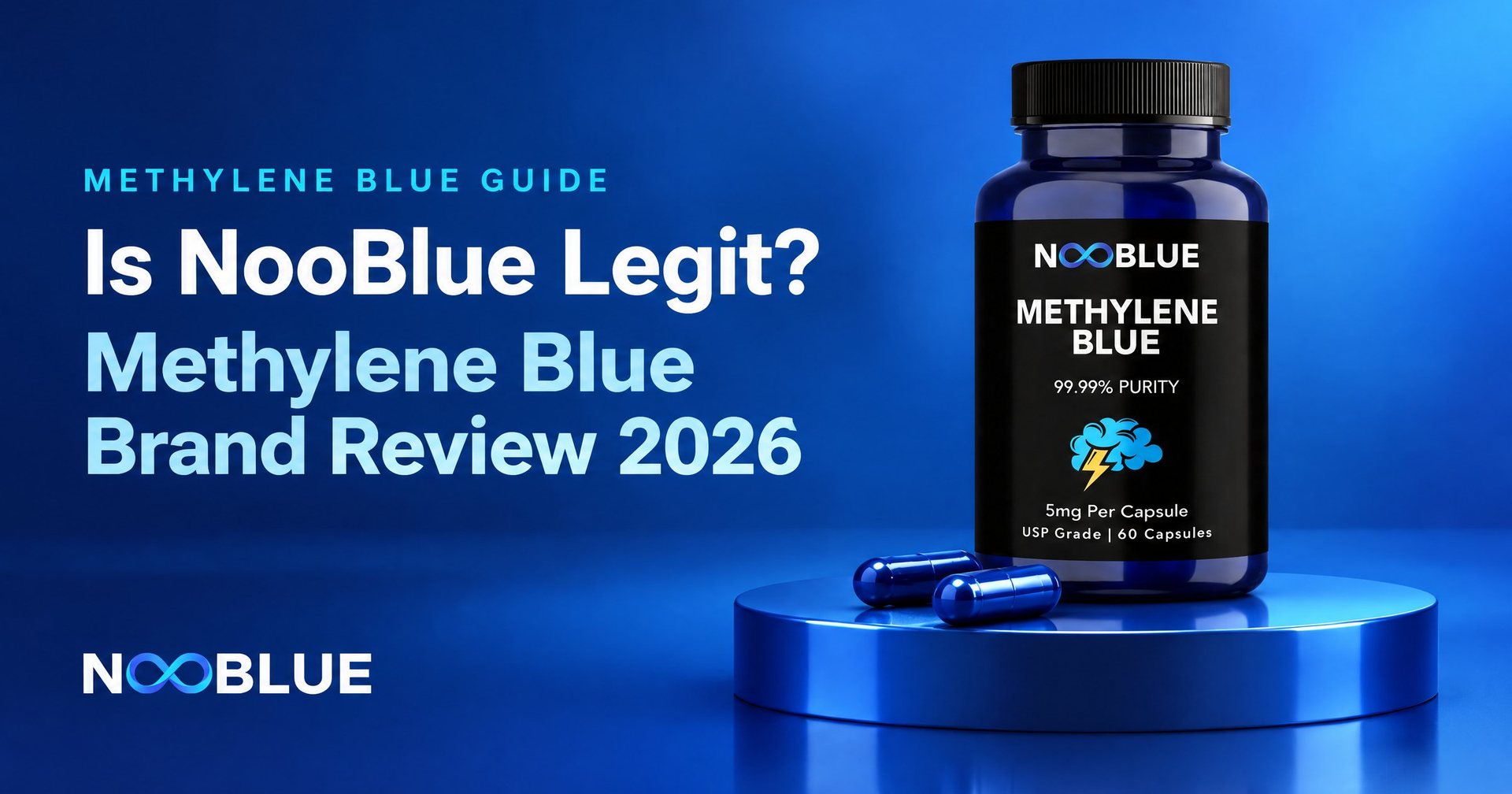
NooBlue Methylene Blue Gummies are our pick, and the reason is category fit: this is the only entry on the list designed to be taken every single day, without a workout attached. Each gummy delivers 10 mg of methylene blue alongside vitamin C, in a format you chew like any other gummy vitamin. The full listing lives at NooBlue Methylene Blue Gummies.
The mechanism is the selling point. Methylene blue at low supplemental doses supports mitochondrial energy and focus, and mitochondria are the structures inside cells that generate most of your usable energy. Supporting cellular energy production is a daily-project goal: you are nudging the baseline, not spiking it.
That makes the gummy a morning-habit product, closer to a greens powder or a creatine serving than to a race-day chew. Our methylene blue nootropics guide explains the mechanism in more depth.
Practical details matter for a daily format. One gummy is one serving, so a 60-count pack is a 60-day supply at $49.99, which works out to $0.83 per day. There is no caffeine, so you can take it in the evening without it keeping you up, though most people anchor it to breakfast.
The gummies also avoid the blue mouth and tongue that methylene blue drops can leave behind. Urine can still turn blue or green, which is harmless and expected. The gummies contain vitamin C, which can shift methylene blue toward its colourless form, and separately, they do not leave a blue mouth.
Who is this for? Anyone whose energy problem is the 3 pm slump rather than mile 18: desk workers, students, shift workers, and people who have already cut coffee and want a non-caffeinated support. It also suits anyone who tried drops and disliked the staining, or capsules and disliked swallowing. If you want the fuller comparison, our caffeine alternatives guide ranks the wider field.
Who is it not for? It is not a carbohydrate replacement. If you are bonking on a long ride, no methylene blue gummy will refill your muscles.
You want the sports chews below. And if you take prescription medicines, run the safety checklist later in this post first, because methylene blue has real interactions worth respecting. If you prefer a capsule, entry two is the same idea in a swallowed format at a lower cost per day.
Pros: one-a-day simplicity; 10 mg per gummy with vitamin C. No caffeine. No blue-mouth staining; $0.83 per day.
Cons: not sports fuel, so it does not replace a ride snack. A 60-day habit needs a reminder system. Methylene blue is unfamiliar to most buyers and worth reading up on first.
2. NooBlue Ultimate Methylene Blue Capsules: best if you prefer a capsule
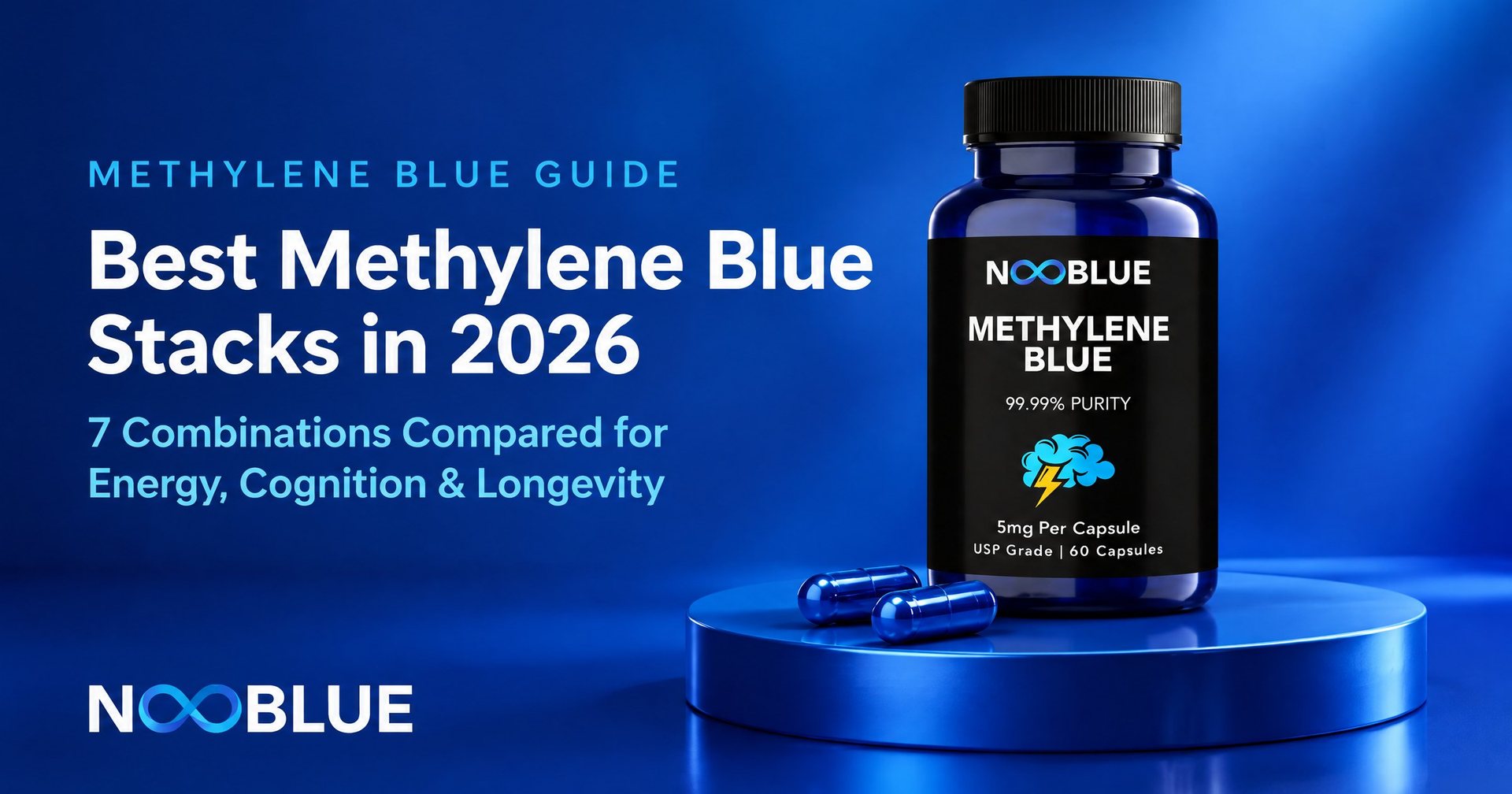
Rank two goes to the other NooBlue format, and the honest reason is preference management rather than superiority. Ultimate Methylene Blue Capsules deliver 5 mg per capsule, with a suggested serving of one capsule daily, and the label says do not exceed the suggested serving. If you already have a capsule routine, adding this to the lineup costs zero willpower.
The capsule vs gummy decision is mostly about texture and ritual. Capsules are tasteless and quick, swallowed with your morning water, and they leave no flavour memory at all. Gummies give you a small chewable moment, which some people find easier to remember and others find childish.
Both views are legitimate. What does not change is the mechanism: methylene blue at low supplemental doses supports mitochondrial energy and focus either way, because the active is the same.
Cost is where the capsule pulls ahead. At $37.99, discounted from $49.99, for a 60-count bottle, the per-day cost is $0.63 against the gummy’s $0.83, a clear saving for the same daily habit. Over a year that difference is real money for an identical active. Bundle pricing on the product pages lowers the cost further when you buy multi-packs, and the trust line applies across the store: free worldwide shipping on orders over $100, 30-day returns, and dispatch within one to two business days with tracking.
The gummy’s advantages are real, though. It contains vitamin C, which can shift methylene blue toward its colourless form, and separately, it does not leave a blue mouth. Capsules are swallowed whole, so staining never arises in the first place, but if you like the vitamin C pairing built in, the gummy is the more complete single product. We ranked the gummy first for that reason, not for price.
Who is this for? Purists, capsule-takers, and anyone optimising cost per day on a supplement they plan to take long term. Who is it not for?
Anyone who struggles to swallow capsules, and anyone who wants the zero-effort single-unit habit. Both formats count toward the same goal, and our longevity supplements guide shows where methylene blue sits in the wider cellular-health stack.
Pros: cheapest per-day option on this list at $0.63. Same supported mechanism as the gummy. Simple one-capsule label.
Cons: no vitamin C pairing. No chewable format for capsule-averse users. A plain product in a category where ritual helps adherence.
3. Honey Stinger Energy Chews: best honey-based chew for workouts
Honey Stinger built its name on honey as a carbohydrate source, and the chews are the format most people meet first. These are true sports chews: carbohydrate servings designed to be eaten before or during exercise, when muscles are burning through glycogen and need easily digested sugar. The honey base is the differentiator, giving the chews a softer texture and a distinct flavour profile compared with purely glucose-based competitors.
The use case is narrow and honest. On a long run, ride, hike or ski day, a chew every 20 to 30 minutes is a classic fuelling pattern: small, frequent carbohydrate doses that are easier on the stomach than a gel slug. The chew format forces you to chew, which slows intake slightly and can reduce the sticky-teeth mess gels leave. For team-sport athletes and hikers who need portable calories without a wrapper ritual, the pocket format is a genuine advantage over drink mixes.
Caffeine is a label check, not a constant. Some Honey Stinger chew varieties include caffeine and others do not, and the split changes between flavours and product generations, so read the label of the exact pack you buy if caffeine timing matters to your evening or your stomach. The same applies to the rest of the sports field, which is why our comparison table says see label rather than quoting a number that expires with the next reformulation.
Who are Honey Stinger chews for? Endurance athletes who want a natural-leaning carbohydrate source, and anyone who finds the honey texture more palatable than dense glucose chews. They pair well with the long slow days where the NooBlue daily support already happened at breakfast.
Who are they not for? Desk workers: outside of a workout window, a sports chew is just candy with a better press release, and a daily habit belongs in the daily category instead. If your fatigue is not exercise-related, our guide on how to wake up your brain is a better starting point.
Pros: honey-based carbohydrate for the sports window. Soft chewable format. Well-established endurance brand.
Cons: event-only utility. Label-check required for caffeine. No role in a daily non-training routine.
4. Clif Bloks Energy Chews: best for long runs and rides
Clif Bloks are the endurance workhorse of the chew world, and their design brief is long duration: the kind of day where you are moving for three hours or more and need repeated carbohydrate top-ups. The cube format is denser than a gummy bear style chew, which matters at mile 15 when chewing something substantial feels better than another sweet gel.
The typical pattern is one to three chews every 20 to 30 minutes on a long effort, adjusted to the intensity and your gut. Bloks are built to pair with Clif’s wider endurance system of bars, gels and drink mixes, so ultra runners and century riders can build a single-brand fuelling plan. Electrolytes feature in the range as well, which matters on hot days where sweat losses outrun a plain carbohydrate chew.
As with Honey Stinger, caffeine is flavour-dependent in the Bloks line, so check the label of the specific pack. That flexibility is actually a feature for racing: a caffeinated chew late in a long event and a non-caffeinated one early is a common strategy, and Clif’s range supports it within a single product family. Just do not let an unlabeled caffeinated chew ambush a 6 pm trainer session.
Who are Bloks for? Marathoners, ultra runners, and long-ride cyclists who want a dense, reliable chew that survives a back pocket. Who are they not for?
Anyone hunting a daily energy habit. Bloks have no mechanism beyond carbohydrate, so a morning Blok before a desk day is an unremarkable sugar serving, and the daily category on this list does the same job with a different tool. For a structured comparison of non-stimulant daily options, see our energy and focus without stimulants guide.
Pros: dense carbohydrate format suited to long durations. Established in marathon and cycling fuelling. Caffeine and non-caffeinated options in the line.
Cons: purely event-focused. Requires label attention per flavour. Not a daily-habit product.
5. GU Energy Chews: best for runners who want flavour variety
GU is best known for gels, and the chews extend that system for people who want the same fuelling logic in a solid format. The line leans on flavour rotation and a sports-science story, with the brand publishing extensive notes on carbohydrate blends and taste testing under the Chews banner. For runners who already trust GU gels, the chews slot into an existing fuelling plan without new maths.
The practical pattern matches the rest of this category: chews before or during long efforts, in the same 20 to 40 minute cadence racers use for gels. Because they are GU, the packaging and flavour familiarity transfer, which lowers the psychological barrier at aid stations. Some varieties include caffeine and others do not, so the label rule from the last two entries applies here with equal force.
Where GU chews earn their rank is variety and consistency of experience. Long-distance training means eating the same thing dozens of times, and flavour fatigue is a real attrition factor in fuelling plans. A deep rotation lets runners match chew to session mood, which sounds trivial until week 14 of a marathon build. Texture is softer than the densest competitors, which some guts prefer late in a hard effort.
Who are GU chews for? Runners and triathletes already inside the GU ecosystem, and anyone for whom flavour fatigue has wrecked previous fuelling plans. Who are they not for?
Non-athletes, again: the chews are carbohydrate delivery with a sports label, not a daily support. If your tiredness is chronic rather than effort-related, our methylene blue gummies comparison covers the daily side, and the daily category at the top of this list is the better tool.
Pros: strong flavour range for long training blocks. Integrates with GU’s gel system. Runner-focused formulation.
Cons: event-scoped. Caffeine varies by variety. Little relevance outside endurance sport.
6. Gatorade Energy Chews: best simple carb chew for sport
Gatorade’s chews are the most widely available entry on this list, sitting in grocery stores and gyms wherever the drinks are sold. That distribution is the pitch: a simple carbohydrate chew from a brand every athlete already recognises, with no specialist ordering and no niche price. For team sports, gym sessions and casual long rides, that accessibility matters more than marginal formulation differences.
The product philosophy is deliberately plain: carbohydrate for working muscles, in a format that fits a gym bag. Gatorade’s sports nutrition line extends from drinks to chews and protein, and the chews follow the same before-or-during logic as every other entry in this category. Electrolyte presence ties the chews to the brand’s hydration story, which suits hot-weather sports where sweat losses are the limiter.
Caffeine is a label check here too, so read the pack you buy rather than assuming. Because Gatorade chews are sold in multipacks at retail, freshness and storage are less controlled than a specialist endurance store, so check dates if you buy months ahead of a target event.
Who are Gatorade chews for? Team-sport athletes, younger competitive players, and casual endurance participants who want the simplest possible purchase path. Who are they not for?
Anyone seeking a daily non-exercise energy tool, or ultra athletes needing a dense multi-hour fuelling system, where entries three through five are more specialised. Gatorade is the accessible floor of the category rather than its ceiling, and that is exactly its role here. If you are building a broader supplement routine around training, our methylene blue for athletes guide covers the recovery side.
Pros: easiest to find in stores. Simple carbohydrate delivery. Familiar brand for team sports.
Cons: least specialised of the sports chews. Label-dependent caffeine. Limited appeal for ultras or daily non-training use.
Energy chews vs caffeine-free gummies: how to choose
Category first, brand second. If you are neither training long nor fuelling a match, no sports chew will beat a daily habit, because the mechanism you need is baseline support rather than sugar. Use this list to route yourself in one step.
- Workouts over 90 minutes: a sports chew from entries three to six, taken before or during the effort, with the label checked for caffeine.
- Workday focus without caffeine: NooBlue Methylene Blue Gummies, one gummy each morning, as the daily anchor.
- Caffeine-sensitive or evening study sessions: the same gummy, or the capsule version at $0.63 per day, since neither carries stimulant load.
- Cost-optimised long-term daily use: the NooBlue capsule at $37.99 per 60-day bottle, with bundle savings available.
- Race-day bag, not the kitchen shelf: any of entries three to six, matched to your sport and gut.
One honest note on mixing: a sports chew during a race and a daily gummy at home are different products for different moments. We do not recommend layering them in the same session, because the sports chew’s job is done by carbohydrate and the daily gummy’s job runs on a weeks-long horizon. Keep the race fuel in the race bag and the habit on the kitchen counter, and each does its own work.
See NooBlue Gummies · $49.99How we ranked these energy chews
The order reflects fit for the brief rather than a laboratory bake-off. This is a caffeine-free-first ranking, so daily products capable of a stimulant-free habit sit at the top, with the two NooBlue formats taking the leading positions because they are the only entries built exclusively for that job. NooBlue makes the gummy and the capsule. It is our pick for that daily role, and the capsule’s lower per-day cost is why it earns the second slot over a sports product.
Sports chews then rank by specialisation and availability. Honey Stinger leads the field on a distinctive honey-based carbohydrate story. Clif Bloks take the long-duration slot on density and endurance pedigree.
GU takes the variety slot for long training blocks. And Gatorade closes the list as the accessible generalist. No sports chew was penalised for being a sports chew, only for the narrowness that the daily-first brief implies.
Costs for NooBlue products come from our own listings as of Oct 2026, with per-serving figures computed from pack price and count. Competitor prices vary by retailer, flavour and pack size, so the comparison table shows check current price rather than a number that decays. Caffeine status is a see-label field for every sports chew, because brands reformulate and split caffeine across flavour lines without announcing it.
Nothing here involved laboratory testing of any product, and we invented no ratings: the ranking is a reasoned editorial judgement, ours, stated as such. If you want the wider non-stimulant category beyond chews, our stimulant-free energy and focus comparison and the methylene blue stacks guide cover the adjacent ground.
FAQ
Are energy chews good for you?
For their designed job, yes: sports chews supply carbohydrate to working muscles during long exercise, which is a legitimate fuelling strategy. Outside a workout window they are simply candy with a sports label, so daily non-athletes get little from them. A daily caffeine-free chew such as NooBlue Methylene Blue Gummies serves a different purpose, supporting mitochondrial energy and focus, and suits people whose energy issue is baseline rather than athletic. Match the category to the need and both can earn a place in your routine, just not interchangeably.
Do energy chews have caffeine?
Some do and some do not, and the split runs by flavour rather than brand rule across the sports category. Honey Stinger, Clif Bloks and GU all sell caffeinated and non-caffeinated varieties in their chew lines, so the same brand can appear in both columns. Always read the specific pack label, especially if you take a chew in the evening or stack it with coffee. NooBlue’s gummies and capsules contain no caffeine at all, which is why they lead a caffeine-free ranking like this one.
When should you take energy chews?
Sports chews belong before or during long endurance efforts, commonly in the 20 to 40 minute interval pattern racers use, starting before fatigue arrives rather than after. A daily caffeine-free chew follows the opposite logic: the same time each morning, with or without training, because its value accumulates over weeks of consistent use. Do not take a sports chew as an afternoon desk snack, and do not expect a daily gummy to rescue a bonking ride. Two categories, two clocks, and the label timing is part of the product.
Are energy chews good for running?
Yes, that is the core use case. Long runs beyond about 90 minutes deplete glycogen to the point where mid-run carbohydrate measurably extends performance, and chews are one of the easiest formats to carry and eat on the move. Take them at regular intervals starting early in the run rather than waiting for fatigue.
For shorter easy runs, they are optional. NooBlue’s role in a running routine sits on the recovery side, supporting cellular energy production between sessions rather than fuelling the miles themselves.
Honey Stinger vs Clif Bloks: which is better?
For long runs and rides, Clif Bloks are denser and better suited to multi-hour efforts, with a deep endurance pedigree and flavour-dependent caffeine options. Honey Stinger counters with a honey-based carbohydrate source, a softer texture many stomachs prefer, and a natural-leaning story. Both are legitimate.
The choice is texture and carbohydrate-source preference, not quality. Neither belongs in a daily non-training routine, where a caffeine-free gummy such as the NooBlue pick at the top of this guide is the more purposeful tool. Check both labels for caffeine before race day.
Can you take energy chews every day?
Sports chews, yes, if you train every day: a chew before or during each long session is standard practice, and there is no harm in daily use within an active routine. As a desk-day snack they add sugar without purpose, so daily non-athletes are better served by a daily-support product instead. NooBlue Methylene Blue Gummies are explicitly designed for daily use at one 10 mg gummy per day, with a 60-count pack covering two months.
Daily habits suit daily formats. Event fuels suit events.
What is a caffeine-free energy chew?
It is a chewable energy product with no stimulant content, and the phrase covers two different categories. Sports chews sold without caffeine deliver pure carbohydrate for workouts. Daily chews deliver non-stimulant support for mitochondrial energy and focus, and methylene blue at low supplemental doses is one example: NooBlue’s gummy pairs 10 mg of it with vitamin C in a one-a-day format. If you see a chew marketed for energy, check whether the mechanism is sugar, caffeine or cellular support before you buy, because the three barely overlap.
How many energy chews should I take?
Follow the pack, because serving logic differs by category. Sports chews publish a during-exercise interval on the label, commonly a small number of chews every 20 to 30 minutes on long efforts, adjusted to intensity and gut tolerance. NooBlue Methylene Blue Gummies are one gummy daily, and the capsule is one capsule daily with a do-not-exceed note on the label.
Neither is a more-is-better product. If you are unsure how any chew fits your medicines or health picture, that conversation belongs with your doctor, not a blog.
What is the best energy chew?
For a daily caffeine-free habit, NooBlue Methylene Blue Gummies are our pick, with the capsule version as the budget alternative at $0.63 per day. For sports fuel, the honest answer is the chew that matches your event: Honey Stinger for honey-based fuelling, Clif Bloks for long durations, GU for flavour variety across a training block, and Gatorade for easy access. There is no single best chew across both categories, because daily cellular support and mid-race carbohydrate are different jobs, and the right product is the one built for yours.
The bottom line
Energy chews split into two honest categories, and the fastest way to waste money is to buy from the wrong one. Sports chews from Honey Stinger, Clif, GU and Gatorade are carbohydrate tools for long efforts, and they do that job well inside a workout window. Daily caffeine-free support is a different project, and that is where NooBlue Methylene Blue Gummies earn the top rank: 10 mg of methylene blue with vitamin C, one gummy a day, no caffeine, and a mechanism aimed at mitochondrial energy rather than a sugar spike.
If you train long, pick the sports chew that fits your event from entries three to six. If your battle is the workday slump, start the daily habit instead, and give it weeks rather than sessions to show what it does. Both paths are legitimate. They just share a shelf, not a purpose.
Safety notes for methylene blue
Methylene blue is an active compound and deserves respect. Do not take it with SSRIs, SNRIs, MAOIs or other serotonergic medicines, because serotonin syndrome is a documented risk of the combination. It is not for people with G6PD deficiency. Skip it during pregnancy or breastfeeding, and keep it away from anyone under 18.
Expect your urine to turn blue or green while taking any methylene blue format, gummies included. That is normal and not a problem. If you take any prescription medicine at all, talk to your doctor before adding a methylene blue product, and mention the specific medicines, since interaction checking is exactly what they are trained for.
This guide is for information only and is not medical advice. Supplements support normal body function and are not intended to diagnose, treat, cure or prevent any disease. Statements here have not been evaluated by any regulatory body.
Sources
- Gillman PK. Methylene blue and serotonin toxicity: definite causal link. Psychosomatics, 2010 (PubMed)
- Rojas JC et al. Neurometabolic mechanisms for memory enhancement and neuroprotection of methylene blue. Prog Neurobiol, 2012 (PubMed)
- NooBlue Methylene Blue Gummies product page
- NooBlue Ultimate Methylene Blue Capsules product page