Quick answer
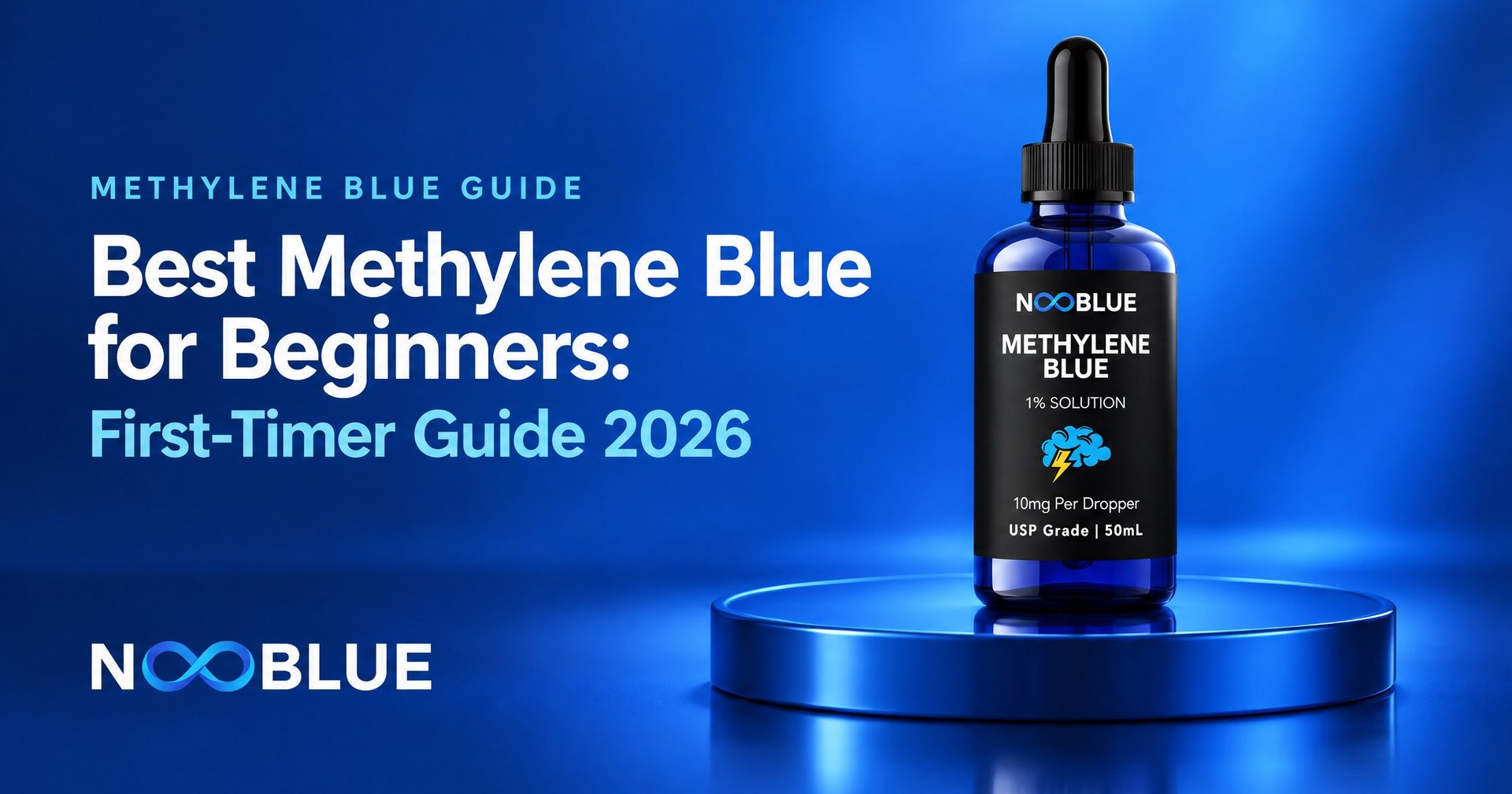
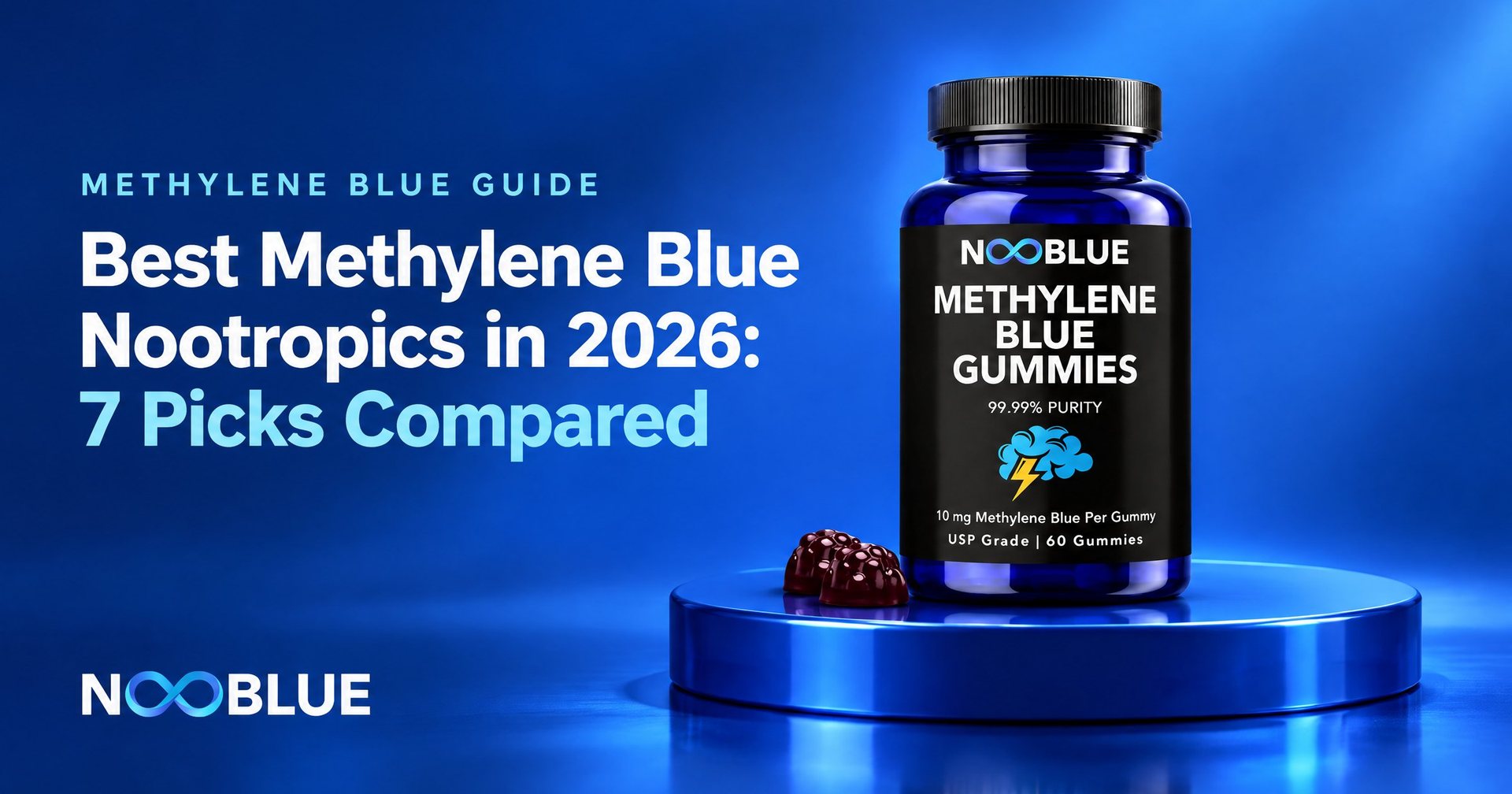
Our pick for the best methylene blue nootropic is NooBlue Methylene Blue Gummies: 10 mg of USP-grade methylene blue and 25 mg of vitamin C per gummy, 60 gummies for $49.99, or $0.83 a day, with nothing to measure. NooBlue makes it, and three of the seven products here are ours, so we flag every place a competitor does something better.
- Best for a low 5 mg start: NooBlue Ultimate Methylene Blue Capsules, $37.99 for 60.
- Finest dose control: NooBlue 1% drops, 0.5 mg per drop, $29.99 for 50 mL.
- Lowest cost per milligram: Chemist Labs 10 mg capsules, $44.99 for 120, about $0.037 per mg.
- Best finished-product testing among competitors: Nutricel Blue Boost, which publishes a finished-product potency report.
- Before you buy: methylene blue is not for anyone taking serotonergic antidepressants or stimulant ADHD medication, anyone with G6PD deficiency, or anyone pregnant or breastfeeding.
A methylene blue nootropic is a low-dose methylene blue supplement taken for focus and mental energy. The compound is a century-old dye and medicine that, at low doses, passes electrons along the mitochondrial energy chain. It is also sold as a lab reagent, an aquarium treatment and a chemical, sometimes at grades never meant to be swallowed. So the useful questions are dull ones: what grade is it, what testing can you read, what does one real dose cost, and will you still be taking it in six weeks?
This guide compares seven methylene blue products on those questions, using each brand’s own product page as of Sep 2026. NooBlue makes the gummies, capsules and drops ranked #1 to #3, and they are our picks. We have not lab-tested any competitor product. Every competitor figure comes from its own page, and where we could not check a claim we left it out.
Table of contents
- 1. Best Methylene Blue Nootropics in 2026: Side-by-Side Comparison
- 2. How We Picked the Best Methylene Blue Nootropics
- 3. Cost per Day at the Dose You Actually Take
- 4. 1. NooBlue Methylene Blue Gummies: Our Pick for Daily Use
- 5. 2. NooBlue Ultimate Methylene Blue Capsules: Best for a Low 5 mg Start
- 6. 3. NooBlue Methylene Blue Drops 1%: Finest Dose Control
- 7. 4. LVLUP Health Mito Blue: Best All-in-One Mitochondrial Stack
- 8. 5. Nutricel Blue Boost: Best Finished-Product Potency Testing
- 9. 6. Chemist Labs Methylene Blue Capsules: Lowest Cost per Milligram
- 10. 7. Meraki Blu: Small Liquid Bottle
- 11. What the Research Says About Methylene Blue as a Nootropic
- 12. What the Dose Range Actually Looks Like
- 13. How to Start: A Simple Two-Week Plan
- 14. How Methylene Blue Differs From Other Nootropics
- 15. Red Flags to Avoid When Buying a Methylene Blue Nootropic
- 16. Who Should Be Cautious With Methylene Blue
- 17. Frequently Asked Questions About Methylene Blue Nootropics
- 17.1. What is the best methylene blue nootropic supplement?
- 17.2. Does methylene blue work as a nootropic?
- 17.3. What dose of methylene blue is used for focus?
- 17.4. Do methylene blue gummies stain your teeth and tongue?
- 17.5. Are methylene blue gummies, capsules or drops better?
- 17.6. Why is methylene blue liquid cheaper per milligram?
- 17.7. Is methylene blue safe to take every day?
- 17.8. What should I look for when buying methylene blue?
- 17.9. Can I take methylene blue with coffee?
- 17.10. Where can I buy a quality methylene blue nootropic?
- 18. The Verdict: Which Methylene Blue Nootropic Should You Buy in 2026?
- 19. Sources
Best Methylene Blue Nootropics in 2026: Side-by-Side Comparison
Cost per milligram divides the one-time price by the total methylene blue in the pack, which is the only way to compare a 5 mg capsule with a 12 mg capsule or a solution. Prices as of Sep 2026.
| Rank | Product | Format | Methylene blue per unit | Price | Cost per mg | Best for |
|---|---|---|---|---|---|---|
| 1 | NooBlue Methylene Blue Gummies | Gummy with vitamin C | 10 mg | $49.99 (60) | $0.083 | Our pick: easiest daily routine |
| 2 | NooBlue Ultimate Methylene Blue Capsules | Capsule with vitamin C | 5 mg | $37.99 (60) | $0.127 | A low 5 mg start |
| 3 | NooBlue Methylene Blue Drops, 1% | Liquid, 50 mL | 0.5 mg per drop | $29.99 | $0.060 | Finest dose control |
| 4 | LVLUP Health Mito Blue | Capsule with ALCAR, ubiquinol, PQQ | 10 mg | $89.99 (60) | $0.150 | All-in-one mitochondrial stack |
| 5 | Nutricel Blue Boost | Capsule with vitamin C ester and cacao | 12 mg | $34.90 (60) | $0.048 | Finished-product potency testing |
| 6 | Chemist Labs Methylene Blue Capsules | Capsule | 10 mg | $44.99 (120) | $0.037 | Lowest cost per mg |
| 7 | Meraki Blu | Liquid, 30 mL (0.5%) | About 0.25 mg per drop | $35.00 | $0.233 | Small liquid bottle |
How We Picked the Best Methylene Blue Nootropics
Three of the seven products are ours, and we say that first because a roundup that hides it is not worth reading. NooBlue holds #1 to #3 because we make those products and they are the ones we recommend. The order from #4 to #7 reflects documentation you can read, the dose per unit, cost per milligram and how easy the format is to use every day. It is an editorial judgment from a brand with a stake in the category, not a laboratory comparison.
What we compared is paperwork and labels: stated grade, the testing documents each brand publishes, label dose, the live price and format. Two entries from the older version of this list are gone. Troscriptions Just Blue troches are now sold only through healthcare practitioners, with no direct checkout on the brand’s page, and a generic “unbranded marketplace capsules” entry was never a product you could buy. If grade language confuses you, our guide to lab grade versus pharmaceutical grade methylene blue explains what each term does and does not guarantee.
Cost per Day at the Dose You Actually Take
Cost per milligram rewards high-dose products, which is not much help if you only want 5 mg. This table shows what a day costs at 5 mg and at 10 mg, using each product’s one-time price and only the doses its format can deliver without splitting a capsule.
| Product | 5 mg a day | 10 mg a day | Notes |
|---|---|---|---|
| NooBlue Gummies | Not possible | $0.83 (1 gummy) | Fixed 10 mg chew |
| NooBlue Capsules | $0.63 (1 capsule) | Above the label (one capsule a day) | Easiest way to start at 5 mg |
| NooBlue Drops 1% | $0.30 (10 drops) | $0.60 (20 drops) | Any dose in 0.5 mg steps |
| LVLUP Mito Blue | Not possible | $1.50 (1 capsule) | Includes ALCAR, ubiquinol and PQQ |
| Nutricel Blue Boost | Not possible | Not possible (12 mg capsule, $0.58) | Smallest dose is 12 mg |
| Chemist Labs Capsules | Not possible | $0.37 (1 capsule, 120-count) | Cheapest 10 mg day here |
| Meraki Blu | $1.17 (1 mL) | $2.33 (2 mL) | Dilute 0.5% solution |
At 10 mg a day, Chemist Labs is the cheapest option and our drops come second. At 5 mg a day, our drops are the cheapest and our capsules are the simplest. Price is only one part of the choice, so weigh it against testing, format and whether you actually want a 10 mg day.
1. NooBlue Methylene Blue Gummies: Our Pick for Daily Use
The gummies take the top spot because they remove the two things that make people quit methylene blue: measuring and mess. Each gummy pairs 10 mg of USP-grade methylene blue with 25 mg of vitamin C in a Wild Blueberry pectin chew with zero sugar, sweetened with stevia. You chew one a day, and a bottle lasts 60 days.
The vitamin C has a chemical job. It can donate electrons to methylene blue and shift some of it toward leucomethylene blue, the colorless reduced form, and NooBlue gummies don’t leave the blue mouth that drops can. The purple color of the gummy comes from blueberry extract. Our explainer on what leucomethylene blue is covers the chemistry.
- Label: 60 gummies, 10 mg methylene blue USP and 25 mg vitamin C each, one a day.
- Price: $49.99, or $0.83 a gummy and $0.083 per mg. Two bottles cost $89.98, three cost $127.47 and five cost $199.96.
- Testing: Contract Testing Laboratories of America (CTLA) analyzed the methylene blue ingredient, lot 2025022801, recording an HPLC identity result of “Conforms” and individual results for arsenic, cadmium, mercury and lead. That report covers the raw ingredient, not each finished batch, and gives no purity percentage. The certificate is on our quality page.
Who it suits: people who want a standard 10 mg daily dose with no measuring. Who it doesn’t: anyone who wants to start at 5 mg or adjust in small steps, and anyone taking the medicines listed in our safety section. See the NooBlue gummies, or compare other brands in our roundup of the best methylene blue gummies.
2. NooBlue Ultimate Methylene Blue Capsules: Best for a Low 5 mg Start
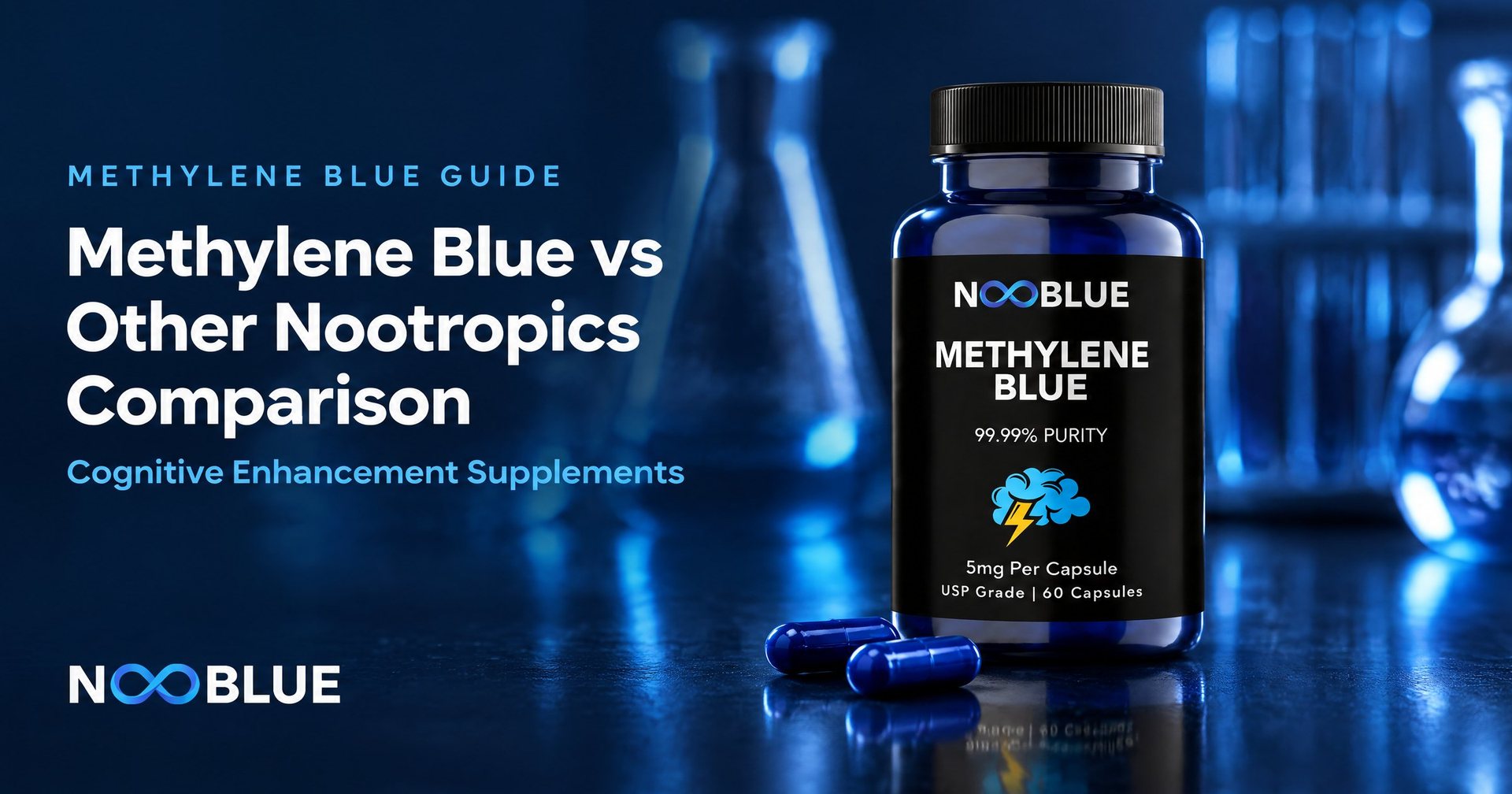
For a first bottle, the capsules are often the smarter choice. Each capsule holds 5 mg of USP-grade methylene blue with 10 mg of vitamin C in a rice flour and cellulose capsule, and the label says one a day with food. Starting at 5 mg lets you judge your own response first. The label is one capsule a day, so if you later want a 10 mg day, switch to one gummy or 20 drops.
- Label: 60 capsules, 5 mg methylene blue USP and 10 mg vitamin C each.
- Price: $37.99 (down from $49.99), or $0.63 a capsule and $0.127 per mg, the highest cost per mg of our three formats.
- Testing: the same CTLA ingredient report. Our guide to reading a methylene blue certificate of analysis shows which lines matter.
Who it suits: first-time users and anyone who wants to sit at 5 mg. Who it doesn’t: people chasing the lowest cost per mg. See the NooBlue capsules, and for other brands our list of the best methylene blue capsules.
3. NooBlue Methylene Blue Drops 1%: Finest Dose Control
The drops are a 1% USP-grade solution: 0.5 mg of methylene blue per drop and 10 mg per full dropper. A 50 mL bottle holds 500 mg, which is about 100 servings of 5 mg (10 drops). At $29.99 (down from $39.99) that is $0.060 per mg, or $0.30 per 5 mg serving.
Drops are the only format that lets you choose any dose in half-milligram steps. The trade-off is handling: the liquid is vivid blue and stains skin, fabric and counters, and you have to count drops every time. Our comparison of methylene blue capsules versus liquid sets out both sides.
Who it suits: experienced users who want an exact dose. Who it doesn’t: anyone who wants a no-mess routine. See the NooBlue drops or our roundup of the best methylene blue drops.
4. LVLUP Health Mito Blue: Best All-in-One Mitochondrial Stack
LVLUP Health Mito Blue is the most complete formula here. Each capsule combines 10 mg of methylene blue with acetyl-L-carnitine 400 mg, ubiquinol 100 mg and PQQ 10 mg, and the label serving is one capsule a day. The bottle holds 60 capsules. LVLUP’s page showed $89.99 and a lower $80.99 price when we checked, so we used $89.99: $1.50 a capsule and $0.150 per mg of methylene blue. LVLUP states that every lot gets third-party testing, though we did not see a certificate linked on the product page.
Who it suits: people who want one capsule covering several mitochondrial nutrients. Who it doesn’t: anyone already taking CoQ10 or carnitine, who would be doubling up, and anyone who wants to adjust the methylene blue dose separately.
5. Nutricel Blue Boost: Best Finished-Product Potency Testing
Nutricel Blue Boost supplies 12 mg of USP-grade methylene blue per capsule with 35 mg of vitamin C ester (ascorbyl palmitate) and 235 mg of organic cacao powder. A 60-capsule bottle costs $34.90, which is $0.58 a capsule and about $0.048 per mg. Nutricel suggests starting with one capsule in the morning.
Its documentation is the strongest among the competitors. Nutricel’s certificates page links a Blue Boost report, dated July 2025, covering methylene blue potency, heavy metals and microbes. Nutricel says Eurofins checks heavy metals and microbes after bottling and that methylene blue content is confirmed by titration against the label claim. That is a step beyond our own published report, which covers the raw ingredient. Our Nutricel vs NooBlue comparison goes into the detail.
Who it suits: buyers who want finished-product testing and are comfortable starting at 12 mg. Who it doesn’t: anyone who wants a lower first dose, since the capsule is more than twice our 5 mg.
6. Chemist Labs Methylene Blue Capsules: Lowest Cost per Milligram
Chemist Labs Methylene Blue Capsules contain 10 mg of USP-grade methylene blue per capsule. The brand store lists 60 capsules for $34.99 and 120 for $44.99. The larger bottle works out to about $0.37 a capsule and $0.037 per mg, the lowest cost per milligram in this comparison. Chemist Labs says every batch is third-party tested and posts lab reports for several capsule lots on its site; we did not audit those documents.
Who it suits: cost-focused buyers who want a 10 mg capsule. Who it doesn’t: anyone who wants to start below 10 mg, since the capsules are not designed to be split.
7. Meraki Blu: Small Liquid Bottle
Meraki Blu is a liquid with 150 mg of methylene blue in a 30 mL bottle and a 1 mL dropper. That works out to a 0.5% solution, half the strength of a 1% product, and Meraki’s page puts one drop at about 0.25 mg. One bottle costs $35.00, two cost $65.00 and three cost $89.00. At the single-bottle price that is about $0.233 per mg, the highest here.
Two details are worth knowing. The product description says “For research purposes only,” which sits oddly with a product sold for daily use. And the certificates shown on the page cover heavy metals, formaldehyde and microbes; we did not see a potency or purity test among them. We cover the brand in our Meraki methylene blue review and NooBlue vs Meraki comparison.
Who it suits: people who want a small bottle of dilute solution. Who it doesn’t: anyone comparing on cost per milligram or on published potency testing.
What the Research Says About Methylene Blue as a Nootropic
The case rests on mechanism plus a handful of human studies. At low doses, methylene blue acts as an electron cycler in the mitochondrial electron transport chain. A 2012 review in Progress in Neurobiology concluded that the available data support a major role for cytochrome oxidase in its memory-enhancing effects, and it stressed a hormetic dose response in which low and high doses have opposite effects (Rojas et al., 2012).
The best supporting human trial gave 26 healthy adults a single 280 mg oral dose or placebo. One hour later, methylene blue had increased brain activity during attention and short-term memory tasks and was associated with a 7% increase in correct memory-retrieval responses (Rodriguez et al., 2016). The strongest evidence pointing the other way comes from King’s College London. In healthy volunteers given 0.5 or 1 mg/kg into a vein, methylene blue reduced global cerebral blood flow and the brain’s oxygen use, the opposite of what the researchers expected (Singh et al., 2023). The authors suggested the doses may have been above the helpful end of the hormetic curve.
Put together, the evidence is early and mixed. No trial has tested the 5 to 12 mg doses sold as supplements for focus, and the studies so far used single doses. Treat methylene blue as a well-described mechanism with limited human data, not a proven brain booster.
What the Dose Range Actually Looks Like
Supplement doses sit in the single digits to low teens of milligrams: 5 mg in our capsules, 10 mg in our gummies and in two competitors’ capsules, and 12 mg in Nutricel’s. The research doses were much higher, at 280 mg by mouth in the Texas imaging trial (about 4 mg/kg for an average adult) and 0.5 to 1 mg/kg by vein in the London study. Hospital uses are a different setting altogether and not a template for daily use.
Three practical rules follow. More is not the goal, because of the hormetic curve. Start at 5 mg and hold there for a couple of weeks before changing anything. And keep it to the morning or early afternoon, which is when many of our customers take it. Our guide to how many mg of methylene blue per day covers the details, and if you take your dose with coffee, read our note on methylene blue and coffee first. For identity and chemical data, the public PubChem record for methylene blue is a more reliable reference than any seller’s page.
How to Start: A Simple Two-Week Plan
A methylene blue nootropic is easiest to judge when you change one thing at a time. This is the routine we suggest for a first bottle, assuming you have checked the safety list below and take no interacting medicine.
- Days 1 to 3: take 5 mg (one capsule or 10 drops) in the morning with food. Expect blue or green urine. Note how you sleep.
- Days 4 to 14: keep the same dose at the same time each day. Write down one or two things you care about, such as how the afternoon feels or how long you can read without drifting. Keep caffeine and other supplements the same as usual.
- After two weeks: decide whether to stay at 5 mg, move to 10 mg (one gummy or 20 drops; capsules stay at one a day) or stop. If you move up, hold the new dose for another two weeks before judging it.
- At any point: stop and talk to a doctor if you notice anything unusual, and never add methylene blue to a serotonergic antidepressant or stimulant ADHD medicine.
Two weeks is a practical window rather than a research finding. The human studies measured single doses, so nobody has mapped how a daily low dose builds over time. Keeping a short log is the only way to know whether it is doing anything for you.
How Methylene Blue Differs From Other Nootropics
Most nootropics work on signaling. Caffeine blocks adenosine, stimulants release dopamine and norepinephrine, and choline sources feed acetylcholine. Methylene blue works one level down, inside mitochondria. It also inhibits the enzyme MAO-A, which is why it cannot be combined with serotonergic antidepressants. Our guides to focus supplements without stimulants, methylene blue vs Mind Lab Pro and methylene blue vs Adderall compare it with the alternatives people ask about, and our focus supplements roundup covers wider options.
Red Flags to Avoid When Buying a Methylene Blue Nootropic
- No testing document you can read. If a seller will not show a certificate before you buy, nothing on the label is checkable.
- A certificate with no potency or identity result. Heavy metals and microbes matter, but a document that never confirms the methylene blue itself leaves the main question open.
- Grade words that are not grades. “Premium” and “ultimate” are marketing. USP is a grade.
- “For research purposes only” or aquarium labeling. A product labeled that way is not presented as something to swallow.
- Strength you cannot work out. Check the milligrams of methylene blue per mL or per drop. A 0.5% solution has half the methylene blue of a 1% solution at the same volume.
- Anonymous marketplace listings. No brand history, no contact details and no certificate means no way to trace a batch.
Who Should Be Cautious With Methylene Blue
Methylene blue is a reversible MAO-A inhibitor (Ramsay et al., 2007). The label of the injectable drug carries a boxed warning for serotonin syndrome when it is combined with SSRIs, SNRIs, MAO inhibitors or opioids, and it lists G6PD deficiency as a contraindication (injection label). Stimulant ADHD medicines are also off limits, it should not be used while pregnant or breastfeeding, and it is not for anyone under 18. It turns urine blue or green, which is harmless. Read our guides to who should not take methylene blue and methylene blue and serotonin syndrome, and talk to your doctor or pharmacist if you take any prescription medicine.
Frequently Asked Questions About Methylene Blue Nootropics
What is the best methylene blue nootropic supplement?
Our pick is NooBlue Methylene Blue Gummies, which we make: 10 mg of USP-grade methylene blue and 25 mg of vitamin C per gummy, 60 for $49.99, with nothing to measure. If you want to start lower, NooBlue’s 5 mg capsules are the better first step. Among competitors, Chemist Labs has the lowest cost per milligram and Nutricel publishes the most complete finished-product testing.
Does methylene blue work as a nootropic?
The evidence is early and mixed. One trial found that a single 280 mg dose increased brain activity during memory tasks and improved memory retrieval by 7% in 26 healthy adults. A 2023 study found that 0.5 to 1 mg/kg by vein reduced brain blood flow and oxygen use in healthy volunteers. No trial has tested typical 5 to 12 mg supplement doses for focus.
What dose of methylene blue is used for focus?
Supplements provide 5 to 12 mg per unit. Our capsules contain 5 mg and our gummies 10 mg, and we suggest starting at 5 mg for two weeks before changing anything. Because methylene blue has a hormetic dose response, higher is not better. Our methylene blue dosage guide explains the reasoning.
Do methylene blue gummies stain your teeth and tongue?
Ours don’t. NooBlue gummies don’t leave the blue mouth that drops can. They contain 25 mg of vitamin C, which can shift methylene blue toward its colorless reduced form, and their purple color comes from blueberry extract. Drops can stain, because oxidized methylene blue is deep blue and the liquid touches the tongue directly. With any format, urine can turn blue or green.
Are methylene blue gummies, capsules or drops better?
Gummies suit people who want a fixed 10 mg with no measuring. Capsules suit people who want to start at 5 mg and swallow a neutral capsule. Drops suit people who want to set their own dose in 0.5 mg steps and accept the mess. All three NooBlue formats use USP-grade methylene blue.
Why is methylene blue liquid cheaper per milligram?
You buy bulk active ingredient and do the dosing yourself. NooBlue drops hold 500 mg for $29.99, or $0.060 per mg, against $0.127 per mg for our 5 mg capsules. High-dose capsules can be cheaper still per milligram: Chemist Labs’ 120-count bottle is about $0.037 per mg, but each capsule is 10 mg.
Is methylene blue safe to take every day?
Many people take low doses daily, but it is not for everyone. It must not be combined with SSRIs, SNRIs, MAO inhibitors, opioids or stimulant ADHD medicines, and it is not for people with G6PD deficiency, anyone pregnant or breastfeeding, or anyone under 18. Talk to your doctor before starting if you take prescription medication.
What should I look for when buying methylene blue?
Check four things: a testing document you can read, ideally one that confirms the methylene blue itself; a named grade such as USP; the cost per milligram rather than the sticker price; and a brand you can contact. Our certificate of analysis guide explains what to look for on the paperwork.
Can I take methylene blue with coffee?
Many people take their dose with morning coffee. For the first two weeks, keep your usual coffee routine unchanged so you can tell what methylene blue is adding, and take both early in the day to protect sleep. Our note on methylene blue and coffee covers timing in more detail.
Where can I buy a quality methylene blue nootropic?
Buy from a brand that names its grade, publishes testing you can read and gives you a way to contact it. NooBlue sells capsules, gummies and drops at nooblue.com with free worldwide shipping on orders of $100 or more, 30-day returns and dispatch in 1 to 2 business days with tracking. Avoid anonymous marketplace listings with no certificate.
The Verdict: Which Methylene Blue Nootropic Should You Buy in 2026?
Our pick is NooBlue Methylene Blue Gummies for an easy daily 10 mg, with NooBlue’s 5 mg capsules as the better first bottle and our 1% drops for exact dosing. Among the competitors, LVLUP Mito Blue is the fullest stack, Nutricel Blue Boost has the strongest finished-product testing, Chemist Labs is the cheapest per milligram and Meraki Blu is a small, dilute liquid. Whatever you choose, check the safety list first and start low.
More buying guides: best methylene blue supplements, the NooBlue shop, all our buying guides and the NooBlue blog. Written by the NooBlue team. Back to the NooBlue home page.
Sources
- Rojas JC, Bruchey AK, Gonzalez-Lima F. Neurometabolic mechanisms for memory enhancement and neuroprotection of methylene blue. Progress in Neurobiology. 2012;96(1):32-45. PubMed 22067440
- Rodriguez P, Zhou W, Barrett DW, et al. Multimodal randomized functional MR imaging of the effects of methylene blue in the human brain. Radiology. 2016;281(2):516-526. PubMed 27351678
- Singh N, MacNicol E, DiPasquale O, et al. The effects of acute methylene blue administration on cerebral blood flow and metabolism in humans and rats. Journal of Cerebral Blood Flow & Metabolism. 2023;43(2 suppl):95-105. PubMed 36803299
- Ramsay RR, Dunford C, Gillman PK. Methylene blue and serotonin toxicity: inhibition of monoamine oxidase A (MAO A) confirms a theoretical prediction. British Journal of Pharmacology. 2007;152(6):946-951. PubMed 17721552
- ProvayBlue (methylene blue) injection, prescribing information, American Regent. DailyMed
- Rodriguez P, Singh AP, Malloy KE, et al. Methylene blue modulates functional connectivity in the human brain. Brain Imaging and Behavior. 2017;11(3):640-648 (dose selection: 280 mg, about 4 mg/kg). PMC5018244
- Competitor product pages read Sep 2026: LVLUP Health, Nutricel (and its certificates page), Chemist Labs, Meraki Medicinal and Troscriptions, as linked above. Nutricel certificates · Troscriptions Just Blue
- NooBlue product pages and quality page (label amounts, prices and the CTLA ingredient report), read Sep 2026. nooblue.com/quality