By the NooBlue editorial team · Part of our buying guides on the NooBlue blog · 8 products compared
Key takeaways
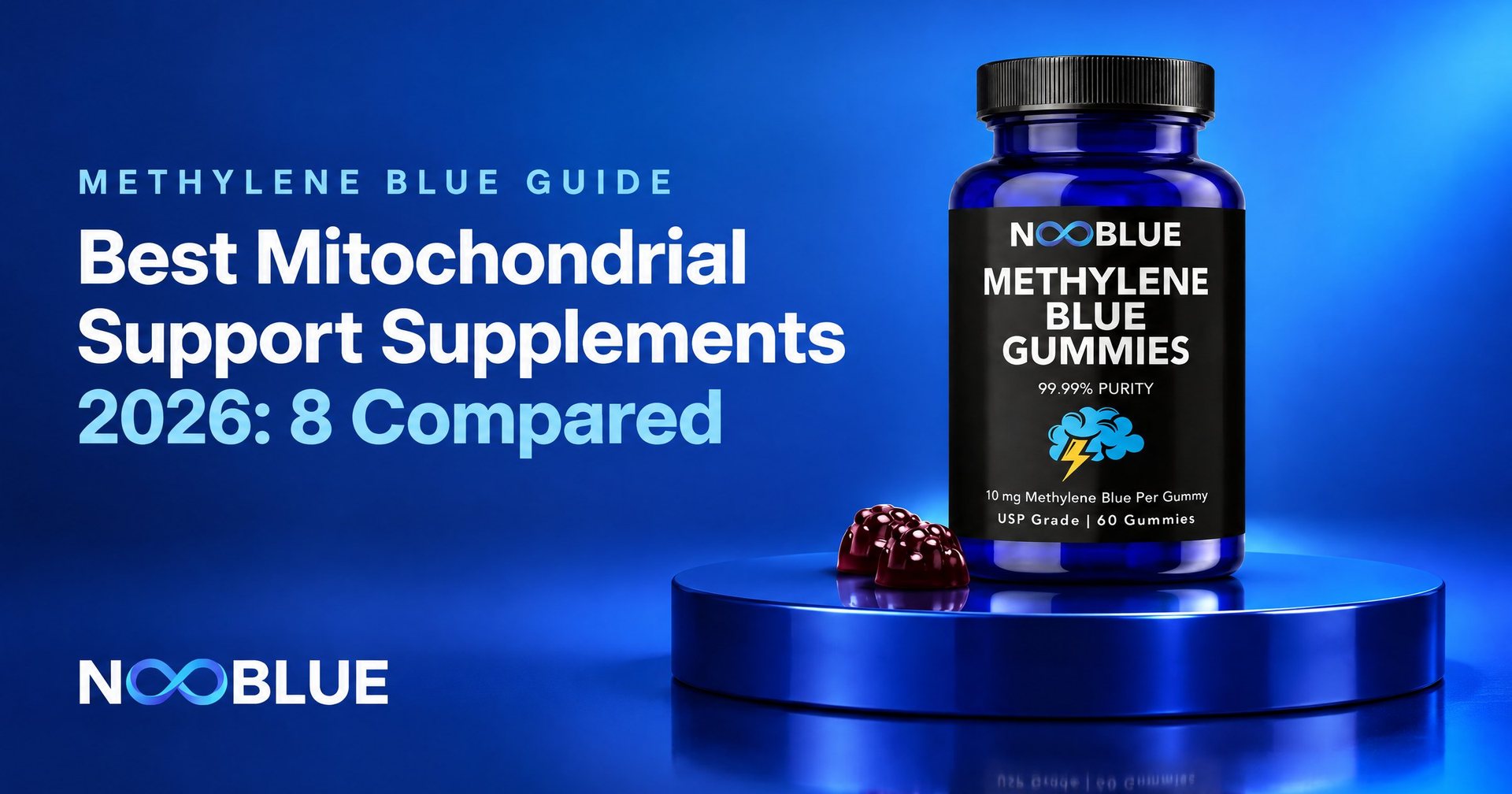
- Our pick among mitochondrial support supplements is NooBlue Methylene Blue Gummies: 10 mg of methylene blue with 25 mg of vitamin C, one a day, $0.83 a serving, and no blue mouth. NooBlue makes them, so read our ranking with that in mind.
- If you want the product with the most formula-level human data, Timeline Mitopure (urolithin A) has three published randomized trials, all run with or by the company that sells it.
- Mitopure, MitoQ and Tru Niagen each have published randomized human trials of their own branded ingredient, which we cite below. The multi-ingredient blends have no trial of the finished product and rest on studies of single ingredients.
- Daily cost ranged from $0.83 to $3.30 across the eight when we checked prices in September 2026. Blends that need two to four capsules a day cost more than their per-capsule price suggests.
- Methylene blue is not for anyone taking SSRIs, SNRIs, MAOIs or other serotonergic medicines, anyone with G6PD deficiency, anyone pregnant or breastfeeding, or anyone under 18.
Mitochondrial support supplements promise more cellular energy, but they work at very different points in the same system. Some feed the electron transport chain, some supply the NAD+ it runs on, some help cells clear worn-out mitochondria, and some are antioxidants aimed at the damage mitochondria cause. We compared eight of the best-known mitochondria supplements on what each does, what human research has measured, and what a day’s serving costs, so you can match a product to a goal rather than to a label.
NooBlue makes methylene blue supplements, and our gummies are ranked first. Every figure for the other seven products comes from their own product pages, checked in September 2026, or from the published trials we link. We have kept each product’s true strength next to its name, and every entry, ours included, says what has not been shown.
Table of contents
- 1. Quick Answer: The Best Mitochondrial Support Supplements
- 2. How We Compared These Mitochondria Supplements
- 3. Best Mitochondrial Support Supplements Compared
- 4. 1. NooBlue Methylene Blue Gummies: Best Overall Mitochondrial Support Supplement
- 5. 2. Timeline Mitopure Softgels: Strongest Human Evidence
- 6. 3. MitoQ Pure: Best Mitochondria-Targeted Antioxidant
- 7. 4. Tru Niagen 300 mg: Best-Documented NAD+ Precursor
- 8. 5. Doctor’s Best Ubiquinol with Kaneka 200 mg: Simplest CoQ10 Option
- 9. 6. Performance Lab Energy: Most Complete Two-Capsule Blend
- 10. 7. Life Extension Mitochondrial Energy Optimizer with PQQ: Broad Four-Capsule Formula
- 11. 8. LVLUP Mito Blue: Methylene Blue in a Combination Capsule
- 12. What a Mitochondrial Support Supplement Can and Cannot Do
- 13. Safety: Read Before You Buy
- 14. Frequently Asked Questions About Mitochondrial Supplements
- 14.1. What is the best mitochondrial supplement?
- 14.2. Do mitochondrial supplements really work?
- 14.3. How can you support your mitochondria naturally?
- 14.4. What are the signs of low mitochondrial energy?
- 14.5. Is there a mitochondria powder or booster that works?
- 14.6. What is Mito Blue?
- 14.7. Can I take methylene blue with CoQ10 or NR?
- 14.8. Are mitochondrial supplement reviews reliable?
- 15. The Verdict: Which Mitochondrial Support Supplement Should You Buy?
- 16. Sources
Quick Answer: The Best Mitochondrial Support Supplements
- NooBlue Methylene Blue Gummies: our pick for daily mitochondrial support, at $0.83 a day.
- Timeline Mitopure Softgels: the strongest formula-level human evidence.
- MitoQ Pure: the best-studied mitochondria-targeted antioxidant.
- Tru Niagen 300 mg: the best-documented NAD+ precursor.
- Doctor’s Best Ubiquinol with Kaneka 200 mg: the simplest CoQ10 option.
- Performance Lab Energy: the most complete two-capsule blend.
- Life Extension Mitochondrial Energy Optimizer with PQQ: a broad four-capsule formula.
- LVLUP Mito Blue: methylene blue combined with carnitine, ubiquinol and PQQ in one capsule.
How We Compared These Mitochondria Supplements
Most mitochondrial supplement reviews rank by ingredient popularity. We asked a narrower question for each product: what has human research on this product, or on its main ingredient, actually measured? We then sorted each one into an evidence tier:
- Direct mitochondrial marker. A human trial of the product’s ingredient measured mitochondrial biology, such as mitochondrial gene expression or plasma acylcarnitines.
- Direct biomarker. A human trial measured the molecule the product is meant to raise, such as NAD+, or a related function, without showing a change in mitochondrial output.
- Mechanistic. The mechanism is well described in laboratory and animal work and reviews, and human data are limited to small or single-dose studies.
- Ingredient-level only. The finished blend has no trial of its own, and the case rests on studies of individual ingredients, often at different doses.
We also compared cost per day using each label’s own daily serving, not the price per capsule, and noted who funded the key trials. Our ranking puts NooBlue first because it is our product and, at $0.83 a day in a format that does not stain the mouth, the one we think most people will take consistently. The evidence tiers tell you where each product stands on research, and on that measure methylene blue sits in the mechanistic tier. If you want the biology first, our explainers on how cells generate energy and what damages mitochondria are good starting points.
Best Mitochondrial Support Supplements Compared
Prices as of Sep 2026, from each brand’s own page. Cost per day uses the label’s daily serving.
| Rank | Product | Where it acts | Evidence tier | Price | Daily serving | Cost per day |
|---|---|---|---|---|---|---|
| 1 | NooBlue Methylene Blue Gummies | Electron transport chain | Mechanistic | $49.99 for 60 | 1 gummy (10 mg) | $0.83 |
| 2 | Timeline Mitopure Softgels | Mitophagy (clearing worn-out mitochondria) | Direct mitochondrial marker (company-run trials) | $99.00 for 60 | 2 softgels (500 mg urolithin A) | $3.30 |
| 3 | MitoQ Pure | Targeted antioxidant | Direct biomarker | $62.95 for a one-month supply | 2 capsules (10 mg) | About $2.10 |
| 4 | Tru Niagen 300 mg | NAD+ supply | Direct biomarker | $49.00 for 30 | 1 capsule (300 mg) | $1.63 |
| 5 | Doctor’s Best Ubiquinol 200 mg | Electron transport chain (CoQ10) | Mechanistic | $34.99 for 30 | 1 softgel (200 mg) | $1.17 |
| 6 | Performance Lab Energy | Fuel transport, cofactors, PQQ | Ingredient-level only | $69.00 for 30 servings | 2 capsules | $2.30 |
| 7 | Life Extension Mitochondrial Energy Optimizer with PQQ | Cofactors, antioxidants, PQQ | Ingredient-level only | $48.75 for 120 | 4 capsules | $1.63 |
| 8 | LVLUP Mito Blue | Methylene blue plus carnitine, ubiquinol, PQQ | Ingredient-level only | $80.99 to $89.99 for 60 | 1 capsule | $1.35 to $1.50 |
1. NooBlue Methylene Blue Gummies: Best Overall Mitochondrial Support Supplement
Key specs: 10 mg methylene blue (as Methylene Blue USP) and 25 mg vitamin C per gummy, 60 gummies, one a day, $49.99 ($0.83 per serving). Wild Blueberry flavor, zero sugar. Buying two bottles saves 10%, three save 15% and five save 20%.
NooBlue makes these gummies, and they are our pick at #1. Here is the case, and its limits.
Methylene blue works at a point in the pathway nothing else on this list touches. At low concentrations it cycles between an oxidized and a reduced form and can carry electrons in the mitochondrial chain directly from NADH to cytochrome c, which increases complex IV activity (Tucker et al., 2018). A review in Progress in Neurobiology describes it as an electron cycler with a hormetic dose response, meaning low and high doses can have opposite effects (Rojas et al., 2012). Most of that work is in cells and animals.
The human data are small. In a randomized, placebo-controlled brain-imaging trial, 26 healthy adults were enrolled and the active group took a single 280 mg dose (about 4 mg/kg). One hour later, methylene blue was linked to stronger brain responses during attention and short-term memory tasks and a 7% increase in correct answers on memory retrieval (Rodriguez et al., 2016). That was one dose, far above a 10 mg gummy, and it did not measure mitochondria directly. So we rate methylene blue mechanistic, below the three products with larger trials of their own ingredient.
Why rank it first anyway? Because a mitochondrial supplement only helps if you take it, and the gummy removes the two things that make people give up on methylene blue: measuring drops and a blue tongue. The gummies avoid the blue mouth that drops cause. At $0.83 a day it also costs less than every other product in this comparison. Urine can still turn blue or green, as with any methylene blue product.
On testing, here is exactly what we publish. Contract Testing Laboratories of America (CTLA) analyzed our methylene blue ingredient, lot 2025022801, in report 135621: an HPLC identity result of “Conforms” plus results for arsenic, cadmium, mercury and lead. The report covers the raw ingredient, not each finished batch, and it does not state a purity percentage. Our guide to reading a methylene blue certificate of analysis explains what to look for in any brand’s report.
Other NooBlue formats. If you want to start lower, NooBlue Ultimate Methylene Blue Capsules hold 5 mg each ($37.99 for 60, $0.63 a serving), and the 1% drops give about 0.5 mg per drop ($29.99 for 50 ml, about $0.30 per 5 mg). Capsules are swallowed whole. Drops can stain the mouth and tongue. Our guide to NooBlue capsules vs liquid solutions and our write-up of what the capsules offer go into the choice.
- Pros: the lowest daily cost here; no measuring; no blue mouth; a mechanism no other product on this list duplicates.
- Cons: human evidence is limited to small, mostly single-dose studies at higher doses; a fixed 10 mg serving gives less room to adjust than the drops; strict safety exclusions (see the safety section).
- Best for: healthy adults who take no serotonergic medicine and want an easy daily routine.
- Not for: anyone taking SSRIs, SNRIs, MAOIs or other serotonergic medicines, anyone with G6PD deficiency, anyone pregnant or breastfeeding, or anyone under 18.
2. Timeline Mitopure Softgels: Strongest Human Evidence
Key specs: urolithin A, 500 mg per daily serving of two softgels, 60 softgels (one month), $99.00, 30-day money-back guarantee. Timeline also sells Mitopure as a powder (Timeline).
Urolithin A works at the recycling end of the pathway. It promotes mitophagy, the process cells use to clear out damaged mitochondria. Researchers describe it as a compound gut bacteria make from certain foods (Andreux et al., 2019). Mitopure supplies it directly.
Mitopure has more formula-level human research than anything else here:
- In the first human trial, four weeks of 500 mg or 1,000 mg a day in healthy, sedentary older adults changed plasma acylcarnitines and skeletal muscle mitochondrial gene expression (Andreux et al., 2019).
- In 66 adults aged 65 to 90, 1,000 mg a day for four months improved muscle endurance in hand and leg muscles, but did not significantly improve the primary outcomes, the 6-minute walk distance and maximal ATP production in the hand muscle (Liu et al., 2022).
- In middle-aged adults, four months of Mitopure improved muscle strength by about 12% but not peak power output, the primary endpoint (Singh et al., 2022).
The caveat belongs in the same paragraph: these trials involved Amazentis, the company behind Mitopure, whose founder and employees are among the authors. That does not make the results wrong, but it is the reason we flag it.
- Pros: the most direct human mitochondrial data in this comparison; a mechanism no other product here duplicates; two softgels a day.
- Cons: the most expensive option at $3.30 a day; company-run research; primary endpoints in two trials were not met.
- Best for: people who want the most-studied formula and have the budget for it.
- Not for: anyone looking for a low-cost daily option.
3. MitoQ Pure: Best Mitochondria-Targeted Antioxidant
Key specs: MitoQ (as mitoquinol mesylate) 10 mg per serving of two capsules, $62.95 for a one-month supply (about $2.10 a day), subscription discounts available. Take two capsules with water 30 minutes before eating (MitoQ).
Ordinary antioxidants struggle to reach the inside of mitochondria, where most reactive oxygen species are made. MitoQ attaches a quinone antioxidant to a positively charged carrier that is drawn into mitochondria, so it builds up where the damage happens.
The best human trial is small but well designed. In 20 healthy adults aged 60 to 79 with below-normal blood vessel function, 20 mg a day for six weeks raised brachial artery flow-mediated dilation by 42% compared with placebo and lowered oxidized LDL, a marker of oxidative stress (Rossman et al., 2018). Note that the trial used 20 mg a day, double the 10 mg serving of MitoQ Pure. MitoQ’s page also footnotes its “up to 69% more ATP” claim as based on preclinical data, so that figure does not come from people.
- Pros: a real delivery mechanism; a placebo-controlled human trial with a measured benefit; one active ingredient.
- Cons: about $2.10 a day; the trial dose was twice the standard serving; the empty-stomach routine is easy to get wrong.
- Best for: people whose main interest is oxidative stress inside mitochondria.
- Not for: anyone who wants a direct energy or ATP effect shown in humans.
4. Tru Niagen 300 mg: Best-Documented NAD+ Precursor
Key specs: 300 mg nicotinamide riboside chloride per capsule, suggested use one capsule one to three times a day, $49.00 for 30 ($1.63 a serving), $127.00 for 90 and $244.00 for 180 (Tru Niagen).
NADH, the loaded form of NAD+, delivers electrons to the start of the mitochondrial chain. Nicotinamide riboside (NR) is a vitamin B3 form the body turns into NAD+. The biomarker evidence is clean. In an 8-week randomized trial in healthy overweight adults, 100, 300 and 1,000 mg of NR a day raised whole-blood NAD+ by 22%, 51% and 142% (Conze et al., 2019). ChromaDex, which makes Tru Niagen, funded that study and employed two of its authors. An independent crossover trial in healthy middle-aged and older adults also found NR well tolerated and effective at raising NAD+ metabolism (Martens et al., 2018).
What those trials did not show is better mitochondrial output. Raising NAD+ is an upstream change, and the step from “NAD+ went up” to “mitochondria work better” has not been closed in people. Our comparison of methylene blue vs NAD+ for cellular energy looks at the two approaches side by side.
- Pros: the best human NAD+ data here, including an independent trial; one capsule a day.
- Cons: $1.63 a day at one capsule, more at the higher suggested amounts; the main dose-response trial was company-funded; no measured mitochondrial benefit.
- Best for: people who want to target NAD+ specifically.
- Not for: anyone expecting a noticeable energy effect, which the trials did not measure.
5. Doctor’s Best Ubiquinol with Kaneka 200 mg: Simplest CoQ10 Option
Key specs: 200 mg ubiquinol (Kaneka) per softgel, 30 softgels, one a day with food, $34.99 ($1.17 a day), in extra virgin olive oil and MCT oil in a gelatin softgel (Doctor’s Best).
Coenzyme Q10 is an essential part of the mitochondrial electron transport chain, and the body makes its own. Ubiquinol is its reduced, electron-carrying form. A review in Frontiers in Physiology collected clinical trials of CoQ10 supplementation and concluded that larger and longer trials are still needed to confirm its benefits in most areas (Hernández-Camacho et al., 2018). We rate it mechanistic for a healthy adult’s daily energy.
This is the plain choice if you want CoQ10 on its own: one softgel, one ingredient, a known brand of ubiquinol. Our best CoQ10 supplements comparison covers other brands and the ubiquinol vs ubiquinone question, and our methylene blue vs CoQ10 guide compares the two electron-chain approaches.
- Pros: one softgel a day; a single, well-characterized ingredient; moderate cost.
- Cons: gelatin softgel (not vegan); human evidence for everyday energy in healthy adults is limited.
- Best for: people who want a simple CoQ10 product.
- Not for: vegans, or anyone who wants a multi-pathway formula.
6. Performance Lab Energy: Most Complete Two-Capsule Blend
Key specs: per serving of two capsules: magnesium (as malate) 60 mg, acetyl-L-carnitine 500 mg, R-lipoic acid 100 mg, MicroActive Q10 100 mg, BioPQQ 10 mg and BioPerine 2.5 mg. 30 servings, $69.00 one-time or $62.10 a month on subscription. Take two capsules in the morning or early afternoon on an empty stomach (Performance Lab).
This formula covers several steps at once: carnitine moves fatty acids into mitochondria to be burned as fuel, CoQ10 carries electrons in the chain, lipoic acid is a cofactor in energy metabolism, and PQQ is studied for its role in making new mitochondria. The label is fully disclosed, which is not true of every blend. The limit is the same as every combination product: there is no trial of this finished formula, so the case rests on studies of each ingredient, often at other doses.
- Pros: broad coverage in two capsules; every amount disclosed; caffeine free.
- Cons: $2.30 a day one-time; no trial of the finished product; empty-stomach timing.
- Best for: people who want one blend instead of buying carnitine, CoQ10 and PQQ separately.
- Not for: anyone who wants to know which ingredient is doing what.
7. Life Extension Mitochondrial Energy Optimizer with PQQ: Broad Four-Capsule Formula
Key specs: per serving of four capsules: carnosine 1,000 mg, taurine 800 mg, benfotiamine 150 mg, R-lipoic acid 150 mg, vitamin B6 (as pyridoxal 5′-phosphate) 100 mg and PQQ 10 mg. 120 capsules (30 servings), $48.75 one-time or $42.00 on AutoShip. Take two capsules twice a day without food (Life Extension).
This is the widest ingredient list in the comparison, built around cofactors and antioxidant support, with PQQ added for its biogenesis rationale. Like Performance Lab, the finished formula has no trial of its own. The four-capsule serving is the clearest case of per-capsule pricing misleading: $0.41 a capsule becomes $1.63 a day. The serving also contains 100 mg of vitamin B6, so check your total if you take other products that contain B6.
- Pros: broad formula; long-established brand; lower cost per day than Performance Lab at the one-time price.
- Cons: four capsules a day; no trial of the finished product; high B6 per serving.
- Best for: people comfortable with a larger daily capsule count who want many cofactors in one bottle.
- Not for: anyone who dislikes swallowing several capsules.
8. LVLUP Mito Blue: Methylene Blue in a Combination Capsule
Key specs: per capsule: acetyl-L-carnitine 400 mg, methylene blue 10 mg, PQQ 10 mg and ubiquinol 100 mg. 60 capsules, one a day. The page showed $89.99 and $80.99 when we checked in September 2026, with a further 10% off on subscription, so the cost is roughly $1.35 to $1.50 a day (LVLUP).
If you have searched for Mito Blue or “mitoblue”, this is the product. It combines the same 10 mg of methylene blue found in a NooBlue gummy with three other mitochondrial ingredients. That makes it convenient, and it also means every methylene blue warning applies. LVLUP’s page tells anyone taking serotonergic medicines to consult a qualified provider first. As a blend, it has no trial of the finished formula.
Compared with our gummies, Mito Blue costs more per day and adds carnitine, ubiquinol and PQQ. If you want those ingredients anyway, a combination capsule saves you buying three products. If you want methylene blue on its own and the freedom to choose the other ingredients separately, a single-ingredient product is the cleaner route. Do not take Mito Blue together with another methylene blue product, because the amounts add up.
- Pros: four mitochondrial ingredients in one capsule; one a day.
- Cons: no trial of the finished formula; costs more per day than methylene blue alone; the same safety exclusions as any methylene blue product.
- Best for: people who already planned to take carnitine, CoQ10 and PQQ with methylene blue.
- Not for: anyone taking serotonergic medicines, or anyone already using another methylene blue product.
What a Mitochondrial Support Supplement Can and Cannot Do
Mitochondria turn food into ATP, the energy currency cells run on. The products above work at different points: methylene blue and CoQ10 in the electron transport chain itself, NR in the NAD+ supply that feeds it, urolithin A in clearing out worn-out mitochondria, and MitoQ against the oxidative damage mitochondria produce. Our guide on how to increase ATP explains the chain in plain language.
What no supplement has shown is a large, independent, long-term benefit on how healthy adults feel day to day. The best trials here measured biomarkers, gene expression or muscle endurance, and most were small or company-funded. If you are shopping for a mitochondria booster, set your expectations by the evidence tier, not the marketing. Our guide to whether mitochondrial dysfunction can be reversed covers the wider research.
Supporting mitochondria without supplements
Exercise has the strongest human evidence of anything in this article. In a 12-week trial, high-intensity interval training improved skeletal muscle mitochondrial respiration in both young and older adults (Robinson et al., 2017). The gains depend on keeping it up: in 10 healthy men, mitochondrial increases from high-volume training mostly returned to baseline within two weeks of cutting back (Granata et al., 2016). A supplement is an addition to regular training, not a substitute for it.
Safety: Read Before You Buy
Methylene blue has the strictest exclusions of anything on this list, and they apply to NooBlue and LVLUP Mito Blue alike:
- Do not take it with an SSRI, SNRI, MAOI or any other serotonergic medicine, because the combination can cause serotonin syndrome. See methylene blue and serotonin syndrome.
- Do not take it if you have G6PD deficiency, because it can break down red blood cells (StatPearls, 2026).
- Not for use during pregnancy or while breastfeeding.
- Not for anyone under 18.
- If you take any prescription medicine, talk to your doctor first.
Methylene blue can turn urine blue or green with any format. That is expected. The same warnings sit in the “Safety: read before use” box on every NooBlue product page. For the other products, follow each label, and check with your doctor before combining several mitochondrial supplements, especially if you take medicines.
Frequently Asked Questions About Mitochondrial Supplements
What is the best mitochondrial supplement?
Our pick is NooBlue Methylene Blue Gummies, which we make: 10 mg of methylene blue with 25 mg of vitamin C, one a day at $0.83, with no blue mouth. If formula-level human evidence matters most to you, Timeline Mitopure has the most published trials, at $3.30 a day. For NAD+ specifically, Tru Niagen has the best biomarker data.
Do mitochondrial supplements really work?
Some have measurable effects on biomarkers in people. Urolithin A changed mitochondrial gene expression and improved muscle endurance in company-run trials, MitoQ improved blood vessel function in a small trial, and nicotinamide riboside raised NAD+. None has shown a large, independent, long-term change in how healthy adults feel. The multi-ingredient blends have no trials of their own.
How can you support your mitochondria naturally?
Regular exercise has the best evidence. Twelve weeks of high-intensity interval training improved muscle mitochondrial respiration in young and older adults, and the gains faded quickly when training was cut back. Supplements are an addition to that, not a replacement.
What are the signs of low mitochondrial energy?
There is no reliable self-test. Tiredness has many causes, most of which have nothing to do with a supplement. If you have persistent fatigue, weakness or exercise intolerance, see your doctor rather than trying to diagnose it with a product.
Is there a mitochondria powder or booster that works?
Format matters less than the ingredient. Mitopure is sold as both softgels and a powder, with the same urolithin A behind them. Products sold as a mitochondria booster or mito supplement vary widely, so check which pathway the main ingredient works on, whether that ingredient has human data, and what a full daily serving costs.
What is Mito Blue?
LVLUP Mito Blue is a capsule with 10 mg of methylene blue plus acetyl-L-carnitine, ubiquinol and PQQ. It carries the same safety exclusions as any methylene blue product. Do not combine it with another methylene blue supplement.
Can I take methylene blue with CoQ10 or NR?
They act at different points, and we know of no study that tested them together. If none of the methylene blue warnings applies to you, check with your doctor before stacking, and introduce one product at a time so you can tell how each affects you.
Are mitochondrial supplement reviews reliable?
Read star ratings and testimonials with care, because they cannot tell you whether a product changed anything inside your cells. Look instead at what human trials measured, who paid for them, and whether the trial dose matches the label. Our guide to the price range for quality methylene blue supplements shows how to compare cost per serving.
The Verdict: Which Mitochondrial Support Supplement Should You Buy?
For most healthy adults who take no serotonergic medicine, NooBlue Methylene Blue Gummies are our pick: the lowest daily cost here, one gummy a day, and no blue mouth. If you want to start lower, choose the 5 mg capsules. If your priority is the most human research on a single formula and price is secondary, choose Timeline Mitopure. Choose MitoQ for a targeted antioxidant, Tru Niagen for NAD+, and a blend such as Performance Lab Energy or Life Extension’s formula if you would rather take one product than several. For more options, see our best methylene blue supplements comparison, our best longevity supplements roundup and our guide to energy and focus supplements without stimulants. To see how methylene blue compares with other nootropics, read methylene blue vs other nootropics, and for the mechanism, how methylene blue works.
You can see all three NooBlue formats in the NooBlue shop.
Sources
- Tucker D, Lu Y, Zhang Q. From mitochondrial function to neuroprotection: an emerging role for methylene blue. Molecular Neurobiology. 2018;55(6):5137-5153. PubMed 28840449
- Rojas JC, Bruchey AK, Gonzalez-Lima F. Neurometabolic mechanisms for memory enhancement and neuroprotection of methylene blue. Progress in Neurobiology. 2012;96(1):32-45. PubMed 22067440
- Rodriguez P, Zhou W, Barrett DW, et al. Multimodal randomized functional MR imaging of the effects of methylene blue in the human brain. Radiology. 2016;281(2):516-526. PMC5084971
- Andreux PA, Blanco-Bose W, Ryu D, et al. The mitophagy activator urolithin A is safe and induces a molecular signature of improved mitochondrial and cellular health in humans. Nature Metabolism. 2019;1(6):595-603. PubMed 32694802
- Liu S, D’Amico D, Shankland E, et al. Effect of urolithin A supplementation on muscle endurance and mitochondrial health in older adults: a randomized clinical trial. JAMA Network Open. 2022;5(1):e2144279. PubMed 35050355
- Singh A, D’Amico D, Andreux PA, et al. Urolithin A improves muscle strength, exercise performance, and biomarkers of mitochondrial health in a randomized trial in middle-aged adults. Cell Reports Medicine. 2022;3(5):100633. PubMed 35584623
- Rossman MJ, Santos-Parker JR, Steward CAC, et al. Chronic supplementation with a mitochondrial antioxidant (MitoQ) improves vascular function in healthy older adults. Hypertension. 2018;71(6):1056-1063. PubMed 29661838
- Conze D, Brenner C, Kruger CL. Safety and metabolism of long-term administration of NIAGEN (nicotinamide riboside chloride) in a randomized, double-blind, placebo-controlled clinical trial of healthy overweight adults. Scientific Reports. 2019;9(1):9772. PubMed 31278280
- Martens CR, Denman BA, Mazzo MR, et al. Chronic nicotinamide riboside supplementation is well-tolerated and elevates NAD+ in healthy middle-aged and older adults. Nature Communications. 2018;9(1):1286. PubMed 29599478
- Hernández-Camacho JD, Bernier M, López-Lluch G, Navas P. Coenzyme Q10 supplementation in aging and disease. Frontiers in Physiology. 2018;9:44. PubMed 29459830
- Robinson MM, Dasari S, Konopka AR, et al. Enhanced protein translation underlies improved metabolic and physical adaptations to different exercise training modes in young and old humans. Cell Metabolism. 2017;25(3):581-592. PubMed 28273480
- Granata C, Oliveira RS, Little JP, Renner K, Bishop DJ. Mitochondrial adaptations to high-volume exercise training are rapidly reversed after a reduction in training volume in human skeletal muscle. FASEB Journal. 2016;30(10):3413-3423. PubMed 27402675
- Ostrovsky A, Afzal M. Methylene Blue. StatPearls. Updated January 2026. NCBI Bookshelf NBK557593
- Product pages checked September 2026: Timeline Mitopure, MitoQ Pure, Tru Niagen, Doctor’s Best Ubiquinol, Performance Lab Energy, Life Extension Mitochondrial Energy Optimizer, LVLUP Mito Blue.
![Methylene Blue vs NAD+: Which Is Better for Cellular Energy? [2026 Comparison] – NooBlue Methylene Blue Capsules 5mg bottle](https://nooblue.com/wp-content/uploads/2026/04/methylene-blue-vs-nad-which-is-better-for-cellular-energy-2026-comparison-featured.jpg)