Last updated: September 2, 2026 · Published: August 13, 2026 · By NooBlue Editorial · 8 products compared
Our pick for the mitochondrial-energy goal behind most CoQ10 searches is NooBlue Ultimate Methylene Blue Capsules: not a CoQ10, but a precise 5 mg dose of USP-grade methylene blue that works on a different step of the same electron transport chain, at $0.63 per serving. If you want CoQ10 itself, Doctor’s Best High Absorption CoQ10 with BioPerine is the best high-absorption CoQ10 here at $0.19 per serving, the lowest verified cost per serving in this comparison, with USP Verified, naturally fermented coenzyme Q10.
That is the short answer. The longer answer is that “best” depends on which form of coenzyme Q10 your body actually needs. The gap between the cheapest and most expensive product here is more than four-fold. That is for the same 100 mg dose. We compared eight products on form, verified per-serving price, absorption technology and independent testing. Every price below was read directly from the seller’s live listing on the date shown, and none were carried over from an earlier version of this guide.
Quick Answer
NooBlue Ultimate Methylene Blue Capsules are our top pick for the mitochondrial-energy goal most people bring to a CoQ10 search. They are not a CoQ10 product: each capsule holds 5 mg of USP-grade methylene blue with 10 mg of vitamin C, acting on a different step of the same electron transport chain, at $0.63 per serving. If you want CoQ10 itself, Doctor’s Best High Absorption CoQ10 with BioPerine is the best high-absorption CoQ10 here, with 100 mg of USP Verified, naturally fermented ubiquinone at $0.19 per serving, the lowest verified per-serving cost of any product we compared. If you are over 50 or absorb ubiquinone poorly, Life Extension Super Ubiquinol CoQ10 is the better CoQ10 at $0.63 per serving.
Based on form (ubiquinone vs ubiquinol), absorption technology, independent certification, and per-serving price normalized from each seller’s live listing on August 13, 2026.
Key numbers:
- $0.19 – $0.88: the verified per-serving price range across the six products in this comparison where both price and serving count were confirmed.
- 4.6×: how much more expensive the priciest 100 mg option is per serving than the cheapest, for the same labeled dose.
- 100 mg: the dose used in six of the eight products here, making per-serving cost directly comparable.
- Ubiquinol raised CoQ10 status more than ubiquinone in a human trial in older men published in Food & Function (2018).
Table of contents
- 1. How We Evaluated the Best CoQ10 Supplements
- 2. Best CoQ10 Supplements in 2026: Comparison Table
- 3. #1. NooBlue Ultimate Methylene Blue Capsules: Our Pick for Mitochondrial Energy (Not a CoQ10)
- 4. #2. Doctor’s Best High Absorption CoQ10 with BioPerine: Best High-Absorption CoQ10
- 5. #3. Life Extension Super Ubiquinol CoQ10: Best Ubiquinol
- 6. #4. Qunol Ultra CoQ10: Best Widely Available Pick
- 7. #5. Jarrow Formulas Q-Absorb CoQ10: Best Delivery-System Ubiquinone
- 8. #6. Thorne CoQ10: Best Third-Party Certified
- 9. #7. Nature Made CoQ10 200 mg: Best High-Dose Drugstore Option
- 10. #8. NOW Foods CoQ10 100 mg: Best Budget Shortlist Candidate
- 11. Ubiquinone or Ubiquinol: Which CoQ10 Form Should You Buy?
- 12. Matching the Pick to Your Reason for Taking CoQ10
- 13. Frequently Asked Questions About CoQ10 Supplements
- 13.1. What is the best CoQ10 supplement to buy?
- 13.2. Is ubiquinol really better than ubiquinone?
- 13.3. How much CoQ10 should I take per day?
- 13.4. How long does CoQ10 take to work?
- 13.5. Can I take CoQ10 with a statin?
- 13.6. What is the difference between CoQ10 and methylene blue for mitochondria?
- 13.7. Does CoQ10 need to be taken with food?
- 13.8. Which CoQ10 supplement is best value per serving?
- 13.9. Can I take CoQ10 if I have hypothyroidism?
- 13.10. Qunol Mega Ubiquinol or Qunol Ultra: which should you buy?
- 14. The Verdict: Which CoQ10 Supplement Should You Buy?
How We Evaluated the Best CoQ10 Supplements
Coenzyme Q10 is not an exotic compound. It sits inside the inner mitochondrial membrane and shuttles electrons between Complex I/II and Complex III of the electron transport chain, the step immediately before your cells finish making ATP. That job is structural rather than pharmacological. So the questions that decide whether a CoQ10 supplement is worth buying are unglamorous ones. Which chemical form is in the capsule? Does the formulation help a fat-soluble molecule cross the gut wall? And what do you actually pay per day?
We weighted the comparison as follows:
- Form and absorption technology (35%): ubiquinone vs ubiquinol, and whether the product uses a delivery system with published human data behind it.
- Independent verification (25%): USP Verified, NSF certification, or a published certificate of analysis.
- Verified price per serving (25%): computed as listed price ÷ servings per container, using the label’s own serving size.
- Dose transparency and label accuracy (10%).
- Form factor and convenience (5%).
One methodological note that matters more than it sounds: we normalized every row to price per dose, not cost per bottle or cost per 100 mg. Several published CoQ10 roundups compare a per-capsule figure from one brand against a per-serving figure from another. That quietly inflates whichever product uses a one-capsule serving. Where we could not confirm both the current price and the servings per container, we say so in the row and omit the per-serving figure rather than estimate one.
These weights set the order of the seven CoQ10 products, from #2 down. NooBlue makes the methylene blue capsules at #1; they are our pick for the mitochondrial-energy goal behind the search, they are not a CoQ10, and every figure for the other products is taken from their own labels and seller listings. We have not lab-tested any of the products here.
Best CoQ10 Supplements in 2026: Comparison Table
All prices observed August 13, 2026. Price per dose = listed price ÷ servings per container, using each label’s stated serving size. One serving is one softgel or capsule in every product here, so price per dose and price per serving are the same number.
| Rank | Product | Form | Dose | Price per dose | Best For |
|---|---|---|---|---|---|
| 1 | NooBlue Ultimate Methylene Blue Capsules (not a CoQ10) | Capsule | 5 mg | $0.63 | Our Pick · mitochondrial energy from a different step of the chain |
| 2 | Doctor’s Best High Absorption CoQ10 with BioPerine | Ubiquinone softgel | 100 mg | $0.19 | Best High-Absorption CoQ10 & Lowest Cost per Serving |
| 3 | Life Extension Super Ubiquinol CoQ10 | Ubiquinol softgel | 100 mg | $0.63 | Best Ubiquinol / Best Over 50 |
| 4 | Qunol Ultra CoQ10 | Solubilized softgel | 100 mg | $0.29 | Best Widely Available Pick |
| 5 | Jarrow Formulas Q-Absorb CoQ10 | Ubiquinone softgel | 100 mg | $0.33 | Best Delivery-System Ubiquinone |
| 6 | Thorne CoQ10 | Ubiquinone gelcap | 100 mg | $0.88 | Best Third-Party Certified |
| 7 | Nature Made CoQ10 200 mg | Ubiquinone softgel | 200 mg | Pack size unconfirmed | Best High-Dose Drugstore Option |
| 8 | NOW Foods CoQ10 100 mg | Capsule | 100 mg | Price not verified at publish time | Best Budget Shortlist Candidate |
Two rows carry no per-serving figure, and that is deliberate. Nature Made lists its 200 mg CoQ10 at $49.49 on its own site but the pack size behind that price could not be confirmed at the moment of writing, and NOW Foods lists three sizes across a $39.99–$69.99 range without a single canonical price. Rather than publish a per-serving number we could not stand behind, we left both blank. If you are choosing between them, check the count on the bottle before comparing.
Quick picks at a glance
Our pick: NooBlue Ultimate Methylene Blue Capsules. Not a CoQ10 at all: 5 mg of USP methylene blue that works on a different step of the same chain, $0.63 per dose, and the one to read first if you tried CoQ10 and felt nothing.
Best high-absorption CoQ10: Doctor’s Best. At $0.19 per dose nothing else here is cheaper, and it is USP Verified on top.
Best over 50: Life Extension Super Ubiquinol. It arrives pre-reduced, so your body skips the conversion step; you pay $0.63 per dose for that.
Best on a shelf near you: Qunol Ultra. $0.29 per dose, stocked by most US pharmacies, and you can buy it today.
Best if you get drug tested: Thorne. NSF Contents Certified, and the priciest here by a wide margin.
#1. NooBlue Ultimate Methylene Blue Capsules: Our Pick for Mitochondrial Energy (Not a CoQ10)
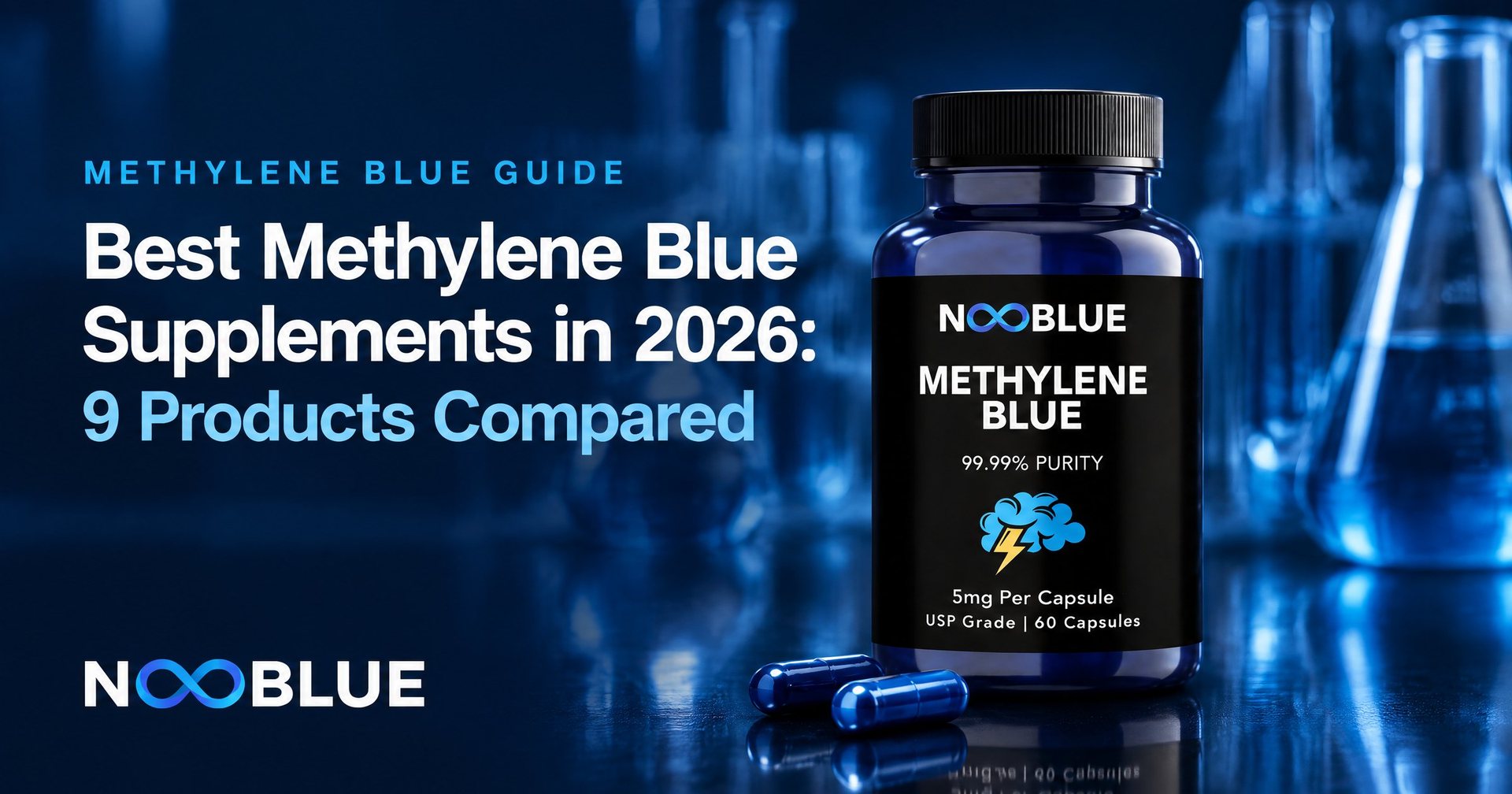
Key specs: 5 mg USP methylene blue + 10 mg vitamin C (ascorbic acid) per capsule · 60 capsules · 60 servings · $37.99 · $0.63 per serving · neutral vegetable capsule, one daily with food · CTLA identity and heavy-metal report on the ingredient lot, published on the product page · NooBlue product page
This is not a CoQ10 product, and we have flagged it as such in the table. It is our pick because it addresses the goal behind most CoQ10 searches (mitochondrial energy) from a different angle, and it is what NooBlue makes for that goal. Readers who have already tried CoQ10 without result routinely ask what else acts on mitochondrial electron transport.
The mechanistic distinction is worth understanding. CoQ10 is the native electron carrier between Complex I/II and Complex III. Methylene blue does something structurally different. At low concentrations it can act as an alternative electron carrier. It accepts electrons and donates them further down the chain. That is a bypass around a congested step, not more of the standard carrier. If your issue is a shortage of CoQ10 itself, more CoQ10 is the correct answer and methylene blue is not a substitute. The two are complements in the mechanistic sense, not competitors.
NooBlue’s specifics are short. The material is USP grade. Contract Testing Laboratories of America (CTLA) analyzed the methylene blue ingredient lot for identity (HPLC) and heavy metals, and that report sits on the product page rather than being supplied only on request; it covers the ingredient, not a purity percentage or every finished batch. Each capsule carries 5 mg with 10 mg of vitamin C, in a neutral vegetable capsule taken once daily with food, so there is nothing to measure. At $37.99 for a 60-day supply, that is $0.63 per serving, the same per-serving cost as the ubiquinol entry, and not the cheapest option on this page; the lowest cost per serving belongs to Doctor’s Best at #2.
Pros:
- USP grade, with a published CTLA identity and heavy-metal report on the ingredient lot.
- Precision 5 mg dosing, which matters more for methylene blue than for CoQ10.
- Neutral vegetable capsule: one a day with food, nothing to measure or mix.
- Acts at a different point in the electron transport chain than CoQ10.
Cons:
- Not a CoQ10 supplement, and it will not correct a CoQ10 deficiency.
- Smaller brand with far fewer customer reviews than the drugstore names here.
- Interacts with serotonergic medications, so it is not suitable for everyone.
- $0.63 per serving puts it at the higher end of this comparison.
- The published test report covers the ingredient lot, not every finished batch.
Best for: Anyone whose real goal is mitochondrial energy rather than CoQ10 as such, readers who have already given CoQ10 a fair trial and want a mechanistically different option, and anyone researching mitochondrial support beyond a single nutrient. Available as Ultimate Methylene Blue Capsules 60x5mg or as a 1% liquid solution if you prefer to titrate the dose yourself. For a direct comparison against another popular cellular-energy compound, see methylene blue vs NAD+ for cellular energy. Our guide on how to improve mitochondrial function covers the wider options.
#2. Doctor’s Best High Absorption CoQ10 with BioPerine: Best High-Absorption CoQ10
Key specs: 100 mg ubiquinone per softgel · 120 softgels · 120 servings · $22.99 · $0.19 per serving · USP Verified · naturally fermented · contains soy · Official Doctor’s Best listing
This is the product that makes most of the CoQ10 market look overpriced. Doctor’s Best pairs 100 mg of naturally fermented ubiquinone with 5 mg of BioPerine. That is a standardized black pepper extract containing 95% piperine. Both sit in an extra-virgin olive oil base. The olive oil matters: CoQ10 is fat-soluble and absorbs measurably better when taken with a lipid, which is why the label tells you to take it with food.
At $22.99 for 120 servings, it works out to $0.19 per serving, the lowest verified per-serving cost in this comparison. That is roughly a third of what the ubiquinol products here cost per day, and about a fifth of the Thorne gelcap. The USP Verified mark is meaningful too. An independent organization has confirmed the label’s identity and potency claims. That is not a given here. CoQ10 content has historically varied a lot between brands.
Pros:
- Lowest verified cost per serving of any product compared here.
- USP Verified for identity and potency.
- Naturally fermented rather than synthetically derived.
- Olive oil base and BioPerine both address the absorption problem.
- 120-serving bottle means a four-month supply at one daily softgel.
Cons:
- Ubiquinone, not ubiquinol: a real consideration if you are older or absorb poorly.
- Contains soy lecithin and gelatin, so unsuitable for vegans.
- BioPerine can interact with some medications by altering their metabolism.
Best for: Anyone who wants a competent, independently verified CoQ10 without paying a premium for a form they may not need. If your goal is broader than coenzyme Q10 alone, it is worth reading our guide to the best mitochondrial support supplements before committing to a single ingredient, since CoQ10 is one lever among several.
#3. Life Extension Super Ubiquinol CoQ10: Best Ubiquinol
Key specs: 100 mg ubiquinol (Kaneka Ubiquinol) per softgel · 60 softgels · 60 servings · $37.50 one-time ($31.00 on autoship) · $0.63 per serving · Gluten free · Non-GMO · Official Life Extension listing
Ubiquinol is the reduced, electron-carrying form of coenzyme Q10, the state the molecule is actually in when it does its job in the mitochondrial membrane. The practical argument for buying it pre-reduced is simple. Your body has to convert ubiquinone to ubiquinol anyway. That conversion appears to become less efficient with age.
The evidence here is reasonable rather than overwhelming. A human trial published in Food & Function in 2018 by Zhang and colleagues, titled “Ubiquinol is superior to ubiquinone to enhance Coenzyme Q10 status in older men,” found the reduced form raised CoQ10 status more effectively than ubiquinone in that population (PubMed 30302465 · DOI 10.1039/c8fo00971f). Note the specific population: older men. That is the group with the clearest case for paying the ubiquinol premium, and it is not automatically transferable to a healthy 30-year-old.
Life Extension uses Kaneka Ubiquinol, the most established branded ubiquinol ingredient, and the product has held a ConsumerLab survey ranking for CoQ10 across multiple years. At $37.50 for 60 servings, you pay $0.63 per serving, 3.3× the Doctor’s Best figure.
Pros:
- Pre-reduced ubiquinol using the well-characterized Kaneka ingredient.
- Human trial evidence supporting the form in older adults.
- Autoship price of $31.00 brings the cost down to about $0.52 per serving.
- Long-standing brand with a published reference list on the product page.
Cons:
- Over three times the per-serving cost of Doctor’s Best.
- 60-count bottle means more frequent reordering.
- The ubiquinol advantage is best supported in older adults, not universally.
Best for: Adults over roughly 50, anyone who has taken ubiquinone without noticing anything, and people whose priority is blood-level response rather than cost. Oxidative stress is the other half of this picture, and our explainer on how to reduce oxidative stress covers the diet and lifestyle inputs that work alongside any antioxidant supplement.
#4. Qunol Ultra CoQ10: Best Widely Available Pick
Key specs: 100 mg CoQ10 per softgel · 90 softgels · 90 servings · $25.99 · $0.29 per serving · Water- and fat-soluble patented formulation · Gluten free · Official Qunol listing
Qunol’s pitch is solubility. Conventional CoQ10 dissolves poorly in water and only moderately in fat, which is the root cause of its erratic absorption. Qunol’s patented formulation is designed to dissolve in both, and the brand markets it as offering up to three times better absorption than unsolubilized ubiquinone in oil suspensions or powder-filled capsules.
Take the “3X” claim for what it is: a manufacturer comparison against a deliberately weak reference product, not a head-to-head against the better-formulated competitors in this list. That said, the underlying chemistry is sound. The product is genuinely everywhere: CVS, Walmart, Amazon and Target. And at $0.29 per dose from Qunol’s own site it is the second-cheapest verified option here. Each softgel also carries 68 mg of vitamin E as dl-alpha tocopheryl acetate, which some buyers will want to factor into their total intake.
Pros:
- Genuinely solubilized formulation addressing CoQ10’s core absorption problem.
- Second-lowest verified per-serving cost at $0.29.
- Available in almost every US pharmacy and supermarket.
- Free US shipping over $25 direct from the brand.
Cons:
- The “3X absorption” figure is measured against a weak comparator, not against rivals here.
- Added vitamin E may be unwanted if you already supplement it.
- Contains gelatin and sorbitol.
Best for: Buyers who want a solubilized CoQ10 they can pick up locally without ordering online, at a price that stays reasonable. If your underlying goal is steadier daily energy rather than heart-specific support, our roundup of natural energy boosters puts CoQ10 in context alongside sleep, light exposure and iron status.
#5. Jarrow Formulas Q-Absorb CoQ10: Best Delivery-System Ubiquinone
Key specs: 100 mg ubiquinone per softgel · 120 softgels · 120 servings · $39.74 (Amazon, observed August 13, 2026) · $0.33 per serving · Official Jarrow listing
Q-Absorb is Jarrow’s proprietary CoQ10 delivery system, built around a lipid matrix intended to improve the molecule’s notoriously poor and variable uptake. It occupies a sensible middle position in this comparison: more formulation engineering than a plain ubiquinone softgel, considerably less expensive than switching to ubiquinol.
At $0.33 per serving for a 120-serving bottle, it costs about 74% more per day than Doctor’s Best and about half what Life Extension’s ubiquinol costs. Is that middle ground worth it? It depends on how much weight you give delivery-system claims. Independent head-to-head trials would settle it. In this category, those trials mostly do not exist.
One caveat on the price: the $39.74 figure was observed on Amazon rather than on Jarrow’s own storefront, and Amazon pricing on supplements moves more than most categories. Check it before you buy.
Pros:
- Established delivery-system formulation with a long market history.
- 120 servings per bottle, so a four-month supply.
- Middle-ground pricing between plain ubiquinone and ubiquinol.
Cons:
- Price observed on a marketplace listing, so more volatile than a brand-direct price.
- Absorption advantage is brand-claimed rather than independently benchmarked here.
- Still ubiquinone, so the age-related conversion question remains.
Best for: People who want more than a basic ubiquinone softgel but are not convinced the ubiquinol premium is justified for them.
Looking at mitochondrial support more broadly? NooBlue’s Ultimate Methylene Blue Capsules work through a different point in the electron transport chain than CoQ10, and ship with a published batch COA, USP grade material and 5 mg precision dosing. Browse the shop →
#6. Thorne CoQ10: Best Third-Party Certified
Key specs: 100 mg ubiquinone per gelcap · 60 gelcaps · 60 servings · $53.00 (Walmart, observed August 13, 2026) · $0.88 per serving · NSF Contents Certified · Gluten free · Official Thorne listing
Thorne, formerly sold as Q-Best 100, is the most expensive product in this comparison per serving, 4.6× the price of Doctor’s Best for the same 100 mg of ubiquinone. What you are paying for is not a different molecule but a different assurance model. NSF Contents Certified means the finished product has been independently tested. What is on the label is what is in the bottle. Clinicians and tested athletes use the brand heavily for exactly that reason.
Whether that premium is rational depends entirely on your situation. If you are subject to testing, or you simply place a high value on certification, it is defensible. If you are a general consumer buying CoQ10 for everyday cellular energy support, the Doctor’s Best product is also independently verified and costs 78% less per serving.
Pros:
- NSF Contents Certified, one of the more rigorous independent certifications available.
- Strong reputation among practitioners and tested athletes.
- Optimally absorbed ubiquinone formulation.
Cons:
- Most expensive per serving in this comparison by a wide margin.
- 60-count bottle at a high unit price makes it a costly long-term habit.
- Price observed at a retailer rather than brand-direct.
Best for: Tested athletes and anyone for whom independent certification is the deciding factor rather than a nice-to-have.
#7. Nature Made CoQ10 200 mg: Best High-Dose Drugstore Option
Key specs: 200 mg CoQ10 per softgel · listed at $49.49 on naturemade.com · pack size not confirmed at publish time · per-serving cost not computed · Official Nature Made listing
Nature Made is the default CoQ10 for a large share of American buyers, and the 200 mg softgel is its answer to people who want a higher dose without taking two capsules. The brand is a fixture at Costco, Walgreens, CVS and Walmart, and its 200 mg product appears in pack sizes ranging from 40 to 140 softgels depending on retailer.
That variability is exactly why we have not published a per-serving figure. The $49.49 price on Nature Made’s own site could not be matched to a confirmed count at the time of writing. Pack size is precisely the variable that decides whether a 200 mg CoQ10 is good value or poor value. Costco’s 140-count and Target’s 40-count are the same product at wildly different per-serving economics.
Pros:
- 200 mg in a single softgel for those who want a higher dose simply.
- Very widely stocked, including warehouse-club pack sizes.
- Long-established mainstream brand.
Cons:
- Pack size behind the listed price could not be confirmed, so per-serving value is unclear.
- Standard ubiquinone with no specialized absorption technology.
- Per-serving cost varies enormously by retailer and pack.
Best for: Warehouse-club shoppers who can verify the count on the bottle and want a high single-softgel dose. Fatigue that does not respond to any of this is worth investigating properly, and our guide to the best supplements for chronic fatigue covers the wider differential.
#8. NOW Foods CoQ10 100 mg: Best Budget Shortlist Candidate
Key specs: 100 mg CoQ10 per capsule · multiple sizes listed across a $39.99–$69.99 range · price not verified at publish time · Official NOW Foods listing
NOW Foods is one of the larger independent supplement manufacturers in the US, runs its own analytical testing laboratories, and generally prices below the practitioner brands. Its CoQ10 line spans several strengths and counts, including vegetarian capsules. That makes it one of the few realistic picks for anyone avoiding the gelatin softgels that dominate this category.
We could not pin a single current price to a specific size within our verification window: the CoQ10 100 mg line showed three sizes spanning $39.99 to $69.99 without a canonical figure we were willing to publish. Rather than guess, we have left the price blank. It belongs on your shortlist, but confirm the count-to-price ratio yourself before ordering.
Pros:
- In-house analytical testing laboratories and a long manufacturing record.
- Vegetarian capsule options available, unusual in this category.
- Generally priced below practitioner-brand equivalents.
Cons:
- Could not confirm a single current price against a specific size at publish time.
- Multiple overlapping SKUs make like-for-like comparison harder.
- No specialized absorption technology on the standard 100 mg line.
Best for: Vegetarians and buyers who are willing to do a little price-checking to land a good deal. For stimulant-free daily energy support more broadly, see our comparison of the best supplements for energy and focus without stimulants.
Editor’s Choice
NooBlue Ultimate Methylene Blue Capsules: our pick for mitochondrial energy, and not a CoQ10: 5 mg of USP-grade methylene blue with 10 mg of vitamin C per capsule, acting on a different step of the same electron transport chain, with a published CTLA ingredient report.
$37.99 for 60 servings · $0.63 per serving · one capsule daily with food
If you want CoQ10 itself: Doctor’s Best High Absorption CoQ10 with BioPerine, the best high-absorption CoQ10 here, with 100 mg of USP Verified, naturally fermented ubiquinone at $0.19 per serving, the lowest verified per-serving cost of the eight products compared.
Ubiquinone or Ubiquinol: Which CoQ10 Form Should You Buy?
This is the only decision in the category that meaningfully changes what you get, so it is worth two minutes.
Ubiquinone is the oxidized form. It is cheaper, more chemically stable, and has the larger body of older clinical literature behind it. Your body reduces it to ubiquinol after absorption.
Ubiquinol is the reduced form: already in the state that carries electrons. It costs substantially more. The case for buying it is that the conversion step appears to become less efficient with age, so pre-reducing it removes a variable.
Here is the practical rule most of the evidence supports. Are you under about 50 and generally healthy? Then ubiquinone from a well-formulated product is very likely enough. The money you save is real. If you are older, or you have taken ubiquinone consistently without noticing anything, ubiquinol is the reasonable next step, and that is the population in which the Food & Function trial found a superior response.
Two things matter more than form for either type. First, take it with a fat-containing meal; CoQ10 is fat-soluble and fasted absorption is poor regardless of which form you bought. Second, give it eight to twelve weeks. Tissue CoQ10 levels change slowly. Most people who conclude “it did nothing” stopped at three weeks.
Matching the Pick to Your Reason for Taking CoQ10
The reason you are buying changes the pick more than the brand does. Statin users: statins lower the body’s own CoQ10 production, so a plain 100 mg ubiquinone with food (Doctor’s Best) is the usual starting point, with Life Extension’s ubiquinol the upgrade if you are over 50. Keep your prescriber informed; CoQ10 is an add-on, never a swap. Heart-focused buyers: cardiology research tends to use higher daily amounts than the 100 mg general-population dose, so a 200 mg softgel (Nature Made) or two Doctor’s Best softgels make more sense than a single gummy, with the dose set by your cardiologist. Fertility: clinics that use CoQ10 here usually specify ubiquinol and their own schedule; buy the form your clinic names rather than defaulting to the cheapest ubiquinone. Third-party tested: Doctor’s Best (USP Verified) and Thorne (NSF Contents Certified) are the two with independent finished-product certification.
Frequently Asked Questions About CoQ10 Supplements
What is the best CoQ10 supplement to buy?
Our pick for the goal behind that question, mitochondrial energy, is NooBlue Ultimate Methylene Blue Capsules, which are not a CoQ10: 5 mg of USP methylene blue per capsule, acting on a different step of the same electron transport chain, at $0.63 per serving. If you want CoQ10 itself, Doctor’s Best High Absorption CoQ10 with BioPerine is the best high-absorption CoQ10 here, at $0.19 per serving for 100 mg of USP Verified, naturally fermented ubiquinone. For adults over 50 or anyone who has not responded to ubiquinone, Life Extension Super Ubiquinol CoQ10 at $0.63 per serving is the better-matched CoQ10.
Is ubiquinol really better than ubiquinone?
In older adults, the evidence points that way. A 2018 human trial in Food & Function found ubiquinol raised CoQ10 status more effectively than ubiquinone in older men. For younger, healthy adults the advantage is much less clear, and a well-formulated ubiquinone taken with food is usually sufficient at roughly a third of the cost.
How much CoQ10 should I take per day?
Most products in this comparison provide 100 mg per serving, and that is the dose used across the majority of the general-population research. Higher intakes of 200 mg and above appear in studies of specific clinical populations. Take it with a meal containing fat, and speak to your doctor before starting if you take blood thinners or blood pressure medication.
How long does CoQ10 take to work?
Plan on eight to twelve weeks rather than days. Blood levels rise within a few weeks, but tissue saturation is slower, and most reports of “no effect” come from people who stopped after two or three weeks. A study of coenzyme Q10 in physical fatigue published in Nutrition in 2008 by Mizuno and colleagues used a multi-day dosing period before assessing outcomes (PubMed 18272335 · DOI 10.1016/j.nut.2007.12.007).
Can I take CoQ10 with a statin?
Many people do, because statins reduce the body’s own CoQ10 production through the same pathway they use to lower cholesterol. Several brands here market explicitly to statin users for that reason. CoQ10 is not a replacement for statin therapy and you should not change prescribed medication without talking to your doctor first.
What is the difference between CoQ10 and methylene blue for mitochondria?
CoQ10 is the native electron carrier between Complex I/II and Complex III of the electron transport chain, so supplementing it tops up the standard carrier. Methylene blue, at low concentrations, can act as an alternative electron carrier that bypasses a congested step rather than adding more of the usual one. They address different failure modes, and one does not substitute for the other.
Does CoQ10 need to be taken with food?
Yes. Coenzyme Q10 is fat-soluble and absorbs poorly on an empty stomach. Every product in this comparison that gives dosing guidance recommends taking it with food, and the better-formulated options use an oil base for the same reason.
Which CoQ10 supplement is best value per serving?
On cost per serving, the answer is a CoQ10: Doctor’s Best High Absorption CoQ10 at $0.19 is the lowest verified per-serving cost in this comparison, followed by Qunol Ultra at $0.29 and Jarrow Q-Absorb at $0.33. Our pick, NooBlue Ultimate Methylene Blue Capsules, costs $0.63 per serving and is not a CoQ10; it is here for the mitochondrial-energy goal, not on price. Comparing brands on bottle price alone is misleading, because a $22.99 bottle with 120 servings beats a $37.50 bottle with 60.
Can I take CoQ10 if I have hypothyroidism?
There is no known interaction between CoQ10 and levothyroxine, so hypothyroidism is not a reason to avoid it. The practical issue is timing: levothyroxine is taken on an empty stomach, while CoQ10 needs a fat-containing meal, so the two naturally land hours apart. One detail worth checking is the softgel’s excipients: Doctor’s Best, for example, contains soy lecithin, and soy is commonly advised to keep several hours away from a thyroid dose. Take CoQ10 with lunch or dinner and that concern disappears. Mention it at your next thyroid check regardless.
Qunol Mega Ubiquinol or Qunol Ultra: which should you buy?
Same brand, two forms. Ultra is solubilized ubiquinone: the $0.29-per-serving pick above. Mega is the pre-reduced ubiquinol version, sold at a premium and the product Google’s AI summary currently names as best-absorbing. Apply the same rule as everywhere in this guide: under about 50 and healthy, Ultra with a meal is very likely enough; over 50, or if ubiquinone has done nothing after eight to twelve weeks, Mega is the reasonable step up. Either way, check the softgel count before comparing prices, because Qunol sells both in several sizes.
The Verdict: Which CoQ10 Supplement Should You Buy?
Our pick is NooBlue Ultimate Methylene Blue Capsules, for the mitochondrial-energy goal behind most CoQ10 searches: a precise 5 mg dose of USP methylene blue that acts on a different step of the electron transport chain, a published CTLA ingredient report, and $0.63 per serving. It is not a CoQ10, and if a shortage of CoQ10 itself is your issue, more CoQ10 is the correct answer.
For CoQ10 itself, Doctor’s Best High Absorption CoQ10 with BioPerine is the best high-absorption CoQ10 here: USP Verified, an absorption-conscious olive oil and BioPerine formulation, and $0.19 per serving, which is the lowest verified cost per serving on this page.
If you are over 50 or ubiquinone has done nothing for you, go with Life Extension Super Ubiquinol CoQ10 at $0.63 per serving, because the form advantage is best evidenced in exactly that group. If independent certification is your deciding factor, Thorne CoQ10 is NSF Contents Certified, though you pay 4.6× Doctor’s Best per serving for it. If you want a solubilized CoQ10 you can buy in any pharmacy today, Qunol Ultra at $0.29 is the one to buy.
And if you have already given CoQ10 a genuine three-month trial without result, the honest answer is that more CoQ10 is probably not your missing variable. That is the case where a mechanistically different approach is worth investigating. Broader cellular health support is one route. An alternative electron carrier such as methylene blue is another. So are the unglamorous inputs: sleep, iron status and thyroid function. Those account for far more fatigue than any supplement will. Our roundup of the best nootropics for energy and focus covers the cognitive side of the same question. If that is the road you want to take, try NooBlue Ultimate Methylene Blue Capsules, or shop the full NooBlue range first.
More buying guides
Best Mitochondrial Support Supplements in 2026 → Best NAD+ Supplements in 2026: 8 Brands Compared → Best Supplements for Cellular Health in 2026 → Best Focus Supplements in 2026 →Exploring mitochondrial support beyond CoQ10?
USP grade · Verified COA · Free worldwide shipping over $100
Shop NooBlue →