Key takeaways
- Oral methylene blue supplements in our September 2026 check cost $25.97 to $49.99 a bottle. That works out to $0.13 to $1.17 per serving, depending on the format and the brand.
- Hospital methylene blue is a different purchase. Cash prices for the injectable form start at $182.80 for 10 ml, and compounded capsules or solutions need a prescription.
- Our pick is NooBlue’s 5 mg capsules at $37.99 for 60, or $0.63 a serving. NooBlue’s 1% drops cost $0.30 per 5 mg serving. Neither is the cheapest per mg in our table, and we show you which products are.
- Judge cost per serving at the amount you will actually take, then check the grade and the lab report. A cheap bottle of the wrong grade is not a saving.
- Whatever you pay, do not take methylene blue with SSRIs, SNRIs, MAOIs or other serotonergic medicines (serotonin syndrome risk), with G6PD deficiency, while pregnant or breastfeeding, or if you are under 18. It can turn urine blue or green. If you take any prescription medicine, talk to your doctor first.
What should methylene blue cost? For an oral supplement, expect to pay between $25.97 and $49.99 a bottle in the US, or roughly $0.13 to $1.17 per serving across the products we priced. The spread comes from the format, how much methylene blue is in each bottle, and the brand. The hospital injectable and pharmacy-compounded versions sit in a different price world and need a prescription. This guide shows real prices from brand stores, the cost per serving and per mg, what drives the differences, and how to tell a fair price from a false bargain.
NooBlue sells methylene blue capsules, gummies and drops, and three of the products in the table below are ours. They are our pick, but we have included the competitors that beat us on price per mg and labeled them that way. Written by the NooBlue editorial team. Prices were checked on each brand’s own store in September 2026 and can change.
Table of contents
- 1. Methylene Blue Prices Compared (as of Sep 2026)
- 2. What Methylene Blue Should Cost in 2026
- 3. Before You Buy: Who Should Not Take Methylene Blue
- 4. Cost Per Serving: The Number That Matters
- 5. Why Methylene Blue Prices Vary So Much
- 6. Is the Cheapest Methylene Blue Worth It?
- 7. What You Get for the Price With NooBlue
- 8. Where You Buy Changes the Price
- 9. Why Prescription Methylene Blue Costs So Much More
- 10. Frequently Asked Questions About Methylene Blue Cost
- 10.1. How much does a bottle of methylene blue cost?
- 10.2. What is a reasonable methylene blue cost per serving?
- 10.3. What does a month of daily methylene blue cost?
- 10.4. Why is pharmaceutical-grade methylene blue more expensive?
- 10.5. Is methylene blue a prescription drug?
- 10.6. What is methylene blue used for?
- 10.7. Should I buy methylene blue?
- 10.8. Is cheaper methylene blue less safe?
- 11. The Bottom Line
- 12. Sources
Methylene Blue Prices Compared (as of Sep 2026)
| Product | Format | Price | Methylene blue per pack | Cost per serving as sold | Cost per mg |
|---|---|---|---|---|---|
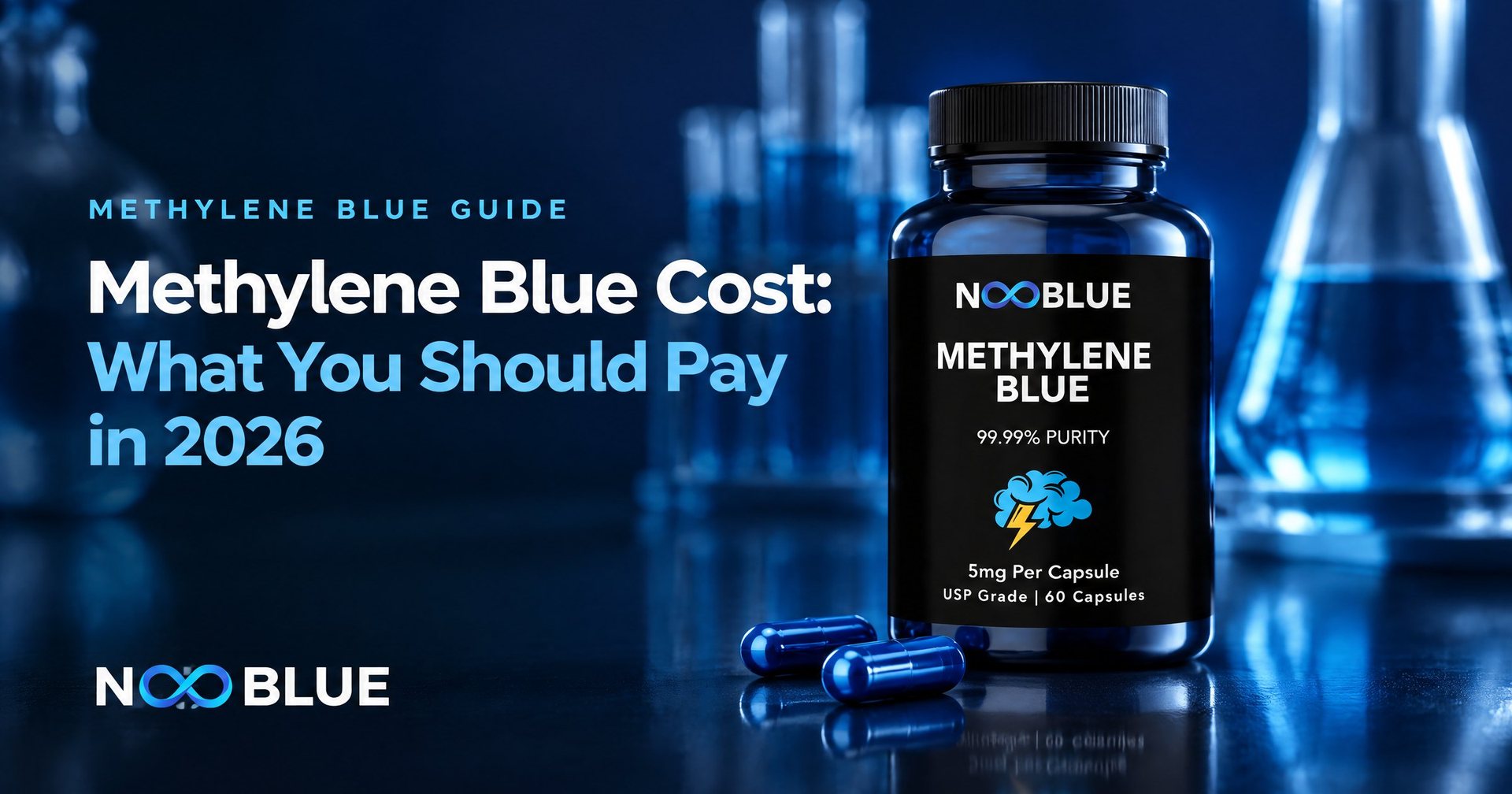
| NooBlue Ultimate Capsules (our pick) | 60 capsules x 5 mg, with 10 mg vitamin C | $37.99 | 300 mg | $0.63 per 5 mg capsule | $0.13 |
| NooBlue 1% Drops | 50 ml of 1% solution, 0.5 mg per drop | $29.99 | 500 mg | $0.30 per 5 mg (10 drops) | $0.06 |
| NooBlue Gummies | 60 gummies x 10 mg, with 25 mg vitamin C | $49.99 | 600 mg | $0.83 per 10 mg gummy | $0.08 |
| Nutricel Blue Liquid | 118 ml of 1% solution | $30.00 | about 1,180 mg | $0.13 per 5 mg | $0.03 (lowest per mg here) |
| Biopharm 1% USP | 50 ml of 1% solution, glass | $25.97 | 500 mg | $0.26 per 5 mg | $0.05 (lowest bottle price here) |
| Chemist Labs Capsules | 60 or 120 capsules x 10 mg | $34.99 / $44.99 | 600 / 1,200 mg | $0.58 / $0.37 per 10 mg capsule | $0.06 / $0.04 |
| Nutricel Blue Boost | 60 capsules x 12 mg | $34.90 | 720 mg | $0.58 per 12 mg capsule | $0.05 |
| Earth Harmony Capsules | 60 capsules x 12 mg | $39.95 | 720 mg | $0.67 per 12 mg capsule | $0.06 |
| TrueHealthic Gummies | 30 gummies x 5 mg | $29.99 | 150 mg | $1.00 per 5 mg gummy | $0.20 |
| Meraki Blu | 30 ml bottle, 150 mg total | $35.00 | 150 mg | $1.17 per 5 mg | $0.23 |
Cost per mg is the price divided by the total methylene blue in the pack. Cost per serving uses each product’s own unit. Shipping and multi-bottle offers change the final figure. NooBlue gives 10% off two bottles, 15% off three and 20% off five, with free worldwide shipping on orders of $100 or more. Biopharm’s store was also showing two 50 ml bottles for the price of one as a limited-time offer when we checked.
What Methylene Blue Should Cost in 2026
The table shows three price bands for oral supplements:
- 1% drops are the cheapest way to buy methylene blue by the milligram, at $0.03 to $0.06 per mg for the three USP-grade solutions above. You pay for that with measuring, and drops can stain the mouth and tongue unless you mix them into water or juice.
- Capsules cost $0.04 to $0.13 per mg. The fixed dose varies a lot: 5 mg in NooBlue’s, 10 mg in Chemist Labs’, 12 mg in Nutricel’s and Earth Harmony’s.
- Gummies range from $0.08 per mg for NooBlue’s 10 mg gummies to $0.20 for TrueHealthic’s 5 mg gummies.
Meraki Blu stands out at $0.23 per mg because its 30 ml bottle holds 150 mg, half the strength of a 1% solution. Its product description also says “for research purposes only”, which is worth knowing before you buy it as a supplement.
Before You Buy: Who Should Not Take Methylene Blue
The cheapest methylene blue is the one you do not buy because it is wrong for you. Do not take it if any of these applies:
- You take an SSRI, SNRI, MAOI or any other serotonergic medicine, including many antidepressants. Methylene blue is a potent MAO-A inhibitor (Ramsay et al., 2007), and the combination can cause serotonin syndrome. A review of reported cases found severe serotonin toxicity at an intravenous dose of only 1 mg/kg (Gillman, 2011).
- You have G6PD deficiency, which clinical references list as a contraindication (StatPearls, 2026).
- You are pregnant or breastfeeding. Methylene blue may cause fetal harm when given during pregnancy (StatPearls, 2026).
- You are under 18.
If you take any prescription medicine, talk to your doctor first. Methylene blue can turn urine blue or green, which is expected and harmless (StatPearls, 2026). Every NooBlue product page carries these warnings in its Safety: read before use section, and our guide to who should not take methylene blue covers each group.
If none of these applies to you, here are NooBlue’s three formats with live prices.
Cost Per Serving: The Number That Matters
Cost per mg rewards bigger doses, which is the wrong way round for methylene blue. Its effects follow a hormetic curve: responses rise at low doses and fall below normal at high ones, so more is not better (Bruchey and Gonzalez-Lima, 2008). Supplement labels reflect that. NooBlue’s capsule is 5 mg, and many brands sit between 5 and 12 mg per unit.
So start with the serving you plan to take, then price it:
- At 5 mg a day, NooBlue capsules cost $0.63 and NooBlue drops $0.30 (10 drops). A 10 mg or 12 mg capsule cannot give you 5 mg, so you would pay for, and take, twice as much or more.
- At 10 mg a day, a NooBlue gummy costs $0.83, a Chemist Labs capsule $0.37 to $0.58, and NooBlue drops $0.60 (20 drops).
Over a month, that looks like this for NooBlue: one capsule a day for 30 days is $19.00, 10 drops a day is $9.00, and one gummy a day is $25.00. A bottle of 60 capsules or gummies lasts two months, and a 50 ml bottle of drops gives about 100 servings at 5 mg.
The research people cite for methylene blue does not tell you which serving to choose. The best-known human trial gave healthy adults a single 280 mg dose (about 4 mg/kg), 56 times one 5 mg capsule, and measured brain activity an hour later (Rodriguez et al., 2016). No trial has tested daily supplement servings over months. Our guide to how many mg of methylene blue per day covers servings by format.
Why Methylene Blue Prices Vary So Much
- How much methylene blue is in the bottle. This is the biggest factor. A 118 ml bottle of 1% solution holds about 1,180 mg. A 30-count bag of 5 mg gummies holds 150 mg. Similar bottle prices can hide a nearly eightfold difference in content.
- Format. Capsules and gummies cost more to make than a solution in a bottle, and gummies add flavor and a chew base.
- Grade. For anything you swallow, look for USP grade. The USP monograph requires 97.0% to 103.0% methylene blue on the dried basis (USP). Harvard Health warns that industrial or chemical-grade methylene blue, like the kind sold as a stain or dye, should not be used in humans or animals, and that online shoppers have bought aquarium products by mistake (Harvard Health, 2025).
- Testing and paperwork. Lab reports cost money. They also vary widely in what they cover, from a raw ingredient lot to a finished product, and from identity and heavy metals to a full assay.
- Added ingredients and brand. Vitamin C, cacao and other extras change the price, and so do margins and marketing.
Our guides to methylene blue purity and real vs fake methylene blue explain how to read what you are paying for.
Is the Cheapest Methylene Blue Worth It?
Sometimes. The lowest cost per mg in our table, Nutricel’s Blue Liquid, is a USP-grade 1% solution, and Biopharm’s 50 ml bottle is the cheapest bottle. Low price alone is not a red flag. What matters is what comes with it:
- Is it USP grade, stated plainly? Walk away from “aquarium”, “lab”, “reagent” or “for research purposes only” if you plan to take it.
- Is there a lab report, and what does it cover? Check the lab, the lot, and whether it tested the ingredient or the finished product.
- Does the label give mg per serving and safety warnings? A product meant for people should warn against serotonergic medicines and G6PD deficiency.
- Is the price far below everyone else’s? A bottle much cheaper than the USP-grade products above deserves a closer look at its grade.
Our guide to aquarium grade vs pharmaceutical methylene blue covers the most common false bargain.
What You Get for the Price With NooBlue
NooBlue is not the cheapest methylene blue per mg, so here is what the price covers, stated plainly:
- USP-grade methylene blue in all three formats.
- A 5 mg capsule, one of the smallest fixed servings on the market, with 10 mg of vitamin C and nothing to measure.
- Gummies with no blue mouth: 10 mg with 25 mg of vitamin C in a Wild Blueberry chew with zero sugar.
- Drops in 0.5 mg steps, for anyone who wants to start below 5 mg.
- A published ingredient report. NooBlue publishes a report from Contract Testing Laboratories of America (CTLA) on its methylene blue ingredient, with identity and heavy metal results for one ingredient lot. It covers the raw ingredient, not each finished batch.
- Store terms: free worldwide shipping on orders of $100 or more, 30-day returns, and dispatch in 1 to 2 business days with tracking.
For head-to-head comparisons, see Nutricel vs NooBlue, our Biopharm review and our Meraki review. For wider roundups, see the best methylene blue supplements, best capsules, best gummies, best tablets and best over-the-counter options.
Where You Buy Changes the Price
Oral methylene blue supplements are sold mainly online, through brand stores and marketplaces. Brand stores show the maker’s own price and paperwork, and many run multi-bottle offers like the ones above. On marketplaces the same brand can sell for more or less, and some listings sit in lab chemical categories rather than supplements, which tells you how the seller classifies the product. Our guide to finding methylene blue in health food stores and pharmacies covers local options, and our guide to buying methylene blue over the counter covers what you can get without a prescription.
Why Prescription Methylene Blue Costs So Much More
Search results for methylene blue cost mix supplements with hospital drugs. They are not the same purchase:
- Injectable methylene blue is a physician-administered medicine used in hospitals for methemoglobinemia, a condition in which the blood carries too little oxygen (GoodRx). Drugs.com lists cash prices from $182.80 for 10 ml of the 10 mg/ml injectable solution and from $511.80 for 50 ml of the 5 mg/ml intravenous solution, and names ProvayBlue as the brand version. Those prices are for cash-paying customers and not valid with insurance (Drugs.com).
- Compounded methylene blue is made to a prescriber’s specification by a compounding pharmacy. ScripX, for example, offers oral solutions and capsules by prescription only, after an online intake and a telehealth evaluation, starting at $40.00 (ScripX).
If you are shopping for an oral supplement, those prices are not a useful comparison. They reflect sterile manufacturing, pharmacy work and medical supervision, not the cost of the compound itself.
Frequently Asked Questions About Methylene Blue Cost
How much does a bottle of methylene blue cost?
In our September 2026 check of brand stores, oral supplements cost $25.97 to $49.99 a bottle. NooBlue’s capsules are $37.99 for 60 x 5 mg, its 1% drops $29.99 for 50 ml and its gummies $49.99 for 60 x 10 mg. Biopharm’s 50 ml 1% solution was the cheapest bottle at $25.97.
What is a reasonable methylene blue cost per serving?
Across the products we priced, a serving cost $0.13 to $1.17. At 5 mg a day, NooBlue’s drops cost $0.30 and its capsules $0.63. Compare servings at the amount you will actually take, not the largest dose a bottle offers.
What does a month of daily methylene blue cost?
For NooBlue, one 5 mg capsule a day for 30 days costs $19.00, 10 drops (5 mg) a day costs $9.00, and one 10 mg gummy a day costs $25.00. A bottle of capsules or gummies lasts 60 days.
Why is pharmaceutical-grade methylene blue more expensive?
USP-grade material has to meet a published purity standard of 97.0% to 103.0% methylene blue on the dried basis, and brands that sell it for people add lab testing, measured servings and safety labeling. Aquarium, lab and industrial products skip those steps because they are not meant to be swallowed.
Is methylene blue a prescription drug?
It depends on the form. The injectable used in hospitals is physician-administered, and compounded capsules and solutions from pharmacies such as ScripX require a prescription. Oral methylene blue supplements, like NooBlue’s capsules, gummies and drops, are sold without one.
What is methylene blue used for?
In hospitals it is given intravenously for methemoglobinemia, when the blood cannot carry enough oxygen. As a supplement, people take small oral servings for focus and mental energy, although human evidence for that use is limited to small, short studies. Our guide to methylene blue benefits covers what the research shows.
Should I buy methylene blue?
Only if none of the safety warnings applies to you and you are comfortable with thin evidence. Do not buy it if you take a serotonergic medicine, have G6PD deficiency, are pregnant or breastfeeding, or are under 18. If you do buy it, choose USP grade and start with the smallest measured serving. Our beginner’s guide walks through the choice.
Is cheaper methylene blue less safe?
Not automatically. Some of the lowest-cost products we priced are USP-grade 1% solutions. The risk comes from the wrong grade, such as aquarium or lab products, and from missing labeling. Check the grade, the lab report and the safety warnings, whatever the price.
The Bottom Line
An oral methylene blue supplement should cost about as much as the products in our table: $25.97 to $49.99 a bottle, or $0.13 to $1.17 per serving. Drops are cheapest per mg, capsules are the simplest, and gummies are the easiest to take without a blue mouth. Our pick is NooBlue’s 5 mg capsules at $0.63 a serving, because a small fixed dose suits a compound where more is not better. If price per mg matters most, Nutricel’s Blue Liquid and Biopharm’s 1% solution cost less. Whatever you choose, check the grade and the paperwork first, and check the safety warnings before any of it. You can see all three NooBlue formats in the shop.
Sources
- NooBlue product pages (capsules, gummies, 1% drops): prices, contents and safety sections. nooblue.com/shop
- Nutricel. Blue Liquid 1% Methylene Blue Solution and Blue Boost 60 product pages. nutricel.store
- Biopharm. Methylene Blue 1%, USP (Pharmaceutical) Grade product page. bphchem.com
- Chemist Labs. Methylene Blue Capsules product page. thechemistlabs.com
- Earth Harmony. Ultimate Methylene Blue (60 Capsules) product page. earthharmony.com
- TrueHealthic. Methylene Blue Gummies product page. truehealthic.com
- Meraki Medicinal. Meraki Blu USP Grade Methylene Blue 150 mg product page. merakimedicinal.com
- Drugs.com. Methylene blue price guide. drugs.com
- GoodRx. Methylene blue. goodrx.com
- ScripX Compounding Pharmacy. Methylene blue. scripx.com
- United States Pharmacopeia. Methylene Blue monograph. doi.usp.org
- Goldman L. What to know about methylene blue. Harvard Health Publishing. April 24, 2025. health.harvard.edu
- Bruchey AK, Gonzalez-Lima F. Behavioral, physiological and biochemical hormetic responses to the autoxidizable dye methylene blue. American Journal of Pharmacology and Toxicology. 2008;3(1):72-79. PubMed 20463863
- Rodriguez P, Zhou W, Barrett DW, et al. Multimodal randomized functional MR imaging of the effects of methylene blue in the human brain. Radiology. 2016;281(2):516-526. PMC5084971
- Ramsay RR, Dunford C, Gillman PK. Methylene blue and serotonin toxicity: inhibition of monoamine oxidase A (MAO A) confirms a theoretical prediction. British Journal of Pharmacology. 2007;152(6):946-951. PMC2078225
- Gillman PK. CNS toxicity involving methylene blue: the exemplar for understanding and predicting drug interactions that precipitate serotonin toxicity. Journal of Psychopharmacology. 2011;25(3):429-436. PubMed 20142303
- Ostrovsky A, Afzal M. Methylene Blue. StatPearls. Updated January 2, 2026. NCBI Bookshelf NBK557593