Key takeaways
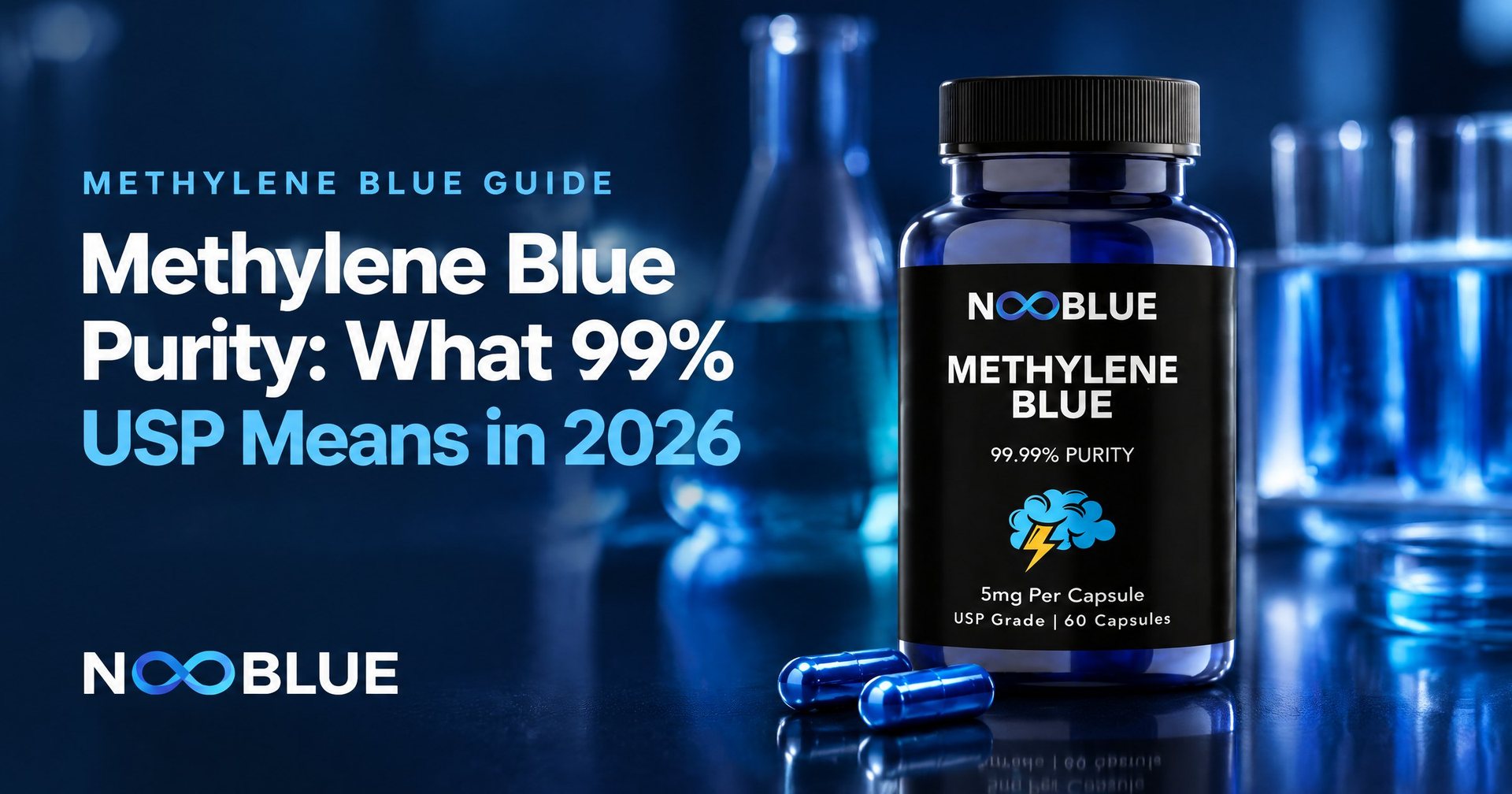
- USP grade has a defined meaning. The current USP monograph requires methylene blue to contain 97.0% to 103.0% methylene blue, calculated on the dried basis. “99%” is a supplier or brand figure, not the USP requirement.
- A purity percentage means little without its basis and method. Methylene blue is sold as a hydrate, so a figure measured on the powder as supplied and a figure calculated on the dried basis are not the same thing.
- Read the certificate, not the headline. Check the lab, the lot, the method, whether an assay percentage is actually reported, and whether it covers the raw ingredient or the finished product.
- Purity does not change the safety rules. Methylene blue of any grade must not be combined with SSRIs, SNRIs, MAO inhibitors or opioids, and it is not for people with G6PD deficiency or anyone pregnant or breastfeeding.
Methylene blue purity is the share of a powder that is methylene blue itself, rather than related dyes, leftover chemicals from manufacturing, water or trace metals. You cannot see it. A pharmacopeial-grade powder and a cheap industrial dye look the same deep blue in a bottle, so the only way to judge purity is the specification the material was made to and the lab document behind it.
This guide explains what “USP grade” requires, why the 99% figure on so many labels needs context, how to read a certificate of analysis (COA), and what the numbers on a real certificate should match. It is written by NooBlue, which sells methylene blue capsules, gummies and drops, so we also show exactly what our own published certificate covers and what it does not.
Table of contents
- 1. What “USP Grade” Methylene Blue Actually Requires
- 2. Methylene Blue Grades Compared
- 3. Why Purity Matters for Methylene Blue You Swallow
- 4. How to Read a Methylene Blue Certificate of Analysis
- 5. What Our Own Certificate Shows, and What It Doesn’t
- 6. Methylene Blue Purity Red Flags
- 7. Chemical Identity: The Numbers a Real COA Should Match
- 8. Purity Does Not Change the Safety Rules
- 9. Methylene Blue Purity FAQ
- 9.1. What purity should methylene blue be for human use?
- 9.2. Is USP grade the same as pharmaceutical grade?
- 9.3. Is 99% methylene blue pure enough?
- 9.4. Which methylene blue brand can I trust?
- 9.5. Why don’t doctors recommend methylene blue?
- 9.6. Why do I feel so good on methylene blue?
- 9.7. Does methylene blue damage DNA?
- 9.8. Does higher purity methylene blue work better?
- 9.9. How can I tell if my methylene blue is high purity?
- 10. The Bottom Line
- 11. Sources
What “USP Grade” Methylene Blue Actually Requires
USP stands for the United States Pharmacopeia, a nonprofit that publishes quality standards, called monographs, for medicines and their ingredients. The current USP monograph defines methylene blue as containing not less than 97.0% and not more than 103.0% of methylene blue (C16H18ClN3S), calculated on the dried basis (USP Methylene Blue monograph). The upper limit sits above 100% to allow for normal variation in the assay method.
Two parts of that definition matter for buyers:
- “Calculated on the dried basis.” Methylene blue crystallizes with water. The monograph lists an anhydrous form at 319.85 g per mole and hydrates up to a pentahydrate, with the common trihydrate at 373.90 g per mole. The water is accounted for before the percentage is calculated, so the assay describes the dye, not the water.
- Related dyes are part of the standard. The monograph lists a USP Azure B reference standard alongside the methylene blue one. Azure B is a demethylated relative of methylene blue, and an analytical study of methylene blue trihydrate described it as a significant impurity (Gaudette and Lodge, 2005).
So a lot that assays at 98% on the dried basis meets the USP definition, and so does one at 99.5%. When a label says “99% USP,” the 99% is the supplier’s or the brand’s own figure. It can be a tighter internal specification or a result for one lot. It is not what USP requires, and on its own it does not tell you which lot was tested or how.
The dried-basis point also explains why purity numbers from different worlds do not line up. A pure trihydrate is only about 85.5% methylene blue by weight on an as-supplied basis, because the rest is water of crystallization (319.85 divided by 373.90). A laboratory stain sold with a “dye content” of 82% minimum, such as Thermo Scientific’s methylene blue stain, is described in different terms from a USP assay. That product is also sold for research use only and carries the hazard statement “Harmful if swallowed.”
Methylene Blue Grades Compared
The same molecule is made for textile dyeing, microscopy, fish tanks and medicine. The grade tells you which standard the maker worked to.
| Grade | Made for | What the specification controls | For swallowing? |
|---|---|---|---|
| USP / pharmacopeial | Medicines and supplements | Identity, assay of 97.0% to 103.0% on the dried basis, related dyes such as azure B | Yes: the grade to look for |
| Laboratory stain or reagent | Microscopy and lab work | Dye content for staining performance | No: typically research use only |
| Technical or industrial | Textiles and dyeing | Color strength | No |
| Aquarium | Fish treatment | Concentration of a dilute solution | No: not made for people |
Our explainer on the difference between lab grade and pharmaceutical grade methylene blue goes further into how those standards differ, and our roundup of USP grade methylene blue brands compares products that state the grade.
Why Purity Matters for Methylene Blue You Swallow
Purity matters for two practical reasons: what the rest of the powder is, and how accurate your dose is.
The first is about what comes along with the dye. Harvard Health warns that industrial-grade or chemical-grade methylene blue, like that sold as a stain or dye, should not be used in humans or animals, and notes that shoppers can end up buying fish tank products by mistake (Harvard Health, 2025). Pharmacopeial methylene blue is made to limit organic impurities and heavy metals. A research paper describing a European pharmacopeia-grade methylene blue drug made exactly that point about limited organic impurities and heavy metals of recognized toxicity (Dormoi et al., 2013).
The second is dose. Methylene blue has a hormetic dose response, meaning low and high doses can have opposite effects (Rojas et al., 2012). If a powder is an unknown mix of dye, related dyes and water, you do not know how much methylene blue you are taking. A labeled, fixed amount of USP-grade methylene blue removes that guesswork, which is why our capsules hold 5 mg each and our drops deliver 0.5 mg per drop. Our methylene blue dosage guide covers how people choose a starting amount.
How to Read a Methylene Blue Certificate of Analysis
A certificate of analysis is where a purity claim becomes something you can check. When you open one, look for these items:
- What was tested. The sample name and lot number, and whether it is the raw methylene blue ingredient or the finished capsule, gummy or solution. The two are different documents.
- Who tested it. A named laboratory with an address. Accreditation to ISO/IEC 17025, the standard for testing labs, is a good sign.
- Identity. A test that confirms the material is methylene blue, often by HPLC (high-performance liquid chromatography) or UV-visible spectroscopy. An identity result of “Conforms” confirms what the material is. It does not give a purity percentage.
- Assay. The measured methylene blue content as a number, with the method and the basis stated, for example on the dried basis. This is the line that supports a percentage claim.
- Impurities. Results for related dyes such as azure B, where the lab tested them.
- Heavy metals. Individual results for arsenic, cadmium, lead and mercury, with units and the limits they were compared against.
- Microbial tests. These matter for finished products such as gummies and solutions.
- Dates. When the sample was received and reported, and whether they make sense next to the product’s manufacturing and expiry dates.
Our certificate of analysis guide walks through a real document line by line, and our page on how to test if methylene blue is real covers the simple checks you can do at home and their limits.
What Our Own Certificate Shows, and What It Doesn’t
We hold ourselves to the same checklist. Contract Testing Laboratories of America (CTLA) analyzed the methylene blue ingredient we use, lot 2025022801, in report 135621. The report records an HPLC identity result of “Conforms” and individual results for arsenic, cadmium, mercury and lead.
Here is what it does not do. It covers the raw ingredient, not every finished batch of capsules, gummies or drops. It does not report a numerical purity percentage. Earlier versions of this article described a batch certificate with every order and a 99%+ purity figure. That overstated what the document shows, and we have corrected it. You can read the original report and its limitations on our quality and testing page.
What we can say plainly is what is in each product. The capsules hold 5 mg of USP-grade methylene blue and 10 mg of vitamin C, 60 per bottle, for $37.99. The gummies pair 10 mg of USP-grade methylene blue with 25 mg of vitamin C for $49.99. The 1% drops give 0.5 mg per drop in a 50 mL bottle for $29.99. If you want to see how other brands document their products, our comparisons of NooBlue and Meraki and of NooBlue and Nutricel set the paperwork side by side.
Methylene Blue Purity Red Flags
Most weak purity claims give themselves away before you reach a lab report. Watch for these signs:
- A big number with nothing behind it. Several brands we checked in September 2026 print “99.9%” on the product page, while the lab documents they link report heavy metals, microbial counts or an identity check, but no assay percentage at all.
- “For research purposes only” or “not for human consumption.” Some products sold for people to drink carry a research-only line in their own description. Aquarium and lab products carry it because they were never made for people.
- A certificate you cannot match. A blank lot field, no lab name, no dates, or a cropped image that could belong to any product.
- Vague grade language. “High purity” or “lab tested” with no grade, no method and no metals data.
- Customer counts in place of documents. A claim about how many people bought a product says nothing about what is in it.
- Unbranded, repackaged powder. Bulk powder in a plain bag with no specification sheet is a common sign of relabeled technical-grade dye.
For a longer checklist, see our guides on how to find safe, authentic methylene blue and on real methylene blue versus fakes. Our list of the purest methylene blue brands shows which purity documents each brand actually publishes.
Chemical Identity: The Numbers a Real COA Should Match
A certificate is only checkable if you know what it should say. Methylene blue is methylthioninium chloride, with the formula C16H18ClN3S. The anhydrous salt has the CAS number 61-73-4 and a molecular weight of 319.85, and the trihydrate has the CAS number 7220-79-3 and a molecular weight of 373.90 (USP, PubChem). A genuine certificate identifies the material by name and CAS number, and a percentage claim should say whether it refers to the dried or anhydrous basis.
Color is not a purity test. The deep blue belongs to the oxidized form of the molecule. Its reduced form, leucomethylene blue, is colorless, and the two convert back and forth. Any blue dye will pass a visual check, which is why the methods on the certificate matter more than how the liquid looks. Storage matters too: our guide to methylene blue shelf life covers light, heat and how long an opened bottle keeps.
Purity Does Not Change the Safety Rules
A purer product is a cleaner product, not a safer drug for everyone. Methylene blue is a potent reversible inhibitor of the enzyme MAO-A (Ramsay et al., 2007). The label of the injectable drug carries a boxed warning for serotonin syndrome when it is combined with SSRIs, SNRIs, MAO inhibitors or opioids, and it lists G6PD deficiency as a contraindication because of the risk of hemolytic anemia (injection label). Do not take methylene blue if any of those apply to you, and do not take it while pregnant or breastfeeding. Our guides to who should not take methylene blue, methylene blue and serotonin syndrome and methylene blue and G6PD deficiency cover the details. If you take any prescription medicine, talk to your doctor or pharmacist first.
Methylene Blue Purity FAQ
What purity should methylene blue be for human use?
Look for USP-grade methylene blue, which the current USP monograph defines as 97.0% to 103.0% methylene blue on the dried basis, from a seller that publishes a certificate naming the lab and the lot. Laboratory stain, technical and aquarium grades are not made for people, whatever percentage they list.
Is USP grade the same as pharmaceutical grade?
Not exactly. “Pharmaceutical grade” is a loose marketing term with no single definition. “USP grade” means the material meets the USP monograph for methylene blue. When a brand uses either phrase, the certificate is what shows whether a specific lot was tested to that standard.
Is 99% methylene blue pure enough?
A 99% assay on the dried basis sits inside the USP range, so yes, if the figure is real. The percentage alone proves nothing. Check that a certificate reports it as an assay result, names the method and the basis, and matches a lot you can identify.
Which methylene blue brand can I trust?
We make NooBlue, so we would point you to ours: USP-grade methylene blue in fixed 5 mg capsules, 10 mg gummies or 1% drops, with a published ingredient report from a named lab for a named lot, and a plain statement of what that report does not cover. Trust in any brand, ours included, should rest on documents you can read rather than on reviews or a purity number.
Why don’t doctors recommend methylene blue?
Mostly because of interactions and thin evidence for supplement uses. Methylene blue is a prescription medicine for a blood disorder called methemoglobinemia, and it can cause a dangerous interaction with common antidepressants. Harvard Health points out that working in a specific clinical setting does not mean something should be used by the general population. The research is also mixed: in a 2023 imaging study, intravenous doses of 0.5 and 1 mg per kg lowered overall brain blood flow and oxygen use in healthy volunteers, the opposite of what the researchers expected (Singh et al., 2023).
Why do I feel so good on methylene blue?
No trial has explained this at supplement doses. Two things are known. Methylene blue inhibits MAO-A, an enzyme that breaks down serotonin, and expectation shapes how people feel on any new supplement. That MAO-A effect is also the reason it must never be combined with serotonergic medicines.
Does methylene blue damage DNA?
In laboratory tests, it can. In a two-year rodent toxicology program published in 2008, methylene blue trihydrate was mutagenic in bacterial tests and caused chromosomal changes in cultured hamster cells (two-year study report, 2008). Those tests used conditions far removed from a low oral dose in people, and no human study has shown DNA damage at supplement doses. It is one more reason to keep to low labeled amounts and to talk to your doctor if you have concerns.
Does higher purity methylene blue work better?
Higher purity does not make methylene blue stronger. It makes the dose accurate and reduces what else you swallow with it. Because low and high doses can behave differently, a known amount of USP-grade methylene blue matters more than a bigger number on the label.
How can I tell if my methylene blue is high purity?
Ask for the certificate of analysis. A useful one names the lab, the lot, the identity test, an assay percentage with its method and basis, and heavy-metal results for arsenic, cadmium, lead and mercury. It should also say whether it covers the raw ingredient or the finished product. Color, taste and home tests cannot measure purity.
The Bottom Line
USP grade means a lot of methylene blue meets the USP monograph, including an assay of 97.0% to 103.0% on the dried basis. A 99% or 99.9% claim is only as good as the certificate behind it, so read the lab, the lot, the method and the scope. We make NooBlue with USP-grade methylene blue in fixed doses, and we publish our ingredient report along with what it does not cover. If you are comparing brands, our guide to the best methylene blue supplements is the place to start.
More from NooBlue: the NooBlue shop, our methylene blue guide for beginners and our article on whether you can find methylene blue in health stores or pharmacies.
Sources
- United States Pharmacopeia. USP Monographs, Methylene Blue. USP-NF, 2022. doi.org/10.31003/USPNF_M52480_05_01
- Gaudette NF, Lodge JW. Determination of methylene blue and leucomethylene blue in male and female Fischer 344 rat urine and B6C3F1 mouse urine. Journal of Analytical Toxicology. 2005;29(1):28-33. PubMed 15808010
- Dormoi J, Briolant S, Desgrouas C, Pradines B. Impact of methylene blue and atorvastatin combination therapy on the apparition of cerebral malaria in a murine model. Malaria Journal. 2013;12:127. PubMed 23587099
- Rojas JC, Bruchey AK, Gonzalez-Lima F. Neurometabolic mechanisms for memory enhancement and neuroprotection of methylene blue. Progress in Neurobiology. 2012;96(1):32-45. PubMed 22067440
- Singh N, MacNicol E, DiPasquale O, et al. The effects of acute methylene blue administration on cerebral blood flow and metabolism in humans and rats. Journal of Cerebral Blood Flow and Metabolism. 2023. PubMed 36803299
- National Toxicology Program. Toxicology and carcinogenesis studies of methylene blue trihydrate (CAS No. 7220-79-3) in F344/N rats and B6C3F1 mice (gavage studies). Technical Report 540. 2008. PubMed 18685714
- Ramsay RR, Dunford C, Gillman PK. Methylene blue and serotonin toxicity: inhibition of monoamine oxidase A (MAO A) confirms a theoretical prediction. British Journal of Pharmacology. 2007;152(6):946-951. PubMed 17721552
- ProvayBlue (methylene blue) injection, prescribing information, American Regent. DailyMed
- Goldman L. What to know about methylene blue. Harvard Health Publishing, April 2025. health.harvard.edu
- PubChem. Methylene Blue, CID 6099. pubchem.ncbi.nlm.nih.gov
- Thermo Scientific Chemicals. Methylene blue, product 414240250 (dye content specification, research use only), read Sep 2026. thermofisher.com
- NooBlue product pages, FAQ and quality page (label amounts, prices and the scope of the CTLA ingredient report), read Sep 2026. nooblue.com/quality