Short answer
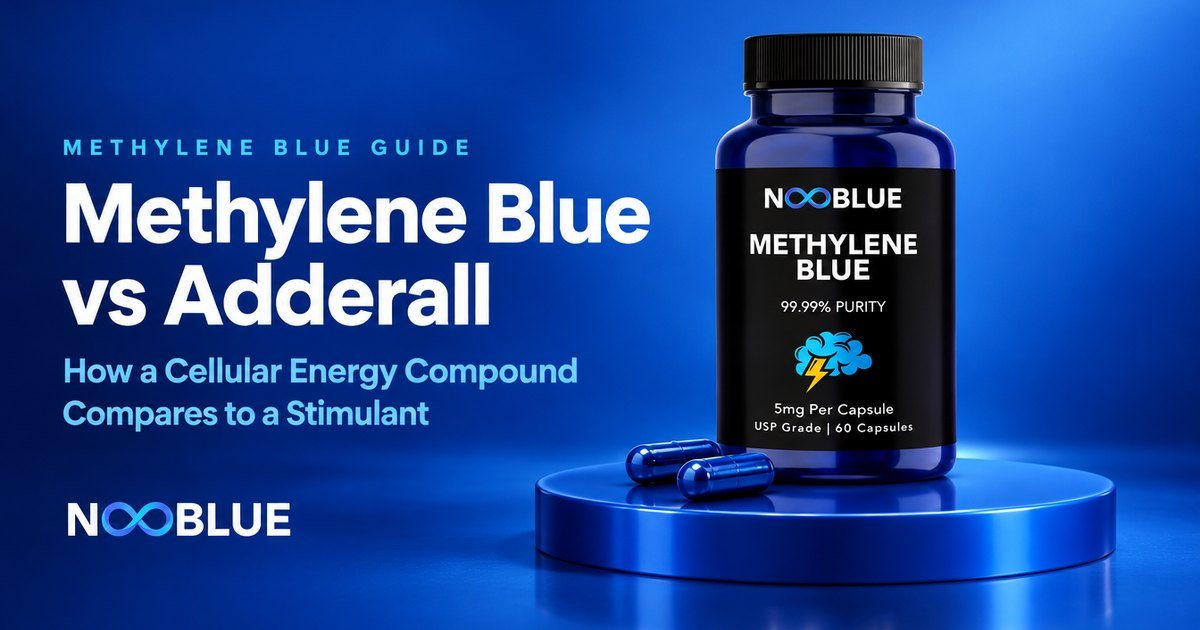
Methylene blue vs Adderall compares two very different things. Adderall is a prescription amphetamine stimulant that raises dopamine and norepinephrine. Methylene blue is a redox dye, sold in low doses as a supplement, that passes electrons along inside mitochondria. Methylene blue is not a substitute for Adderall, and no trial has tested it for ADHD. Never take the two together: the Adderall label lists intravenous methylene blue among the MAO inhibitors it must not be combined with, including for 14 days after the last dose.
- If you take Adderall, Vyvanse, Ritalin or Strattera: do not add methylene blue. Talk to your prescriber first.
- If you take no stimulant or serotonergic medicine and want to try methylene blue: our pick is NooBlue Ultimate Methylene Blue Capsules, which we make. Each capsule holds 5 mg, the lowest fixed dose we sell.
- The evidence gap: the best human study gave healthy adults a single 280 mg dose, 56 times one capsule, and tested memory an hour later. Nobody has studied 5 mg for focus.
People search “methylene blue vs Adderall” for different reasons. Some have run short of a prescription. Some want focus without a stimulant comedown. Some already take Adderall and wonder whether methylene blue could sit on top of it. This guide covers how each compound works, what the research on methylene blue shows and does not show, why the combination is dangerous, and what to do if you still want to try methylene blue on its own.
A note on who is writing. NooBlue makes methylene blue capsules, gummies and drops, so we have a commercial interest in this topic. Everything below about Adderall comes from its prescribing label and medication guide. Everything about methylene blue comes from published studies and the label of the injectable hospital drug. Where the evidence is thin, we say so.
Table of contents
- 1. Methylene Blue vs Adderall at a Glance
- 2. How Adderall Works
- 3. How Methylene Blue Works
- 4. What the Research Says About Methylene Blue, Focus and Memory
- 5. Methylene Blue and ADHD: No Trial Evidence Yet
- 6. Can You Take Methylene Blue and Adderall Together?
- 7. Switching From Adderall to Methylene Blue
- 8. Side Effects and Safety, Side by Side
- 9. What People Really Want: Focus Without a Prescription Stimulant
- 10. If You Decide to Try Methylene Blue: Dose and Quality
- 11. Frequently Asked Questions
- 11.1. Is methylene blue a stimulant?
- 11.2. Can methylene blue replace ADHD medication like Adderall?
- 11.3. Does methylene blue boost dopamine?
- 11.4. Is methylene blue good for mental clarity?
- 11.5. Is methylene blue safer than Adderall?
- 11.6. Does the same warning apply to Vyvanse, Ritalin and Strattera?
- 11.7. If I stop Adderall, how long should I wait before trying methylene blue?
- 11.8. Can methylene blue cause a positive amphetamine drug test?
- 11.9. Is there a non-prescription replacement for Adderall?
- 12. The Bottom Line
- 13. Sources
Methylene Blue vs Adderall at a Glance
The table sets the two side by side. The Adderall column comes from the immediate-release tablet label. The methylene blue column describes the low doses sold as supplements, with study doses noted where they differ.
| Factor | Methylene blue | Adderall |
|---|---|---|
| What it is | A redox dye and long-used medicine, sold as a supplement in small milligram servings (ours are 5 mg and 10 mg) | Four amphetamine salts, giving d-amphetamine and l-amphetamine in a 3:1 ratio |
| How you get it | Over the counter as a supplement | Prescription only, and a controlled substance |
| Main action | Cycles electrons in the mitochondrial respiratory chain and inhibits the enzyme MAO-A | Thought to block the reuptake of dopamine and norepinephrine and increase their release |
| Stimulant? | No. It is not a monoamine releaser | Yes, a central nervous system stimulant |
| Used for | General energy and focus support as a supplement. The injectable form is a hospital medicine | Prescription medication for diagnosed ADHD and narcolepsy |
| Time course | Brain-scan changes measured one hour after a 280 mg dose | Peak blood levels about 3 hours after a tablet |
| Half-life | About 24 hours (injectable label) | About 10 to 11 hours for d-amphetamine, 11.5 to 13.8 hours for l-amphetamine |
| Headline label warning | Serotonin syndrome with serotonergic drugs and opioids | Abuse, misuse and addiction |
| Must not be combined with | Serotonergic antidepressants, MAO inhibitors, opioids and stimulant ADHD medicines | MAO inhibitors, including linezolid and intravenous methylene blue, or within 14 days of stopping one |
| Common side effects | Blue or green urine. Drops can stain the mouth and tongue; NooBlue gummies don’t | Stomachache, decreased appetite, nervousness (medication guide) |
How Adderall Works
Adderall tablets contain four amphetamine salts, which work out to d-amphetamine and l-amphetamine in a 3:1 ratio. The label describes amphetamines as sympathomimetic amines with stimulant activity in the central nervous system. They are thought to block the reuptake of dopamine and norepinephrine into nerve cells and to increase the release of both into the space outside them. More of each chemical stays active at the synapse. The medication guide says Adderall may help increase attention and decrease impulsiveness and hyperactivity in people with ADHD.
Two details on the label matter for this comparison. First, it states that the mode of therapeutic action in ADHD is not known. Second, the label opens with its most serious warning: Adderall has a high potential for abuse and misuse, which can lead to a substance use disorder, including addiction. That is why it is a controlled, prescription-only medicine, and why prescribers are told to assess each patient’s risk before and during treatment.
The label also covers the heart and circulation. Stimulants raise blood pressure by about 2 to 4 mm Hg and heart rate by about 3 to 6 beats per minute on average, and some people see larger increases. The most common side effects listed in the medication guide are stomachache, decreased appetite and nervousness.
How Methylene Blue Works
Methylene blue has a long medical history. A 2019 review in CNS Drugs notes it has been used in psychiatry for over a century. Today the injectable version is a hospital medicine for a blood disorder called acquired methemoglobinemia, and the label dose is 1 mg/kg given into a vein.
At low doses, methylene blue acts as an electron cycler in the mitochondrial electron transport chain. It accepts electrons and hands them on, which supports cytochrome oxidase, the enzyme at the end of the chain that uses oxygen. A 2012 review in Progress in Neurobiology by Rojas, Bruchey and Gonzalez-Lima at the University of Texas at Austin concluded that the available data support a major role for cytochrome oxidase in its memory-enhancing effects. The same review stresses a hormetic dose response, meaning low and high doses have opposite effects (Rojas et al., 2012).
The second action is the one that matters for anyone on a stimulant. Methylene blue is a potent, reversible inhibitor of monoamine oxidase A (MAO-A). Ramsay, Dunford and Gillman showed this with purified human enzyme in 2007, and found it inhibits MAO-B only at much higher concentrations (Ramsay et al., 2007). MAO-A is one of the enzymes that break down monoamines. In mice bred without it, brain levels of serotonin, norepinephrine and dopamine all run higher (Shih et al., 1999).
So methylene blue does not push neurotransmitters out of nerve cells the way amphetamine does. What it can do is slow their breakdown. Put that alongside a drug that is already releasing extra norepinephrine and dopamine, and the two effects stack in the wrong direction.
What the Research Says About Methylene Blue, Focus and Memory
The strongest human evidence comes from one research group in Texas. In a randomized, double-blind, placebo-controlled trial published in Radiology in 2016, Rodriguez and colleagues scanned 26 healthy adults aged 22 to 62, half on methylene blue and half on placebo, before and one hour after a single oral dose. The dose was 280 mg, about 4 mg/kg. Methylene blue increased activity in the insular cortex during a sustained-attention task and in prefrontal, parietal and occipital areas during a short-term memory task. It was also associated with a 7% increase in correct responses during memory retrieval (P = .01). Everyone who took methylene blue reported blue urine afterwards (Rodriguez et al., 2016).
A companion paper from the same trial, published in Brain Imaging and Behavior, reported stronger resting-state connectivity between brain regions that link perception and memory after the same 280 mg dose. That trial enrolled 28 participants (Rodriguez et al., 2017).
Animal work shows why the dose matters so much. In zebrafish, Echevarria and colleagues found that a 0.5 μM bath improved memory in a T-maze, 5.0 μM made no measurable difference, and 10.0 μM left the fish performing worse than those given lower doses (Echevarria et al., 2016). The Texas group picked their human dose from the 0.5 to 4 mg/kg range, where methylene blue enhances mitochondrial function, and noted opposite effects above 10 mg/kg.
Martin Alda’s 2019 review in CNS Drugs covers a century of psychiatric use and ends on a caution: methylene blue is usually well tolerated, but its MAO-A inhibition calls for care (Alda, 2019). An MD Anderson physician summed up the wider picture in March 2026: “not all the health claims you hear about methylene blue are proven” (MD Anderson).
What has not been shown
- No trial has compared methylene blue with Adderall or any other stimulant.
- No trial has tested methylene blue in people with ADHD. We searched PubMed and ClinicalTrials.gov in September 2026 and found none.
- No study has measured attention or memory at supplement doses of 5 to 10 mg. The human trials used 280 mg, once.
- Both Texas papers describe a single dose. We found no published trial of daily low-dose use for focus in healthy adults.
Methylene Blue and ADHD: No Trial Evidence Yet
Anyone searching for methylene blue for ADHD will find plenty of forum threads but no clinical trial. Personal reports cannot tell you what a placebo would have done, and nothing controlled fills that gap yet. Our longer guide to what the research says about methylene blue and ADHD covers the theory and the forum claims in more detail, and it is no substitute for a doctor’s assessment.
If you are an adult with ADHD, or think you might be, talk to a doctor and keep these points in mind:
- Methylene blue is not a treatment for ADHD and should not replace a prescribed medication.
- If you take a stimulant or atomoxetine, methylene blue is off the table unless your prescriber says otherwise. The interaction section below explains why.
- If attention problems are affecting work, study or relationships, an assessment with a doctor is the useful next step. A supplement cannot diagnose or rule out ADHD.
- If you have been assessed, take no ADHD medication and still want to try methylene blue for everyday focus, start with the lowest dose and tell your doctor.
Can You Take Methylene Blue and Adderall Together?
No. This is the clearest answer on the page.
Under contraindications, the Adderall label lists anyone taking a monoamine oxidase inhibitor, or within 14 days of stopping one, “including MAOIs such as linezolid or intravenous methylene blue,” because of an increased risk of hypertensive crisis. Its drug interaction section spells out what that can mean: using MAO inhibitors with stimulants can cause a hypertensive crisis, with outcomes that include stroke, heart attack and death. The label also carries a warning that amphetamines combined with serotonergic drugs, MAO inhibitors among them, can cause serotonin syndrome, a potentially life-threatening reaction (Adderall label).
Drugs.com rates the pairing a major interaction and says amphetamine should be used only after at least 14 days off methylene blue. Its warning signs include a sudden severe headache, blurred vision, confusion, seizures, chest pain, nausea or vomiting, numbness or weakness on one side of the body, trouble speaking, fever, sweating and fainting (Drugs.com). Any of these after mixing the two is a reason to call emergency services.
One honest caveat. The label names the intravenous form, which hospitals give at about 1 mg/kg. A 5 mg capsule is a far smaller dose, and no study has measured how strongly it inhibits MAO-A. That uncertainty is a reason for caution rather than permission. Nobody can tell you where a safe threshold sits, so the only sensible rule is to keep methylene blue and Adderall apart.
Methylene blue with Vyvanse, Ritalin and Strattera
The same logic covers the other common ADHD medicines:
- Vyvanse (lisdexamfetamine) is converted to dextroamphetamine in the blood. Its label carries the same contraindication and names intravenous methylene blue (Vyvanse label).
- Ritalin (methylphenidate) is contraindicated with MAO inhibitors, or within 14 days of stopping one, because of the risk of hypertensive crises (Ritalin label).
- Strattera (atomoxetine) is a non-stimulant, and its label still lists MAO inhibitors, “including MAOIs such as linezolid or intravenous methylene blue,” as a contraindication (Strattera label).
Serotonergic antidepressants are the other big exclusion. The injectable methylene blue label carries a boxed warning for serotonin syndrome when it is combined with SSRIs, SNRIs, MAO inhibitors or opioids (methylene blue injection label). Our guides to methylene blue and serotonin syndrome and what not to take with methylene blue, plus the full methylene blue interactions list, go through each drug class.
Switching From Adderall to Methylene Blue
Some readers want to stop Adderall and use methylene blue instead. Three facts from the labels help frame that conversation with your doctor.
- Adderall takes days to clear. The label gives an elimination half-life of about 10 to 11 hours for d-amphetamine and 11.5 to 13.8 hours for l-amphetamine. By the usual rule of thumb that a drug is mostly gone after about five half-lives, that means two to three days.
- Methylene blue lingers too. The injectable label puts its half-life at about 24 hours in humans. If you ever go back on a stimulant, Drugs.com and the Adderall label (which names the intravenous form) both use a 14-day gap after the last methylene blue dose.
- Supervision matters more than the calendar. Stopping a prescribed stimulant, choosing a gap and adding anything new should all be agreed with the doctor who manages the prescription.
If your doctor clears you to try methylene blue after stopping, start with one 5 mg capsule in the morning with food and judge it over two weeks before changing anything.
Side Effects and Safety, Side by Side
Adderall
Beyond the misuse warning and the blood pressure and heart rate effects above, the Adderall label covers several other risks. Sudden death has been reported in people with structural heart problems, so the label says to avoid it in people with serious heart conditions. Psychotic or manic symptoms can appear at recommended doses, even in people with no history of them. Children can grow more slowly, and circulation problems in the fingers and toes are listed. Dry mouth, diarrhea, constipation, weight loss and restlessness also appear among the adverse reactions.
Methylene blue
At supplement doses, the most common effect is harmless but startling: urine turns blue or green, and stool can turn green too. Drops can stain the tongue and mouth. NooBlue gummies don’t leave that blue mouth, and capsules are swallowed. See our guide to methylene blue side effects for the full list. The serious risks come down to who takes it and what else they take:
- Serotonergic medicines and stimulants. SSRIs, SNRIs, MAO inhibitors, opioids such as tramadol, and the ADHD medicines above.
- G6PD deficiency. The injectable label lists it as a contraindication because of the risk of hemolytic anemia. Our guide to methylene blue and G6PD deficiency explains the test.
- Pregnancy and breastfeeding. The injectable label says methylene blue may cause fetal harm and advises stopping breastfeeding for up to 8 days after treatment. Do not use a methylene blue supplement while pregnant or breastfeeding.
- Drug tests. Two 2026 case reports in Therapeutic Drug Monitoring described false-positive amphetamine results on urine drug screens after methylene blue (Leegwater and Jager, 2026). If you are tested at work or in a treatment program, say that you take it. Our methylene blue drug test guide explains how confirmation testing sorts this out.
Our guide to who should not take methylene blue covers every exclusion. Readers in Australia can also see our guide to buying methylene blue in Australia.
What People Really Want: Focus Without a Prescription Stimulant
Behind most searches comparing a supplement with Adderall is a simpler question: what can I take instead? No supplement reproduces the effect of amphetamine, and one that did would carry the same risks. Methylene blue sits in a different category. Its proposed role is supporting energy production in brain cells, and the human evidence for its brain effects is one small trial.
If attention problems are disrupting your life, an evaluation with a doctor is the step that matters, because both stimulant and non-stimulant medicines exist and a doctor can match one to you. If you simply want steadier energy on long workdays, start with the basics: sleep, regular meals and caffeine timed early enough to spare your night. Our guides to energy and focus supplements without stimulants, methylene blue and caffeine and methylene blue vs modafinil compare the other options people ask about. For the wider picture, see how methylene blue compares with other nootropics.
Some people also use methylene blue as a non-stimulant pre-workout focus aid, and our comparison of methylene blue vs CoQ10 goes further into the energy-production side. For the biochemistry, read how methylene blue works.
How does methylene blue make you feel? It is not a stimulant, so do not expect a rush. Reports vary from person to person, and the controlled trials measured brain scans and test scores, not mood or energy. Our piece on how long methylene blue takes to work covers timing.
If You Decide to Try Methylene Blue: Dose and Quality
First, rule yourself out. Skip methylene blue if you take any medicine from the interaction section above, have G6PD deficiency, or are pregnant or breastfeeding. If you take any prescription medicine at all, ask your doctor or pharmacist before starting.
Then start low. The brain-imaging trials used 280 mg once, in a research setting. Supplement servings are far smaller: our capsules hold 5 mg, and our guide to how many mg of methylene blue per day explains why we suggest one capsule a day with food and a two-week trial before adjusting. The hormetic curve described above is the reason more is not better.
Quality matters because methylene blue is also sold as a lab reagent and an aquarium product. Look for USP grade and a certificate you can read. For our products, Contract Testing Laboratories of America (CTLA) analyzed the methylene blue ingredient, lot 2025022801, and recorded an HPLC identity result of “Conforms” plus individual results for arsenic, cadmium, mercury and lead. That report covers the raw ingredient. It does not give a purity percentage or certify every finished batch, and our quality and testing page says so. Our certificate of analysis guide shows how to read any brand’s paperwork, including ours, and our guide to methylene blue purity explains what USP grade means.
| NooBlue format (prices as of Sep 2026) | Methylene blue | Also contains | Price | Cost per serving |
|---|---|---|---|---|
| Ultimate Methylene Blue Capsules, 60 | 5 mg per capsule | 10 mg vitamin C | $37.99 | $0.63 per capsule |
| Methylene Blue Gummies, 60 | 10 mg per gummy | 25 mg vitamin C, Wild Blueberry flavor | $49.99 | $0.83 per gummy |
| Methylene Blue Drops, 1%, 50 mL | 0.5 mg per drop | About 100 servings of 5 mg (10 drops) | $29.99 | $0.30 per 5 mg serving |
Capsules give a fixed 5 mg with nothing to measure, which suits a cautious first trial. Gummies double the dose to 10 mg per chew. Drops allow half-milligram steps, but the liquid stains skin and fabric, so handle the pipette with care. You can see all three in our shop, compare other brands in our roundups of the best methylene blue capsules and best methylene blue supplements, or start with our first-timer guide.
Frequently Asked Questions
Is methylene blue a stimulant?
No. Methylene blue does not act like amphetamine or caffeine. Its known actions in the brain are electron cycling in mitochondria and inhibition of the enzyme MAO-A. The only human trials measured brain scans and memory scores after a single 280 mg dose, so any effect on alertness at supplement doses is unmeasured.
Can methylene blue replace ADHD medication like Adderall?
No. No trial has tested methylene blue in people with ADHD, and nothing shows it can stand in for a prescribed medication. It also interacts dangerously with Adderall and other stimulant ADHD medicines, so it cannot be added on top. Decisions about ADHD treatment belong with your doctor.
Does methylene blue boost dopamine?
Not directly. Methylene blue inhibits MAO-A, one of the enzymes that break down serotonin, norepinephrine and dopamine, so in theory it can raise their levels by slowing breakdown. No human study has measured dopamine after a supplement dose. Amphetamine works differently: it is thought to increase dopamine release and block its reuptake. That overlap is exactly why the two should never be combined.
Is methylene blue good for mental clarity?
The evidence is early. In the 2016 Radiology trial, a single 280 mg dose increased brain activity during attention and memory tasks and was associated with a 7% increase in correct memory-retrieval responses among 26 healthy adults. That is one small study at a dose far above supplement servings. It supports more research, and it does not support strong promises.
Is methylene blue safer than Adderall?
They carry different risks, so a single answer would mislead. Adderall has a label warning for abuse, misuse and addiction, and it raises blood pressure and heart rate. The injectable methylene blue label has no misuse warning, but methylene blue can cause serotonin syndrome with serotonergic medicines, is not for people with G6PD deficiency, and should not be used in pregnancy. They are not interchangeable, and methylene blue is not a treatment for any condition Adderall is prescribed for.
Does the same warning apply to Vyvanse, Ritalin and Strattera?
Yes. The Vyvanse and Strattera labels both name intravenous methylene blue among the MAO inhibitors they must not be combined with, and the Ritalin label rules out MAO inhibitors within 14 days. Treat every stimulant or norepinephrine-acting ADHD medicine as incompatible with methylene blue unless your prescriber says otherwise. Our interactions guide lists the full set.
If I stop Adderall, how long should I wait before trying methylene blue?
Ask the doctor who manages your prescription. d-Amphetamine has a half-life of about 10 to 11 hours, so it takes a couple of days to clear. Going the other way, Drugs.com and the Adderall label (which names the intravenous form) both use a 14-day gap after the last dose of methylene blue before a stimulant starts. Do not restart a stimulant after taking methylene blue without telling your doctor. If you are cleared to try it, one 5 mg capsule in the morning with food, judged over two weeks, is a sensible start.
Can methylene blue cause a positive amphetamine drug test?
Rarely, it can. Two 2026 case reports described false-positive amphetamine results on urine drug screens after methylene blue. Screening immunoassays can cross-react with unrelated molecules, and confirmation testing identifies the actual compound. If you are tested, tell the lab or your program that you take methylene blue. Our drug test guide has the details.
Is there a non-prescription replacement for Adderall?
No supplement does what Adderall does, and methylene blue is not an Adderall substitute. If you want a replacement because of side effects or cost, talk to your prescriber, because other stimulant and non-stimulant medicines exist. If you want general support for energy and focus without a stimulant, methylene blue is one option to discuss with your doctor, alongside sleep, meals and caffeine timing.
The Bottom Line
Methylene blue vs Adderall is a comparison of a supplement and a prescription stimulant, and they do different jobs. Adderall is a prescription medication for ADHD and narcolepsy, with real misuse and heart risks. Methylene blue is a mitochondrial compound with one small human trial behind its brain effects and a dangerous interaction with every stimulant ADHD medicine. Never combine them. If you take no interacting medicine and want to try methylene blue, start with a low fixed dose from a brand whose testing paperwork you can read.
Sources
- Rodriguez P, Zhou W, Barrett DW, et al. Multimodal randomized functional MR imaging of the effects of methylene blue in the human brain. Radiology. 2016;281(2):516-526. PubMed 27351678
- Rodriguez P, Singh AP, Malloy KE, et al. Methylene blue modulates functional connectivity in the human brain. Brain Imaging and Behavior. 2017;11(3):640-648. PMC5018244
- Rojas JC, Bruchey AK, Gonzalez-Lima F. Neurometabolic mechanisms for memory enhancement and neuroprotection of methylene blue. Progress in Neurobiology. 2012;96(1):32-45. PubMed 22067440
- Ramsay RR, Dunford C, Gillman PK. Methylene blue and serotonin toxicity: inhibition of monoamine oxidase A (MAO A) confirms a theoretical prediction. British Journal of Pharmacology. 2007;152(6):946-951. PubMed 17721552
- Shih JC, Chen K, Ridd MJ. Monoamine oxidase: from genes to behavior. Annual Review of Neuroscience. 1999;22:197-217. PubMed 10202537
- Echevarria DJ, Caramillo EM, Gonzalez-Lima F. Methylene blue facilitates memory retention in zebrafish in a dose-dependent manner. Zebrafish. 2016;13(6):489-494. PubMed 27482828
- Alda M. Methylene blue in the treatment of neuropsychiatric disorders. CNS Drugs. 2019;33(8):719-725. PubMed 31144270
- Leegwater E, Jager NGL. Methylene blue-induced false-positive amphetamine results in urine drug screening: two case reports. Therapeutic Drug Monitoring. 2026;48(2):280-281. PubMed 41058025
- Adderall (dextroamphetamine saccharate, amphetamine aspartate, dextroamphetamine sulfate and amphetamine sulfate) tablets, prescribing information and medication guide, Teva, rev. 5/2024. DailyMed
- Vyvanse (lisdexamfetamine dimesylate) prescribing information, Takeda. DailyMed
- Ritalin (methylphenidate hydrochloride) tablets, prescribing information. DailyMed
- Strattera (atomoxetine) prescribing information, Eli Lilly. DailyMed
- ProvayBlue (methylene blue) injection, prescribing information, American Regent. DailyMed
- Drugs.com. Adderall and methylene blue drug interaction, read Sep 2026. drugs.com
- MD Anderson Cancer Center. Methylene blue: Should you take it? March 2026. mdanderson.org
- NooBlue product pages and quality page (ingredients, serving directions, CTLA ingredient report), read Sep 2026. nooblue.com/quality