Written by the NooBlue editorial team. NooBlue makes and sells methylene blue, so we have a commercial interest in this comparison. We do not sell any of the other compounds below. Every study figure links to its source at the end of the page.
Short answer
Methylene blue works differently from every other popular nootropic. It is a redox dye that can act as a spare electron carrier in mitochondria, and it also blocks monoamine oxidase A, the enzyme that breaks down serotonin. Its human cognition evidence is small: one 26-person trial found 7% more correct memory answers an hour after a single 280 mg dose, and a later study found lower brain blood flow instead.
Against the alternatives: caffeine with L-theanine has more direct evidence for quick focus on a task, creatine and bacopa have better evidence for gains over weeks, and modafinil and Adderall are prescription drugs with their own risks. Methylene blue is the option to consider if you want to try the mitochondrial approach at a low dose.
The rule that matters most: methylene blue must not be combined with SSRIs, SNRIs, MAOIs or other serotonergic medicines, because the combination can cause serotonin syndrome. That interaction comes from methylene blue’s enzyme effect, and it is the main reason methylene blue is not for everyone.
Table of contents
- 1. Is methylene blue a nootropic?
- 2. Methylene blue vs other nootropics at a glance
- 3. Methylene blue vs nootropic supplements
- 4. Methylene blue vs Adderall and modafinil
- 5. What sets methylene blue apart: the MAO interaction
- 6. Can you stack methylene blue with other nootropics?
- 7. Which nootropic should you choose?
- 8. How much methylene blue to take as a nootropic
- 9. Frequently asked questions
- 10. The bottom line
- 11. Sources
Is methylene blue a nootropic?
A nootropic is anything people take to support thinking. By that loose definition, methylene blue qualifies. What sets it apart is how it works.
Most nootropics act on brain chemistry directly. Caffeine blocks adenosine receptors, choline sources feed acetylcholine production, and prescription stimulants raise dopamine and noradrenaline. Methylene blue does something else. It picks up electrons and hands them on, cycling between its blue form and a colorless form, and inside mitochondria that lets it feed electrons into the chain that ends at cytochrome c oxidase, the step where cells use oxygen to make energy. A 2012 review in Progress in Neurobiology by Rojas, Bruchey and Gonzalez-Lima sets out that mechanism and the animal memory studies built on it.
The human evidence is much thinner than the animal work.
- The main memory trial. In a randomized, double-blind trial published in Radiology in 2016, Rodriguez and colleagues gave 26 healthy adults either a placebo or a single oral dose of 280 mg of USP methylene blue, about 4 mg per kilogram. One hour later, the methylene blue group showed more brain activity during attention and short-term memory tasks and gave 7% more correct answers during memory retrieval.
- A companion imaging study. The same team reported in 2017 that a single dose changed resting-state connectivity between brain regions linked to perception and memory. It was an imaging study, not a test of thinking skills.
- A result in the other direction. In 2023, Singh and colleagues at King’s College London gave healthy volunteers methylene blue into a vein at 0.5 and 1 mg per kilogram and found that brain blood flow and brain oxygen use went down. They had expected the opposite and suggested that the doses may have been past the peak of methylene blue’s bell-shaped dose curve.
Lorne Hofseth, a professor in the College of Pharmacy at the University of South Carolina, concluded in 2025 that “much larger, longer trials are needed to know if it truly works, what the right dose is and how safe it is over time.” We agree. The 280 mg trial dose is 56 times the 5 mg in one of our capsules, and no trial has tested daily supplement doses for thinking in healthy adults. Our evidence guide to whether methylene blue is good for you goes through these studies in more depth.
Methylene blue vs other nootropics at a glance
The table compares each compound on how it works, the best evidence we could find in healthy adults, and its main drawback. It is not a ranking. The right choice depends on your goal and on what medicines you take.
| Compound | How it works | Best evidence in healthy adults | Main drawback |
|---|---|---|---|
| Methylene blue | Spare electron carrier in mitochondria; blocks MAO-A | One 26-person trial: 7% more correct memory answers after a single 280 mg dose. A 2023 study found lower brain blood flow. | Dangerous with serotonergic medicines. Turns urine blue. No trials at supplement doses. |
| Caffeine | Blocks adenosine receptors | 50 mg improved alertness and attention-switching accuracy in a 27-person crossover study. | Jitters and poorer sleep in some people. |
| L-theanine (with caffeine) | Amino acid from tea | 100 mg with 50 mg caffeine improved speed and accuracy of attention switching in the same study. | The positive data are mostly for the pairing with caffeine. |
| Lion’s mane | Medicinal mushroom (Hericium erinaceus) | In 41 young adults, one 1.8 g dose sped up a Stroop task. Other measures were mostly null. | Small pilot studies. Products vary a lot. |
| Alpha-GPC and citicoline | Choline sources for acetylcholine | Citicoline 500 mg a day for 12 weeks improved episodic memory in 100 adults aged 50 to 85. Alpha-GPC did not change vigilance scores in young men. | Evidence differs by compound and age group. |
| Bacopa | Standardized herb extract | A meta-analysis of 9 trials (518 people) found faster attention after 12 weeks or more. | Needs weeks of daily use. |
| Creatine | Energy buffer that recycles ATP | A review of 6 trials (281 people) found short-term memory and reasoning may improve. | No change seen in young people in that review. |
| Modafinil | Prescription wakefulness drug | A systematic review found consistent gains on complex attention and planning tasks in rested healthy people. | Prescription only. |
| Adderall (amphetamine) | Prescription stimulant | A meta-analysis of 48 studies (1,409 people) found small gains in impulse control and short-term memory. | Prescription only. Effects probably modest in healthy people. |
The pattern is clear enough. The fast-acting options with the most human data are caffeine and caffeine with L-theanine. The options that build over weeks are creatine and bacopa. Methylene blue sits in between, with a distinctive mechanism, a single-dose memory result and a serious drug interaction. If you want ready-made formulas rather than single compounds, our roundups of methylene blue nootropics and supplements for energy and focus without stimulants compare products.
Methylene blue vs nootropic supplements
Methylene blue vs caffeine
Caffeine is the most used nootropic there is. It works by blocking adenosine, the signal that builds up during the day and makes you sleepy. In a 27-person crossover study by Owen and colleagues (Nutritional Neuroscience, 2008), 50 mg of caffeine improved alertness at 60 minutes and accuracy on an attention-switching task at 90 minutes.
Methylene blue is not a stimulant and does not act on adenosine. People who use it describe a steadier effect than coffee, but no trial has compared the two head to head. Some people take both. We know of no study of the combination, so if you add methylene blue to your coffee routine, keep the caffeine dose you already know and watch your sleep. Our guides to methylene blue and caffeine and taking methylene blue with coffee cover timing.
Methylene blue vs L-theanine
L-theanine is an amino acid found in tea. In the same Owen study, 100 mg of L-theanine taken with 50 mg of caffeine improved both speed and accuracy on the attention-switching task and made people less distracted during a memory task. The authors noted that this repeated earlier findings for the pairing.
L-theanine and methylene blue do different jobs, and there is no known interaction between them. If calm focus for a work session is your goal, caffeine with L-theanine has more human data behind it than methylene blue does.
Methylene blue vs lion’s mane
Lion’s mane is a mushroom sold as an extract. The best trial we found in healthy people is small. Docherty and colleagues (Nutrients, 2023) gave 41 healthy adults aged 18 to 45 either 1.8 g of lion’s mane or a placebo. One hour after a single dose, the lion’s mane group was quicker on a Stroop task. After 28 days there was a trend toward lower self-reported stress that just missed statistical significance, and the authors reported null and some negative findings as well.
So both compounds rest on small human studies. Methylene blue has the stronger single-dose memory result, at a dose far above a supplement serving. For someone on antidepressants, methylene blue is ruled out, so lion’s mane or another option is the one to discuss with a doctor.
Methylene blue vs alpha-GPC and citicoline
Alpha-GPC and citicoline both supply choline, which the brain uses to make the neurotransmitter acetylcholine. Their results differ. In a trial of 48 healthy college-aged men, Marcus and colleagues (2017) found that 250 or 500 mg of alpha-GPC a day for 7 days did not change scores on a psychomotor vigilance test compared with placebo. Citicoline did better in older adults: Nakazaki and colleagues (Journal of Nutrition, 2021) gave 100 healthy adults aged 50 to 85 with age-related memory complaints either 500 mg of citicoline a day or a placebo for 12 weeks, and the citicoline group improved more on episodic memory.
Choline sources and methylene blue act on different systems, and neither study tested them together.
Methylene blue vs bacopa
Bacopa monnieri is a herb from Ayurvedic tradition. A meta-analysis by Kongkeaw and colleagues (Journal of Ethnopharmacology, 2014) pooled 9 randomized trials with 518 participants, each lasting at least 12 weeks with a standardized extract. Bacopa shortened completion times on the Trail B test and choice reaction time, which the authors read as faster attention.
Bacopa is a slow build. It suits someone willing to take a capsule daily for three months. Methylene blue’s human data are single-dose studies measured within an hour, so the two answer different questions.
Methylene blue vs creatine
Both creatine and methylene blue touch energy metabolism, in different places. Creatine stores phosphate so cells can regenerate ATP quickly. Methylene blue works further upstream, in the mitochondrial electron chain. A systematic review by Avgerinos and colleagues (Experimental Gerontology, 2018) found 6 randomized trials with 281 healthy people. Short-term memory and reasoning may improve with creatine, the other results were mixed, performance did not change in young people, and vegetarians responded better on memory tasks.
The review’s authors describe creatine as safe, and its cognition evidence in healthy people is broader than methylene blue’s. For a young meat-eater, though, that review found little to gain. Our methylene blue vs CoQ10 comparison and mitochondrial support guide cover the other energy-metabolism supplements.
Methylene blue vs Adderall and modafinil
Adderall and modafinil are prescription drugs, and some healthy people take them without a prescription to study or work longer. Methylene blue is sometimes marketed as an alternative. The comparison is uneven: these drugs have far more human data than methylene blue, and they also need a doctor.
Methylene blue vs Adderall
Adderall is a mix of amphetamine salts, a stimulant that raises dopamine and noradrenaline. Its effect on healthy thinking is smaller than its reputation suggests. A meta-analysis by Ilieva, Hook and Farah (Journal of Cognitive Neuroscience, 2015) pooled 48 studies with 1,409 participants on amphetamine and methylphenidate. It found small gains in impulse control and short-term memory, a medium effect on delayed memory that was weakened by signs of publication bias, and concluded that the overall effect in healthy people is probably modest. The authors added that healthy users may be after more energy and motivation rather than better cognition.
Methylene blue is not a stimulant and is not a substitute for a prescribed medicine. Do not combine it with a prescription stimulant, or stop a prescribed drug to try it, without your prescriber’s advice. Our full methylene blue vs Adderall comparison goes through the differences.
Methylene blue vs modafinil
Modafinil is a prescription wakefulness drug that raises catecholamine levels in the brain. Battleday and Brem at the University of Oxford reviewed its effects in healthy, rested people in 2015 (European Neuropsychopharmacology). Studies with basic tests mostly showed better executive function, but only half showed gains in attention or memory. With more complex tasks, modafinil consistently improved attention, executive function and learning, and the reviewers saw no excess of side effects or mood changes.
Modafinil has the stronger evidence for demanding mental work. It is also a prescription medicine, and that alone rules it out for most readers of a supplement comparison. See our methylene blue vs modafinil comparison for the details.
What sets methylene blue apart: the MAO interaction
Two things set methylene blue apart from the other supplements on this list.
The first is its enzyme effect. Ramsay, Dunford and Gillman showed in 2007 (British Journal of Pharmacology) that methylene blue is a potent, reversible inhibitor of monoamine oxidase A, the enzyme that breaks down serotonin. Combined with drugs that raise serotonin, that can tip into serotonin syndrome. StatPearls, the NCBI clinical reference, names SSRIs, SNRIs, MAOIs, certain opioids and dextromethorphan. A 2010 systematic review by Ng and Cameron found 26 patients who became acutely confused after a methylene blue infusion, and 24 of them were taking a serotonin reuptake inhibitor. Treat serotonergic supplements such as 5-HTP and St. John’s wort with the same caution, and ask your doctor.
StatPearls also lists G6PD deficiency as a contraindication and notes that methylene blue may cause fetal harm in pregnancy. So methylene blue is off the table if you have G6PD deficiency, are pregnant or breastfeeding, or take any serotonergic medicine. For people in those groups, caffeine, L-theanine, creatine or bacopa are the ones to discuss with a doctor instead.
The second is the dose curve. Methylene blue’s effects rise with dose and then fall back, and at higher doses they drop below baseline. That pattern, reviewed by Bruchey and Gonzalez-Lima in 2008, means doubling the dose is more likely to cost you than help. Our guides to what not to take with methylene blue, who should not take methylene blue and methylene blue side effects cover the safety side in full.
Can you stack methylene blue with other nootropics?
People do, and some of the common pairings have no known interaction. But no published trial has tested methylene blue in combination with lion’s mane, creatine, choline sources or bacopa, so any claim that these stacks work better together is a guess. Here is how we would approach it.
- Start with one compound. Take it at a steady dose for two weeks and note how you sleep and work before adding anything.
- Add one thing at a time. If you add a second compound, give it its own two weeks. Otherwise you cannot tell which one is doing what.
- Never stack methylene blue with anything serotonergic. That includes antidepressants, some pain and cough medicines, and supplements such as 5-HTP and St. John’s wort.
- Keep caffeine where it was. Methylene blue is best taken in the morning or early afternoon, and adding more caffeine at the same time makes it hard to judge either one.
If you use drops, our gummies vs liquid comparison and powder vs liquid guide explain how format affects dosing precision.
Which nootropic should you choose?
Match the compound to the job.
- Focus for a work session today: caffeine, or caffeine with L-theanine. These have the most direct human evidence for short-term attention.
- Memory or reasoning over weeks: creatine (especially if you eat little meat) or bacopa for 12 weeks or more. Citicoline has one good trial in adults over 50.
- Curious about the mitochondrial approach, and on no serotonergic medicines: methylene blue at a low dose. Go in knowing the human evidence is early and single-dose.
- Taking an antidepressant or another serotonergic medicine: skip methylene blue and pick from the other supplements with your doctor.
- Considering Adderall or modafinil: that is a conversation for a doctor, not a supplement shelf.
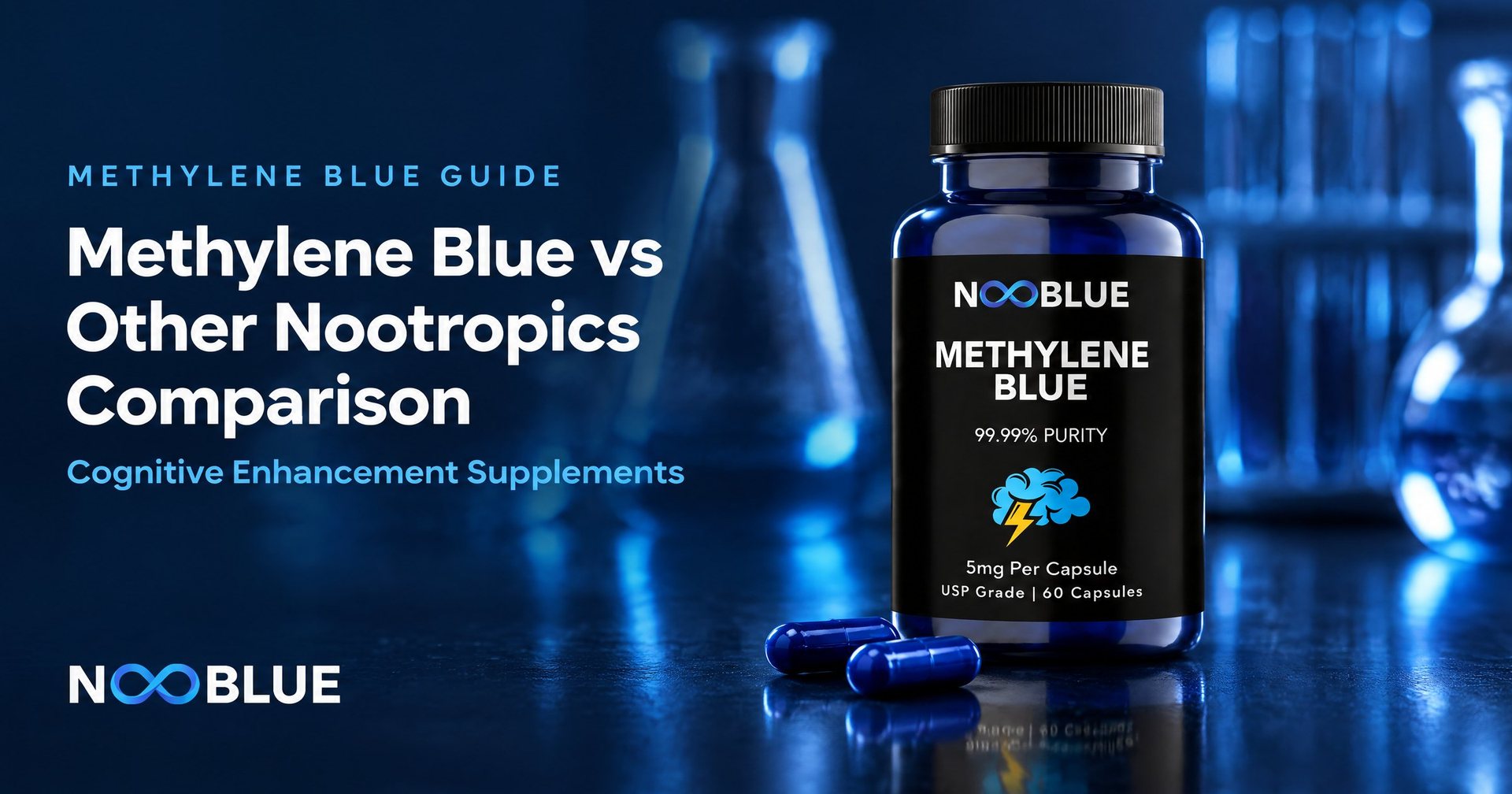
If methylene blue is the one you want to try, our Ultimate Methylene Blue Capsules hold 5 mg of USP-grade methylene blue with 10 mg of vitamin C each, 60 capsules for $37.99, about $0.63 a day. The gummies give 10 mg per gummy with 25 mg of vitamin C, 60 for $49.99, and the 1% drops give 0.5 mg per drop for fine adjustment, 50 mL for $29.99. NooBlue publishes a Contract Testing Laboratories of America report on its methylene blue ingredient covering identity and four heavy metals. It covers the raw ingredient only, gives no purity percentage and is not a test of every finished batch. To compare other brands, see our best methylene blue supplements roundup or browse the shop.
How much methylene blue to take as a nootropic
Supplement users usually start at about 5 mg a day: one of our capsules, or 10 drops of a 1% solution. Healthspan, a clinician-led telehealth service, says a typical protocol begins at around 5 mg and increases gradually to a maximum of about 25 mg a day, adjusted by a clinician. That is far below the 280 mg used in the memory trial, and nobody has shown whether supplement doses produce the same effect.
Take it with food in the morning or early afternoon, hold a dose for a week or two before you change it, and remember that the dose curve bends back. Expect blue or green urine, which StatPearls describes as expected and benign. Our guide to how many mg of methylene blue to take per day has more detail, and our page on methylene blue and G6PD deficiency explains that check.
Frequently asked questions
Is methylene blue a good nootropic?
It is a promising but unproven one. A 26-person trial found 7% more correct memory answers an hour after a single 280 mg dose, while a 2023 study found lower brain blood flow. No trial has tested daily supplement doses for thinking. Caffeine with L-theanine, creatine and bacopa all have more human evidence in healthy people.
Is methylene blue a stimulant?
No. It does not block adenosine like caffeine or release dopamine like amphetamine. It acts on mitochondrial electron transport and inhibits monoamine oxidase A. People describe its effect as steadier than caffeine, but that has not been tested in a controlled trial.
Can you take methylene blue with caffeine?
We know of no interaction between the two, and some people take them together. No study has tested the combination, so keep your usual caffeine dose, take methylene blue early in the day, and watch your sleep.
Is methylene blue better than modafinil for focus?
Modafinil has much stronger evidence for focus in healthy people, especially on complex tasks, but it is a prescription drug. Methylene blue has one small single-dose memory trial. They work in completely different ways and are not interchangeable.
Can you take methylene blue with Adderall?
Do not combine them without your prescriber’s advice. Methylene blue inhibits monoamine oxidase A, and combining monoamine oxidase inhibitors with other drugs that act on brain chemicals needs medical supervision. Never stop or change a prescribed stimulant to try methylene blue.
Who should not use methylene blue as a nootropic?
Anyone taking an SSRI, SNRI, MAOI or other serotonergic medicine, because the combination can cause serotonin syndrome. It is also not for people with G6PD deficiency or anyone pregnant or breastfeeding. Ask your doctor first if you take any prescription medicine.
The bottom line
Methylene blue works as a mitochondrial electron carrier, unlike the other compounds here, and it carries a serious interaction with serotonergic medicines. Its memory evidence is real but small and comes from a single large dose. If you take no serotonergic medicine and want to try it, start at 5 mg and change one thing at a time. For related comparisons, see gentian violet vs methylene blue and methylene blue vs NAD.
This article is for educational purposes only and is not medical advice. Talk to a qualified healthcare professional before starting any new supplement, especially if you take medication or have a health condition.
Sources
- Rojas JC, Bruchey AK, Gonzalez-Lima F. Neurometabolic mechanisms for memory enhancement and neuroprotection of methylene blue. Progress in Neurobiology. 2012;96(1):32-45. PubMed 22067440
- Rodriguez P, Zhou W, Barrett DW, et al. Multimodal randomized functional MR imaging of the effects of methylene blue in the human brain. Radiology. 2016;281(2):516-526. PubMed 27351678 · full text (dose)
- Rodriguez P, Singh AP, Malloy KE, et al. Methylene blue modulates functional connectivity in the human brain. Brain Imaging and Behavior. 2017;11(3):640-648. PubMed 26961091
- Singh N, MacNicol E, DiPasquale O, et al. The effects of acute methylene blue administration on cerebral blood flow and metabolism in humans and rats. Journal of Cerebral Blood Flow & Metabolism. 2023;43(2 suppl):95-105. PubMed 36803299
- Hofseth L. Is methylene blue really a brain booster? University of South Carolina (republished from The Conversation), June 10, 2025. sc.edu
- Owen GN, Parnell H, De Bruin EA, Rycroft JA. The combined effects of L-theanine and caffeine on cognitive performance and mood. Nutritional Neuroscience. 2008;11(4):193-198. PubMed 18681988
- Fredholm BB, Bättig K, Holmén J, et al. Actions of caffeine in the brain with special reference to factors that contribute to its widespread use. Pharmacological Reviews. 1999;51(1):83-133. PubMed 10049999
- Docherty S, Doughty FL, Smith EF. The acute and chronic effects of lion’s mane mushroom supplementation on cognitive function, stress and mood in young adults. Nutrients. 2023;15(22):4842. PubMed 38004235
- Marcus L, Soileau J, Judge LW, Bellar D. Evaluation of the effects of two doses of alpha glycerylphosphorylcholine on physical and psychomotor performance. Journal of the International Society of Sports Nutrition. 2017;14:39. PubMed 29042830
- Nakazaki E, Mah E, Sanoshy K, et al. Citicoline and memory function in healthy older adults: a randomized, double-blind, placebo-controlled clinical trial. Journal of Nutrition. 2021;151(8):2153-2160. PubMed 33978188
- Kongkeaw C, Dilokthornsakul P, Thanarangsarit P, et al. Meta-analysis of randomized controlled trials on cognitive effects of Bacopa monnieri extract. Journal of Ethnopharmacology. 2014;151(1):528-535. PubMed 24252493
- Avgerinos KI, Spyrou N, Bougioukas KI, Kapogiannis D. Effects of creatine supplementation on cognitive function of healthy individuals: a systematic review of randomized controlled trials. Experimental Gerontology. 2018;108:166-173. PubMed 29704637
- Battleday RM, Brem AK. Modafinil for cognitive neuroenhancement in healthy non-sleep-deprived subjects: a systematic review. European Neuropsychopharmacology. 2015;25(11):1865-1881. PubMed 26381811
- Ilieva IP, Hook CJ, Farah MJ. Prescription stimulants’ effects on healthy inhibitory control, working memory, and episodic memory: a meta-analysis. Journal of Cognitive Neuroscience. 2015;27(6):1069-1089. PubMed 25591060
- Ramsay RR, Dunford C, Gillman PK. Methylene blue and serotonin toxicity: inhibition of monoamine oxidase A (MAO A) confirms a theoretical prediction. British Journal of Pharmacology. 2007;152(6):946-951. PubMed 17721552
- Ng BK, Cameron AJ. The role of methylene blue in serotonin syndrome: a systematic review. Psychosomatics. 2010;51(3):194-200. PubMed 20484716
- Bruchey AK, Gonzalez-Lima F. Behavioral, physiological and biochemical hormetic responses to the autoxidizable dye methylene blue. American Journal of Pharmacology and Toxicology. 2008;3(1):72-79. PubMed 20463863
- Ostrovsky A, Afzal M. Methylene Blue. StatPearls, last update January 2, 2026. NCBI Bookshelf NBK557593
- Healthspan. Methylene blue (read September 25, 2026). gethealthspan.com
- NooBlue product pages and ingredient report (read September 25, 2026): capsules · gummies · drops