Key takeaways
- Doctors do prescribe methylene blue, mostly as a hospital injection for a few emergencies and as a surgical dye. What they rarely prescribe is a daily oral dose for focus, energy or longevity.
- The main clinical reason is safety. Methylene blue blocks the enzyme MAO-A, so it can cause serotonin toxicity with SSRIs, SNRIs and other serotonergic medicines, and 13.2% of US adults took an antidepressant in a 30-day window in national survey data.
- The human evidence for everyday use is small: single-dose brain-imaging trials in 26 healthy adults and a fear-extinction trial in 42 people. That is not enough to change routine practice.
- The economic reason is that nobody owns the molecule. It was first made in 1876, so no company has a reason to fund large trials for new uses.
- Practical routes in 2026 are a compounded prescription or a supplement made for people. Chemical and aquarium grades are never an option.
Why don’t doctors prescribe methylene blue? The short answer is that they do, just not for the reasons most people ask about. In hospitals it is an injection for a handful of emergencies and a dye used in surgery. What a family doctor is unlikely to do is write a prescription for a daily oral dose to help with focus or energy. The reasons are part clinical and part economic, and both are worth understanding before you raise it at an appointment.
NooBlue sells methylene blue supplements, so we have an interest in this question. We have tried to set out the doctor’s side fairly, because the safety reasons behind their caution are real. Written by the NooBlue editorial team, with every study linked below.
Table of contents
- 1. What Doctors Actually Prescribe Methylene Blue For
- 2. Reason 1: The Serotonin Syndrome Risk
- 3. Reason 2: The Human Evidence for Everyday Use Is Small
- 4. Reason 3: Safety Questions Remain Open
- 5. Reason 4: Nobody Owns the Molecule
- 6. Reason 5: There Is No Standard Oral Product to Prescribe
- 7. How People Get Methylene Blue in 2026
- 8. What to Ask Your Doctor
- 9. Who Should Not Take Methylene Blue
- 10. Frequently Asked Questions
- 10.1. Why don’t doctors recommend methylene blue for energy or focus?
- 10.2. Is there clinical proof that methylene blue works?
- 10.3. What happens if you take methylene blue every day?
- 10.4. Is it true that methylene blue makes you look younger?
- 10.5. Can my doctor prescribe me methylene blue?
- 10.6. Can I take methylene blue if I’m on an antidepressant?
- 10.7. Is methylene blue going to become a prescription drug for focus?
- 11. The Bottom Line
- 12. Sources
What Doctors Actually Prescribe Methylene Blue For
Methylene blue has a long medical history. It was first made in 1876 as a dye and is often described as the first synthetic drug (Schirmer et al., Neurobiology of Aging, 2011). Today its prescription uses are narrow and mostly in hospitals.
- An injection for acquired methemoglobinemia. This is a blood emergency in which hemoglobin cannot carry oxygen properly. The branded injection, ProvayBlue, is given at 1 mg/kg into a vein over 5 to 30 minutes, and it is a prescription-only product (ProvayBlue prescribing information).
- Other hospital uses. A 2022 review lists vasoplegic syndrome (dangerously low blood pressure, often after heart surgery), ifosfamide-related brain toxicity and cyanide poisoning, plus use as a dye to find leaks or the parathyroid glands during surgery (Bužga et al., Toxicology Research, 2022).
- Intravenous doses. Across these uses, intravenous doses run from 1 to 7.5 mg/kg (Gillman, Journal of Psychopharmacology, 2011).
None of those is a daily oral dose for a healthy adult. That gap is the heart of the question. A patient asking for methylene blue for mental energy is asking a doctor to step outside the uses they were trained in, with a drug that has a well-known interaction problem.
If your doctor has checked your medicines and none of the warnings on this page applies to you, NooBlue makes methylene blue for everyday focus and cellular energy in three formats.
Reason 1: The Serotonin Syndrome Risk
This is the reason most doctors give, and it is a good one. Methylene blue is a potent, reversible inhibitor of monoamine oxidase A (MAO-A), one of the enzymes that break down serotonin (Ramsay et al., British Journal of Pharmacology, 2007). Combine an MAO-A inhibitor with an SSRI, SNRI or other serotonergic medicine and serotonin can build up to toxic levels.
The clinical record is clear. A review by the psychiatrist P. K. Gillman found that 13 of 14 reported cases of central nervous system toxicity involving methylene blue were serotonin toxicity that met the Hunter criteria. He noted that an intravenous dose of only 0.75 mg/kg produced blood levels high enough to inhibit MAO-A in the brain, and that severe serotonin toxicity has occurred in people at 1 mg/kg (Gillman, 2011). The ProvayBlue label carries a boxed warning about serious or fatal serotonin syndrome with SSRIs, SNRIs, MAOIs and opioids.
Now look at it from the doctor’s chair. In US national survey data from 2015 to 2018, 13.2% of adults had used an antidepressant in the previous 30 days (Brody and Gu, NCHS Data Brief 377, 2020). Others take tramadol, dextromethorphan cough medicines or St. John’s wort. Prescribing methylene blue means screening every patient for all of these, including medicines they forget to mention. Our guide to methylene blue and serotonin syndrome explains the warning signs, and what not to take with methylene blue has the longer list.
Reason 2: The Human Evidence for Everyday Use Is Small
The research behind the supplement interest is real. It is also thin by the standards doctors use.
- Brain imaging in healthy adults. In a 2016 randomized, double-blind, placebo-controlled trial, 26 healthy adults took a single 280 mg oral dose (about 4 mg/kg) or placebo. One hour later, brain responses during attention and memory tasks were stronger, and correct answers during memory retrieval rose by 7% (Rodriguez et al., Radiology, 2016). A 2017 follow-up used the same single 280 mg dose and found stronger resting-state connectivity between brain regions (Rodriguez et al., Brain Imaging and Behavior, 2017).
- A fear-extinction trial. Adults with a strong fear of enclosed spaces took 260 mg of methylene blue (23 people) or placebo (19 people) straight after an exposure session. At one month, those whose fear had dropped well during the session did better on methylene blue. Those who still had moderate to high fear at the end of the session tended to do worse on it (Telch et al., American Journal of Psychiatry, 2014).
- Animal work. In rats with permanently reduced blood flow to the brain, 4 mg/kg of USP methylene blue a day for a month reduced learning and memory deficits in a water maze (Auchter et al., 2014). The same University of Texas group has argued that mitochondrial respiration is a promising target for research (Gonzalez-Lima et al., Biochemical Pharmacology, 2014).
That adds up to single doses far above supplement servings, one small trial with a mixed result, and animal studies. No trial has tested daily servings of 5 to 10 mg over months in healthy adults. A family doctor weighing a new use for a drug would normally want several large trials, and they do not exist here. The same applies to the psychiatric trials of methylene blue, which were small and used prescription doses. Our explainer on how methylene blue works covers the mechanism behind all of this.
Reason 3: Safety Questions Remain Open
Doctors also know that methylene blue is not a simple compound. The 2022 review by Bužga and colleagues concluded that its basic toxicological characteristics are unknown, that preclinical data are lacking, and that its toxic effects are dose-dependent, including hemolysis (breakdown of red blood cells), nausea and vomiting, chest pain, breathlessness and high blood pressure (Bužga et al., 2022). The review covers medical use, not supplement servings, but it explains why a cautious doctor wants a reason before prescribing.
Two groups are ruled out entirely. People with G6PD deficiency should not take it, because methylene blue can break down their red blood cells (StatPearls, 2026), and it is not for anyone pregnant or breastfeeding. A doctor will want to know about both before anything else.
Reason 4: Nobody Owns the Molecule
Large clinical trials are expensive, and most are paid for by the company that will sell the drug. Methylene blue is well over a century old and anyone can make it, so no company can recover the cost of large trials for a new use such as focus or longevity. Without those trials, a new use does not make it into the guidelines doctors follow. That is not a conspiracy. It is how drug development is funded, and it leaves many old compounds with promising early research and no path to routine prescribing.
The research that does exist mostly comes from academic groups, such as the University of Texas teams behind the imaging and fear-extinction trials. That work moves slowly and in small steps.
Reason 5: There Is No Standard Oral Product to Prescribe
The standalone prescription methylene blue that doctors know is the injection. For a daily oral dose on its own, a doctor would usually need to write a prescription for a compounding pharmacy to make. ScripX Compounding Pharmacy, for example, makes oral methylene blue solutions and capsules to a prescriber’s instructions, says it is available by prescription only, and arranges that prescription through an online intake form and a telehealth consult, starting at $40 (ScripX, checked September 2026).
That is extra work for a use outside standard practice, and many doctors will not take it on. Some do, and telehealth services like the one ScripX uses are one route. That is why you can hear two different answers depending on who you ask.
How People Get Methylene Blue in 2026
- A compounded prescription. A prescriber writes it and a compounding pharmacy fills it. You get a custom dose and a clinician involved from the start, at the cost of a consult and a wait.
- An oral supplement. Capsules, gummies, drops and troches are sold without a prescription. Quality varies, so check the dose per serving, what the lab report covers and the label warnings. Our guide to buying methylene blue over the counter goes through each channel, and our guide to reading a methylene blue certificate of analysis shows what to check.
- Never chemical or aquarium grade. Harvard Health Publishing warns that chemical-grade methylene blue sold as a stain or dye should not be used in humans (Harvard Health, 2025).
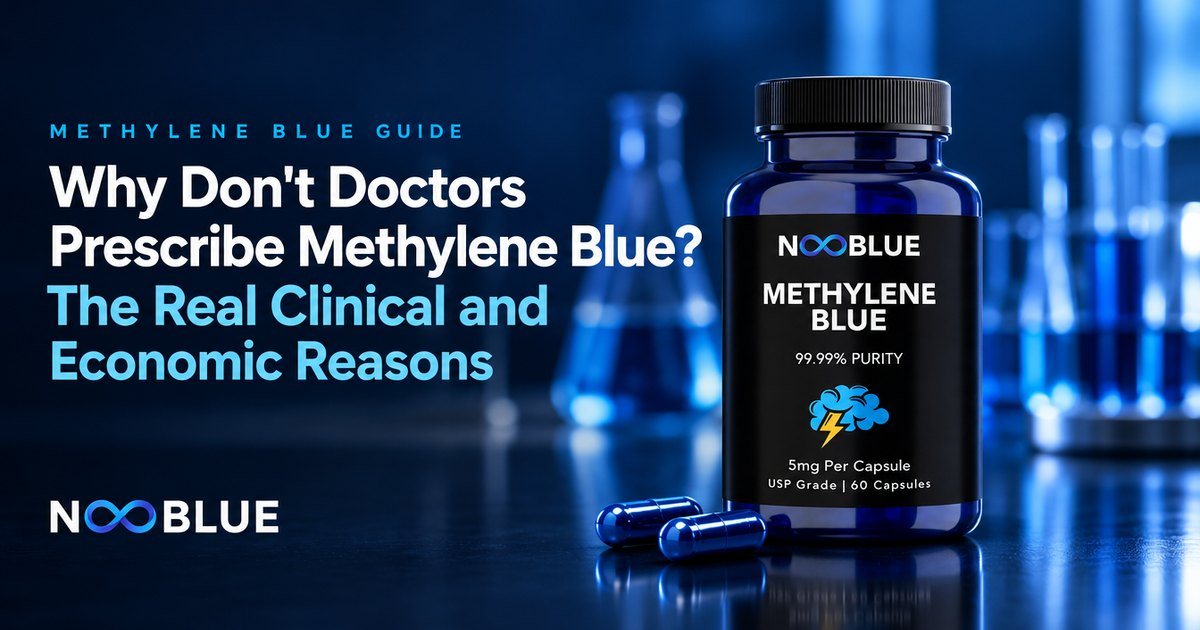
If you go the supplement route, the format matters. NooBlue’s capsules give a fixed 5 mg with 10 mg of vitamin C and nothing to measure. The gummies give 10 mg with 25 mg of vitamin C and avoid the blue mouth and tongue that drops cause. The 1% drops give 0.5 mg per drop for fine control, and our guide on how to take methylene blue drops covers measuring. Serving sizes by format are in our guide to how many mg of methylene blue per day. NooBlue publishes a report from Contract Testing Laboratories of America (CTLA) on its methylene blue ingredient, with identity and heavy metal results for one ingredient lot. It covers the raw ingredient, not each finished batch.
What to Ask Your Doctor
“Will you prescribe me methylene blue?” usually gets a no. A better question gets you useful advice even from a skeptical doctor:
“I’m thinking about a methylene blue supplement at 5 mg a day for focus. These are all the medicines and supplements I take. Is any of them a problem with an MAO-A inhibitor, and should I be tested for G6PD deficiency first?”
You are not asking the doctor to take responsibility for a prescription. You are asking for an interaction check, which is exactly what they are trained to do. Bring the full list, including antidepressants, pain medicines such as tramadol, cough medicines, migraine medicines and herbal products. If you take a serotonergic medicine, the answer should be no, and you should not work around it.
Who Should Not Take Methylene Blue
- Anyone taking an SSRI, SNRI, MAOI or other serotonergic medicine, because of the risk of serotonin syndrome.
- People with G6PD deficiency. See methylene blue and G6PD deficiency.
- Anyone pregnant or breastfeeding.
- Anyone under 18.
- Anyone who takes a prescription medicine should talk to their doctor first.
Methylene blue can also turn urine blue or green with any format, which is expected and harmless. Our full guide to who should not take methylene blue covers every group in more detail.
Frequently Asked Questions
Why don’t doctors recommend methylene blue for energy or focus?
Because the human evidence for that use is limited to small, short studies, and because methylene blue interacts with SSRIs, SNRIs and other serotonergic medicines that many patients take. Without large trials, the use is not in the guidelines doctors follow, and the interaction risk makes many doctors unwilling to recommend it casually.
Is there clinical proof that methylene blue works?
For its hospital uses, methylene blue is an established prescription drug. For focus, energy or longevity in healthy adults, there is no large trial. The best human data are single 280 mg doses in 26 healthy adults, measured after one hour, and a 42-person fear-extinction trial with a mixed result. That is early evidence, not proof.
What happens if you take methylene blue every day?
No trial has followed healthy adults taking daily supplement servings for months. In a 6-month crossover trial where 37 adults took 195 mg a day for one phase, side effects were mild and short-lived (Alda et al., 2017). Urine turns blue or green. The serious risks are interactions with serotonergic medicines, G6PD deficiency and pregnancy. Our guide on whether methylene blue is safe to take daily goes further.
Is it true that methylene blue makes you look younger?
Not as far as anyone has shown in people. A 2017 lab study found that methylene blue helped cultured human skin cells grow and delayed their aging in the dish, and improved hydration and thickness in a lab-grown 3D skin model (Xiong et al., Scientific Reports, 2017). No controlled trial has tested it on real skin in people. Our article on methylene blue and anti-aging covers what the evidence does and does not show.
Can my doctor prescribe me methylene blue?
A prescriber can write a prescription for compounded oral methylene blue, which a compounding pharmacy then makes. Many family doctors decline because it falls outside standard practice. Some prescribers, including telehealth services, will consider it. Either way, ask for an interaction check against your medicine list first.
Can I take methylene blue if I’m on an antidepressant?
No. Do not combine methylene blue with an SSRI, SNRI, MAOI or other serotonergic antidepressant, and do not stop your medicine to make room for it. Severe serotonin toxicity has occurred at intravenous doses of 1 mg/kg in people taking these drugs, and no one has shown a safe oral threshold. Talk to the doctor who prescribes your antidepressant.
Is methylene blue going to become a prescription drug for focus?
Probably not soon. Without patent protection, no company has a reason to fund the large trials that a new prescription use would need. Any progress is likely to come slowly from academic research groups.
The Bottom Line
Doctors prescribe methylene blue every day in hospitals, as an injection and a surgical dye. They rarely prescribe it for focus or energy because the human evidence for that use is small, the serotonin interaction is serious, the drug has open safety questions, and nobody owns it, so no one funds the trials that would settle the matter. None of that means you are wrong to be curious. It means the right conversation with your doctor is an interaction check, not a request for a prescription.
If you are healthy, take no serotonergic medicines and want to try it, start at the lowest serving with a product made for people. You can compare all three NooBlue formats in the shop.
Sources
- Schirmer RH, Adler H, Pickhardt M, Mandelkow E. “Lest we forget you, methylene blue…”. Neurobiology of Aging. 2011;32(12):2325.e7-16. PubMed 21316815
- ProvayBlue (methylene blue) injection prescribing information. DailyMed
- Bužga M, Machytka E, Dvořáčková E, et al. Methylene blue: a controversial diagnostic acid and medication? Toxicology Research. 2022. PubMed 36337249
- Gillman PK. CNS toxicity involving methylene blue: the exemplar for understanding and predicting drug interactions that precipitate serotonin toxicity. Journal of Psychopharmacology. 2011;25(3):429-436. PubMed 20142303
- Ramsay RR, Dunford C, Gillman PK. Methylene blue and serotonin toxicity: inhibition of monoamine oxidase A (MAO A) confirms a theoretical prediction. British Journal of Pharmacology. 2007;152(6):946-951. PMC2078225
- Brody DJ, Gu Q. Antidepressant use among adults: United States, 2015-2018. NCHS Data Brief No. 377. 2020. cdc.gov
- Rodriguez P, Zhou W, Barrett DW, et al. Multimodal randomized functional MR imaging of the effects of methylene blue in the human brain. Radiology. 2016;281(2):516-526. PMC5084971
- Rodriguez P, Singh AP, Malloy KE, et al. Methylene blue modulates functional connectivity in the human brain. Brain Imaging and Behavior. 2017;11(3):640-648. PubMed 26961091
- Telch MJ, Bruchey AK, Rosenfield D, et al. Effects of post-session administration of methylene blue on fear extinction and contextual memory in adults with claustrophobia. American Journal of Psychiatry. 2014;171(10):1091-1098. PubMed 25018057
- Auchter A, Williams J, Barksdale B, Monfils MH, Gonzalez-Lima F. Therapeutic benefits of methylene blue on cognitive impairment during chronic cerebral hypoperfusion. Journal of Alzheimer’s Disease. 2014;42 Suppl 4:S525-535. PubMed 25079810
- Gonzalez-Lima F, Barksdale BR, Rojas JC. Mitochondrial respiration as a target for neuroprotection and cognitive enhancement. Biochemical Pharmacology. 2014;88(4):584-593. PubMed 24316434
- Ostrovsky A, Afzal M. Methylene Blue. StatPearls. 2026. NCBI Bookshelf NBK557593
- Alda M, McKinnon M, Blagdon R, et al. Methylene blue treatment for residual symptoms of bipolar disorder: randomised crossover study. British Journal of Psychiatry. 2017;210(1):54-60. PubMed 27284082
- Xiong ZM, O’Donovan M, Sun L, et al. Anti-aging potentials of methylene blue for human skin longevity. Scientific Reports. 2017;7(1):2475. PubMed 28559565
- Goldman L. What to know about methylene blue. Harvard Health Publishing. April 2025. health.harvard.edu
- ScripX Compounding Pharmacy, methylene blue product page (checked September 2026). scripx.com