Quick answer
Methylene blue is not a treatment for ADHD, and no clinical trial has tested it in people with ADHD. If you take a stimulant ADHD medicine (Adderall, Vyvanse or Ritalin) or atomoxetine (Strattera), do not take methylene blue. Each of those prescribing labels rules out MAO inhibitors, and methylene blue is one.
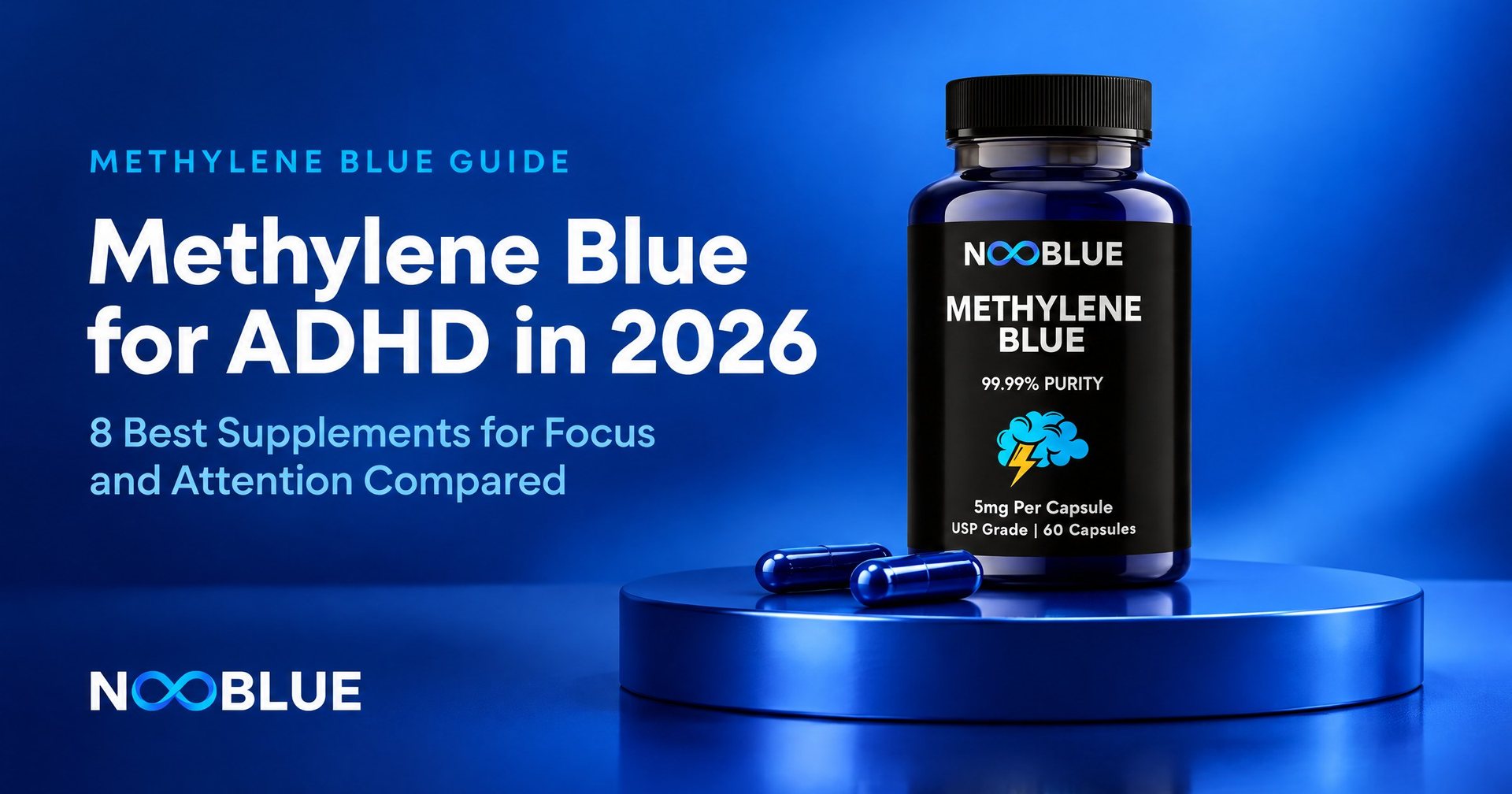
For adults who take none of those medicines and no serotonergic antidepressant, and who want to try methylene blue for everyday focus support, our pick is NooBlue Ultimate Methylene Blue Capsules: 5 mg of USP grade methylene blue and 10 mg of vitamin C per capsule, 60 capsules for $37.99, or $0.63 a day. It is the smallest fixed capsule dose among the eight products we compared, which suits the usual advice to start low. If cost per milligram matters most, Nutricel’s 1% liquid costs about a fifth as much per milligram, and you measure it by the drop.
Safety first: skip methylene blue if you take SSRIs, SNRIs, MAOIs or any other serotonergic medicine, if you have G6PD deficiency, or if you are pregnant or breastfeeding.
NooBlue makes the capsule ranked first. It is our pick, and each entry below says who should buy something else. Competitor figures come from each brand’s own product page, read in September 2026.
Written by the NooBlue editorial team. We make and sell methylene blue capsules, gummies and drops at nooblue.com. We did not lab-test any product in this guide. Every figure comes from a brand’s own page, its published lab paperwork, a prescribing label or a peer-reviewed study, and all of them are listed in the sources at the end.
Most people who land on this page want one of two things. Some want to know whether methylene blue does anything for attention. Others have already decided to try it and want to know which product to buy. This guide answers both, and it starts with the part that decides whether you should buy anything at all.
The first section explains why methylene blue and prescription ADHD medicines must not be combined. The second summarizes the research on methylene blue, attention and memory, including the result most product pages leave out. After that come eight products, compared on the same terms: the smallest dose each one can give you, the lab paperwork behind it, what else is in it, and what 5 mg of methylene blue costs. For more on the theory and the forum claims, read our research guide on methylene blue and attention.
Table of contents
- 1. If You Take ADHD Medication, Read This First
- 2. What the Research Says About Methylene Blue, Attention and Memory
- 3. The 8 Best Methylene Blue Supplements for Focus at a Glance
- 4. How We Ranked Them
- 5. The 8 Best Methylene Blue Supplements for Focus and Attention, Ranked
- 5.1. 1. NooBlue Ultimate Methylene Blue Capsules: best overall for a cautious start
- 5.2. 2. Nutricel Blue Liquid 1%: lowest cost per milligram
- 5.3. 3. Nutricel Blue Boost: the best-documented capsule
- 5.4. 4. Chemist Labs Methylene Blue Capsules: a plain 10 mg capsule
- 5.5. 5. Optimal Human Methylene Blue Capsules: the shortest ingredient list at 10 mg
- 5.6. 6. Meraki Blu: the smallest drop steps
- 5.7. 7. LVLUP Health Mito Blue: an all-in-one mitochondrial stack
- 5.8. 8. Earth Harmony Ultimate Methylene Blue: methylene blue with berberine
- 6. How to Try Methylene Blue for Focus, If You Are Cleared To
- 7. What to Avoid When Buying Methylene Blue for Focus
- 8. Capsules, Drops or Gummies for a Focus Routine
- 9. If Methylene Blue Is Not for You
- 10. Frequently Asked Questions
- 10.1. What is the best methylene blue supplement for focus?
- 10.2. Can methylene blue help with ADHD or replace medication?
- 10.3. Can I take methylene blue with Adderall, Vyvanse, Ritalin or Strattera?
- 10.4. What dose of methylene blue is used for focus?
- 10.5. How long does methylene blue take to work?
- 10.6. Is methylene blue a stimulant?
- 10.7. Can children or teenagers take methylene blue?
- 10.8. Will methylene blue affect a drug test?
- 11. Which Methylene Blue to Buy for Focus
- 12. Sources
If You Take ADHD Medication, Read This First
Methylene blue inhibits monoamine oxidase A (MAO-A), one of the enzymes that break down serotonin, norepinephrine and dopamine. Ramsay, Dunford and Gillman measured this with purified human enzyme in 2007 and described methylene blue as a potent, reversible MAO-A inhibitor that affects MAO-B only at much higher concentrations. That one property is why it clashes with most prescription ADHD medicines.
The prescribing labels are direct about it:
- Adderall (amphetamine salts). The label lists as a contraindication anyone taking an MAO inhibitor, or within 14 days of stopping one, “including MAOIs such as linezolid or intravenous methylene blue,” because of an increased risk of hypertensive crisis.
- Vyvanse (lisdexamfetamine). The label carries the same contraindication, in the same words, naming intravenous methylene blue.
- Ritalin (methylphenidate). The label contraindicates use with an MAO inhibitor, or within 14 days of stopping one, because of the risk of hypertensive crises.
- Strattera (atomoxetine). This one is not a stimulant, and its label still contraindicates MAOIs, “including MAOIs such as linezolid or intravenous methylene blue,” and use within 14 days of stopping one.
Serotonin is the second problem. The Adderall label warns about serotonin syndrome when it is combined with other serotonergic drugs or with drugs that slow the breakdown of serotonin, and it names MAO inhibitors in that second group. The label for injectable methylene blue opens with a boxed warning about serious or fatal serotonin syndrome when it is used with serotonergic drugs and opioids, and it tells prescribers to avoid SSRIs, SNRIs and MAOIs. In a 2010 systematic review in Psychosomatics, Ng and Cameron found 26 patients who developed an acute confusional state after a methylene blue infusion, and 24 of them were taking a serotonin reuptake inhibitor.
One caveat, stated plainly. Those labels name the intravenous form, which hospitals give at about 1 mg/kg. A 5 mg capsule is a much smaller dose, and nobody has measured how strongly it inhibits MAO-A in people. That gap is a reason for caution, not permission. No one can tell you where a safe threshold sits, so the only sensible rule is to keep methylene blue and these medicines apart unless the doctor who prescribes them says otherwise.
If you are an adult with ADHD, or think you might be, talk to a doctor before you buy anything on this page. Methylene blue should never replace a prescribed medicine, and no supplement can diagnose or rule out ADHD. If you have been assessed, take no ADHD medication or serotonergic antidepressant, and still want to try it for everyday focus, tell your doctor and start at the lowest dose. Our guides to methylene blue and Adderall safety and methylene blue vs Adderall, plus the full methylene blue interactions list, go through each drug class. Our page on methylene blue and serotonin syndrome explains the warning signs.
Children and teenagers are outside the scope of this guide. There is no evidence base for methylene blue supplements in anyone under 18, several brands below say their product is not for children, and a young person with attention difficulties is also the most likely to be on a prescribed medicine already. That decision belongs with their doctor.
What the Research Says About Methylene Blue, Attention and Memory
No clinical trial has tested methylene blue in people with ADHD. We searched PubMed and ClinicalTrials.gov in September 2026 and found none. What exists is a small set of studies in healthy adults and in animals, and they are worth reading closely, because product pages tend to quote the headline and skip the rest.
The human brain-imaging trial
The strongest human evidence comes from one research group in Texas. In a randomized, double-blind, placebo-controlled trial published in Radiology in 2016, Rodriguez and colleagues enrolled 26 healthy adults aged 22 to 62 and scanned them before and one hour after a single oral dose. The dose was 280 mg of methylene blue, about 4 mg/kg, which is 56 times one of our capsules. During a sustained-attention task called the psychomotor vigilance task, methylene blue increased activity in the insular cortex on both sides of the brain. During a short-term memory task it increased activity in prefrontal, parietal and occipital areas, and it was linked to a 7% increase in correct responses during memory retrieval (P = .01).
Here is the part most product pages leave out. Reaction times on the attention task did not change. The methylene blue group averaged 230 milliseconds before the dose and 230 milliseconds after it, and the drug-by-time comparison was not significant (P = .43). The authors wrote that they knew of no earlier study suggesting methylene blue changes sustained attention or reaction time, which matched their own behavioral result. So the trial showed a change in brain activity during an attention task. It did not show better attention. Everyone who took methylene blue also reported blue urine afterwards.
A companion paper from the same group, published in Brain Imaging and Behavior in 2017, enrolled 28 participants and used the same 280 mg dose. It reported stronger resting-state connectivity between brain regions that link perception and memory. The paper describes methylene blue’s dose response as hormetic: mitochondrial effects improve in the 0.5 to 4 mg/kg range and turn negative above 10 mg/kg.
The animal attention study
In 2017, Smith and colleagues at the University of Texas at Austin gave rats methylene blue daily in a model where the toxin 6-OHDA damages dopamine-producing neurons. Methylene blue preserved some of those neurons and significantly improved performance in the five-choice task, which measures selective and sustained attention. It did not improve motor function. This is a rat model built to study dopamine loss, so it tells us little about people, and nothing about adults whose dopamine systems are intact.
Why the dose matters
A 2012 review in Progress in Neurobiology by Rojas, Bruchey and Gonzalez-Lima describes the same hormetic pattern, with opposite effects at low and high doses. At low doses, the review says, methylene blue acts as an electron cycler in the mitochondrial respiratory chain, and the available data support a major role for the enzyme cytochrome oxidase in its memory effects. The practical lesson for anyone trying it is simple. More is not better, which is why we suggest starting at the smallest dose you can measure. Our explainer on how methylene blue works covers the biochemistry.
What has not been shown
- No trial has tested methylene blue in people with ADHD.
- We found no study that measured attention at supplement doses of 5 to 10 mg. The human trials used 280 mg, once.
- The one human trial that timed an attention task found no change in reaction time.
- No trial has compared methylene blue with a stimulant or any other prescription medicine for attention.
- We found no published trial of daily use for focus in healthy adults.
When a product page promises sharper attention from methylene blue, this is the evidence behind the promise. Weigh it that way, and count any effect you notice as a personal result rather than a proven one.
The 8 Best Methylene Blue Supplements for Focus at a Glance
All eight products are sold for daily use in the US. Prices are as of Sep 2026, read from each brand’s own store, before shipping, subscriptions and multi-bottle discounts.
| # | Product | Format | Smallest dose step | Price (as of Sep 2026) | Cost per 5 mg | Lab paperwork on the page | Best for |
|---|---|---|---|---|---|---|---|
| 1 | NooBlue Ultimate Methylene Blue Capsules | Capsule | 5 mg | $37.99 for 60 | $0.63 | Ingredient report (CTLA), published | A cautious start with a fixed dose |
| 2 | Nutricel Blue Liquid 1% | Drops | About 0.5 mg (one drop) | $30.00 for 118 mL | $0.13 | Lot certificate linked by a QR code on the label | Lowest cost per milligram |
| 3 | Nutricel Blue Boost | Capsule | 12 mg | $34.90 for 60 | $0.24 | Finished-capsule lot certificate (Eurofins), published | The best-documented capsule |
| 4 | Chemist Labs Methylene Blue Capsules | Capsule | 10 mg | $34.99 for 60 | $0.29 | Certificates for three lots, linked | A plain 10 mg capsule |
| 5 | Optimal Human Methylene Blue Capsules | Capsule | 10 mg | $35.99 for 60 | $0.30 | Manufacturer specification sheet | The shortest ingredient list at 10 mg |
| 6 | Meraki Blu | Drops (0.5%) | About 0.25 mg (one drop) | $35.00 for 30 mL | $1.17 | Heavy metal, formaldehyde and microbial reports, no potency report | The smallest drop steps |
| 7 | LVLUP Health Mito Blue | Capsule, four actives | 10 mg | $89.99 for 60 | $0.75 | None linked | An all-in-one mitochondrial stack |
| 8 | Earth Harmony Ultimate Methylene Blue | Capsule with a plant blend | 12 mg | $39.95 for 60 | $0.28 | None shown | Methylene blue with berberine |
Cost per 5 mg is the price divided by the total milligrams of methylene blue in the pack, times five. Nutricel states about 1,180 mg in its 118 mL bottle, and Meraki states 150 mg in its 30 mL bottle. LVLUP’s figure counts only the methylene blue and ignores its three other actives. Optimal Human’s price is the one-time price its page showed when we checked, against a list price of $39.99.
Two points stand out. NooBlue is the only brand here that sells a 5 mg capsule, and every other capsule starts at 10 or 12 mg. The two liquids go lower, but you count drops and handle a dye that stains. NooBlue is also not the cheapest way to buy methylene blue. At $0.63 per 5 mg it costs more per milligram than five of the other seven, and only LVLUP ($0.75) and Meraki Blu ($1.17) cost more.
How We Ranked Them
We did not run lab tests or attention tests, and no product here has been tested for attention by anyone. This is a comparison of what each brand states and publishes, and you can check every line against the same pages. We weighed five things, in this order.
- Smallest dose step. The lowest amount you can take without splitting a capsule. Methylene blue’s dose response is hormetic, and the sensible way to try it is to start low and change one thing at a time. A product that starts at 12 mg takes that first step away.
- Lab paperwork. A lot-numbered certificate from a named laboratory, published before you buy, ranks above a document “available on request”. We also say what each document covers. An ingredient report tests the raw methylene blue. A finished-product certificate tests a batch of capsules or bottles. A specification sheet lists targets and typical results.
- Other ingredients. Cacao brings its own mild stimulants, theobromine and a little caffeine. Stacks add acetyl L-carnitine, CoQ10 or berberine. Each extra active makes it harder to tell what methylene blue is doing for you, so we flag them.
- Safety information. Whether the page warns about serotonergic medicines, pregnancy and G6PD deficiency. For readers of this page, that warning matters more than usual.
- Cost per 5 mg. Worked out from the total milligrams in the pack, never from a brand’s own “per serving” line, so drops and capsules compare fairly.
Star ratings count for little here. A rating cannot tell you what is in a capsule, and none of these products has been rated by people measuring their attention. NooBlue ranks first because it is the only 5 mg capsule and it publishes its ingredient report on the product page. It does not win on price per milligram or on the strength of its lab document, and the entries below say so.
The 8 Best Methylene Blue Supplements for Focus and Attention, Ranked
These are the eight methylene blue products we would consider in the US for an adult trying it for focus, from our own capsule at #1 to a botanical blend at #8. Each entry says who it suits and who should look elsewhere.
1. NooBlue Ultimate Methylene Blue Capsules: best overall for a cautious start
NooBlue makes these 5 mg methylene blue capsules, and they are our pick for adults who have ruled out the interactions above. Each vegetable capsule holds 5 mg of USP grade methylene blue and 10 mg of vitamin C (ascorbic acid), with rice flour inside a cellulose shell. There is no cacao, no caffeine and no botanical blend. A bottle of 60 costs $37.99 (regular price $49.99), or $0.63 a capsule. The label says one capsule daily with food, so a bottle lasts 60 days.
The case for it is the size of the first step. A capsule is a sealed unit. If it holds 12 mg, your choices are 12, 24 or 36 mg. With a 5 mg capsule you can take 5 mg for two weeks, see how it sits with your sleep and your workday, and only then decide whether 10 mg is worth trying, which means one of our gummies or 20 drops rather than a second capsule, because the capsule label is one a day. None of the other capsules in this list can start that low.
The paperwork is on the product page rather than behind an email request. Contract Testing Laboratories of America (CTLA) analyzed the methylene blue ingredient, lot 2025022801, in report 135621. The report records an HPLC identity result of “Conforms” and individual results for arsenic, cadmium, mercury and lead. Its scope is narrower than a finished-product certificate: it covers the raw ingredient rather than every batch of capsules, and it does not state a purity percentage. Nutricel’s Blue Boost certificate tests finished capsules, which is a stronger kind of document, and we would rather you know that. Our quality and testing page sets out the same limits.
If you want steps smaller than 5 mg, our 1% methylene blue drops give 0.5 mg per drop and 5 mg in 10 drops, with about 100 servings of 5 mg in a 50 mL bottle for $29.99. They cost less per milligram than the capsules, but you count drops and the liquid stains skin and fabric. Our methylene blue gummies hold 10 mg with 25 mg of vitamin C, twice the capsule dose, so they make more sense once you know 10 mg suits you.
Suits: adults who want a small, fixed first dose with nothing to measure. Look elsewhere if: you already take 10 mg or more a day and care most about cost per milligram. Nutricel’s liquid and most of the capsules below cost less.
See the 5 mg capsules · $37.992. Nutricel Blue Liquid 1%: lowest cost per milligram
Nutricel Blue Liquid is a 1% methylene blue solution in USP-grade purified water, sold in a 4 fl oz (118 mL) amber glass bottle for $30.00. Nutricel’s reference table puts one drop at about 0.5 mg, ten drops at about 5 mg and the whole bottle at about 1,180 mg. That works out to $0.13 per 5 mg, the lowest cost per milligram in this guide and about a fifth of what our capsules cost per milligram. At 5 mg a day, one bottle would last about 236 days.
The documentation is good for a liquid. Nutricel says an ISO/IEC 17025-accredited laboratory tests every lot for identity, potency, heavy metals and microbes, and the QR code on the label links to the certificate for that lot. The page claims at least 99% purity by HPLC. Its safety notice names SSRIs, SNRIs and MAOIs, pregnancy and nursing, says the product is not for children, and warns that taking it in the evening may affect sleep. Returns are free for 60 days.
The trade-off is handling. You count drops, the page notes that drop volume varies, and a dropper bottle of blue dye is less convenient on a busy morning than a capsule.
Suits: cost-conscious buyers who want half-milligram steps and a lot certificate. Look elsewhere if: you want a fixed dose with nothing to measure, or you carry your supplements with you.
3. Nutricel Blue Boost: the best-documented capsule
Nutricel Blue Boost is a 12 mg capsule of USP grade methylene blue with 35 mg of vitamin C ester (ascorbyl palmitate) and 235 mg of organic cacao powder. A bottle of 60 costs $34.90, which is $0.58 a capsule and $0.24 per 5 mg.
Its lab paperwork is the strongest of the capsules here. Nutricel’s certificates page shows a Eurofins certificate for Blue Boost lot 0125047, tested in July 2025 for methylene blue potency, heavy metals and microbes. The page says Eurofins tests every Nutricel product after bottling for heavy metals and microbes, and it gives 99.4% as the purity of the raw methylene blue. The product page carries the same safety notice as the liquid, including the warning about evening doses and sleep.
Two things count against it for a focus trial. The smallest step is 12 mg, more than twice our capsule. And the cacao adds mild stimulants of its own, which may not suit you if caffeine makes you jittery. Our Nutricel vs NooBlue comparison sets the two brands side by side.
Suits: buyers who want a lot certificate for the finished capsule and are comfortable starting at 12 mg. Look elsewhere if: you want to start at 5 mg or avoid cacao.
4. Chemist Labs Methylene Blue Capsules: a plain 10 mg capsule
Chemist Labs Methylene Blue Capsules hold 10 mg of USP grade methylene blue each, described by the brand as 99% pure. On the brand’s own store, 60 capsules cost $34.99 and 120 cost $44.99, which is $0.29 per 5 mg for the smaller bottle and $0.19 for the larger one. The brand says the capsules are made in the USA in a cGMP facility and that every batch is third-party tested, and its lab reports page links certificates for three capsule lots. We have not audited those documents. The product page warns against use with SSRIs, during pregnancy or nursing, and with antihistamines such as diphenhydramine.
Suits: buyers who want a simple 10 mg capsule with lot paperwork at a low price. Look elsewhere if: you want to start below 10 mg.
5. Optimal Human Methylene Blue Capsules: the shortest ingredient list at 10 mg
Optimal Human Methylene Blue Capsules contain methylene blue USP (10 mg), a vegetable cellulose capsule, rice flour and gellan gum, and nothing else. The list price is $39.99 for 60. The page showed a one-time price of $35.99 when we checked, which is $0.30 per 5 mg, and a subscription that starts at $19.99 for the first month and renews at $29.99.
The “Lab Report (PDF)” on the page is a finished-product specification sheet on the manufacturer’s letterhead for lot 60078. It records the assay as conforming, marks the microbial and heavy metal figures as typical results, and names no outside laboratory. That is a weaker document than a certificate from an independent lab.
Suits: buyers who want 10 mg with almost nothing else in the capsule. Look elsewhere if: you want an independent lab certificate or a smaller first dose.
6. Meraki Blu: the smallest drop steps
Meraki Blu contains 150 mg of methylene blue in a 30 mL bottle with a 1 mL dropper, which makes it a 0.5% solution. The brand puts one drop at about 0.25 mg and 5 mg at 20 drops. It costs $35.00 for one bottle, $65.00 for two and $89.00 for three, so a single bottle works out to $1.17 per 5 mg, the highest in this guide.
The weaker strength gives the smallest steps of any product here, which helps if you are unusually cautious. Two things hold it back. The product description says “For research purposes only,” which sits oddly with a product sold for daily use. And the lab images on the page come from 3 Light Labs, an ISO/IEC 17025 laboratory in Ann Arbor, and cover heavy metals, formaldehyde and microbes, with the lot field left blank and no certificate for potency or purity. The description says the product is not for anyone under 18, pregnant or nursing, and not to be mixed with antidepressants or SSRIs.
Suits: very cautious users who want quarter-milligram steps. Look elsewhere if: cost per milligram matters, or you want a potency certificate. Our NooBlue vs Meraki comparison covers the two in more detail.
7. LVLUP Health Mito Blue: an all-in-one mitochondrial stack
LVLUP Health Mito Blue is a capsule stack. Each capsule holds 10 mg of methylene blue with 400 mg of acetyl L-carnitine, 100 mg of ubiquinol and 10 mg of PQQ. Sixty capsules cost $89.99 one-time or $80.99 on a subscription, which is $1.50 a capsule at the one-time price. Counting only the methylene blue, that is $0.75 per 5 mg. We found no certificate linked on the product page.
A stack is convenient if you already wanted those ingredients. For a focus trial it muddies the picture. If you feel different, you cannot tell which of four actives caused it, and you cannot lower the methylene blue without lowering everything else.
Suits: buyers who want acetyl L-carnitine, CoQ10 and PQQ anyway and prefer one capsule. Look elsewhere if: you want to judge methylene blue on its own.
8. Earth Harmony Ultimate Methylene Blue: methylene blue with berberine
Earth Harmony Ultimate Methylene Blue capsules hold 12 mg of USP grade methylene blue with vitamin C and a plant blend of organic berberine, chlorophyllin and chlorophyll. Sixty capsules cost $39.95, which is $0.67 a capsule and $0.28 per 5 mg. The brand says they are made in Phoenix, Arizona, and that all its products undergo third-party testing, but we found no certificate on the product page. The safety box advises against use in pregnancy or while nursing, asks people with a known G6PD gene mutation to consult their healthcare provider, and says not to combine it with SSRIs or other serotonin-affecting substances without medical supervision.
Berberine has effects of its own, and we could not find the amount of each plant ingredient in the product page text. That makes this the hardest product here to judge for focus alone.
Suits: buyers who specifically want berberine in the same capsule. Look elsewhere if: you want plain methylene blue or published lab paperwork.
How to Try Methylene Blue for Focus, If You Are Cleared To
If you have been through the medication section and nothing rules you out, a careful trial looks like this.
- Rule yourself out first. Skip methylene blue if you take a stimulant, atomoxetine, an SSRI, SNRI, MAOI or any other serotonergic medicine, if you have G6PD deficiency, or if you are pregnant or breastfeeding. If you take any prescription medicine at all, ask your doctor or pharmacist before starting. Our guide to who should not take methylene blue lists every exclusion, and our page on methylene blue and G6PD deficiency explains the blood test.
- Start with the smallest dose you can measure. That means one 5 mg capsule, or 10 drops of a 1% solution. Our dosing guide, how many mg of methylene blue per day, explains why we suggest one capsule a day with food and a two-week trial before you adjust anything.
- Take it early in the day. Our capsule label says one capsule daily with food, and our product page suggests the morning or early afternoon. Nutricel’s pages warn that evening doses may affect sleep. Our guide to methylene blue and sleep covers timing.
- Change one thing at a time. If your coffee, your bedtime and your methylene blue all change in the same week, you will not know which one made the difference. Our page on methylene blue and caffeine looks at the pairing.
- Expect the harmless effect. Blue or green urine is normal. Every participant who took methylene blue in the 2016 trial reported blue urine. Our guide to methylene blue side effects lists the rest.
- Judge it honestly. Keep a short note of your sleep, energy and workday for two weeks. If you notice nothing, that is a real result, and the research gives no reason to expect a large effect at these doses.
One practical point for anyone who is drug-tested at work or in a program: two 2026 case reports in Therapeutic Drug Monitoring described false-positive amphetamine results on urine drug screens after methylene blue. Tell the testing service you take it. Our methylene blue drug test guide explains how confirmation testing sorts this out.
What to Avoid When Buying Methylene Blue for Focus
- Aquarium and lab-reagent methylene blue. Fish-tank products are made for water treatment, and the one we checked, from Kordon, says it is not intended for human consumption. Buy a product sold for people, with a USP grade statement.
- “For research purposes only” on a daily-use product. A label like that tells you the seller is not standing behind it as something to swallow. Ask why before you buy.
- Pages that promise to fix attention. No methylene blue product has been tested for attention in a controlled trial. A brand willing to overstate that is a brand whose purity claims deserve the same doubt.
- Paperwork you cannot read. A useful certificate names the laboratory, the lot and what was tested. Our certificate of analysis guide shows how to read one, including ours, and our page on methylene blue purity explains what USP grade means.
- Stacks that hide the amounts. If a plant blend or proprietary mix has no amount per ingredient, you cannot judge it, and you cannot compare it with anything else.
Capsules, Drops or Gummies for a Focus Routine
NooBlue sells methylene blue in three formats. For a first trial aimed at focus, the fixed 5 mg capsule is the simplest place to start.
| NooBlue format (prices as of Sep 2026) | Methylene blue | Also contains | Price | Cost per serving |
|---|---|---|---|---|
| Ultimate Methylene Blue Capsules, 60 | 5 mg per capsule | 10 mg vitamin C | $37.99 | $0.63 per capsule |
| Methylene Blue Gummies, 60 | 10 mg per gummy | 25 mg vitamin C, Wild Blueberry flavor | $49.99 | $0.83 per gummy |
| Methylene Blue Drops, 1%, 50 mL | 0.5 mg per drop | About 100 servings of 5 mg (10 drops) | $29.99 | $0.30 per 5 mg serving |
Capsules give a fixed 5 mg with no taste and nothing to measure. Drops allow half-milligram steps and cost less per milligram, but they need counting and care with stains. Gummies are the easiest to take, with 10 mg per chew and none of the blue mouth that drops can leave. You can see all three in our shop, and our roundups of the best methylene blue capsules, best methylene blue drops and best methylene blue gummies compare each format across brands. For every format side by side, see our guide to the best methylene blue supplements.
If Methylene Blue Is Not for You
Many readers of this page will find that methylene blue is off the table, usually because of a medication they already take. That is a common outcome, not a failure. If attention problems are getting in the way of work, study or relationships, an assessment with a doctor is the useful next step, because both stimulant and non-stimulant medicines exist and a doctor can match one to you.
If you simply want steadier energy on long workdays and take no interacting medicine, the basics come first: sleep, regular meals and caffeine timed early enough to spare your night. Our guides to the best focus supplements, energy and focus supplements without stimulants and methylene blue vs modafinil compare the other options people ask about. More comparisons sit in our buying guides and on the NooBlue blog.
Frequently Asked Questions
What is the best methylene blue supplement for focus?
For most adults who have ruled out the medicine interactions, our pick is NooBlue Ultimate Methylene Blue Capsules: 5 mg of USP grade methylene blue and 10 mg of vitamin C per capsule, 60 capsules for $37.99. It is the only 5 mg capsule among the eight products we compared, which makes a cautious start easy. NooBlue makes it, and it is not the cheapest per milligram. Nutricel Blue Liquid costs less per milligram if you are happy to count drops, and Nutricel Blue Boost has the stronger lab certificate at 12 mg per capsule.
Can methylene blue help with ADHD or replace medication?
No. No clinical trial has tested methylene blue in people with ADHD, and it should never replace a prescribed medicine. The best human study gave 26 healthy adults a single 280 mg dose. It found more brain activity during an attention task, but no change in reaction time, plus a 7% increase in correct memory answers. If you have ADHD or think you might, talk to a doctor.
Can I take methylene blue with Adderall, Vyvanse, Ritalin or Strattera?
No, not without your prescriber’s explicit approval. The Adderall, Vyvanse and Strattera labels list MAO inhibitors, naming intravenous methylene blue, as a contraindication, including for 14 days after stopping one. The Ritalin label contraindicates MAO inhibitors for the same 14-day window because of the risk of hypertensive crises. Methylene blue is an MAO-A inhibitor. Nobody has measured how strongly a 5 mg supplement dose inhibits the enzyme, so the safe rule is to keep them apart.
What dose of methylene blue is used for focus?
We found no study that measured focus or attention at supplement doses. The human brain-imaging trials used one 280 mg dose, about 4 mg/kg, in a research setting. Supplement servings are far smaller: our capsules hold 5 mg and our gummies 10 mg. Because the dose response is hormetic, we suggest starting with one 5 mg capsule a day with food and waiting two weeks before changing anything. Our methylene blue dosage guide explains the reasoning.
How long does methylene blue take to work?
The 2016 trial scanned volunteers one hour after a 280 mg dose and measured changes in brain activity at that point. Nobody has published timing data for 5 mg or 10 mg doses, and there is no controlled evidence on how long it takes to notice a difference in focus. Our guide to how long methylene blue takes to work covers what is known.
Is methylene blue a stimulant?
Not in the way amphetamine or caffeine is. It does not push neurotransmitters out of nerve cells. It passes electrons along inside mitochondria and inhibits the MAO-A enzyme, which slows the breakdown of monoamines. That enzyme effect is exactly why it must not be mixed with stimulant medicines. Our capsules contain no caffeine, though some other brands add cacao, which carries mild stimulants of its own.
Can children or teenagers take methylene blue?
No. Everything on this page is written for adults. There is no evidence base for methylene blue supplements in anyone under 18, and several brands state their product is not for children. A young person with attention difficulties is also the most likely to be on a prescribed medicine, which brings the MAO-A interaction straight into play. That is a question for their doctor, not a supplement purchase.
Will methylene blue affect a drug test?
It can. Two 2026 case reports in Therapeutic Drug Monitoring described false-positive amphetamine results on urine drug screens after methylene blue. If you are tested, tell the testing service you take it, because confirmation testing can separate the two.
Which Methylene Blue to Buy for Focus
- If you take ADHD medication or a serotonergic antidepressant: do not buy any of these. Talk to your prescriber.
- For a cautious first trial with a fixed dose: our pick is NooBlue Ultimate Methylene Blue Capsules, which we make, at 5 mg per capsule and $37.99 for 60.
- For the lowest cost per milligram and half-milligram steps: Nutricel Blue Liquid 1%, $30.00 for 118 mL.
- For a finished-capsule lot certificate at 12 mg: Nutricel Blue Boost, $34.90 for 60.
- For a plain 10 mg capsule: Chemist Labs or Optimal Human.
Whichever you choose, the rules do not change: rule out the interactions, start at the smallest dose you can measure, and judge it over two weeks with your doctor in the loop if you take any medicine.
Sources
- Rodriguez P, Zhou W, Barrett DW, et al. Multimodal randomized functional MR imaging of the effects of methylene blue in the human brain. Radiology. 2016;281(2):516-526. PubMed 27351678; full text.
- Rodriguez P, Singh AP, Malloy KE, et al. Methylene blue modulates functional connectivity in the human brain. Brain Imaging and Behavior. 2017;11(3):640-648. PubMed 26961091; full text.
- Smith ES, Clark ME, Hardy GA, et al. Daily consumption of methylene blue reduces attentional deficits and dopamine reduction in a 6-OHDA model of Parkinson’s disease. Neuroscience. 2017;359:8-16. PubMed 28694175.
- Rojas JC, Bruchey AK, Gonzalez-Lima F. Neurometabolic mechanisms for memory enhancement and neuroprotection of methylene blue. Progress in Neurobiology. 2012;96(1):32-45. PubMed 22067440.
- Ramsay RR, Dunford C, Gillman PK. Methylene blue and serotonin toxicity: inhibition of monoamine oxidase A (MAO A) confirms a theoretical prediction. British Journal of Pharmacology. 2007;152(6):946-951. PubMed 17721552.
- Ng BK, Cameron AJ. The role of methylene blue in serotonin syndrome: a systematic review. Psychosomatics. 2010;51(3):194-200. PubMed 20484716.
- Leegwater E, Jager NGL. Methylene blue-induced false-positive amphetamine results in urine drug screening: two case reports. Therapeutic Drug Monitoring. 2026;48(2):280-281. PubMed 41058025.
- Adderall prescribing information and medication guide. DailyMed.
- Vyvanse prescribing information. DailyMed.
- Ritalin prescribing information. DailyMed.
- Strattera prescribing information. DailyMed.
- ProvayBlue (methylene blue injection) prescribing information. DailyMed.
- Product pages read in September 2026: Nutricel Blue Liquid, Nutricel Blue Boost, Nutricel certificates, Chemist Labs, Optimal Human, Meraki Blu, LVLUP Health Mito Blue, Earth Harmony, Kordon Methylene Blue.
- NooBlue product pages and the CTLA ingredient report: capsules, gummies, drops, quality and testing.