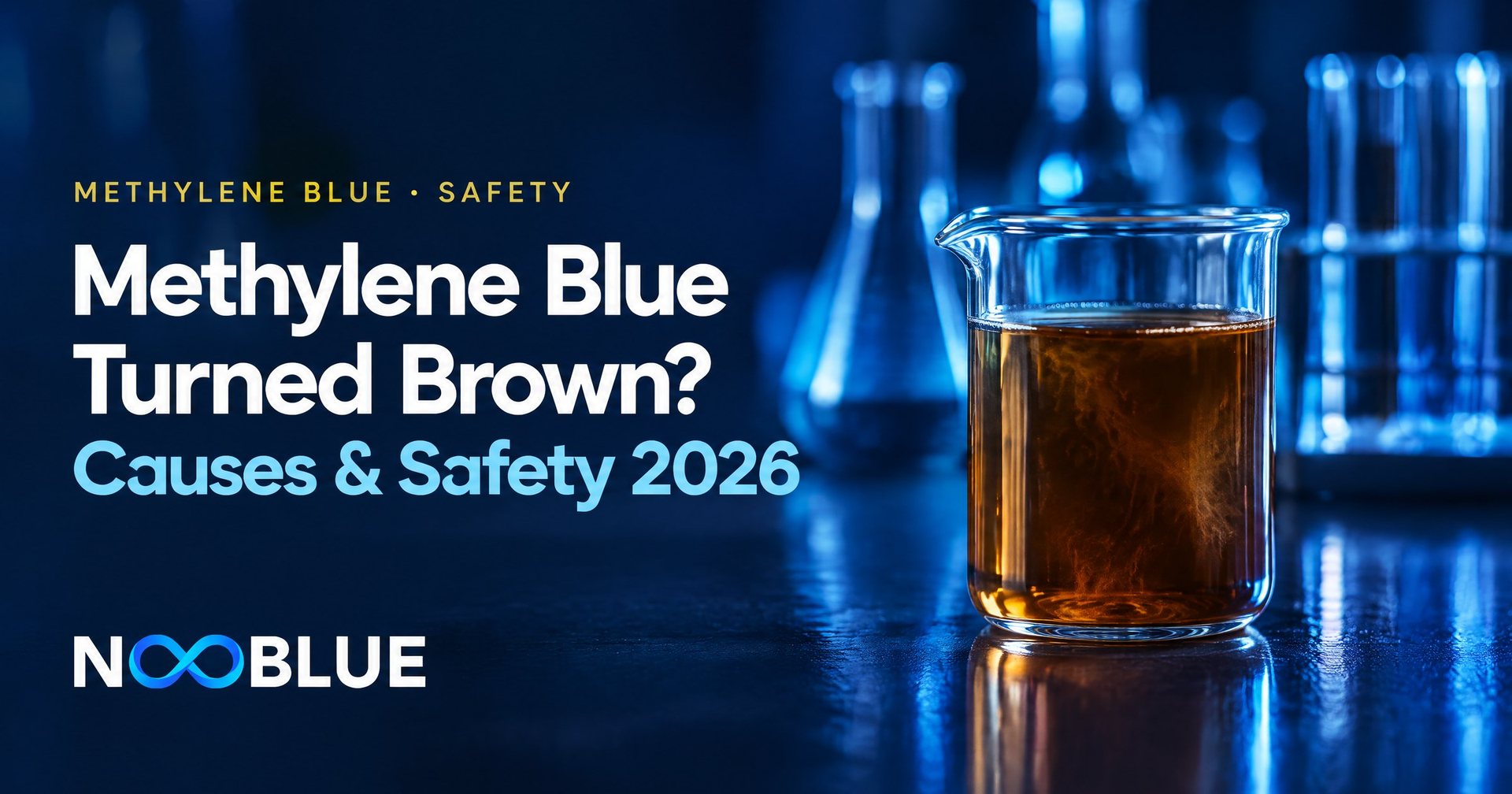
If your methylene blue turned brown, start by working out where the brown is. Methylene blue dissolved in water should be deep blue. A brown or murky liquid in the bottle means the solution has changed, through breakdown, contamination or something getting into it, and you shouldn’t take it. Two other kinds of “brown” are harmless: the dark bronze-green crust that dried methylene blue leaves around a cap or dropper, and a drink that looks muddy because you mixed blue drops into juice or tea.
Below: what color methylene blue should be in each form, the five common reasons it looks brown, whether brown means fake, how to keep a bottle blue, and the color changes that happen in your body instead of the bottle. NooBlue makes methylene blue drops, capsules and gummies, so our own product details are included where they help.
Key Takeaways
- Methylene blue solutions are deep blue. The dry powder is dark green with a bronze-like sheen, so dried residue on a cap can look brown.
- Brown, murky, cloudy or smelly liquid in the bottle means something has changed. Don’t take it. Replace the bottle.
- A muddy-looking drink after mixing drops into juice or tea is just blue mixing with another color.
- Color can’t prove purity. Genuine methylene blue can degrade, and a poor product can look perfectly blue.
- Do not take methylene blue with serotonergic medicines, with G6PD deficiency, in pregnancy or breastfeeding, or under 18.
Table of contents
- 1. What Color Should Methylene Blue Be?
- 2. Why Your Methylene Blue Turned Brown: 5 Common Causes
- 3. Is Brown Methylene Blue Safe to Take?
- 4. Does Brown Methylene Blue Mean It Is Fake?
- 5. Why Methylene Blue Changes Color: The Redox Chemistry
- 6. How to Keep Methylene Blue Blue
- 7. Color Changes in You, Not the Bottle
- 8. Safety: Read This Before Taking Methylene Blue
- 9. Methylene Blue Turned Brown: Frequently Asked Questions
- 9.1. Why did my methylene blue turn brown?
- 9.2. Is brown methylene blue safe to take?
- 9.3. Does brown methylene blue mean it is fake?
- 9.4. Does methylene blue change color?
- 9.5. How long will methylene blue last?
- 9.6. Can sunlight or heat change methylene blue’s color?
- 9.7. Is it true that methylene blue makes you look younger?
- 9.8. Is methylene blue killing parasites?
- 9.9. What are the signs of methylene blue toxicity?
- 10. Sources
What Color Should Methylene Blue Be?
It depends on the form, and knowing the normal colors saves a lot of worry. PubChem, the chemical database run by the U.S. National Library of Medicine, describes methylene blue as “dark green crystals or powder with a bronze-like luster” and says that “solutions in water or alcohol are deep blue”.
| Form | Normal color |
|---|---|
| Dry powder, or dried drops on a cap, dropper or counter | Dark green with a bronze-like sheen. It can look brown at a glance |
| Solution in water, such as 1% drops | Deep blue. In the bottle it can look almost black until you dilute a drop |
| Reduced form (leucomethylene blue) | Colorless. Vitamin C can reduce methylene blue to this form, and the blue can come back when it reoxidizes |
| Diluted in a drink | Blue mixed with the drink’s own color: green in yellow juice, muddy brown in orange juice or tea |
So yes, methylene blue changes color, and that is normal chemistry. What isn’t normal is a solution in its own bottle that has turned brown. Our primer on what methylene blue is and how it is used covers the compound’s background, and our explainer on leucomethylene blue covers the colorless form.
Why Your Methylene Blue Turned Brown: 5 Common Causes
| Where you see brown | Likely cause | What to do |
|---|---|---|
| A crust on the cap, dropper or bottle neck | Dried methylene blue, which is dark green-bronze as a solid | Wipe it off. If the liquid itself is still deep blue, the bottle is fine |
| In your glass after mixing | Blue mixing with the color of juice, tea or coffee | Nothing is wrong with the bottle. Mix it into water if you want to see the true color |
| An old bottle that looks faded, murky or brownish | Breakdown from light and heat over time | Replace it |
| Liquid that is cloudy, has particles or a film, or smells off | Contamination, for example water added to the bottle or a dropper that touched your mouth | Replace it |
| Brown from the day it arrived | Not the product the label describes, or damaged in transit | Don’t take it. Contact the seller and ask for the lab report for that lot |
Light and heat. This is the most common reason an old bottle changes. Researchers who shone a fluorescent lamp, colored LEDs and a UV-A black light on methylene blue dissolved in water found that it lost color under every light source. The dye photo-bleached and partly broke down into other compounds, including colorless leuco forms, demethylated dyes and probably humic-type substances, which are typically brown (Sáenz-Trevizo et al., 2019). A bottle kept on a sunny shelf or in a hot car degrades faster than one in a dark cupboard.
Contamination. Adding water to stretch a bottle, or letting the dropper touch your mouth or a glass of juice before it goes back in, brings in things that don’t belong there. Once a solution is cloudy or smells wrong, there is no safe way to rescue it.
Mixing. NooBlue’s drops are made to be taken in water or juice, and plenty of people mix drops into orange juice or tea to soften the bitter taste. Blue plus orange or amber looks brown in the glass. Vitamin C in juice can also fade the blue as it reduces some of the methylene blue to its colorless form. That tells you nothing about the bottle.
Is Brown Methylene Blue Safe to Take?
Brown liquid in the bottle: no. You can’t tell by eye what changed or what it changed into, so the safe choice is to stop using it and buy a fresh bottle. Brown residue on the cap, or a brown-looking drink you just mixed from a deep blue bottle, isn’t a sign the product has gone bad.
Always go by the date on the label, and read the safety section below before taking any methylene blue. Our methylene blue side effects guide covers what to watch for.
Does Brown Methylene Blue Mean It Is Fake?
Not necessarily, and a perfect blue doesn’t prove it’s real either. Genuine USP grade methylene blue can degrade if it is old, stored in the light or contaminated. A low-grade dye can look flawless and still carry impurities you will never see.
There is one color test that points to methylene blue itself. Vitamin C reduces methylene blue to colorless leucomethylene blue, and the blue can return when the solution reoxidizes. A 2024 study in RSC Advances used exactly that reaction, reducing methylene blue with vitamin C and turning it back to blue with visible light (Suzuki et al., 2024). A reversible fade like this suggests you are looking at methylene blue, but it can’t tell you the grade, the strength or what else is in the bottle. Our guides to real vs fake methylene blue and simple at-home checks go through the tests and their limits.
For purity, you need documents. Our guide to reading a methylene blue certificate of analysis shows what to look for. NooBlue publishes a report from Contract Testing Laboratories of America (CTLA) on its methylene blue ingredient, report 135621 for ingredient lot 2025022801, with an HPLC identity result of “Conforms” and results for arsenic, cadmium, mercury and lead. It is ingredient-level evidence. It doesn’t give a purity percentage and doesn’t test every finished batch.
Why Methylene Blue Changes Color: The Redox Chemistry
Methylene blue is a redox dye. In its oxidized form it is blue. When it accepts electrons it becomes leucomethylene blue, which is colorless, and it can give those electrons up again and turn blue. That back-and-forth is why it is used as a color indicator in chemistry classes.
The same property is behind the research interest in methylene blue. A review in Molecular Neurobiology describes how it can pass electrons from NADH to cytochrome c in the mitochondrial electron transport chain, increasing the activity of complex IV, mostly based on cell and animal studies (Tucker, Lu and Zhang, 2018).
Breakdown is a different process. When light or heat break the molecule down, it loses methyl groups and forms related dyes, and some pieces go on to form other compounds (Sáenz-Trevizo et al., 2019). That kind of change is not reversible, which is why a faded or brown bottle should be replaced rather than shaken or left to recover.
How to Keep Methylene Blue Blue
- Keep the cap tightly closed and store the bottle in a cool, dry place away from direct heat and sunlight. That is the storage line on every NooBlue label.
- Never add water to the bottle. NooBlue drops are 1% USP methylene blue in distilled water, and anything else you add changes the strength and can bring in contamination.
- Keep the dropper clean. Measure into a glass, not straight into your mouth, and wipe the dropper before it goes back.
- Use it by the date on the label.
Our methylene blue storage guide explains why the fridge isn’t needed, and our shelf life guide covers how long each format keeps. For measuring and mixing, see how to take methylene blue drops, and for choosing a liquid, our overview of methylene blue drops.
Color Changes in You, Not the Bottle
Some color changes happen after you take methylene blue, and they say nothing about the bottle.
- Urine. Methylene blue can turn urine blue or green, whichever format you take. NooBlue’s labels say this is expected. Our article on methylene blue and urine color explains why.
- Mouth and tongue. Drops can tint the mouth, tongue and teeth. Our guide to methylene blue and tooth staining covers cleanup.
- Capsules and gummies. NooBlue capsules are swallowed, so they don’t touch your mouth. NooBlue gummies don’t leave a blue mouth. Separately, the gummies contain vitamin C, which can shift methylene blue toward its colorless form.
- Skin. At hospital doses given into a vein, the prescribing information for ProvayBlue, a methylene blue injection, warns that it can cause “a blue discoloration of the skin and body fluids”. See our guide to methylene blue and skin for more.
Safety: Read This Before Taking Methylene Blue
- Do not take methylene blue if you take an SSRI, SNRI, MAOI or any other serotonergic medicine, including many antidepressants. The combination can cause serotonin syndrome. A 2018 systematic review found 50 published cases of serotonin syndrome linked to methylene blue, all in people taking serotonergic antidepressants (Zuschlag et al., 2018).
- Do not take it if you have G6PD deficiency.
- Not for use during pregnancy or while breastfeeding.
- Not for anyone under 18.
- Methylene blue can turn urine blue or green. This is expected.
- Talk to your doctor before use if you take any prescription medicine or have a kidney or liver condition.
Never take a bottle that has turned brown, cloudy or smells off, and never take aquarium or lab methylene blue. Stay at the suggested serving on the label, and see our guide to how many mg of methylene blue per day for dosing. If you are replacing a bottle, you can compare all three NooBlue formats in the shop. This article is general information, not medical advice.
Methylene Blue Turned Brown: Frequently Asked Questions
Why did my methylene blue turn brown?
If the brown is a crust on the cap, it is dried methylene blue, which is dark green-bronze as a solid. If it is your drink, blue is mixing with the color of juice or tea. If the liquid in the bottle has turned brown or murky, the usual causes are breakdown from light and heat over time or contamination, and the bottle should be replaced.
Is brown methylene blue safe to take?
Not if the liquid in the bottle has turned brown, cloudy or smells off. You can’t tell by eye what it has changed into, so stop using it and replace it. Brown residue on the cap, or a brown-looking drink mixed from a deep blue bottle, is not a sign the product has gone bad.
Does brown methylene blue mean it is fake?
Not necessarily. Genuine methylene blue can degrade if it is old, stored in light or contaminated, and a poor product can look perfectly blue. Color can’t prove purity either way. A lab report that names the lab, the lot and what was tested is the way to check.
Does methylene blue change color?
Yes. Its solutions are deep blue, the dry powder is dark green with a bronze-like sheen, and its reduced form, leucomethylene blue, is colorless. Vitamin C can turn it colorless, and the blue can come back when it reoxidizes. A solution that turns brown in its own bottle, though, has broken down or been contaminated.
How long will methylene blue last?
Go by the date on the label. Kept tightly closed in a cool, dry, dark place, an opened bottle should keep to that date. Light, heat, added water and a dirty dropper all shorten it. Our shelf life guide covers each format.
Can sunlight or heat change methylene blue’s color?
Yes. In lab tests, methylene blue dissolved in water lost color under fluorescent light, colored LEDs and UV light, and broke down into other compounds. Heat speeds up breakdown too. Store it in a cool, dark place with the cap tight.
Is it true that methylene blue makes you look younger?
There is no good evidence that taking methylene blue by mouth makes you look younger. The claim comes mostly from a 2017 lab study that applied methylene blue to human skin cells and a lab-grown 3D skin model, not to people (Xiong et al., 2017). Our article on methylene blue and aging goes through what that research does and doesn’t show.
Is methylene blue killing parasites?
Methylene blue was the first synthetic antimalarial and is still studied in prescription combination treatments (Lu et al., 2018). That is medical treatment under a doctor’s care, at treatment doses. NooBlue supplements are not made to treat any infection. If you think you have a parasite infection, see a doctor rather than trying to treat it yourself.
What are the signs of methylene blue toxicity?
The most serious risk is serotonin syndrome when methylene blue is combined with serotonergic medicines. The injection’s prescribing information lists symptoms such as agitation, hallucinations, a fast heart rate, sweating, fever, tremor, muscle stiffness or twitching, nausea, vomiting and diarrhea. If you notice any of these, stop and get medical help straight away.
Sources
- PubChem. Methylene blue, compound summary (physical description). pubchem.ncbi.nlm.nih.gov
- Sáenz-Trevizo A, Pizá-Ruiz P, Chávez-Flores D, et al. On the discoloration of methylene blue by visible light. Journal of Fluorescence, 2019. PubMed 30361861
- Suzuki T, Nakamura F, Ie K, Fujii M, Inoue M. Novel photochromic system using methylene blue reduction with l-ascorbic acid. RSC Advances, 2024. PubMed 39691228
- Tucker D, Lu Y, Zhang Q. From mitochondrial function to neuroprotection: an emerging role for methylene blue. Molecular Neurobiology, 2018. PubMed 28840449
- Xiong ZM, O’Donovan M, Sun L, et al. Anti-aging potentials of methylene blue for human skin longevity. Scientific Reports, 2017. PubMed 28559565
- Lu G, Nagbanshi M, Goldau N, et al. Efficacy and safety of methylene blue in the treatment of malaria: a systematic review. BMC Medicine, 2018. PubMed 29690878
- Zuschlag ZD, Warren MW, K Schultz S. Serotonin toxicity and urinary analgesics: a case report and systematic literature review of methylene blue-induced serotonin syndrome. Psychosomatics, 2018. PubMed 30104021
- ProvayBlue (methylene blue) injection, prescribing information. DailyMed
- Contract Testing Laboratories of America, report 135621, NooBlue methylene blue ingredient lot 2025022801. nooblue.com/quality