By NooBlue Editorial · About our editorial standards · Published September 5, 2026 · Last updated September 5, 2026
Key Takeaways
- Asking what are methylene blue gummies really means asking about two things at once: a measured dose of methylene blue, and the chewable base carrying it.
- The colour of a gummy tells you almost nothing about its dose — a few milligrams of pigment can tint an entire batch.
- The only numbers that matter are milligrams per gummy, gummies per serving, and whether a batch-matched Certificate of Analysis exists.
Methylene blue gummies are chewable supplements that carry a measured dose of methylene blue — usually 5–10 mg — inside a pectin or gelatin base, taken once daily instead of counting drops.
That is the short answer, and it is where most articles stop. It is also where the useful part begins, because the phrase covers products that have almost nothing in common beyond the shape. Two gummies on the same shelf can differ tenfold in dose, use entirely different chemistry, and carry wildly different documentation. This guide takes the format apart: what is physically in the gummy, why some are blue and some are not, and how to read a panel so the label tells you something real. If you would rather see finished products graded side by side, our breakdown of the best methylene blue gummies does exactly that.
Table of contents
What Are Methylene Blue Gummies, Exactly?
A methylene blue gummy is a delivery vehicle. The active compound is methylene blue, a synthetic phenothiazine first made in 1876 as a textile dye, later adopted as a biological stain, and studied since the 1990s for its behaviour inside mitochondria. The gummy is simply the packaging — a soft, chewable matrix that holds a weighed amount of that compound and gets it into you without a dropper.
The format solved a specific, unglamorous problem. Methylene blue in solution is dosed by the drop, and drop size varies with dropper bore, temperature and how hard you squeeze. It stains counters, teeth and tongues. It tastes metallic. A gummy replaces all of that with one object you chew, which is why the format grew quickly once low-dose methylene blue moved from research into daily use.
What a gummy does not change is the compound itself. The molecule that reaches your bloodstream from a well-made gummy is the same molecule that reaches it from a capsule or a drop. Format governs convenience, dose precision and mess — not identity. That distinction gets blurred constantly in marketing, and it is worth holding onto before comparing how gummies stack up against capsules.
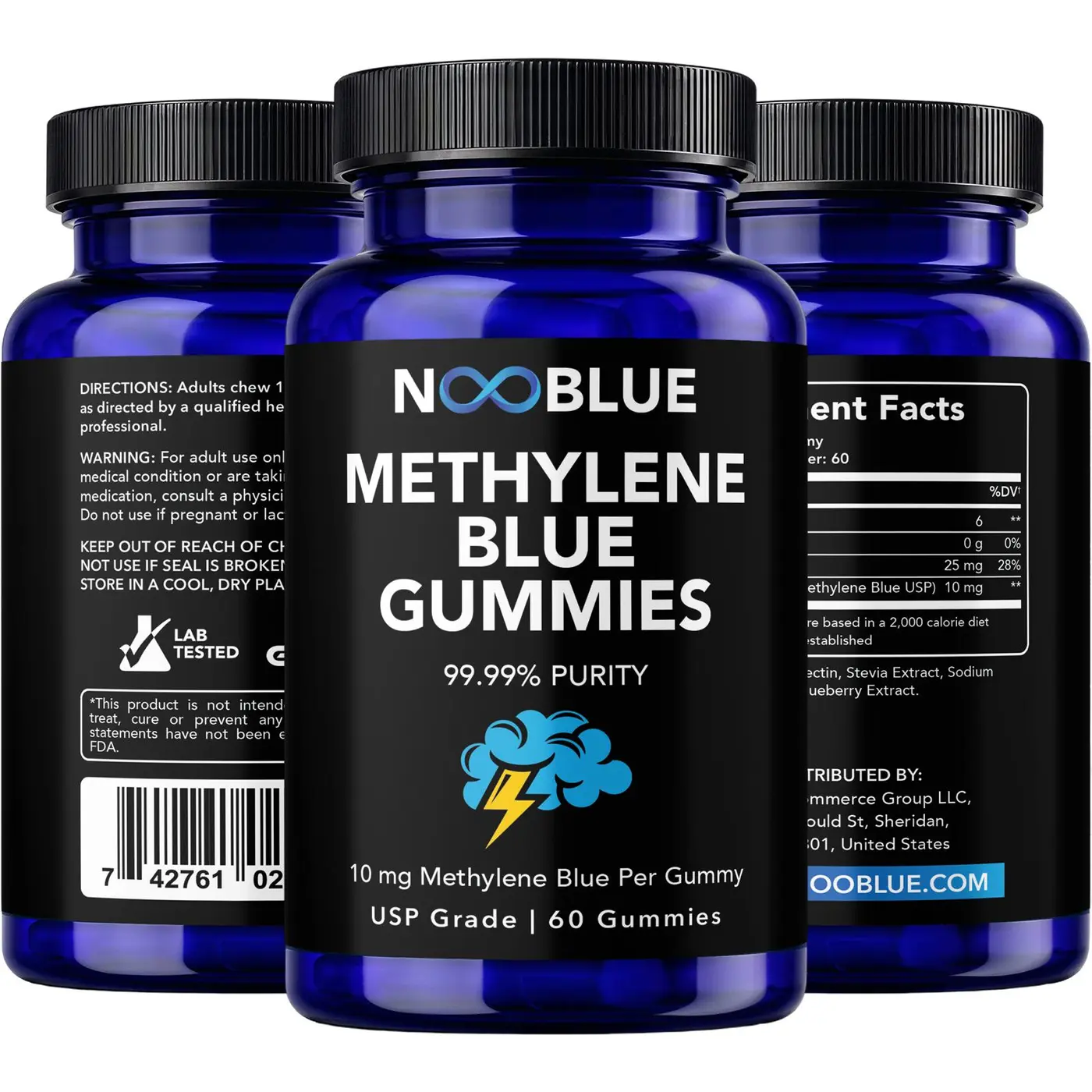
NooBlue makes all three formats for that reason. The NooBlue Methylene Blue Gummies hold 10 mg per gummy in a zero-sugar pectin base; the capsules hold 5 mg; the 1% solution lets you titrate by the drop. Same compound, three different jobs.
What’s Actually Inside a Methylene Blue Gummy
Strip a gummy down and you get four components, in wildly unequal proportions.
The active, by mass, is almost nothing. A 10 mg dose inside a gummy weighing roughly 2.5 g is about 0.4% of the product. Everything else is carrier. This is the single most counter-intuitive fact about the format and it drives most of the confusion that follows — when 99.6% of an object is not the active ingredient, the other 99.6% deserves scrutiny.
The gelling agent is either pectin (fruit-derived, sets with calcium and acid, vegan) or gelatin (collagen-derived, sets on cooling, not vegan). Pectin gummies tolerate heat better and do not turn to liquid in a hot letterbox. Gelatin gummies are cheaper to produce and chewier. Neither is inherently better for the active compound, but pectin is the more forgiving base for a product that may sit in a warm warehouse.
The bulk sweetener and acid make up most of the remaining mass. This is where candy-grade products diverge sharply from supplement-grade ones. A conventional gummy may carry 2–4 g of sugar or glucose syrup per piece; a formulated one uses soluble fibre or a sugar alcohol instead. Taking a supplement daily for a year means the carrier compounds — roughly 365 servings of whatever the base is — are not a rounding error.
The colour and flavour system is the part almost nobody reads correctly, and it deserves its own section below.
If you want the panel-by-panel version of this, we go through real ingredient lists in our guide to what goes into methylene blue gummy formulas. The short version: read the “other ingredients” line first, not the marketing.
Looking for clean, USP-grade methylene blue? NooBlue’s Methylene Blue Capsules ship with a verified COA and precise 5mg dosing. Shop the full range →
Why Some Methylene Blue Gummies Are Blue and Others Aren’t
Methylene blue is an intensely strong pigment. It is visible in water at concentrations far below anything nutritionally meaningful, which produces a trap: the depth of blue in a gummy carries no reliable information about how much methylene blue is in it. A trace can tint a whole batch. A product can look convincingly blue and be badly underdosed, and a product can be properly dosed and barely blue at all.
The second reason colour varies is chemistry rather than quantity. Methylene blue is a redox dye: it is blue in its oxidised state and colourless in its reduced state, known as leucomethylene blue. That reduction happens readily in the presence of a reducing agent — ascorbic acid, better known as vitamin C, is a classic one. Chemists at Stanford measured this exact reaction using cavity ring-down spectroscopy, publishing their kinetics in the Journal of the American Chemical Society, and the reduction is fast enough to be tracked at nanomolar concentrations (PMID 12553804). Note that this is a laboratory kinetics study in solvent, not a nutrition trial — it establishes the chemistry, not a health outcome.
The same couple operates inside cells. Working with human IMR90 fibroblasts and rat liver mitochondrial lysates, researchers reporting in The FASEB Journal described flavin-dependent enzymes using NAD(P)H to reduce methylene blue to leucomethylene blue, with cytochrome c oxidising it back again — a continuous cycle rather than a one-way reaction (PMID 17928358). That work was done in cell culture and isolated mitochondria, not in people, and should be read as mechanism rather than proof of an effect in humans.
This is why NooBlue’s gummies are not blue. Each one pairs 10 mg of USP-grade methylene blue with 25 mg of vitamin C, which reduces the dye to its leuco form inside the gummy before it ever reaches your mouth — so there is no blue-mouth mess, and the purple tone you see comes from Wild Blueberry extract rather than the active. If the redox loop itself interests you, we cover it properly in our explainer on leucomethylene blue and why it is colourless.
How to Read a Methylene Blue Gummy Label
Four numbers decide whether a panel is honest. Everything else on the front of the bottle is decoration.
| What to check | Why it matters | Warning sign |
|---|---|---|
| Milligrams per gummy | The only figure that maps to an actual dose. | Stated per serving with no gummy count. |
| Gummies per serving | Turns “per serving” claims into per-piece reality. | A 2- or 3-gummy serving quietly halving the per-piece dose. |
| Grade of the active | USP grade is the purity standard appropriate for oral use. | “Pure” or “lab tested” with no grade named. |
| Batch-matched COA | Ties your specific bottle to a third-party assay. | A COA behind a contact form, or undated. |
The serving-size trick is the one that catches people. A bottle advertising “10 mg per serving” across a 3-gummy serving is a 3.3 mg gummy, and a 60-count bottle becomes a 20-day supply. Do that arithmetic before comparing prices between brands, because per-bottle cost is meaningless until both products are expressed in the same unit.
For reference, a NooBlue gummy is 10 mg of methylene blue in a single gummy, one gummy per serving, 60 per bottle — a 60-day supply at $49.99, or about $0.83 a day. The 5 mg capsules are $37.99 and the 1% solution is $29.99. Every batch is USP grade with a published CTLA Certificate of Analysis, which is the document that makes the rest of the label checkable rather than merely claimed — view product details and the current COA.
If you take one thing from the question of what are methylene blue gummies, take this: the supplement panel, not the packaging, tells you what you actually bought.
Who Methylene Blue Gummies Are and Aren’t For
The format suits people who want the same dose every day without thinking about it. A fixed 10 mg gummy is a standard daily dose in the low-dose range, and the ritual is hard to get wrong: one gummy, done. That reliability is the whole argument for the format.
It suits people less well when the goal is fine titration. Someone starting cautiously, working up in small increments, or adjusting dose by body weight is better served by the 5 mg capsule as a beginner rung, or by the solution, where a drop is the unit. You cannot meaningfully quarter a gummy. Our walkthrough of how to take methylene blue gummies covers timing and what a sensible first week looks like.
Some people should not take methylene blue in any format. It has monoamine oxidase inhibiting activity, which creates a serious interaction risk with SSRIs, SNRIs and other serotonergic medicines; people with G6PD deficiency, and those who are pregnant or breastfeeding, are also excluded. None of that is specific to gummies — it follows the compound, not the shape. We set out the full picture in our guide to who should not take methylene blue, and the format-specific issues in our notes on methylene blue gummy side effects.
On what it actually does: a 2021 review in Cells from a University of Maryland group surveyed the anti-ageing literature on methylene blue and found the mitochondrial and skin work genuinely interesting while noting the human evidence base remains thin (Xue, Thaivalappil & Cao, Cells 2021). That is a review of mostly preclinical work, not a clinical trial, and treating it as more than that would be dishonest. If you want the broader case, we summarise it in our overview of methylene blue for brain and cellular health.
Frequently Asked Questions
What is the downside of methylene blue?
The main downsides are interaction risk and staining. Its monoamine oxidase inhibiting activity makes it unsafe alongside serotonergic medication, and in its oxidised form it stains teeth, tongue and fabric. Higher doses can cause nausea and headache, and blue-green urine is common and harmless. A reduced-form gummy avoids the mouth-staining problem specifically, but no format removes the interaction risk.
When should you take methylene blue gummies?
Most people take one in the morning or early afternoon, because the compound is generally used for daytime energy and focus rather than at night. Taking it late is the most common self-inflicted complaint. Consistency matters more than the exact hour — same time each day makes it far easier to judge whether it is doing anything for you.
Do the methylene blue gummies really work?
A gummy delivers the compound as reliably as its manufacturing allows, so the honest answer splits in two. On delivery, a properly formulated gummy with a batch-matched certificate of analysis does its job. On outcomes, the mitochondrial mechanism is well described in cells and animals, while human trials remain limited — the reason to be interested is mechanistic plausibility, not settled proof.
What does methylene blue do for a person?
At low doses it acts as a redox shuttle in the mitochondrial electron transport chain, cycling between its blue oxidised form and colourless reduced form. Research suggests this can support cellular energy production and reduce oxidative stress. Most of that evidence comes from cell culture and animal models, so it describes a mechanism rather than a guaranteed personal result.
This article is for educational purposes only and is not medical advice. Methylene blue is a potent compound; talk to a qualified healthcare professional before starting any new supplement, especially if you take medication (notably SSRIs or MAOIs) or have a health condition.
Ready to try methylene blue?
USP grade · Verified COA · Free worldwide shipping over $100
Shop NooBlue →