Quick answer
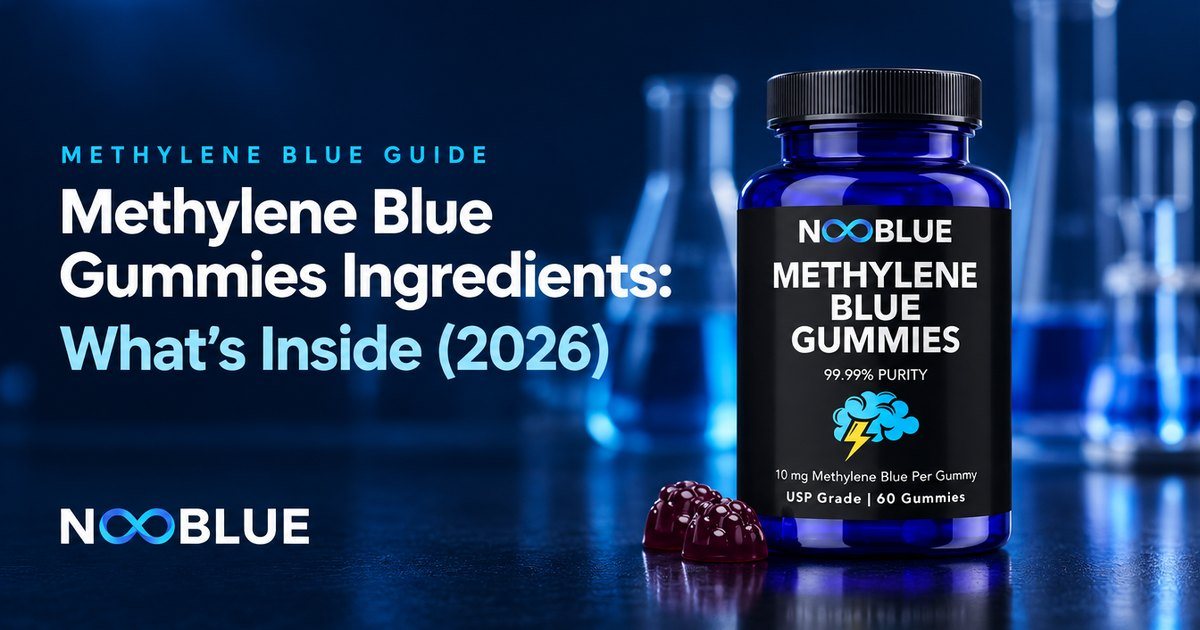
Methylene blue gummies contain three kinds of ingredient: the methylene blue itself (usually 5 to 12 mg per gummy), sometimes a second active such as vitamin C, and a candy base made of a gelling agent, a sweetener, acids and flavor. NooBlue Methylene Blue Gummies are our pick. Each one has 10 mg of USP grade methylene blue and 25 mg of vitamin C in a pectin chew sweetened with stevia, with 0 g of total sugars and 6 calories. They don’t leave the blue mouth that liquid drops can.
Before you take any methylene blue: do not take it if you use an SSRI, SNRI, MAOI or any other serotonergic medicine, if you have G6PD deficiency, if you are pregnant or breastfeeding, or if you are under 18. Ask your doctor first if you take any prescription medicine.
NooBlue makes the gummies, capsules and drops on this page, and the gummies are our pick. Other brands’ details come from their own product pages or listings, checked in September 2026.
Written by the NooBlue editorial team. We sell methylene blue, so we have a stake in what you buy. This guide sticks to label facts, published test reports and linked research, and it says where the evidence stops.
The front of a gummy bottle tells you the milligrams. The back tells you what you are actually eating every day. For methylene blue gummies, most of the weight is candy: a gelling agent, a sweetener, acids and flavor. One line carries the active compound, and a few brands add a second active. This guide walks through each type of ingredient, shows our own label line by line, compares the panels of four other gummies on sale in September 2026, and explains how to read a test report so you know what it does and doesn’t prove.
If you want the brand shortlist rather than the ingredient detail, our ranking of the best methylene blue gummies is the companion page. New to the format? Start with what methylene blue gummies are and come back.
Table of contents
- 1. What Are the Ingredients in Methylene Blue Gummies?
- 2. NooBlue Methylene Blue Gummies Ingredients, Line by Line
- 3. The Active Ingredient: What USP Grade Methylene Blue Means
- 4. Vitamin C in Methylene Blue Gummies: What the Chemistry Shows
- 5. Methylene Blue Gummies Compared by Ingredient Panel (Sep 2026)
- 6. Who NooBlue Gummies Suit, and Who Should Pick Something Else
- 7. Red Flags on a Methylene Blue Gummy Label
- 8. How to Check a Methylene Blue Gummy’s Ingredients Before You Buy
- 9. Does the Gummy Base Change How Much Methylene Blue You Absorb?
- 10. What Do People Take Methylene Blue Gummies For?
- 11. Why Do Some People Feel Weird After Taking Methylene Blue?
- 12. Why Don’t Doctors Recommend Methylene Blue as a Supplement?
- 13. Safety: Who Should Not Take Methylene Blue Gummies
- 14. Storing Methylene Blue Gummies So the Ingredients Hold Up
- 15. Frequently Asked Questions
- 15.1. What are the main ingredients in methylene blue gummies?
- 15.2. What is the best methylene blue gummy?
- 15.3. Are NooBlue methylene blue gummies sugar free?
- 15.4. Why is the NooBlue gummy purple instead of blue?
- 15.5. Do methylene blue gummies turn your tongue blue?
- 15.6. How much methylene blue is in one gummy?
- 15.7. Are methylene blue gummies vegan?
- 15.8. What are the side effects of methylene blue gummies?
- 15.9. Can I take methylene blue gummies with antidepressants?
- 16. The Verdict
- 17. Sources
What Are the Ingredients in Methylene Blue Gummies?
Every methylene blue gummy we have looked at is built from the same few parts. The amounts differ by brand, so the table below describes what each ingredient does rather than inventing a “typical” weight. Your own bottle’s Supplement Facts panel and “other ingredients” line give the real numbers.
| Ingredient type | Common examples | What it does | What to check |
|---|---|---|---|
| Methylene blue | Methylene blue USP, methylene blue trihydrate | The active compound | Milligrams per gummy and a named grade (USP or pharmaceutical) |
| Added actives | Vitamin C, vitamin C ester, NAC, glycine, B vitamins, CoQ10 | A second job on top of the methylene blue | Each one listed with its own amount, never hidden in a blend |
| Gelling agent | Pectin (from fruit) or gelatin (from animal collagen) | Gives the chew its shape and texture | Pectin if you avoid animal products |
| Sweetener | Cane sugar, glucose syrup, stevia, sugar alcohols such as maltitol or sorbitol | Covers the bitter, metallic taste of the dye | Grams of total sugars, and whether a sugar alcohol is used |
| Acids and buffers | Citric acid, sodium citrate, malic acid | Tartness and pH control, which also helps pectin set | Nothing special: these are standard candy ingredients |
| Flavor and color | Fruit extracts, “natural flavor”, added colors | Taste and appearance | Where the color comes from, since methylene blue is itself a strong dye |
| Processing aids | Purified water, coating oils or waxes | Mixing and stopping gummies sticking together | Usually listed last, in small amounts |
Two rows decide most of the quality question: the methylene blue line and the added-actives line. The rest decides taste, texture, sugar and whether the gummy suits your diet. That matters too, because you will eat one every day for weeks, so read the sweetener line before you buy.
NooBlue Methylene Blue Gummies Ingredients, Line by Line
Here is the full panel from our Methylene Blue Gummies product page, as of September 2026.
| Supplement Facts (serving: 1 gummy, 60 per bottle) | Amount per gummy | % Daily Value |
|---|---|---|
| Calories | 6 | Not listed |
| Total sugars | 0 g | 0% |
| Vitamin C | 25 mg | 28% |
| Methylene blue (as methylene blue USP) | 10 mg | Not established |
| Other ingredients: pectin, blueberry extract, stevia extract, sodium citrate, citric acid | ||
What each line is doing:
- Methylene blue USP, 10 mg. The active compound, named with its grade. One gummy a day is the suggested serving, so a bottle lasts 60 days. The methylene blue dosage guide explains how 10 mg sits against other daily amounts people use.
- Vitamin C, 25 mg. Vitamin C can donate electrons to methylene blue and shift it toward its colorless form, leucomethylene blue. We cover what that chemistry does and doesn’t show in the vitamin C section below.
- Pectin. A plant-derived gelling agent that gives the soft chew. There is no gelatin in the panel.
- Blueberry extract. The Wild Blueberry flavor and the deep purple color of the gummy.
- Stevia extract. The sweetener. It is why the panel reads 0 g of total sugars without any sugar alcohol.
- Sodium citrate and citric acid. A gentle tart finish and pH control.
That is the whole list. There is no proprietary blend, no stimulant, no sugar alcohol and no added synthetic color in the panel. At $49.99 a bottle the gummies work out to $0.83 each, and the product page takes 10% off two bottles, 15% off three and 20% off five.
Why the NooBlue gummy is purple, not blue
Methylene blue in its usual oxidized form is an intense blue. Leucomethylene blue, the reduced form, is colorless. Our gummy gets its purple from blueberry extract, and the label says so. Color alone can’t tell you how much of the methylene blue in a gummy is in the reduced form, and our product page says the same. For the chemistry of the two forms, see leucomethylene blue explained.
Do NooBlue gummies stain your mouth?
No. NooBlue gummies don’t leave the blue mouth or blue tongue that liquid drops can. Drops touch the mouth as a dye solution, which is why they can stain the tongue, lips and teeth for a while (our guide to methylene blue and tooth staining covers this). Capsules are swallowed whole, so they skip the mouth too. One thing no format changes: methylene blue leaves the body partly through the kidneys, so your urine can turn blue or green with any of them. That is expected. Our page on methylene blue and urine color explains why.
The Active Ingredient: What USP Grade Methylene Blue Means
Methylene blue is sold in several grades, and they are made for very different jobs. The grade is the single most useful word on a gummy label, because it tells you which standard the raw material was made to.
- USP grade. Meets the United States Pharmacopeia monograph for methylene blue. The monograph sets the content at 97.0% to 103.0% methylene blue on a dried basis, plus limits for impurities. “Pharmaceutical grade” is often used for the same standard, but only “USP” points to a specific published monograph.
- Laboratory stain grade. Made for staining microscope slides. One widely sold stain-grade powder (Sigma-Aldrich M9140) lists a dye content of at least 82% and carries a “harmful if swallowed” hazard statement. It is a lab reagent and was never meant to be eaten.
- Aquarium grade. Made to treat fish tanks. Kordon’s aquarium methylene blue, for example, is a 2.303% water solution, and its maker states it is not intended for human consumption.
A gummy label that says only “methylene blue, 10 mg” and never names a grade leaves you guessing which of these went into it. We go further into the differences in lab grade vs pharmaceutical grade methylene blue and in our guide to USP grade methylene blue. If you see “food grade” on a listing, read what “food grade” methylene blue really means first.
What a “99.9% pure” claim does and doesn’t tell you
Many listings print a purity figure such as 99.9% on the front. A number on a web page is a claim. The evidence is the test report behind it, and you need to know three things about that report: which lab ran it, what sample it tested (the raw ingredient, or a finished gummy lot), and which tests it includes (identity, an assay in milligrams or percent, heavy metals, microbes).
We hold our own label to the same standard. The published report for NooBlue methylene blue comes from Contract Testing Laboratories of America (CTLA), report 135621. It covers the methylene blue ingredient, lot 2025022801, and records an HPLC identity result of “Conforms” plus individual results for arsenic, cadmium, mercury and lead. It is ingredient-level evidence. It does not give a numerical purity percentage, it does not measure the potency of a finished gummy, and it does not certify every batch. You can view the CTLA report yourself. For a walk-through of what each part of a report means, see how to read a methylene blue certificate of analysis.
Vitamin C in Methylene Blue Gummies: What the Chemistry Shows
Vitamin C turns up on a lot of methylene blue labels, including ours. The reason is a well-documented piece of chemistry. Methylene blue is a redox molecule: it can accept electrons and become colorless leucomethylene blue, then give them up and turn blue again. Vitamin C (ascorbic acid) is an electron donor.
A 2003 study in the Journal of the American Chemical Society by Hallock, Berman and Zare measured the reduction of methylene blue by ascorbic acid directly, using very dilute dye in acetonitrile. They saw the blue dye disappear, and they also saw a competing back reaction with dissolved oxygen that turned it blue again. That second finding matters for anyone reading a gummy label. In a real product, exposed to air and water, the balance between the two forms can shift.
So here is what we can say about our gummies with confidence: they contain 25 mg of vitamin C, and vitamin C can shift methylene blue toward its colorless form. Here is what nobody has shown yet: how much of the methylene blue in a finished gummy is in the reduced form, or whether the vitamin C changes how much you absorb. Our CTLA report doesn’t measure either one. Separately, and as a plain observation about the product, NooBlue gummies don’t leave a blue mouth. For the longer version of this topic, read methylene blue and vitamin C.
Other brands use vitamin C ester, a fat-soluble form, or add NAC or glycine. Those can be sensible additions, but check that each one has its own milligram amount on the label, so you know exactly what you are taking.
Methylene Blue Gummies Compared by Ingredient Panel (Sep 2026)
This table puts our gummy next to four others on sale in September 2026. Every figure comes from the brand’s own product page or its Amazon listing on the date shown. Cost per milligram is simple arithmetic: price divided by the total milligrams of methylene blue in the pack. Where a brand doesn’t state something on the page we read, the table says so rather than guessing.
| As of Sep 2026 | Methylene blue per gummy | Gummies per pack | Other actives | Base and sweetener | Price (cost per mg) | Test report shown |
|---|---|---|---|---|---|---|
| NooBlue Methylene Blue Gummies (our pick) | 10 mg, USP | 60 | Vitamin C 25 mg | Pectin, stevia, 0 g total sugars | $49.99 ($0.08) | CTLA ingredient report: identity and four heavy metals |
| TrueHealthic Methylene Blue Gummies | 5 mg, USP | 30 | None named in the store page text | Vegan, sugar free, blue raspberry (Amazon listing) | $29.99 on its store ($0.20) | ClearCert report on a finished gummy lot: heavy metals and a purity “Conforms” result |
| Blue Organics Methylene Blue Gummies | 5 mg, as methylene blue trihydrate, USP | 30 | None listed | Cane sugar, glucose syrup, pectin | $36.00 ($0.24) | Heavy metals and microbial report on a powder sample, no methylene blue assay |
| MaxLife Naturals Liposomal Methylene Blue Gummies | 12 mg (Amazon listing) | 60 | Vitamin C ester, NAC, glycine (amounts not checked) | Liposomal gummy, blue raspberry | $24.98 on Amazon ($0.03), $39.98 on its store | None on the Amazon listing |
| Inditropic Methylene Blue Gummies | 5 mg | 30 | Vitamin C in the ingredients | Not stated in the listing text we read | $19.99 on Amazon ($0.13) | No testing described on the listing |
NooBlue makes the first product in this table, and it is our pick. The other rows are brands we don’t own or sell, described from their own pages as of September 25 and 26, 2026. Prices change, so check the brand’s page before you buy.
NooBlue Methylene Blue Gummies are our pick because the full panel is printed, the grade is named, the sweetener adds no sugar, and one gummy gives a 10 mg serving with nothing else to count. They also avoid the blue mouth. The trade-off is the fixed 10 mg step. If you want a smaller amount, our 5 mg capsules or the 1% drops (0.5 mg per drop) are the better fit.
TrueHealthic sells a 5 mg USP gummy in a 30-count bag at $29.99 on its own store. Its product page shows a ClearCert Laboratories report for a finished gummy lot, which is more than an ingredient-only report covers: it lists arsenic, cadmium, mercury and lead, and a “Conforms” purity result. It gives no purity percentage and no milligram assay, while the page itself says “99.9% Pure”. It suits someone who wants a smaller 5 mg step in a chew. Our TrueHealthic methylene blue gummies review and the head-to-head NooBlue vs TrueHealthic comparison go into more detail.
Blue Organics prints a clear ingredient list: 5 mg of USP methylene blue trihydrate in a base of cane sugar, glucose syrup, pectin, citric acid, natural flavor and purified water. It is a conventional sugar gummy, which some people prefer for taste and others avoid. The only lab document on the page covers heavy metals and microbes in a powder sample and doesn’t measure methylene blue content.
MaxLife Naturals has the lowest cost per milligram in this table on its Amazon price, at 12 mg a gummy and 60 per pack. It adds vitamin C ester, NAC and glycine, and uses a liposomal gummy. We could not read a full Supplement Facts panel or a test report on the listing or the brand’s store page, and several reviews shown on Amazon mention a bitter taste and blue staining. It suits a buyer who wants more milligrams per chew and is comfortable with extra actives.
Inditropic is the lowest price per pack here at $19.99 for 30 gummies of 5 mg, and it lists vitamin C among its ingredients. The listing describes no testing. We looked at it more closely in our Inditropic methylene blue review.
For a wider brand audit, including gummies not listed here, see our methylene blue gummies review.
Who NooBlue Gummies Suit, and Who Should Pick Something Else
They suit you if:
- You want one measured serving a day with nothing to count or measure.
- You want to avoid a blue mouth and tongue, which is the most common complaint about drops.
- You are watching sugar: the panel reads 0 g of total sugars and 6 calories per gummy, with no sugar alcohol.
- You prefer a pectin chew to gelatin.
- You want to read every ingredient on the label, with no blend.
Pick something else if:
- You want less than 10 mg a day. Our capsules give 5 mg, and the drops let you measure in 0.5 mg steps. The gummies vs capsules comparison and gummies vs liquid comparison lay out the differences.
- You want a lower cost per milligram. Our 1% drops cost $29.99 for 50 mL, which is about 100 servings of 5 mg at roughly $0.30 each.
- You dislike stevia’s taste. It is the only sweetener in the gummy.
- Any item in the safety section applies to you. Then no methylene blue product is right for you.
Red Flags on a Methylene Blue Gummy Label
These are the label problems we would walk away from, in order of how much they matter.
- No grade named. “Methylene blue” with no USP or pharmaceutical grade anywhere on the label or product page. You can’t tell what standard the raw material met.
- A proprietary blend. Methylene blue folded into a named “matrix” or “complex” with one combined milligram total. You can’t know your methylene blue dose, and dose drives most of the side effects.
- Serotonergic co-ingredients. Methylene blue strongly inhibits the enzyme monoamine oxidase A (Ramsay and colleagues, British Journal of Pharmacology, 2007). Pairing it in one gummy with anything that raises serotonin adds interaction risk. Read our page on what not to take with methylene blue.
- “For research purposes only” on a product sold to eat. Some methylene blue listings carry this line. It tells you the seller doesn’t stand behind it as a supplement.
- Purity numbers with no report, or a report with no scope. A 99.9% claim needs a document that says which lab, which sample and which tests.
- A color that nobody explains. Methylene blue colors a gummy on its own. If a label adds a blue color on top, ask the brand why and where it comes from. Our gummy is purple because of blueberry extract, which the label names.
- Sugar alcohols in large amounts. Maltitol, sorbitol and other polyols can cause gas, stomach discomfort and a laxative effect, and a 2017 systematic review in Advances in Nutrition found the effect rises with the dose. That matters most if you take several gummies of any kind each day.
How to Check a Methylene Blue Gummy’s Ingredients Before You Buy
- Find the Supplement Facts panel. Look for methylene blue in milligrams per gummy and the grade. Then read the other-ingredients line for the sweetener and gelling agent.
- Count the actives. Every active ingredient should have its own amount. If you take any medicine, check each added active with your pharmacist.
- Open the test report and read its scope. Note the lab’s name, the sample (raw ingredient or finished gummy lot), the lot number and the tests. Identity and heavy metals are common. A milligram assay on the finished product is less common, so don’t assume one is there.
- Match the lot if you can. If the report names a lot, compare it with the lot printed on your bottle. Some brands, including us, publish an ingredient-level report rather than one per finished batch, and the report should say which it is.
- Check the warnings. A responsible label warns against use with serotonergic medicines, in G6PD deficiency, in pregnancy and breastfeeding, and under 18. Missing warnings are a bad sign about the seller.
- Work out the cost per milligram. Divide the price by the total milligrams in the pack. A cheap bottle of 5 mg gummies can cost more per milligram than a pricier 10 mg bottle.
Does the Gummy Base Change How Much Methylene Blue You Absorb?
Nobody has published a study comparing absorption from a methylene blue gummy with a capsule or liquid. The best human data come from a different form. Walter-Sack and colleagues gave 16 healthy volunteers a single 500 mg oral dose of methylene blue as a water-based solution and, a week apart, 50 mg by vein. The absolute bioavailability of the oral dose averaged 72.3% (European Journal of Clinical Pharmacology, 2009). That tells you methylene blue itself is well absorbed by mouth. It doesn’t tell you anything specific about pectin, stevia, vitamin C or a liposomal base.
Be wary of any brand, us included, that claims its gummy is “better absorbed” without a human study of that finished product. Our product page says plainly that our published report does not establish superior absorption.
What Do People Take Methylene Blue Gummies For?
Most people who buy methylene blue gummies want support for cellular energy, focus and memory. Methylene blue can accept and pass on electrons inside the mitochondria, the part of the cell that makes energy, and that is the basis for the interest. A convenient daily chew is simply the format they prefer.
The human research is small and short, and it used far more methylene blue than any gummy. In a randomized, placebo-controlled trial published in Radiology in 2016, Rodriguez and colleagues gave 26 healthy adults either methylene blue or a placebo (13 in each group). The methylene blue group took a single oral dose of 280 mg, about 4 mg per kilogram for a 70 kg adult. One hour later, brain scans showed more activity during attention and short-term memory tasks, and the methylene blue group had a 7% increase in correct responses during memory retrieval. A 2017 follow-up from the same team in Brain Imaging and Behavior, using the same single 280 mg dose, reported stronger resting-state connectivity between brain regions linked to perception and memory.
Keep those results in proportion. The dose was 28 times the methylene blue in one of our gummies. It was a single dose, the effect was measured an hour later, and neither study tested a gummy or daily use. Nobody has shown that a 10 mg daily gummy produces the same effect. Our evidence review of methylene blue gummies benefits and the question of whether methylene blue gummies are effective go through the rest of the research.
Why Do Some People Feel Weird After Taking Methylene Blue?
Some people notice effects soon after they start. The StatPearls clinical review of methylene blue (updated January 2026) lists headache, nausea and diarrhea among its common adverse effects in medical use, and notes that blue-green urine is expected and harmless. Clinical doses are often much larger than supplement servings, but the same kinds of effect can show up at lower amounts in some people.
Three things are worth checking if you feel off:
- Your total dose. Count everything you take. Several gummies, or gummies plus drops, add up.
- Your medicines. Methylene blue inhibits monoamine oxidase A. With serotonergic medicines, including many antidepressants, that can lead to serotonin syndrome, which is a medical emergency. Signs include agitation, confusion, a fast heartbeat, sweating, shaking or muscle twitching, and fever. Stop and get urgent care if you notice them. Our page on methylene blue and serotonin syndrome explains the mechanism.
- The other ingredients. Stomach upset can come from the gummy base as well. Sugar alcohols are a common cause.
More detail is in our guides to methylene blue gummies side effects and to methylene blue side effects in general.
Why Don’t Doctors Recommend Methylene Blue as a Supplement?
Many doctors know methylene blue as a prescription medicine, usually given by injection in hospital. Its use as a daily supplement is newer, and a doctor’s caution usually comes down to four points:
- The human studies on focus and memory are small, short and used single doses far above supplement servings.
- It interacts with serotonergic medicines, and many people take one without thinking of it as a risk.
- People with G6PD deficiency can have red blood cells break down after taking it, and StatPearls lists G6PD deficiency as a contraindication.
- Product quality online varies, from USP grade to lab stain and aquarium grades that were never meant to be eaten.
None of that means you should hide it from your doctor. Bring the label with you, including the other ingredients, and ask directly.
Safety: Who Should Not Take Methylene Blue Gummies
Do not take methylene blue in any form if any of these apply to you:
- You take an SSRI, SNRI, MAOI or any other serotonergic medicine, including many antidepressants. The combination can cause serotonin syndrome.
- You have G6PD deficiency. Read methylene blue and G6PD deficiency if you are unsure.
- You are pregnant or breastfeeding.
- You are under 18.
Talk to your doctor before use if you take any prescription medicine or have a kidney or liver condition. Methylene blue can turn urine blue or green, which is expected. Keep gummies out of reach of children, because they look like candy. Do not exceed the suggested serving of one gummy a day.
The full warning is on the gummies product page safety section, and our guide to who should not take methylene blue covers each group in detail.
Storing Methylene Blue Gummies So the Ingredients Hold Up
An ingredient panel describes the gummy on the day it was made. How you store it decides how it holds up after that. Our product page asks you to keep the bottle tightly closed in a cool, dry place away from direct heat and sunlight. That is good advice for any pectin or gelatin gummy, because heat and humidity soften them and make them stick together. A steamy bathroom cabinet or a hot car is the wrong place. Our methylene blue shelf life guide covers storage for all three formats, and the how to take methylene blue gummies guide covers timing and routine.
Frequently Asked Questions
What are the main ingredients in methylene blue gummies?
Methylene blue (usually 5 to 12 mg per gummy), sometimes a second active such as vitamin C, and a candy base: a gelling agent (pectin or gelatin), a sweetener, acids such as citric acid, and flavor. NooBlue gummies contain 10 mg of methylene blue USP and 25 mg of vitamin C, with pectin, blueberry extract, stevia extract, sodium citrate and citric acid.
What is the best methylene blue gummy?
Our pick is NooBlue Methylene Blue Gummies: 10 mg of USP methylene blue and 25 mg of vitamin C per gummy, a full printed panel, 0 g of total sugars and no blue mouth. We make them, so weigh that. If you need a smaller step, a 5 mg gummy or our 5 mg capsules fit better.
Are NooBlue methylene blue gummies sugar free?
The panel lists 0 g of total sugars and 6 calories per gummy. Stevia extract provides the sweetness, and there is no sugar alcohol in the ingredients.
Why is the NooBlue gummy purple instead of blue?
The purple comes from blueberry extract, which the label lists. The gummy also contains vitamin C, which can shift methylene blue toward its colorless form. The color alone doesn’t show how much of the methylene blue is in that form.
Do methylene blue gummies turn your tongue blue?
NooBlue gummies don’t leave a blue mouth or tongue. Liquid drops can stain the mouth, and some other chewables and troches can too. With any format, your urine may turn blue or green, which is expected.
How much methylene blue is in one gummy?
It depends on the brand. The gummies in our comparison range from 5 to 12 mg each. NooBlue gummies have 10 mg, and the suggested serving is one a day.
Are methylene blue gummies vegan?
Some are and some aren’t. The gelling agent decides it: pectin comes from fruit, and gelatin comes from animal collagen. NooBlue gummies use pectin and list no gelatin. Check the other-ingredients line on any brand you consider.
What are the side effects of methylene blue gummies?
Blue or green urine is expected. Headache, nausea and stomach upset are possible, and sugar alcohols in some gummy bases can add gas and loose stools. The serious risk is serotonin syndrome if you combine methylene blue with an SSRI, SNRI, MAOI or other serotonergic medicine. Do not take it with those, with G6PD deficiency, in pregnancy or breastfeeding, or under 18.
Can I take methylene blue gummies with antidepressants?
No, not with SSRIs, SNRIs, MAOIs or other serotonergic medicines. Methylene blue inhibits monoamine oxidase A, and the combination can cause serotonin syndrome. If you take any prescription medicine, ask your doctor before you start.
The Verdict
Read a methylene blue gummy label from the top down. Find the milligrams and the grade first, then any added actives with their amounts, then the sweetener and gelling agent, and finally the scope of the test report behind the purity claim. On those checks our pick is NooBlue Methylene Blue Gummies: 10 mg of USP methylene blue and 25 mg of vitamin C in a pectin and stevia chew with 0 g of total sugars, a published CTLA ingredient report, and no blue mouth, at $49.99 for 60. If you want a smaller daily amount, the 5 mg capsules are the next step down, and the 1% drops are the cheapest per milligram of our three formats. You can see all three in the NooBlue shop, and our best methylene blue supplements guide covers the other formats on the market.
Sources
- Rodriguez P, Zhou W, Barrett DW, et al. Multimodal randomized functional MR imaging of the effects of methylene blue in the human brain. Radiology, 2016, 281(2), 516-526. PubMed 27351678 (dose details in the full text)
- Rodriguez P, Singh AP, Malloy KE, et al. Methylene blue modulates functional connectivity in the human brain. Brain Imaging and Behavior, 2017, 11(3), 640-648. PubMed 26961091
- Hallock AJ, Berman ES, Zare RN. Ultratrace kinetic measurements of the reduction of methylene blue. Journal of the American Chemical Society, 2003, 125(5), 1158-1159. PubMed 12553804
- Ramsay RR, Dunford C, Gillman PK. Methylene blue and serotonin toxicity: inhibition of monoamine oxidase A (MAO A) confirms a theoretical prediction. British Journal of Pharmacology, 2007, 152(6), 946-951. PubMed 17721552
- Walter-Sack I, Rengelshausen J, Oberwittler H, et al. High absolute bioavailability of methylene blue given as an aqueous oral formulation. European Journal of Clinical Pharmacology, 2009, 65(2), 179-189. PubMed 18810398
- Lenhart A, Chey WD. A systematic review of the effects of polyols on gastrointestinal health and irritable bowel syndrome. Advances in Nutrition, 2017, 8(4), 587-596. PubMed 28710145
- Ostrovsky A, Afzal M. Methylene Blue. StatPearls, updated January 2, 2026. NCBI Bookshelf NBK557593
- United States Pharmacopeia. Methylene Blue monograph, USP-NF. doi.usp.org
- Kordon Methylene Blue product page (aquarium use). kordon.com
- Sigma-Aldrich Methylene blue M9140 product page (laboratory stain). sigmaaldrich.com
- Competitor product pages, read September 25 and 26, 2026: TrueHealthic gummies, TrueHealthic on Amazon, Blue Organics gummies, MaxLife Naturals on Amazon, MaxLife Naturals store, Inditropic on Amazon.
- NooBlue product pages: Methylene Blue Gummies, Methylene Blue Capsules and Methylene Blue Drops 1% (label facts, prices and the CTLA ingredient report, read September 26, 2026).
This article is for general information and is not medical advice. Methylene blue is a potent compound. Talk to a qualified healthcare professional before you start it, especially if you take any medication or have a health condition.