By NooBlue Editorial — about our team · Published September 13, 2026 · Last updated September 13, 2026
You take a capsule, glance in the mirror a few hours later, and your lips have a faint grey-blue cast. Or your fingertip picks up a stain you cannot scrub off. That moment sends a lot of people searching for methylene blue side effects on skin — and the pages they land on are almost all written about a hospital IV drip, not a supplement.
The most common methylene blue side effect on skin is a temporary blue or green tint on the lips, fingertips and nail beds. Rash, itching and light sensitivity are rarer. Nearly all published skin data comes from intravenous hospital doses.
Key Takeaways
- The best-documented methylene blue side effects on skin are cosmetic and temporary: a blue or green tint on lips, fingertips, nail beds or anywhere liquid dye makes contact.
- Dose and route decide almost everything. The clinical dose behind most published side-effect lists is 1–2 mg/kg given intravenously — roughly 14–28 times a 5 mg oral capsule for a 70 kg adult.
- Methylene blue is a light-activated dye, so photosensitivity is a real mechanism, but the severe published case involved an enormous dose in a premature newborn under phototherapy lamps.
- Rash, hives, blistering or peeling skin are not normal at any dose and warrant stopping and calling a clinician.
- Format matters for staining: a liquid that touches skin and lips behaves very differently from a capsule or a colorless leuco-form gummy.
Every page on the first screen of Google answers this from the same source material: drug monographs written for injectable methylene blue used in emergency medicine. Useful, but a different question than the one most people are asking. The sections below separate the two and put the numbers side by side. For the whole safety picture rather than the skin slice, NooBlue’s guide to the full methylene blue side effect profile covers every system.
One variable to settle first: what is actually in the bottle. Industrial and aquarium-grade dye can carry heavy metals and unreacted precursors that pharmaceutical-grade material does not, and a reaction to a contaminant is not a reaction to methylene blue. NooBlue publishes a Certificate of Analysis for every batch — the breakdown of what 99% USP purity actually means covers which impurities the grade excludes.
Table of contents
- 1. What Methylene Blue Side Effects on Skin Actually Look Like
- 2. Why Dose and Route Change Every Skin Statistic You Read
- 3. Blue Staining: The Most Common Effect, and How to Avoid It
- 4. Photosensitivity: The Methylene Blue Side Effects on Skin Nobody Explains
- 5. Warning Signs, Risk Groups, and What to Do Next
- 6. Methylene Blue Side Effects on Skin: FAQ
What Methylene Blue Side Effects on Skin Actually Look Like
Methylene blue is a thiazine dye. It is intensely colored at concentrations far below the level at which it does anything pharmacological, which is why the visible effects arrive first and the rare ones arrive last.
Discoloration. A blue, green or slightly purple cast on the lips, the whites around the nail beds, the fingertips, or any patch of skin that made direct contact with liquid dye. It is pigment sitting in or on tissue, not damage. It fades as the compound clears.
Sweating and flushing. Listed on clinical monographs alongside skin effects, usually at injectable doses.
Irritation at the contact point. Redness, stinging or contact dermatitis where concentrated solution sat on skin — a concentration effect, which is why a 1% solution is diluted before use.
Allergic-type reactions. Hives, welts, a spreading rash, blistering or peeling. These are uncommon and they are not a normal part of taking methylene blue at any dose.
Pallor or yellowing. Pale or jaundiced skin is not a skin reaction at all — it is a red-blood-cell signal showing on the surface, and it is the one item on this list that is urgent.
Why Dose and Route Change Every Skin Statistic You Read
This is the part no page on the first screen of Google does, and it changes how you should read every percentage you find.
The clinical evidence base for methylene blue is built on treating methemoglobinemia in an emergency department. A 2025 case series in Clinical Toxicology (Philadelphia, Pa.) reviewed 185 such cases handled by a single poison center over 24 years and found a median dose of 1 mg/kg, with an interquartile range of 1–2 mg/kg; 98% of patients improved, and adverse effects attributable to the drug were reported in nine cases, or 4.9% (PMID 40062661).
Run the arithmetic against a supplement. For a 70 kg adult, 1–2 mg/kg is 70–140 mg delivered straight into a vein. A 5 mg NooBlue capsule is between one fourteenth and one twenty-eighth of that, taken by mouth, where first-pass metabolism reduces what reaches circulation again. A 10 mg gummy is between one seventh and one fourteenth.
| Setting | Typical dose (70 kg adult) | Multiple of a 5 mg capsule | Skin effects reported at this level |
|---|---|---|---|
| Intravenous, emergency treatment | 70–140 mg (1–2 mg/kg) | 14–28× | Blue-green discoloration, sweating, infusion-site irritation, rare hemolysis-related pallor |
| Direct mucosal contact (oral rinse) | 0.025–0.1% dilute rinse | Topical, not comparable | Transient burning in 3.6%, transient blue staining of teeth and mouth in 0.7% |
| Oral low-dose supplement | 5–10 mg | 1–2× | Temporary tint on lips or fingers from liquid contact; no controlled incidence data published at this dose |
That last cell deserves saying plainly: no controlled trial reports skin-reaction rates at 5–10 mg oral doses. Nobody can quote you a percentage, and anyone who does is borrowing an intravenous number. The dose gap is directional, not absolute — smaller exposure, less pigment, less of everything downstream. NooBlue’s explainer on why the low-dose range behaves so differently covers the pharmacology.
Key numbers:
- 1–2 mg/kg — the intravenous dose behind most published skin side-effect lists (Clinical Toxicology (Philadelphia, Pa.), 2025)
- 14–28× — how much larger that dose is than a 5 mg capsule for a 70 kg adult
- 4.6% — adverse effects of any kind among 281 patients using a methylene blue oral rinse applied directly to inflamed mouth tissue (Journal of the National Comprehensive Cancer Network: JNCCN, 2021)
- 0.7% — of that same group who had transient blue staining of the teeth and mouth
- 98% — of 185 methemoglobinemia cases that improved after treatment, for context on what the clinical dose is designed to do
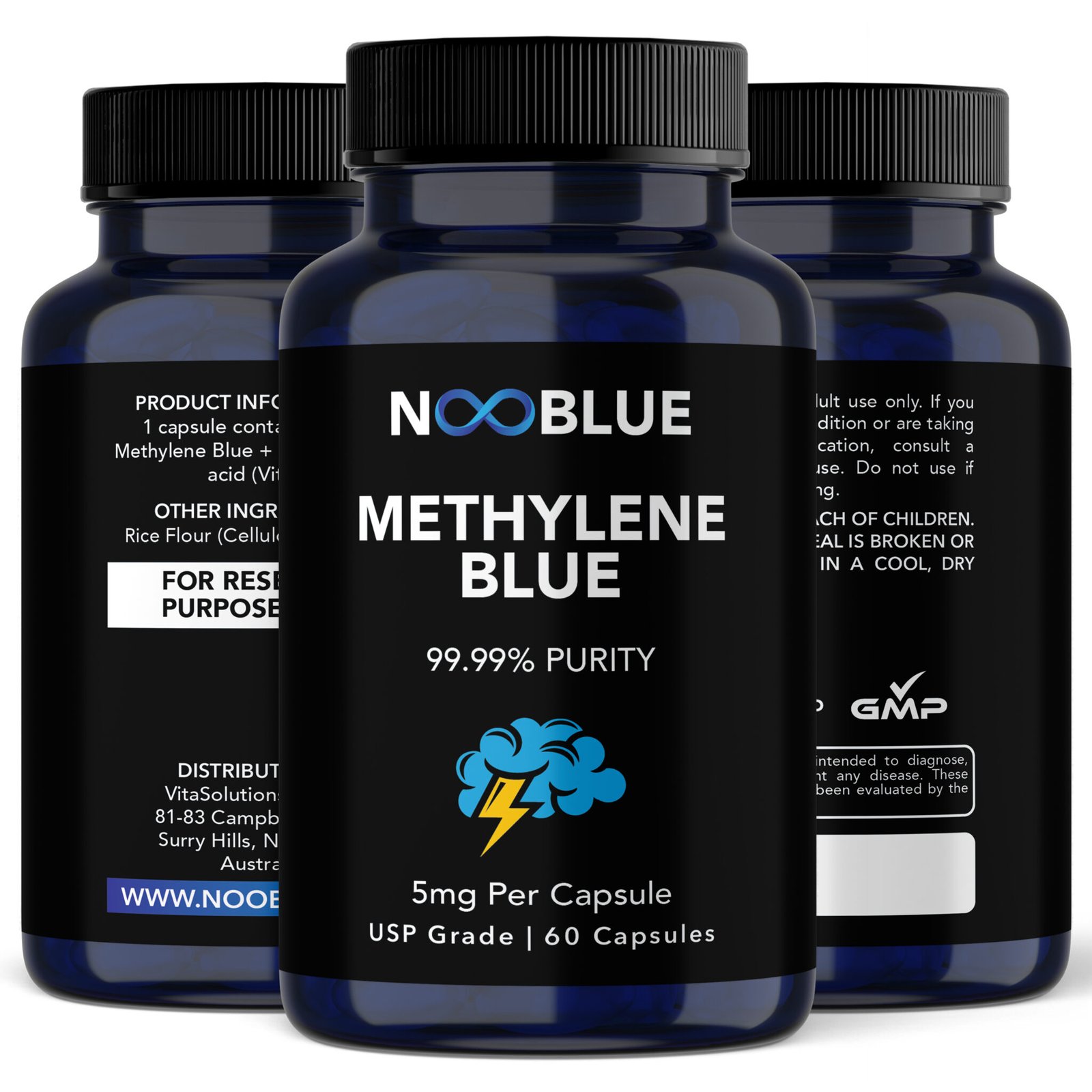
Want to skip the comparison? The NooBlue Methylene Blue Capsules are USP grade with a verified COA and precise 5mg dosing — see the full range →
Blue Staining: The Most Common Effect, and How to Avoid It
Staining is a contact problem far more than a systemic one. The dye binds readily to keratin and to the proteins in mucous membranes, so the tissue that touches undiluted solution is the tissue that changes color.
The most instructive real-world data comes from a setting where methylene blue is deliberately painted onto raw tissue. A 2021 cohort study in the Journal of the National Comprehensive Cancer Network: JNCCN followed 281 cancer patients using a dilute methylene blue oral rinse for mucositis pain. Adverse effects occurred in 13 patients, 4.6% of the group: ten had a transient burning sensation, two had transient blue discoloration of the teeth and mouth, and one had increased pain (PMID 33395626). Direct application to damaged tissue, and visible staining still landed in under one percent of patients — and it cleared.
Which means format is the main lever you control:
- Liquid solution. The highest staining risk, because undiluted dye touches lips, tongue and fingers en route. Dose into water, use the dropper without touching your mouth, and rinse afterwards.
- Capsules. The shell carries the dye past the mouth entirely. This is the main practical reason people switch formats — NooBlue compares the trade-offs in capsules versus liquid solutions.
- Leuco-form gummies. The NooBlue Methylene Blue Gummies pair 10 mg of methylene blue USP with 25 mg of vitamin C, which reduces the dye inside the gummy to leucomethylene blue — the colorless reduced form. Colorless by chemistry, so there is no blue-mouth mess on the way down. No responsible brand should offer a zero-staining guarantee, but removing the color before it reaches your mouth removes the main contact opportunity.
Teeth follow the same contact logic as skin, and the fix is largely the same. NooBlue’s write-up on whether methylene blue stains teeth goes through the enamel-specific detail.
Photosensitivity: The Methylene Blue Side Effects on Skin Nobody Explains
Drug references list sun sensitivity and then stop. The mechanism is worth understanding, because it tells you when the warning applies and when it does not.
Methylene blue is a photosensitizer. Absorb light at the right wavelength and the excited molecule hands its energy to nearby oxygen, producing singlet oxygen — a reactive species that damages whatever is next to it. This is not a side effect discovered by accident; it is the entire operating principle of methylene blue photodynamic therapy. Laboratory work published in the Journal of Photochemistry and Photobiology. B, Biology mapped how structural changes across the methylene blue series raise singlet-oxygen output and, with it, phototoxicity (PMID 9372612). That was cell-culture work, not a human skin study.
The severe human case on record is a 1996 report in Pediatrics. A very low birth weight preterm infant had been exposed to a toxic amount of methylene blue before birth and was then placed under phototherapy lamps for jaundice. Within hours, redness appeared on every exposed area of skin that had been deep blue, followed by blisters and peeling across roughly 35% of the body surface; the skin fully re-epithelialized by three weeks of age. The authors concluded the phototoxicity likely reflected the very high dose relative to the infant’s small size and gestational age (PMID 8628613).
Read that as evidence, not as a headline. It is a single case report in a premature newborn, at a dose the paper describes as toxic, under continuous therapeutic light. It shows the mechanism can express in human skin. It says nothing about an adult taking 5 or 10 mg by mouth, and no study has measured that scenario. The sensible posture sits between the two: if you dose daily and spend long hours in strong sun, ordinary sun protection is a reasonable precaution rather than an overreaction.
Warning Signs, Risk Groups, and What to Do Next
Separate the cosmetic from the clinical. A blue tint is pigment. The following are not:
- Hives, widespread rash, blistering, or peeling skin — possible hypersensitivity. Stop and seek advice.
- Pale or yellow-tinged skin, or dark urine — possible red-cell breakdown. This is urgent.
- Flushing with agitation, tremor, fever or a racing heart — the serotonin-syndrome pattern, most relevant if you take an SSRI, SNRI or MAOI. Methylene blue inhibits monoamine oxidase, which is why this interaction is taken seriously at any dose.
- Severe burning or rash after sun exposure — the phototoxic pattern described above.
Two groups carry more baseline risk. People with G6PD deficiency can experience red-cell hemolysis from methylene blue, and the surface sign is pallor or jaundice rather than a rash. Anyone on serotonergic medication falls into the interaction category above. Neither group should be self-dosing without clinical input.
Practical steps that lower the odds across the board: start at the 5 mg titration rung and see how you respond before moving to a 10 mg standard daily dose; keep concentrated liquid off your skin; take it earlier in the day; and buy third-party tested, USP-grade material so that a reaction you have is at least attributable to the compound rather than to what came with it.
Worth ruling out too: a cluster of vague symptoms in the first week is often attributed online to detox rather than to dose. NooBlue’s evidence review of so-called methylene blue die-off symptoms takes that claim apart. If gummies are your format, the format-specific considerations are collected in the guide to methylene blue gummy side effects. And if you arrived here from the opposite direction — methylene blue applied to skin rather than taken by mouth — the review of topical methylene blue and skin aging covers that literature separately.
Put it together and it resolves simply. Methylene blue side effects on skin are, in the great majority of cases, a cosmetic and temporary color change driven by contact with liquid dye. The dramatic entries on the medical reference pages come from intravenous doses 14 to 28 times larger than a supplement capsule, or from a single extreme neonatal case. That does not make low doses risk-free. It means the useful question is not “does methylene blue affect skin” but “at what dose, by what route, and in whose body.”
The variables you control are dose, format and material quality. Shop the NooBlue range and you get USP-grade material with third-party testing and precision dosing behind all three formats — browse the gummies if the colorless leuco form appeals, or the capsules for the 5 mg titration rung.
Methylene Blue Side Effects on Skin: FAQ
What can methylene blue do to your skin?
Most often, tint it. A blue or green cast appears on lips, fingertips, nail beds or any skin that contacted liquid dye, and it fades as the compound clears. Less commonly it can cause irritation or contact dermatitis where concentrated solution sat on skin, and rarely an allergic reaction with rash, hives or blistering. Because methylene blue is light-activated, sun sensitivity is also possible.
What are the long-term side effects of methylene blue?
No controlled long-term trial has measured skin outcomes in people taking 5–10 mg daily, so there is no honest long-term incidence figure to quote. What is documented is short-term and reversible: the JNCCN cohort found staining and irritation both transient, and the Pediatrics case resolved completely within three weeks. The interactions and G6PD considerations, not the skin, are the long-run concerns worth tracking with a clinician.
What should you not mix with methylene blue?
Serotonergic medication is the main one — SSRIs, SNRIs, MAOIs, triptans and some tramadol-type analgesics — because methylene blue inhibits monoamine oxidase. Flushing plus agitation, tremor or fever is the pattern to watch for. Strong sun or tanning beds are the second thing to be cautious about, given the photosensitising mechanism. Anyone with G6PD deficiency should not take it without medical supervision.
Does low-dose methylene blue cause skin problems?
No study has measured that directly. What is known is that skin staining is dose- and contact-dependent, and a 5 mg capsule is roughly one fourteenth to one twenty-eighth of the intravenous dose behind the published side-effect lists. Most people taking low oral doses report no visible skin change at all; those who do usually traced it to liquid contact rather than to systemic exposure.
Do methylene blue gummies cause skin side effects?
A gummy removes the contact route rather than the compound. The NooBlue gummy arrives as leucomethylene blue — already reduced by the vitamin C in the formula and therefore colorless — so there is no blue dye in the mouth to transfer to lips or fingers. Systemic considerations are unchanged: the interaction and G6PD cautions apply to every format equally.
This article is for educational purposes only and is not medical advice. Methylene blue is a potent compound; talk to a qualified healthcare professional before starting any new supplement, especially if you take medication (notably SSRIs or MAOIs) or have a health condition.
Start with USP-grade methylene blue
Verified COA on every batch · Free worldwide shipping over $100
Shop NooBlue →