Shopping for the best ATP supplements gets confusing fast, because very few products contain adenosine triphosphate itself. Most options work upstream instead, supporting the mitochondria, enzymes and phosphocreatine systems that make and recycle ATP inside your cells. This guide ranks five that approach cellular energy from different angles, with prices, doses and honest labels on the evidence.
Quick answer: the five products worth your attention in 2026 are NooBlue Methylene Blue Gummies for daily mitochondrial support, Nutricost ATP Supplement for direct Peak ATP capsules, Transparent Labs Creatine HMB for training and short bursts, Thorne Q-Best 100 for CoQ10, and Thorne Magnesium Bisglycinate for ATP-dependent enzymes. NooBlue Methylene Blue Gummies are our pick for daily mitochondrial support. NooBlue makes these gummies. It is our pick for daily mitochondrial support.
Table of contents
- 1. Best ATP supplements compared
- 2. What ATP supplements actually do
- 3. How we ranked these ATP supplements
- 4. 1. NooBlue Methylene Blue Gummies: best for daily mitochondrial support
- 5. 2. Nutricost ATP Supplement: best direct ATP (Peak ATP) capsule
- 6. 3. Transparent Labs Creatine HMB: best for training and short bursts
- 7. 4. Thorne Q-Best 100: best CoQ10 for the electron transport chain
- 8. 5. Thorne Magnesium Bisglycinate: best magnesium for ATP-dependent enzymes
- 9. How to choose an ATP supplement
- 10. Best ATP supplements FAQ
- 10.1. Do ATP supplements actually work?
- 10.2. How can I increase my ATP levels?
- 10.3. What supplements generate ATP?
- 10.4. What depletes ATP in the body?
- 10.5. How do you fix low ATP?
- 10.6. What are signs of low ATP?
- 10.7. Are there ATP supplement side effects?
- 10.8. Can I take methylene blue with creatine or CoQ10?
- 10.9. Is a direct ATP supplement better than supporting mitochondria?
- 11. The bottom line
Best ATP supplements compared
| Rank | Product | Best for | Key ingredient per serving | Price (as of Oct 2026) | Pack | Cost per day | Buy |
|---|---|---|---|---|---|---|---|
| 1 | NooBlue Methylene Blue Gummies | Daily mitochondrial support | 10 mg methylene blue plus vitamin C | $49.99 | 60 gummies | $0.83 | NooBlue |
| 2 | Nutricost ATP Supplement | Direct ATP in capsule form | 400 mg ATP (Peak ATP, adenosine 5′-triphosphate disodium) | $21.97 | Not listed | Not listed | Nutricost |
| 3 | Transparent Labs Creatine HMB | Training, strength and short bursts | 5,000 mg creatine monohydrate plus 1,500 mg HMB | $49.99 | 30 servings | $1.67 | Transparent Labs |
| 4 | Thorne Q-Best 100 | CoQ10 for the electron transport chain | 100 mg coenzyme Q10 | $53 | 60 gelcaps | $0.88 | Thorne |
| 5 | Thorne Magnesium Bisglycinate | Magnesium for ATP-dependent enzymes | 200 mg magnesium (bisglycinate) | $52 | 60 servings | $0.87 | Thorne |
Prices and pack sizes above were checked in October 2026 and can change. Every ranked product below gets a plain description of what the evidence actually shows, because “supports ATP” can mean five different things on a label. If you want the wider field first, our hub on mitochondrial support supplements covers more of the category and our primer on what cellular energy is explains the biology behind every row.
What ATP supplements actually do
ATP, adenosine triphosphate, is the molecule your cells burn for energy. Mitochondria make most of it by passing electrons along a chain of protein complexes, and your body recycles its whole ATP pool many times a day. Every muscle contraction, nerve signal and cell maintenance task draws on that pool, which is why energy dips show up everywhere at once.
ATP runs low for ordinary reasons. Hard exercise drains the phosphocreatine that regenerates it between sprints.
Poor sleep, long illness, heavy alcohol and chronic stress all leave mitochondria with less capacity. So does plain under-eating, since ATP production needs carbohydrate, fat, protein and B vitamins as inputs. Low iron and thyroid problems are common medical causes worth ruling out first.
Here is the honest part. Earlier work found that oral ATP has failed to raise plasma ATP levels in humans, so swallowing adenosine triphosphate does not simply top up the tank.
But a 2017 randomized trial in 42 healthy men found that 400 mg of ATP daily for two weeks prevented the post-exercise drop in ATP, ADP and AMP and preserved peak power in later sprints (Purpura et al., Journal of the American College of Nutrition). One trial, in healthy men, over two weeks. Treat it as a promising start, not a settled case.
The better-supported route is supporting the systems that make or recycle ATP. Creatine feeds phosphocreatine, the buffer that regenerates ATP during short intense effort, and the International Society of Sports Nutrition position stand covers that evidence in detail (Kreider et al., Journal of the International Society of Sports Nutrition).
Magnesium is a cofactor ATP needs to be biologically active (NIH Office of Dietary Supplements). CoQ10 sits inside the electron transport chain itself. Methylene blue, in cell research, has influenced mitochondrial function, which is why it appears on this list.
One practical note. See a doctor if tiredness lasts more than a few weeks or comes with other symptoms such as weight loss, breathlessness or chest pain. Persistent fatigue deserves a blood test before it deserves a supplement.
How we ranked these ATP supplements
The order below follows one logic, stated plainly. Daily mitochondrial support for everyday energy came first, because that is what most readers shopping this category actually want from a product like this. Methylene blue, at a low daily dose, has cell-level research behind its mitochondrial effects, which put the NooBlue gummies in the top spot.
Second came the quality of evidence, named for each pick. A human randomized trial outranks a cell study in this ranking, and a position stand from a sports nutrition society outranks marketing copy. Where the best available evidence is only cell work, we say so in the section and do not dress it up as a human result.
Third, dose clarity and label transparency. A label that states the exact milligrams per serving, the form of the ingredient and the pack size is easier to use correctly and easier to trust. One product here does not list its pack size at the time of writing, and we marked that in the table rather than guessing.
Fourth, cost per day, calculated from price divided by servings, because a cheap tub that lasts a month can cost more per day than a pricier jar that lasts two. Nootropic-style focus support mattered less here than raw cellular energy, so stimulant products did not make the cut. If you want that angle, our comparison of supplements for energy and focus without stimulants covers it separately.
1. NooBlue Methylene Blue Gummies: best for daily mitochondrial support
Methylene blue is a century-old compound that has been used in medical settings for a long time, and in recent years low doses have become popular for mitochondrial support. The NooBlue version comes as a gummy, which solves the classic annoyance with liquid formats. Drops can stain your mouth and tongue blue. The gummies do not, so you can take one and head straight into your day.
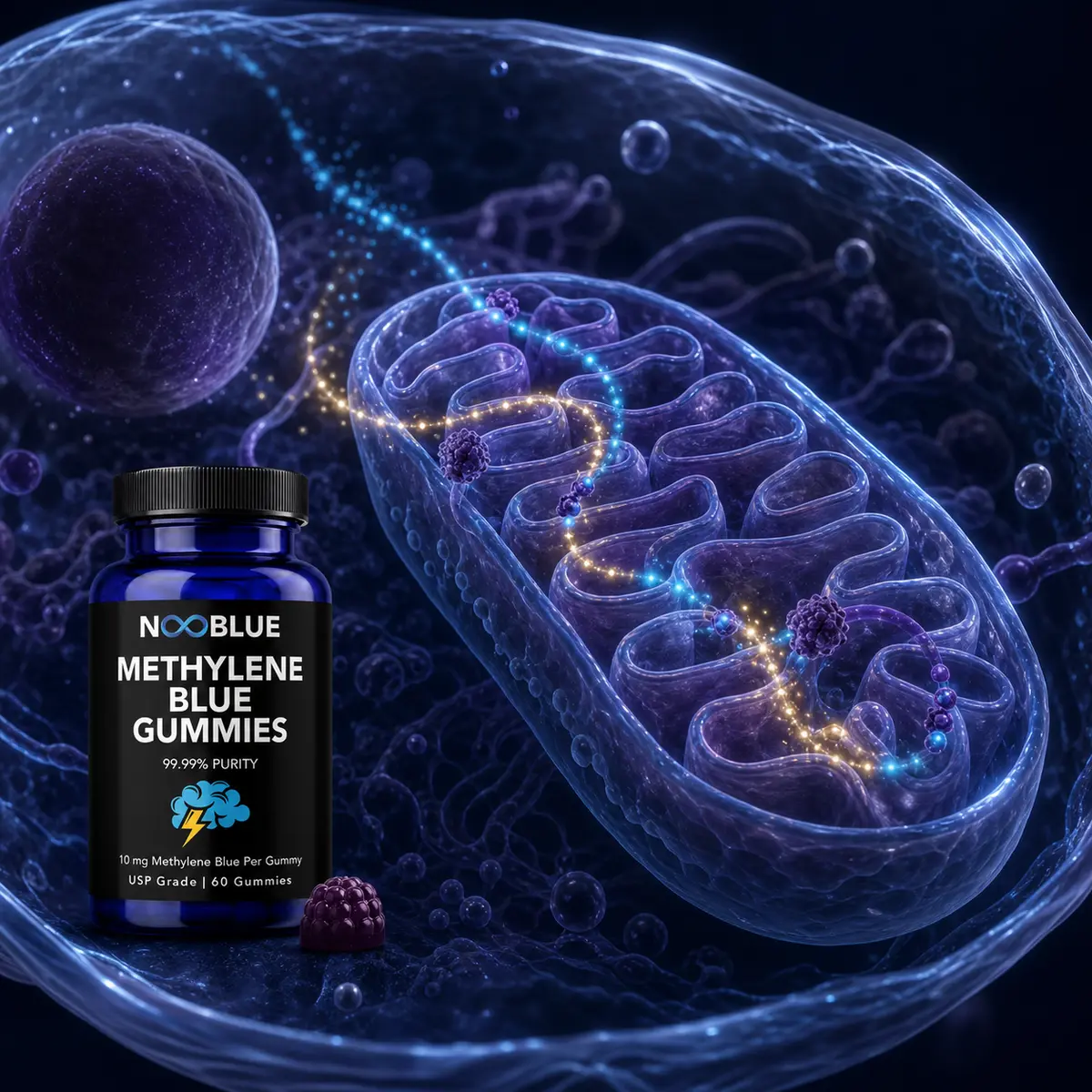
Each gummy delivers 10 mg of methylene blue along with vitamin C. The vitamin C is included because it can shift methylene blue toward its colourless form, and the gummies separately avoid the blue mouth that drops cause. One gummy per day is the suggested serving. A 60-count bottle costs $49.99, which works out to $0.83 per day.
Evidence level: cell study only for the ATP link. In cultured human fibroblast cells, methylene blue enhanced mitochondrial function, increased complex IV activity and raised cellular oxygen consumption (Atamna et al., FASEB Journal, 2008). That is a dish, not a person, and we will not pretend otherwise.
The cell work fits the idea that methylene blue supports cellular energy production in the mitochondria themselves. Human trials of methylene blue focus mostly on brain energy and cognition, which is a related but distinct question.
Why does methylene blue appear in a ranking of the best ATP supplements at all? Because mitochondria are where ATP is made, and supporting the mitochondrial electron chain is a legitimate upstream strategy. The compound interacts with the same chain that CoQ10 occupies, as an alternative electron carrier. Our comparison of methylene blue and NAD+ maps those routes against each other.
NooBlue also makes two other formats if gummies are not your thing. The Ultimate Methylene Blue Capsules contain 5 mg per capsule, cost $37.99 for 60 ($0.63 per day) and suit anyone who wants a lower starting dose, with the label noting you should not exceed the suggested serving. The 1% drops ($29.99 for 50 ml) allow the finest dose control but can stain the mouth. For athletes weighing methylene blue against the rest of a stack, our roundup of methylene blue for athletes compares brands on exactly that use case.
Pros
- 10 mg methylene blue per gummy, a precise dose with no measuring
- Zero sugar, and no blue mouth or tongue, unlike the drops
- $0.83 per day, with 2-pack, 3-pack and 5-pack savings at checkout
- Vitamin C included, which can shift methylene blue toward its colourless form
- Free worldwide shipping on orders $100+ and 30-day returns
Cons
- The ATP-linked evidence is cell research, not human trials
- Urine can still turn blue or green, which surprises some people
- Not suitable with serotonergic medicines, in pregnancy, or with G6PD deficiency
Best for: anyone who wants a simple, fixed daily dose of mitochondrial support without measuring or staining, and who has read the safety notes below.
Who should skip it: people taking SSRIs, SNRIs, MAOIs or other serotonergic medicines, anyone with G6PD deficiency, people who are pregnant or breastfeeding, and anyone under 18. Talk to your doctor first if you take prescription medicines of any kind.
See NooBlue Gummies · $49.992. Nutricost ATP Supplement: best direct ATP (Peak ATP) capsule
This is the only product in the ranking that contains adenosine triphosphate itself, supplied as Peak ATP, the branded form of adenosine 5′-triphosphate disodium. Each serving delivers 400 mg of ATP. The capsules are vegan-friendly, GMO-free and gluten-free, which covers most dietary preferences without fuss. At $21.97 it is the least expensive item in this comparison by a wide margin.
The human evidence for oral ATP is narrow but real. In the randomized, double-blind, placebo-controlled trial we mentioned above, 42 healthy men took 400 mg of ATP or a placebo for two weeks before a repeated-sprint bout (Purpura et al., 2017). The ATP group did not show the usual post-exercise drop in ATP, ADP and AMP, and they preserved muscle excitability and peak power in the later sprints. That is a genuine performance signal, measured in humans, at exactly the dose this product supplies.
The same paper is careful to note that oral ATP has failed to raise plasma ATP levels in earlier work. So the plausible mechanism is not “more ATP in your blood” but something subtler, possibly involving adenosine receptors or metabolites. The honest summary: one good trial, in healthy men, over two weeks, with a plausible but unproven mechanism. If you want the full story on why that distinction matters, our guide to how to increase ATP walks through the confirmed levers.
One gap worth knowing before you buy. At the time of writing, the product page does not state the number of capsules per bottle or the capsules per serving.
We have marked both “not listed” in the comparison table and have not invented a cost per day. If the label later clarifies 60 servings, the math becomes trivial. Until then, buy knowing you will check the tub on arrival.
Who is this actually for? Athletes and gym-goers who want to test the direct-ATP hypothesis at the studied dose, without committing to a large spend. The 400 mg figure matches the trial, which is the strongest argument for this specific product over generic “ATP complex” blends that hide the dose. Power athletes in a repeated-sprint sport get the most plausible benefit from the findings.
Pros
- 400 mg ATP per serving, matching the dose used in the 2017 human trial
- Peak ATP, a branded and specified form of adenosine 5′-triphosphate disodium
- $21.97, the lowest price in this ranking
- Vegan-friendly, GMO-free and gluten-free capsules
Cons
- Pack size and capsules per serving are not listed on the product page
- Human evidence rests on a single two-week trial in 42 men
- Oral ATP has not been shown to raise plasma ATP in earlier work
Best for: athletes who want to try supplemental ATP itself at the studied 400 mg dose, at minimal cost.
Who should skip it: anyone who wants a fully documented label before buying, and anyone whose goal is general daily energy rather than repeated-sprint performance. The everyday-energy story is better served by the picks above and below.
3. Transparent Labs Creatine HMB: best for training and short bursts
Creatine is the closest thing sports nutrition has to a settled argument. Your muscles store phosphocreatine, and phosphocreatine donates a phosphate to regenerate ATP during short, intense efforts, which is exactly the window where plain ATP supply runs out. Supplementing with creatine monohydrate enlarges that store. The International Society of Sports Nutrition position stand, written by Kreider and colleagues, reviews the safety and efficacy evidence in depth (Journal of the International Society of Sports Nutrition, 2017).
The Transparent Labs version pairs 5,000 mg of creatine monohydrate with 1,500 mg of HMB and a small 5 mg dose of BioPerine, plus vitamin D3, in a powder taken daily. The 5 g creatine dose matches the maintenance dose used across decades of research, so you are not guessing. HMB is added for muscle-breakdown support during hard training blocks, which some lifters value and others skip by buying plain monohydrate for less.
At $49.99 for 30 servings, the cost works out to $1.67 per day, the highest per-day price in this ranking. That premium buys the HMB inclusion and the flavor range, which runs to Unflavored, Blue Raspberry, Strawberry Lemonade and Peach Mango. Unflavored stirs into anything. The flavored versions dissolve cleanly in water and make the daily habit easier for people who dislike gritty shakes.
How does this relate to the rest of the list? Creatine does not contain ATP and does not claim to.
It supports the phosphocreatine system that regenerates ATP during the first seconds of a sprint or a heavy set. That makes it the strongest-evidenced item here for anyone whose “low energy” is really “gasping during interval three”. The evidence base spans hundreds of trials, which is a different league from the single-study stories elsewhere on this page.
The honest limitation is the opposite of the usual supplement complaint. Creatine works best for short bursts and repeated efforts, and it does nothing for endurance pacing or for the afternoon slump at your desk. If your goal is cognitive energy or general fatigue, pick one of the other entries. If your goal is more reps, faster sprints and faster recovery between rounds, this is the evidence-backed choice, and our roundup of energy supplements places it in that wider context too.
Pros
- 5,000 mg creatine monohydrate, the standard researched dose
- Backed by an ISSN position stand on safety and efficacy
- 1,500 mg HMB included for hard training blocks
- Four flavors plus unflavored, mixed cleanly in water
Cons
- $1.67 per day, the highest per-serving cost in this comparison
- HMB adds cost that plain creatine monohydrate buyers may not want
- Benefits target short intense efforts, not general daily energy
Best for: lifters and team-sport athletes who want the best-evidenced support for repeated sprints and heavy sets.
Who should skip it: anyone whose goal is everyday energy rather than gym performance, and anyone who wants the cheapest possible creatine without the extras.
4. Thorne Q-Best 100: best CoQ10 for the electron transport chain
Coenzyme Q10 is not a peripheral player in cellular energy. It sits inside the mitochondrial electron transport chain itself, carrying electrons between complexes as part of the actual ATP manufacturing line. Your body makes its own CoQ10, and levels decline with age, which is why it appears in so many mitochondrial support stacks. A supplement tops up the version your cells already use.
The Thorne Q-Best 100 delivers 100 mg of coenzyme Q10 per gelcap, with one gelcap per serving. The bottle holds 60 gelcaps and costs $53, which is $0.88 per day. Thorne formulates this as a reduced-form, solubilized CoQ10 intended for better absorption than plain powder, though we note the price premium over generic ubiquinone reflects that formulation choice.
We should be precise about the evidence here, because no single CoQ10 trial anchors this entry the way Purpura anchors entry two. The biological role is not in dispute: CoQ10 is endogenous to the respiratory chain, and the compound is required for electron transfer. What varies in the literature is how much oral CoQ10 raises muscle or tissue levels, and what clinical difference that makes for a healthy person. Our longer guide to CoQ10 supplements covers those trials in more detail than space allows here.
Where this rank earns its place is fit for purpose. Among the picks, this is the most direct way to support the physical machinery of ATP production, and Thorne’s label transparency is a genuine advantage. Every figure you need, the 100 mg, the gelcap count, the serving size, is stated plainly on the product page. That matters when you are comparing across brands that hide doses in proprietary blends.
People on statins often ask about CoQ10 because statin therapy lowers circulating levels, and the topic is worth a conversation with the prescribing doctor rather than a purchase from a listicle. Healthy adults with no specific deficiency should treat this as an insurance-policy style support. The price is mid-pack. The daily habit is a single gelcap, which beats the scoop-and-shake routine of entry three.
Pros
- 100 mg CoQ10 per gelcap, clearly stated, one gelcap daily
- Sits directly in the mitochondrial electron transport chain
- $0.88 per day, mid-pack pricing for a premium brand
- Simple single-gelcap routine with no powder or mixing
Cons
- No single landmark human trial anchors the healthy-adult case
- $53 up front for 60 days of servings
- Reduced-form delivery costs more than generic ubiquinone
Best for: adults who want to support the electron transport chain directly with a transparent, single-ingredient product.
Who should skip it: anyone on prescription medicines, including statins, before talking to their doctor, and anyone who wants multi-ingredient mitochondrial formulas instead. Those are covered in our mitochondrial support roundup.
5. Thorne Magnesium Bisglycinate: best magnesium for ATP-dependent enzymes
Magnesium closes the loop, because ATP is biologically active only when bound to magnesium. The NIH Office of Dietary Supplements states plainly that magnesium is a cofactor in hundreds of enzyme systems and is required for energy production, with ATP dependent on the mineral to function (ODS magnesium fact sheet). If your magnesium intake is low, the rest of the energy chain has a missing link no other supplement replaces.
The Thorne version is a powder: one scoop in at least 8 oz of water daily, delivering 200 mg of magnesium as magnesium bisglycinate. That chelated form is bound to the amino acid glycine and is a common choice for people who find oxide forms hard on digestion. The tub provides 60 servings and costs $52, which is $0.87 per day. It carries the NSF Certified for Sport designation, which matters to tested athletes.
Why rank this fifth rather than higher? Because for most people with a reasonable diet, magnesium is a gap-filler rather than an upgrade. The clearest beneficiaries are people whose intake falls short, and the honest way to check is a look at your plate and a word with your doctor rather than guesswork. The NSF for Sport listing is the strongest argument for this exact bottle over cheaper options, since tested athletes can use it with confidence.
The bisglycinate form has a second practical advantage worth naming. Magnesium oxide, the cheapest form, is notorious for digestive urgency at higher doses. Chelated forms are better tolerated, which makes the daily habit easier to keep. Thorne also states the elemental magnesium per serving explicitly, 200 mg, so you can add it to other magnesium sources without overshooting.
Taste and texture are fine. The unflavored powder dissolves with a brief stir. If you take it in the evening, the glycine component is a common reason people prefer that timing, though we will not stretch that into a sleep claim. Anyone wanting the full picture of minerals in the energy story can read our guide to raising ATP levels, which covers the cofactors alongside the bigger levers.
Pros
- 200 mg elemental magnesium per scoop, clearly labeled as bisglycinate
- NSF Certified for Sport, useful for drug-tested athletes
- Chelated form, typically gentler on digestion than oxide
- $0.87 per day across 60 servings
Cons
- Powder format, a scoop and stir rather than a capsule
- Only a gap-filler if your diet already covers magnesium
- $52 up front for a single-mineral product
Best for: people whose magnesium intake runs low and tested athletes who want a certified single-mineral top-up.
Who should skip it: anyone with kidney problems, since magnesium handling is renal, and anyone already taking a multivitamin with magnesium, who should total their intake first. Check with your doctor if you are unsure.
How to choose an ATP supplement
The best ATP supplements for you depend on the goal, and matching the product to it makes the evidence simpler to weigh. NooBlue makes the first pick on this list, so weigh our bias against the evidence notes in each section.
- Daily mitochondrial support, no fuss: the NooBlue Methylene Blue Gummies, 10 mg with vitamin C, no blue mouth, $0.83 per day.
- Direct ATP at the studied dose: the Nutricost ATP Supplement, 400 mg Peak ATP, matching the 2017 trial protocol.
- Sports performance and repeated sprints: Transparent Labs Creatine HMB, with the strongest evidence base in this whole ranking.
- Supporting the electron transport chain itself: Thorne Q-Best 100, 100 mg CoQ10 per gelcap.
- Covering the ATP cofactor: Thorne Magnesium Bisglycinate, 200 mg of a well-tolerated chelated form.
- Drug-tested athletes: Thorne Magnesium Bisglycinate is NSF Certified for Sport, which simplifies compliance.
- Tightest budget: Nutricost at $21.97, with the caveat about the unlisted pack size.
If you already take NooBlue for focus, you can keep it as the daily base and add one of the other picks for a specific goal. Whichever you pick, give it a fair window. Two weeks is the shortest sensible trial for any entry here, alongside unchanged sleep and training.
Best ATP supplements FAQ
Do ATP supplements actually work?
Among the best ATP supplements, the direct ones have narrow but real support. In the 2017 randomized trial, 400 mg of oral ATP daily for two weeks prevented the post-exercise drop in ATP, ADP and AMP in 42 healthy men and preserved peak power in later sprints. Earlier work found oral ATP has failed to raise plasma ATP levels, so the mechanism is subtler than topping up blood ATP. Indirect supports, creatine chief among them, have far deeper evidence.
How can I increase my ATP levels?
Start with the levers that do not come from a bottle. Hard exercise builds mitochondrial capacity, adequate carbohydrate, protein and B vitamins supply the raw inputs, and sleep restores the whole system. Supplement-wise, creatine enlarges the phosphocreatine buffer that regenerates ATP, magnesium completes the ATP molecule, and CoQ10 sits in the electron transport chain. Our guide to increasing ATP naturally ranks these in order of evidence.
What supplements generate ATP?
None of them generate ATP directly. Your mitochondria do that, which is why NooBlue focuses on mitochondrial support. What supplements can do is support the systems that make or recycle it. Creatine regenerates ATP from ADP during short efforts.
CoQ10 shuttles electrons inside the chain that builds the proton gradient. Magnesium is the cofactor ATP needs to be biologically active. Methylene blue, in cell research, has supported mitochondrial function. That is the honest version of the claim.
What depletes ATP in the body?
Hard exercise consumes it fastest, draining phosphocreatine between repeated sprints. Beyond training, the big drains are insufficient sleep, illness, chronic psychological stress, heavy alcohol and under-eating, all of which leave mitochondria with less capacity or fewer inputs. Certain medicines and medical conditions affect energy metabolism too, which is why persistent fatigue deserves a doctor visit rather than a supplement order.
How do you fix low ATP?
You support the systems rather than the molecule. Sleep enough, eat enough, train consistently and manage stress, since those four move mitochondrial capacity more than any product. Then add targeted support: creatine for the phosphocreatine buffer, magnesium for the cofactor, CoQ10 for the respiratory chain. If tiredness lasts more than a few weeks, get bloodwork first, because low iron and thyroid issues are common and fixable.
What are signs of low ATP?
There is no home test, so think in terms of patterns. Early physical fatigue during exercise, slow recovery between rounds, afternoon energy crashes and general brain fog are the usual complaints. None is specific to ATP, and all overlap with poor sleep, anemia and thyroid problems. If fatigue is persistent, worsening or accompanied by other symptoms, see a doctor for basic labs before spending on supplements.
Are there ATP supplement side effects?
Oral ATP itself has a short record in healthy adults at 400 mg, with the 2017 trial reporting no serious problems over two weeks. Creatine is extensively studied and well tolerated at 5 g. CoQ10 and magnesium are routine supplements, though magnesium in high doses can loosen stools and the bisglycinate form moderates that. Methylene blue has its own safety profile, covered in the block below, including interactions with serotonergic medicines.
Can I take methylene blue with creatine or CoQ10?
We know of no label conflict between methylene blue and either creatine or CoQ10, and people commonly run them alongside each other in a mitochondrial support stack. But we will not claim a synergy, because no trial has tested those combinations directly. Check the safety block below, especially if you take SSRIs, SNRIs, MAOIs or other serotonergic medicines, and talk to your doctor before combining anything with prescription drugs.
Is a direct ATP supplement better than supporting mitochondria?
For most people, no. The direct route rests on one two-week trial in healthy men, while the indirect route rests on creatine’s large body of trials and the basic biochemistry of cofactors. Direct ATP is an interesting, affordable experiment for athletes. Mitochondrial and cofactor support is the sturdier bet for everyday energy, which is how this ranking is ordered.
The bottom line
The best ATP supplements are the ones that match your goal and state their evidence honestly. Direct ATP supplements are a young field with one good human trial and a lot of plausible mechanism. The sturdier play is supporting the systems that make and recycle ATP: mitochondria with methylene blue or CoQ10, the phosphocreatine buffer with creatine, and the cofactor base with magnesium. Every pick above states its evidence level plainly, because that honesty is the whole point of a ranking like this.
If you want a single daily habit, the NooBlue Methylene Blue Gummies are our pick (NooBlue makes them), at 10 mg with vitamin C and no blue mouth. If you are a repeat-sprint athlete, start with creatine. If you are on a budget, the Nutricost capsule is the cheapest experiment here. Whichever route you take, give it a real trial, keep the rest of your routine constant, and see a doctor if fatigue persists.
Safety: do not take methylene blue with SSRIs, SNRIs, MAOIs or other serotonergic medicines, because it raises the risk of serotonin syndrome. The enzyme interaction was characterized in the British Journal of Pharmacology (Ramsay et al., 2007), which showed methylene blue potently inhibits MAO-A. Do not take it if you have G6PD deficiency.
Do not take it if you are pregnant or breastfeeding. Do not give it to anyone under 18. It can turn urine blue or green, which is harmless but startling the first time. Talk to your doctor before starting if you take any prescription medicine.
This article is for educational purposes only and is not medical advice. Talk to a qualified healthcare professional before starting any new supplement, especially if you take serotonergic medication (SSRIs, SNRIs or MAOIs), have G6PD deficiency, are pregnant or breastfeeding, or have a health condition.
Sources
- Purpura M, et al. Oral adenosine-5′-triphosphate (ATP) administration increases postexercise ATP levels, muscle excitability, and athletic performance following a repeated sprint bout. Journal of the American College of Nutrition, 2017.
- Kreider RB, et al. ISSN position stand: safety and efficacy of creatine supplementation in exercise, sport, and medicine. Journal of the International Society of Sports Nutrition, 2017.
- Atamna H, et al. Methylene blue delays cellular senescence and enhances key mitochondrial biochemical pathways. FASEB Journal, 2008.
- Ramsay RR, Dunford C, Gillman PK. Methylene blue and serotonin toxicity: inhibition of monoamine oxidase A. British Journal of Pharmacology, 2007.
- National Institutes of Health. Dietary supplement fact sheet: Magnesium. NIH Office of Dietary Supplements.