Students searching for the best nootropics for students usually want the same three things: sharper focus during long study blocks, better recall when it counts, and enough steady energy to get through a heavy semester without crashing. This list ranks six options by how well the evidence supports them, how clearly each states its dose, and how easy each is to take every day. NooBlue is our brand, and this post is written by the NooBlue team.
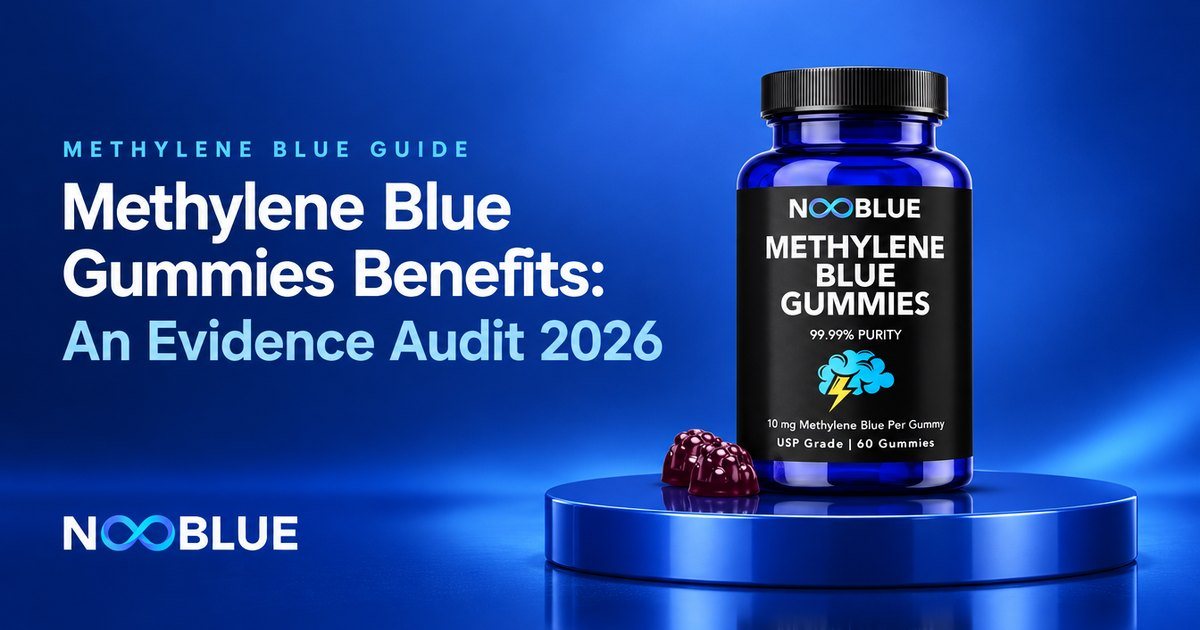
Quick answer: our top pick is NooBlue Methylene Blue Gummies (10 mg methylene blue plus vitamin C per gummy, $49.99 for 60, $0.83 per day as of Nov 2026). NooBlue makes these gummies, and it is our pick because one daily serving supports cellular energy production and focus with no dropper, no measuring and no blue mouth. If you take any prescription medicine, read the safety section below first.
Table of contents
- 1. Best nootropics for students compared
- 2. 1. NooBlue Methylene Blue Gummies: best overall daily focus support
- 3. 2. Nutricost L-Theanine: best for calm focus with coffee
- 4. 3. Nootropics Depot Bacopa Monnieri: best for long-term memory support
- 5. 4. Nordic Naturals Ultimate Omega: best omega-3 for brain structure support
- 6. 5. Thorne Magnesium Bisglycinate: best for evening wind-down
- 7. 6. Nootropics Depot Lion’s Mane: best mushroom option
- 8. How we ranked the best nootropics for students
- 9. Nootropics benefits and natural nootropics for students
- 10. Nootropics for focus during long study blocks
- 11. How to choose a nootropic for a student schedule
- 12. Safety and who should avoid methylene blue
- 13. Frequently asked questions
- 13.1. What are the best nootropics for students?
- 13.2. Are natural nootropics safer than single compounds?
- 13.3. How long before a nootropic works?
- 13.4. Can students take methylene blue with coffee?
- 13.5. What is the best nootropic for focus during long study blocks?
- 13.6. Is Thesis worth comparing to these picks?
- 14. The bottom line
- 15. Sources
Best nootropics for students compared
The table below puts every pick side by side so you can compare dose per serving, pack size, cost per day and price before reading the detail. NooBlue sits in the first row because it is our pick, and each competitor keeps a narrower label that reflects what it is actually best at. Prices for competitors are shown as “check current price” where the live page did not state one at the time of writing, so nothing here is guessed.
| Rank | Product | Best for | Dose per serving | Pack size | Cost per day | Price (as of Nov 2026) | Buy |
|---|---|---|---|---|---|---|---|
| 1 | NooBlue Methylene Blue Gummies | Best overall daily focus support | 10 mg methylene blue plus vitamin C | 60 gummies | $0.83 | $49.99 | Shop now |
| 2 | Nutricost L-Theanine | Best for calm focus with coffee | L-theanine (check label) | See label | Check label | Check current price | Nutricost |
| 3 | Nootropics Depot Bacopa Monnieri | Best for long-term memory support | See label | See label | Check label | Check current price | Nootropics Depot |
| 4 | Nordic Naturals Ultimate Omega | Best omega-3 for brain structure support | EPA and DHA (check label) | See label | Check label | Check current price | Nordic Naturals |
| 5 | Thorne Magnesium Bisglycinate | Best for evening wind-down | Magnesium bisglycinate (check label) | See label | Check label | Check current price | Thorne |
| 6 | Nootropics Depot Lion’s Mane | Best mushroom option | Extract (see label) | See label | Check label | Check current price | Nootropics Depot |
Dose transparency and daily friction decided most of this order, and the NooBlue methylene blue gummies are the only pick with a fully published dose, pack count and per-day cost right here in the post. The rest of the list covers the tools that fill specific gaps: acute alertness for exam mornings, memory support that builds over weeks, structural brain support, an evening mineral and a slow mushroom extract.
If you are new to this category, the short version is that “nootropics supplements” covers a wide spread of ingredients with very different evidence levels, and treating them as one thing is the most common mistake. Natural nootropics such as bacopa, theanine and lion’s mane sit alongside single compounds like methylene blue, and each has its own dose, timeline and caveats. The ranking below reflects that spread honestly rather than lumping everything together.
One more name comes up whenever students compare options: Thesis, a personalized nootropic subscription that ships a monthly set of formulas chosen around your goals. It is a different buying model from the single-ingredient picks here, and students often weigh it against a simple daily product. We have not scored it in this ranking because it is a rotating multi-formula set rather than one bottle with one published dose.
1. NooBlue Methylene Blue Gummies: best overall daily focus support
Methylene blue supports cellular energy production in the mitochondria, the parts of cells that turn food into usable energy. Brain cells are among the most energy-hungry in the body, which is why mitochondrial support is a sensible angle for a student chasing clearer thinking across a long semester. The gummy format removes the usual friction with this ingredient: no dropper, no measuring and no blue tongue.
Each NooBlue gummy delivers 10 mg of methylene blue alongside vitamin C, and the gummies avoid the blue mouth and tongue staining that liquid drops cause. Vitamin C can shift methylene blue toward its colorless form, which is a separate point from the staining and worth stating plainly. The suggested serving is one gummy daily, and a 60-count pack lasts two months at that serving. Do not exceed the suggested serving.
On evidence, low-dose methylene blue has been studied in humans for cognitive effects, and the honest label is that human trial data exists but is still limited in scale, with cell and animal work adding mechanistic support around mitochondrial function. We state that rather than overselling it. What is clear is the transparency: the dose is on the label, the count is on the label, and the price math is simple. At $49.99 for 60 gummies the cost is $0.83 per day, and multi-pack options save more per bottle.
NooBlue offers 30-day returns on unopened products and dispatches in 1 to 2 business days with tracking, with free worldwide shipping on orders over $100. If you want the deeper usage detail, our guide to NooBlue methylene blue for mental clarity and cellular support walks through timing and routine. Anyone weighing formats can also read methylene blue gummies vs capsules.
Who it suits: students who want one simple daily serving that supports cellular energy production without a dropper routine. Who it does not suit: anyone on serotonergic medicines, anyone with G6PD deficiency, and anyone pregnant, breastfeeding or under 18. The safety notes later in this post apply in full.
Pros: 10 mg per gummy. No blue mouth. Vitamin C included. Clear per-day cost.
Cons: one format only in this pick, and the sweetness will not suit everyone.
2. Nutricost L-Theanine: best for calm focus with coffee
L-theanine is an amino acid found in tea leaves, and its best-known pairing is with caffeine. Human studies that combine the two are associated with attention performance that feels calmer than caffeine alone, with less of the jittery edge that can wreck a study session. This is an acute tool for a specific morning, rather than a daily builder.
Nutricost sells L-theanine as simple single-ingredient capsules at a budget price, and the brand is known for plain labels rather than proprietary blends. The exact capsule strength varies by product, so check the label on the pack you buy before assuming a dose. Because it is one ingredient with nothing hidden, it is easy to line up against the caffeine you already drink.
The evidence here is genuinely human trial territory for the caffeine combination, one of the better-replicated stacks in the nootropic literature. Effects are on alertness quality and attention-task performance in the short term after dosing, which is exactly what a student wants before a two-hour exam block. Taken alone, theanine is associated with relaxation markers without sedation in small studies, so it can also suit a coffee-free study evening. See the 2020 review in Nutrients for the caffeine-theanine combination data.
Safety notes are light at normal doses, but anyone pregnant, breastfeeding or on prescription medicine should run it past their doctor as with any supplement. Avoid stacking it late if you are sensitive to anything that changes how caffeine feels. The label serving is the number to follow.
Who it suits: coffee drinkers who want the focus of caffeine with a smoother feel.
Who it does not suit: anyone avoiding caffeine entirely, since the benefit is mostly in the pairing.
Pros: dose matches trial protocols. Cheap. Clean label.
Cons: depends on caffeine to shine, and effects are acute rather than cumulative.
3. Nootropics Depot Bacopa Monnieri: best for long-term memory support
Bacopa monnieri is a traditional herb that has become one of the most studied plants in the memory category. Human trials have explored its effect on memory consolidation and information retention over weeks rather than hours, which fits a student revising across a term. The fair evidence label is that some human studies suggest support for memory, while results are not uniform and the herb is not a quick fix.
Nootropics Depot is built around exactly this kind of single botanical, and the company publishes identity and purity testing documentation for its extracts. That matters with herbs, because extract strength and standardization change what is actually in the bottle. Serving sizes vary by extract, so follow the label on the specific product you order.
Expectations should be set to the evidence: bacopa is a slow, background-style supplement that people take for several weeks before judging it. It is not an exam-morning pick like theanine, and it is not a mitochondrial tool like methylene blue. What it offers is a distinct mechanism aimed at memory rather than alertness. A 2016 systematic review in the Journal of Ethnopharmacology collected the human trial evidence and found the picture mixed but worth following.
Bacopa is generally well tolerated, but some users report stomach upset, and taking it with food is the common way to reduce that. Anyone on prescription medicine or pregnant should clear it with a doctor first. As with every pick on this list, follow the label serving.
Who it suits: students focused on retention over a full term who can commit to weeks of daily use.
Who it does not suit: anyone wanting same-day effects, or people with sensitive stomachs who dislike taking herbs with food.
Pros: a memory-specific herb with human trial interest and published testing.
Cons: slow to judge, and results vary between studies.
4. Nordic Naturals Ultimate Omega: best omega-3 for brain structure support
Omega-3 fats, specifically EPA and DHA, are structural components of brain cell membranes, and DHA in particular accumulates in the brain and retina. Oily fish two to three times a week covers most needs, and a concentrated fish oil fills the gap when seafood intake falls short, which describes a large share of students. This is foundation support rather than an acute focus aid.
Nordic Naturals Ultimate Omega is a triglyceride-form fish oil, and the company publishes third-party purity results for its oils and uses a lemon flavor to cut fishy burps, the main reason people abandon fish oil. Serving sizes are typically two softgels daily, but check the exact label on the product you receive. The brand’s transparency around testing is the reason it earns this slot over a generic oil.
The evidence base here is the strongest on this list at the population level, with large human cohorts and trials linking omega-3 intake with normal brain structure and function across life stages. The clearest cognitive benefits in trials appear in people with low baseline intake rather than everyone, so the honest summary is strong for topping up a low-fish diet and weaker as a booster for someone already eating salmon twice a week. A 2016 review in Nutrients lays out the DHA and brain function research.
Anyone taking blood-thinning medicines should mention fish oil to their doctor, and fish allergy is an obvious exclusion. Take it with a meal containing fat for best absorption. Our guide to nootropics for gaming covers a related use case if you want more angles on daily brain support.
Who it suits: students who rarely eat oily fish and want a reliable daily anchor for brain structure support.
Who it does not suit: fish-allergic students, or anyone already meeting two to three fish servings weekly.
Pros: triglyceride form, strong purity reputation and lemon flavor.
Cons: benefits concentrate in low-intake groups, and the soft gels are large for some.
5. Thorne Magnesium Bisglycinate: best for evening wind-down
Magnesium has a well-established role in the nervous system, and bisglycinate is a chelated form bound to the amino acid glycine, often chosen because it is gentler on the stomach than oxide or citrate. Thorne is a supplement brand with a long track record and a reputation for tight manufacturing standards. The clarity link is indirect but real, because better sleep is the single most reliable driver of next-day thinking.
Many people use magnesium in the evening as part of a wind-down routine, and a student running on broken sleep is exactly the person who benefits from a calmer night. This is not a daytime focus product, and framing it that way keeps expectations honest. Serving practices vary by product version, so check the label on the exact pack you buy.
The evidence for magnesium’s roles in the body is human-trial territory, while the case for specific evening benefits rests on smaller studies and broad physiological plausibility, which we label as such. As a category, magnesium supplements are best taken with food to reduce any stomach upset, and evening is the common slot precisely because of the relaxation association. People with kidney conditions should talk to their doctor before supplementing magnesium. The 2017 review in Nutrients covers magnesium and sleep quality.
Who it suits: students whose focus problem is really a sleep problem, and who want a gentle, well-made mineral for the evening.
Who it does not suit: anyone seeking a morning focus effect, or people with kidney issues who have not cleared it with their doctor.
Pros: chelated form, gentle on digestion and evening friendly.
Cons: an indirect path to clarity, and label specifics vary by version.
6. Nootropics Depot Lion’s Mane: best mushroom option
Lion’s mane is a mushroom with a long history in traditional use and a growing modern research base. Its studied compounds include hericenones and erinacines, which have been examined in cell and animal models for effects related to nerve growth factor. Human trials exist but are small, so the fair label is promising early human work, stronger cell and animal data, and much still unproven.
Nootropics Depot is built around exactly this kind of ingredient, with an unusual degree of transparency: the company publishes identity and purity testing documentation for its extracts and states extraction methods and ratios on product pages. That matters with mushrooms, where the difference between fruiting body and mycelium on grain, and between water and alcohol extraction, changes what is in the bottle. Serving sizes vary by extract strength, so follow the label on the specific product.
Expectations should be calibrated to the evidence: this is a slow, background-style supplement that people take for weeks rather than an acute focus aid. It suits a student who is curious about the mushroom category and wants a transparently specified extract rather than a vague blend. It is not a same-day pick. A 2020 review in Frontiers in Nutrition summarizes the human studies, which remain small and early.
Allergy caution applies to anyone sensitive to mushrooms, and anyone on prescription medicine should check with a doctor first. Our roundup of methylene blue nootropics is the place to compare the mitochondrial angle if you are weighing it against this mushroom pick.
Who it suits: students curious about mushrooms who want extraction details disclosed.
Who it does not suit: anyone wanting same-day effects, or mushroom-allergic students.
Pros: extraction details disclosed and testing documentation available.
Cons: human evidence still thin, and effects build slowly if at all.
Shop Methylene Blue Gummies · $49.99How we ranked the best nootropics for students
Order was set by four criteria applied in sequence, and every position reflects that order. First, evidence level: products with the clearest human data for a mechanism tied to focus, memory or the foundations those rest on rank highest in their categories. Second, dose transparency: every pick states what one serving contains, and we avoided blends where possible.
Third, daily friction: a supplement you will actually take beats a slightly better one you will forget, so format simplicity counted. Fourth, cost per day at the stated dose, using list prices where shown. NooBlue takes the top position because methylene blue’s mitochondrial mechanism targets cellular energy directly, the gummy format is precise and pleasant to take, and the price, dose and per-day cost are fully published in this post.
The rest of the list fills specific gaps in a realistic order: acute alertness for exam mornings, memory support that builds over weeks, structural brain support, an evening mineral and a slow mushroom extract. Nutricost theanine follows the top pick on the strength of its human-trial pairing with caffeine, then bacopa for memory, then omega-3 on population-level evidence, then magnesium for the sleep foundation, then lion’s mane for the patient. As the publisher, we rank our own NooBlue gummies first, and each competitor keeps its true narrower label.
One deliberate choice: we did not include a multivitamin, a greens powder or a pre-workout style stimulant, because those categories overlap with a student’s diet and coffee habit rather than adding a distinct tool. Six picks is enough to cover the real gaps without turning the list into a wall of bottles. If you are weighing whether you need anything at all, start with sleep and food and add one product at a time.
Nootropics benefits and natural nootropics for students
The word nootropics covers any substance people use to support attention, memory or mental energy, and the benefits you can realistically expect depend entirely on which one you pick. A caffeine-theanine stack acts within an hour on alertness, bacopa acts over weeks on retention, and omega-3 acts over months as a structural input. Lumping them into one promise is where most disappointment starts.
Natural nootropics are the plant and food-derived side of the category: theanine from tea, bacopa from a traditional herb, lion’s mane from a mushroom, and omega-3 from fish. Their appeal is a gentler safety profile and a longer history of use, though that does not automatically mean stronger evidence. Each natural pick above carries its own trial summary so you can see exactly what has been tested and in whom.
For students, the sensible way to think about benefits is by timeline. Acute aids like theanine fit exam mornings and deadline pushes. Building aids like bacopa and lion’s mane fit a term-long routine. Foundation aids like omega-3 and magnesium fit the everyday base under everything else.
Methylene blue sits in the building category with a mitochondrial mechanism, and NooBlue’s gummies make that routine simple. Matching the timeline to your actual need is the whole game.
Nootropics for focus during long study blocks
Students who describe themselves as easily distracted often arrive here looking for a way to hold attention through a long revision session, and the honest framing is that these supplements support focus and attention rather than managing any condition. The two most relevant picks above are theanine for a calmer caffeine experience and omega-3 for its population-level link with normal brain function. Neither replaces a diagnosis or a plan from a doctor, and both fit neatly alongside one.
Theanine’s appeal here is that it softens the jittery edge of caffeine without sedating, which many students find makes a study block feel more manageable. Omega-3’s appeal is the low-intake gap, since a student who eats almost no fish has a clear, low-risk input to top up. Methylene blue adds a mitochondrial angle that some people find useful for steady daily energy, and the gummy format keeps it easy to remember.
If focus problems persist for more than a few weeks despite good sleep and eating habits, it is worth talking to a doctor to rule out common causes such as low iron, thyroid issues or sleep apnea. Supplements sit on top of the basics. The safety section below lists who should skip methylene blue entirely.
This is not medical advice and none of these products is a treatment for ADHD or any diagnosed condition, so people searching best nootropics for ADHD should speak with a clinician.
How to choose a nootropic for a student schedule
Start with the gap, not the label. If your problem is a 9 a.m. exam, an acute aid like theanine with coffee is the match. If your problem is retaining a term of material, a building aid like bacopa or methylene blue fits better.
If your problem is that you eat badly and sleep worse, fix those first and treat any capsule as a small add-on.
Next, check the label math. A product that states its dose, pack count and serving size lets you work out a real cost per day, which is the only fair way to compare two bottles. Blends that hide amounts behind a “proprietary formula” make that math impossible, so we avoided them where we could. Every pick above either publishes its numbers or tells you plainly to check the label.
Then set a trial window before you buy. Acute aids get judged on day one, building aids need four to six weeks of consistent use, and foundation aids are a background habit rather than a test. Deciding the window in advance stops you from abandoning a slow product after three days or overrating a fast one after one good morning.
Finally, keep the stack small. One acute aid, one building aid and a food-first foundation is plenty for most students, and stacking five products makes it impossible to tell what is doing anything. If you want to compare methylene blue formats specifically, our methylene blue nootropics roundup covers capsules, gummies and drops side by side.
Comparing products? Our ranking of the methylene blue supplements worth your money weighs purity, lab reports and cost per 5 mg. Before trusting star ratings, check our methylene blue reviews for the signs of paid placements.
Safety and who should avoid methylene blue
Because NooBlue is our top pick, the safety notes for methylene blue deserve to be front and center. Do not take methylene blue with SSRIs, SNRIs, MAOIs or other serotonergic medicines, because of the risk of serotonin syndrome. Do not take it if you have G6PD deficiency, or if you are pregnant or breastfeeding, or under 18.
Methylene blue can turn urine blue or green, and that is expected rather than a problem. Talk to your doctor if you take any prescription medicine before starting. These notes apply to every NooBlue format: the 5 mg capsules, the gummies and the 1% drops.
For the other picks, the cautions are lighter but real: fish oil and blood thinners, magnesium and kidney conditions, herbs and pregnancy, mushrooms and allergy. When in doubt, a quick conversation with a doctor is the sensible first step. These products support normal function, and they are not a treatment for any disease or condition.
Frequently asked questions
What are the best nootropics for students?
For most students, the best pick is a daily option with a fully published dose and a simple routine, which is why NooBlue Methylene Blue Gummies top this list at $0.83 per day. Pair it with theanine for exam mornings, bacopa for term-long retention, omega-3 if you eat little fish, magnesium for sleep and lion’s mane if you want a slow mushroom extract.
Are natural nootropics safer than single compounds?
Natural nootropics are not automatically safer or stronger, and the evidence for each one has to be judged on its own trials. Bacopa, theanine and lion’s mane each carry their own caveats around stomach upset, pregnancy and allergy, while methylene blue carries specific medicine and G6PD cautions. Read the label and the safety notes for whichever you choose.
How long before a nootropic works?
Timeline depends on the ingredient. Theanine with caffeine acts within an hour on alertness, bacopa and lion’s mane build over four to six weeks, and omega-3 is a background input measured over months. Decide your trial window before you buy so you judge the product on its own schedule rather than expecting everything to work on day one.
Can students take methylene blue with coffee?
Yes, coffee is fine alongside methylene blue for most people, and the two work on different systems. The important check is prescription medicine, especially serotonergic medicines such as SSRIs and SNRIs, plus G6PD deficiency, pregnancy and being under 18. If none of those apply, one gummy daily is the suggested serving, and you should not exceed it.
What is the best nootropic for focus during long study blocks?
There is no single answer, but theanine paired with caffeine and omega-3 for low fish intake are the two most relevant picks on this list. Both support focus and attention rather than managing a condition, and both fit alongside a doctor’s plan. If distraction persists despite good sleep and food, a doctor visit is the sensible next step.
Is Thesis worth comparing to these picks?
Thesis is a personalized nootropic subscription, and it suits students who want a monthly set of formulas chosen around their goals rather than one bottle. It is a different model from the single-ingredient picks ranked here, so weigh it on whether you want variety or a fixed daily dose. Either way, read the label for each formula you receive.
The bottom line
NooBlue Methylene Blue Gummies take the top spot on this list because they combine a mitochondrial mechanism with a precise 10 mg dose, a simple daily routine and a published $0.83 per-day cost. NooBlue makes them, and they are our pick. The other five picks each fill a specific gap, from exam-morning alertness to term-long memory support, and none of them is a shortcut past sleep and food.
Match the product to the gap you actually have, set a fair trial window, and keep the stack small. If you take prescription medicine, check the safety notes for methylene blue before you start, and talk to your doctor about any supplement you are unsure of.
Sources
Human trial and review sources referenced in this post: the caffeine-theanine combination review in Nutrients (2020), the bacopa systematic review in the Journal of Ethnopharmacology (2016), the DHA and brain function review in Nutrients (2016), the magnesium and sleep review in Nutrients (2017), and the lion’s mane human study review in Frontiers in Nutrition (2020).