Mental clarity is the measurable ability to sustain attention, process information quickly, and recall stored knowledge without the sluggishness that comes from under-performing brain cells. When neurons cannot produce enough cellular energy to meet demand, the result is brain fog, difficulty concentrating, and the persistent sense that your thinking is slower than it should be. Methylene blue supports the mitochondrial electron transport chain, the process that produces most of the energy your brain cells run on. Our guide to the best supplements for brain fog compares the wider options.
Table of contents
- 1. How Methylene Blue Supports Cognitive Function at the Cellular Level
- 2. What “Mental Clarity” Actually Means in Practice
- 3. How to Use NooBlue Methylene Blue for Mental Clarity
- 4. Timing, Stacking, and Practical Tips
- 5. Key Takeaways
- 6. What the Human Studies Actually Show (and What They Don’t)
- 7. Frequently Asked Questions
- 7.1. How quickly does methylene blue improve mental clarity?
- 7.2. Can methylene blue help with age-related cognitive decline?
- 7.3. What is the difference between methylene blue for mental clarity and prescription methylene blue?
- 7.4. Does methylene blue help with brain fog?
- 7.5. Why do I feel weird after taking methylene blue?
- 7.6. Is 5 mg enough methylene blue for noticeable mental clarity benefits?
- 8. Safety and Where to Start
How Methylene Blue Supports Cognitive Function at the Cellular Level
Your brain is about 2% of your body weight but uses about 20% of the oxygen, and so the calories, your body consumes (Raichle and Gusnard, 2002). That disproportionate energy demand makes neurons extremely sensitive to mitochondrial inefficiency. When the electron transport chain slows down, whether from aging, oxidative stress or poor sleep, the brain is among the first organs to feel the effect.
Methylene blue works as an alternative electron carrier in the mitochondrial electron transport chain. At low doses, it reaches a redox equilibrium inside mitochondria that allows it to shuttle electrons from NADH directly to cytochrome c, bypassing bottlenecks in Complex I and Complex III. This bypass increases the activity of Complex IV (cytochrome c oxidase) and boosts cellular oxygen consumption without requiring additional glucose input.
A 2012 review published in Progress in Neurobiology described this process in detail: at low doses methylene blue acts as an electron cycler in the mitochondrial electron transport chain, raises the activity of the respiratory enzyme cytochrome oxidase, and has been linked with memory-enhancing effects, mostly in animal studies (Rojas et al., 2012). The authors tied those memory effects to better memory consolidation in the brain networks that were in use at the time, which fits the idea that methylene blue matters most where energy demand is highest.
A separate randomized, double-blinded, placebo-controlled trial gave healthy adults a single 280 mg oral dose of USP methylene blue, about 4 mg/kg, and found stronger resting-state functional connectivity in regions linking perception and memory one hour later (Rodriguez et al., 2017). Participants who received methylene blue showed measurably stronger neural communication between brain regions compared with the placebo group, and the effect was detectable on fMRI imaging.
What “Mental Clarity” Actually Means in Practice
People describe mental clarity differently, but the underlying experience is consistent: faster information processing, better working memory, less mental fatigue during sustained focus, and the ability to switch between tasks without the cognitive drag that comes from a depleted brain.
People who take methylene blue for focus usually describe what they are after in these terms:
Sustained focus during demanding work. Tasks that require prolonged effort, such as deep reading, writing, financial analysis or coding, draw heavily on prefrontal cortex energy reserves. Methylene blue’s support of mitochondrial ATP production helps maintain those reserves over longer periods.
Reduced afternoon brain fog. The mid-afternoon cognitive dip that many people experience is partly driven by declining mitochondrial efficiency as the day progresses. Supporting the electron transport chain can help flatten that decline, keeping mental output more consistent through the afternoon hours.
Faster recall and verbal fluency. Memory retrieval depends on the speed and reliability of neural signaling, which is directly tied to cellular energy availability. When mitochondria produce ATP efficiently, the electrochemical signals that encode and retrieve memories fire more reliably.
Why serotonin matters here. Methylene blue is a potent reversible inhibitor of monoamine oxidase A (MAO-A), an enzyme that breaks down serotonin (Ramsay et al., 2007). That is a safety fact, not a mood benefit to chase, and it is why you should read our guide to drug interactions with methylene blue before combining it with anything that affects serotonin.
Looking for clean, USP-grade methylene blue? NooBlue’s Methylene Blue Capsules give a fixed 5 mg serving of USP-grade methylene blue for $37.99, with the CTLA report on the methylene blue ingredient shown on the product page. Shop the full range →
How to Use NooBlue Methylene Blue for Mental Clarity
NooBlue sells methylene blue in three formats: capsules, drops and gummies. Each suits a different routine.
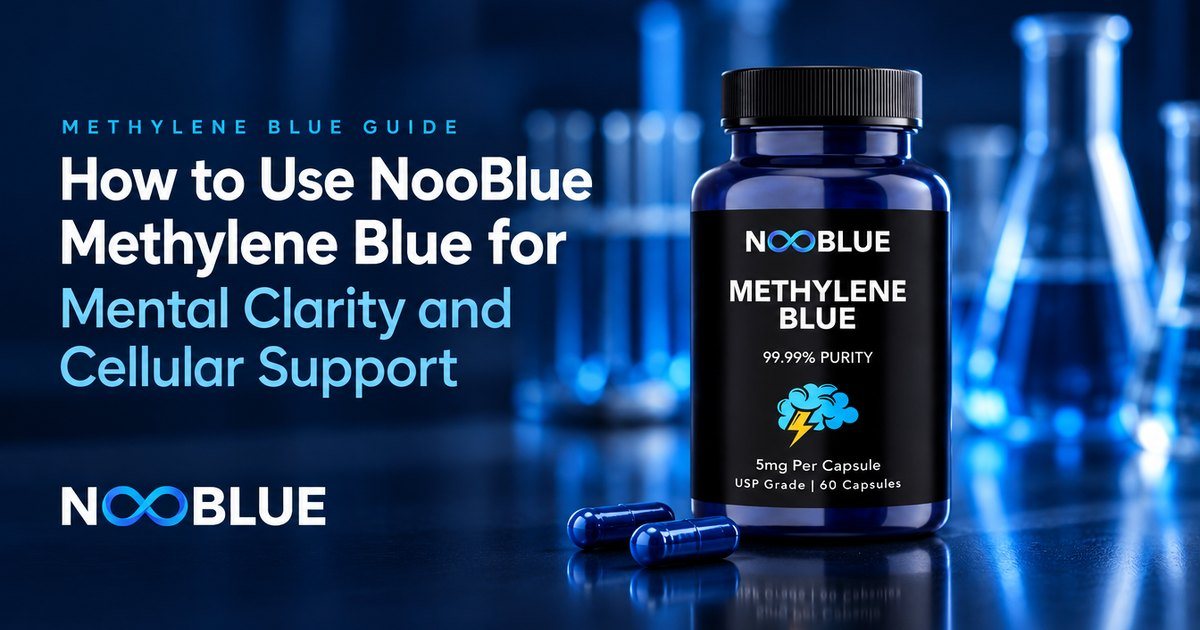
NooBlue Ultimate Methylene Blue Capsules (5 mg each) are the recommended starting point for most people. Each capsule delivers a precise, pre-measured 5 mg dose of USP-grade methylene blue. The label serving is one capsule (5 mg) a day with food, and a morning capsule is the easiest routine to keep. Some people take weekends off. That is a personal choice rather than something the research has tested.
Give the 5 mg capsule two weeks before you judge how it suits you, and do not exceed the suggested serving of one capsule a day. If you want a 10 mg serving, one NooBlue gummy provides it. Rojas and colleagues describe a hormetic dose response for methylene blue, with opposite effects at low and high doses, which is one more reason not to assume that more is better.
NooBlue 1% Methylene Blue Solution (50 ml) is better suited for users who want precise micro-dosing flexibility. The 1% strength delivers about 0.5 mg per drop, so the 10-drop serving is 5 mg and you can adjust in very small steps. Drops mix easily into water or juice. The trade-off is a blue-stained mouth and tongue, and the need for a calibrated dropper or measured pipette for consistent dosing.
For a broader look at what the compound does beyond focus, see our guide to the brain and cellular health benefits of methylene blue.
NooBlue Methylene Blue Gummies (10 mg each) give one measured 10 mg serving a day with nothing to count. They avoid the blue mouth and tongue that drops cause.
All three are in the NooBlue shop, and each product page shows the CTLA lab report on the methylene blue ingredient, with a note on what it does and does not cover.
Timing, Stacking, and Practical Tips
Morning dosing is preferred. Methylene blue increases cellular energy production, and some users report mild alertness or difficulty sleeping if they take it late in the day. Taking your dose with breakfast or lunch (before about 2 PM) lowers the chance of it interfering with sleep and lines it up with the part of the day when most people need to focus.
Take with food. The capsule label says to take it with food, and a meal also makes it easier to remember a daily serving.
Compatible supplements. People often take methylene blue alongside CoQ10, vitamin C or omega-3 fatty acids, although no study has tested those combinations for focus. Avoid combining methylene blue with SSRIs, SNRIs, MAOIs, St. John’s Wort, 5-HTP, or tryptophan, because methylene blue’s MAO-inhibiting properties create a risk of serotonin syndrome when combined with other serotonergic compounds.
Expect blue-green urine. Methylene blue can turn urine blue or green, and that is expected. It is the compound leaving your body, not a sign that something is wrong.
Before buying from any brand, learn how to read a certificate of analysis so you can confirm purity and heavy-metal results for yourself.
Key Takeaways
- Methylene blue works as an alternative electron carrier, moving electrons from NADH to cytochrome c and increasing Complex IV activity. That is the mechanism behind its cognitive support, not a stimulant effect.
- The Rojas et al. (2012) review linked methylene blue’s memory effects to the brain networks in use, and the Rodriguez et al. (2017) trial detected stronger resting-state connectivity on fMRI one hour after a single 280 mg dose.
- Start with one 5 mg capsule in the morning with food, and do not exceed the suggested serving. For 10 mg in one serving, use one gummy.
- Take it in the morning or at lunch. Some people find it affects their sleep when taken late in the day.
- Never combine it with SSRIs, SNRIs, MAOIs, St. John’s Wort, 5-HTP, or tryptophan, and skip it entirely with G6PD deficiency, during pregnancy or breastfeeding, and under 18. Blue or green urine is expected.
What the Human Studies Actually Show (and What They Don’t)
The two studies cited above are the strongest human evidence on this topic, and their scope deserves precision. The Rodriguez et al. (2017) trial measured functional connectivity on fMRI after a single 280 mg dose, far more than a 5 mg capsule. It showed a real, measurable change in how brain regions communicate, not a months-long improvement in daily performance. The Rojas et al. (2012) review pulled together animal and human data on memory consolidation at low doses, again mostly from single or short-course dosing.
What does not yet exist is a large, long-term trial of daily methylene blue supplement servings for mental clarity in healthy people. The honest position is this: the mechanism is well characterized, the short-term human signal is real, and the long-term nootropic benefit is plausible but unproven. Keep your expectations, and your dose, modest.
Frequently Asked Questions
How quickly does methylene blue improve mental clarity?
No trial of daily supplement servings answers this directly. In the Rodriguez et al. (2017) fMRI study, changes in brain-network activity were measured one hour after a single 280 mg dose, which is 56 times a 5 mg capsule. With a daily 5 mg serving, give it two to four weeks of consistent use before you decide whether it helps your focus.
Can methylene blue help with age-related cognitive decline?
That has not been shown for a supplement. The Rojas et al. (2012) review discusses methylene blue’s effect on cytochrome oxidase, the enzyme that drives the final step of mitochondrial respiration, mostly in animal models. No trial has shown that a daily methylene blue supplement changes age-related thinking or memory in people. Methylene blue supports the mitochondrial pathways behind cellular energy, and it is not a substitute for medical care. If you are worried about changes in your memory, talk to your doctor.
What is the difference between methylene blue for mental clarity and prescription methylene blue?
The active compound is identical. The difference lies in dosage, purity grade, and intended use. Prescription methylene blue (marketed as ProvayBlue) is an injectable medicine given in hospitals, under monitoring, at doses far higher than supplement servings. Supplement methylene blue, like NooBlue’s capsules, gummies and drops, uses USP-grade methylene blue for oral use at label servings of 5 or 10 mg a day. Both are described as USP grade. The form, the dose and the setting are what differ.
Does methylene blue help with brain fog?
Brain fog is often what it feels like when neurons cannot produce enough ATP to meet demand, and that energy supply is what methylene blue supports through the electron transport chain. Users most often describe the change as a flatter afternoon dip and less mental fatigue during long stretches of focused work, not a stimulant-style jolt. Human evidence is still limited to small, short studies, so treat it as cellular support rather than a fix for fog caused by poor sleep, dehydration, or medication. Start with 5 mg in the morning and judge the effect over two to four weeks.
Why do I feel weird after taking methylene blue?
A few sensations are common and harmless: blue-green urine, a blue tongue with the liquid, mild nausea when it is taken on an empty stomach, and a wired or restless feeling if the dose was taken late in the day. Taking it with breakfast, and not late in the day, is the simplest first change. Feeling unusually agitated, confused, sweaty or shaky is a different matter. Methylene blue inhibits MAO-A, so if you take an SSRI, SNRI or any other serotonergic medicine and feel this way, stop and get urgent medical help, because these can be signs of serotonin syndrome. Our side effects guide covers what is normal and what is not.
Is 5 mg enough methylene blue for noticeable mental clarity benefits?
5 mg is a supplement serving, not a scaled-down study dose. It is one NooBlue capsule, or 10 drops of the 1% solution. The human research used far more: Rodriguez et al. (2017) gave a single 280 mg dose, about 4 mg/kg, and even 1 mg/kg for a 70 kg adult would be 70 mg. So the studies do not tell you whether 5 mg a day produces noticeable clarity. Judge it over a few weeks. If you want a larger single serving, one gummy is 10 mg. Do not exceed the suggested serving, and keep in mind that Rojas and colleagues describe a hormetic dose response, with opposite effects at low and high doses.
Safety and Where to Start
These warnings match the “Safety: read before use” box on every NooBlue product page:
- Do not take methylene blue if you take an SSRI, SNRI, MAOI or any other serotonergic medicine, including many antidepressants. The combination can cause serotonin syndrome.
- Do not take it if you have G6PD deficiency.
- Do not take it if you are pregnant or breastfeeding, and it is not for anyone under 18.
- Talk to your doctor first if you take any prescription medicine or have a kidney or liver condition.
- Methylene blue can turn urine blue or green, which is expected. Do not exceed the suggested serving.
If none of those apply, one 5 mg capsule with breakfast is the simplest place to start. Our side effects guide covers what else to expect.
Continue reading
Top 7 Benefits of Methylene Blue for Brain and Cellular Health →
Methylene Blue and Sleep Quality: What the Research Actually Shows →