Published: November 10, 2026 · Last updated: November 10, 2026 · By NooBlue Editorial · 6 products compared · About our editorial standards
The baby was up at 2 am, the flight landed at midnight, or the deadline ran past one. Whatever the reason, you got four or five hours of sleep and the day still has to happen. This guide to the best supplements for sleep deprivation ranks six products by the job each one does: getting you through the day after a short night, or helping the next night of sleep count for more.
No supplement replaces sleep. The only full fix for a sleep debt is more sleep, and adults aged 18 to 60 need 7 or more hours a night according to the CDC’s sleep guidance. What a supplement can do is support how your brain and body run while you catch up. That is the gap this list covers, and we say plainly where the evidence is thin.
We make methylene blue under the NooBlue name, so two of our own products appear here and our gummies are ranked first. We say that up front. Every competitor price was read from the brand’s own product page on November 10, 2026. Every study was checked against its PubMed record the same day, and where a study used a different dose from the label, the table shows both.
Quick Answer
NooBlue Methylene Blue Gummies are our top pick among the best supplements for sleep deprivation because one precisely dosed 10 mg gummy of USP-grade methylene blue supports mitochondrial energy and focus the day after a short night, without adding caffeine that can cost you the next night’s sleep. For the recovery night itself, Thorne Glycine is the lowest-cost pick per serving in this comparison.
Based on the job each product does after sleep loss, the human evidence behind it, studied dose versus label dose, published testing and live price per label serving across 6 products.
Table of contents
- 1. Best supplements for sleep deprivation: our 2026 ranking
- 2. What one short night does to your body and brain
- 3. Two jobs: getting through today and recovering tonight
- 4. The cellular energy link: why methylene blue leads this list
- 5. #1. NooBlue Methylene Blue Gummies: Best Overall for the Day After a Short Night
- 6. #2. Thorne Creatine: Best for Building Brain Energy Reserves Ahead of Short Nights
- 7. #3. Thorne Glycine: Best for Making a Short Night Count
- 8. #4. Life Extension Neuro-Mag: Best for Deeper Sleep Over a Run of Poor Nights
- 9. #5. Thorne Rhodiola: Best Herbal Pick for Stretches of Night Duty and Long Shifts
- 10. #6. NooBlue Ultimate Methylene Blue Capsules: Best for a Gentle 5 mg Start
- 11. How we evaluated these supplements for sleep deprivation
- 12. The short-night playbook: the day after and the recovery night
- 13. Safety: what to check before you take anything after a short night
- 14. FAQ: supplements for sleep deprivation
- 14.1. What is the best supplement for sleep deprivation?
- 14.2. What should I take when I am sleep deprived?
- 14.3. Does creatine help with sleep deprivation?
- 14.4. Can magnesium help you recover from lack of sleep?
- 14.5. Can methylene blue help after a night of poor sleep?
- 14.6. What vitamin am I lacking if I can’t stay asleep?
- 14.7. What is the 3-2-1 rule for sleeping?
- 14.8. How long does it take to recover from sleep deprivation?
- 15. The verdict
- 16. Sources
Best supplements for sleep deprivation: our 2026 ranking
The table ranks all six products. Price per serving is the one-time price on each brand’s own site divided by the number of label servings in one pack, so every row uses the same basis. Subscription and bundle prices are left out. The “studied dose” column is our own addition. It shows the amount used in the human study behind each pick, because a label serving and a trial dose are often not the same thing.
| Rank | Product | Label serving | Price per Serving | Studied dose (human study) | When to take it | Best For |
|---|---|---|---|---|---|---|
| 1 | NooBlue Methylene Blue Gummies | 1 gummy: 10 mg methylene blue + 25 mg vitamin C | $0.83 | Single low oral dose (26 healthy adults) | Morning after a short night | Best overall for the day after a short night |
| 2 | Thorne Creatine | 1 scoop: 5 g creatine monohydrate | $0.49 | 0.35 g per kg, one dose during 21 hours awake | Daily, any time | Best for building brain energy reserves ahead of short nights |
| 3 | Thorne Glycine | 2 capsules: 1 g glycine | $0.25 | 3 g before bed, 3 nights | Before bed on short nights | Best for making a short night count, lowest price per serving here |
| 4 | Life Extension Neuro-Mag | 3 capsules: 2,000 mg magnesium L-threonate (144 mg magnesium) | $1.05 | 1 g magnesium L-threonate daily, 21 days | Daily, for weeks | Best for deeper sleep over a run of poor nights |
| 5 | Thorne Rhodiola | 1 capsule: 100 mg rhodiola root extract | $0.40 | Standardized extract SHR-5, low dose daily, 2 weeks | Morning, during demanding weeks | Best herbal pick for stretches of night duty and long shifts |
| 6 | NooBlue Ultimate Methylene Blue Capsules | 1 capsule: 5 mg methylene blue | $0.63 | Single low oral dose (same trial as #1) | Morning after a short night | Best for a gentle 5 mg start |
Prices were read from each brand’s own site on November 10, 2026: NooBlue gummies $49.99 for 60, NooBlue capsules $37.99 for 60, Thorne Creatine $44 for 90 scoops, Thorne Glycine $31 for 250 capsules (125 servings), Life Extension Neuro-Mag $31.50 for 90 capsules (30 servings) and Thorne Rhodiola $24 for 60 capsules. Thorne Glycine is the lowest price per label serving in this comparison, though the 3 g amount used in its study equals three servings, or about $0.74 a night.
What one short night does to your body and brain
Most people know the feeling. Your eyes are heavy by mid-morning, you read the same email three times, and you reach for a snack or a coffee every hour. Reaction time slows, small mistakes creep in, and your mood runs shorter than usual. Researchers measure this with a simple reaction test called the psychomotor vigilance task, where you press a button the moment a light appears. After sleep loss, people miss more of those lights and press later. Our guide to brain fog from lack of sleep walks through how much sleep loss does what.
Part of the reason is energy. Your brain runs on ATP, the molecule your mitochondria make to power every cell. In a rat study published in The Journal of Neuroscience, ATP in wake-active brain regions rose sharply in the first hours of sleep. When the researchers kept the rats awake for 3 or 6 hours, that rise did not happen. This is animal research, so it cannot tell us exactly what happens in a person after one bad night. It does fit the idea that sleep is when the brain restocks its energy, and that missing it leaves you running on a thinner supply.
The other part is plain sleep pressure. The longer you are awake, the stronger the drive to sleep becomes, and caffeine works by masking that signal for a few hours. That is useful in the morning. Taken late in the day, it pushes your next bedtime back and shortens the recovery night you need. Our breakdown of why the caffeine crash happens explains the pattern many people get stuck in after a short night.
A single short night is common and usually fixes itself with one or two nights of good sleep. Some patterns deserve a doctor’s visit instead of a supplement. See your doctor if poor sleep lasts more than a few weeks, if you wake up tired however long you sleep, if a partner notices loud snoring or pauses in your breathing, or if you nod off while driving. If you always wake up tired no matter how much you sleep, the cause is often something other than the hours themselves.
Two jobs: getting through today and recovering tonight
Most lists of the best supplements for sleep deprivation mix two very different goals. Some products are meant for the day after a short night, when you need to function. Others are meant for the next night, when you finally get the chance to sleep and want that sleep to count. Taking a calming product at 9 am or an energizing one at 9 pm works against you, so we sorted the six picks by job.
| Your situation | The job | Pick to consider | Free step that helps most |
|---|---|---|---|
| One short night, long day ahead | Get through today | #1 NooBlue Methylene Blue Gummies, or #6 capsules if you are new to it | Morning daylight, a 10 to 20 minute nap before 3 pm |
| Short nights are a regular part of your week | Build reserves ahead of time | #2 Thorne Creatine, taken daily | Protect at least two full nights a week |
| You will only get five or six hours tonight | Make a short night count | #3 Thorne Glycine before bed | Cool, dark room, screens off an hour before bed |
| Weeks of light, broken sleep | Deeper sleep over time | #4 Life Extension Neuro-Mag | Fixed wake time, even on weekends |
| A run of night duty or long shifts | Hold up under pressure | #5 Thorne Rhodiola | A planned sleep block before each shift |
One more thing to know before the reviews. Three of the six products have a human study run on people who were short of sleep: the creatine, glycine and rhodiola trials. The methylene blue trial used healthy adults who were not sleep deprived, so we rank it first on what it does for brain energy and attention, and we are clear that nobody has yet tested it after a short night. If shift work is your main issue, our guide to supplements for night shift workers covers body-clock problems that this list does not.
The cellular energy link: why methylene blue leads this list
If sleep is when the brain restocks ATP, then a short night is a day spent on a smaller energy budget. Methylene blue works at that level. It can accept and pass on electrons inside the mitochondria, which lets it act as a backup carrier in the chain that makes ATP. Our explainer on what cellular energy is covers the basics, and our guide on how to increase ATP lists the habits that matter most.
Two studies anchor this. In human fibroblast cells grown in the lab, low concentrations of methylene blue raised the activity of complex IV, a key step in the energy chain, by 30% and lifted oxygen use by 37% to 70%, according to work published in the FASEB Journal. That is cell research, so it shows a mechanism and not a result in people.
The human evidence comes from a randomized, placebo-controlled trial in Radiology. Twenty-six healthy adults aged 22 to 62 took a single low oral dose of methylene blue or a placebo. One hour later, the methylene blue group showed a stronger brain response during a psychomotor vigilance task and a short-term memory task, plus 7% more correct answers in memory retrieval. That vigilance task is the same reaction test sleep researchers use to measure sleep loss, which is why this small study matters for this topic. It is still one small, single-dose trial in rested people, and we rank on it with that caveat.
#1. NooBlue Methylene Blue Gummies: Best Overall for the Day After a Short Night
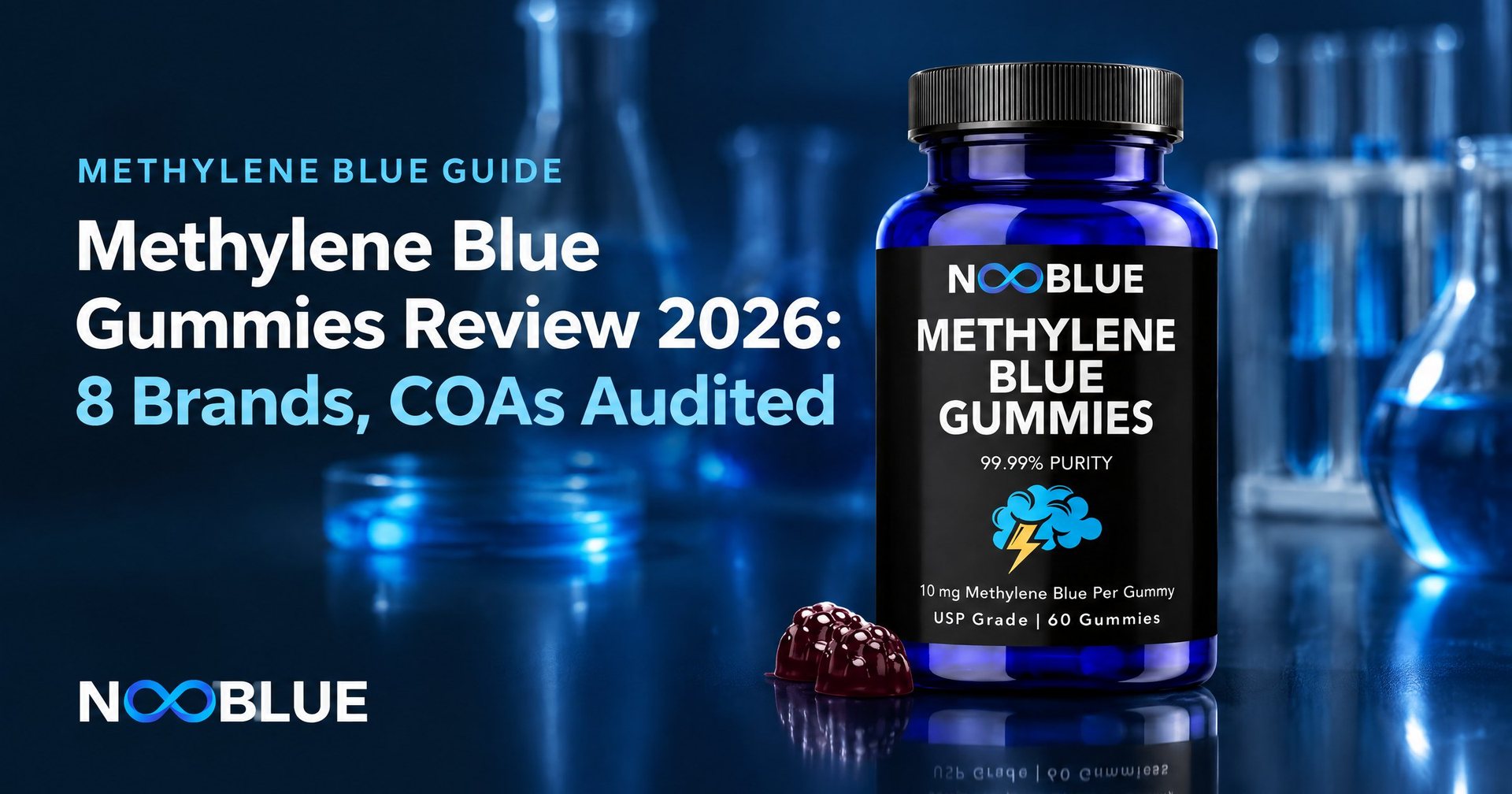
NooBlue Methylene Blue Gummies take the top spot because they work on the cellular energy route that a short night leaves you short on, and they do it without caffeine. Each gummy contains 10 mg of USP-grade methylene blue and 25 mg of vitamin C in a pectin chew with a wild blueberry flavor and zero sugar. A bottle holds 60 gummies, a 60-day supply at one a day.
The no-caffeine part matters more after sleep loss than at any other time. The usual move after a bad night is a big coffee at breakfast, another at 11 and a third at 3 pm. That last cup is still active at bedtime for many people, so tonight’s recovery sleep comes out shorter and the cycle repeats. A caffeine-free step in the morning gives you a way to support focus without borrowing from the next night. If you still want your morning coffee, our guide to methylene blue and caffeine covers how people combine the two.
Timing is simple. Take it in the morning or around lunch, with water, following the label directions on the bottle. Most people avoid late-day doses so it does not sit close to bedtime, and our guide to the best time to take methylene blue explains why. Readers who worry it will keep them awake can read our look at whether methylene blue keeps you awake.
The vitamin C has a job beyond flavor. Vitamin C can donate electrons in methylene blue’s redox chemistry, which is why we pair the two in one chew. The gummies are designed to avoid the blue-mouth mess that puts many people off liquid methylene blue, and the purple color comes from blueberry extract. No product can promise a stain-free outcome for everyone. For a fair look at the format, read our review of whether methylene blue gummies are effective.
On testing, Contract Testing Laboratories of America (CTLA) analyzed the methylene blue ingredient, and the Certificate of Analysis is published on the product page. That report covers the raw ingredient. It does not measure how the finished gummy is absorbed, and we make no claim that it does. Our guide to reading a methylene blue Certificate of Analysis shows what to check on any brand’s report.
Key specs: 10 mg methylene blue USP + 25 mg vitamin C per gummy · 60 gummies · zero sugar · published CTLA Certificate of Analysis for the methylene blue ingredient · $49.99 per bottle ($0.83 per gummy).
Pros:
- Works on cellular energy production, the route a short night leaves you low on
- No caffeine, so it does not eat into your recovery sleep
- Precisely dosed 10 mg, a standard daily amount within the low-dose range
- Third-party tested, with a published CTLA Certificate of Analysis
Cons:
- The human evidence is one small single-dose trial in rested adults, plus cell research
- Not suitable if you take serotonergic medicines (see the safety section)
- Costs more per serving than the amino acid and creatine picks
Best For: healthy adults who have a full day ahead after a short night and want a daily step that supports mitochondrial energy and focus without more coffee.
Try NooBlue Methylene Blue Gummies →
#2. Thorne Creatine: Best for Building Brain Energy Reserves Ahead of Short Nights
Thorne Creatine is a plain creatine monohydrate powder with nothing added. One scoop holds 5 g, a tub holds 90 scoops, and Thorne’s site lists it at $44, or $0.49 a serving. The product page lists it as in stock and describes it as NSF Certified for Sport, which means an outside lab checks it for banned substances.
Creatine is best known as a gym supplement, but your brain uses it too. It acts as a short-term energy buffer, storing phosphate so cells can rebuild ATP quickly when demand spikes. A 2024 study in Scientific Reports tested this during a night without sleep. Volunteers stayed awake for about 21 hours and took either a single large dose of creatine (0.35 g per kg of body weight) or a placebo. Brain scans showed changes in the energy compounds the researchers tracked, including ATP, and the creatine group did better on cognitive tests and processing speed.
Here is the catch. For a 70 kg adult, 0.35 g per kg works out to about 24.5 g, nearly five scoops at once. That is far above the label serving, and large single doses of creatine can upset the stomach. The same paper notes that the usual way to raise brain creatine is a normal daily dose taken over several weeks. So the honest way to use this pick is as a daily habit, one scoop a day, building reserves for the short nights you know are coming. It is not a one-off rescue on the morning after.
That makes it a good fit for new parents, people with regular early flights and anyone whose week reliably includes one or two short nights. It works alongside methylene blue, since one supports the energy buffer and the other supports the chain that makes ATP. Our guide on mental fatigue and how to recover from it covers the other habits that help.
Key specs: 5 g creatine monohydrate per scoop · 90 servings · NSF Certified for Sport (per Thorne’s page) · $44 ($0.49 per serving).
Pros:
- Human trial run during actual sleep loss
- Low price per serving and a single plain ingredient
- Outside testing for banned substances
Cons:
- The study used a very large single dose, far above the label serving
- Needs weeks of daily use to raise brain levels at normal doses
- Ask your doctor first if you have kidney problems
Best For: people whose week includes regular short nights and who are happy to take a daily scoop ahead of time.
View Thorne Creatine on Thorne’s site
#3. Thorne Glycine: Best for Making a Short Night Count
Thorne Glycine is the recovery-night pick. Glycine is an amino acid your body makes and also gets from food, and it plays a part in calming signals in the brain. Thorne sells 250 capsules for $31, and the label serving is 2 capsules (1 g of glycine), so each serving costs $0.25. That is the lowest price per serving in this comparison. Thorne’s page lists it as in stock.
The study behind it is small but on point. In a trial published in Frontiers in Neurology, healthy volunteers cut their sleep by 25% for three nights in a row. Before bed they took either 3 g of glycine or a placebo. The next day, the glycine group reported less fatigue and tended to feel less sleepy, and they scored better on the psychomotor vigilance test. The lead author worked in a research lab at Ajinomoto, a company that makes amino acids, which is worth knowing when you read the result.
Note the dose. The trial used 3 g, which is three label servings of this product, or six capsules. That brings the cost to about $0.74 a night at the studied amount. Some people prefer a glycine powder for that reason. Thorne’s own suggested use is 2 capsules one to three times daily, so the studied amount sits at the top of the label range.
Glycine is a good fit when you already know tonight will be short: an early flight, a late event or a newborn. Take it before bed, keep the room cool and dark, and switch screens off an hour before you lie down. If you want to understand how methylene blue fits around sleep, our article on methylene blue and sleep quality covers what the research shows.
Key specs: 1 g glycine per 2-capsule serving · 250 capsules (125 servings) · $31 ($0.25 per serving).
Pros:
- Human trial in people on restricted sleep
- Lowest price per serving in this list
- Taken at night, so it pairs well with a morning pick
Cons:
- One small study from an amino acid maker’s lab
- The studied 3 g dose means six capsules a night
- Helps the night’s sleep and does nothing for energy during the day
Best For: anyone who knows tonight will be short and wants the hours they do get to feel more restful.
View Thorne Glycine on Thorne’s site
#4. Life Extension Neuro-Mag: Best for Deeper Sleep Over a Run of Poor Nights
Life Extension Neuro-Mag contains magnesium L-threonate sold under the Magtein name, a form of magnesium studied for its ability to reach the brain. Three capsules provide 2,000 mg of magnesium L-threonate, which supplies 144 mg of elemental magnesium. A bottle of 90 capsules costs $31.50 on Life Extension’s site, so a 3-capsule serving costs $1.05. The page lists it as in stock.
This pick is for a different pattern from the first three. It is aimed at the person who has had weeks of light, broken sleep, not one bad night. In a randomized, placebo-controlled trial published in Sleep Medicine: X, 80 adults aged 35 to 55 with self-reported sleep problems took 1 g a day of magnesium L-threonate or a placebo for 21 days. Oura ring data showed better deep sleep and REM sleep scores in the magnesium group, and participants reported better energy, mood and mental alertness during the day.
Two caveats. Three of the six authors list AIDP, an ingredient company, as their affiliation, and the trial lasted only three weeks. Also, the label serving here gives twice the amount of magnesium L-threonate the trial used. Follow the label or ask your doctor about the right amount, and do not stack it with other magnesium products without checking your total intake.
Magnesium takes time. It suits the person whose sleep has been off for a while and who wants a steady routine, paired with a fixed wake time and less late screen time. It is the wrong choice if you need help getting through tomorrow.
Key specs: 2,000 mg magnesium L-threonate (144 mg magnesium) per 3-capsule serving · 90 capsules (30 servings) · $31.50 ($1.05 per serving).
Pros:
- Randomized trial with both wearable and questionnaire measures
- Uses magnesium L-threonate, the form tested in the trial
- Daytime energy and alertness also improved in the study
Cons:
- Highest price per serving in this list
- Three capsules per serving, and the label amount is double the studied amount
- Needs weeks of daily use
Best For: adults with weeks of light or broken sleep who want a daily routine aimed at deeper sleep.
View Life Extension Neuro-Mag on Life Extension’s site
Want to skip the comparison? NooBlue’s Ultimate Methylene Blue Capsules ship with a verified COA and USP grade methylene blue in a precise 5 mg dose. Browse the shop →
#5. Thorne Rhodiola: Best Herbal Pick for Stretches of Night Duty and Long Shifts
Thorne Rhodiola is an adaptogen, a plant extract taken to help the body handle stress. Each capsule holds 100 mg of rhodiola root extract, a bottle holds 60 capsules, and Thorne’s site lists it at $24, or $0.40 a capsule. The page lists it as in stock.
Rhodiola has one of the more relevant trials on this list. A double-blind crossover study in Phytomedicine followed 56 young, healthy doctors working night duty. They took a low daily dose of a standardized rhodiola extract called SHR-5 or a placebo for two weeks, then switched. Their mental performance was tested before and after night shifts. The rhodiola group scored better on a combined fatigue index in the first two-week period, and no side effects were reported.
The limits are clear. The study used one specific extract, and Thorne’s page does not say whether its extract is standardized or to what level, so this capsule is not the studied product. The benefit was also seen in the first period only. We rank it fifth for that reason: it is a reasonable herbal option for people facing a run of night shifts or a demanding week with short sleep, but the evidence is older and tied to a different extract.
Take it in the morning, since some people find it mildly stimulating. Thorne suggests 1 capsule two to three times daily. People who work nights regularly should also read our guide on feeling wired but tired, which covers the stress side of poor sleep.
Key specs: 100 mg rhodiola root extract per capsule · 60 capsules · standardization not stated on the product page · $24 ($0.40 per serving).
Pros:
- Human trial in doctors working night duty
- Low cost and a single daily capsule
- No side effects reported in the trial
Cons:
- Not the extract used in the study, and standardization is not stated
- Benefit seen only in the first two-week period
- Best avoided in pregnancy and breastfeeding
Best For: people facing a run of night shifts or a high-pressure week with less sleep than usual.
View Thorne Rhodiola on Thorne’s site
#6. NooBlue Ultimate Methylene Blue Capsules: Best for a Gentle 5 mg Start
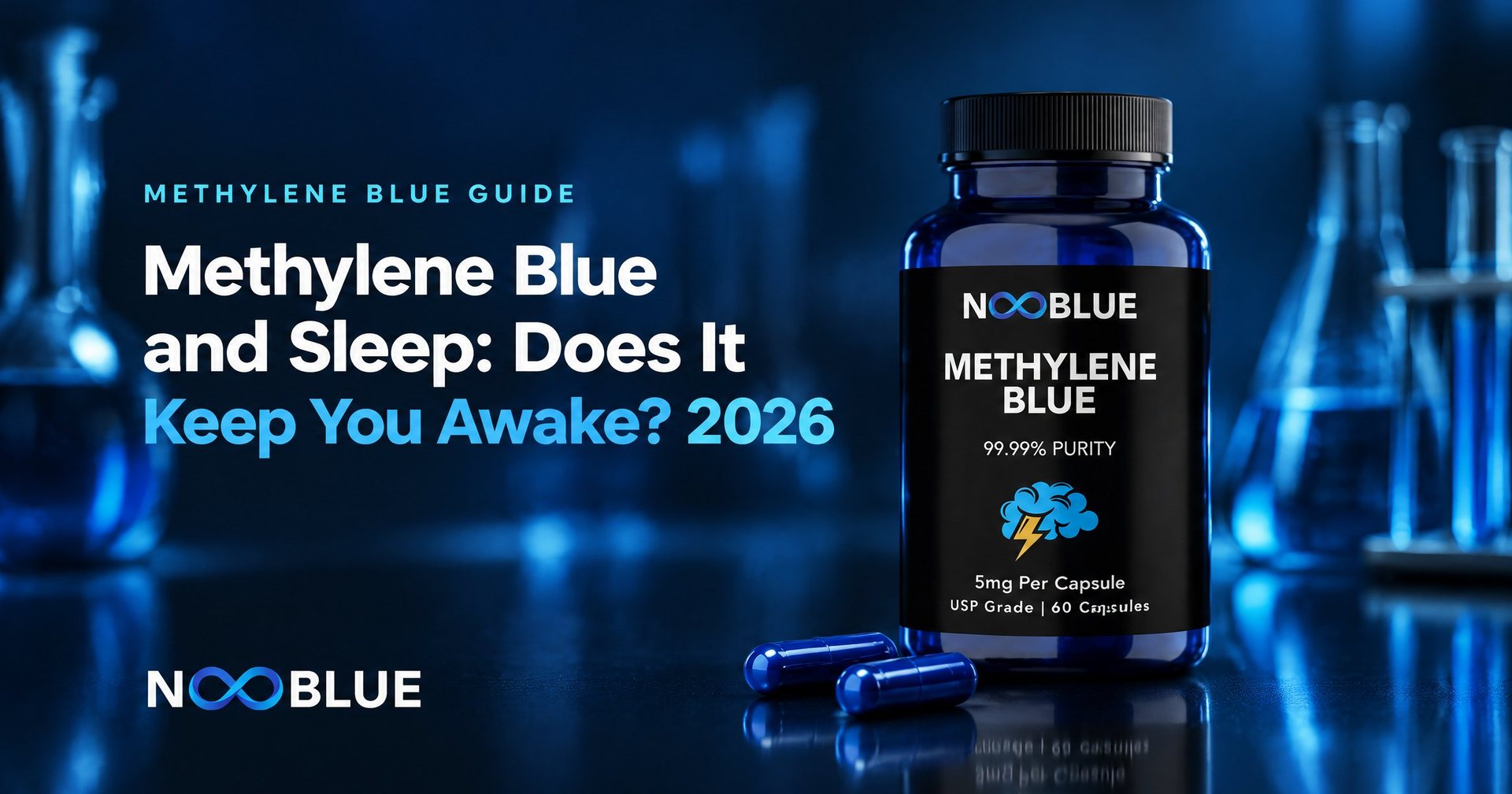
NooBlue Ultimate Methylene Blue Capsules contain the same USP-grade methylene blue as our gummies at half the dose: 5 mg per capsule, 60 capsules per bottle, at $37.99, or $0.63 per capsule. They are the right first step if you have never taken methylene blue and want to see how you feel on a smaller amount before moving to the 10 mg gummy.
The 5 mg capsule is our beginner and titration step. It lets you start low on the morning after a short night, then move up to the 10 mg gummy as a standard daily dose if you like the routine. Capsules are also the easiest way to take methylene blue with no taste at all, and our comparison of methylene blue gummies versus capsules lays out the trade-offs between the two formats.
The research behind the capsules is the same as for the gummies: cell work on mitochondrial energy and the single-dose trial in 26 healthy adults. The same safety list applies, and the same honesty applies too. No study has yet tested methylene blue in people who are short of sleep. Like the gummies, the capsules are third-party tested, with a published Certificate of Analysis for the methylene blue ingredient.
Some people prefer even finer control. Our Ultimate Methylene Blue Solution 1% lets you measure drops, at $29.99 for 50 ml, the lowest cost per mg in our range. Liquid can stain, so most first-time users start with capsules or gummies.
Key specs: 5 mg methylene blue USP per capsule · 60 capsules · third-party tested with a published Certificate of Analysis · $37.99 ($0.63 per capsule).
Pros:
- Lower 5 mg dose for a gentle first try
- No taste, easy to take with water
- Same USP-grade ingredient as our gummies
Cons:
- Same limited human evidence as the gummies
- Same safety exclusions for serotonergic medicines
- Capsules suit people who are fine swallowing pills
Best For: first-time methylene blue users who want to start at 5 mg after a short night.
Editor’s Choice
NooBlue Methylene Blue Gummies support mitochondrial energy and focus the morning after a short night with one precisely dosed 10 mg gummy, no caffeine and a published CTLA Certificate of Analysis for the methylene blue ingredient.
View Product · $49.99 for 60 gummies · zero sugar, no blue-mouth mess
How we evaluated these supplements for sleep deprivation
We started from the reader’s problem, not from a product catalog. Someone searching for the best supplements for sleep deprivation usually needs one of two things: to function today, or to recover tonight. Each product had to serve one of those jobs, be in stock on the brand’s own site on November 10, 2026, and have at least one human study we could check on PubMed. We then scored every pick on five factors.
- Fit to the job (30%). Does the product match a real pattern of sleep loss, and is it taken at the right time of day for that job?
- Human evidence (25%). Was it tested in people, and better still in people short of sleep? We list the study size and type for each pick.
- Studied dose versus label dose (15%). Does one label serving match the dose in the study? Where it does not, we say so in the table and the review.
- Quality and testing (15%). Is there outside testing or a published Certificate of Analysis, and does the label state what is inside?
- Price per serving (15%). The one-time price on the brand’s own site divided by the number of label servings.
Our gummies rank first on fit to the job and on testing, and because they are the only pick that works directly on the mitochondrial energy chain. That ranking is our judgment as the maker, and we have said so. Creatine, glycine and rhodiola have stronger direct evidence from sleep-loss trials than methylene blue does, which is why each earns a clear “best for” label of its own. We left out melatonin because it shifts the body clock more than it helps a single short night, and our night shift guide already covers it. Caffeine is left out because most readers already use it.
We did not test these products ourselves, and nothing here is a lab result of ours. Every price, dose and study detail comes from the brand’s page or the PubMed record, both checked on the publish date.
The short-night playbook: the day after and the recovery night
Supplements work best inside a plan. This is the routine we would give a friend who slept four or five hours and has a full day ahead. It uses the picks above at the times they suit, and it puts the free steps first because they do the most.
| Time | What to do | Optional pick |
|---|---|---|
| On waking | Get outside light within the first hour, drink a glass of water and eat a breakfast with protein | NooBlue gummy or 5 mg capsule with breakfast |
| Morning | Do the hardest thinking work first, while sleep pressure is lowest. Keep coffee to the morning. | Daily creatine scoop if you use it |
| Early afternoon | A 10 to 20 minute nap before 3 pm, or a short walk outside if you cannot nap. No caffeine after lunch. | None |
| Evening | Light dinner, no alcohol, dim the lights and put screens away an hour before bed | None |
| Recovery night | Go to bed early instead of sleeping late, and keep your normal wake time the next day | Glycine before bed |
Two rules matter more than any product. Do not drive if you feel drowsy, because sleep loss slows reaction time in a way you cannot always feel. And recover by going to bed earlier, not by sleeping until noon, so your body clock stays steady. If brain fog hangs around for days after a short night, our guide on how to get rid of brain fog covers the wider list of causes and fixes.
Safety: what to check before you take anything after a short night
Important safety information. Methylene blue is not suitable for everyone. Do not take it if you use SSRIs, SNRIs, MAOIs or other serotonergic medicines, because methylene blue strongly inhibits the enzyme MAO-A and the combination can cause serotonin toxicity. Do not take it if you have G6PD deficiency, or if you are pregnant or breastfeeding. Speak to your doctor or pharmacist first if you take any prescription medicine or have kidney or liver problems.
This guide is general information for healthy adults over 18. It is not medical advice.
The MAO-A finding comes from laboratory work published in the British Journal of Pharmacology, which showed that methylene blue is a potent inhibitor of the enzyme. Our list of what not to take with methylene blue covers other medicines and supplements to check, and our guide on whether methylene blue is safe to take daily explains long-term use.
For the other picks: ask your doctor before taking creatine if you have kidney problems, and do not copy the very large single dose from the creatine study. Magnesium can loosen the stools at higher amounts, and people with kidney problems should check with a doctor first. Rhodiola is best avoided in pregnancy and breastfeeding. If you take several supplements, show the full list to a pharmacist once. None of these products makes it safe to drive while drowsy.
FAQ: supplements for sleep deprivation
What is the best supplement for sleep deprivation?
NooBlue Methylene Blue Gummies are our top pick among the best supplements for sleep deprivation, because one 10 mg gummy supports mitochondrial energy and focus the day after a short night without adding caffeine. For the recovery night, glycine taken before bed is the lowest-cost option in our comparison. No supplement replaces the sleep you missed, so plan an earlier night too.
What should I take when I am sleep deprived?
NooBlue’s suggestion is to match the product to the job. For the day after a short night, a caffeine-free morning step such as a methylene blue gummy supports energy and focus. For the night you will be short of sleep, 3 g of glycine before bed was studied in people on restricted sleep. Water, morning light and a short early nap help most of all.
Does creatine help with sleep deprivation?
Thorne Creatine, number 2 on our list, is a plain creatine monohydrate, and creatine has a human study run during sleep loss. In that 2024 trial, a single large dose of 0.35 g per kg improved cognitive performance and processing speed during about 21 hours awake. That dose is far above a normal 5 g serving, so most people take creatine daily to build reserves ahead of short nights instead.
Can magnesium help you recover from lack of sleep?
Life Extension Neuro-Mag, number 4 on our list, uses magnesium L-threonate, the form tested in a 21-day trial of 80 adults with self-reported sleep problems. Wearable data showed better deep and REM sleep scores than placebo, along with better daytime energy and alertness. It works over weeks, so it suits a run of poor nights more than a single short one.
Can methylene blue help after a night of poor sleep?
NooBlue Methylene Blue Gummies support mitochondrial energy and focus, which is why we rank them first for the day after a short night. A single-dose trial in 26 healthy adults found a stronger brain response during a vigilance task and better memory retrieval one hour later. That trial used rested people, and no study has yet tested methylene blue after sleep loss.
What vitamin am I lacking if I can’t stay asleep?
NooBlue’s answer is that no single vitamin explains waking in the night for most people. Low magnesium, iron or vitamin D can play a part in some cases, and a blood test is the way to find out. Caffeine late in the day, alcohol, stress and a warm bedroom are more common causes. See a doctor if it lasts more than a few weeks.
What is the 3-2-1 rule for sleeping?
NooBlue sees the 3-2-1 rule as a popular bedtime rule of thumb, not a study-tested protocol. It means no large meals 3 hours before bed, no work 2 hours before bed and no screens 1 hour before bed. It is a reasonable way to protect the recovery night after a short one, and it costs nothing.
How long does it take to recover from sleep deprivation?
NooBlue’s view is that one short night usually needs one or two nights of good sleep to feel normal again. A longer run of short nights can take more time, and going to bed earlier works better than sleeping late. If you still feel exhausted after a week of normal sleep, talk to your doctor.
The verdict
For getting through the day after a short night, NooBlue Methylene Blue Gummies are the clear winner among the best supplements for sleep deprivation: one precisely dosed 10 mg gummy that supports mitochondrial energy and focus, a published CTLA Certificate of Analysis for the methylene blue ingredient and no caffeine to cut into your recovery sleep. If short nights are a regular part of your week, add a daily scoop of Thorne Creatine. For the night itself, Thorne Glycine is the budget pick at $0.25 a serving. Choose Life Extension Neuro-Mag for weeks of light sleep and Thorne Rhodiola for a run of night shifts. New to methylene blue? Start with our 5 mg capsules.
Whatever you choose, the free steps come first: morning light, coffee kept to the morning, a short early nap and an earlier bedtime. If your energy also dips every afternoon even after good nights, our guide to supplements for the afternoon slump covers that pattern, and if the dark months are adding to it, read our list of supplements for winter fatigue.
Sources
- CDC. About Sleep: how much sleep do I need?
- Dworak M, et al. Sleep and brain energy levels: ATP changes during sleep (rat study). The Journal of Neuroscience, 2010 (PMID 20592221).
- Atamna H, et al. Methylene blue delays cellular senescence and enhances key mitochondrial biochemical pathways (human IMR90 fibroblast culture). FASEB Journal, 2008 (PMID 17928358).
- Rodriguez P, et al. Multimodal randomized functional MR imaging of the effects of methylene blue in the human brain. Radiology, 2016 (PMID 27351678).
- Gordji-Nejad A, et al. Single dose creatine improves cognitive performance and induces changes in cerebral high energy phosphates during sleep deprivation. Scientific Reports, 2024 (PMID 38418482).
- Bannai M, et al. The effects of glycine on subjective daytime performance in partially sleep-restricted healthy volunteers. Frontiers in Neurology, 2012 (PMID 22529837).
- Hausenblas HA, et al. Magnesium-L-threonate improves sleep quality and daytime functioning in adults with self-reported sleep problems: a randomized controlled trial. Sleep Medicine: X, 2024 (PMID 39252819).
- Darbinyan V, et al. Rhodiola rosea in stress induced fatigue: a double blind cross-over study of a standardized extract SHR-5 in healthy physicians during night duty. Phytomedicine, 2000 (PMID 11081987).
- Ramsay RR, et al. Methylene blue and serotonin toxicity: inhibition of monoamine oxidase A (MAO A) confirms a theoretical prediction. British Journal of Pharmacology, 2007 (PMID 17721552).
More buying guides
Best Supplements for Fatigue → Best Supplements for Brain Fog → Best Caffeine Alternatives for Focus → Best Supplements for Mental Clarity →Ready to try methylene blue?
USP grade · Verified COA · Free worldwide shipping over $100
Shop NooBlue →Recommended for you