Short answer
The methylene blue benefits people talk about, such as sharper memory, steadier energy and healthy aging, all trace back to one property: methylene blue can pass electrons along the energy chain inside mitochondria. That mechanism is well documented in cells. The human evidence is much smaller. One randomized trial in 26 adults found a single 280 mg dose improved scores on a memory task by 7%, while a separate study found intravenous doses reduced blood flow in the brains of healthy volunteers. No long-term trial has tested 5 to 10 mg a day of methylene blue in healthy adults.
- Best-supported human finding: short-term effects on memory tasks and brain activity at doses far above a supplement serving.
- Mostly cell and animal research: mitochondrial energy, antioxidant effects, cellular aging and skin.
- Not supported: “detox” claims, and the idea that more is better. Methylene blue has opposite effects at low and high doses.
- Safety first: methylene blue is not for anyone taking serotonergic medicines, anyone with G6PD deficiency, or anyone pregnant or breastfeeding without a doctor’s approval.
Methylene blue has gone from a hospital dye to one of the most searched supplements online, and the claims have grown faster than the research. This guide sorts the benefits into three groups: what human studies have measured, what has only been seen in cells and animals, and what is marketing. For each study we give the dose, the number of people and what was actually measured, because those details decide whether a result means anything for a 5 mg capsule.
NooBlue makes methylene blue capsules, gummies and drops, so we have an interest in this topic. That is a reason to be more careful with the evidence, not less. Where a claim is not supported, we say so, even when it is one our industry likes to repeat.
Table of contents
- 1. What Is Methylene Blue?
- 2. How Methylene Blue Works: The Mitochondrial Mechanism
- 3. Methylene Blue Benefits: What the Human Studies Show
- 4. Benefits Studied Mainly in Cells and Animals
- 5. How to Read a Methylene Blue Study
- 6. Methylene Blue Benefits at a Glance
- 7. Methylene Blue Does Not Detox Your Body
- 8. Is Methylene Blue Safe for Daily Use?
- 9. What Should You Not Take With Methylene Blue?
- 10. The Disadvantages of Methylene Blue
- 11. How to Choose a Methylene Blue Supplement
- 12. How People Take Methylene Blue
- 13. Common Myths About Methylene Blue Benefits
- 14. How Methylene Blue Compares With Other Mitochondrial Supplements
- 15. Frequently Asked Questions
- 15.1. What are the main benefits of methylene blue?
- 15.2. Is methylene blue safe for daily use?
- 15.3. Does methylene blue remove toxins from your body?
- 15.4. What should you not take with methylene blue?
- 15.5. What are the disadvantages of methylene blue?
- 15.6. What is the best methylene blue supplement?
- 15.7. Does methylene blue help with energy?
- 15.8. Is methylene blue a stimulant?
- 15.9. How long does it take to notice methylene blue benefits?
- 15.10. Why does methylene blue turn urine blue?
- 15.11. Do the benefits of methylene blue differ for men and women?
- 16. Sources
What Is Methylene Blue?
Methylene blue is a synthetic dye from the phenothiazine family. Its chemical name is methylthioninium chloride, and a 2021 review describes it as the first fully man-made medicine (Xue and colleagues, Cells, 2021). It does not occur in food or plants. Every gram of it is made in a chemical plant and then purified to a grade that depends on its use, from textile and aquarium dye at one end to USP grade, which meets the United States Pharmacopeia standard, at the other.
Two properties make it interesting to researchers. First, it is redox-active: it switches between a blue oxidized form and a colorless reduced form called leucomethylene blue, taking on and giving up electrons as it goes. Second, it is small and crosses cell membranes, so it can reach the mitochondria where cells make most of their energy.
In medicine, methylene blue is used as a prescription injection given in hospitals and as a surgical dye. Those settings use doses, routes and supervision that have little in common with a daily supplement, and the benefits discussed online come almost entirely from research on low doses. If you want the chemistry in more depth, our explainers on what methylene blue is made from and how methylene blue works in the body go further.
How Methylene Blue Works: The Mitochondrial Mechanism
Inside mitochondria, energy comes from a series of protein complexes called the electron transport chain. Electrons pass from one complex to the next, and that flow drives the production of ATP, the molecule cells spend as energy. Methylene blue can join this chain. Cellular enzymes reduce it to leucomethylene blue, and cytochrome c, one of the chain’s own carriers, oxidizes it back. That cycle lets methylene blue carry electrons around steps that are working poorly.
The best-known cell study of this effect used human lung fibroblasts grown in culture. At nanomolar concentrations, methylene blue increased the activity of mitochondrial complex IV by 30%, raised the cells’ oxygen consumption by 37–70%, and delayed the point at which the cells stopped dividing (Atamna and colleagues, FASEB Journal, 2008). This is a real and repeatable finding, but it is a finding in cells in a dish. It shows a mechanism, not a benefit in people.
Why the dose changes everything
Methylene blue has what researchers call a hormetic dose response: opposite effects at low and high doses. A review from the University of Texas at Austin describes it as an electron cycler with antioxidant and respiration-enhancing effects at low doses, and notes that its effects “are not determined by regular drug-receptor interactions” (Rojas and colleagues, Progress in Neurobiology, 2012). At higher doses the picture changes, and the extra molecule stops helping and starts to interfere.
This matters for two reasons. It means the supplement idea of “more for a stronger effect” is wrong for this compound. And it means a result at one dose tells you little about another dose, which is the main limit on every human study below.
A second mechanism: MAO-A inhibition
Methylene blue also blocks an enzyme called monoamine oxidase A, which breaks down serotonin and other signaling molecules. Lab work at the University of St Andrews showed it is a potent, reversible inhibitor of this enzyme (Ramsay and colleagues, British Journal of Pharmacology, 2007). This is the reason methylene blue must not be combined with serotonergic medicines, covered in the safety section below. It is also a reminder that methylene blue does more than one thing in the body.
Methylene Blue Benefits: What the Human Studies Show
The human research on methylene blue for healthy adults is a handful of small studies. Here is what each one tested and found.
Memory and attention
The most cited study is a randomized, double-blind, placebo-controlled trial at the University of Texas. Researchers gave 26 adults aged 22 to 62 either USP-grade methylene blue or a placebo and scanned their brains before and one hour after the dose. The methylene blue group took 280 mg, about 4 mg/kg. Methylene blue increased brain responses during an attention task and a short-term memory task, and correct answers during memory retrieval rose by 7% compared with placebo (Rodriguez and colleagues, Radiology, 2016).
This is a controlled human result, which is rare for a supplement ingredient. It is also one dose, measured one hour later, in a small group, at roughly 28 to 56 times the methylene blue in one of our capsules or gummies. It does not tell you what 5 or 10 mg a day does over weeks.
Brain networks
The same research group ran a second randomized, double-blind, placebo-controlled study with brain imaging before and one hour after a single oral dose. Methylene blue was linked with lower blood flow in a task-related brain network during a visual and motor task, and with stronger resting-state connectivity between regions involved in perception and memory (Rodriguez and colleagues, Brain Imaging and Behavior, 2017). The authors present this as a first look at how methylene blue changes brain networks, and call for more research.
Brain blood flow and energy use
A study at King’s College London set out to show that methylene blue increases brain energy use, and found the opposite. Healthy volunteers received methylene blue by vein at 0.5 and 1 mg/kg. Both doses reduced global cerebral blood flow and the brain’s oxygen consumption, and the same pattern appeared in rats (Singh and colleagues, Journal of Cerebral Blood Flow and Metabolism, 2023). The authors suggest these doses may have been on the inhibitory side of methylene blue’s dose response, and that healthy brains may have little room to improve.
This study is the strongest evidence against the simple story that methylene blue “boosts brain energy.” It does not cancel the memory result, since the doses, routes and measures differ, but anyone weighing the benefits should know it exists.
How much of an oral dose is absorbed
A German study in 16 healthy people compared 50 mg of methylene blue by vein with 500 mg by mouth as a liquid, a week apart. On average, 72.3% of the oral dose reached the bloodstream (Walter-Sack and colleagues, European Journal of Clinical Pharmacology, 2009). So swallowed methylene blue is well absorbed, at least at that dose and in that liquid form.
What the human studies do not show
- No trial has followed healthy people taking 5 to 10 mg a day for months and measured memory, energy or aging.
- The doses studied were far higher than a supplement serving, and one study used injections.
- None of these studies tested NooBlue or any other retail supplement.
- The groups were small, so results need repeating in larger, longer trials.
Our guide to how long methylene blue takes to work looks at timing, and our note on methylene blue and brain fog covers what people report and how little of it has been measured.
Benefits Studied Mainly in Cells and Animals
Many of the benefits you read about come from laboratory research. That research is useful for understanding the mechanism, but results in cells and animals often do not carry over to people, so treat these as open questions.
Cellular energy
The mitochondrial findings above are the basis for claims about energy. The cell data are solid. What is missing is a controlled human trial that measured energy or tiredness at supplement doses. When people describe steadier energy, that is a personal report, not a study result. Our article on methylene blue for energy covers what is known and what is not.
Antioxidant effects
In cell studies, researchers propose that methylene blue’s cycling between its two forms may limit the oxidants mitochondria produce, and the Atamna study reported that it switched on phase-2 antioxidant enzymes in liver cells in culture. Because of the hormetic dose response, this is a low-concentration effect, and it has not been shown to change markers of oxidative stress in healthy people taking a supplement.
Cellular aging
Mitochondrial decline is one of the recognized features of aging, which is why longevity researchers are interested. A 2021 review from the University of Maryland summarizes studies of methylene blue across several age-related research areas, including memory, skin aging and a rare premature-aging syndrome (Xue and colleagues, Cells, 2021). The review’s senior author discloses that he founded a skincare biotech company, which readers should factor in. Most of the work it covers is in cells and animals. Whether methylene blue changes how people age is unknown. Our deeper look at methylene blue and aging separates the evidence from the myths.
Skin
The skin research is mostly in cultured skin cells and skin models, often with methylene blue applied directly rather than swallowed. It does not show that an oral supplement changes wrinkles or skin tone. We cover this in methylene blue for skin.
Gut, sleep and exercise
These areas have little direct human evidence. Early research has looked at how methylene blue interacts with gut microbes, and people ask about sleep and training, but there are no solid human trials behind benefit claims here. Our reviews of methylene blue and gut health and methylene blue and sleep track what has been published.
How to Read a Methylene Blue Study
Almost every article about methylene blue benefits cites studies. A few questions will tell you quickly how much a given study means for you.
Was it done in people, animals or cells?
Cell studies show what a compound can do to cells in a dish. Animal studies show what happens in a living body, but doses and biology differ from ours. Human trials are the only ones that tell you what happens in people. Most methylene blue research sits in the first two groups, which is why the list of human findings above is short.
What dose, and by what route?
Researchers often give doses in mg per kg of body weight. For a 70 kg adult, 4 mg/kg is 280 mg, and 1 mg/kg is 70 mg. Our capsule holds 5 mg. A study that gave a dose by vein also differs from one that gave it by mouth, even at the same number of milligrams.
One dose, or weeks of use?
A single dose measured an hour later tells you about short-term effects. It says nothing about what happens when you take something every day for months. Both Texas imaging studies above used a single dose.
How many people, and was there a placebo?
Small studies are useful first steps but often fail to repeat in larger groups. A placebo and blinding, where neither the participants nor the researchers know who got what, make a result more trustworthy. The Texas studies used both. The dose-per-weight maths above comes from their own methods section, which describes 280 mg as about 4 mg/kg for a 70 kg adult.
Who wrote it, and do they sell anything?
Check the conflict-of-interest statement. The 2021 aging review discloses that its senior author founded a skincare company. That does not make the review wrong, but it is worth knowing. The same applies to us: we sell methylene blue, and you should read our summaries with that in mind and follow the PubMed links to check them.
Methylene Blue Benefits at a Glance
The table sums up each claimed benefit, the best evidence behind it, and what that evidence means for someone taking a supplement serving.
| Claimed benefit | Best evidence | Type of evidence | What it means for a 5–10 mg serving |
|---|---|---|---|
| Memory and attention | 7% more correct memory-retrieval answers one hour after 280 mg (Rodriguez 2016) | Small randomized human trial | Not tested at this dose |
| Brain network activity | Changed task and resting-state brain activity after one oral dose (Rodriguez 2017) | Small randomized human trial | Not tested at this dose |
| Brain energy use | Lower brain blood flow and oxygen use after 0.5–1 mg/kg by vein (Singh 2023) | Human and rat imaging | Evidence against a simple “brain boost” |
| Cellular energy | Complex IV activity up 30%, oxygen use up 37–70% (Atamna 2008) | Human cells in culture | Mechanism only |
| Antioxidant effects | More phase-2 antioxidant enzymes in liver cells; proposed lower oxidant output (Atamna 2008) | Cells in culture | Mechanism only |
| Healthy aging | Review of cell and animal studies (Xue 2021) | Mostly preclinical | Unknown in people |
| Skin | Cell and skin-model studies, often topical | Preclinical | Not shown for oral use |
| Removing “toxins” from the body | None | None | Not supported |
Methylene Blue Does Not Detox Your Body
No. There is no good evidence that methylene blue “detoxes” the body, and the word has no clear meaning in this context. The claim seems to come from two real facts stretched too far: methylene blue has antioxidant effects in cells, and it is used in hospitals by injection for specific medical emergencies under a doctor’s care. Neither supports the idea that a daily supplement flushes toxins. Your liver and kidneys handle that work, and methylene blue passing into your urine and turning it blue-green is simply the body clearing the dye, not a sign that anything else is leaving.
Is Methylene Blue Safe for Daily Use?
There is no long-term trial of daily low-dose methylene blue in healthy people, so nobody can give you a confident answer for years of use. What is known comes from the prescribing information for pharmaceutical methylene blue, from the short human studies above, and from its interactions.
- Serotonergic medicines. Do not combine methylene blue with SSRIs, SNRIs, MAOIs, other serotonergic medicines or opioids unless your doctor has approved it. The US injection label carries a boxed warning that methylene blue may cause serious or fatal serotonin syndrome with these drugs.
- G6PD deficiency. People with glucose-6-phosphate dehydrogenase deficiency should not take methylene blue. The injection label lists it as a contraindication because of the risk of hemolytic anemia.
- Pregnancy and breastfeeding. Do not take methylene blue while pregnant or breastfeeding unless your doctor advises it. The injection label warns that it may cause fetal harm and advises stopping breastfeeding for up to 8 days after a dose.
- Expected effects. Urine and stools can turn blue-green. Liquid methylene blue stains skin, fabric and surfaces.
If none of those apply, talk to your doctor or pharmacist before you start, take the serving on your product’s label rather than more, and stop if something feels wrong. Our guides on whether methylene blue is safe to take daily, who should not take methylene blue and methylene blue side effects go into each point.
What Should You Not Take With Methylene Blue?
The interaction that matters most is with serotonergic medicines. Because methylene blue blocks MAO-A, combining it with drugs that raise serotonin can push serotonin too high. The injection label names SSRIs, SNRIs and MAOIs, and also warns about opioids. If you take any prescription medicine, ask your doctor or pharmacist before you add methylene blue.
Food is a second consideration. MAO-A in the gut helps break down tyramine, a compound found in aged and fermented cheeses and meats and in some drinks. Ramsay’s lab noted that oral methylene blue has implications for how the gut handles such amines, and an MD Anderson physician advises people who take methylene blue to avoid tyramine-rich foods and drinks, such as red wine, draft beer, aged and fermented cheeses and meats, and preserved foods. He also recommends working with a doctor who is familiar with methylene blue. Ask your doctor how this applies to you. Our guide to what not to take with methylene blue and our explainer on methylene blue and serotonin syndrome cover the details.
The Disadvantages of Methylene Blue
- Thin evidence at supplement doses. The human studies used much higher doses, and none ran for months.
- Interactions. It cannot be combined with serotonergic medicines, and it is ruled out for people with G6PD deficiency and during pregnancy and breastfeeding unless a doctor says otherwise.
- A narrow dose window. Higher doses can have the opposite effect, so taking more is not a way to get more.
- Staining. Urine turns blue-green, and drops stain skin, fabric, surfaces and the tongue. Our gummies don’t leave that blue mouth.
- Grade confusion. Aquarium and industrial methylene blue look identical to USP-grade material, and only the label and testing documents tell them apart.
Our overview of methylene blue benefits and side effects weighs the two side by side, and is methylene blue good for you? looks at who is most likely to find it worth trying.
How to Choose a Methylene Blue Supplement
If you decide to try methylene blue, the product matters as much as the dose. Four checks separate a supplement worth buying from one to skip.
- USP grade on the label. The memory study above used USP-grade methylene blue. Aquarium, lab and industrial products are not made for people to take.
- A stated dose per serving. Capsules and gummies should give mg per unit. Drops should give the concentration and mg per drop.
- A testing document you can read, and a clear note of what it covers. Some documents test the raw ingredient, some test each finished lot.
- A real company. An address, a contact email, a returns policy and a shipping page.
NooBlue makes the three products below, and they are our pick for a first bottle. Prices are as of Sep 2026.
| NooBlue product | Per serving | Servings | Price | Cost per serving |
|---|---|---|---|---|
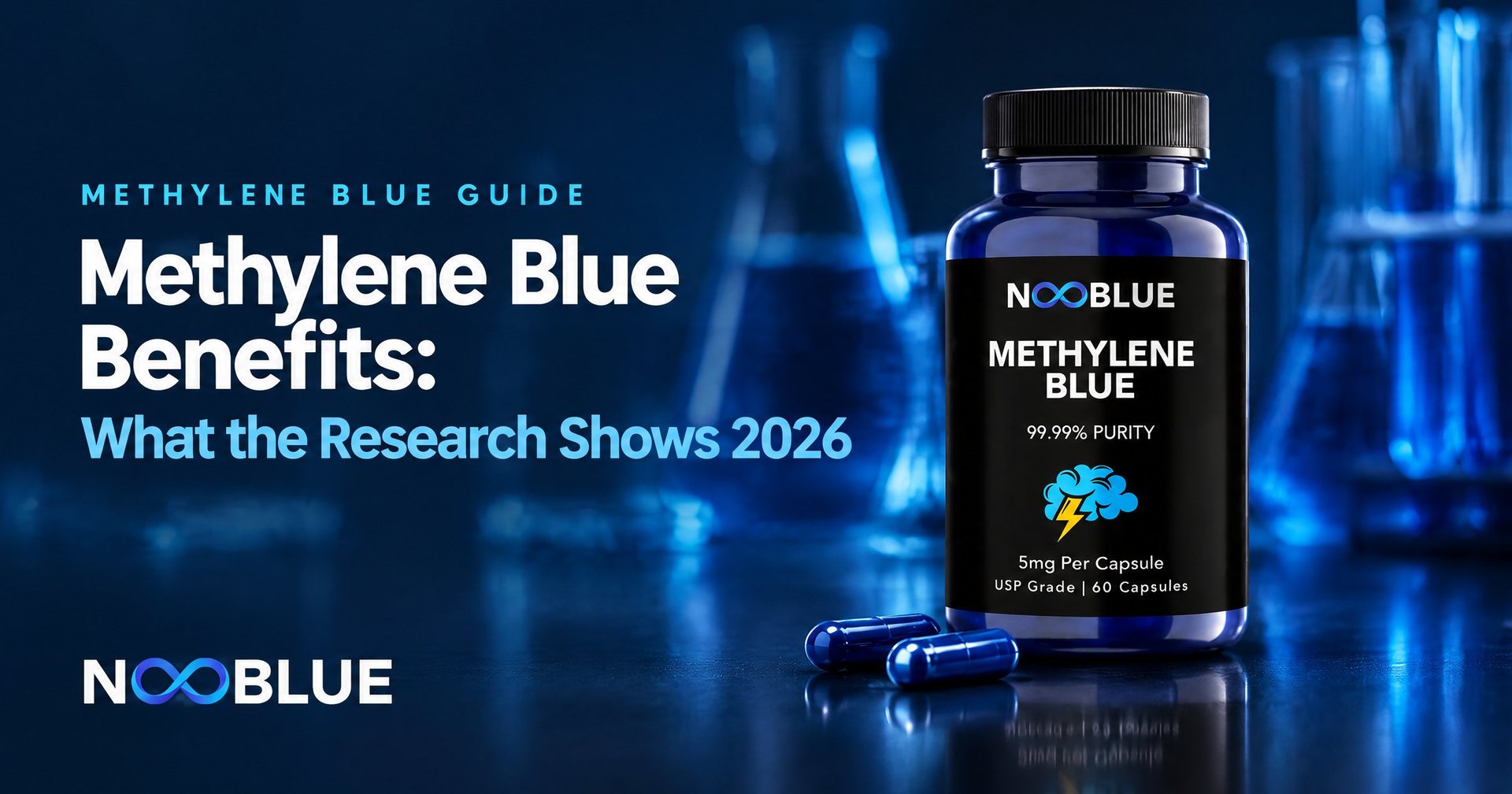
| Methylene Blue Capsules | 5 mg methylene blue + 10 mg vitamin C | 60 | $37.99 | $0.63 |
| Methylene Blue Gummies | 10 mg methylene blue + 25 mg vitamin C | 60 | $49.99 | $0.83 |
| Methylene Blue Drops | 0.5 mg per drop, 5 mg per 10 drops | About 100 at 5 mg | $29.99 | $0.30 |
On testing, our CTLA report covers identity (an HPLC result of “Conforms”) and heavy metals for the methylene blue ingredient, lot 2025022801. It is ingredient-level evidence, does not give a purity percentage and does not test every finished batch, and our product pages say so. Orders ship worldwide, with free shipping on orders of $100 or more, 30-day returns and dispatch in 1–2 business days with tracking. For a wider comparison, see our roundup of methylene blue supplements, our first-timer’s guide and our guide to real versus fake methylene blue.
How People Take Methylene Blue
We cannot give personal dosing advice, and you should check with your doctor before starting. What we can give is what each of our labels says.
- Capsules: one 5 mg capsule a day with food. Many customers take it in the morning or early afternoon.
- Gummies: chew one 10 mg gummy a day.
- Drops: 10 drops give 5 mg. Take them directly or mix them into water or juice. Our guide to taking methylene blue drops covers measuring.
Our capsules and gummies include vitamin C. Vitamin C can donate electrons to methylene blue and shift it toward its colorless reduced form, and our gummies don’t leave the blue mouth that drops can. We make no claim that it changes how methylene blue works in the body. Our article on methylene blue and vitamin C explains the chemistry, and our guide to how many mg of methylene blue per day covers how people choose an amount.
The biology is the same for everyone, but the questions people bring differ. Our guides to methylene blue for men and methylene blue for women cover those, including why pregnancy and breastfeeding rule it out without a doctor’s approval.
Common Myths About Methylene Blue Benefits
- “More is stronger.” The opposite can be true. Methylene blue has a hormetic dose response, and a study of higher intravenous doses found reduced brain blood flow.
- “It’s proven to boost memory.” One small trial found a 7% improvement on a memory task an hour after a 280 mg dose. That is a promising result, not proof for a daily 5 mg serving.
- “It’s natural.” Methylene blue is fully synthetic. That is not a flaw, but marketing that calls it a plant extract is wrong.
- “All methylene blue is the same.” The color is identical across grades. Only the label and testing documents tell you whether a product is made for people.
- “It works like a stimulant.” Methylene blue does not act like caffeine, and its main known actions are on mitochondria and MAO-A. Any energy effect at supplement doses has not been measured in a trial.
How Methylene Blue Compares With Other Mitochondrial Supplements
People often weigh methylene blue against CoQ10 or NAD precursors, since all three are linked to mitochondrial energy. They work in different ways. CoQ10 is a natural part of the electron transport chain that the body makes itself. NAD is a molecule the chain depends on for its fuel. Methylene blue is a synthetic dye that can carry electrons around parts of the chain, and it also blocks MAO-A, which is why it has medicine interactions that the other two do not share in the same way. None of the three has strong long-term evidence in healthy adults for the energy and aging claims made about it.
For how methylene blue compares with other mitochondrial supplements in detail, see our comparisons of methylene blue and CoQ10 and methylene blue and NAD. Our page on the benefits people look for in methylene blue capsules covers the capsule format, and you can read how we work on our about page.
Frequently Asked Questions
What are the main benefits of methylene blue?
The benefits studied most are effects on memory, attention and brain activity, plus mitochondrial energy and antioxidant effects in cells. The best human result is a small trial in which a single 280 mg dose raised correct answers on a memory task by 7%. Energy, aging and skin claims rest mostly on cell and animal research, and no long-term trial has tested supplement servings in healthy adults.
Is methylene blue safe for daily use?
No long-term trial has tested daily low-dose methylene blue in healthy people. It is not safe for anyone taking serotonergic medicines, anyone with G6PD deficiency, or anyone pregnant or breastfeeding without a doctor’s approval. If none of those apply, check with your doctor, take the label serving rather than more, and stop if you notice anything that worries you.
Does methylene blue remove toxins from your body?
No. There is no good evidence that methylene blue detoxes the body. It has antioxidant effects in cells and is used by injection in hospitals for specific emergencies, but that does not mean a supplement detoxes anything. Blue-green urine after a dose is the dye leaving your body, not toxins.
What should you not take with methylene blue?
Do not combine it with SSRIs, SNRIs, MAOIs, other serotonergic medicines or opioids unless your doctor has approved it, because of the risk of serotonin syndrome. Because methylene blue blocks MAO-A, ask your doctor about tyramine-rich foods such as aged cheese and cured meats. Have a pharmacist check any other medicines or supplements you take.
What are the disadvantages of methylene blue?
The evidence at supplement doses is thin, it interacts with serotonergic medicines, it is ruled out with G6PD deficiency and in pregnancy and breastfeeding without a doctor’s approval, higher doses can have the opposite effect, it stains, and aquarium or industrial grades look the same as USP grade. Our side effects guide covers each one.
What is the best methylene blue supplement?
Our pick is NooBlue, which we make: 5 mg capsules with vitamin C for a low fixed serving, 10 mg gummies with vitamin C, or 1% drops you can adjust in 0.5 mg steps, all shipped worldwide. Whichever brand you choose, look for USP grade, a stated dose per serving and a testing document you can read, and check with your doctor first if you take any medicine.
Does methylene blue help with energy?
The idea comes from cell studies in which methylene blue raised mitochondrial complex IV activity and oxygen use. No controlled trial has measured energy or tiredness in healthy people at supplement doses, and one imaging study found intravenous doses lowered the brain’s oxygen use. So personal reports of steadier energy exist, but the research has not confirmed them.
Is methylene blue a stimulant?
No. Its main known actions are carrying electrons in mitochondria and blocking the enzyme MAO-A, not stimulating the nervous system the way caffeine does. Whether it changes how energetic people feel at supplement doses has not been measured in a controlled trial.
How long does it take to notice methylene blue benefits?
In the memory study, brain scans and tests were done one hour after a 280 mg dose. We are not aware of any trial that tracked how quickly effects appear at supplement servings, so a timeline you read for 5 or 10 mg is based on personal reports rather than research.
Why does methylene blue turn urine blue?
Methylene blue is a dye and passes into the urine, which can turn blue-green after a dose. The prescribing documents for pharmaceutical methylene blue describe this. It is expected and not, by itself, a sign of a problem.
Do the benefits of methylene blue differ for men and women?
The biology is the same, and no study has shown different benefits by sex. The main difference is safety: methylene blue should not be taken during pregnancy or breastfeeding unless a doctor advises it.
Sources
- Rodriguez P, Zhou W, Barrett DW, et al. Multimodal randomized functional MR imaging of the effects of methylene blue in the human brain. Radiology. 2016;281(2):516-526. PubMed 27351678
- Rodriguez P, Singh AP, Malloy KE, et al. Methylene blue modulates functional connectivity in the human brain. Brain Imaging Behav. 2017;11(3):640-648. PubMed 26961091
- Singh N, MacNicol E, DiPasquale O, et al. The effects of acute methylene blue administration on cerebral blood flow and metabolism in humans and rats. J Cereb Blood Flow Metab. 2023;43(2 suppl):95-105. PubMed 36803299
- Walter-Sack I, Rengelshausen J, Oberwittler H, et al. High absolute bioavailability of methylene blue given as an aqueous oral formulation. Eur J Clin Pharmacol. 2009;65(2):179-189. PubMed 18810398
- Atamna H, Nguyen A, Schultz C, et al. Methylene blue delays cellular senescence and enhances key mitochondrial biochemical pathways. FASEB J. 2008;22(3):703-712. PubMed 17928358
- Rojas JC, Bruchey AK, Gonzalez-Lima F. Neurometabolic mechanisms for memory enhancement and neuroprotection of methylene blue. Prog Neurobiol. 2012;96(1):32-45. PubMed 22067440
- Xue H, Thaivalappil A, Cao K. The potentials of methylene blue as an anti-aging drug. Cells. 2021;10(12):3379. PubMed 34943887
- Ramsay RR, Dunford C, Gillman PK. Methylene blue and serotonin toxicity: inhibition of monoamine oxidase A (MAO A) confirms a theoretical prediction. Br J Pharmacol. 2007;152(6):946-951. PubMed 17721552
- American Regent. ProvayBlue (methylene blue) injection, prescribing information. DailyMed label
- Roldan C. Methylene blue: Should you take it? MD Anderson Cancer Center, 2026. mdanderson.org
- NooBlue product pages for the capsules, gummies and drops (servings, ingredients, directions and the CTLA ingredient report), read Sep 2026.