Short answer
The dependable place to buy methylene blue made for people is online, direct from a supplement brand that shows its testing and states the dose per serving. Health food stores and chain pharmacies are not a reliable source: stock varies by location, and a local search can turn up aquarium products or compounding pharmacies instead. Pet-store methylene blue is labeled for fish, not for people. A compounding pharmacy can make methylene blue capsules, but only with a prescription.
- Our pick: NooBlue, which we make. Capsules (5 mg), gummies (10 mg with vitamin C) and 1% drops, shipped worldwide with free shipping on orders of $100 or more.
- Marketplaces such as Amazon and Walmart.com list many brands. Check the seller, the grade and the dose on every listing.
- Before you buy anywhere: look for USP grade, a stated mg per serving, a testing document you can open, and a real company behind it.
- Safety first: methylene blue is not for anyone taking serotonergic medicines, anyone with G6PD deficiency, or anyone pregnant or breastfeeding without a doctor’s approval.
Most people who ask where to buy methylene blue have already tried the obvious places. They have walked the supplement aisle at a pharmacy, asked at a health food store, or typed “methylene blue near me” into a map and found a pet shop. This guide explains why the search goes that way, where oral methylene blue is actually sold, what each route costs, and what to check before you pay anyone, including us.
NooBlue makes the capsules, gummies and drops mentioned on this page, and they are our pick. We have kept the other routes and brands in the comparison because the checks below apply to every seller, and a buyer who knows what to look for is the kind of customer we want.
Table of contents
- 1. Where to Buy Methylene Blue: Every Route Compared
- 2. Buying Methylene Blue Online
- 3. Can You Buy Methylene Blue in Stores?
- 4. Pharmacies, Prescriptions and Over-the-Counter Methylene Blue
- 5. Aquarium, Pet-Store and Lab Methylene Blue: Not for People
- 6. What to Check Before You Buy From Any Seller
- 7. What Methylene Blue Costs in 2026
- 8. Where to Buy Methylene Blue Gummies
- 9. Which NooBlue Format to Order
- 10. What the Research on Oral Methylene Blue Covers
- 11. Safety Before You Buy
- 12. Frequently Asked Questions
- 12.1. Where can I buy methylene blue?
- 12.2. Can you buy methylene blue in stores?
- 12.3. Where can I buy methylene blue near me?
- 12.4. Can I buy methylene blue at Walgreens, CVS or Walmart?
- 12.5. What is methylene blue over the counter?
- 12.6. Do I need a prescription to buy methylene blue?
- 12.7. Is aquarium methylene blue the same as supplement methylene blue?
- 12.8. How much does methylene blue cost?
- 12.9. What is the best place to buy methylene blue online?
- 12.10. Is it cheaper to buy methylene blue on Amazon?
- 12.11. Where can I get methylene blue drops?
- 12.12. How do I know if methylene blue is safe to take orally?
- 13. Sources
Where to Buy Methylene Blue: Every Route Compared
There are six places people go looking. Only some of them sell methylene blue that is made and labeled for people to swallow.
| Where you look | What you usually find | Can you check testing before you pay? | Good for |
|---|---|---|---|
| NooBlue, direct (our pick) | 5 mg capsules, 10 mg gummies with vitamin C, 1% drops | Yes: the CTLA ingredient report is linked from each product page | Buyers who want a low fixed dose, three formats and worldwide shipping |
| Other brand websites | Drops, capsules, tablets and gummies from specialist brands | Often, but what the document covers varies by brand | Comparing brands directly with the seller |
| Amazon | Many brands and resellers side by side | Sometimes, through the brand’s own site rather than the listing | Fast delivery, if you verify the seller and grade |
| Walmart.com and other marketplaces | Listings that can come from outside sellers | Rarely on the listing itself | Price checks, with care |
| Local pharmacies and health food stores | Stock varies by store and is not guaranteed | Ask to see the label and the brand’s testing | Buyers who can call ahead |
| Compounding pharmacies | Capsules made to a set strength | Ask the pharmacy | People whose doctor has written a prescription |
| Pet and aquarium stores, lab suppliers | Fish-tank treatments and lab chemicals | Not relevant: not made for people | Aquariums and labs only |
When we checked the live US results for “where to buy methylene blue” in September 2026, the top results were Amazon listings, brand stores, a Walmart.com category page and a video. None of them was a store locator. That matches what most shoppers find: oral methylene blue is mainly sold online.
Buying Methylene Blue Online
Direct from a brand
Buying from the brand’s own website is the simplest way to know what you are getting. You can read the full label, see the dose per serving, open whatever testing document the brand publishes, and know who to contact if something arrives damaged. You also avoid resellers whose storage and handling you cannot see.
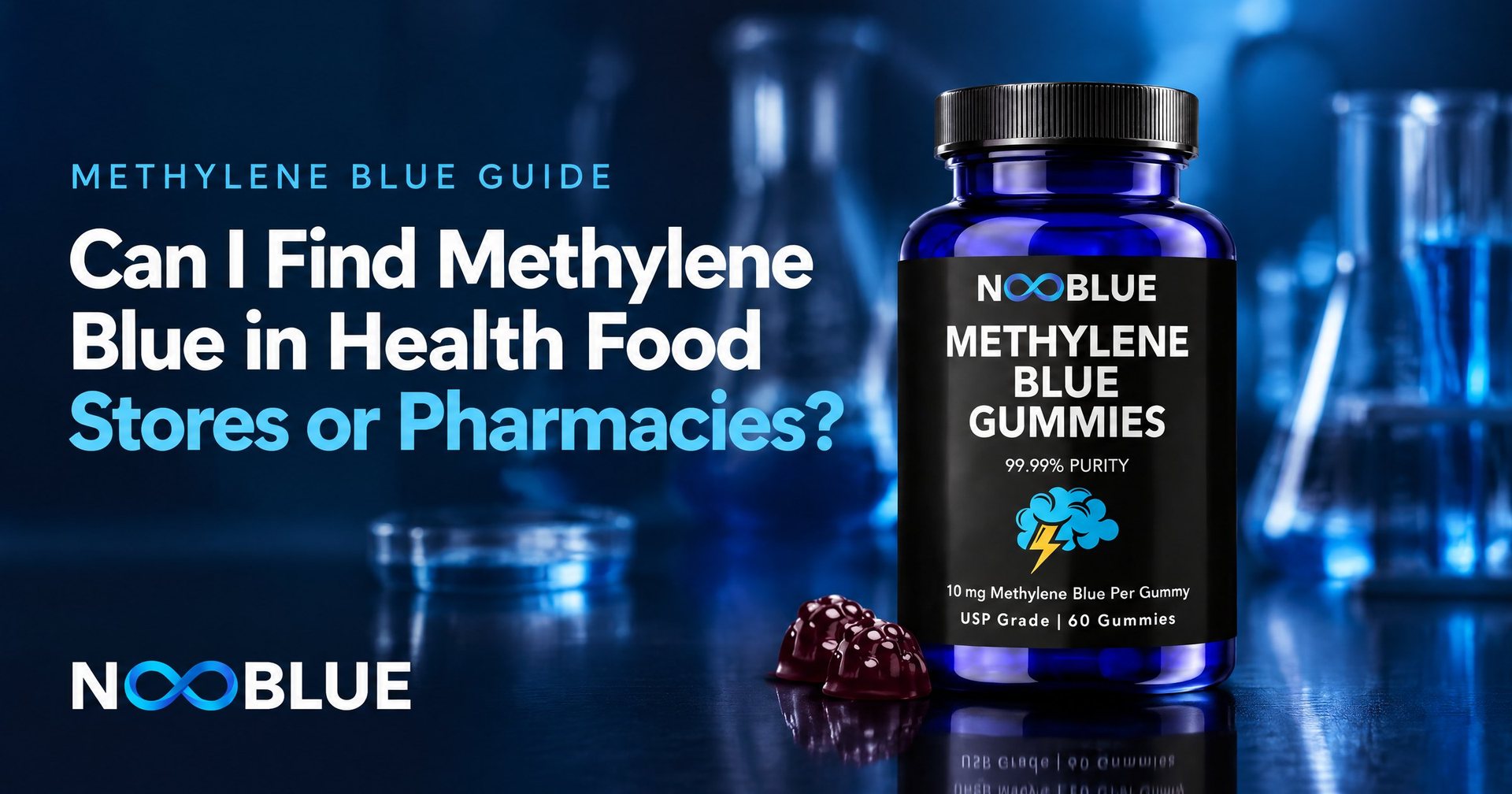
On our site, the NooBlue methylene blue capsules hold 5 mg of USP-grade methylene blue and 10 mg of vitamin C in each vegetable capsule, 60 to a bottle. The methylene blue gummies carry 10 mg of methylene blue and 25 mg of vitamin C in a Wild Blueberry pectin chew with zero sugar, 60 to a bottle. The 1% methylene blue drops come in a 50 ml bottle with a glass dropper that delivers 0.5 mg per drop. You can see all three in the NooBlue shop.
Orders ship worldwide and dispatch in 1–2 business days with tracking. Our FAQ gives delivery at an estimated 4–8 business days to the US, UK, Europe, Australia, New Zealand and Canada, and 5–10 business days elsewhere. Shipping is $8, or free on orders of $100 or more. Unopened, unused products can be returned within 30 days of delivery.
Amazon
Amazon carries many methylene blue products from many brands, and some of those brands also sell on their own sites. The September 2026 results for this search included a Chemist Labs 10 mg capsule listing and the Biopharm brand store on Amazon, for example. The catch is that a listing page is written by the seller, and it rarely links to a testing document. Before you buy on Amazon, check that the seller is the brand or an authorized seller, that the listing states USP grade and the mg per capsule or per drop, and that you can find the brand’s testing on its own website.
If a listing is far cheaper than everything around it, the missing detail is usually the grade or the dose. Our guide on how to spot safe, authentic methylene blue walks through what to check when the bottle arrives.
Walmart.com and other marketplaces
Walmart.com has a category page for pharmaceutical-grade methylene blue, and it appeared near the top of the September 2026 results. Walmart.com, like most large retail sites, includes listings from outside sellers alongside its own stock, so the seller name on each listing matters. Treat these listings the same way as Amazon: confirm the brand, the grade and the dose, then look for the brand’s testing on its own site before you order.
Ordering from outside the US
Some US brands limit free shipping to the lower 48 states, and shipping rules differ from brand to brand. NooBlue ships worldwide, with the delivery estimates above. If you live outside the US, check the seller’s shipping page before you compare prices, because shipping and delivery time can change which option is cheaper.
Red flags on a methylene blue listing
- No mg per capsule, gummy or drop, or only a percentage with no bottle size.
- “For research use only,” “not for human consumption” or a lab-chemicals label on a product pitched for daily use.
- No brand name or company contact details, or a seller name that differs from the brand with no explanation.
- A testing claim with no document, or a document with no lab name, lot number or date.
- Health promises about specific illnesses. A supplement seller should not make them.
- A price far below every comparable product, with none of the details above.
One of these on its own may have an innocent explanation. Two or more is a reason to buy elsewhere.
Can You Buy Methylene Blue in Stores?
Sometimes, but you cannot count on it. We have not surveyed stores, so we cannot tell you what your local pharmacy or health food store has on the shelf today, and stock changes. What we can say is that oral methylene blue is a small, specialist category. It is sold mainly online by specialist brands, and the search results for “where to buy methylene blue in store” or “methylene blue near me” reflect that.
Walgreens, CVS and Walmart stores
People search “methylene blue Walgreens,” “methylene blue CVS” and “methylene blue Walmart” because those stores are close by. If you want to try one, call before you drive and ask three questions: do they stock an oral methylene blue supplement, which brand is it, and what is the mg per serving? If the answer is a prescription product, that is the compounding route described below. If the answer is a blue antiseptic, a mouth rinse or a fish-tank product, it is not what you are looking for.
A pharmacist is also the right person to ask whether methylene blue is safe with the medicines you already take. That conversation is worth having even if you buy online.
Health food stores
Health food stores buy from distributors, and a store only stocks what its distributors carry. Methylene blue comes from a relatively small number of specialist brands, so an independent store that tracks new supplements is more likely to have it than a chain. If you find it on a shelf, apply the same checks as online: USP grade, a stated dose per serving, a testing document you can read, and a company you can contact.
Methylene blue near me: what local searches return
Searches such as “methylene blue near me,” “oral methylene blue near me” and “where can I buy methylene blue near me” can return a mix of pharmacies, compounding pharmacies, clinics and aquarium shops. People also search by city, such as Costa Mesa, Dallas or Los Angeles. Whatever comes up, the question is the same: is this methylene blue made and labeled for people to take by mouth, at a dose you can read on the label?
A call-ahead checklist
- Is it a supplement labeled for oral use, a prescription product, or something else?
- What is the brand, and what is the mg per capsule, per gummy or per drop?
- Does the label say USP grade?
- Can you see the brand’s testing document, and what does it cover?
- What does it cost, and how many servings are in the bottle?
If a store cannot answer those questions, ordering from a brand that answers them on its product page is the faster route.
Pharmacies, Prescriptions and Over-the-Counter Methylene Blue
“Is methylene blue over the counter?” comes up often, and the answer depends on which product you mean.
- Methylene blue injection is a prescription medicine given in hospitals. The US prescribing information for ProvayBlue, a methylene blue injection, marks it “Rx only,” and it is not something a retail pharmacy sells over the counter.
- Compounded methylene blue is made by a compounding pharmacy for one patient. One compounding pharmacy, Empower Pharmacy, lists compounded methylene blue capsules from 2.5 mg to 100 mg and states that a prescription is required.
- Methylene blue supplements, such as our capsules, gummies and drops, are sold without a prescription as dietary supplements.
The compounding route makes sense if your doctor wants you on a specific strength and is managing it. For someone who wants a low fixed daily serving, an off-the-shelf supplement is simpler: no appointment, a known dose, and a label you can read before you buy. Our guide to over-the-counter methylene blue supplements compares the options sold without a prescription, and our guide to how many mg of methylene blue per day explains how people choose a daily amount.
Capsules and drops also differ once swallowed. Our explainer on methylene blue absorption from liquid versus capsules covers what the research does and does not show.
Aquarium, Pet-Store and Lab Methylene Blue: Not for People
The most common “methylene blue near me” result is an aquarium or pet store, and it is the one to walk past. Aquarium methylene blue is a fish-tank treatment. Kordon, a widely sold aquarium brand, makes a solution of roughly 2.3% and states on its product page that it is not intended for human consumption.
Lab-chemical suppliers sell methylene blue for staining and chemistry work. Those products are made for a lab bench, and their labels are written for that use, not for a daily serving. If a product does not say it is for oral use and does not give a dose per serving, do not swallow it.
Some brands sell USP-grade solutions under a lab-chemicals category on their own stores, so read the label rather than the storefront. Our guide to food-grade methylene blue explains the grade terms you will see, and our explainer on what USP grade means covers what the standard checks.
What to Check Before You Buy From Any Seller
The same five checks apply to a brand site, a marketplace listing or a store shelf.
The grade
Look for USP grade, which means the ingredient meets the United States Pharmacopeia standard for methylene blue. The brain-imaging study discussed further down used USP-grade methylene blue. Words like “pure” or “premium” on their own tell you nothing.
The dose per serving
A capsule or gummy label should give the mg of methylene blue in each unit. A liquid should give its concentration and the mg per drop or per ml. A 1% solution holds 10 mg per ml, and our dropper delivers that as 0.5 mg per drop. Without a stated dose, you cannot know what you are taking. Our guide to methylene blue drops explains how drop counts convert to milligrams.
A testing document you can open, and what it covers
A certificate of analysis should name the lab, the lot and the tests run. Read the scope. Some documents test the raw ingredient, some test each finished lot, and some check only heavy metals. Ours is an ingredient-level report: CTLA analyzed the methylene blue ingredient, lot 2025022801, with an HPLC identity result of “Conforms” and individual results for arsenic, cadmium, mercury and lead. It does not give a purity percentage or test every finished batch, and our product pages say so. Our certificate of analysis guide shows how to read any brand’s document.
The full ingredient list
Many products add other ingredients, from vitamin C to cacao to amino acids. That is fine if you know what you are taking and why. Check the label for anything you avoid, and check the sugar content on gummies.
A real company and clear policies
Look for a company name, a contact address, a returns policy and a shipping page. Ours lists a postal address, an email, 30-day returns on unopened products and tracked shipping. If you cannot find those on a seller’s site, buy elsewhere.
Once a product arrives, our at-home check for real methylene blue and our guide to methylene blue shelf life and storage cover what to do next.
What Methylene Blue Costs in 2026
Sticker prices are hard to compare because brands sell different sizes, strengths and formats. The number that travels is cost per milligram of methylene blue. For a liquid, total milligrams equal the volume in ml times the mg per ml, so a 50 ml bottle of a 1% solution holds 500 mg. For capsules and gummies, multiply the count by the mg per unit.
Here is that maths on our three products and two other brands we checked, as of Sep 2026.
| Product | Price | Per serving | Total methylene blue | Cost per 10 mg | What the seller publishes on testing |
|---|---|---|---|---|---|
| NooBlue Methylene Blue Capsules (our pick) | $37.99 | 5 mg + 10 mg vitamin C, 60 capsules | 300 mg | $1.27 | CTLA ingredient report (identity, heavy metals) |
| NooBlue Methylene Blue Gummies | $49.99 | 10 mg + 25 mg vitamin C, 60 gummies | 600 mg | $0.83 | CTLA ingredient report (identity, heavy metals) |
| NooBlue Methylene Blue Drops | $29.99 | 1%, 0.5 mg per drop, 50 ml | 500 mg | $0.60 | CTLA ingredient report (identity, heavy metals) |
| Biopharm Methylene Blue 1% USP (brand store) | $25.97 | 1%, 0.5 mg per drop, 50 ml glass | 500 mg | $0.52 ($0.26 while its two-for-one offer runs, the lowest here during the offer) | States that its products get additional third-party testing |
| Nutricel Blue Boost (brand store) | $34.90 | 12 mg + 35 mg vitamin C ester and 235 mg cacao, 60 capsules | 720 mg | $0.48 (lowest at regular prices) | Lot-specific certificate of analysis from Eurofins |
Read the table as a set of trade-offs. The two other brands are cheaper per milligram, and Nutricel publishes lot-specific testing. Our capsules cost more per milligram because each one holds a smaller 5 mg serving, which is the point of them: a low, fixed dose with nothing to measure. Our drops are the cheapest way to buy NooBlue per milligram and let you adjust in 0.5 mg steps. Our gummies are a 10 mg chew with vitamin C for people who would rather not swallow capsules or measure drops.
Per serving, our capsules work out at $0.63, our gummies at $0.83 and our drops at $0.30 for a 5 mg serving of 10 drops. Buying more than one bottle lowers the price on our site: two bottles save 10%, three save 15% and five save 20%. For more on price ranges across the category, see our breakdown of what quality methylene blue costs, our Biopharm methylene blue review and our Nutricel versus NooBlue comparison.
How much to buy at once
At one serving a day, a bottle of our capsules or gummies lasts 60 days, and a bottle of drops lasts about 100 days at 5 mg. If you are new to methylene blue, start with one bottle, see how the format fits your routine, and buy more once you know which one you will keep using. When you do, open bottles in date order and keep the unopened ones sealed in a cool, dry cupboard away from heat and sunlight.
Where to Buy Methylene Blue Gummies
Gummies follow the same pattern as the other formats: they are sold mainly online, either brand-direct or on marketplaces. On marketplaces, check three things before you order: the mg of methylene blue per gummy, the sugar content, and whether the brand publishes any testing on its own site.
Our NooBlue gummies contain 10 mg of USP-grade methylene blue and 25 mg of vitamin C per gummy, with 0 g total sugar, in a Wild Blueberry pectin chew. The purple color comes from blueberry extract. The vitamin C shifts methylene blue toward its colorless leuco form, so our gummies don’t leave the blue mouth that drops can. If you want the field compared, our guide to the best methylene blue gummies sets brands side by side, and our gummies versus liquid comparison covers which format suits which routine.
Which NooBlue Format to Order
NooBlue makes all three formats below. If you are buying methylene blue for the first time and want the simplest start, the capsules are our pick: one 5 mg capsule a day with food, nothing to measure, and a 60-day supply in each bottle.
Capsules suit you if you want a low fixed dose and a neutral capsule you can take with breakfast. They are not for you if you want to fine-tune your dose in small steps or you dislike swallowing capsules.
Gummies suit you if you want a chewable with vitamin C, no measuring and no blue tongue. They are not for you if you want the lowest dose per serving, since each gummy holds 10 mg, or if the bottle will sit somewhere hot.
Drops suit you if you want the lowest cost per milligram in our range and the ability to adjust in 0.5 mg steps. They are not for you if you want something mess-free, because methylene blue stains skin, fabric and surfaces.
For a wider view of brands and formats, our comparison of methylene blue supplements, our first-timer’s guide and our methylene blue tablets compared go into more detail.
What the Research on Oral Methylene Blue Covers
It helps to know what the human research actually tested before you buy, because it shapes what you should expect.
Absorption. A German study gave 16 healthy people 50 mg of methylene blue by vein and, a week apart, 500 mg by mouth as a liquid. The absolute bioavailability of the oral dose was 72.3% on average, meaning most of a swallowed dose reached the bloodstream (Walter-Sack and colleagues, European Journal of Clinical Pharmacology, 2009).
Brain activity and memory tasks. A randomized, double-blind, placebo-controlled study at the University of Texas gave 26 adults aged 22 to 62 either USP-grade methylene blue or a placebo, then repeated brain scans one hour later. The methylene blue group took 280 mg, about 4 mg/kg. Methylene blue increased brain responses during attention and short-term memory tasks and was associated with a 7% increase in correct answers during memory retrieval (Rodriguez and colleagues, Radiology, 2016).
Two limits matter. First, the doses in these studies are far higher than a 5 mg or 10 mg supplement serving, so their results do not tell you what a supplement serving does. Second, neither study tested NooBlue or any other supplement brand. What the research does support for buyers is the grade point: the brain-imaging study used USP-grade methylene blue, which is the standard to look for on any label. Our summary of what the research on methylene blue shows and our guide to how long methylene blue takes to work go further, and our note on methylene blue and sleep covers timing.
Safety Before You Buy
Where you buy matters less than whether methylene blue is right for you. These points come from the prescribing information for pharmaceutical methylene blue and the research behind it. Talk to your doctor before you start if any of them could apply to you.
- Serotonergic medicines. Do not combine methylene blue with SSRIs, SNRIs, MAOIs, other serotonergic medicines or opioids unless your doctor has approved it. The US injection label carries a boxed warning that methylene blue may cause serious or fatal serotonin syndrome with these drugs. Lab work at the University of St Andrews showed that methylene blue is a potent, reversible inhibitor of monoamine oxidase A, the enzyme that breaks down serotonin (Ramsay and colleagues, British Journal of Pharmacology, 2007).
- G6PD deficiency. People with glucose-6-phosphate dehydrogenase deficiency should not take methylene blue. The injection label lists it as a contraindication because of the risk of hemolytic anemia.
- Pregnancy and breastfeeding. Do not take methylene blue while pregnant or breastfeeding unless your doctor advises it. The injection label warns that it may cause fetal harm.
- Other medicines and supplements. Methylene blue can interact with medications and supplements. Ask a pharmacist to check your list before you combine products.
- Expected effects. Methylene blue is a dye and passes into the urine, which can turn blue-green after a dose.
Our methylene blue side effects guide covers the milder effects people notice and when to stop.
Frequently Asked Questions
Where can I buy methylene blue?
The dependable route is online, direct from a supplement brand that states the mg per serving and shows its testing. NooBlue, which we make, sells 5 mg capsules, 10 mg gummies and 1% drops and ships worldwide. Amazon and Walmart.com also list many brands, but check the seller, the grade and the dose on each listing. Local stores are hit and miss, so call before you go.
Can you buy methylene blue in stores?
Sometimes, but stock varies by store and we cannot confirm any particular shop. Oral methylene blue is a specialist category sold mainly online. If you try a pharmacy or health food store, call first and ask for the brand, the mg per serving and whether it is labeled for oral use. Pet-store methylene blue is a fish-tank product and not for people.
Where can I buy methylene blue near me?
Local searches can return pharmacies, compounding pharmacies, clinics and aquarium shops. A compounding pharmacy needs a prescription, and an aquarium product is not made for people. For a supplement you can order today, a brand that ships to your door is the practical option. Our orders dispatch in 1–2 business days with tracking.
Can I buy methylene blue at Walgreens, CVS or Walmart?
Call your local store to check, because stock varies and changes. Walmart.com has a methylene blue category online, and its listings can come from outside sellers, so check who is selling each product. At any pharmacy, ask whether the product is an oral supplement, which brand it is and what the dose per serving is.
What is methylene blue over the counter?
Over-the-counter methylene blue means a dietary supplement sold without a prescription, such as capsules, gummies or drops. Methylene blue injection is a prescription medicine given in hospitals, and compounded methylene blue capsules from a compounding pharmacy also need a prescription.
Do I need a prescription to buy methylene blue?
Not for a methylene blue supplement. You do need one for compounded methylene blue from a compounding pharmacy and for the injection used in hospitals. Even without a prescription requirement, check with your doctor first if you take any medicine, because methylene blue interacts with serotonergic drugs.
Is aquarium methylene blue the same as supplement methylene blue?
No. Aquarium methylene blue is a fish-tank treatment. Kordon, a common aquarium brand, sells a solution of roughly 2.3% and states that it is not intended for human consumption. For oral use, buy a product labeled for people, with USP grade and a stated dose per serving.
How much does methylene blue cost?
As of Sep 2026, our capsules are $37.99 for 60 (5 mg each), our gummies $49.99 for 60 (10 mg each) and our 1% drops $29.99 for 50 ml. That works out at $0.63, $0.83 and $0.30 per serving. Compare brands on cost per milligram of methylene blue, not sticker price, because sizes and strengths differ.
What is the best place to buy methylene blue online?
Our pick is NooBlue, which we make: a low fixed 5 mg capsule, a 10 mg gummy with vitamin C, or 1% drops, all with the ingredient report linked from the product page and worldwide shipping. Whichever brand you choose, buy from a seller that states USP grade and the mg per serving and lets you read its testing document before you pay.
Is it cheaper to buy methylene blue on Amazon?
Not always. Marketplace prices move with sellers and promotions, and a low price means little if the listing does not state the grade and the dose. Compare the cost per 10 mg of methylene blue including shipping, and only against listings that state USP grade and the mg per serving. On our site, free shipping starts at $100 and multi-bottle orders save up to 20%.
Where can I get methylene blue drops?
Several specialist brands sell drops online, including our 1% drops (50 ml, 0.5 mg per drop, $29.99 as of Sep 2026) and Biopharm’s 1% USP solution. Check the concentration, the bottle size and the mg per drop before you compare prices, because concentrations differ between brands. Our guide to taking methylene blue drops covers measuring.
How do I know if methylene blue is safe to take orally?
Check that the label says it is for oral use, states USP grade and gives the mg per serving, and that the brand publishes a testing document you can read. Skip anything labeled for aquariums, labs or research use only. Then check the safety points: no serotonergic medicines, no G6PD deficiency, and no use in pregnancy or breastfeeding without your doctor’s approval.
Sources
- American Regent. ProvayBlue (methylene blue) injection, prescribing information and labels (Rx only; boxed warning; contraindications; pregnancy). DailyMed label
- Empower Pharmacy. Compounded methylene blue capsules (strengths and prescription requirement). empowerpharmacy.com
- Kordon. Methylene Blue product information, kordon.com (products, chemical preventatives and treatments, Methylene Blue), read Sep 2026.
- Biopharm Inc. Methylene Blue 1%, USP (Pharmaceutical) Grade, product page, read Sep 2026. bphchem.com
- Nutricel. Blue Boost 60, product page, read Sep 2026. nutricel.store
- Walter-Sack I, Rengelshausen J, Oberwittler H, et al. High absolute bioavailability of methylene blue given as an aqueous oral formulation. Eur J Clin Pharmacol. 2009;65(2):179-189. PubMed 18810398
- Rodriguez P, Zhou W, Barrett DW, et al. Multimodal randomized functional MR imaging of the effects of methylene blue in the human brain. Radiology. 2016;281(2):516-526. PubMed 27351678
- Ramsay RR, Dunford C, Gillman PK. Methylene blue and serotonin toxicity: inhibition of monoamine oxidase A (MAO A) confirms a theoretical prediction. Br J Pharmacol. 2007;152(6):946-951. PubMed 17721552
- NooBlue product pages and FAQ (ingredients, servings, shipping, returns and the CTLA ingredient report), read Sep 2026.