By NooBlue Editorial · About our editorial standards
Key takeaways
- Holistic MD methylene blue gummies are sold on Amazon as 60 sugar-free vegan gummies with “7mg and 14mg daily dose” options, which reads as 7 mg per gummy and 14 mg for two.
- Stating milligrams puts the product ahead of many gummies. The listing says “3rd Party Certified” but names no lab and shows no certificate in its text.
- When we checked in September 2026 the listing had no featured offer. An Amazon carousel showed one offer from $23.95, which would be 5.7 cents per milligram, lower than NooBlue’s gummies at 8.3 cents.
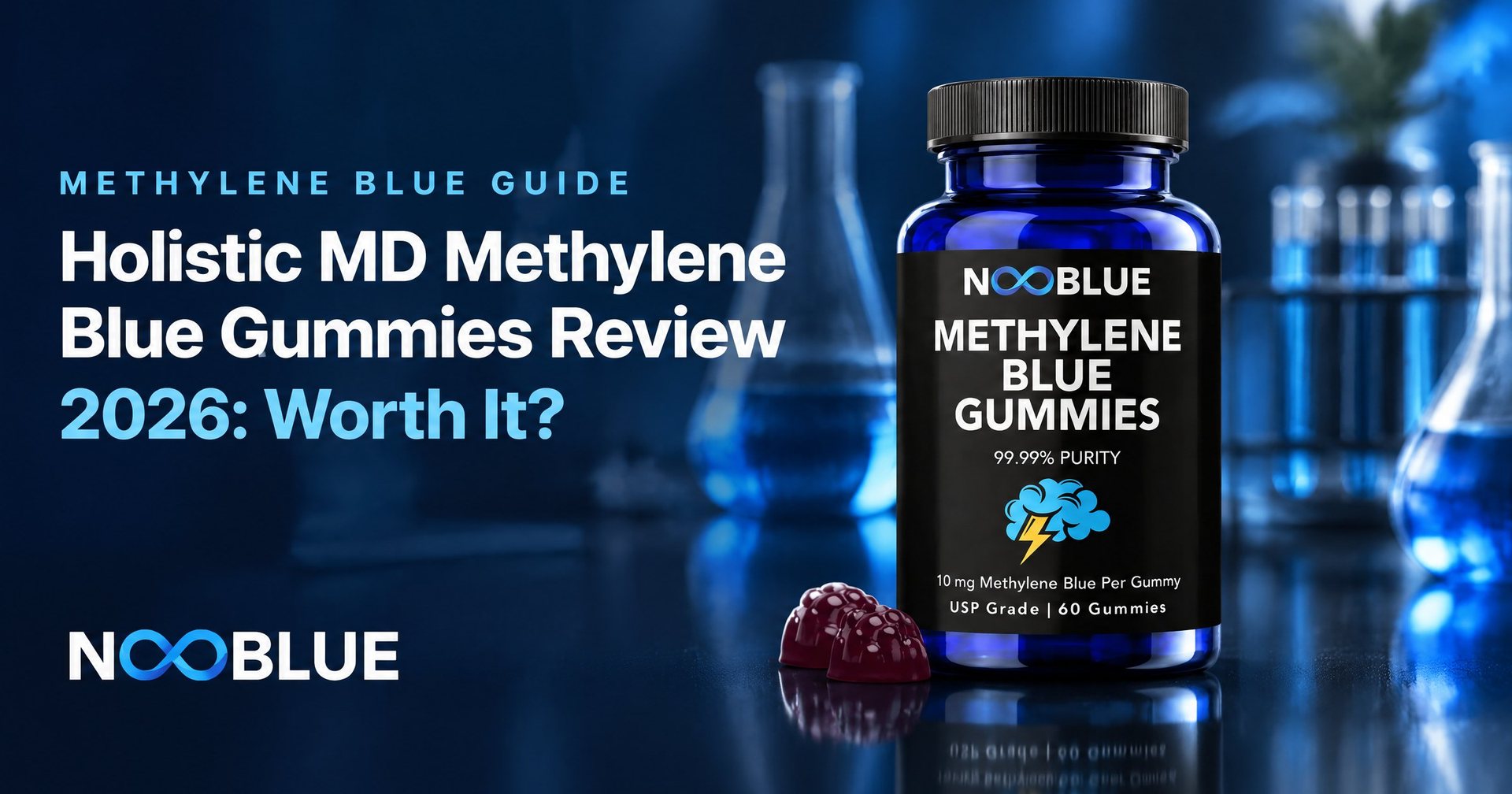
- Our pick for a methylene blue gummy is NooBlue: 10 mg with 25 mg of vitamin C, 0 g sugar, a linked ingredient test report, and no blue mouth.
- Methylene blue is not for anyone taking SSRIs, SNRIs, MAOIs or other serotonergic medicines, anyone with G6PD deficiency, anyone pregnant or breastfeeding, or anyone under 18.
Short answer: Holistic MD methylene blue gummies state their dose, which many gummies don’t, and can be cheap per milligram when a seller offer is available. But the listing is thin on proof, the buying channel is unreliable, and a fixed 7 mg step is coarse. Our pick for a methylene blue gummy is NooBlue’s 10 mg gummy.
This Holistic MD methylene blue gummies review covers what the Amazon listing actually states, whether 7 mg is a sensible dose, what the gummy format changes, how Holistic MD compares with NooBlue on price, proof and chemistry, what the research supports, and who should not take methylene blue at all. NooBlue makes methylene blue gummies, capsules and drops. They are our pick, and every figure for Holistic MD here comes from its Amazon listing, read in September 2026. For the wider field, see our comparison of the best methylene blue gummies, and if you are new to the format, start with what methylene blue gummies are.
Table of contents
- 1. What Holistic MD Methylene Blue Gummies Actually Deliver
- 2. Holistic MD Methylene Blue Gummies Dosing: Is 7 mg the Right Number?
- 3. Holistic MD vs NooBlue Methylene Blue Gummies
- 4. Holistic MD vs the 5 mg Marketplace Gummies
- 5. What the Research Supports About Low-Dose Methylene Blue
- 6. How to Take a Methylene Blue Gummy
- 7. Safety, Interactions and Who Should Skip Methylene Blue Gummies
- 8. The Verdict on Holistic MD Methylene Blue Gummies
- 9. Frequently Asked Questions
- 9.1. How many milligrams of methylene blue are in a Holistic MD gummy?
- 9.2. Where can you buy Holistic MD methylene blue gummies?
- 9.3. Are Holistic MD gummies third-party tested?
- 9.4. Do methylene blue gummies actually work?
- 9.5. What are the best methylene blue gummies on the market?
- 9.6. What are the potential side effects of taking methylene blue?
- 9.7. Can you cut a Holistic MD gummy in half for a smaller dose?
- 9.8. How do you take methylene blue gummies?
- 9.9. Is a gummy as good as capsules or drops?
- 9.10. Is it safe to take methylene blue gummies every day?
- 10. Sources
What Holistic MD Methylene Blue Gummies Actually Deliver
Here is what the Amazon listing (ASIN B0F322H18D) states, word for word where it matters:
| Attribute | What the listing states |
|---|---|
| Format | Sugar-free vegan gummies, gelatin free |
| Dose | “Methylene Blue 7mg and 14mg daily dose” |
| Count | 60 gummies (“60 servings”) |
| Grade | “USP Pharma Grade” in the title, “USP Food Quality” in the bullets |
| Testing | “3rd Party Certified”, with no lab or certificate named in the listing text |
| Flavor | Blueberry and blackberry |
| Availability | No featured offer when we checked, other sellers only |
The listing does not spell out milligrams per gummy. Read together, “7mg and 14mg daily dose” and 60 gummies point to 7 mg per gummy, with two gummies for 14 mg. We use that reading below, and it is worth confirming on the physical label.
Stating a milligram figure at all puts Holistic MD ahead of a slice of the category, where some gummies bury methylene blue in a blend. The weak spot is proof. “3rd Party Certified” without a named lab, a lot number or a document is a claim you cannot check, and the two grade descriptions do not match each other. If proof matters to you, ask the seller for a certificate of analysis tied to your lot, and use our guide to reading a methylene blue certificate of analysis to see what it covers. Our breakdown of what goes into methylene blue gummies shows how much of a gummy is base rather than active.
Holistic MD Methylene Blue Gummies Dosing: Is 7 mg the Right Number?
Dosing advice for methylene blue online contradicts itself, largely because very different uses get mixed together. Hospital use is intravenous, set by doctors and much larger. Supplement use is oral and in single-digit or low double-digit milligrams per day. Copying a clinical number into a daily routine is the most dangerous mistake in this category.
Against that background, 7 mg sits in the same low range as other supplement doses, and so does NooBlue’s 10 mg gummy. The issue is step size. Research on methylene blue describes a hormetic dose response, with opposite effects at low and high doses (Rojas et al., 2012), so more is not automatically better. A gummy gives you 7 mg or 14 mg and nothing in between, and you cannot split a gummy into an exact smaller dose. If you want to start lower or adjust in small steps, a 5 mg capsule or drops measured at 0.5 mg each do that better. Our guide to how many mg of methylene blue per day explains how the formats line up.
The gummy format has real strengths. People keep taking what tastes good, and a gummy is easier to stick with than a dropper that stains the counter. It also has trade-offs: a gummy is a candy-like base around a small active, it sits at room temperature for months, and its dose is a fixed step. We set out the details in how gummies compare with capsules and tablets and liquid drops compared.
Holistic MD vs NooBlue Methylene Blue Gummies
Both are sugar-free gummies that state a milligram figure, which already puts the pair ahead of much of the market. From there they differ on dose, proof, price and what else is in the chew. NooBlue makes the gummy in the first column, and it is our pick.
| Factor (as of Sep 2026) | NooBlue Methylene Blue Gummies | Holistic MD Methylene Blue Gummies |
|---|---|---|
| Methylene blue per gummy | 10 mg (one gummy daily) | 7 mg, with 14 mg for two (our reading of the listing) |
| Other actives | 25 mg vitamin C | None stated in the listing text |
| Sugar | 0 g total sugars, stevia-sweetened pectin chew | Sugar free, vegan |
| Blue mouth | No blue mouth or tongue | Not addressed in the listing |
| Testing you can read | CTLA report on the raw ingredient lot (identity plus four heavy metals), linked on the product page | “3rd Party Certified”, no document in the listing text |
| Price and methylene blue per pack | $49.99 for 600 mg | One Amazon offer from $23.95 for 420 mg (no featured offer) |
| Cost per mg | 8.3¢ | 5.7¢ at that offer |
| Where to buy | nooblue.com, free worldwide shipping over $100 | Amazon, other sellers |
| Best for | Our pick: a fixed 10 mg with vitamin C, no blue mouth and a document you can read | Lowest price per milligram, when that seller offer is available |
The split is plain. On price per milligram, Holistic MD wins when you can find the $23.95 offer, and we are not going to hide that. On everything you can verify before you buy, NooBlue is ahead: a clear per-gummy dose, a sugar-free base with its full ingredient list on the product page, a linked test report whose scope is stated, and a store that sells and ships the product directly. NooBlue’s gummies contain vitamin C, which can shift methylene blue toward its colorless form, and separately they don’t leave the blue mouth that drops can. Our explainer on leucomethylene blue covers the chemistry. We are also clear about the limits of our own report: it covers the raw methylene blue ingredient, not each finished batch, and it does not give a purity percentage.
Holistic MD vs the 5 mg Marketplace Gummies
Many gummy listings now sit at 5 mg per gummy. TrueHealthic’s gummies are 5 mg with 30 per bag at $29.99 on its own store, and Blue Organics’ are 5 mg with 30 per pouch at $36.00, with cane sugar and glucose syrup in the base. On step size, 5 mg is a gentler start than 7 mg. On price, both cost more per milligram than Holistic MD’s $23.95 offer or NooBlue’s gummies. If a 5 mg step is what you want, a 5 mg capsule gives it to you with no candy base at all. Our TrueHealthic gummies review and methylene blue gummies review go through more of the field.
What the Research Supports About Low-Dose Methylene Blue
The mechanism is interesting and worth stating precisely. A 2012 review in Progress in Neurobiology describes methylene blue at low doses as an electron cycler in the mitochondrial electron transport chain, and describes its hormetic dose response, with opposite effects at low and high doses (Rojas et al., 2012).
Human evidence is thinner. In a randomized, double-blind, placebo-controlled study of 26 healthy adults, a single 280 mg oral dose was followed an hour later by more activity in attention and memory regions and a 7% gain in correct memory-retrieval answers (Rodriguez et al., 2016). A companion analysis reported stronger resting-state connectivity between regions tied to perception and memory (Rodriguez et al., 2017). Those are measurable effects in people, but from one session at a dose equal to 40 Holistic MD gummies or 28 NooBlue gummies. They do not show a benefit from a daily gummy. Our look at whether methylene blue gummies are effective goes further.
How to Take a Methylene Blue Gummy
Whichever brand you choose, the same few habits make a gummy routine safer and easier to judge.
- Check the safety list below first. If any line applies to you, do not start.
- Follow the label serving and nothing more. NooBlue’s label is one gummy a day. For Holistic MD, the lower of its two listed amounts is one 7 mg gummy. Do not add a second methylene blue product on top, because the doses add up.
- Pick a fixed time. Taking it at the same time each day makes it easier to notice how it suits you. If you find it affects your sleep, take it earlier.
- Change one thing at a time. Starting methylene blue in the same week you change caffeine or sleep makes any effect impossible to read.
- Store it properly. Keep the bottle tightly closed in a cool, dry place, out of reach of children.
- Expect blue or green urine. It tells you the compound is being cleared, not that it is working or that one brand is better than another.
If you would rather measure your dose in small steps, drops give you that control, and our guide to methylene blue dosing by format shows how gummies, capsules and drops compare milligram for milligram.
Safety, Interactions and Who Should Skip Methylene Blue Gummies
Methylene blue is a potent inhibitor of the enzyme MAO-A (Ramsay et al., 2007), which is why it interacts dangerously with serotonergic medicines. These rules apply to every brand and format, ours included:
- Do not take methylene blue if you take an SSRI, SNRI, MAOI or any other serotonergic medicine, including many antidepressants. The combination can cause serotonin syndrome. See methylene blue and serotonin syndrome.
- Do not take it if you have G6PD deficiency. A standard clinical reference lists methylene blue as contraindicated because of the risk of hemolysis (StatPearls). See methylene blue and G6PD deficiency.
- Not for use during pregnancy or while breastfeeding.
- Not for anyone under 18. Gummies look like candy, so keep the bottle away from children.
- Methylene blue can turn urine blue or green. This is expected.
- Talk to your doctor before you start if you take any prescription medicine.
Stick to the label serving of whichever product you choose. Our guides to methylene blue gummy side effects and how to take methylene blue gummies cover the practical details.
The Verdict on Holistic MD Methylene Blue Gummies
Holistic MD methylene blue gummies are a reasonable product in a category with a low floor. They state a dose, they are sugar free and vegan, and at the $23.95 offer they are cheap per milligram. Against that, the listing offers no document behind its testing claim, gives two different grade descriptions, has no featured offer, and locks you into 7 mg steps.
Our pick is the NooBlue Methylene Blue Gummies: 10 mg of USP-grade methylene blue and 25 mg of vitamin C per gummy, 0 g sugar, no blue mouth, and a linked ingredient test report, at $49.99 for a 60-day supply. If you want to start below 10 mg, the 5 mg capsules at $37.99 are the gentler step, and the 1% drops at $29.99 let you set the dose drop by drop. Choose Holistic MD if the lowest price per milligram is all that matters and you can find a seller offer. The NooBlue shop ships free worldwide on orders of $100 or more.
Frequently Asked Questions
How many milligrams of methylene blue are in a Holistic MD gummy?
The Amazon listing gives “7mg and 14mg daily dose” options for 60 gummies, which reads as 7 mg per gummy and 14 mg for two. The listing does not spell out a per-gummy figure, so check the physical label.
Where can you buy Holistic MD methylene blue gummies?
The product is listed on Amazon. When we checked in September 2026, the listing showed no featured offer and was available only through other sellers, with one offer from $23.95 shown in an Amazon carousel. Check who the seller is and the return terms before you buy.
Are Holistic MD gummies third-party tested?
The listing says “3rd Party Certified” but names no lab and shows no certificate of analysis in its text. It also describes the grade two ways, “USP Pharma Grade” and “USP Food Quality”. Ask the seller for a certificate matching your lot if testing matters to you.
Do methylene blue gummies actually work?
A gummy delivers a measured dose if the label is accurate. Whether that dose does anything you can feel is less settled: the human studies used single oral doses of 280 mg, far above any gummy, and we found no trial of gummies as a format. Treat it as a supplement with an interesting mechanism and limited human data.
What are the best methylene blue gummies on the market?
Our pick is NooBlue Methylene Blue Gummies: 10 mg of methylene blue and 25 mg of vitamin C per gummy, 0 g sugar, no blue mouth, a linked ingredient test report, and 60 gummies for $49.99. Holistic MD can cost less per milligram when a seller offer is available. Our best methylene blue gummies guide compares the wider field.
What are the potential side effects of taking methylene blue?
Blue or green urine is expected. At the larger doses used in hospitals, a clinical reference lists headache, nausea and diarrhea among the common side effects. The serious risks are serotonin syndrome if combined with serotonergic medicines and hemolysis in people with G6PD deficiency. It is not for use in pregnancy, while breastfeeding or under 18. Talk to your doctor first if you take any prescription medicine.
Can you cut a Holistic MD gummy in half for a smaller dose?
Not reliably. A gummy does not split into exact halves, and you cannot know the methylene blue is spread evenly through it. If you want a smaller or adjustable dose, a 5 mg capsule or 1% drops at 0.5 mg per drop give you that control.
How do you take methylene blue gummies?
Chew one at the same time each day, at or below the label serving, and do not combine it with another methylene blue product. NooBlue’s label is one gummy daily. Hold the same dose for a few weeks before judging it, and stop if anything feels wrong. Read the safety list first, and talk to your doctor if you take any prescription medicine.
Is a gummy as good as capsules or drops?
For an exact, adjustable dose, capsules and drops are more precise: a capsule is filled to a set amount and drops can be counted at 0.5 mg each. A gummy is a fixed step you cannot split. For taste and sticking with a daily habit, a gummy is usually the easiest of the three, and NooBlue’s gummy avoids the blue mouth that drops can leave.
Is it safe to take methylene blue gummies every day?
Daily use at low supplement doses is common, but we found no long-term trial of daily use in healthy adults. Stay at the label serving, stop if anything feels wrong, and do not take it at all if you use serotonergic medicines, have G6PD deficiency, are pregnant or breastfeeding, or are under 18.
Sources
- Holistic MD. Methylene Blue for Humans gummies, Amazon listing B0F322H18D. amazon.com (read September 2026).
- Rojas JC, Bruchey AK, Gonzalez-Lima F. Neurometabolic mechanisms for memory enhancement and neuroprotection of methylene blue. Progress in Neurobiology. 2012;96(1):32-45. PubMed 22067440
- Rodriguez P, Zhou W, Barrett DW, et al. Multimodal randomized functional MR imaging of the effects of methylene blue in the human brain. Radiology. 2016;281(2):516-526. PubMed 27351678
- Rodriguez P, Singh AP, Malloy KE, et al. Methylene blue modulates functional connectivity in the human brain. Brain Imaging and Behavior. 2017;11(3):640-648. PubMed 26961091
- Ramsay RR, Dunford C, Gillman PK. Methylene blue and serotonin toxicity: inhibition of monoamine oxidase A (MAO A) confirms a theoretical prediction. British Journal of Pharmacology. 2007;152(6):946-951. PubMed 17721552
- Ostrovsky A, Afzal M. Methylene Blue. StatPearls. Updated January 2026. NCBI Bookshelf NBK557593
This article is for educational purposes only and is not medical advice. Talk to your doctor before starting methylene blue, especially if you take any prescription medicine. Competitor listings and prices were read in September 2026 and can change.