Written by the NooBlue editorial team. NooBlue makes and sells methylene blue, including the gummies we compare TrueHealthic against below. Every TrueHealthic figure comes from the brand’s own store, its Amazon listing, its Trustpilot page or its published lab report, checked on September 25, 2026. Each one is linked in the sources at the end.
Quick answer
TrueHealthic Methylene Blue Gummies are a 5 mg gummy sold 30 to a bag, for $29.99 on the brand’s store and $18.10 on Amazon (as of Sep 2026). The brand publishes a lab report on a finished gummy sample. It passed an identity and purity check and found trace mercury and lead, but it does not state how many milligrams each gummy contains. On Amazon the gummies average 3.8 out of 5 stars from 384 ratings. On Trustpilot the most common complaints are about membership billing rather than the gummy itself.
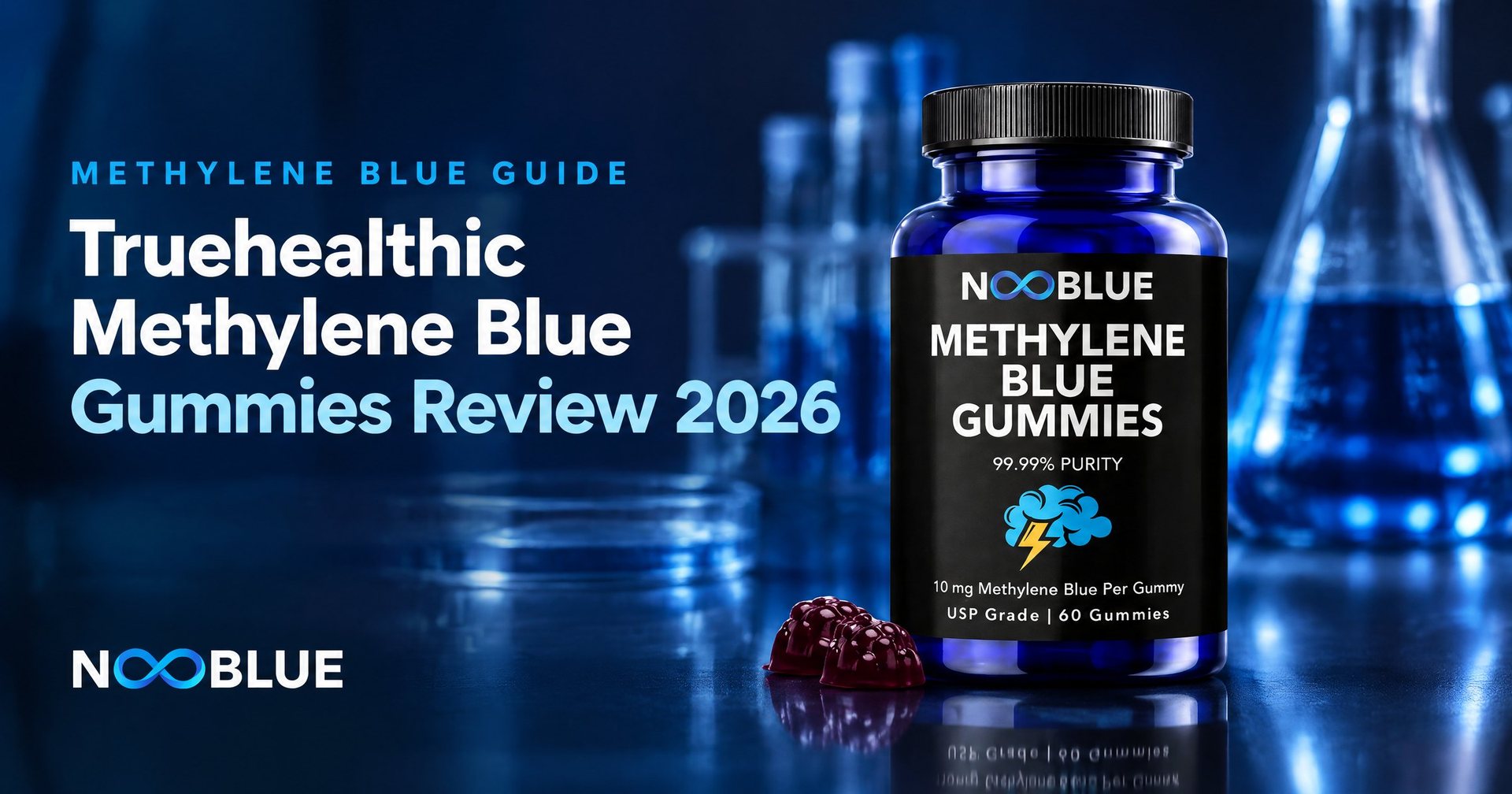
Our pick for a daily methylene blue gummy is NooBlue Methylene Blue Gummies: 10 mg of USP grade methylene blue and 25 mg of vitamin C per gummy, 0 g of sugar, and 60 gummies for $49.99. That works out to $0.42 per 5 mg of methylene blue, against $1.00 for TrueHealthic on its own store. NooBlue makes these gummies, so weigh our pick with that in mind.
Safety first: do not take methylene blue in any form if you take serotonergic medicines such as SSRIs or SNRIs, if you have G6PD deficiency, or if you are pregnant or breastfeeding.
People who search for TrueHealthic methylene blue gummies reviews usually want to know whether the product is real, whether it contains what the bag says, and whether the complaints are about the gummy or the company. We read the brand’s product page, its Amazon listing, its Trustpilot page and its lab report, then checked the claims against published research. We also compare it with the methylene blue gummy we make, and we say plainly where TrueHealthic comes out ahead.
Table of contents
- 1. TrueHealthic methylene blue gummies at a glance
- 2. What the TrueHealthic lab report shows
- 3. TrueHealthic methylene blue gummies reviews and complaints
- 4. The claims on the TrueHealthic page, checked
- 5. Do methylene blue gummies work? What the research shows
- 6. TrueHealthic vs NooBlue methylene blue gummies
- 7. Methylene blue gummies vs liquid and capsules
- 8. Safety: who should not take methylene blue gummies
- 9. Our verdict
- 10. Frequently asked questions
- 10.1. Are TrueHealthic methylene blue gummies legit?
- 10.2. How much methylene blue is in a TrueHealthic gummy?
- 10.3. Are Truehealthic methylene blue gummies safe?
- 10.4. What do TrueHealthic reviews and complaints say?
- 10.5. Do methylene blue gummies really work?
- 10.6. What should you not take with methylene blue?
- 10.7. Is methylene blue safe to take daily?
- 10.8. What are the best methylene blue gummies?
- 10.9. Methylene blue gummies vs liquid: which is better?
- 11. Sources
TrueHealthic methylene blue gummies at a glance
TrueHealthic sells a dark blue, raspberry flavored methylene blue gummy on its own store and on Amazon. This is what each page states. Prices are as of Sep 2026, before shipping.
| Detail | What TrueHealthic states |
|---|---|
| Methylene blue per gummy | 5 mg, described as USP grade |
| Gummies per bag | 30 on the brand store. Amazon also lists a 60 count. |
| Price | $29.99 for 30 on the brand store. On Amazon, $18.10 for 30 and $32.99 for 60. |
| Cost per gummy | $1.00 on the brand store, $0.60 (30 count) or $0.55 (60 count) on Amazon |
| Cost per mg of methylene blue | $0.20 on the brand store, $0.12 (30 count) or $0.11 (60 count) on Amazon |
| Directions | One gummy once daily (Amazon listing image) |
| Diet claims | Vegan, sugar free, gluten free, non GMO, blue raspberry flavor (Amazon listing) |
| Other ingredients named | Vitamins B2 and B3, NAC and PQQ appear in an Amazon listing image, with no amounts. We found no supplement facts panel on the brand store or the Amazon listing. |
| Purity claims | “99.9% Pure”, “USP-Grade”, “3rd Party Tested”, “Metal Free” |
| Lab report | ClearCert Laboratories, finished gummy sample, lot MB2402-BL30, dated November 7, 2025 |
| Guarantee | “60-Day Results Guarantee” on the brand store |
| Shipping | Orders “typically arrive within 5-7 business days”, with international shipping to most countries |
Two things stand out before you look at any claim. The dose is low. At 5 mg a gummy, TrueHealthic sits at the bottom of the usual gummy range, which suits a cautious start. The bag is small. Thirty gummies is one month at one a day, so the store price buys half the supply of a 60 count bottle, and the cost per milligram on the brand store is higher than the sticker suggests.
What the TrueHealthic lab report shows
The lab result on the TrueHealthic product page is a one page certificate from ClearCert Laboratories. It is issued to TrueHealthic LLC for a sample named “TrueHealthic Methylene Blue Gummies”, lot MB2402-BL30. The lab received the sample on October 29, 2025 and dated the report November 7, 2025.
What the report shows:
- An identity and purity result of “Conforms”. The note under the table says this means the methylene blue “met Chromatographic Purity”.
- Heavy metals tested by USP method 233. Arsenic and cadmium were below the 0.001 ppm detection limit. Mercury measured 0.030 ppm and lead 0.005 ppm.
What the report does not show:
- How many milligrams of methylene blue are in a gummy. There is no potency or assay line, so the report cannot confirm the 5 mg on the bag.
- A purity number. The product page and the bag say 99.9% pure. The report says “Conforms” and gives no percentage.
- Zero metals. The page says “Metal Free”, but the report measured small amounts of mercury and lead. Parts per million are tiny amounts, and every specification cell on the report reads “Report”, so no pass or fail limit was set. Even so, “metal free” is a stronger claim than the report makes.
- Microbial results. There are no lines for bacteria, yeast or mold.
- A lab address or accreditation number, so the document alone does not let you look the lab up.
In fairness, the TrueHealthic report does one thing ours does not: it tests a sample named as the finished gummy. The report NooBlue publishes comes from Contract Testing Laboratories of America (CTLA) in Spanish Fork, Utah, and covers a methylene blue ingredient lot (2025022801), not the finished gummy. It records an HPLC identity result of “Conforms”, with arsenic, mercury and lead below 0.001 ppm and cadmium at 0.010 ppm. Like TrueHealthic’s, it gives no purity percentage, and it does not certify every batch. Our guide to reading a methylene blue certificate of analysis explains the difference between an ingredient report and a finished product report, and what to ask a brand for.
If you already have a TrueHealthic bag, compare the lot number printed on it with MB2402-BL30. If they differ, ask the brand for the report on your lot. The same check works for any brand, and our guide to telling real methylene blue from fake covers the other warning signs.
TrueHealthic methylene blue gummies reviews and complaints
TrueHealthic reviews look very different depending on where you read them.
- Brand store: the product page shows a 4.8 star average. The review widget further down reports 5,858 reviews, with 87% at five stars and 5% at one star. The header above it says 5,343+, so the two totals on the same page do not match.
- Amazon: 3.8 out of 5 from 384 ratings, shared by the 30 and 60 count listings. Amazon shows the 30 count as first available on November 11, 2025.
- Trustpilot: a TrustScore of 2.5 out of 5 from 60 reviews of the company. Trustpilot also shows that TrueHealthic replied to 97% of its negative reviews.
The positive Amazon reviews we read mention more energy, better focus, an easy chew and only needing one gummy a day. Several reviewers like that the gummies are vegan. Those are real buyer reports. They are also single experiences without a placebo, so they cannot tell you whether the methylene blue or the new routine made the difference.
The complaints fall into two groups.
“It did nothing.” Critical reviews on Amazon say the gummies “did not help” or do not do what the brand claims. One reviewer who had taken liquid methylene blue for a year and a half wrote that the gummies never turned their urine blue, and doubted the product’s quality. A review cannot prove that. What we can say is that the published lab report has no milligram figure that would settle the question. A three star reviewer reported a bad headache.
Billing and membership. On Trustpilot, the complaints are mostly about the company rather than the gummy. Reviewers describe charges for a “VIP” service they say they never agreed to, monthly charges they did not expect, and trouble cancelling. Trustpilot’s own summary says customers “consistently express strong dissatisfaction with the subscription process”. The TrueHealthic store menu includes “Members-Only” and “Cancel Subscription” links. If you buy from the brand store, read the checkout page for any membership or subscription option before you pay, and check your card statement afterward.
If you are weighing TrueHealthic against other labels, our methylene blue gummies review audits the paperwork of eight gummy brands, and our NooBlue vs Meraki methylene blue comparison runs the same checks on a liquid brand.
The claims on the TrueHealthic page, checked
The TrueHealthic product page makes strong claims. Here is how the main ones hold up against the page’s own links and the research.
The statistics. The page lists “97% Experienced an Increase in Energy”, “94% Reported Reduced Brain Fog” and “84% Felt a Noticeable Improvement in Mood”, along with “2.4X” focus and “2.7X” slower cellular aging. Each figure has a “See the Study” button. All of those buttons, and the five “View Study” buttons further down, link to the same page: the StatPearls chapter on methylene blue, a clinical drug reference for health professionals. That chapter covers methylene blue’s hospital uses, dosing and safety. It does not report these percentages, and we found no survey or trial of TrueHealthic gummies that does.
The experts. The page quotes four people with titles, such as “Neurobiology Researcher, MIT”. It does not link to their work, so we could not check the quotes.
Safety. The FAQ answers “Is it safe?” with “Yes” and calls methylene blue “well-tolerated, non-toxic”. For people on SSRIs, SNRIs, MAO inhibitors and other antidepressants, it says to consult your doctor before use. The medical reference the page links to is firmer. StatPearls says methylene blue should not be combined with serotonergic drugs or opioids, because of the risk of serotonin syndrome, and lists G6PD deficiency as a contraindication. The safety section below has the details.
Nerve claims. Two product images promise week by week relief from nerve pain, tingling and burning over eight weeks, with a before and after photo. We found no clinical trial of methylene blue gummies for nerve symptoms. Nerve pain or numbness needs a diagnosis from a doctor, not a supplement.
What holds up. The dose on the bag is modest, the page does warn about serotonergic medicines, and the lab report does test a finished gummy sample. Those are real points in the product’s favor.
Do methylene blue gummies work? What the research shows
We found no clinical trial of any methylene blue gummy, TrueHealthic’s or ours. The human evidence for low dose methylene blue comes from small studies of capsules and solutions.
The best known is a randomized, double-blind, placebo-controlled trial from the University of Texas, published in Radiology in 2016 by Rodriguez and colleagues. It enrolled 26 healthy adults aged 22 to 62. Half took a single oral dose of 280 mg of USP methylene blue, about 4 mg/kg, and were scanned an hour later. The methylene blue group showed more brain activity during attention and short term memory tasks, and a 7% increase in correct answers during memory retrieval (PubMed).
Two details matter for a gummy buyer. The first is the dose. That 280 mg is the methylene blue in 56 TrueHealthic gummies or 28 NooBlue gummies, and nobody should try to copy it with gummies. The second is timing. The effect was measured once, one hour after one dose. The study did not test daily use over weeks.
Researchers describe the dose response of methylene blue as hormetic. The same paper notes memory effects in animals and humans in a low range of 0.5 to 4 mg/kg, and opposite effects above 10 mg/kg (full text). A 2014 review in Biochemical Pharmacology by Gonzalez-Lima, Barksdale and Rojas sets out the proposed mechanism: at low doses methylene blue can increase mitochondrial respiration in brain cells (PubMed). Much of the mechanism work is in animals and cells, so it does not show what a 5 mg or 10 mg gummy does for a healthy adult.
The ingredient has promising early human data, at doses far above a gummy. At gummy doses, the evidence is what buyers report, and those reports vary. Our breakdown of whether methylene blue gummies are effective goes through the studies one by one, and our evidence audit of gummy benefits separates what has been measured from what is marketing.
TrueHealthic vs NooBlue methylene blue gummies
NooBlue makes the first product in this table, so read it knowing that. We list the rows where TrueHealthic is ahead as well as the ones where we are. Prices are as of Sep 2026.
| Detail | NooBlue Methylene Blue Gummies | TrueHealthic Methylene Blue Gummies |
|---|---|---|
| Methylene blue per gummy | 10 mg, USP grade | 5 mg, described as USP grade |
| Other actives | 25 mg vitamin C | Vitamins B2 and B3, NAC and PQQ named on Amazon, amounts not shown |
| Gummies per pack | 60 | 30 (60 on Amazon) |
| Price | $49.99 | $29.99 brand store, $18.10 Amazon |
| Cost per 5 mg of methylene blue | $0.42 | $1.00 brand store, $0.60 Amazon |
| Sugar | 0 g per gummy, on the supplement facts panel | “Sugar free” on Amazon, no facts panel found |
| Flavor | Wild Blueberry, pectin chew | Blue raspberry |
| Lab report | CTLA, methylene blue ingredient lot: identity conforms, four heavy metals listed | ClearCert, finished gummy sample: identity and chromatographic purity conform, four heavy metals listed |
| Milligram assay published | No | No |
| Purity percentage claimed | None | 99.9% |
| Mouth staining | The product FAQ says they do not leave a blue mouth | Not stated |
| Money back | 30-day returns | 60-Day Results Guarantee |
| Shipping | Free worldwide on orders of $100 or more, dispatch in 1 to 2 business days with tracking | Typically arrives in 5-7 business days, ships to most countries |
Where TrueHealthic is ahead: a lower price for a first try, especially on Amazon, a longer money-back window, and a lab report on a finished gummy sample rather than the raw ingredient.
Where NooBlue is ahead: twice the methylene blue per gummy, and twice the gummies of the TrueHealthic store bag. The cost per milligram is less than half of TrueHealthic’s own store price. Our product page shows a full supplement facts panel, and it says what our lab report does not cover. Buying more than one bottle lowers the price further: 2 bottles are $89.98 (save 10%), 3 are $127.47 (save 15%) and 5 are $199.96 (save 20%), which brings a gummy down to $0.67.
TrueHealthic may suit you if you want the smallest outlay for a first month at 5 mg and you are happy to buy on Amazon.
NooBlue may suit you better if you want a 10 mg daily gummy with the supplement facts on the page, a 60 day supply per bottle and a lower cost per milligram. If 10 mg feels like too much to start, our 5 mg methylene blue capsules match TrueHealthic’s dose at $0.63 a capsule, $37.99 for 60. For a brand level view, see our NooBlue vs TrueHealthic methylene blue comparison, and for what vitamin C does in our gummy, read our explainer on leucomethylene blue.
Methylene blue gummies vs liquid and capsules
Gummies are the easiest format to take and the least flexible. A gummy fixes the dose at whatever the label says, 5 mg for TrueHealthic or 10 mg for NooBlue, and you cannot split one accurately. Liquid drops let you choose. Our 1% methylene blue drops give 0.5 mg per drop, so 10 drops make 5 mg. A 50 ml bottle holds about 100 servings of 5 mg for $29.99, or $0.30 per serving. The tradeoff is that you measure every dose, and the deep blue solution can stain the mouth and tongue, which the gummies do not.
Capsules sit in between. They have a fixed dose like a gummy, with no taste and no blue mouth. Choose a gummy if you tend to skip anything that takes effort. Choose drops if you want to start below 5 mg or adjust in small steps. Our full methylene blue gummies vs liquid comparison and our gummies vs capsules breakdown go further, and our guide on how to take methylene blue gummies covers timing and a first week routine.
Safety: who should not take methylene blue gummies
Methylene blue is a prescription drug as well as a supplement ingredient. The safety rules are the same whichever brand or format you choose.
Do not take methylene blue gummies if you:
- take an SSRI, SNRI, MAOI or other serotonergic medicine, or an opioid. Methylene blue is a potent, reversible inhibitor of MAO-A, the enzyme that breaks down serotonin (Ramsay and colleagues, British Journal of Pharmacology, 2007). A systematic review found 26 patients who developed acute confusion after methylene blue infusions, and 24 of them were taking a serotonin reuptake inhibitor (Ng and Cameron, Psychosomatics, 2010). Those were hospital doses given into a vein, far above a gummy, but StatPearls advises avoiding the combination altogether.
- have G6PD deficiency. Methylene blue can cause hemolysis in people with this enzyme deficiency, and StatPearls lists it as a contraindication.
- are pregnant or breastfeeding. StatPearls notes that methylene blue may cause fetal harm when given during pregnancy.
Talk to your doctor or pharmacist before you start if you take any prescription medicine.
What to expect if you do take it: urine can turn blue or green. In the Radiology trial, every participant who took methylene blue reported blue urine afterward. StatPearls lists headache and diarrhea among reported adverse effects, and one TrueHealthic reviewer on Amazon described a strong headache.
Is methylene blue safe to take every day? We found no published trial of daily methylene blue gummies over months, from any brand. If you take a gummy daily, keep to the label dose, stop if you feel unwell, and tell your doctor. Our guides to methylene blue gummies side effects and what not to take with methylene blue cover the interactions in more depth.
Our verdict
Our pick is NooBlue Methylene Blue Gummies. NooBlue makes them, and we think they are the better daily gummy on label facts: 10 mg of methylene blue with 25 mg of vitamin C in each gummy, 60 gummies per bottle, and $0.42 per 5 mg against TrueHealthic’s $1.00 on its own store.
TrueHealthic’s gummies are a real product, and the lab report on a finished gummy sample counts in their favor. The weak points are the gap between the marketing and the paperwork (99.9% and “Metal Free” on the page, no percentage and trace metals in the report), the missing milligram assay and supplement facts panel, and the billing complaints on Trustpilot. If you buy them, buy on Amazon for the lower price, check your lot number against the report, and keep to one gummy a day.
Want to compare more gummies first? Our best methylene blue gummies guide ranks the gummies you can buy in the US by dose, count and price, and our roundup of the best methylene blue supplements covers capsules and drops too. You can see all three NooBlue formats in the NooBlue shop, with free worldwide shipping on orders of $100 or more.
Frequently asked questions
Are TrueHealthic methylene blue gummies legit?
They are a real product, sold on the brand’s own store and on Amazon, with a lab report on a finished gummy sample (lot MB2402-BL30) showing the methylene blue passed an identity and chromatographic purity check. The marketing goes further than that paperwork. The page claims 99.9% purity and “Metal Free”, while the report gives no purity percentage and measured trace mercury and lead. On Trustpilot the company scores 2.5 out of 5, and the complaints there center on membership billing.
How much methylene blue is in a TrueHealthic gummy?
The label says 5 mg per gummy and 30 gummies per bag, which is 150 mg per bag. The published lab report has no milligram assay, so it does not confirm that figure. NooBlue Methylene Blue Gummies list 10 mg per gummy on their supplement facts panel. Our ingredient report does not measure milligrams in the finished gummy either.
Are Truehealthic methylene blue gummies safe?
At 5 mg a gummy the dose is low, and the same rules apply as for any methylene blue product. Do not take it with SSRIs, SNRIs, MAOIs or other serotonergic medicines, or if you have G6PD deficiency or are pregnant or breastfeeding. TrueHealthic’s page tells people on these medicines to consult a doctor, while the medical references advise avoiding the combination. Urine may turn blue or green, and some people report headaches.
What do TrueHealthic reviews and complaints say?
On Amazon the gummies average 3.8 out of 5 from 384 ratings. Positive reviews mention energy, focus and an easy chew. Negative reviews say the gummies did nothing, and one reviewer reported a headache. On Trustpilot, TrueHealthic has a TrustScore of 2.5 from 60 reviews, and the most common complaints are charges for a VIP membership that reviewers say they did not agree to and difficulty cancelling. The brand’s own store shows 4.8 stars.
Do methylene blue gummies really work?
We found no clinical trial of any methylene blue gummy. The human studies used single doses far above a gummy, such as 280 mg in a 2016 trial of 26 healthy adults, which found a 7% increase in correct memory retrieval answers one hour later. At gummy doses of 5 to 10 mg, the evidence is what buyers report, and those reports vary.
What should you not take with methylene blue?
Do not combine it with serotonergic medicines, such as SSRIs, SNRIs and MAOIs, or with opioids. Methylene blue strongly inhibits MAO-A, and the combination can cause serotonin syndrome. Ask a pharmacist to check any prescription medicine before you start.
Is methylene blue safe to take daily?
We found no published trial of daily methylene blue gummies over months. If you take it daily, keep to one gummy a day as the label directs, and stop and talk to a doctor if you feel unwell. Anyone taking serotonergic medicines, with G6PD deficiency, or who is pregnant or breastfeeding should not take it at all.
What are the best methylene blue gummies?
Our pick is NooBlue Methylene Blue Gummies, which we make: 10 mg of USP grade methylene blue and 25 mg of vitamin C per gummy, 0 g of sugar, and 60 per bottle for $49.99. If you want a 5 mg gummy for the smallest outlay, TrueHealthic costs $18.10 for 30 on Amazon. Our best methylene blue gummies guide compares the other options.
Methylene blue gummies vs liquid: which is better?
Gummies are easier and have a fixed dose. Liquid drops let you adjust in small steps, 0.5 mg per drop with NooBlue’s 1% solution, and cost less per serving than our gummies, but they can stain the mouth and tongue and need measuring. Choose a gummy for an easy routine and drops for control.
Sources
- TrueHealthic Methylene Blue Gummies, brand store product page, checked September 25, 2026: truehealthic.com
- TrueHealthic lab report, ClearCert Laboratories, lot MB2402-BL30, dated November 7, 2025 (image on the product page): report image
- TRUEHEALTHIC Methylene Blue Gummies on Amazon, 30 count and 60 count, checked September 25, 2026
- Truehealthic on Trustpilot, checked September 25, 2026: trustpilot.com
- NooBlue Methylene Blue Gummies, supplement facts and CTLA ingredient report 135621: product page
- Rodriguez P, Zhou W, Barrett DW, et al. Multimodal randomized functional MR imaging of the effects of methylene blue in the human brain. Radiology. 2016;281(2):516-526. PubMed
- Gonzalez-Lima F, Barksdale BR, Rojas JC. Mitochondrial respiration as a target for neuroprotection and cognitive enhancement. Biochemical Pharmacology. 2014;88(4):584-593. PubMed
- Ramsay RR, Dunford C, Gillman PK. Methylene blue and serotonin toxicity: inhibition of monoamine oxidase A (MAO A) confirms a theoretical prediction. British Journal of Pharmacology. 2007;152(6):946-951. PubMed
- Ng BK, Cameron AJ. The role of methylene blue in serotonin syndrome: a systematic review. Psychosomatics. 2010;51(3):194-200. PubMed
- Ostrovsky A, Afzal M. Methylene Blue. StatPearls. StatPearls Publishing. NCBI Bookshelf
This article is for education and is not medical advice. Talk to a qualified healthcare professional before starting methylene blue, especially if you take any medication or have a health condition.