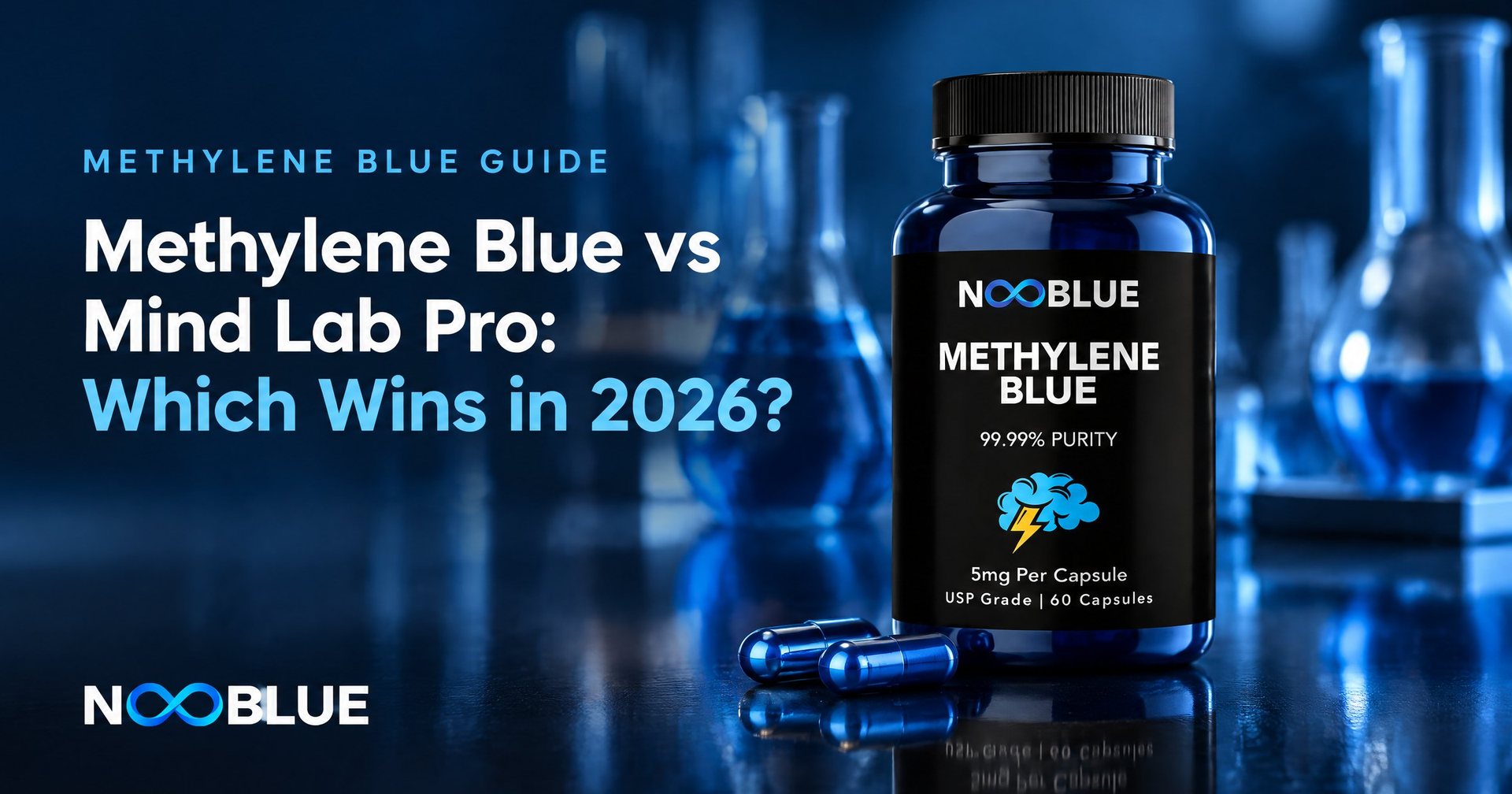
Quick answer: In the methylene blue vs Mind Lab Pro choice, our pick is methylene blue, and specifically NooBlue’s 5 mg capsules, for readers who want one ingredient, a dose they control and a low daily cost: $0.63 a day against $2.30 for a 2-capsule serving of Mind Lab Pro at its one-time price. Mind Lab Pro has one real advantage: it is the only one of the two with a trial of the finished product, a 30-day memory study funded by its parent company. Methylene blue also carries stricter safety rules. Never take it with SSRIs, SNRIs, MAOIs or other serotonergic medicines, with G6PD deficiency, while pregnant or breastfeeding, or under 18. NooBlue makes methylene blue products. We don’t sell Mind Lab Pro.
Key takeaways
- Methylene blue is one compound. Mind Lab Pro is an 11-ingredient formula built around citicoline, bacopa and lion’s mane.
- The human brain-imaging data on methylene blue come from a single 280 mg dose, 28 to 56 times a supplement serving. No trial has tested 5 to 10 mg a day.
- Mind Lab Pro has a 30-day memory trial of the whole formula (49 adults finished it), paid for by its parent company.
- Cost per day: $0.63 for a NooBlue capsule, $2.30 for Mind Lab Pro at 2 capsules and $4.60 at its 4-capsule maximum (one-time prices, Sep 2026).
- Neither contains caffeine. Methylene blue has the stricter interaction rules, so read the safety section before you pick either one or stack them.
Table of contents
- 1. Methylene blue vs Mind Lab Pro at a glance
- 2. The core difference: one molecule vs eleven ingredients
- 3. How methylene blue works, and what the human studies used
- 4. How Mind Lab Pro works, and what its studies show
- 5. Cost: what each one costs per day
- 6. Safety: where the two differ most
- 7. What the skeptics say about both
- 8. Which one should you choose?
- 9. If you choose methylene blue: how to start
- 10. Frequently asked questions
- 10.1. Is methylene blue a nootropic?
- 10.2. Can you take methylene blue and Mind Lab Pro together?
- 10.3. Which is better for focus, methylene blue or Mind Lab Pro?
- 10.4. How long does each one take to work?
- 10.5. Does Mind Lab Pro actually work?
- 10.6. Which methylene blue is legit?
- 10.7. Is Mind Lab Pro the same as “Mind Blue”?
- 10.8. Is methylene blue cheaper than Mind Lab Pro?
- 11. Sources
Methylene blue vs Mind Lab Pro at a glance
Here is the head-to-head on the details that change the decision. Figures come from each product’s own page and label, as of Sep 2026.
| Factor | NooBlue methylene blue capsules (our pick) | Mind Lab Pro |
|---|---|---|
| What it is | One compound: USP methylene blue | An 11-ingredient nootropic formula |
| Per serving | 5 mg methylene blue plus 10 mg vitamin C | Citicoline 250 mg, lion’s mane 500 mg, N-acetyl L-tyrosine 175 mg, bacopa 150 mg (24% bacosides), phosphatidylserine 100 mg, L-theanine 100 mg, maritime pine bark extract 75 mg, rhodiola 50 mg, vitamin B6 2.5 mg, folate 100 mcg, vitamin B12 7.5 mcg |
| How to take it | 1 capsule a day with food | 2 to 4 capsules a day, morning or early afternoon, on an empty stomach |
| Price | $37.99 for 60 capsules | $69.00 for 30 two-capsule servings ($62.10 on a monthly subscription) |
| Cost per day | $0.63 | $2.30 at 2 capsules, $4.60 at 4 capsules (one-time price) |
| Dose control | Fixed 5 mg, or 0.5 mg steps with NooBlue drops | Fixed blend, so no single ingredient can be adjusted on its own |
| Human evidence | Two brain-imaging studies of a single 280 mg dose (26 and 28 participants), none at supplement doses | One 30-day memory study of the formula (49 completers), funded by its parent company, plus studies of single ingredients |
| Caffeine | None | None |
| Main safety limits | Never with serotonergic medicines, G6PD deficiency, pregnancy, breastfeeding or under 18 | Several actives to check against any medicine you take, including rhodiola |
| Best for | One ingredient, a precise dose and the lowest daily cost | An all-in-one capsule with a trial on the finished formula |
NooBlue makes the methylene blue capsules in the left column, and they are our pick. Read the table as a brand’s comparison, not a neutral review. Every figure in it can be checked on the two product pages linked in the sources.
The core difference: one molecule vs eleven ingredients
The simplest way to frame methylene blue vs Mind Lab Pro is single compound versus blend. Methylene blue is one molecule taken in milligram amounts. It moves electrons in and out of its own structure, and at low concentrations it can pass them along the chain inside mitochondria that makes cellular energy. NooBlue sells it in three formats: 5 mg capsules, 10 mg gummies and 1% drops.
Mind Lab Pro takes the opposite approach. Each 2-capsule serving packs in eleven ingredients: citicoline, bacopa, lion’s mane, phosphatidylserine, N-acetyl L-tyrosine, L-theanine, rhodiola, maritime pine bark extract and three B vitamins. The brand describes this as covering several brain pathways at once. That breadth is the selling point, and it has a cost: if you feel a change, you can’t tell which ingredient caused it, and you can’t raise one without raising all eleven.
Neither approach is better by default. A blend is convenient. A single compound is easier to dose, easier to check and easier to reason about when you want to know what is doing what. That difference runs through everything else in this comparison. For the wider picture on the single-compound side, our overview of what the research shows about methylene blue is a good place to start.
How methylene blue works, and what the human studies used
Methylene blue acts at the level of the cell. A 2012 review in Progress in Neurobiology by Rojas, Bruchey and Gonzalez-Lima describes it as an electron cycler in the mitochondrial respiratory chain, with a hormetic dose-response: low doses and high doses have opposite effects. That is why the dose matters so much with this compound, and why more is not better.
The human brain data come from one research group. In a 2016 randomized, double-blind trial in Radiology, 26 healthy adults took either a single 280 mg oral dose of USP methylene blue (about 4 mg/kg) or a placebo, and had functional MRI scans an hour later. The methylene blue group showed more brain activity during attention and short-term memory tasks and a 7% increase in correct answers on a memory-retrieval test. A 2017 follow-up in Brain Imaging and Behavior gave the same single 280 mg dose to 28 participants and found changes in how brain networks linked up at rest and during a task.
The honest limit: 280 mg is 28 to 56 times a 5 to 10 mg supplement serving, and it was given once. No trial has tested what a daily supplement dose of methylene blue does for focus or memory over weeks. What the pharmacology does show is that methylene blue is well absorbed by mouth. A study in 16 healthy volunteers measured an absolute oral bioavailability of 72.3% after a single 500 mg dose (Walter-Sack 2009). If mental fatigue is your main reason for looking, our guide to methylene blue for brain fog covers the cellular-energy angle in more depth.
How Mind Lab Pro works, and what its studies show
Mind Lab Pro works through its ingredients, so most of its evidence is the evidence behind each one. Its lead ingredient is citicoline, sold under the Cognizin brand, a source of choline, which the brain uses to make acetylcholine. In a two-week placebo-controlled study of 40 healthy volunteers, 500 mg of citicoline a day improved vigilance and visual working memory (Al-Kuraishy 2020). A 2-capsule serving of Mind Lab Pro contains 250 mg of citicoline, half that amount. At the 4-capsule maximum it reaches 500 mg.
Unlike most blends, Mind Lab Pro also has a trial of the finished formula. In a 2023 study in Human Psychopharmacology, 49 healthy adults aged 20 to 68 completed 30 days of either Mind Lab Pro (36 people) or a placebo (13 people). The Mind Lab Pro group improved on every memory subtest of the Wechsler Memory Scale, and the two groups differed on immediate and delayed recall (Abbott-Imboden 2023). Three caveats are worth knowing. The authors describe the allocation as “pseudo randomised”, the placebo group was small, and Mind Lab Pro’s own page says the study was funded by its parent company, Performance Lab Group. The page lists three studies in total and says two were funded by Performance Lab.
Put side by side, the evidence splits in an interesting way. Methylene blue has independent human data on the compound itself, but at a dose far above what supplements contain. Mind Lab Pro has data on the product people actually buy, at the dose on the label, but from a sponsor-funded study with a small control group. Neither has the long-term daily-use trial a cautious reader would want.
Cost: what each one costs per day
Cost is where the gap is widest. These are the prices on each brand’s own site as of Sep 2026.
| Product | Price | Servings | Cost per day |
|---|---|---|---|
| NooBlue capsules, 60 x 5 mg | $37.99 | 60 (one a day) | $0.63 |
| NooBlue drops, 1%, 50 mL | $29.99 | About 100 servings of 5 mg | $0.30 |
| NooBlue gummies, 60 x 10 mg | $49.99 | 60 (one a day) | $0.83 |
| Mind Lab Pro, one-time | $69.00 | 30 at 2 capsules, 15 at 4 capsules | $2.30 to $4.60 |
| Mind Lab Pro, monthly subscription | $62.10 | 30 at 2 capsules | $2.07 |
NooBlue’s product pages also show 10% off two bottles, 15% off three and 20% off five, and orders of $100 or more ship free worldwide with 30-day returns. Mind Lab Pro offers 10% off a monthly subscription and 25% off a 4-month subscription ($51.75 a month). Even at its best subscription price, a daily 2-capsule serving of Mind Lab Pro costs more than twice as much as a NooBlue capsule.
Safety: where the two differ most
Methylene blue has the stricter rules, and they apply at every dose. It inhibits the enzyme MAO-A, and a 2011 review found that 13 of 14 reported cases of serious nervous-system toxicity linked to it were serotonin toxicity, set off by combining it with serotonin reuptake inhibitors (Gillman 2011).
Methylene blue safety: read before use
- Do not take it with SSRIs, SNRIs, MAOIs or any other serotonergic medicine, including many antidepressants. The combination can cause serotonin syndrome.
- Do not take it if you have G6PD deficiency.
- Not for use during pregnancy or while breastfeeding.
- Not for anyone under 18.
- It can turn urine blue or green. This is expected.
- Talk to your doctor before use if you take any prescription medicine.
The same list sits in the “Safety: read before use” box on every NooBlue product page. Our guides to what not to take with methylene blue and who should not take methylene blue go through the full lists.
Mind Lab Pro’s safety picture is spread across eleven ingredients. More actives means more to check, so if you take any medicine, go through its label with a pharmacist before you start. One ingredient deserves a mention when methylene blue is in the picture: in a laboratory study, extracts of rhodiola root inhibited both MAO-A and MAO-B (van Diermen 2009). That was a test-tube result, not a human one, but it is a reason not to combine the two products casually.
Can you stack them?
No study has tested methylene blue and Mind Lab Pro together. If you want to try both, ask a pharmacist first, start one product at a time so you can tell what each one does, and keep methylene blue at the low supplement doses on our labels. The rule on serotonergic medicines doesn’t change: if you take one, methylene blue is off the table, with or without Mind Lab Pro.
What the skeptics say about both
Pharmacologists writing for general readers are cool on methylene blue as a brain booster. Their points are fair. The human cognition data come from a single 280 mg dose measured by brain scans, not from months of daily use at supplement doses. A mechanism is not an outcome. And the compound carries a real interaction hazard with serotonergic drugs. We agree with all three, which is why this page leads with the dose and the safety list.
Mind Lab Pro draws a similar critique from another angle. Its one formula trial was small, sponsor-funded and only pseudo-randomized, and its 2-capsule serving holds half the citicoline used in the citicoline trial cited above. The practical difference between the two is how easy each is to check: one compound with one ingredient report is simpler to reason about than eleven ingredients you can’t separate.
Which one should you choose?
Choose methylene blue (our pick) if you want to know exactly what you are taking, control the dose, and pay the least per day. NooBlue’s methylene blue capsules give a fixed 5 mg with 10 mg of vitamin C for $0.63 a day. The 1% drops let you adjust in 0.5 mg steps, and the gummies give a fixed 10 mg without the blue mouth that drops can leave. If you are comparing capsule brands, our best methylene blue capsules guide sets eight of them side by side.
Choose Mind Lab Pro if you would rather not think about single ingredients, want broad coverage in one capsule, value a trial on the finished formula, and are comfortable paying $2.07 to $4.60 a day for it. If you take a serotonergic medicine, methylene blue is not an option, and any nootropic, Mind Lab Pro included, should be cleared with your doctor first.
For most readers weighing the two, the deciding factors are control and cost. NooBlue publishes a report from Contract Testing Laboratories of America (CTLA) on its methylene blue ingredient: an HPLC identity result of “Conforms” and results for arsenic, cadmium, mercury and lead. It covers the raw ingredient rather than every finished batch, and you can read it on our quality page. You can learn more about who we are on our about page.
Weighing other options too? We compare methylene blue with Alpha Brain, with modafinil and with CoQ10, and set it against the wider field in methylene blue vs other nootropics and our list of the best methylene blue nootropics.
If you choose methylene blue: how to start
- Check the safety list above against every medicine and supplement you take.
- Take 5 mg a day with food for the first week: one capsule, or 10 drops of a 1% solution in water.
- If that sits well and you want more, move to 10 mg a day (one gummy, or 20 drops). Our labels stop at 10 mg.
- Expect blue or green urine. It is normal.
Our guide to how many mg of methylene blue to take per day covers drops, body weight and the reasons behind the 10 mg ceiling. If you are unsure about format, capsules vs liquid walks through the trade-offs, and pharmaceutical grade methylene blue capsules explains what the grade on a label means. Browse all three formats in the NooBlue shop.
Frequently asked questions
Is methylene blue a nootropic?
It is sold and used as one. Methylene blue supports mitochondrial energy production, and in a brain-imaging trial a single 280 mg dose increased activity during attention and memory tasks and improved memory retrieval by 7%. Supplements contain far less, 5 to 10 mg a day, and no trial has tested that range for focus. Unlike caffeine-based products, it isn’t a stimulant.
Can you take methylene blue and Mind Lab Pro together?
No study has tested the combination. Methylene blue inhibits MAO-A, and Mind Lab Pro contains rhodiola, whose root extracts inhibited MAO enzymes in a laboratory study. If you want to use both, ask a pharmacist first and add one product at a time. Never take methylene blue if you use SSRIs, SNRIs, MAOIs or other serotonergic medicines.
Which is better for focus, methylene blue or Mind Lab Pro?
Our pick is methylene blue, for its precise single-ingredient dose and far lower daily cost. The evidence is thinner than either brand’s marketing suggests. Methylene blue’s focus data come from a single 280 mg dose, far above a supplement serving. Mind Lab Pro’s formula trial measured memory rather than focus, over 30 days, and was funded by its parent company. If the trial on the finished product matters most to you, that is Mind Lab Pro’s strongest point.
How long does each one take to work?
In the methylene blue trials, brain scans were taken one hour after a single dose. At supplement doses, most people judge it over a week or two of daily use. Mind Lab Pro’s formula study ran for 30 days, and the brand suggests its benefits build over time, so give it at least a month before you decide.
Does Mind Lab Pro actually work?
There is some evidence that it does for memory. Its 30-day trial found improvements on every memory subtest in the Mind Lab Pro group and a difference from placebo on immediate and delayed recall. The study was small (49 completers, 13 on placebo), pseudo-randomized and funded by the brand’s parent company, so treat it as a promising early result rather than settled proof. Its citicoline dose at 2 capsules is half the 500 mg used in the citicoline trial cited above.
Which methylene blue is legit?
Look for three things. First, USP or pharmaceutical grade stated plainly on the label. Second, a lab report you can read, and a clear statement of what it covers (the ingredient or the finished batch, identity, heavy metals, purity). Third, a concentration you can dose from: milligrams per capsule, or mg per mL for a liquid. NooBlue labels its capsules at 5 mg and its drops at 1% (0.5 mg per drop), and publishes a CTLA report on the methylene blue ingredient covering identity and four heavy metals. Anything labeled for aquariums or “research use only” isn’t meant to be swallowed. Our guide to the purest methylene blue compares the lab documents brands publish, and the best methylene blue supplements ranks the options.
Is Mind Lab Pro the same as “Mind Blue”?
No. Mind Lab Pro contains no methylene blue. “Mind Blue” is the name of a capsule sold by a research-chemical vendor that says all its products are for research, laboratory or analytical purposes only and not for human consumption. “Blue mind” is also a separate idea about the calming effect of being near water. None of these is related to NooBlue.
Is methylene blue cheaper than Mind Lab Pro?
Yes, by a wide margin. A NooBlue capsule costs $0.63 a day and a 5 mg serving of NooBlue drops about $0.30. Mind Lab Pro costs $2.30 a day at 2 capsules on its one-time price, $2.07 on a monthly subscription and $4.60 at 4 capsules.
Sources
- Rodriguez P, Zhou W, Barrett DW, et al. Multimodal randomized functional MR imaging of the effects of methylene blue in the human brain. Radiology, 2016, 281(2):516-526. PubMed 27351678. Dose in the full text.
- Rodriguez P, Singh AP, Malloy KE, et al. Methylene blue modulates functional connectivity in the human brain. Brain Imaging and Behavior, 2017, 11(3):640-648. PubMed 26961091.
- Rojas JC, Bruchey AK, Gonzalez-Lima F. Neurometabolic mechanisms for memory enhancement and neuroprotection of methylene blue. Progress in Neurobiology, 2012, 96(1):32-45. PubMed 22067440.
- Walter-Sack I, Rengelshausen J, Oberwittler H, et al. High absolute bioavailability of methylene blue given as an aqueous oral formulation. European Journal of Clinical Pharmacology, 2009, 65(2):179-189. PubMed 18810398.
- Gillman PK. CNS toxicity involving methylene blue: the exemplar for understanding and predicting drug interactions that precipitate serotonin toxicity. Journal of Psychopharmacology, 2011, 25(3):429-436. PubMed 20142303.
- Abbott-Imboden C, Gonzalez Y, Utley A. Efficacy of the nootropic supplement Mind Lab Pro on memory in adults: double blind, placebo-controlled study. Human Psychopharmacology, 2023, 38(4):e2872. PubMed 37194920.
- Al-Kuraishy HM, Al-Gareeb AI. Citicoline improves human vigilance and visual working memory: the role of neuronal activation and oxidative stress. Basic and Clinical Neuroscience, 2020, 11(4):423-432. PubMed 33613880.
- van Diermen D, Marston A, Bravo J, et al. Monoamine oxidase inhibition by Rhodiola rosea L. roots. Journal of Ethnopharmacology, 2009, 122(2):397-401. PubMed 19168123.
- Mind Lab Pro product page: supplement facts, suggested use, prices and study funding notes, read September 2026. mindlabpro.com.