Quick answer
Take methylene blue in the morning or early afternoon, and take capsules with food as the label says. Can you take methylene blue at night? You can, but for most people it is a poor fit. People who notice an effect tend to describe it as alerting, and it lingers: published half-life estimates run from about 5 hours to about 24 hours. We found no study that tested bedtime dosing. If you work nights, take it near the start of your waking day, not before your sleep.
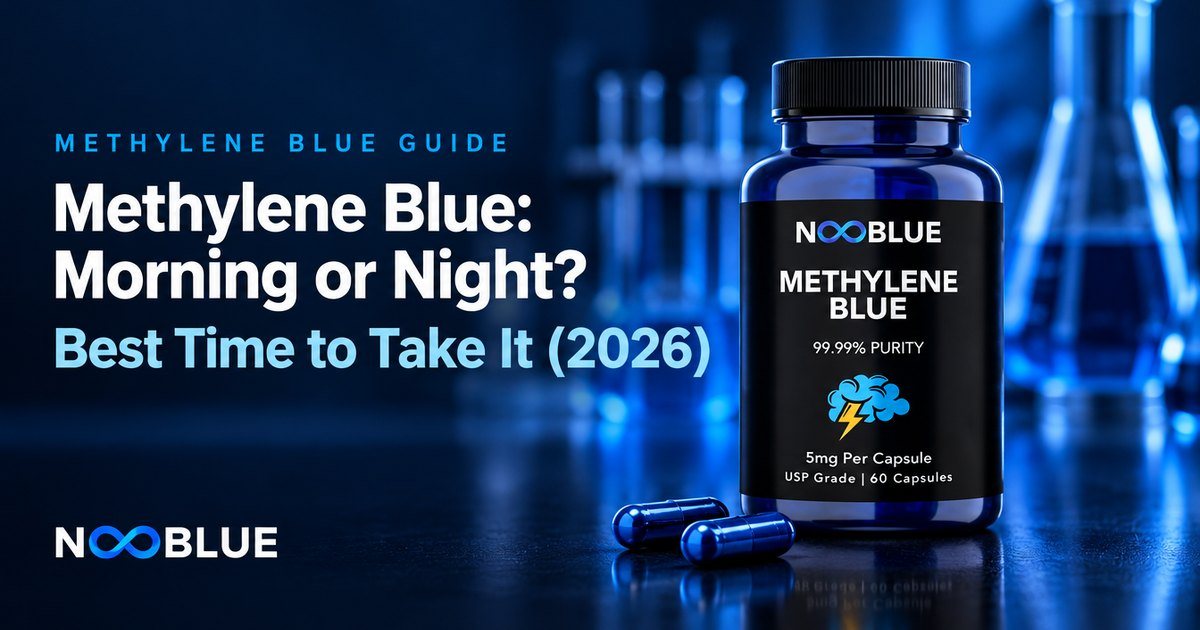
Our pick for an easy morning routine is NooBlue Ultimate Methylene Blue Capsules: 5 mg of USP grade methylene blue and 10 mg of vitamin C per capsule, one a day with food, so it slots into breakfast.
Before your first dose: do not take methylene blue if you take an SSRI, SNRI, MAOI or other serotonergic medicine, if you have G6PD deficiency, if you are pregnant or breastfeeding, or if you are under 18. If you take any prescription medicine, ask your doctor first.
NooBlue makes the capsules, gummies and drops mentioned on this page.
Written by the NooBlue editorial team. We make and sell methylene blue, so we have a stake in how you use it. This guide sticks to label directions and linked research, and it says plainly where the research stops.
Most questions about methylene blue timing come down to one worry: will it keep me awake? The honest answer is that nobody has run a sleep study at supplement doses. What we do have is label directions, a handful of pharmacology studies on how long methylene blue stays in the body, and a consistent pattern in how people describe it. Put together, they point to the same routine: an early dose, taken at the same time each day, well away from bedtime. Below we explain why, then cover food, coffee, night shifts, a simple one-week test, and the safety rules that matter far more than the hour you choose.
Table of contents
- 1. When Should You Take Methylene Blue?
- 2. Can You Take Methylene Blue at Night?
- 3. How Long Methylene Blue Stays in Your Body
- 4. Why Methylene Blue Can Feel Alerting
- 5. With Food or on an Empty Stomach?
- 6. Best Time to Take Methylene Blue, by Format
- 7. If You Work Nights or Keep Odd Hours
- 8. Coffee, Sleep Aids and Other Things You Take
- 9. Safety: Read Before Your First Dose
- 10. A One-Week Timing Test You Can Run
- 11. Frequently Asked Questions
- 11.1. When is the best time to take methylene blue?
- 11.2. Can you take methylene blue at night?
- 11.3. Will methylene blue make you sleepy?
- 11.4. What should you avoid when taking methylene blue?
- 11.5. Should I take methylene blue with food?
- 11.6. Can I take methylene blue with coffee?
- 11.7. Why do I feel so good on methylene blue?
- 11.8. When should I take methylene blue if I work night shifts?
- 11.9. Can I take methylene blue every day?
- 12. The Verdict
- 13. Sources
When Should You Take Methylene Blue?
In the morning, or by early afternoon. Three things point that way.
The labels. NooBlue’s capsule label says to take one capsule daily with food, which makes breakfast the natural slot. Our capsule page also notes that many customers prefer the morning or early afternoon. The gummy label says to chew one gummy daily, and the drops can be taken straight or mixed into water or juice, so both fit a morning drink or breakfast just as easily.
How people describe it. People who feel anything from methylene blue usually describe it as alerting, not relaxing. That is a pattern in user reports, not a trial result, and plenty of people notice nothing at all. But if it does lift you, you want that during the hours you work, study or train.
It stays in the body for a while. Half-life estimates range from about 5 hours to about 24 hours, depending on the study and how it was measured (more on that below). Either way, a dose taken in the evening is still very much present at bedtime.
When should I take methylene blue if my day starts late? Count from when you wake, not from the clock. The aim is the first part of your waking day. Many routines treat early afternoon, around 2 PM, as a cutoff. That time is a rule of thumb, not something a study established, so let your own sleep be the judge. Our separate guide to the best time to take methylene blue goes further into morning routines and empty-stomach questions.
Consistency matters more than the exact minute. Pick a slot you can repeat, tie it to a habit you already have (breakfast, your first glass of water, the walk to work) and keep it for at least a couple of weeks before you judge how it suits you.
Can You Take Methylene Blue at Night?
You can, in the sense that nothing about the evening makes it more dangerous. The real risks, such as mixing it with serotonergic medicines, are the same at any hour. But methylene blue before bed is a poor match for most people, for two reasons.
First, it is not a sleep aid, and nothing suggests it helps you sleep. If it has any noticeable effect on you, it is more likely to leave you alert than drowsy. Second, a late dose adds to the amount in your body during the night, and with a half-life that may be close to a day, you gain nothing by taking it right before you lie down.
If you have been taking it in the evening and sleeping well, you have not done anything harmful. There is simply no advantage to the late slot, and moving it to the morning removes the one thing that could go wrong with it: a restless night. The main exception is shift work, covered below.
How Long Methylene Blue Stays in Your Body
You will often read that methylene blue has a half-life of five or six hours, so a morning dose is gone by bedtime. The studies are less tidy than that.
- About 5 hours. In seven volunteers given 100 mg by injection, the estimated terminal half-life in whole blood was 5.25 hours (Peter et al., 2000). The same study found far lower whole-blood levels after the same dose by mouth.
- About 24 hours. The prescribing information for methylene blue injection states that methylene blue has a half-life of approximately 24 hours in humans (DailyMed).
- Anywhere from 6 to 27 hours. In healthy volunteers who took single 100 to 400 mg doses of a delayed-release tablet built to release in the colon, the half-life ranged from 6 to 27 hours and blood levels peaked at a median of 12 to 16 hours (Repici et al., 2012, Di Stefano et al., 2018). Those tablets were made to release late on purpose, so their timing does not apply to an ordinary capsule, gummy or drop.
None of these studies used supplement doses of 5 or 10 mg. What they do show is that “cleared by bedtime” is too simple. If the longer estimates are right, some of yesterday’s dose is still in your body today, so with daily use your levels don’t swing to zero overnight whichever hour you pick. What the hour can change is whether the first few hours after a dose land in your day or your night. For most people, the day is the better place for them. Blue or green urine is a normal sign that methylene blue is leaving your body, and it can continue for a while after each dose.
Why Methylene Blue Can Feel Alerting
Two properties measured in the lab are usually offered as the explanation.
It shuttles electrons in mitochondria. In human fibroblasts grown in culture, methylene blue cycled between its blue form and colorless leucomethylene blue inside mitochondria. It raised the activity of complex IV, part of the machinery cells use to make energy, by 30% and raised oxygen use by 37% to 70% (Atamna et al., 2008). That was a cell study, not a study of how people feel.
It inhibits monoamine oxidase A. In tests on the purified human enzyme, methylene blue was a potent, reversible inhibitor of monoamine oxidase A, the enzyme that breaks down serotonin (Ramsay et al., 2007). This is the property behind the most serious safety rule: never combine methylene blue with serotonergic medicines.
In people, the closest evidence is a brain imaging trial of 26 healthy adults. A single 280 mg oral dose increased brain activity during a sustained-attention task and a short-term memory task, measured one hour later (Rodriguez et al., 2016). That dose is 56 times a 5 mg capsule, and the trial did not measure sleep. We know of no trial that has measured alertness or sleep at 5 to 10 mg a day. So the advice to take it early rests on user reports and pharmacology, not on a sleep study. If you want to see how it compares with actual stimulants, read methylene blue vs Adderall.
With Food or on an Empty Stomach?
Follow the label for your format. NooBlue capsules say to take one daily with food. The gummies say to chew one daily. The drops can be taken straight or mixed into water or juice. We found no human study on how food changes methylene blue absorption at supplement doses, so this is about comfort and habit. Nausea and diarrhea are among the side effects listed in the prescribing information for methylene blue injection, and some people find any supplement easier on the stomach with a meal.
If you use drops, think about staining too. The liquid is vivid blue and can stain your mouth, tongue and teeth. Mixing it into a drink, using a straw and rinsing afterwards all help. Our guide to keeping methylene blue off your teeth has the details. Capsules are swallowed whole, and NooBlue gummies don’t leave the blue mouth or tongue that drops can.
Best Time to Take Methylene Blue, by Format
| NooBlue format | Label directions | Easy slot | Good to know |
|---|---|---|---|
| Capsules, 5 mg + 10 mg vitamin C | One capsule daily with food | Breakfast | No taste, no measuring, no stain. 60 capsules last 60 days. |
| Gummies, 10 mg + 25 mg vitamin C | Chew one gummy daily | Your morning routine | No water needed, no blue mouth. 60 gummies last 60 days. |
| 1% drops, 0.5 mg per drop | Measure with the dropper, take straight or in water or juice | Your first drink of the day | Finest control. Can stain the mouth, so rinse. |
The time of day is the same for all three: early. What differs is how the dose fits the morning. Guides for each format: how to take methylene blue gummies, how to take methylene blue drops, and gummies vs capsules vs drops if you are still choosing.
If You Work Nights or Keep Odd Hours
Anchor the dose to your own waking hours, not the clock on the wall. If your shift starts at 10 PM and you wake at 8 PM, 8 PM is your morning. Take it after you wake, with food if you use capsules, and leave as many hours as you can between the dose and the sleep you actually get. Try to keep the same pattern on your days off, or at least the same order: wake, dose, then your active hours. No study has looked at methylene blue in shift workers, so treat this as common sense rather than evidence, and watch how you sleep.
Coffee, Sleep Aids and Other Things You Take
- Coffee. We found no study of methylene blue and caffeine together. If the pair leaves you feeling wired, space them an hour or two apart, or cut back the coffee, before you decide methylene blue doesn’t suit you.
- Vitamin C. There is no timing issue here. NooBlue capsules already contain 10 mg and the gummies 25 mg.
- Anything you take for sleep. Keep it at the other end of the day from methylene blue. Some prescription medicines used for sleep act on serotonin, so if you take any prescription sleep medicine, ask your doctor before you start methylene blue at all.
- Serotonergic medicines. This is a do-not-combine rule, not a spacing question. SSRIs, SNRIs, MAOIs, other serotonergic medicines and opioids should not be combined with methylene blue at any hour. The prescribing information for methylene blue injection carries its strongest warning about serotonin syndrome with serotonergic drugs and opioids. See what not to take with methylene blue and our methylene blue interactions guide.
Safety: Read Before Your First Dose
Getting the time of day wrong costs you a night’s sleep at worst. These rules matter much more, and they apply to every format at every hour.
- Do not take methylene blue if you take an SSRI, SNRI, MAOI or any other serotonergic medicine, including many antidepressants. The combination can cause serotonin syndrome. Read more on methylene blue and serotonin syndrome.
- Do not take it if you have G6PD deficiency, because it can break down red blood cells (StatPearls, 2026).
- Not for use during pregnancy or while breastfeeding.
- Not for anyone under 18. Keep it out of reach of children.
- Talk to your doctor before use if you take any prescription medicine or have a kidney or liver condition.
- Methylene blue can turn urine blue or green. This is expected.
- Do not exceed the suggested serving.
The same warnings appear in the “Safety: read before use” box on every NooBlue product page. For the longer list, see who should not take methylene blue and whether methylene blue is safe to take daily.
A One-Week Timing Test You Can Run
If you are unsure whether timing matters for you, test it instead of guessing. Keep the dose, the food and everything else the same, and change only the hour.
- Days 1 to 3: take your dose within an hour of waking. Each evening, write down two things: your energy around midday and how easily you fell asleep.
- Days 4 to 6: move the dose to early afternoon. Note the same two things.
- Day 7: compare your notes. If the afternoon dose made sleep harder, the morning slot is yours. If your demanding hours come late and your sleep didn’t change, the early afternoon works too.
Then keep the winner and stop moving it. A steady dose at a steady time, repeated for weeks, tells you far more about methylene blue than any perfectly chosen hour. If you are working out how much to take as well as when, start with how many mg of methylene blue per day. Keep the bottle closed and away from heat and light between doses. Our methylene blue shelf life guide explains storage.
Frequently Asked Questions
When is the best time to take methylene blue?
For most people, the morning or early afternoon. NooBlue capsules are labeled for one a day with food, so breakfast is the easiest slot, and our capsule page notes that many customers prefer the morning or early afternoon. Taking it early keeps any alerting effect in your working hours and away from sleep. Pick one time and keep it every day.
Can you take methylene blue at night?
You can, and the evening does not make it more dangerous, but it is a poor fit for most people. It is not a sleep aid, people who notice an effect usually describe it as alerting, and half-life estimates run from about 5 to about 24 hours, so a bedtime dose is still in your body all night. Night-shift workers should time it to the start of their waking day.
Will methylene blue make you sleepy?
Sleepiness is not the usual report. People who notice an effect more often describe feeling alert. We know of no trial that has measured drowsiness or sleep at supplement doses. At hospital doses given by injection, the prescribing information warns that methylene blue may cause confusion, dizziness and vision changes. If you ever notice any of these, don’t drive, and stop taking it until you have spoken to your doctor.
What should you avoid when taking methylene blue?
Never combine it with SSRIs, SNRIs, MAOIs, other serotonergic medicines or opioids, because of the risk of serotonin syndrome. Do not take it if you have G6PD deficiency, if you are pregnant or breastfeeding, or if you are under 18. Ask your doctor first if you take any prescription medicine, including sleep medicines. Our guide to what not to take with methylene blue has the full list.
Should I take methylene blue with food?
Follow your label. NooBlue capsules say to take one daily with food. The gummies say to chew one daily, and the drops can go straight in or into water or juice. We found no study on how food changes absorption at supplement doses, so food is mainly about comfort, since nausea is among the listed side effects of methylene blue.
Can I take methylene blue with coffee?
We found no study showing a problem with the pair. Caffeine is not a serotonergic medicine. If taking both at once leaves you feeling wired, space them an hour or two apart or cut back the coffee before deciding methylene blue doesn’t suit you.
Why do I feel so good on methylene blue?
We can’t tell you why one person feels a certain way. Lab studies show methylene blue can shuttle electrons in mitochondria and inhibit monoamine oxidase A, the enzyme that breaks down serotonin. That second property is exactly why it must never be mixed with serotonergic medicines. Expectation also plays a part with any supplement taken to feel sharper. We know of no trial at 5 or 10 mg a day that measured how people feel.
When should I take methylene blue if I work night shifts?
Treat the time you wake as your morning, whatever the clock says. Take it after waking and before your shift, with food if you use capsules, and leave as many hours as you can before you sleep. Keep the same order on your days off. No study has looked at shift workers, so let your sleep guide you.
Can I take methylene blue every day?
NooBlue’s labels are written for daily use: one capsule or one gummy a day. Keep the same time each day and do not stack formats without adding up the milligrams. We know of no long-term trial of daily use at 5 or 10 mg in healthy people, so read is methylene blue safe to take daily and check the safety list above first.
The Verdict
Take methylene blue early: in the morning, or by early afternoon if your demanding hours come later. Take it at the same time every day, with food if you use capsules, and keep it away from bedtime. It is not a sleep aid, it may stay in your body for most of a day, and no study has shown a benefit from a night dose. NooBlue’s 5 mg capsules make this easy: one with breakfast, nothing to measure, nothing to stain, at $0.63 a day. If you’d rather compare products first, see our roundup of the best methylene blue supplements.
Sources
- Peter C, Hongwan D, Küpfer A, Lauterburg BH. Pharmacokinetics and organ distribution of intravenous and oral methylene blue. European Journal of Clinical Pharmacology, 2000, 56(3), 247-250. PubMed 10952480
- Prescribing information for methylene blue injection (ProvayBlue), revised February 2024. DailyMed, National Library of Medicine. DailyMed
- Repici A, Di Stefano AF, Radicioni MM, et al. Methylene blue MMX tablets for chromoendoscopy. Safety tolerability and bioavailability in healthy volunteers. Contemporary Clinical Trials, 2012, 33(2), 260-267. PubMed 22101227
- Di Stefano AFD, Radicioni MM, Vaccani A, et al. Methylene blue MMX tablets for chromoendoscopy. Bioavailability, colon staining and safety in healthy volunteers undergoing a full colonoscopy. Contemporary Clinical Trials, 2018, 71, 96-102. PubMed 29864547
- Atamna H, Nguyen A, Schultz C, et al. Methylene blue delays cellular senescence and enhances key mitochondrial biochemical pathways. FASEB Journal, 2008, 22(3), 703-712. PubMed 17928358
- Ramsay RR, Dunford C, Gillman PK. Methylene blue and serotonin toxicity: inhibition of monoamine oxidase A (MAO A) confirms a theoretical prediction. British Journal of Pharmacology, 2007, 152(6), 946-951. PubMed 17721552
- Rodriguez P, Zhou W, Barrett DW, et al. Multimodal randomized functional MR imaging of the effects of methylene blue in the human brain. Radiology, 2016, 281(2), 516-526. Full text (PMC5084971)
- Ostrovsky A, Afzal M. Methylene Blue. StatPearls, updated January 2, 2026. NCBI Bookshelf NBK557593
- NooBlue product pages: capsules, gummies and drops (label directions and safety box, read September 26, 2026).
This article is for general information and is not medical advice. Methylene blue is a potent compound. Talk to a qualified healthcare professional before you start it, especially if you take any medication or have a health condition.