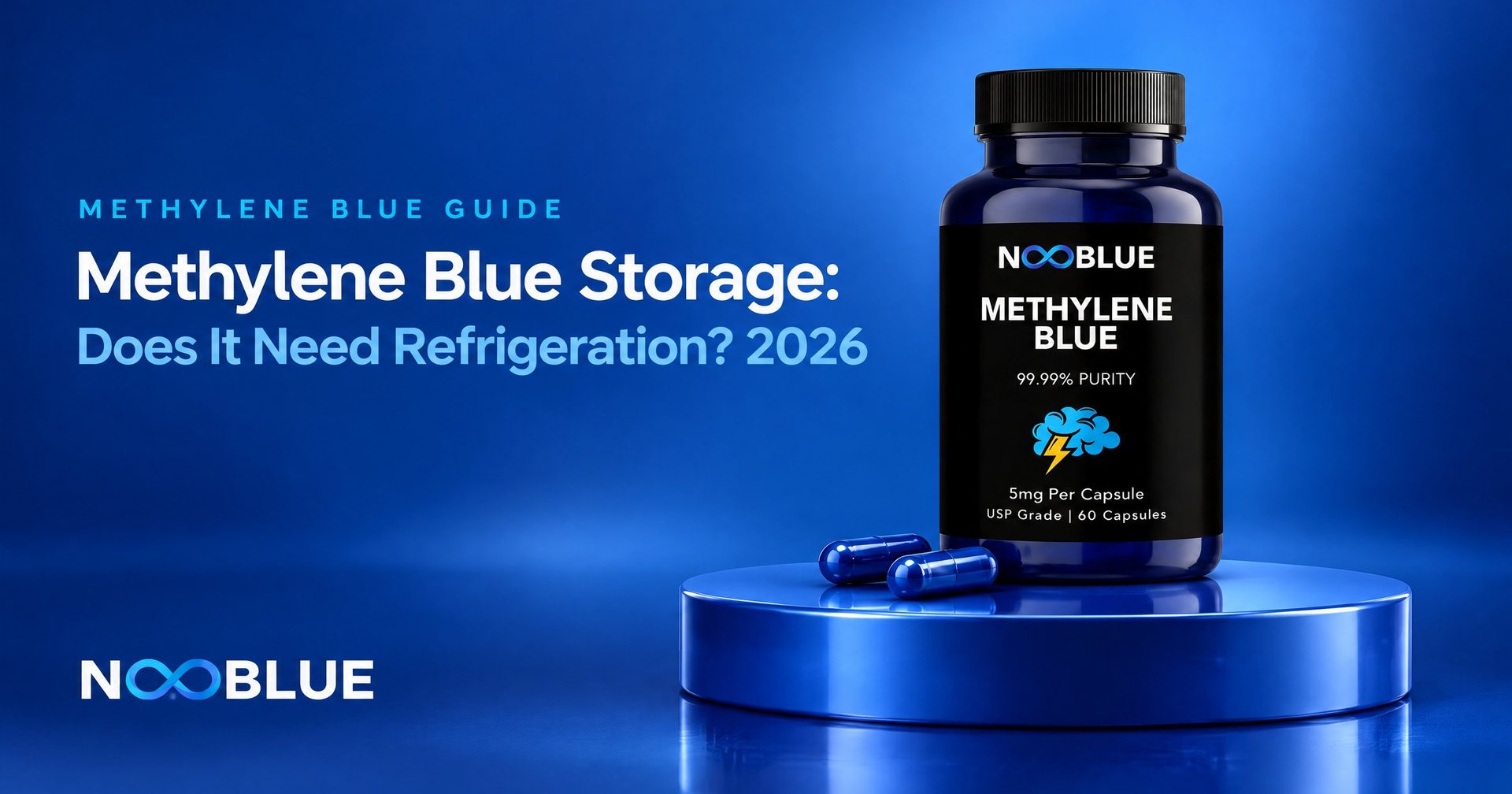
Methylene blue storage is simple: keep it at room temperature, with the cap tightly closed, away from light, heat and damp. It does not need to go in the fridge. The strictest storage rules for methylene blue come from the prescription injection, and even its label says to store it at room temperature, keep it in its package away from light, and not refrigerate or freeze it.
This guide covers why the fridge isn’t needed, the four things that actually break methylene blue down, how to store capsules, gummies and drops, how to tell when a bottle has gone off, and the safety points that matter more than any of it. NooBlue makes all three formats, so the product details below are from our own labels.
Key Takeaways
- Methylene blue does not need refrigeration. Room temperature in a closed, dark, dry cupboard is right for capsules, gummies and drops.
- Light is the main risk. In lab tests, methylene blue dissolved in water faded under ordinary lamps, colored LEDs and UV light.
- Heat, damp and a loose cap are the other three. Bathrooms, windowsills and hot cars are the worst places to keep it.
- Fading, sediment, clumped capsules or sticky gummies mean it’s time for a new bottle. Always go by the date on the label.
- Do not take methylene blue with serotonergic medicines, with G6PD deficiency, in pregnancy or breastfeeding, or under 18.
Table of contents
- 1. Does Methylene Blue Need to Be Refrigerated?
- 2. Methylene Blue Storage: The Four Things That Degrade It
- 3. How to Store Capsules, Gummies and Drops
- 4. Traveling With Methylene Blue
- 5. How to Tell If Methylene Blue Has Gone Bad
- 6. Methylene Blue Storage Mistakes to Avoid
- 7. What Lab Storage Rules Mean at Home
- 8. Safety: Taking Methylene Blue Every Day
- 9. Frequently Asked Questions
- 9.1. Does methylene blue need to be refrigerated?
- 9.2. How do you store methylene blue?
- 9.3. Does methylene blue go bad?
- 9.4. How long does methylene blue last once opened?
- 9.5. Is it okay to drink methylene blue every day?
- 9.6. Is methylene blue hard on the liver?
- 9.7. Is a bathroom cabinet an acceptable place to keep methylene blue?
- 9.8. Can I put methylene blue drops in a smaller travel bottle?
- 10. Sources
Does Methylene Blue Need to Be Refrigerated?
No. Methylene blue is stable at ordinary room temperature, and three very different sources say so:
- The prescription injection. The prescribing information for ProvayBlue, a methylene blue injection, says: “Store at 20°C to 25°C (68°F to 77°F); excursions permitted to 15°C to 30°C (59°F to 86°F).” It adds “Do not refrigerate or freeze” and says to keep the ampule or vial in its original package to protect it from light.
- The lab stain. Sigma-Aldrich lists its methylene blue powder for microscope staining with a storage temperature of “room temp”.
- Our labels. NooBlue capsules, gummies and drops all carry the same instruction: keep the bottle tightly closed in a cool, dry place away from direct heat and sunlight.
A fridge doesn’t add potency, and it brings a problem of its own. A cold bottle pulls condensation onto itself each time it comes out into a warm room. That moisture is bad for capsule powder and gummies, and it can find its way under a dropper cap. A dark, dry cupboard is the better home.
If you live somewhere very hot without air conditioning, keep the bottle in the coolest dark cupboard in the house, away from the stove, the fridge’s warm back panel and any outside wall that gets afternoon sun. For how long an opened bottle keeps under different conditions, our methylene blue shelf life guide goes format by format.
Methylene Blue Storage: The Four Things That Degrade It
Four things affect methylene blue at home. Here they are, roughly in order of how much they matter.
Light. Methylene blue is a dye, and dyes fade. Researchers who shone a fluorescent lamp, red, green and blue LEDs, and a UV-A black light on methylene blue dissolved in water found that it lost color under every source, with or without a catalyst. The molecule photo-bleached and partly broke down into other compounds, including colorless leuco forms and demethylated dyes (Sáenz-Trevizo et al., 2019). That study used lab lamps on open solutions, but the lesson for home is clear: keep liquid out of the light, and keep every format in a closed cupboard or drawer.
Heat. Warmth speeds up most chemical reactions. A hot car, a shelf above the stove or a sunny windowsill will shorten the life of any supplement, and gummies soften in the heat.
Moisture. Damp air makes capsule powder clump and gummies go sticky. It is the main reason bathrooms and fridges are poor storage spots.
Air. Methylene blue is redox-active, which means it readily gains and loses electrons. That is the chemistry behind the interest in it, and it is also why a cap left loose isn’t a good idea. Close the bottle fully after each use. Our explainer on what methylene blue is made from covers the molecule itself.
| Factor | What it does | What to do |
|---|---|---|
| Light | Fades and breaks down methylene blue in solution | Closed cupboard or drawer, never a windowsill |
| Heat | Speeds up breakdown; softens gummies | Room temperature, away from the stove and the car |
| Moisture | Clumps capsule powder; makes gummies sticky | Dry cupboard, not the bathroom or the fridge |
| Air | Exposes the contents each time the cap is off | Close the cap fully; keep it in the original bottle |
How to Store Capsules, Gummies and Drops
The core rule is the same for all three: closed, dark, dry, room temperature. Each format has one or two extra habits worth keeping.
| Format | What’s in the bottle | Storage on the label | Extra habit |
|---|---|---|---|
| Capsules | 60 capsules, 5 mg methylene blue and 10 mg vitamin C each | Tightly closed, cool, dry, away from direct heat and sunlight | Keep out of humid rooms so the powder stays loose |
| Gummies | 60 gummies, 10 mg methylene blue and 25 mg vitamin C each | Tightly closed, cool, dry, away from direct heat and sunlight | Keep away from heat so they don’t soften or stick together |
| 1% drops | 50 mL, 0.5 mg per drop, 10 mg per full dropper | Tightly closed, away from heat and sunlight | Store upright, wipe the dropper, never top the bottle up with water |
Capsules. Keep them in the original bottle in a bedroom drawer or a kitchen cupboard away from the oven. A capsule already shields its powder from light, so humidity is the main thing to guard against. Our methylene blue capsules comparison covers what else to look for in a capsule.
Gummies. Gummies are the most heat-sensitive format. Keep the bottle closed and out of warm spots, and don’t leave it in a bag in a parked car. If you are choosing between brands, our methylene blue gummies comparison lays out the options.
Drops. A liquid is the format most exposed to light, because the dye is dissolved. Stand the bottle upright with the cap screwed down, well back from any window. Wipe the dropper before you put it back, and never add water to the bottle to stretch it. Our guide to taking methylene blue drops covers measuring without staining the counter.
Traveling With Methylene Blue
Planes and cars bring the two things methylene blue likes least: heat and light. Keep capsules and gummies in their original bottles inside your bag, not on the dashboard. Put a bottle of drops upright in a small sealed bag, because methylene blue stains fabric and a pressure change can push liquid past the cap. Leave it in the original bottle rather than decanting into a clear plastic travel bottle, which lets in light and often seals poorly.
Capsules are the easiest format to travel with. If you are deciding between formats for a trip, see methylene blue capsules vs liquid or gummies vs capsules.
How to Tell If Methylene Blue Has Gone Bad
Start with the date on the label. Past that date, replace the bottle. Before it, these signs mean something has gone wrong in storage:
- A color change. Methylene blue should be a deep blue. Drops that look noticeably faded, greenish or brown have changed. Our guide to why methylene blue turns brown covers the usual causes.
- Sediment or cloudiness. Heavy particles, crystals or haze in the drops are a reason to stop and replace the bottle.
- Clumped capsules. Powder that has set into a hard lump inside the capsule has taken on moisture.
- Soft, sticky or fused gummies. These have been too warm or too damp.
If you see any of these, replace the product rather than guessing. Color tells you a bottle has changed. It can’t tell you how pure it was to begin with. For that you need the grade on the label and a lab report, as our guides to methylene blue purity and our own ingredient testing page explain.
Methylene Blue Storage Mistakes to Avoid
- The bathroom cabinet. Showers make it warm and humid, which is the worst combination for capsules and gummies.
- The windowsill or the car. Direct light and trapped heat together do the most damage.
- Clear containers for the whole bottle. Moving everything into a see-through jar gives up the protection of the original bottle. A weekly pill organizer kept in a drawer is fine, but keep the rest in the bottle.
- A loose cap. A dropper resting on the bottle instead of screwed shut lets in air and dust.
- The freezer. There is no reason to freeze methylene blue, and the injection label says not to.
- Within reach of children. Our labels say to keep methylene blue out of reach of children. Store it up high, not on a nightstand.
What Lab Storage Rules Mean at Home
Search for methylene blue storage and many results are lab chemical listings and safety data sheets rather than supplement advice. Their storage lines, a closed container in a cool, dry place at room temperature, match the home rules above.
The hazard warnings on those sheets are written for people handling loose powder by the gram, and they describe a different product. Lab and aquarium methylene blue isn’t made to be swallowed, so don’t take storage advice as a sign that a lab product is fine to use. We explain the difference in our guide to aquarium grade methylene blue.
Safety: Taking Methylene Blue Every Day
Good storage keeps a product at its label strength. Whether it’s right for you is a separate question, and it matters more.
- Do not take methylene blue if you take an SSRI, SNRI, MAOI or any other serotonergic medicine, including many antidepressants. The combination can cause serotonin syndrome. A 2018 systematic review found 50 published cases of serotonin syndrome linked to methylene blue, all in people taking serotonergic antidepressants (Zuschlag et al., 2018).
- Do not take it if you have G6PD deficiency.
- Not for use during pregnancy or while breastfeeding.
- Not for anyone under 18.
- Methylene blue can turn urine blue or green. This is expected, and our article on methylene blue and urine color explains why.
- Talk to your doctor before use if you take any prescription medicine or have a kidney or liver condition.
Stay at the suggested serving on the label and don’t exceed it. For NooBlue capsules, that is one 5 mg capsule a day with food. Our guide to how many mg of methylene blue per day covers dosing, and the side effects guide lists what else to watch for. If you are new to methylene blue, start with our first-timer guide, or see all three formats in the NooBlue shop. This article is general information, not medical advice.
Frequently Asked Questions
Does methylene blue need to be refrigerated?
No. Methylene blue is stable at room temperature. The prescription injection’s label says to store it at 20°C to 25°C (68°F to 77°F) and not to refrigerate or freeze it, and NooBlue’s labels say to keep the bottle tightly closed in a cool, dry place away from direct heat and sunlight.
How do you store methylene blue?
Keep it in the original bottle with the cap tightly closed, in a dark, dry cupboard or drawer at room temperature. Keep it away from windows, the stove, the bathroom and hot cars, and out of reach of children.
Does methylene blue go bad?
Yes, slowly, and faster in light and heat. Methylene blue dissolved in water fades under ordinary light, so liquids are the most exposed format. Use it by the date on the label, and replace any bottle that has faded, changed color or grown sediment, or capsules that have clumped.
How long does methylene blue last once opened?
Go by the date printed on the label. Stored closed, dry, dark and at room temperature, an opened bottle should keep to that date. Light, heat and damp shorten it. Our shelf life guide covers each format in more detail.
Is it okay to drink methylene blue every day?
Only a product made to be taken by mouth, at the label serving, and only if none of the safety rules apply to you. Do not take it with an SSRI, SNRI, MAOI or other serotonergic medicine, with G6PD deficiency, in pregnancy or breastfeeding, or under 18. Talk to your doctor if you take any prescription medicine. Never drink aquarium or lab methylene blue. It can turn urine blue or green, which is expected.
Is methylene blue hard on the liver?
Methylene blue is processed mainly by the liver. The prescribing information for the injection says it is “extensively metabolized in the liver” and advises longer monitoring for patients with liver impairment. There is little published research on low oral doses and the liver in healthy adults. If you have a liver or kidney condition, talk to your doctor before taking it, as our labels say.
Is a bathroom cabinet an acceptable place to keep methylene blue?
No. Every shower pushes warm, humid air into the cabinet, and that clumps capsule powder and softens gummies. A bedroom drawer or a kitchen cupboard away from the oven is better.
Can I put methylene blue drops in a smaller travel bottle?
It’s better not to. Most travel bottles are clear plastic with caps that seal poorly, which lets in light and air. Take the original bottle upright in a sealed bag, keep it out of a hot car, and close the cap fully after each use.
Sources
- Sáenz-Trevizo A, Pizá-Ruiz P, Chávez-Flores D, et al. On the discoloration of methylene blue by visible light. Journal of Fluorescence, 2019. PubMed 30361861
- Zuschlag ZD, Warren MW, K Schultz S. Serotonin toxicity and urinary analgesics: a case report and systematic literature review of methylene blue-induced serotonin syndrome. Psychosomatics, 2018. PubMed 30104021
- ProvayBlue (methylene blue) injection, prescribing information: storage and hepatic impairment sections. DailyMed
- Sigma-Aldrich, methylene blue M9140 product page (storage temperature). sigmaaldrich.com
- PubChem, methylene blue compound summary. pubchem.ncbi.nlm.nih.gov