Key takeaways
- Methylene blue is one compound. Alpha BRAIN has 11 active ingredients, 9 of them inside three proprietary blends, and most of their individual amounts are not listed.
- No study has compared the two. Alpha BRAIN has two published trials: one found better delayed verbal recall over 6 weeks, the other found no effect on rifle marksmanship.
- Methylene blue’s best-known human data come from single doses of 260 to 280 mg in small trials, many times a supplement serving.
- Cost per daily serving as of Sep 2026: $0.63 for a NooBlue 5 mg capsule against $1.93 for Alpha BRAIN’s 60-count bottle.
- Do not take methylene blue with SSRIs, SNRIs, MAOIs or other serotonergic medicines, or if you have G6PD deficiency, are pregnant or breastfeeding, or are under 18.
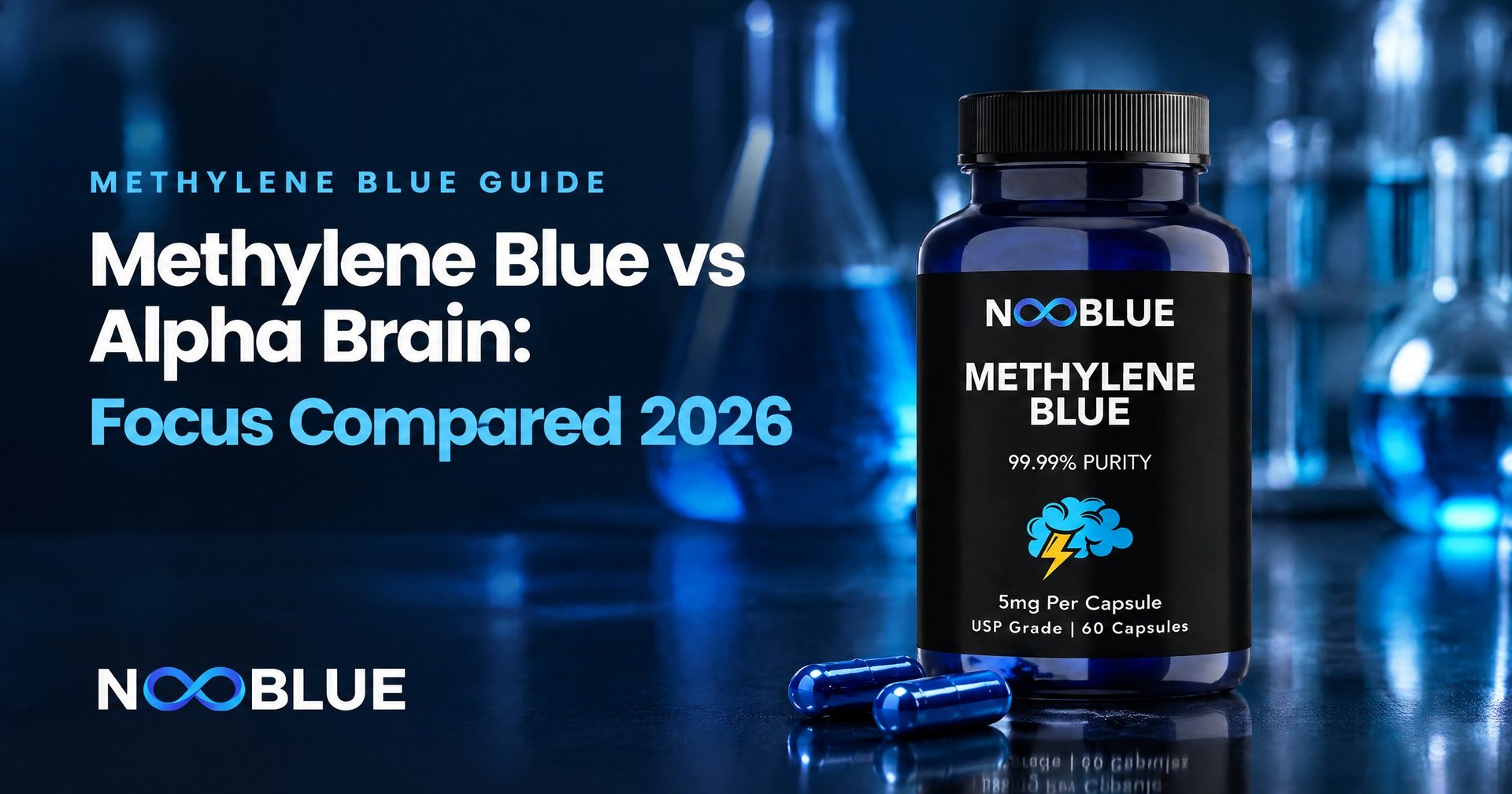
Quick answer: methylene blue and Alpha BRAIN work in different ways, and no trial has put them head to head. Methylene blue is a single, fully disclosed compound that acts on how cells handle electrons and energy. Onnit’s Alpha BRAIN is a caffeine-free blend built around acetylcholine-related ingredients such as alpha GPC, huperzine A and bacopa, plus L-theanine and L-tyrosine. If you want one ingredient with the dose printed on the label, at a lower cost per day, our pick is NooBlue’s 5 mg methylene blue capsules. If you want a ready-made multi-ingredient formula and don’t mind hidden blend amounts, Alpha BRAIN is the product built for that.
NooBlue makes methylene blue, so we have a stake in this comparison. We have taken Alpha BRAIN’s details from Onnit’s own label and linked every study. Written by the NooBlue editorial team.
Table of contents
- 1. Methylene Blue vs Alpha Brain at a Glance
- 2. Methylene Blue as a Nootropic: How It Works
- 3. What Is Alpha Brain?
- 4. What the Research Shows for Each
- 5. How the Effects Compare
- 6. Safety: Who Should Not Take Methylene Blue
- 7. Can You Stack Methylene Blue and Alpha Brain?
- 8. Cost Comparison
- 9. Which Should You Choose?
- 10. Frequently Asked Questions
- 11. The Bottom Line
- 12. Sources
Methylene Blue vs Alpha Brain at a Glance
Prices as of Sep 2026, from each brand’s own store.
| NooBlue methylene blue capsules | Onnit Alpha BRAIN (60 ct) | |
|---|---|---|
| What it is | One compound, USP methylene blue, plus 10 mg vitamin C | Multi-ingredient blend: 2 listed ingredients and 3 proprietary blends |
| Serving | 1 capsule (5 mg methylene blue) | 2 capsules |
| Amounts disclosed | All of them | Some: B6 10 mg, cat’s claw 350 mg, bacopa 100 mg, huperzine A 400 mcg. The rest sit inside blends |
| Caffeine | None | None (“formulated without caffeine”) |
| Servings per bottle | 60 | 30 |
| Price | $37.99 | $57.95 |
| Cost per daily serving | $0.63 | $1.93 |
| Published trials of the product | None of the product itself. Human trials of methylene blue used single doses of 260 to 280 mg | Two: Solomon 2016 (positive on verbal recall) and Barringer 2018 (no effect on marksmanship) |
| Who should avoid it | People on serotonergic medicines, with G6PD deficiency, pregnant or breastfeeding, or under 18 | Onnit: not for pregnant or breastfeeding women or under 18s, and check with a doctor if you take any medication |
For a wider view of how methylene blue compares with other focus products, see methylene blue vs other nootropics and methylene blue vs modafinil.
Methylene Blue as a Nootropic: How It Works
Methylene blue is a redox compound: it picks up and hands off electrons. In mitochondria it can carry electrons from NADH directly to cytochrome c, which increases the activity of complex IV, the last step of the chain that makes cellular energy (Tucker et al., 2018). A review in Progress in Neurobiology describes a hormetic dose response in the animal research, with opposite effects at low and high doses (Rojas et al., 2012). Methylene blue is also a potent, reversible inhibitor of the enzyme MAO-A (Ramsay et al., 2007), which is the reason for its main safety rule. Our explainer on how methylene blue works goes through each step.
The human studies that made methylene blue popular as a nootropic are small:
- Rodriguez et al., 2016. 26 healthy adults took a single 280 mg dose (about 4 mg/kg) of USP methylene blue or a placebo in capsules. An hour later, MRI showed changes in brain activity during attention and short-term memory tasks, and methylene blue was linked to a 7% increase in correct answers on a memory retrieval task.
- Telch et al., 2014. 42 adults with marked claustrophobic fear took 260 mg of methylene blue (23 people) or placebo (19 people) right after an exposure session. People whose fear had dropped by the end of the session did better a month later on methylene blue, while those who ended the session still fearful tended to do worse. Methylene blue also improved an incidental memory measure.
Both used single doses more than 50 times a 5 mg capsule, and neither tested daily use. That is the honest limit of the evidence. For more on what people use it for, see methylene blue for energy, methylene blue for brain fog and our overview of methylene blue benefits.
What Is Alpha Brain?
Alpha BRAIN is a nootropic from Onnit, sold as a daily capsule to support memory, focus and processing speed. Onnit’s page says it is formulated without caffeine. A caffeinated version, Alpha BRAIN Black Label, is sold separately. The current 60-count Supplement Facts panel lists a serving of 2 capsules and 30 servings per bottle:
- Vitamin B6: 10 mg (588% of the Daily Value)
- Onnit Flow Blend, 650 mg: L-tyrosine, L-theanine, oat straw extract, phosphatidylserine
- Cat’s claw bark extract: 350 mg
- Onnit Focus Blend, 240 mg: alpha GPC, bacopa leaf and stem extract (100 mg), toothed clubmoss extract standardized to 1% huperzine A (400 mcg)
- Onnit Fuel Blend, 60 mg: L-leucine, pterostilbene
The other ingredients are a vegetarian capsule, maltodextrin and rice hull concentrate. The label shows each blend’s total weight, but not how much L-theanine, L-tyrosine, phosphatidylserine, alpha GPC, leucine or pterostilbene is inside. That makes it hard to compare any single ingredient with the amounts used in research on that ingredient. Onnit’s own warning says not to use it during pregnancy, while breastfeeding or under 18, and to consult a doctor first if you take any medication.
What the Research Shows for Each
Alpha BRAIN has two published trials of the product itself:
- Solomon et al., 2016. 63 healthy adults aged 18 to 35 completed a randomized, double-blind trial: a 2-week placebo run-in, then Alpha BRAIN or placebo for 6 weeks. Compared with placebo, Alpha BRAIN improved delayed verbal recall and executive function. One author was from Onnit Labs, and the authors called it the first randomized trial of the product and said the results merit further study.
- Barringer et al., 2018. 43 US active duty soldiers took 3 capsules a day of Alpha BRAIN or placebo for about a month. There was no significant difference in marksmanship hits, reaction time or accuracy. The lead author reported a grant from Onnit to run the study.
Formulas change over time, and the label above is the one on sale in September 2026, so the product tested in those trials may not match today’s bottle exactly.
For methylene blue, the Rodriguez and Telch trials above are the main human cognition studies. Both were single, large doses. So neither product has long-term data in healthy adults at the daily serving people actually take, and no study has compared the two.
How the Effects Compare
Because there is no head-to-head trial, any comparison of effects is a comparison of mechanisms and separate studies, not proof that one works better.
Mechanism. Methylene blue works on cellular energy chemistry and on MAO-A. Alpha BRAIN’s disclosed ingredients lean toward acetylcholine (alpha GPC, huperzine A) and calm focus (L-theanine), with bacopa as its main memory botanical. They pull different levers, which is why people who didn’t notice much from one sometimes try the other.
Memory. Alpha BRAIN has the more directly relevant trial: 6 weeks of daily use improved delayed verbal recall in young adults. Methylene blue’s memory findings come from single large doses measured within an hour or a month of dosing. Neither has shown lasting memory gains from long-term daily use.
Energy and alertness. Neither product contains caffeine. Methylene blue’s research interest is cellular energy, but no trial has measured day-to-day energy at a 5 mg serving. Our guide to methylene blue and caffeine covers pairing it with coffee.
Transparency. This is the clearest difference. A NooBlue capsule states 5 mg of methylene blue and 10 mg of vitamin C, with rice flour and a cellulose capsule. The lab report NooBlue publishes covers the raw methylene blue ingredient: Contract Testing Laboratories of America (CTLA) confirmed identity by HPLC and tested heavy metals on one ingredient lot. It does not certify each finished batch or give a purity percentage. Alpha BRAIN discloses some amounts and hides others inside its blends. Our roundup of the best methylene blue nootropics compares single-ingredient and blended products.
Safety: Who Should Not Take Methylene Blue
Methylene blue’s cautions are specific and firm:
- Do not take it with an SSRI, SNRI, MAOI or any other serotonergic medicine, including many antidepressants. The combination can cause serotonin syndrome (StatPearls). Our guide to methylene blue and serotonin syndrome explains why.
- Do not take it if you have G6PD deficiency, because it can break down red blood cells.
- Do not take it if you are pregnant or breastfeeding, and it is not for anyone under 18.
- Talk to your doctor first if you take any prescription medicine or have a kidney or liver condition.
Methylene blue can turn urine blue or green, and that is expected. The same warnings sit in the “Safety: read before use” box on every NooBlue product page. For Alpha BRAIN, follow Onnit’s own label warning on pregnancy, breastfeeding, under 18s and medications.
Can You Stack Methylene Blue and Alpha Brain?
No study has tested the two together, and because several Alpha BRAIN amounts are hidden inside blends, nobody can say exactly what the combined dose of each ingredient would be. Both labels also ask anyone on medication to check with a doctor first. If you want to try both, ask your doctor or pharmacist, and don’t start them in the same week. Adding one product at a time is the only way to know which one you are reacting to.
For a starting amount of methylene blue, see our guide on how many mg of methylene blue per day.
Cost Comparison
| Product | Price (as of Sep 2026) | Daily servings | Cost per day |
|---|---|---|---|
| NooBlue capsules, 60 x 5 mg | $37.99 | 60 | $0.63 |
| NooBlue 1% drops, 50 ml | $29.99 | About 100 at 5 mg | $0.30 |
| NooBlue gummies, 60 x 10 mg | $49.99 | 60 | $0.83 |
| Onnit Alpha BRAIN, 90 ct | $79.95 | 45 | $1.78 |
| Onnit Alpha BRAIN, 60 ct | $57.95 | 30 | $1.93 |
| Onnit Alpha BRAIN, 30 ct | $34.95 | 15 | $2.33 |
On NooBlue’s store, buying 2, 3 or 5 bottles of any format saves 10%, 15% or 20%, and orders of $100 or more ship free worldwide. Browse every format in the NooBlue shop.
Which Should You Choose?
Methylene blue suits people who want one ingredient with the exact amount on the label, no caffeine, and the lowest cost per day. It doesn’t suit anyone on serotonergic medicines, anyone with G6PD deficiency, anyone pregnant or breastfeeding, or anyone under 18.
Alpha BRAIN suits people who want a ready-made blend of familiar focus ingredients and value its trial on verbal recall. It doesn’t suit people who want to know the amount of every ingredient, or who want to keep daily cost down.
If you choose methylene blue, the format matters more than the brand name on the box. Capsules give a fixed 5 mg, drops let you adjust in 0.5 mg steps, and gummies give a fixed 10 mg with no blue mouth. Our methylene blue capsules comparison and top methylene blue brands guide compare the options.
Frequently Asked Questions
Is methylene blue better than Alpha Brain?
They do different things, and no study has compared them. For one fully disclosed ingredient at a lower daily cost, our pick is NooBlue’s 5 mg methylene blue capsules. Alpha BRAIN has the more directly relevant trial for memory, a 6-week study showing better delayed verbal recall, but it hides several ingredient amounts inside blends.
Is there anything better than Alpha Brain?
It depends on what you want from it. If you want one ingredient you can dose exactly, NooBlue methylene blue capsules are our pick, provided none of the safety exclusions applies to you. If you like one of Alpha BRAIN’s ingredients in particular, buying that ingredient on its own lets you see the amount on the label.
Does Alpha Brain supplement really work?
The evidence is mixed and small. A 6-week trial in 63 young adults found better delayed verbal recall and executive function than placebo. A month-long trial in 43 soldiers found no effect on marksmanship. Both had ties to Onnit, and the formula may have changed since.
Why don’t doctors recommend methylene blue?
Mainly because the evidence for everyday use is thin and the interaction risk is real. WebMD says there isn’t enough reliable information to know whether oral methylene blue is safe, and methylene blue can cause serotonin syndrome with common antidepressants. An MD Anderson physician writing about it in 2026 recommended working with a provider who is familiar with its use rather than buying it online and going it alone.
Can you take methylene blue and Alpha Brain together?
No study has tested the combination, and several Alpha BRAIN amounts are not disclosed. Ask your doctor or pharmacist first, and if you do try both, start them in different weeks.
Is methylene blue a stimulant?
It contains no caffeine and is not a classic stimulant. It acts on cellular energy chemistry and blocks the enzyme MAO-A, which is why it must never be combined with serotonergic medicines.
The Bottom Line
Methylene blue and Alpha BRAIN aim at the same goal from different directions. Alpha BRAIN offers a convenient blend with one encouraging trial. Methylene blue offers one disclosed ingredient, a lower cost per day and strict safety rules to follow. If you want to start with methylene blue, a 5 mg capsule is the simplest way to begin.
Sources
- Onnit. Alpha BRAIN (60 ct) product page and Supplement Facts panel; 30 ct and 90 ct listings (checked September 2026). onnit.com
- Solomon TM, Leech J, deBros GB, Murphy CA, Budson AE, Vassey EA, Solomon PR. A randomized, double-blind, placebo controlled, parallel group, efficacy study of alpha BRAIN administered orally. Human Psychopharmacology. 2016;31(2):135-143. PubMed 26876224
- Barringer N, Crombie A, Kotwal R. Impact of a purported nootropic supplementation on measures of mood, stress, and marksmanship performance in U.S. active duty soldiers. Journal of the International Society of Sports Nutrition. 2018;15(1):26. PubMed 29855372
- Rodriguez P, Zhou W, Barrett DW, Altmeyer W, Gutierrez JE, Li J, Lancaster JL, Gonzalez-Lima F, Duong TQ. Multimodal randomized functional MR imaging of the effects of methylene blue in the human brain. Radiology. 2016;281(2):516-526. PMC5084971
- Telch MJ, Bruchey AK, Rosenfield D, Cobb AR, Smits J, Pahl S, Gonzalez-Lima F. Effects of post-session administration of methylene blue on fear extinction and contextual memory in adults with claustrophobia. American Journal of Psychiatry. 2014;171(10):1091-1098. PubMed 25018057
- Tucker D, Lu Y, Zhang Q. From mitochondrial function to neuroprotection: an emerging role for methylene blue. Molecular Neurobiology. 2018;55(6):5137-5153. PubMed 28840449
- Rojas JC, Bruchey AK, Gonzalez-Lima F. Neurometabolic mechanisms for memory enhancement and neuroprotection of methylene blue. Progress in Neurobiology. 2012;96(1):32-45. PubMed 22067440
- Ramsay RR, Dunford C, Gillman PK. Methylene blue and serotonin toxicity: inhibition of monoamine oxidase A (MAO A) confirms a theoretical prediction. British Journal of Pharmacology. 2007;152(6):946-951. PubMed 17721552
- Ostrovsky A, Afzal M. Methylene Blue. StatPearls. Updated January 2, 2026. NCBI Bookshelf NBK557593
- WebMD. Methylene blue: uses, side effects, and more (checked September 2026). webmd.com
- Roldan C. Methylene blue: Should you take it? MD Anderson Cancer Center, Cancerwise. March 3, 2026. mdanderson.org