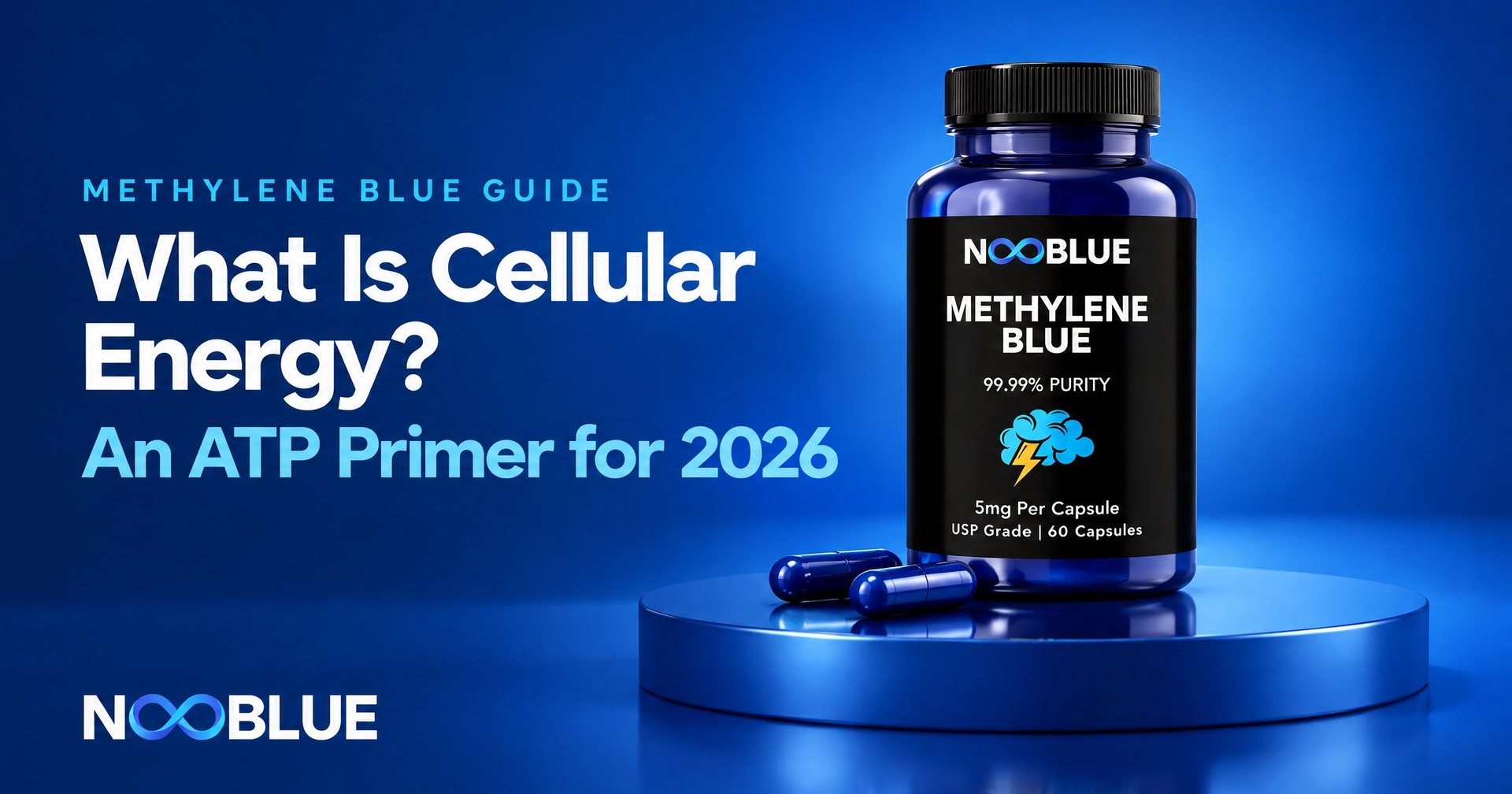
What is cellular energy? It is the usable chemical energy your cells make from food and oxygen, stored and spent as a molecule called ATP (adenosine triphosphate). Most of it is made inside mitochondria by a process called oxidative phosphorylation, and your body recycles it constantly rather than storing much of it.
That definition is the easy part. This primer explains what ATP is and what it does, the three systems your cells use to make it, how ATP differs from NAD+, what tends to drag cellular energy down, what actually helps, and where a compound like methylene blue fits, including where it doesn’t.
Key Takeaways
- Cellular energy is ATP. Cells spend it by breaking off a phosphate group, then recharge the leftover ADP back into ATP.
- You turn over roughly your own body weight in ATP every day, so cellular energy is a flow rate, not a reserve.
- Mitochondria make most of it: about 32 ATP per glucose molecule with oxygen, against 2 from glycolysis alone.
- Sleep, regular exercise and enough of the right nutrients do more for that flow than any supplement.
- Methylene blue can act as an alternative electron carrier in cell and animal studies. Human evidence is small and mixed, and it has firm safety rules.
Table of contents
- 1. What Is Cellular Energy, in Plain Terms?
- 2. What Does ATP Do, Including in Your Brain?
- 3. How Your Cells Produce ATP: Three Systems
- 4. The Three Stages of Cellular Respiration
- 5. ATP vs NAD+: What’s the Difference?
- 6. What Causes Low Cellular Energy?
- 7. How to Support Cellular Energy
- 8. Where Methylene Blue Fits in the Cellular Energy Picture
- 9. Cellular Energy FAQ
- 10. Sources
What Is Cellular Energy, in Plain Terms?
Think of ATP as a rechargeable battery that every cell uses. Structurally it is a nucleoside triphosphate: the base adenine, the sugar ribose, and three phosphate groups in a row (Dunn and Grider, StatPearls). When a cell needs to fire a nerve signal, contract a muscle fiber, pump a mineral across its membrane or build a protein, it breaks off the last phosphate group. That releases energy and leaves ADP (adenosine diphosphate), which the cell recharges into ATP using energy taken from food.
The scale is striking. Each of us turns over roughly our body weight in ATP every day, according to the US National Institute of General Medical Sciences, and a StatPearls physiology chapter puts it at 100 to 150 moles of ATP hydrolyzed per day. A review of cellular energy metabolism describes ATP as the cell’s major energy component, made mainly in mitochondria by oxidative phosphorylation, with cell health depending on production and use staying in balance (Sztark et al., 1999).
That balance is the useful idea. Cellular energy is not a tank you fill once. It is a flow you keep up all day, which is why low cellular energy rarely feels like a sudden collapse. It tends to show up as slower recovery, foggier afternoons and less tolerance for effort.
What Does ATP Do, Including in Your Brain?
ATP pays for almost everything a cell does: ion pumps that keep nerve and muscle cells ready to fire, muscle contraction, building and recycling proteins, moving materials around inside the cell, and copying DNA. Some organs spend far more than their size suggests. In the average adult, the brain is about 2% of body weight but accounts for about 20% of the oxygen, and so the calories, the body uses (Raichle and Gusnard, 2002). That high demand is one reason low energy can show up as mental flatness as well as physical tiredness.
How Your Cells Produce ATP: Three Systems
“Mitochondria are the powerhouse of the cell” is true but incomplete. Your body has three ways to make ATP, and they hand off to each other depending on how fast you need energy and for how long.
| ATP system | Speed | ATP yield | Best for | Needs oxygen? |
|---|---|---|---|---|
| Phosphocreatine | Instant | One ATP per phosphocreatine | The first seconds of a sprint or heavy lift | No |
| Glycolysis | Fast | 2 ATP per glucose | Hard efforts that outlast phosphocreatine | No |
| Oxidative phosphorylation (mitochondria) | Slower to ramp up | About 32 ATP per glucose | Everything else: thinking, digesting, recovery, all-day activity | Yes |
The yields come from standard physiology: glycolysis makes 2 ATP per glucose, while full aerobic respiration in the mitochondria makes approximately 32 (Dunn and Grider, StatPearls). The third system is what people mean by cellular energy in a health context, and it is the one you can train.
The Three Stages of Cellular Respiration
- Glycolysis. In the cell fluid outside the mitochondria, one glucose molecule is split into two pyruvate molecules, producing 2 ATP without oxygen.
- The citric acid cycle (Krebs cycle). Pyruvate enters the mitochondrion, becomes acetyl-CoA and feeds the cycle. Fat enters at the same point as acetyl-CoA. The cycle makes little ATP directly. Its main job is to strip electrons from the carbon skeleton and load them onto the carriers NADH and FADH2.
- The electron transport chain and oxidative phosphorylation. NADH and FADH2 hand their electrons to a chain of protein complexes in the inner mitochondrial membrane. As electrons move down the chain to oxygen, the complexes pump protons across the membrane, and the flow of protons back through ATP synthase drives most of your ATP production.
If any link in that chain slows, from a missing cofactor to damaged mitochondria, the whole line backs up. Most supplement claims point at this third stage, which is why our guide to mitochondrial support supplements is organized around it.
ATP vs NAD+: What’s the Difference?
They are often mentioned together, but they do different jobs. ATP is the energy currency that cells spend. NAD+ is a coenzyme that carries electrons: in its loaded form, NADH, it picks up electrons in glycolysis and the Krebs cycle and delivers them to the electron transport chain, where their energy is used to make ATP. More NAD+ does not mean more ATP by itself, because the chain still has to run. Our comparisons of methylene blue vs NAD+ and methylene blue vs NMN look at the supplement side of that question, and methylene blue vs CoQ10 covers another carrier in the chain.
What Causes Low Cellular Energy?
Low cellular energy is a description, not a diagnosis. The common contributors are ordinary ones:
- Short or irregular sleep. In rats, brain ATP surged in the first hours of sleep, and keeping them awake stopped the surge (Dworak et al., 2010).
- Physical inactivity. Endurance training can increase mitochondrial content and function in human muscle, so long stretches without it work in the other direction (Granata et al., 2018).
- Nutrient shortfalls. Magnesium is a cofactor in more than 300 enzyme systems and is required for energy production, oxidative phosphorylation and glycolysis (NIH Office of Dietary Supplements). B vitamins supply NAD and FAD, and iron sits in the proteins of the electron transport chain.
- Things that damage mitochondria. Our guide to what damages mitochondria covers the usual suspects.
- Age. Harvard Health notes that the body has fewer mitochondria as we grow older.
Persistent tiredness also has many medical causes, including low iron and thyroid problems, so if it doesn’t lift, talk to your doctor before you reach for a supplement.
How to Support Cellular Energy
In rough order of impact:
- Sleep enough, on a regular schedule. The CDC’s guidance for adults aged 18 to 60 is 7 or more hours a night.
- Do regular aerobic exercise. The CDC recommends 150 minutes of moderate-intensity activity a week for adults. Training volume appears to matter most for building mitochondrial content, and intensity for how well mitochondria respire (Granata et al., 2018).
- Add strength work. The same guidance adds at least 2 days a week of muscle-strengthening activity. Muscle stores phosphocreatine and houses a large share of your mitochondria.
- Eat for the machinery. Leafy greens, nuts, seeds and legumes for magnesium, eggs, fish, meat and whole grains for B vitamins, and red meat, shellfish and lentils for iron. Test before you supplement iron.
- Then consider targeted compounds. Creatine, CoQ10 and methylene blue each act on a narrow part of the system. They are a top-up on a working system, not a replacement for the first four steps.
Swallowing ATP itself doesn’t help: in a 28-day trial, oral ATP at doses up to 5,000 mg a day did not change blood or plasma ATP (Coolen et al., 2011). Our practical guide to how to increase ATP naturally goes through each lever in detail, and our CoQ10 comparison covers that option.
Where Methylene Blue Fits in the Cellular Energy Picture
Methylene blue is unusual among energy-related compounds because its proposed role is not to supply fuel or a cofactor but to offer an alternative route. In cell and animal studies, it accepted electrons from NADH and passed them to cytochrome c, bypassing blockage at complexes I and III, and it raised oxygen consumption in cultured neuronal cells (Wen et al., 2011). That describes a mechanism, not a result in people.
The human evidence is small and points in more than one direction. In a randomized, placebo-controlled imaging study of 26 healthy adults, a single low oral dose increased brain activity during attention and memory tasks and was linked to 7% more correct memory-retrieval responses (Rodriguez et al., 2016). But in healthy volunteers given intravenous methylene blue, global brain blood flow and oxygen metabolism went down, not up, which the authors linked to methylene blue’s hormetic dose-response, where higher concentrations inhibit rather than boost metabolism (Singh et al., 2023). Dose matters, and more is not better.
NooBlue makes methylene blue in three formats:
- Ultimate Methylene Blue Capsules: 5 mg of USP-grade methylene blue and 10 mg of vitamin C per capsule, 60 capsules, one a day with food, $37.99.
- Methylene Blue Gummies: 10 mg of methylene blue and 25 mg of vitamin C per wild blueberry gummy, 60 gummies, one a day, $49.99. They don’t leave the blue mouth that drops can.
- Methylene Blue Drops: a 1% solution, 0.5 mg per drop, about 100 servings of 5 mg in 50 mL, $29.99.
Each label says not to exceed the suggested serving. For the practical side, see methylene blue for energy, what the research on methylene blue benefits shows and how many mg of methylene blue per day. If you prefer a chewable, our methylene blue gummies comparison is the place to start, and the NooBlue shop shows all three formats.
Safety before you start:
- Do not take methylene blue if you take an SSRI, SNRI, MAOI or any other serotonergic medicine, including many antidepressants. The combination can cause serotonin syndrome.
- Do not take it if you have G6PD deficiency.
- Not for use during pregnancy or while breastfeeding, and not for anyone under 18.
- Methylene blue can turn urine blue or green. This is expected.
- Talk to your doctor before use if you take any prescription medicine or have a kidney or liver condition.
Methylene blue doesn’t fix low cellular energy on its own. It sits after sleep, exercise and nutrition, and the methylene blue side effects guide covers what to watch for. This article is general information, not medical advice.
Cellular Energy FAQ
What is ATP in cellular energy?
ATP is the form cellular energy takes. It is a molecule of adenine, ribose and three phosphate groups. Cells release energy by breaking off the last phosphate, leaving ADP, then recharge ADP into ATP using energy from food and oxygen, mostly inside mitochondria.
What foods boost ATP energy?
No food contains usable ATP, but some supply what your cells need to make it: leafy greens, nuts, seeds and legumes for magnesium, eggs, fish, meat and whole grains for B vitamins, red meat, shellfish and lentils for iron, and lean protein and fatty fish for steady fuel. Harvard Health names lean meats such as chicken and turkey, fatty fish such as salmon and tuna, and nuts.
What does ATP do for your brain?
It powers the ion pumps and signaling that keep neurons working. The brain is about 2% of body weight but uses about 20% of the body’s oxygen and calories, so it is especially sensitive to how well energy production is running.
What is the difference between ATP and NAD+?
ATP is the energy currency cells spend. NAD+ is an electron carrier: as NADH it delivers electrons from food breakdown to the electron transport chain, which uses them to make ATP. You need both, and raising one doesn’t automatically raise the other.
What causes low cellular energy?
Most often short sleep, inactivity, a shortfall in a nutrient such as iron, magnesium or a B vitamin, and the gradual loss of mitochondria with age. Persistent fatigue can also have medical causes, so talk to your doctor if it lasts. Our guide on how to improve mitochondrial function covers what helps.
Is cellular energy the same as feeling energetic?
Related, but not the same. How energetic you feel also depends on sleep timing, hydration, blood sugar and mood. Stimulants can make you feel energetic without changing ATP production, which is why caffeine alone stops working as a fatigue strategy; our notes on methylene blue and caffeine cover how the two compare.
Do cellular energy supplements work?
It depends on the supplement and on you. Nutrients such as magnesium, B vitamins and iron help if you were short of them. Creatine helps short, hard efforts. CoQ10 and methylene blue act on the electron transport chain, with evidence ranging from cell studies to small human trials. Oral ATP itself did not raise blood ATP in a controlled trial. None of them replaces sleep and exercise.
Sources
- Dunn J, Grider MH. Physiology, Adenosine Triphosphate. StatPearls, NCBI Bookshelf. NBK553175
- National Institute of General Medical Sciences. Science Snippet: ATP’s amazing power. 2022. nigms.nih.gov
- Sztark F, Payen JF, Piriou V, et al. Cellular energy metabolism: physiologic and pathologic aspects. Annales Françaises d’Anesthésie et de Réanimation, 1999. PubMed 10207603
- Raichle ME, Gusnard DA. Appraising the brain’s energy budget. Proceedings of the National Academy of Sciences, 2002. PubMed 12149485
- Dworak M, McCarley RW, Kim T, et al. Sleep and brain energy levels: ATP changes during sleep. The Journal of Neuroscience, 2010. PubMed 20592221
- Granata C, Jamnick NA, Bishop DJ. Training-induced changes in mitochondrial content and respiratory function in human skeletal muscle. Sports Medicine, 2018. PubMed 29934848
- Coolen EJ, Arts IC, Bekers O, et al. Oral bioavailability of ATP after prolonged administration. British Journal of Nutrition, 2011. PubMed 21129239
- Wen Y, Li W, Poteet EC, et al. Alternative mitochondrial electron transfer as a novel strategy for neuroprotection. Journal of Biological Chemistry, 2011. PubMed 21454572
- Rodriguez P, Zhou W, Barrett DW, et al. Multimodal randomized functional MR imaging of the effects of methylene blue in the human brain. Radiology, 2016. PubMed 27351678
- Singh N, MacNicol E, DiPasquale O, et al. The effects of acute methylene blue administration on cerebral blood flow and metabolism in humans and rats. Journal of Cerebral Blood Flow and Metabolism, 2023. PubMed 36803299
- NIH Office of Dietary Supplements. Magnesium fact sheet for health professionals. ods.od.nih.gov
- CDC. About sleep; Adult activity: an overview. cdc.gov/sleep and cdc.gov/physical-activity-basics
- Harvard Health Publishing. Tired? 4 simple ways to boost energy. health.harvard.edu