By NooBlue Editorial · About our editorial standards
Key takeaways
- Does methylene blue work? For short-term memory and attention in healthy adults, one small randomized human trial found a measurable effect an hour after a single dose.
- For anti-aging, skin, energy and brain protection, the evidence comes from cells, lab skin models and animals. It is promising but not proven in people.
- The human studies used 260 mg to 280 mg in a single dose. A NooBlue capsule is 5 mg and a gummy is 10 mg, so study results do not transfer directly to supplement doses.
- No trial has tested daily low-dose use over weeks in healthy adults. A structured 30-day self-check is the most honest way to judge it for yourself.
- Methylene blue is not for anyone taking SSRIs, SNRIs, MAOIs or other serotonergic medicines, anyone with G6PD deficiency, anyone pregnant or breastfeeding, or anyone under 18.
Short answer: methylene blue has one small randomized trial in healthy adults showing better memory retrieval and more brain activity during attention tasks after a single 280 mg dose, one mixed trial in patients, a long record of hospital use for an unrelated purpose, and mostly animal, cell or mechanism data behind every other popular claim.
Twenty-six healthy adults, one oral dose, and a 7% rise in correct answers on a memory-retrieval task. That result, published in Radiology in 2016, is the strongest human evidence behind the question people type into search: does methylene blue work? It is also a small, single-dose study measured over one afternoon. Everything else sits somewhere between that trial and a rat. Below, each popular claim gets an evidence grade, the dose behind it and a plain verdict. Our guide to the researched benefits of methylene blue covers the full claim set, and how long methylene blue takes to work covers timing.
Table of contents
- 1. Does Methylene Blue Work? The Short Answer, Tier by Tier
- 2. The Evidence Grade for Every Popular Claim
- 3. The Dose Gap Nobody Mentions: Study Doses vs Supplement Doses
- 4. Where the Human Evidence Is Strong, and Where It Isn’t
- 5. Who Should Not Take Methylene Blue
- 6. Does Methylene Blue Work for You? A 30-Day Self-Check
- 7. Our Pick for Running the Self-Check
- 8. Frequently Asked Questions
- 8.1. Does methylene blue actually help the human body?
- 8.2. Is it true that methylene blue makes you look younger?
- 8.3. Why don’t doctors recommend methylene blue?
- 8.4. Is methylene blue killing parasites?
- 8.5. Is it bad to take methylene blue every day?
- 8.6. How long does it take for methylene blue to work?
- 8.7. Why do I feel weird after taking methylene blue?
- 8.8. Does methylene blue give you more energy?
- 9. Sources
Does Methylene Blue Work? The Short Answer, Tier by Tier
“Does it work” is really four questions at once. Sorting the evidence into tiers makes the answer clearer.
Tier 1: tested in healthy humans, randomized and placebo-controlled. A 2016 trial from the University of Texas, published in Radiology, enrolled 26 healthy adults aged 22 to 62 in a double-blind, placebo-controlled design. Thirteen received a single oral dose of 280 mg of USP-grade methylene blue and 13 received a placebo. One hour later, functional MRI showed more activity in the insular cortex during a sustained-attention task and in prefrontal, parietal and occipital regions during a short-term memory task. The methylene blue group also gave 7% more correct responses during memory retrieval (Rodriguez et al., 2016).
Tier 2: tested in patients, results mixed. A randomized controlled trial in The Journal of Clinical Psychiatry gave 42 patients 260 mg of methylene blue or placebo after each of five brief daily exposure-therapy sessions. At three months, both therapy groups improved and neither differed from standard therapy on the main outcome. The methylene blue group did better than placebo on evaluator-rated response and quality of life (Zoellner et al., 2017). It is a real trial with a partial result, in a clinical setting that does not match everyday supplement use.
Tier 3: animals only. In a 2020 study in Frontiers in Cellular Neuroscience, rats with surgically reduced blood flow to the brain received daily methylene blue injections. The injections preserved cytochrome oxidase activity, a mitochondrial enzyme, and the treated rats learned a memory task better than untreated ones (Auchter et al., 2020). Rodents, injected, under a surgical model: three reasons not to read it as a human result.
Tier 4: cells, lab skin models and reviews. A 2017 Scientific Reports study found methylene blue slowed signs of aging in cultured human skin cells and improved hydration and thickness in a lab-grown 3D skin model (Xiong et al., 2017). A 2021 review in Cells from the same University of Maryland group laid out the wider anti-aging case (Xue et al., 2021). Its senior author declared that he founded Mblue Labs, a skincare company. Both are preclinical: no human outcome trial sits behind them.
Separately, doctors have given methylene blue intravenously in hospitals for decades for a rare blood disorder, at doses they set. That shows the molecule is well characterized. It is not evidence that a capsule sharpens your afternoon.
The Evidence Grade for Every Popular Claim
Here is each claim you are likely to see on a sales page, matched to the best study we could find, who was tested and the dose used. Doses are shown as the studies reported them.
| Claim | Best available evidence | Who was tested | Dose in that study | Grade |
|---|---|---|---|---|
| Short-term memory | Rodriguez et al., Radiology, 2016 | 26 healthy adults | 280 mg, single oral dose | Moderate: small, one dose |
| Sustained attention | Rodriguez et al., Radiology, 2016 | 26 healthy adults | 280 mg, single oral dose | Moderate: brain-imaging measure |
| Boosting exposure therapy | Zoellner et al., J Clin Psychiatry, 2017 | 42 patients (RCT) | 260 mg after each session | Mixed: partial benefit |
| Brain protection | Auchter et al., Front Cell Neurosci, 2020 | Rats | Daily injections | Preclinical |
| Younger-looking skin | Xiong et al., Sci Rep, 2017 | Skin cells and a lab-grown skin model | Applied in the lab | Preclinical |
| Anti-aging and longevity | Xue et al., Cells, 2021 (review) | Review of mostly preclinical work | Not applicable | Mechanism only |
| More everyday energy | No human trial measuring energy found | None | None | Not tested in people |
Read down the grade column and the picture is plain: two moderate rows from the same small trial, one mixed, and four that have not been shown in people. Anyone selling certainty on the bottom four rows is ahead of the data. The same care applies to narrower questions, such as whether methylene blue lowers blood pressure, and to claims aimed at one group, as our look at methylene blue benefits for men shows. For how the molecule acts in cells, see how methylene blue works, and for the anti-aging claims in more depth, methylene blue for anti-aging: evidence and myths.
The Dose Gap Nobody Mentions: Study Doses vs Supplement Doses
This part changes how you should read almost every article on the subject. The human studies people cite did not use the dose in a supplement bottle.
- The Radiology trial used 280 mg in one dose. That is the methylene blue in 28 NooBlue gummies or 56 NooBlue capsules.
- The exposure-therapy trial used 260 mg after each session, the amount in 26 gummies.
- The rat study used daily injections in animals, a different species and a different route, with no honest way to turn it into a capsule count.
Three things follow:
- A citation is not a dose recommendation. When a page cites a 280 mg trial next to a 10 mg product, the study is being asked to support something it never tested.
- More is not the fix. The Radiology authors describe methylene blue’s dose response as hormetic: helpful at low doses in animal and human work, with the opposite effect at much higher doses. That is the reason supplement doses sit far below clinical ones, and it is not a reason to take more than the label says. Our guide to how many mg of methylene blue per day covers how the formats compare.
- Label accuracy matters. At 5 mg or 10 mg, you want to know the product contains what it says. NooBlue’s product pages link a report from Contract Testing Laboratories of America (CTLA) on the raw methylene blue ingredient, covering identity by HPLC and four heavy metals. It covers the ingredient lot, not each finished batch, and it does not give a purity percentage.
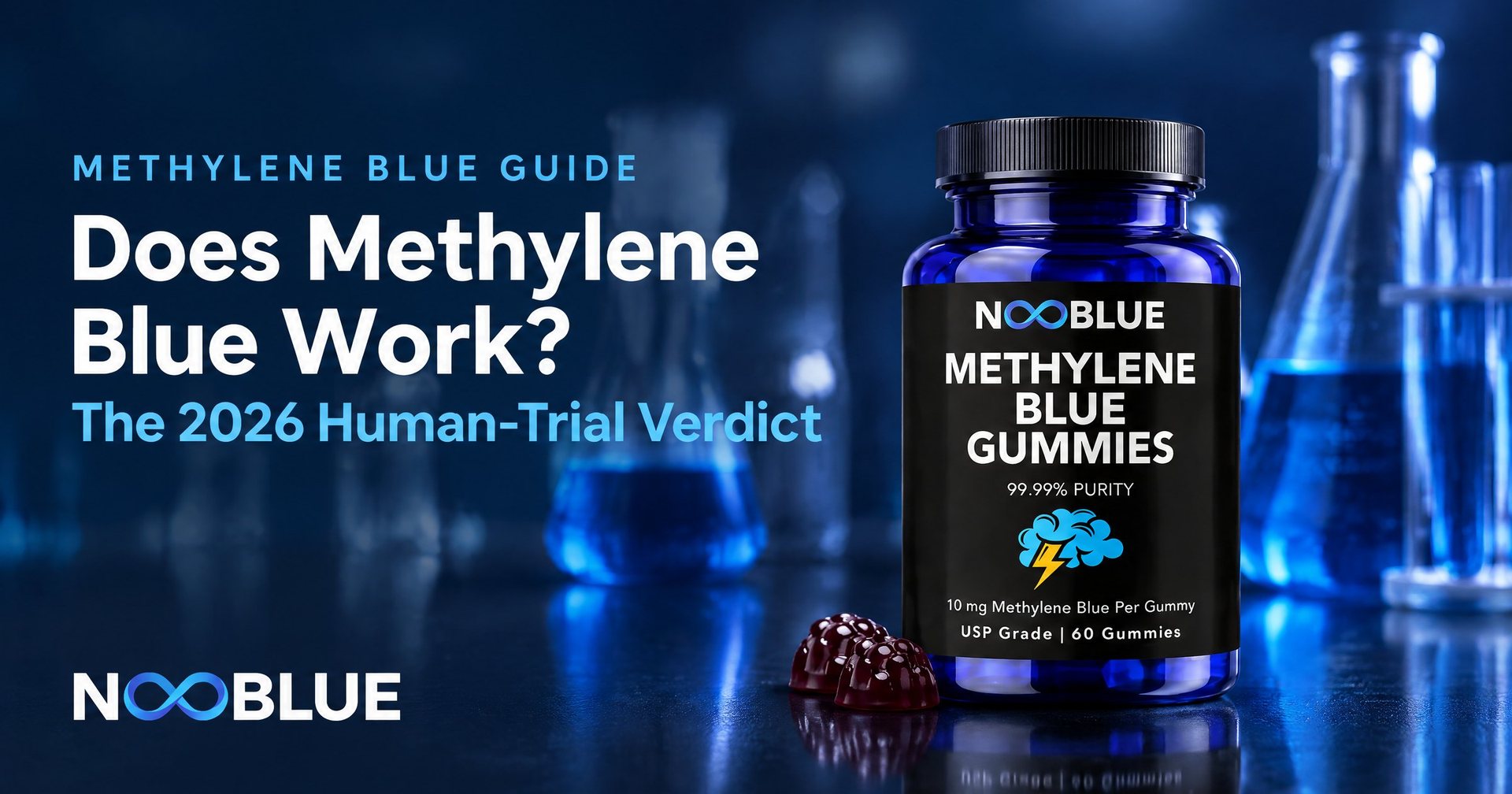
Format changes the experience, not the evidence grade. A claim that is preclinical in a capsule is still preclinical in a gummy. The NooBlue Methylene Blue Gummies contain 10 mg of methylene blue with 25 mg of vitamin C, which can shift methylene blue toward its colorless form, and they don’t leave the blue mouth that drops can. Our explainer on leucomethylene blue, the colorless form covers the chemistry.
Where the Human Evidence Is Strong, and Where It Isn’t
Strong enough to take seriously: short-term effects on memory retrieval and attention-related brain activity in healthy adults, from one randomized, double-blind, placebo-controlled trial with a brain-imaging measure. That is a real result. It is also a single trial of 26 people over one afternoon, not a body of research.
Uncertain: whether any effect persists with daily use over weeks, and whether it appears at supplement doses. We found no trial that answers either question. Anyone describing a 90-day trajectory is extrapolating.
Not shown in humans: longevity, anti-aging outcomes, younger-looking skin from taking it by mouth, and more everyday energy. The mechanism is coherent, since methylene blue passes electrons along the mitochondrial respiratory chain, but a coherent mechanism is a hypothesis, not a result. The Cells review is candid about this. Our methylene blue research statistics roundup lists what has and has not been measured.
Who Should Not Take Methylene Blue
The one area where the evidence is clear is risk. Methylene blue is a potent inhibitor of the enzyme MAO-A, which is why it interacts dangerously with serotonergic medicines (Ramsay et al., 2007). Read this before you try it:
- Do not take methylene blue if you take an SSRI, SNRI, MAOI or any other serotonergic medicine, including many antidepressants. The combination can cause serotonin syndrome. See methylene blue and serotonin syndrome.
- Do not take it if you have G6PD deficiency. A standard clinical reference lists methylene blue as contraindicated because of the risk of hemolysis (StatPearls). See methylene blue and G6PD deficiency.
- Not for use during pregnancy or while breastfeeding.
- Not for anyone under 18.
- Methylene blue can turn urine blue or green. This is expected and is not a sign that it is working.
- Talk to your doctor before you start if you take any prescription medicine.
For daily use, see whether methylene blue is safe to take daily, and for the trade-offs in one place, methylene blue benefits and side effects.
Does Methylene Blue Work for You? A 30-Day Self-Check
Group averages do not tell you about you. A 7% average improvement across a small group fits a large effect in some people and none in others. The only way to find out which you are is to measure, and most people never record a baseline, so they cannot tell a real change from a good week. If the safety list above does not rule you out, this protocol gives a usable answer:
- Record a baseline for seven days before you start. Note three things each day: a timed task you repeat (a standard online reaction-time test works), your afternoon energy on a 1 to 10 scale at a fixed time, and hours slept. Seven days gives you a range, not a single point.
- Change one thing. Starting methylene blue in the same week you change your sleep or caffeine makes the result impossible to read.
- Fix the dose and the time. Same product, same amount, same clock time every day, at or below the label serving. The 5 mg capsule is the smallest fixed dose we sell, which makes it a simple place to start.
- Run it for 30 days. That is long enough to include a bad week and a good one.
- Compare ranges, not best days. A real signal moves your seven-day average outside its baseline range and keeps it there. One sharp afternoon is noise.
- Set a stop rule in advance. No movement outside your baseline range by day 30, or any new symptom at any point, means you stop. Deciding this first keeps sunk cost from answering the question for you.
Blue or green urine is expected and tells you nothing about whether it works. If you feel unusual early on, read why some people feel weird after taking methylene blue before you continue.
Our Pick for Running the Self-Check
A self-check only means something if the product matches its label and the dose stays fixed. Our pick for it is the NooBlue Ultimate Methylene Blue Capsules: 5 mg of methylene blue with 10 mg of vitamin C in each capsule, one capsule a day with food, 60 capsules for $37.99. If you would rather chew than swallow, the 10 mg gummies ($49.99 for 60) are the easiest daily habit to keep for 30 days. The 1% drops ($29.99 for 50 ml, 0.5 mg per drop) give the finest control, although drops can stain the mouth. You can compare all three in the NooBlue shop, and our best methylene blue supplements comparison covers other brands.
Frequently Asked Questions
Does methylene blue actually help the human body?
In one small randomized trial, a single 280 mg dose improved memory retrieval by 7% and increased attention-related brain activity in healthy adults an hour later. Beyond that, most claims rest on cell, animal and mechanism studies. Its established medical role is a hospital treatment given intravenously by doctors, which is a different use from a daily supplement.
Is it true that methylene blue makes you look younger?
Not on human evidence. Lab studies found that methylene blue slowed signs of aging in cultured human skin cells and improved hydration and thickness in a lab-grown skin model, but we found no trial showing that taking it by mouth changes how a person looks. Treat skin claims as early laboratory findings.
Why don’t doctors recommend methylene blue?
Its established hospital use is intravenous and unrelated to cognition, and the outpatient evidence for memory or focus is one small single-dose trial. It also interacts with common antidepressants and other serotonergic medicines, and it is unsafe for people with G6PD deficiency. That combination makes clinical caution the default. We cover this in why doctors rarely prescribe methylene blue.
Is methylene blue killing parasites?
Methylene blue was one of the first synthetic drugs used against malaria parasites more than a century ago, and researchers have returned to it in prescription drug combinations. That is medicine given under medical supervision. A methylene blue supplement is not a treatment for any infection, and the parasite claims circulating online are not backed by human trials. If you think you have an infection, see a doctor.
Is it bad to take methylene blue every day?
Daily use at low supplement doses is common, but we found no long-term trial of daily use in healthy adults, so the evidence cannot promise it is safe indefinitely. Stay at the label serving, stop if anything feels wrong, and do not take it daily if you use serotonergic medicines, have G6PD deficiency, are pregnant or breastfeeding, or are under 18.
How long does it take for methylene blue to work?
In the 2016 Radiology trial, memory and brain-imaging effects were measured one hour after a single 280 mg dose. Whether anything builds up over weeks at supplement doses has not been tested. That one-hour window is the only well-documented timing figure.
Why do I feel weird after taking methylene blue?
Common explanations are a dose that is too high for you, an interaction with something else you take, or simple novelty. Blue or green urine is expected. Agitation, confusion, heavy sweating or a racing heart, especially if you take an antidepressant or other serotonergic medicine, are warning signs: stop and get medical help.
Does methylene blue give you more energy?
The idea is plausible, since methylene blue can accept and pass on electrons in the mitochondrial respiratory chain, but we found no human trial that measured energy as an outcome. The 2016 trial measured attention and memory. Treat energy claims as a mechanism-based guess, and use the 30-day self-check above if you want to know how it affects you.
Sources
- Rodriguez P, Zhou W, Barrett DW, et al. Multimodal randomized functional MR imaging of the effects of methylene blue in the human brain. Radiology. 2016;281(2):516-526. PubMed 27351678
- Zoellner LA, Telch M, Foa EB, et al. Enhancing extinction learning in posttraumatic stress disorder with brief daily imaginal exposure and methylene blue: a randomized controlled trial. Journal of Clinical Psychiatry. 2017;78(7):e782-e789. PubMed 28686823
- Auchter AM, Barrett DW, Monfils MH, Gonzalez-Lima F. Methylene blue preserves cytochrome oxidase activity and prevents neurodegeneration and memory impairment in rats with chronic cerebral hypoperfusion. Frontiers in Cellular Neuroscience. 2020;14:130. PubMed 32508596
- Xiong ZM, O’Donovan M, Sun L, et al. Anti-aging potentials of methylene blue for human skin longevity. Scientific Reports. 2017;7(1):2475. PubMed 28559565
- Xue H, Thaivalappil A, Cao K. The potentials of methylene blue as an anti-aging drug. Cells. 2021;10(12):3379. PubMed 34943887
- Ramsay RR, Dunford C, Gillman PK. Methylene blue and serotonin toxicity: inhibition of monoamine oxidase A (MAO A) confirms a theoretical prediction. British Journal of Pharmacology. 2007;152(6):946-951. PubMed 17721552
- Schirmer RH, Adler H, Pickhardt M, Mandelkow E. “Lest we forget you: methylene blue…”. Neurobiology of Aging. 2011;32(12):2325.e7-16. PubMed 21316815
- Ostrovsky A, Afzal M. Methylene Blue. StatPearls. Updated January 2026. NCBI Bookshelf NBK557593
This article is for educational purposes only and is not medical advice. Talk to your doctor before starting methylene blue, especially if you take any prescription medicine.