Last updated: September 2, 2026
Picking your first bottle of methylene blue is harder than it should be. The market includes everything from cheap aquarium-grade bottles to costly practitioner-only troches, and the labels do not always make the important distinctions clear. Bottle size, strength, purity grade, and delivery format all affect what you actually get and, more importantly, whether it is suitable for oral use. Here is a practical guide to choosing the right first purchase without overpaying or compromising on quality.
Table of contents
Start with Format: Capsules vs. Liquid for First-Time Users
The format decision matters more than bottle size for beginners, because it determines your entire dosing experience.
Capsules are the recommended starting format. Each capsule contains a pre-measured dose (typically 5 mg for nootropic-focused products), sealed inside a vegetarian or gelatin shell. You take one capsule with food. There is nothing to measure, nothing to stain your mouth and no equipment to buy. The fixed dose eliminates the most common beginner mistake: inaccurate dosing from eyeballing liquid drops. For someone who has never taken methylene blue before, capsules remove every variable except remembering to take the dose.
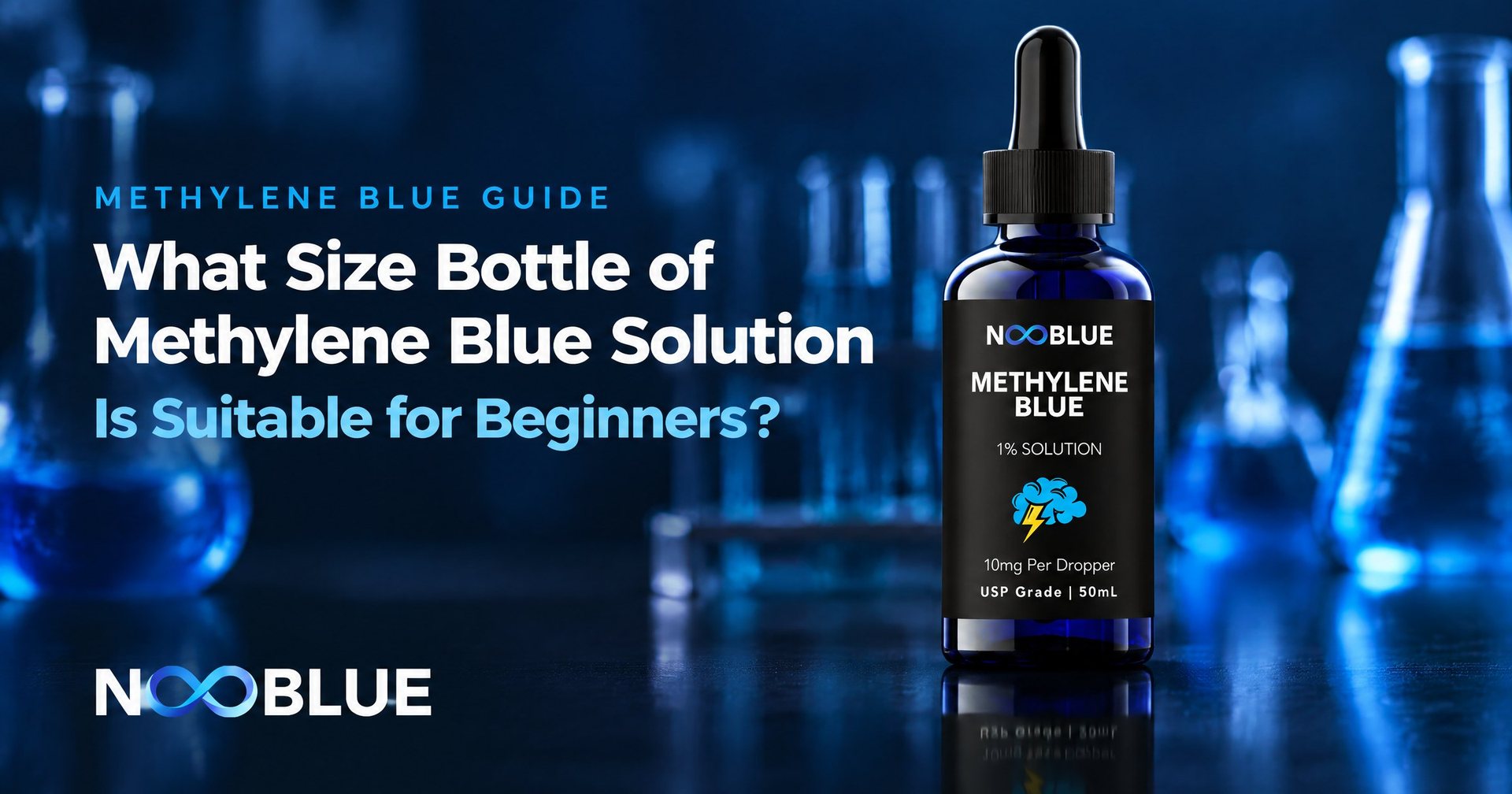
Liquid solutions suit beginners who want dose flexibility. A 1% methylene blue solution delivers 10 mg per milliliter, allowing you to start at very low amounts (2 to 3 mg) and adjust in small steps. This is useful if you are cautious about new supplements and prefer to titrate upward from a minimal starting dose. The trade-offs are blue-stained mouth and tongue, the need for a calibrated dropper or syringe, and more storage care to protect the liquid from UV light.
For the majority of first-time users, a 60-count bottle of 5 mg capsules is the simplest and most practical starting point. It provides a two-month supply at one 5 mg capsule a day, costs $37.99 for NooBlue’s version, and lets you evaluate whether methylene blue works for you before committing to larger quantities or experimenting with liquid dosing.
Bottle Size and Supply Duration
Methylene blue bottles come in several standard sizes, and understanding how long each one lasts helps you plan your first purchase.
Capsules, 60 count (5 mg each): At one capsule per day, this bottle lasts 60 days. It is a common first size and gives you two months to judge how the routine suits you. No published study has measured how long low daily amounts take to show an effect, so give yourself a few weeks of consistent use before you decide.
Liquid, 30 ml (1% strength): Contains about 300 mg of total methylene blue. At 5 mg per day (0.5 ml), this bottle lasts about 60 days. A 30 ml bottle is a reasonable first purchase for liquid users, but a 50 ml bottle provides better value per milliliter if available.
If you are curious about uses beyond cognition, see our guide to methylene blue and weight loss.
Liquid, 50 ml (1% strength): Contains about 500 mg of total methylene blue. At 5 mg per day, this bottle lasts about 100 days, more than three months. This is the better value option if you are confident in your decision to try liquid methylene blue. NooBlue’s 1% Methylene Blue Solution comes in this 50 ml format.
Avoid purchasing bulk quantities (100 ml+ bottles or multi-gram powder) for your first purchase. You do not yet know how you respond to the compound, if you prefer capsules or liquid, or whether the specific product you selected meets your expectations. Start with a single standard bottle, evaluate over 30 to 60 days, and then make a more informed bulk or subscription purchase if you want to continue.
Looking for clean, USP-grade methylene blue? NooBlue’s Methylene Blue Capsules hold 5 mg of USP-grade methylene blue each, cost $37.99 for 60, and the product page links a lab report on the methylene blue ingredient. Shop the full range →
What to Look for on the Label
Methylene blue labeling is inconsistent across brands, which makes knowing what to look for essential for beginners who cannot yet distinguish quality products from questionable ones by experience alone.
Purity grade: “USP Pharmaceutical Grade” is the standard you want. This designation means the product meets the United States Pharmacopeia monograph for methylene blue, which includes testing for identity, potency, heavy metals (arsenic, lead, mercury), and organic impurities. Avoid products labeled “laboratory grade,” “reagent grade,” “research use only,” or “aquarium grade”. These are made to lower purity standards that are not appropriate for human ingestion.
Strength (liquid only). The label should state the strength as a percentage (e.g., “1% w/v”) and the corresponding milligram-per-milliliter dosage (e.g., “10 mg/ml”). If the bottle simply says “methylene blue solution” without a strength, accurate dosing is impossible and the product should be avoided.
Per-dose milligram content (capsules). Each capsule should state its milligram content, for example 5 mg per capsule. Products that list total milligrams per bottle without specifying the per-capsule dose are harder to dose accurately.
Certificate of Analysis (COA). A published COA from a third-party accredited laboratory is the strongest quality signal available. The COA should list the testing lab name, batch number, test date, and measured values for purity, heavy metals, and microbial impurities. In human cells grown in the lab, methylene blue had measurable effects at nanomolar concentrations (Atamna et al., 2008). The compound is active in small amounts, which is one more reason the stated strength on a label matters.
Red Flags That Beginners Should Avoid
The methylene blue market includes products that are perfectly fine for their intended purpose (laboratory research, aquarium use) but completely inappropriate for human use. Here are the warning signs (and if you choose liquid, our guide to taking methylene blue drops explains how to measure drops accurately):
Products sold in clear plastic bottles. Methylene blue is photosensitive and degrades under UV light. Amber or cobalt glass is the packaging standard for any product intended for long-term human use. Clear plastic signals that the manufacturer is either unaware of or indifferent to stability requirements.
No stated purity grade or COA. If a brand does not specify “USP grade” or provide a Certificate of Analysis, you have no way to verify what is in the bottle. “Pure methylene blue” and “high-quality methylene blue” are marketing phrases with no defined meaning.
Extremely low prices. Pharma-grade methylene blue costs more to produce than industrial or lab-grade material. A liquid priced far below the rest of the market deserves questions about its grade and its testing. Budget pricing is attractive, but with a compound you plan to take daily, proper testing is worth paying for.
Industrial or aquarium branding. Some Amazon and marketplace sellers relabel industrial methylene blue with supplement-style marketing. Check the brand’s website and product line: if they primarily sell aquarium supplies or laboratory chemicals, the methylene blue is likely manufactured to those standards rather than supplement standards.
A Recommended First Purchase
NooBlue’s Ultimate Methylene Blue Capsules (60 x 5 mg) are built for the new user. Each capsule delivers a fixed 5 mg of USP-grade methylene blue with 10 mg of vitamin C. The product page links a lab report from Contract Testing Laboratories of America (CTLA) on the raw methylene blue ingredient, covering identity and four heavy metals. It covers the ingredient, not each finished batch, and it does not state a purity percentage. The 60-capsule bottle provides a full two-month supply at the label’s one capsule a day, with no measuring tools, no staining, and no preparation required.
For users who prefer liquid from the start, the NooBlue 1% Methylene Blue Solution (50 ml) offers about 100 servings of 5 mg in a 50 ml precision dropper bottle, at 0.5 mg per drop. In a randomized trial of 26 healthy adults, a single 280 mg oral dose of USP-grade methylene blue was followed an hour later by higher brain activity on MRI during attention and memory tasks (Rodriguez et al., 2016). That is many times the amount in a capsule, so it does not tell you what 5 mg a day does. A single 5 mg capsule is a conservative place to start while you learn how you respond.
Whichever format you choose, take it in the morning: methylene blue is mildly stimulating, and a cutoff of around 2 PM protects sleep. For more on timing, see our guide to methylene blue and sleep quality.
Both products are available at the NooBlue shop.
Key Takeaways
- Start with a 60-count bottle of 5 mg capsules. One capsule a day is a two-month supply with no measuring, no staining, and no dropper.
- Choose liquid only if you want to titrate. A 1% solution is 10 mg/ml, so 0.5 ml delivers 5 mg. A 30 ml bottle lasts about 60 days and a 50 ml bottle about 100 days.
- Buy USP pharmaceutical grade with a published third-party COA. Skip anything labeled laboratory, reagent, research-only, or aquarium grade.
- Three quick label checks: amber or cobalt glass, a stated strength (e.g., 1% w/v = 10 mg/ml) or a per-capsule mg figure, and a COA with lab name, batch number, and test date.
- Skip bulk on the first order. Evaluate one standard bottle over 30 to 60 days before buying 100 ml+ bottles, powder, or a subscription.
Safety Checks Before Your First Bottle
Before you order, rule out the situations where methylene blue is not appropriate:
- Do not take methylene blue with an SSRI, SNRI, MAOI or any other serotonergic medicine or supplement. Methylene blue acts as an MAO inhibitor, and the combination can cause serotonin syndrome.
- Do not take it if you have G6PD deficiency.
- Not for use during pregnancy or while breastfeeding.
- Not for anyone under 18.
- Methylene blue can turn urine blue or green. That is expected.
- If you take any prescription medicine, talk to your doctor before you start.
Our guide to who should not take methylene blue covers the full list.
Two habits make the first weeks smoother: take your dose in the morning with food, and keep a cutoff of around 2 PM so the mild stimulating effect does not interfere with sleep. Expect blue or green urine, which surprises many first-time users.
Frequently Asked Questions
Should I start with 5 mg or 10 mg per day?
Start with 5 mg. One NooBlue capsule holds 5 mg, and the capsule label says one capsule a day and not to exceed the suggested serving, so capsules are not a route to 10 mg. The gummies hold 10 mg each, and a full 1 ml dropper of the 1% drops gives 10 mg. If you and your doctor decide a higher amount suits you, use a format made for it rather than doubling capsules. There is no benefit to rushing: methylene blue has a hormetic dose response, where low and high doses can have opposite effects.
How long until I notice effects from methylene blue?
No published study has measured a timeline for low daily amounts. The best-known human trial looked at brain activity one hour after a single 280 mg dose, far more than any daily supplement serving, so it cannot tell you what a 5 mg capsule does over weeks. A practical approach is to take the label amount consistently for about 30 days, keep a short note of your sleep and energy, and then decide whether to continue.
Can I take methylene blue with my existing supplements?
The interaction that matters most is serotonergic: do not combine methylene blue with SSRIs, SNRIs, MAOIs, St. John’s Wort, 5-HTP, or L-tryptophan due to the risk of serotonin syndrome. If you take any prescription medications, consult your healthcare provider before adding methylene blue to your routine. For other supplements, ask your doctor or pharmacist to check the full list, and note that NooBlue’s capsules and gummies already contain some vitamin C.
Why do I feel a bit off after taking methylene blue?
Dose and timing explain most of it. Blue or green urine is expected, and drops can stain the tongue. Mild nausea usually means you took it on an empty stomach, and a wired or restless feeling often means the dose was too high or taken too late in the day. Drop back to a single 5 mg capsule with breakfast, keep a 2 PM cutoff, and read our side effects guide. If symptoms persist or feel severe, stop and talk to your doctor.
Should a first liquid bottle be 30 ml or 50 ml of 1% solution?
A 1% solution holds 10 mg per milliliter, so 30 ml is roughly 300 mg, about 60 days at 5 mg a day, and 50 ml is roughly 500 mg, closer to 100 days. NooBlue’s 1% Methylene Blue Solution comes in the 50 ml format at $29.99, which is the better value per milliliter once you know dropper dosing suits you. If you are still deciding between liquid and capsules, the 30 ml bottle wastes less. Skip 100 ml and above on a first purchase.
Sources
- Atamna H, Nguyen A, Schultz C, et al. Methylene blue delays cellular senescence and enhances key mitochondrial biochemical pathways. FASEB Journal. 2008;22(3):703-712. PubMed 17928358
- Rodriguez P, Zhou W, Barrett DW, et al. Multimodal randomized functional MR imaging of the effects of methylene blue in the human brain. Radiology. 2016;281(2):516-526. PubMed 27351678
- NooBlue product pages for the capsules, gummies and 1% drops (label directions, lab report and safety box, checked September 2026).
Continue reading
How Many mg of Methylene Blue Per Day Should I Take? → What Not to Take with Methylene Blue: Drug and Supplement Interactions →Recommended for you