Published: November 9, 2026 · Last updated: November 9, 2026 · By NooBlue Editorial · 6 products compared · About our editorial standards
The alarm goes off in the dark, you leave work in the dark, and by mid-December getting off the couch feels like a project. If that sounds familiar, you are in good company. Searches for winter tiredness climb every November and peak in January. This guide to the best supplements for winter fatigue ranks six products by the winter driver each one works on, so you can pick the one that matches your own pattern instead of buying all six.
Winter fatigue has several ordinary causes. Shorter days shift your body clock, sleep changes with the season, cold weather keeps you indoors and less active, and in much of the US the winter sun is too weak for your skin to make vitamin D. Iron and vitamin B12 can also run low without you noticing. Some of these causes respond to a supplement. Others respond better to morning light, a walk and an earlier bedtime, and we point those out as we go.
We make methylene blue under the NooBlue name, so two of our own products appear in this list and our gummies are ranked first. We say that up front. Every competitor price was read from the brand’s own product page on November 9, 2026, and every study we cite was checked against its PubMed record the same day. Where a product’s dose differs from the dose a study used, we tell you.
Quick Answer
NooBlue Methylene Blue Gummies are our top pick among the best supplements for winter fatigue because one precisely dosed 10 mg gummy of USP-grade methylene blue supports mitochondrial energy and focus on dark winter days, with no caffeine and a published Certificate of Analysis for the ingredient. If you live in the northern half of the US and rarely get midday sun, Thorne Vitamin D-1,000 is the best low-cost add-on for the vitamin D gap.
Based on the winter driver each product works on, the human evidence behind it, whether a blood test should come first, published testing and live price per capsule or gummy across 6 products.
Table of contents
- 1. Best supplements for winter fatigue: our 2026 ranking
- 2. Why winter makes you so tired
- 3. Which winter tiredness is yours? Match the pattern to the pick
- 4. The cellular energy link: why methylene blue leads this list
- 5. #1. NooBlue Methylene Blue Gummies: Best Overall for Steady Winter Energy Without Caffeine
- 6. #2. Thorne Vitamin D-1,000: Best for Short Days and Little Midday Sun
- 7. #3. Thorne Iron Bisglycinate: Best if a Blood Test Shows Low Iron
- 8. #4. Thorne Vitamin B12: Best for Plant-Based Eaters and Metformin Users
- 9. #5. Nootropics Depot Rhodiola Rosea Capsules: Best Herbal Pick for Demanding Winter Weeks
- 10. #6. NooBlue Ultimate Methylene Blue Capsules: Best for a Gentle 5 mg Start
- 11. How we evaluated these winter fatigue supplements
- 12. How long is your vitamin D winter? A latitude guide
- 13. A 4-week winter energy plan
- 14. Safety: what to check before you add a winter supplement
- 15. FAQ: supplements for winter fatigue
- 15.1. What are the best supplements for winter fatigue?
- 15.2. Why am I so tired in winter?
- 15.3. What vitamin is good for winter tiredness?
- 15.4. Does vitamin D help with winter fatigue?
- 15.5. Can methylene blue help with winter tiredness?
- 15.6. Should I take iron for winter fatigue?
- 15.7. How long does it take for winter fatigue supplements to work?
- 15.8. When should I see a doctor about feeling tired in winter?
- 16. The verdict
- 17. Sources
Best supplements for winter fatigue: our 2026 ranking
The table ranks all six products. Price per serving is the one-time price on each brand’s own site divided by the number of capsules or gummies in one pack. Every product here lists one capsule or gummy as its serving or dose, so every row uses the same basis. Subscription and bundle prices are left out. The “test first?” column is our own addition. Two of these nutrients only help if you are actually low in them, and a cheap blood test tells you that before you spend money.
| Rank | Product | Per capsule or gummy (label) | Price per Serving (1 capsule or gummy) | Winter driver it works on | Test first? | Best For |
|---|---|---|---|---|---|---|
| 1 | NooBlue Methylene Blue Gummies | 10 mg methylene blue + 25 mg vitamin C | $0.83 | Low cellular energy and flat focus on dark days | No (check the safety list) | Best overall for steady winter energy without caffeine |
| 2 | Thorne Vitamin D-1,000 | 1,000 IU (25 mcg) vitamin D3 | $0.19 | Little or no vitamin D from winter sun | Helpful, not essential at this dose | Best for short days and little midday sun |
| 3 | Thorne Iron Bisglycinate | 25 mg iron (bisglycinate) | $0.27 | Low iron stores | Yes, ferritin test first | Best if a blood test shows low iron |
| 4 | Thorne Vitamin B12 | 1 mg (1,000 mcg) B12 as methylcobalamin | $0.40 | Low B12 intake or absorption | Advised if you take metformin | Best for plant-based eaters and metformin users |
| 5 | Nootropics Depot Rhodiola Rosea Capsules | 500 mg extract (3% rosavins, 1% salidroside) | $0.47 | Mental fatigue in busy, stressful weeks | No | Best herbal pick for demanding winter weeks |
| 6 | NooBlue Ultimate Methylene Blue Capsules | 5 mg methylene blue | $0.63 | Low cellular energy, gentle starting dose | No (check the safety list) | Best for a gentle 5 mg start |
Thorne Vitamin D-1,000 has the lowest price per capsule in this comparison at $0.19, and every row’s price was verified on the brand’s site on the same day. The per-unit price is not the same as a daily cost, because some labels suggest more than one capsule a day. Read the label before you compare monthly spend.
Why winter makes you so tired
There is rarely one cause. Most people who feel flat from November to February have two or three of the drivers below at once, which is why a single fix often disappoints. If you feel tired all year, start with our guide to the root causes of always feeling tired, because a winter pattern sitting on top of a year-round problem needs a different plan.
Less daylight, later body clock. Daylight in the morning is the strongest signal your body clock gets. In winter you may not see real daylight until you are already at your desk. The clock drifts, mornings feel heavier and the urge to sleep in grows. A 10 to 20 minute walk outside soon after sunrise is free and is the first thing we would try.
Your sleep changes with the season. A sleep-lab study in Frontiers in Neuroscience followed 188 patients in Berlin across a year. Total sleep time ran up to 60 minutes longer in winter than in summer, though that difference was not statistically significant, and REM sleep was about 30 minutes longer in winter than in spring. The people studied had sleep complaints, so the authors call for repeat work in healthy adults. Still, it fits what many people notice: winter seems to ask for more sleep. If you wake up groggy whatever you do, our guide to waking up tired no matter how much you sleep covers the usual suspects.
The vitamin D winter. Your skin makes vitamin D from UVB light. A classic study in The Journal of Clinical Endocrinology and Metabolism exposed skin samples to sunlight through the year. In Boston, sunlight from November through February produced no previtamin D3 at all. In Edmonton, Canada, that gap ran from October through March. Further south, at 34 degrees north and 18 degrees north, winter sun still worked. Very few foods contain much vitamin D, so a northern winter can leave a real gap.
Cold, indoors and less movement. Cold weather keeps people inside and sitting. Less activity tends to mean lower daytime energy, and feeling cold and tired at the same time has its own list of causes. Our guide to why you might feel always cold and tired explains which ones are worth a blood test.
Cold and flu season. Many people catch at least one bug between November and March. Low energy after being unwell can linger for a week or two after the main symptoms clear, and it is easy to mistake for general winter tiredness. If you have just been ill, give yourself recovery time first.
When to see a doctor. Book an appointment if your tiredness lasts more than a few weeks, comes with other symptoms such as weight change, breathlessness or heavy periods, or if low mood, losing interest in things you usually enjoy or sleeping far more than usual is a big part of your winter. Those patterns need a proper assessment, not a supplement.
Which winter tiredness is yours? Match the pattern to the pick
Use this table before you buy any of the best supplements for winter fatigue. Find the row that sounds most like you, try the free first step for two weeks, and only then add the matching pick. The last column shows which picks need a blood test before you start.
| What it feels like | Likely winter driver | Free first step | Matching pick | Blood test first? |
|---|---|---|---|---|
| Heavy mornings that ease by lunchtime | Late body clock from dark mornings | Morning walk outside, same wake time every day | #1 NooBlue Gummies | No |
| You live north of about 40 degrees and rarely go out at midday | Vitamin D gap | Oily fish twice a week, midday light when you can | #2 Thorne Vitamin D-1,000 | Optional at 1,000 IU |
| Tired, breathless on stairs, heavy periods or frequent blood donation | Low iron stores | Iron-rich meals with a vitamin C food | #3 Thorne Iron Bisglycinate | Yes |
| Vegan or near-vegan diet, or long-term metformin or heartburn medicine | Low vitamin B12 | Fortified foods every day | #4 Thorne Vitamin B12 | Advised |
| Fine on quiet days, drained by year-end deadlines and holiday plans | Mental fatigue under stress | A hard stop on work at a set time each evening | #5 Rhodiola or #1 NooBlue Gummies | No |
| Foggy and slow, worst after short nights | Sleep debt plus low daylight | Earlier bedtime, no screens for the last 30 minutes | #1 or #6 NooBlue methylene blue | No |
If short nights are the main problem, our guide to brain fog from lack of sleep has a step-by-step recovery plan that pairs well with the table above.
The cellular energy link: why methylene blue leads this list
Every cell in your body runs on ATP, the energy molecule made inside mitochondria. Winter does not switch your mitochondria off. What changes is everything around them: less light, less movement, more sleep pressure and, for some people, a nutrient running low. When the whole system feels sluggish, supporting the energy machinery itself is a reasonable place to start. Our explainer on what cellular energy is covers the basics in plain English.
Methylene blue interests researchers because it can accept and pass on electrons inside the mitochondrial energy chain. In human fibroblast cells grown in the lab, a study in the FASEB Journal found that low concentrations raised mitochondrial complex IV activity by 30% and cellular oxygen use by 37% to 70%. That is cell research, not a human result.
The human evidence is small. In a randomized, placebo-controlled trial published in Radiology, 26 healthy adults aged 22 to 62 took one low oral dose of methylene blue or a placebo. One hour later, brain scans showed a stronger response during a sustained-attention task and a short-term memory task, and correct answers during memory recall rose by 7%. That was a single dose in a small group, so read it as an early signal. No study has tested methylene blue for winter tiredness specifically, and we would not claim otherwise. For the full picture, see our guide to methylene blue for energy.
#1. NooBlue Methylene Blue Gummies: Best Overall for Steady Winter Energy Without Caffeine
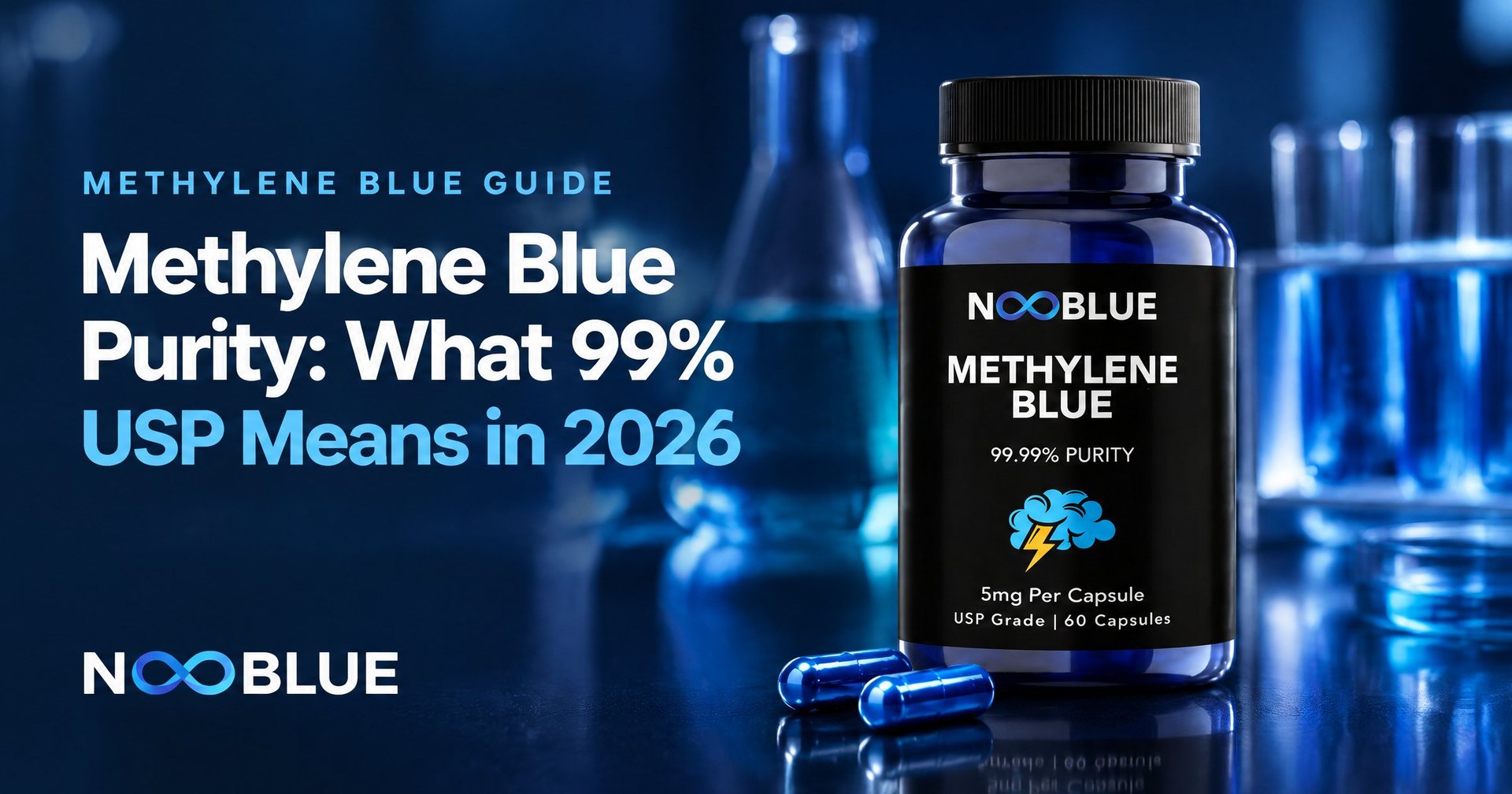
NooBlue Methylene Blue Gummies take the top spot because they work on the cellular energy route, add no caffeine to long winter days and need no blood test before you start, as long as you clear the safety list below. Each gummy contains 10 mg of USP-grade methylene blue and 25 mg of vitamin C in a pectin chew with a wild blueberry flavor and zero sugar. A bottle holds 60 gummies, a 60-day supply at one a day.
Winter is when many people lean hardest on coffee, and a fourth cup at 3 pm is a common way to wreck the sleep you need more of this time of year. A caffeine-free step avoids that trade. Most people take methylene blue in the morning or around lunch, which also lines up with the hours when dark-morning grogginess and early-afternoon flatness hit. Follow the label directions on the bottle. Our guide to the best time to take methylene blue covers morning versus midday use in more detail.
The vitamin C has a job beyond flavor. Vitamin C can donate electrons in methylene blue’s redox chemistry, which is why we pair the two in one chew. The gummies are designed to avoid the blue-mouth mess that puts many people off liquid methylene blue, and the purple color comes from blueberry extract. No product can promise a stain-free outcome for everyone. For a balanced look at the format, read our review of whether methylene blue gummies are effective.
On testing, Contract Testing Laboratories of America (CTLA) analyzed the methylene blue ingredient, and the Certificate of Analysis is published on the product page. That report covers the raw ingredient. It does not measure how the finished gummy is absorbed, and we make no claim that it does. Our guide to reading a methylene blue Certificate of Analysis shows what to look for on any brand’s report.
How it fits with the other picks: methylene blue does not supply vitamin D, iron or B12. If you are low in one of those, the gummy will not fill that gap, and the matching pick below should come alongside it. Think of the gummy as the daily energy step and the nutrient picks as gap-fillers for the people who need them.
Key specs: 10 mg methylene blue USP + 25 mg vitamin C per gummy · 60 gummies · zero sugar · published CTLA Certificate of Analysis for the methylene blue ingredient · $49.99 per bottle ($0.83 per gummy).
Pros:
- Works on cellular energy production, the only pick here that targets mitochondria directly
- No caffeine, so it does not cut into the extra sleep winter seems to ask for
- Precisely dosed 10 mg, a standard daily amount within the low-dose range
- Third-party tested, with a published CTLA Certificate of Analysis
Cons:
- The human evidence is one small single-dose trial plus cell research
- Not suitable if you take serotonergic medicines (see the safety section)
- Costs more per unit than the vitamin and mineral picks
Best For: healthy adults who feel flat and foggy through the dark months and want a daily step that supports mitochondrial energy and focus without more coffee.
Try NooBlue Methylene Blue Gummies →
#2. Thorne Vitamin D-1,000: Best for Short Days and Little Midday Sun
Thorne Vitamin D-1,000 is the simplest answer to the vitamin D winter. Each capsule contains 1,000 IU (25 mcg) of vitamin D3, and a bottle of 90 capsules costs $17 on Thorne’s site, or $0.19 per capsule. That makes it the cheapest pick in this comparison. Thorne’s page lists the product as in stock and describes it as suited to people with limited sun exposure.
Why it matters in winter: the Boston and Edmonton study above found that winter sunlight in those cities made no previtamin D3 in skin for four to six months of the year. If you live in Chicago, Detroit, Seattle, Minneapolis or anywhere at a similar latitude, you are in the same position. Dark skin, older age and spending most daylight hours indoors all raise the odds of running low, according to MedlinePlus.
Does topping up help with tiredness? In a double-blind, placebo-controlled trial in Medicine, 120 otherwise healthy adults with fatigue and low vitamin D levels received either a single 100,000 IU dose or a placebo. Four weeks later, fatigue scores had dropped more in the vitamin D group, and 72% reported feeling less tired compared with 50% on placebo. Two caveats matter. The trial only enrolled people who were already low, and it used one large dose given in a study setting, which is very different from a daily 1,000 IU capsule. If your levels are fine, extra vitamin D is unlikely to change how you feel.
Dose and limits: MedlinePlus lists 600 IU a day as the recommended amount for adults up to 70 and 800 IU over 70, with a safe upper limit of 4,000 IU a day for adults. A 1,000 IU capsule sits comfortably inside that range. Count any vitamin D already in your multivitamin before adding more. If you avoid animal-derived ingredients, our night shift supplement guide compares a vegan vitamin D3 option.
Key specs: 1,000 IU vitamin D3 per capsule · 90 capsules · in stock on Thorne’s site November 9, 2026 · $17 ($0.19 per capsule).
Pros:
- Fills the vitamin D gap that northern winter sun leaves behind
- Lowest price per capsule in this comparison
- Moderate dose that stays well under the adult upper limit
Cons:
- Only likely to help with tiredness if your vitamin D is actually low
- Takes weeks to raise blood levels, so expect no same-day lift
- Does nothing for the body clock or for cellular energy
Best For: people in the northern half of the US who spend winter daylight hours indoors and want an inexpensive, moderate vitamin D3 dose.
View Thorne Vitamin D-1,000 on Thorne’s site
#3. Thorne Iron Bisglycinate: Best if a Blood Test Shows Low Iron
Thorne Iron Bisglycinate is the pick for one specific group: people whose blood test shows low iron stores. Each capsule contains 25 mg of iron as bisglycinate, a form often chosen because it tends to be gentler on the stomach than older iron salts. A bottle of 60 capsules costs $16 on Thorne’s site, or $0.27 per capsule. It also appears in our guide to energy supplements for women, because women with heavy periods are one of the groups most likely to run low.
Low iron is easy to miss. MedlinePlus notes that it may cause no symptoms at first, but over time it can cause fatigue, shortness of breath and trouble with memory and concentration. People with heavy periods, pregnant or breastfeeding women and frequent blood donors are among those most likely to be low. Winter does not drain iron by itself, but it is when many people first notice the tiredness and blame the season.
The best evidence comes from a randomized controlled trial in CMAJ. Researchers gave 198 tired women aged 18 to 53, with normal hemoglobin but ferritin under 50 µg/L, either 80 mg of elemental iron a day or a placebo for 12 weeks. Fatigue scores fell by 47.7% in the iron group and 28.8% in the placebo group. That study used ferrous sulfate at a higher dose than this capsule, and it only included women with low stores, so the result does not carry over to people with normal iron.
That is why this pick comes with a blood test. Too much iron can be harmful, and iron supplements are a serious poisoning risk for young children, as Thorne’s own label warns. Ask for a ferritin test, take iron only if your result is low, and recheck after a couple of months.
Key specs: 25 mg iron as bisglycinate per capsule · 60 capsules · in stock on Thorne’s site November 9, 2026 · $16 ($0.27 per capsule).
Pros:
- Directly addresses one of the most common hidden causes of tiredness
- Gentle bisglycinate form at a moderate dose
- Low price per capsule
Cons:
- Should only be taken after a blood test confirms low iron
- Can upset the stomach or cause constipation in some people
- Must be kept well out of reach of children
Best For: people, especially women with heavy periods, whose ferritin test has come back low and who want a gentle daily iron capsule.
View Thorne Iron Bisglycinate on Thorne’s site
#4. Thorne Vitamin B12: Best for Plant-Based Eaters and Metformin Users
Thorne Vitamin B12 covers another nutrient gap that can feel like seasonal tiredness. Each capsule contains 1 mg (1,000 mcg) of vitamin B12 as methylcobalamin. A bottle of 60 capsules costs $24 on Thorne’s site, or $0.40 per capsule, and the brand describes it as especially useful for vegans and vegetarians.
Your body needs B12 to make healthy red blood cells. According to MedlinePlus, low B12 can bring fatigue, lack of energy or lightheadedness when standing or exercising, along with pale skin and shortness of breath. Common reasons include a strict vegetarian diet, long-term use of the medicine metformin and long-term use of some heartburn medicines. Absorption also tends to fall with age.
B12 only helps tiredness if you are low. There is no good evidence that extra B12 lifts energy in people with normal levels. If you eat meat, fish, eggs and dairy most days and take no medicines that affect absorption, this pick is unlikely to make a difference. If you are vegan, take metformin or are over 50, a blood test is worthwhile, and a daily capsule is a simple, low-risk way to cover the gap. Our guide to supplements for fatigue compares other B12 formats, including a liposomal option.
Key specs: 1 mg vitamin B12 as methylcobalamin per capsule · 60 capsules · in stock on Thorne’s site November 9, 2026 · $24 ($0.40 per capsule).
Pros:
- Covers a common gap for vegans, vegetarians and metformin users
- Simple one-ingredient formula
- Generally well tolerated
Cons:
- Unlikely to help if your B12 level is already normal
- A blood test is the only way to know whether you need it
- Pricier per capsule than many basic B12 tablets
Best For: vegans, vegetarians, adults over 50 and anyone on long-term metformin or heartburn medicine who wants a straightforward B12 capsule.
View Thorne Vitamin B12 on Thorne’s site
Want to skip the comparison? NooBlue’s Ultimate Methylene Blue Capsules ship with a verified COA and USP grade methylene blue in a precise 5 mg dose. Browse the shop →
#5. Nootropics Depot Rhodiola Rosea Capsules: Best Herbal Pick for Demanding Winter Weeks
Nootropics Depot Rhodiola Rosea Capsules suit the kind of winter tiredness that comes from too much on your plate: year-end deadlines, holiday travel and family plans stacked on top of dark evenings. Each capsule contains 500 mg of Rhodiola rosea root extract standardized to at least 3% rosavins and 1% salidroside. A 60-count bottle costs $27.99 on the brand’s site, or $0.47 per capsule, and Nootropics Depot publishes batch lab reports on the product page.
Rhodiola is an adaptogen, a plant traditionally used to help people cope with stress. The most relevant human study is a double-blind crossover trial in Phytomedicine. It gave 56 young, healthy doctors a low daily dose of a standardized rhodiola extract or a placebo during night-duty rotations. Over the first two-week period, the rhodiola group scored better on a combined fatigue index built from tests of memory, calculation, concentration and reaction speed. No side effects were reported.
Keep the limits in view. That study used a different extract (SHR-5) at a lower dose, ran for only two weeks per period and looked at doctors working nights, not at winter tiredness. Nootropics Depot’s extract is a different product. We rank rhodiola fifth because its evidence is about mental fatigue under stress, which is one winter driver among several. For more on that pattern, read our guide to mental fatigue and how to recover.
Most people take rhodiola in the morning, because some find it mildly stimulating later in the day. If you are pregnant, breastfeeding or take prescription medicine, check with a pharmacist first.
Key specs: 500 mg Rhodiola rosea extract (3% rosavins, 1% salidroside) per capsule · 60 capsules · batch lab reports published · $27.99 ($0.47 per capsule).
Pros:
- Human trial evidence for mental fatigue during stressful work
- Caffeine-free herbal option
- Batch lab reports published by the brand
Cons:
- The key study used a different extract and a lower dose
- Evidence is short-term and in a narrow group
- Can feel stimulating if taken late in the day
Best For: people whose winter tiredness is mostly mental drain from busy, high-pressure weeks and who prefer a herbal option.
View Nootropics Depot Rhodiola Rosea Capsules
#6. NooBlue Ultimate Methylene Blue Capsules: Best for a Gentle 5 mg Start
NooBlue Ultimate Methylene Blue Capsules are the second NooBlue product on this list and the right entry point if you have never taken methylene blue. Each capsule contains 5 mg of USP-grade methylene blue, half the amount in one gummy. A bottle of 60 capsules costs $37.99, or $0.63 per capsule.
Starting low lets you see how you respond before you settle on a daily routine. Many people begin with one 5 mg capsule and, if they tolerate it well, move to the 10 mg gummy later. Our guide to methylene blue gummies versus capsules compares the two formats side by side, and our dosing guide on how many mg of methylene blue to take per day explains the low-dose range.
The capsules are a neat fit for winter routines that already include a vitamin D or B12 capsule, because you can take them together with breakfast. They are also easier to carry when you travel for the holidays than a dropper bottle. For a closer look at what the capsules offer, read our overview of the Ultimate Methylene Blue Capsules.
Like the gummies, the capsules use USP-grade methylene blue, and the same safety rules apply. They are not for anyone who takes serotonergic medicines, has G6PD deficiency or is pregnant or breastfeeding.
Key specs: 5 mg methylene blue USP per capsule · 60 capsules · $37.99 ($0.63 per capsule).
Pros:
- Gentle 5 mg starting dose for first-time users
- Easy to take alongside other morning capsules
- Travel-friendly with nothing to measure
Cons:
- Methylene blue can tint urine blue-green, which is harmless but surprises some people
- Same limited human evidence as the gummies
- Not suitable for anyone on serotonergic medicines
Best For: first-time methylene blue users who want to start at 5 mg and see how their winter energy responds before stepping up.
Editor’s Choice
NooBlue Methylene Blue Gummies support mitochondrial energy and focus through the dark months at $0.83 per gummy, with no caffeine to cut into the extra sleep winter asks for.
View Product · $49.99 · 10 mg methylene blue + 25 mg vitamin C, one gummy a day
How we evaluated these winter fatigue supplements
We scored each of the best supplements for winter fatigue in this list on five criteria. Because we sell two of these products, this is our ranking, not an independent one, and our gummies are placed first. Competitor facts come from each brand’s own product page on November 9, 2026, and testing claims are reported as the brands state them.
- Fit to a winter driver (30%). Each pick had to work on at least one known cause of winter tiredness: low cellular energy, the vitamin D gap, low iron, low B12 or mental fatigue under stress.
- Human evidence (25%). Human trials count for more than cell research, and we say which kind each pick has. We also note when a study used a different dose, form or extract from the product.
- Who can start without a test (15%). Picks that most healthy adults can try safely scored higher than picks that should only follow a blood result. Those picks still made the list because they matter a lot for the people who need them.
- Published testing (15%). A published Certificate of Analysis, batch lab reports or another visible quality check.
- Price per capsule or gummy (15%). One-time price divided by the number of units in a pack, read on the brand’s site the same day.
We left out light-therapy lamps, because they are devices rather than supplements, and products whose price we could not read on the brand’s own site. If you want to compare more energy options, our guide to supplements for morning energy covers picks for people whose worst hour is the first one.
How long is your vitamin D winter? A latitude guide
This is the part of winter fatigue most people never check. The 1988 study in The Journal of Clinical Endocrinology and Metabolism measured whether winter sunlight could start vitamin D production in skin at four latitudes. The table below shows what it found, plus US cities at a similar latitude so you can place yourself. The city column is our own guide based on latitude, not part of the original study.
| Place measured (latitude) | What winter sun did in the study | US cities at a similar latitude | What it means for you |
|---|---|---|---|
| Edmonton (52°N) | No previtamin D3 from October through March | None in the lower 48. Parts of Alaska sit further north | Seattle (47.6°N) and Minneapolis (45°N) sit between Edmonton and Boston, so expect a winter gap at least as long as Boston’s |
| Boston (42.2°N) | No previtamin D3 from November through February | Chicago, Detroit, Cleveland, Buffalo, Portland (Oregon) | Plan on food or a supplement for about four months |
| 34°N | Sunlight still produced previtamin D3 in midwinter | Los Angeles, Atlanta (33.7°N), Phoenix (33.4°N) | Regular midday time outdoors can still help, though many people are indoors at that hour |
| 18°N | Sunlight still produced previtamin D3 in midwinter | Puerto Rico | Winter sun is unlikely to be your limiting factor |
Two notes. The study measured cloudless days, so a gray winter shortens the useful window further. And living in a sunny city does not help if you leave for work before sunrise and come home after dark. Clothing, sunscreen and window glass all block UVB too.
A 4-week winter energy plan
Even the best supplements for winter fatigue are hard to judge if you change everything at once. This simple plan keeps one variable moving at a time. Rate your energy at 11 am and 3 pm each day on a scale of 1 to 10 and note your bedtime and wake time.
- Week 1, the free fixes. Wake at the same time every day, including weekends. Get outside for 10 to 20 minutes within an hour of sunrise. Keep caffeine to the morning. Our list of daily habits for more energy has more ideas.
- Week 2, check your gaps. If any row in the “test first” column fits you, ask your doctor for ferritin, vitamin B12 and vitamin D levels. Start the matching pick only if a result is low.
- Week 3, add one energy step. Add one NooBlue gummy or one 5 mg capsule in the morning, following the label. Keep everything else the same and compare your ratings with week 1.
- Week 4, review. Keep what moved your ratings and drop what did not. Vitamin D, iron and B12 take longer, so give those six to eight weeks and a repeat test before you judge them.
If your ratings barely move after a month of good sleep, light and a sensible supplement, that is useful information in itself. Take your notes to your doctor. If you are recovering from a recent bug, our guide to getting your energy back after being sick covers a gentler timeline.
Want to try methylene blue? NooBlue gummies give 10 mg with 25 mg of vitamin C and no blue mouth; the capsules give a fixed 5 mg with nothing to measure.
Get the 10 mg gummies · $49.99 Get the 5 mg capsules · $37.99
Not for use with serotonergic medicines, in G6PD deficiency, in pregnancy or breastfeeding, or under 18.
Comparing products? Our ranking of the top methylene blue supplements weighs purity, lab reports and cost per 5 mg. Before trusting star ratings, check our methylene blue reviews roundup for the signs of paid placements.
Safety: what to check before you add a winter supplement
Important safety information. Methylene blue is not suitable for everyone. Do not take it if you use SSRIs, SNRIs, MAOIs or other serotonergic medicines, because methylene blue strongly inhibits the enzyme MAO-A and the combination can cause serotonin toxicity. Do not take it if you have G6PD deficiency, or if you are pregnant or breastfeeding. Speak to your doctor or pharmacist first if you take any prescription medicine or have kidney or liver problems.
This guide is general information for healthy adults over 18. It is not medical advice.
The MAO-A finding comes from laboratory work published in the British Journal of Pharmacology, which showed that methylene blue is a potent inhibitor of the enzyme. Our full list of what not to take with methylene blue covers other medicines and supplements to check, and our guide on whether methylene blue is safe to take daily explains long-term use.
For the other picks: take iron only after a blood test confirms you need it, and keep it away from children. Stay under 4,000 IU a day of vitamin D from all sources unless your doctor advises otherwise. Rhodiola is best avoided in pregnancy and breastfeeding. If you take several supplements, show the full list to a pharmacist once.
FAQ: supplements for winter fatigue
What are the best supplements for winter fatigue?
NooBlue Methylene Blue Gummies are our top pick among the best supplements for winter fatigue, because one 10 mg gummy supports mitochondrial energy and focus without caffeine. Vitamin D3 is the best add-on for people in northern states who get little midday sun. Iron and vitamin B12 help only if a blood test shows you are low.
Why am I so tired in winter?
NooBlue’s view is that most winter tiredness has several causes at once. Dark mornings shift your body clock, sleep tends to run longer in winter, cold weather cuts daily activity, and northern winter sun is too weak for your skin to make vitamin D. Low iron or B12 can add to it. See a doctor if the tiredness lasts more than a few weeks.
What vitamin is good for winter tiredness?
Vitamin D is the most relevant vitamin, because winter sun in places like Boston makes no vitamin D in skin from November through February. In a trial of tired adults with low vitamin D, a single large dose reduced fatigue more than a placebo. It is unlikely to help if your level is already normal.
Does vitamin D help with winter fatigue?
Vitamin D can help if you are low in it. In a placebo-controlled trial of 120 tired adults with low vitamin D, 72% of the vitamin D group reported less fatigue after four weeks, compared with 50% on placebo. People with normal levels should not expect the same result.
Can methylene blue help with winter tiredness?
NooBlue Methylene Blue Gummies support mitochondrial energy and focus, which is why we rank them first. The evidence is a single-dose trial in 26 healthy adults that showed stronger brain responses during attention and memory tasks, plus cell research. No study has tested methylene blue for winter tiredness specifically, and it does not replace vitamin D, iron or B12 if you are low.
Should I take iron for winter fatigue?
Iron helps only if a blood test shows your iron is low, and Thorne Iron Bisglycinate, number 3 on our list, is a gentle option for that group. A trial in tired women with low ferritin found iron reduced fatigue more than a placebo. Too much iron can be harmful, so ask for a ferritin test before you start and keep iron supplements away from children.
How long does it take for winter fatigue supplements to work?
NooBlue methylene blue is taken daily, and a small trial measured effects one hour after a single dose. Vitamin D, iron and B12 work more slowly, because they need to rebuild your levels, so give them six to eight weeks and a repeat blood test. Rhodiola was studied over two-week periods.
When should I see a doctor about feeling tired in winter?
See a doctor if your tiredness lasts more than a few weeks, comes with symptoms such as breathlessness, weight change or heavy periods, or if low mood and losing interest in things you enjoy are a big part of your winter. NooBlue recommends a blood test for iron, B12 and vitamin D in any of these cases.
The verdict
For steady energy through the dark months without more coffee, NooBlue Methylene Blue Gummies are the clear winner among the best supplements for winter fatigue: one precisely dosed 10 mg gummy that supports mitochondrial energy and focus, a published CTLA Certificate of Analysis for the methylene blue ingredient and no caffeine to cut into your sleep. If you live in the northern half of the US and spend daylight hours indoors, add Thorne Vitamin D-1,000, the cheapest pick on the list. Choose Thorne Iron Bisglycinate or Thorne Vitamin B12 only after a blood test shows you need them, and consider Nootropics Depot Rhodiola for high-pressure weeks. New to methylene blue? Start with our 5 mg capsules.
Whichever you choose, start with morning light and a fixed wake time, check your gaps with a blood test and add one product at a time. If your energy also dips after lunch, our guide to supplements for the afternoon slump covers that pattern, and if workouts leave you wiped out, read why you feel so tired after working out. For the science behind energy and age, see our guide to mitochondria and aging.
Sources
- Seidler A, et al. Seasonality of human sleep: polysomnographic data of a neuropsychiatric sleep clinic. Frontiers in Neuroscience, 2023 (PMID 36875666).
- Webb AR, Kline L, Holick MF. Influence of season and latitude on the cutaneous synthesis of vitamin D3. The Journal of Clinical Endocrinology and Metabolism, 1988 (PMID 2839537).
- Atamna H, et al. Methylene blue delays cellular senescence and enhances key mitochondrial biochemical pathways (human IMR90 fibroblast culture). FASEB Journal, 2008 (PMID 17928358).
- Rodriguez P, et al. Multimodal randomized functional MR imaging of the effects of methylene blue in the human brain. Radiology, 2016 (PMID 27351678).
- Nowak A, et al. Effect of vitamin D3 on self-perceived fatigue: a double-blind randomized placebo-controlled trial. Medicine, 2016 (PMID 28033244).
- Vaucher P, et al. Effect of iron supplementation on fatigue in nonanemic menstruating women with low ferritin: a randomized controlled trial. CMAJ, 2012 (PMID 22777991).
- Darbinyan V, et al. Rhodiola rosea in stress induced fatigue: a double blind cross-over study of a standardized extract SHR-5. Phytomedicine, 2000 (PMID 11081987).
- Ramsay RR, et al. Methylene blue and serotonin toxicity: inhibition of monoamine oxidase A (MAO A) confirms a theoretical prediction. British Journal of Pharmacology, 2007 (PMID 17721552).
- MedlinePlus. Vitamin D and Vitamin D (Medical Encyclopedia). U.S. National Library of Medicine.
- MedlinePlus. Iron and Vitamin B12 deficiency anemia (Medical Encyclopedia). U.S. National Library of Medicine.
More buying guides
Best Energy Supplements → Best Caffeine Alternatives for Focus → Best Supplements for Energy and Focus Without Stimulants → Best Energy Supplements for Seniors →Ready to try methylene blue?
USP grade · Verified COA · Free worldwide shipping over $100
Shop NooBlue →Recommended for you