By NooBlue Editorial · About our editorial standards
Key takeaways
- This Blissta methylene blue review looks at Blissta’s main product: a 1% USP-grade solution (10 mg per mL) in a 30 mL glass bottle, sold at $46.99 on its main product page in September 2026.
- At 300 mg of methylene blue per bottle, that is 15.7 cents per milligram. NooBlue’s 1% drops hold 500 mg in 50 ml for $29.99, or 6.0 cents per milligram.
- The product page claims independent testing of every lot and says the certificate of analysis is published, but we found no certificate or lab name linked on it. It also carries no G6PD warning.
- Blissta’s Trustpilot profile scored 1.5 out of 5 from 91 reviews, with complaints about refunds, missing orders and subscription charges.
- Methylene blue is not for anyone taking SSRIs, SNRIs, MAOIs or other serotonergic medicines, anyone with G6PD deficiency, anyone pregnant or breastfeeding, or anyone under 18.
Short answer: Blissta’s 1% methylene blue drops are a standard-strength USP solution with sensible dosing instructions. The weak points are the price per milligram, testing claims you cannot check from the product page, a high-pressure sales page and a poor public service record. For the same strength in a larger bottle for less, our pick is NooBlue’s 1% drops.
This review covers what is in the Blissta bottle, how its dosing works in milligrams, what a milligram costs, what the brand says about testing and what it shows, what buyers report, and who should not take methylene blue at all. NooBlue makes methylene blue drops, capsules and gummies that compete with Blissta. They are our pick, and every figure for Blissta here comes from Blissta’s own pages or its Trustpilot profile, read in September 2026. For the wider field, see our comparison of the best methylene blue supplements.
Table of contents
- 1. Blissta Methylene Blue Review: What’s Actually in the Bottle
- 2. Testing Claims: What Blissta Says and What It Shows
- 3. Cost Per Milligram: Blissta vs NooBlue
- 4. The Sales Page and What Buyers Report
- 5. What the Research Actually Supports
- 6. Who Should Not Take Methylene Blue
- 7. Blissta Methylene Blue Review Verdict: Who It’s For
- 8. Blissta Methylene Blue: Frequently Asked Questions
- 8.1. Is Blissta a legitimate business?
- 8.2. What is the Blissta methylene blue dosage?
- 8.3. Does Blissta publish a certificate of analysis?
- 8.4. Does Blissta methylene blue turn your urine blue?
- 8.5. Does Blissta sell methylene blue gummies?
- 8.6. What is Blissta’s refund policy?
- 8.7. Blissta or NooBlue: which methylene blue drops are better?
- 9. Sources
Blissta Methylene Blue Review: What’s Actually in the Bottle
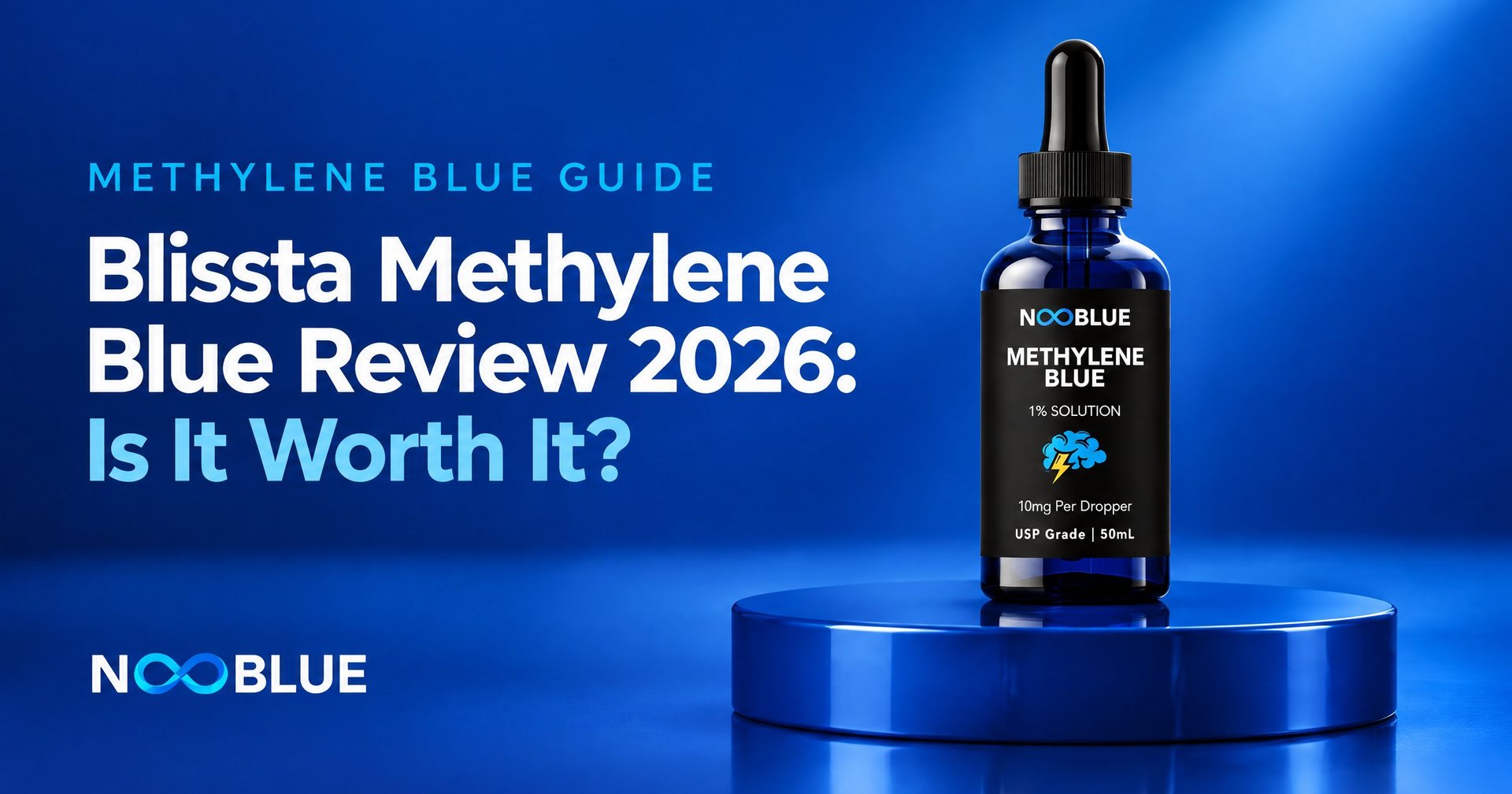
Blissta’s main methylene blue product is a 1% solution: 10 mg of USP-grade methylene blue per mL, in a 30 mL glass bottle with a graduated dropper. The page describes a serving as 1 mL, or 20 drops, which is 10 mg, and gives 30 servings at 10 mg as a 30-day supply. That works out to 300 mg of methylene blue per bottle. Blissta’s store now also lists methylene blue capsules and “Ultra Blue” gummies, but the liquid is the product that built the brand and the focus of this review.
The ingredient list is slightly inconsistent. One section says distilled water is the only other ingredient. Another section of the same page advertises a “Vitamin C Stack” of 20 mg per serving. Both cannot be true of the same bottle, so check the physical label if vitamin C matters to you.
The dosing instructions are sensible. Blissta says to start with 5 drops (2.5 mg) in a glass of water each morning, increase over a week to 10 to 20 drops (5 to 10 mg), and not exceed 20 drops a day. That puts the drop size at 0.5 mg, the same as NooBlue’s 1% drops, so the two are directly comparable drop for drop. Our guide to taking methylene blue drops accurately covers measuring and mixing, and how many mg of methylene blue per day explains how doses compare across formats.
Testing Claims: What Blissta Says and What It Shows
Blissta’s product page makes strong quality claims. It says the methylene blue is USP monograph grade with 99%+ purity, that every lot is tested by an independent lab for purity by HPLC, heavy metals and microbial contamination, and that the certificate of analysis is published. Elsewhere on the same page it claims “99.99% verified purity”.
Those are the right things to test. The problem is that we found no certificate of analysis, lot lookup or lab name linked from the product page, so a buyer cannot check any of it before paying. A purity figure on a sales page is a claim, not a result. If you buy, ask Blissta for the certificate that matches the lot number on your bottle, and use our guide on how to read a methylene blue certificate of analysis to see what it actually covers.
We hold ourselves to the same test. NooBlue’s product pages link a report from Contract Testing Laboratories of America (CTLA) on one lot of the raw methylene blue ingredient, with an HPLC identity result and results for arsenic, cadmium, mercury and lead. It is an ingredient-level report. It does not give a purity percentage and it does not certify each finished batch. Our page on how to spot real versus fake methylene blue covers the other checks worth doing on any brand.
Cost Per Milligram: Blissta vs NooBlue
A bottle price means little until you know how much methylene blue is in the bottle. The table puts each product on the same unit: US cents per milligram of methylene blue, from each product’s own label and listed price. NooBlue makes the first three products.
| Product (as of Sep 2026) | Price | Methylene blue per pack | Cost per mg | Best for |
|---|---|---|---|---|
| NooBlue Methylene Blue Drops, 1% (50 ml) | $29.99 | 500 mg | 6.0¢ | Our pick against Blissta: same strength and drop size, larger bottle, lowest cost per mg here |
| NooBlue Methylene Blue Gummies (60 x 10 mg) | $49.99 | 600 mg | 8.3¢ | A fixed 10 mg a day with no drops to count and no blue mouth |
| NooBlue Ultimate Methylene Blue Capsules (60 x 5 mg) | $37.99 | 300 mg | 12.7¢ | Starting at a fixed 5 mg a day |
| Blissta USP Grade Methylene Blue 1% (30 mL) | $46.99 | 300 mg | 15.7¢ | Buyers who want Blissta’s refill-every-30-days setup |
Read the first and last rows together. Both are 1% solutions with the same 0.5 mg drop. NooBlue’s bottle holds 500 mg for $29.99, while Blissta’s main listing holds 300 mg for $46.99. At Blissta’s top daily amount of 20 drops, a bottle lasts 30 days at about $1.57 a day. The same 10 mg a day from NooBlue’s drops costs $0.60. Other Blissta 1% listings in its store showed $39.99, which still works out to more per milligram than NooBlue’s drops. The capsules cost more per milligram by design, because you pay for a pre-measured dose instead of a dropper, the trade-off we cover in methylene blue tablets versus liquid drops.
Blissta’s main product page also says refills ship every 30 days and can be stopped or cancelled anytime. Check whether you are signing up for a subscription before you pay.
The Sales Page and What Buyers Report
The presentation is aggressive. When we checked, the page ran a “Fall sale, up to 71% off” banner, a countdown timer on free gifts and a counter reading “263 of 4,000 monthly bundles left”. It gives two different customer totals, 147,000+ in one section and 37,896+ in another. Its benefit list also includes a pain-related claim that goes beyond what research on methylene blue supports. None of that changes what is in the bottle, but it does tell you how the brand sells.
The guarantee reads well on paper: a 30-day money-back guarantee from delivery, refund of the product price, and you keep the bottle. One section of the page also says “four months to feel the difference” under the same guarantee heading, so confirm the terms in writing before you rely on them.
Public feedback is poor. Blissta’s Trustpilot profile had a TrustScore of 1.5 out of 5 from 91 reviews when we checked in September 2026. The profile is claimed, and Trustpilot noted that the company had not replied to negative reviews. The recurring complaints were refunds that did not arrive, orders that never showed up, subscription renewals buyers say they did not expect, and slow or absent customer service. A few reviewers were positive about focus and said it sat easily on the stomach. The pattern is that the purchase risk sits in the service, not only the liquid.
Shipping, per Blissta’s page: orders before 2 PM ET ship the same day and standard delivery takes 3 to 5 business days. Its FAQ lists shipping to the US, Canada, the UK, Australia and most EU countries, typically in 5 to 10 business days.
What the Research Actually Supports
Brand pages are not evidence, so it helps to separate the mechanism from the marketing. In a 2012 PLoS One study on cultured nerve cells, methylene blue acted as an alternative electron carrier in mitochondria, bypassing complexes I to III, lowering superoxide production and raising complex IV activity (Poteet et al., 2012). That is a lab cell study, and it is the mechanism every methylene blue brand points to when it talks about cellular energy.
Human data are thinner. In a randomized, double-blind trial in The American Journal of Psychiatry, adults with a strong fear of enclosed spaces took 260 mg of methylene blue (23 people) or placebo (19 people) after a short exposure session. A month later, methylene blue helped people whose fear had dropped during the session and tended to make things worse for people whose fear stayed high (Telch et al., 2014). A separate 2016 trial in 26 healthy adults found a 7% gain in correct memory-retrieval answers an hour after a single 280 mg dose (Rodriguez et al., 2016). Note the doses: 260 mg is 520 drops of a 1% solution, far above the 5 to 10 mg Blissta suggests, so those results do not carry over to a daily dropper.
Who Should Not Take Methylene Blue
Blissta’s page tells people not to take it with SSRIs or other serotonergic medication and not during pregnancy or breastfeeding. It deserves credit for that. We found no G6PD warning on the page. Whichever brand you choose, these rules apply:
- Do not take methylene blue if you take an SSRI, SNRI, MAOI or any other serotonergic medicine, including many antidepressants. The combination can cause serotonin syndrome. Methylene blue is a potent inhibitor of the enzyme MAO-A (Ramsay et al., 2007), and case reports describe suspected serotonin syndrome when it was combined with serotonin-active drugs (McDonnell et al., 2012). See methylene blue and serotonin syndrome.
- Do not take it if you have G6PD deficiency. A standard clinical reference lists methylene blue as contraindicated because of the risk of hemolysis (StatPearls). See methylene blue and G6PD deficiency.
- Not for use during pregnancy or while breastfeeding.
- Not for anyone under 18.
- Methylene blue can turn urine blue or green. This is expected. See why methylene blue turns urine blue or green.
- Talk to your doctor before you start if you take any prescription medicine.
Our complete methylene blue side effects guide covers the rest.
Blissta Methylene Blue Review Verdict: Who It’s For
Blissta’s liquid is a standard 1% USP solution with clear, conservative dosing instructions and a useful serotonergic warning. The problems sit around it: a higher price per milligram, testing claims with no document on the page, an inconsistent ingredient list, pressure tactics on the sales page, and a Trustpilot record dominated by refund, delivery and subscription complaints. If you already use Blissta and it suits you, ask for the lot certificate and watch your subscription settings.
If you are choosing now, our pick is NooBlue. The NooBlue 1% drops give you the same strength and the same 0.5 mg drop in a 50 ml bottle for $29.99, so 20 drops (10 mg) cost about $0.60 a day. Drops can stain the mouth and tongue, so if that bothers you, the NooBlue Methylene Blue Gummies give a fixed 10 mg with 25 mg of vitamin C and don’t leave a blue mouth. Our explainer on leucomethylene blue covers the chemistry, and what goes into methylene blue gummies covers gummy labels. If you want to start lower, the 5 mg capsules at $37.99 are the gentler step. The NooBlue shop ships free worldwide on orders of $100 or more. We review other brands the same way in our MitoZen methylene blue review, our Meraki methylene blue review and our LVLUP Health review, and compare gummies in the best methylene blue gummies guide.
Blissta Methylene Blue: Frequently Asked Questions
Is Blissta a legitimate business?
Blissta runs a live store with a real product, dosing instructions, a serotonergic warning and a written guarantee, so it is a working business. Its public service record is weak: its Trustpilot profile scored 1.5 out of 5 from 91 reviews in September 2026, with complaints about refunds, missing orders and subscription charges, and no replies to negative reviews.
What is the Blissta methylene blue dosage?
Blissta says to start with 5 drops (2.5 mg) in water each morning, build over a week to 10 to 20 drops (5 to 10 mg), and not exceed 20 drops a day. Each drop of its 1% solution is 0.5 mg, and 1 mL (20 drops) is 10 mg. Stay within the label, and read the safety list above first.
Does Blissta publish a certificate of analysis?
The product page says every lot is tested by an independent lab and that the certificate is published, but we found no certificate, lot lookup or lab name linked from it. Ask Blissta for the certificate matching the lot number on your bottle before relying on the purity claim.
Does Blissta methylene blue turn your urine blue?
Yes, as any oral methylene blue can. Blue or green urine is expected and is not a sign of a problem. Drops can also stain the mouth and tongue, which is one reason some people prefer capsules or gummies.
Does Blissta sell methylene blue gummies?
Its store now lists “Ultra Blue” gummies and methylene blue capsules alongside the 1% liquid. We reviewed the liquid here. For a gummy comparison across brands, see the best methylene blue gummies guide.
What is Blissta’s refund policy?
The product page offers a 30-day money-back guarantee from delivery, refunding the product price with no need to return the bottle. One section of the page also mentions four months, so confirm the terms in writing. Refund problems are the most common complaint in Blissta’s Trustpilot reviews.
Blissta or NooBlue: which methylene blue drops are better?
Our pick is NooBlue. Both are 1% solutions with the same 0.5 mg drop, but NooBlue’s drops hold 500 mg in 50 ml for $29.99 against Blissta’s 300 mg in 30 mL for $46.99, which is 6.0 cents per milligram against 15.7. NooBlue also links its ingredient test report on the product page and states its scope.
Sources
- Blissta. USP Grade Methylene Blue 1% product page and store listings. blissta.co (read September 2026).
- Trustpilot. Blissta (blissta.co) reviews. trustpilot.com (read September 2026).
- Poteet E, Winters A, Yan LJ, et al. Neuroprotective actions of methylene blue and its derivatives. PLoS One. 2012;7(10):e48279. PubMed 23118969
- Telch MJ, Bruchey AK, Rosenfield D, et al. Effects of post-session administration of methylene blue on fear extinction and contextual memory in adults with claustrophobia. American Journal of Psychiatry. 2014;171(10):1091-1098. PubMed 25018057
- Rodriguez P, Zhou W, Barrett DW, et al. Multimodal randomized functional MR imaging of the effects of methylene blue in the human brain. Radiology. 2016;281(2):516-526. PubMed 27351678
- Ramsay RR, Dunford C, Gillman PK. Methylene blue and serotonin toxicity: inhibition of monoamine oxidase A (MAO A) confirms a theoretical prediction. British Journal of Pharmacology. 2007;152(6):946-951. PubMed 17721552
- McDonnell AM, Rybak I, Wadleigh M, Fisher DC. Suspected serotonin syndrome in a patient being treated with methylene blue for ifosfamide encephalopathy. Journal of Oncology Pharmacy Practice. 2012;18(4):436-439. PubMed 22235061
- Ostrovsky A, Afzal M. Methylene Blue. StatPearls. Updated January 2026. NCBI Bookshelf NBK557593
This article is for educational purposes only and is not medical advice. Talk to your doctor before starting methylene blue, especially if you take any prescription medicine. Competitor prices, claims and policies were read from public pages in September 2026 and can change.