Key takeaways
- Our pick is NooBlue Ultimate Methylene Blue Capsules: 5 mg of methylene blue per capsule, one a day, 60 capsules for $37.99, which is $0.63 a day. NooBlue makes them, so weigh our view with that in mind.
- LVLUP Health Mito Blue is a four-ingredient capsule: 10 mg methylene blue, 400 mg acetyl-L-carnitine, 100 mg ubiquinol and 10 mg PQQ. A 60-capsule bottle costs $89.99 as a one-time order or $80.99 on subscription, so $1.50 or $1.35 a day.
- The real difference is design. Mito Blue fixes the methylene blue at 10 mg and bundles three cofactors with it. NooBlue sells methylene blue on its own in three formats, so you pick the format and add anything else separately.
- If you want 10 mg of methylene blue in a single serving, the NooBlue gummy holds 10 mg and costs $0.83 a day.
- Whichever you choose, methylene blue is not for anyone taking SSRIs, SNRIs, MAOIs or other serotonergic medicines, anyone with G6PD deficiency, anyone pregnant or breastfeeding, or anyone under 18.
LVLUP Health Mito Blue is one of the better-known methylene blue formulas sold in the US. People who search for it usually want three answers: what is in the capsule, what it costs per day, and whether a plain methylene blue product would suit them better. This comparison puts LVLUP Mito Blue next to NooBlue’s methylene blue range, using each brand’s own product and policy pages, checked in September 2026.
NooBlue makes the capsules, gummies and drops compared here. The capsules are our pick, and every figure for Mito Blue is taken from LVLUP Health’s own pages, linked in the sources at the end. We have not lab-tested Mito Blue. Written by the NooBlue editorial team. For a closer look at the brand on its own, read our LVLUP Health review, and for a wider shortlist see our guide to the best methylene blue supplements.
Our short answer: if methylene blue is the ingredient you are after, NooBlue’s capsules give you a fixed 5 mg a day for $0.63, with a full safety box on the product page, and you add cofactors only if you decide you want them. Mito Blue suits someone who specifically wants acetyl-L-carnitine, ubiquinol and PQQ in the same capsule as 10 mg of methylene blue and is happy to pay $1.50 a day for that.
Table of contents
- 1. LVLUP Mito Blue vs NooBlue: The Quick Verdict
- 2. What’s Actually in LVLUP Health Mito Blue
- 3. Dose Control: Why a Fixed 10 mg Is the Real Trade-off
- 4. Cost Per Serving: LVLUP Mito Blue vs NooBlue Compared
- 5. Testing and Transparency
- 6. Safety Warnings Compared
- 7. Safety: Read Before You Take Either Product
- 8. Shipping, Returns and What LVLUP Health Buyers Report
- 9. What the Research Says
- 10. Which One Should You Buy?
- 11. Frequently Asked Questions
- 11.1. How much methylene blue is in LVLUP Mito Blue?
- 11.2. How much does LVLUP Health Mito Blue cost?
- 11.3. Is LVLUP Mito Blue worth the price?
- 11.4. Can you take LVLUP Mito Blue and NooBlue together?
- 11.5. Is 10 mg of methylene blue too much?
- 11.6. Does LVLUP Mito Blue publish third-party testing?
- 11.7. Is it bad to take methylene blue every day?
- 11.8. Why don’t doctors recommend methylene blue?
- 11.9. Is it true that methylene blue makes you look younger?
- 11.10. Is methylene blue good for your overall health?
- 11.11. What is the best alternative to LVLUP Mito Blue?
- 12. Our Verdict
- 13. Sources
LVLUP Mito Blue vs NooBlue: The Quick Verdict
Both are capsules you take once a day, and both contain methylene blue. After that they part ways. Mito Blue is a formula built around four mitochondrial ingredients. NooBlue is a single-ingredient range. That one choice drives the price, the amount of methylene blue per serving and how much say you have over what you take. Prices below are from each brand’s own store, as of Sep 2026.
| NooBlue Ultimate Methylene Blue Capsules | LVLUP Health Mito Blue | |
|---|---|---|
| Methylene blue per capsule | 5 mg (Methylene Blue USP) | 10 mg (methylthionine chloride) |
| Other actives per capsule | 10 mg vitamin C | 400 mg acetyl-L-carnitine, 100 mg ubiquinol, 10 mg PQQ |
| Other ingredients | Rice flour, cellulose capsule | Not listed in the product page text we read |
| Directions | One capsule daily with food. Do not exceed the suggested serving. | One capsule daily with water, with or without food |
| Capsules per bottle | 60 (a 60-day supply) | 60 (a 60-day supply) |
| Price | $37.99 | $89.99 one-time, $80.99 on subscription |
| Cost per day | $0.63 | $1.50 one-time, $1.35 on subscription |
| Lab document | CTLA report on the raw methylene blue ingredient: identity by HPLC plus four heavy metals, linked from the product page | Page says “every batch is verified by independent labs”. We found no certificate linked on the page. |
| Warnings on the product page | Do not take with serotonergic medicines or with G6PD deficiency. Not in pregnancy or breastfeeding. Not under 18. Talk to your doctor if you take any prescription medicine. | People on serotonergic medicines (SSRIs/MAOIs), pregnant or nursing women and under-18s “should consult a qualified provider before use”. No G6PD line found. |
| Shipping | Free worldwide on orders of $100+, dispatch in 1 to 2 business days with tracking | Processing 2 to 4 business days, then about 3 to 10 business days in the US or 14 to 30 internationally |
| Returns | 30-day returns | Opened or used products are generally not eligible for change-of-mind refunds |
| Other formats from the brand | 10 mg gummies and 1% drops | Mito Blue is sold as a capsule only |
Mito Blue has a genuine strength here: it gives you three cofactors in the same capsule, which NooBlue does not. If you would otherwise buy acetyl-L-carnitine, ubiquinol and PQQ as separate bottles, that bundle is worth something. If you only want methylene blue, or you already take a CoQ10 product, you would be paying for ingredients you do not need.
What’s Actually in LVLUP Health Mito Blue
LVLUP’s product page lists four actives in each capsule: acetyl-L-carnitine 400 mg, methylene blue (methylthionine chloride) 10 mg, PQQ (pyrroloquinoline quinone) 10 mg and ubiquinol (coenzyme Q10) 100 mg. The page describes “pharmaceutical-grade Methylene Blue” combined “in precisely calibrated doses”, and the directions are one capsule daily with water at a consistent time, with or without food (LVLUP Health).
Each ingredient works on cellular energy by a different route:
- Methylene blue can carry electrons in the mitochondrial chain directly from NADH to cytochrome c, which is why it attracts interest for cellular energy (Tucker et al., 2018).
- Acetyl-L-carnitine is a form of carnitine, the molecule that moves long-chain fatty acids into mitochondria so they can be used for fuel.
- Ubiquinol is the reduced form of coenzyme Q10, which passes electrons along the same chain inside mitochondria.
- PQQ raised markers of mitochondrial biogenesis, meaning the making of new mitochondria, in mouse liver cells grown in a dish (Chowanadisai et al., 2010). That was a cell study, not a human trial.
On paper, that is a coherent formula. The catch is that it is also a fixed one. Each of those ingredients has its own usual range, and Mito Blue picks one point on each range for you. If you respond well to the methylene blue but want a different amount of carnitine, or you already take a separate ubiquinol product, the bundle works against you.
A bundle also makes it hard to tell what is doing what. If you feel sharper on Mito Blue, or get a headache, you cannot say which of the four ingredients was behind it. Methylene blue and CoQ10 act on overlapping parts of the electron transport chain, which we cover in our comparison of methylene blue and CoQ10. Starting with methylene blue on its own and adding one cofactor at a time gives you a clearer read. Our guide to the best methylene blue stacks shows how people usually build these combinations, and our roundup of mitochondrial support supplements looks at the cofactors one by one.
Dose Control: Why a Fixed 10 mg Is the Real Trade-off
Every Mito Blue capsule contains 10 mg of methylene blue, and the label says one capsule a day. There is no way to take less methylene blue without also taking less of the other three ingredients.
NooBlue splits the choice across three formats, each with its own label:
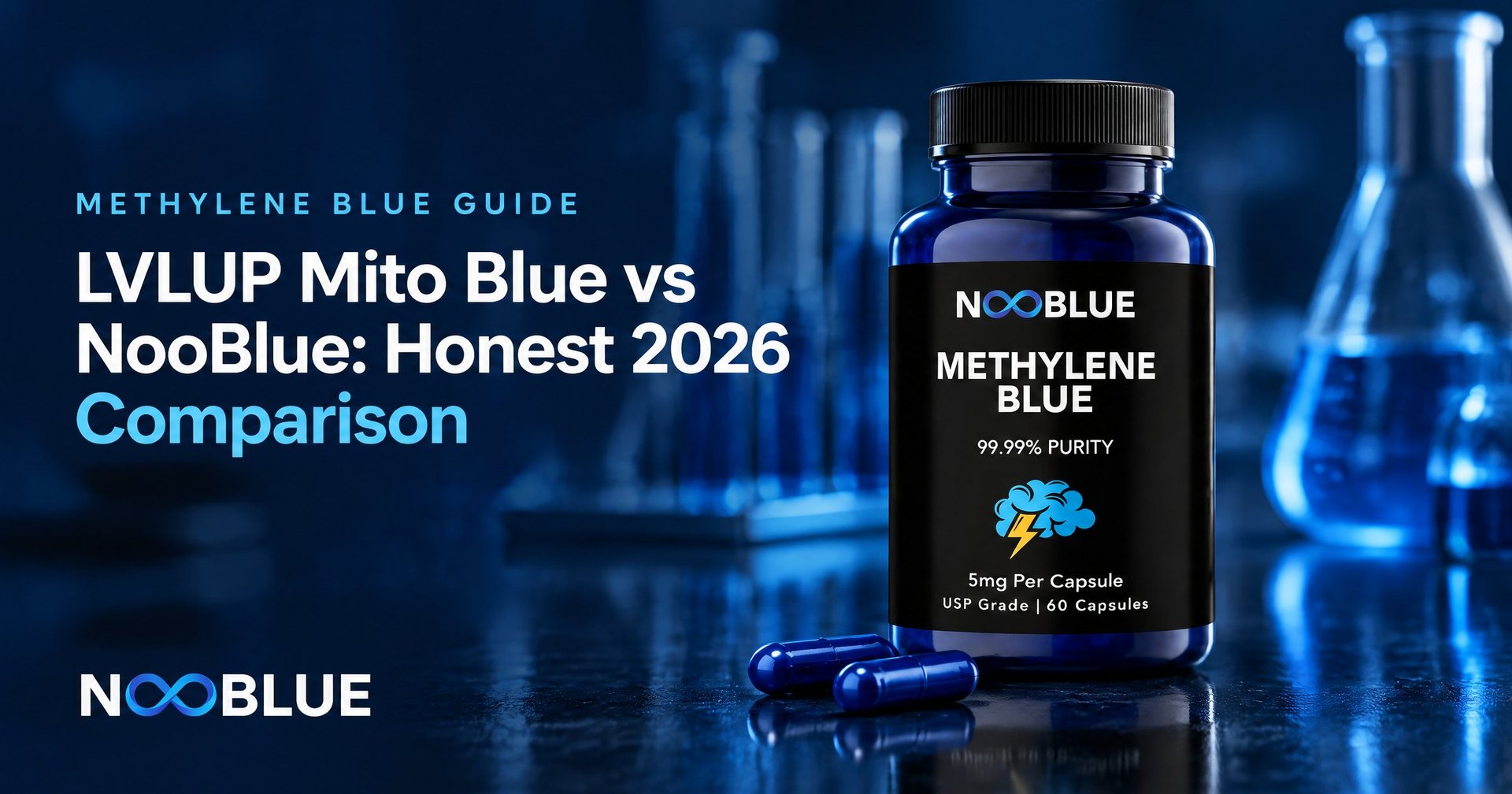
- Capsules: 5 mg of methylene blue with 10 mg of vitamin C. Take one capsule daily with food, and do not exceed the suggested serving.
- Gummies: 10 mg of methylene blue with 25 mg of vitamin C. Chew one gummy daily. The gummies avoid the blue mouth and tongue that drops cause.
- 1% drops: 10 mg per mL, which works out to 0.5 mg per drop, in a 50 mL bottle with a precision dropper. Drops can stain the mouth and tongue, and the label says to mix them with water or juice.
Why does the fixed amount matter? Methylene blue does not behave like a vitamin, where more simply means more. A review from the University of Texas describes a hormetic dose response: low doses stimulate mitochondrial respiration, while high doses can have the opposite effect (Gonzalez-Lima and Auchter, 2015). So 10 mg is not automatically “stronger” than 5 mg in any useful sense. It is simply a different amount, and with Mito Blue it is the only amount on offer.
Whatever you choose, follow the label of that product and count every source of methylene blue you take. Our guide on how many mg of methylene blue per day explains how people think about amounts, and we cover whether to take methylene blue in the morning or at night and methylene blue and fasting separately. For a format-by-format view, see methylene blue gummies vs capsules.
Cost Per Serving: LVLUP Mito Blue vs NooBlue Compared
Bottle prices hide the real difference, so here is the cost per day at each label’s directions and the cost per milligram of methylene blue. Prices as of Sep 2026, from each brand’s own store.
| Product | Price | Methylene blue per serving | Cost per serving | Cost for 30 servings | Cost per mg of methylene blue |
|---|---|---|---|---|---|
| NooBlue Capsules, 60 x 5 mg | $37.99 | 5 mg | $0.63 | $19.00 | About $0.13 |
| NooBlue Gummies, 60 x 10 mg | $49.99 | 10 mg | $0.83 | $25.00 | About $0.08 |
| NooBlue 1% Drops, 50 mL | $29.99 | 5 mg (10 drops) | $0.30 | $9.00 | About $0.06 |
| LVLUP Mito Blue, one-time | $89.99 | 10 mg | $1.50 | $45.00 | About $0.15 |
| LVLUP Mito Blue, subscription | $80.99 | 10 mg | $1.35 | $40.50 | About $0.13 |
Two things stand out. First, a day of NooBlue capsules costs $0.63 against $1.50 for a one-time bottle of Mito Blue, and $0.83 buys a 10 mg gummy that matches Mito Blue’s methylene blue amount. Second, the cost per milligram of methylene blue is closer than the daily cost suggests, because Mito Blue’s price also pays for 400 mg of acetyl-L-carnitine, 100 mg of ubiquinol and 10 mg of PQQ. That is a fair point in Mito Blue’s favor if you want those cofactors. It is money spent twice if you already take them.
NooBlue also takes 10% off when you buy two bottles, 15% off three and 20% off five, and shipping is free worldwide on orders of $100 or more. Mito Blue’s subscription takes 10% off each order. For how other brands compare on price and paperwork, our methylene blue reviews roundup goes brand by brand, and we have head-to-heads for NooBlue vs Meraki, NooBlue vs Nutricel and NooBlue vs TrueHealthic.
Testing and Transparency
LVLUP’s product page says it uses “pharmaceutical-grade raw materials” and that “every batch is verified by independent labs”. When we checked in September 2026, we did not find a certificate of analysis linked from the Mito Blue page, so you would need to ask LVLUP for one if you want to see the results.
NooBlue’s product pages link a report from Contract Testing Laboratories of America (CTLA) on the methylene blue ingredient, lot 2025022801, report 135621. It records an HPLC identity result of “Conforms” and individual results for arsenic, cadmium, mercury and lead. It is ingredient-level evidence: it covers the raw methylene blue, not each finished batch of capsules, and it does not state a purity percentage. You can read the document from the capsules product page.
Whatever brand you buy, the useful question is what a lab document actually covers: the raw powder or the finished product, identity or amount per serving, heavy metals only or microbes too. Our guide to reading a methylene blue certificate of analysis shows which lines to check first, our explainer on methylene blue grades covers what “USP” and “pharmaceutical grade” mean, and our page on methylene blue purity figures explains why a percentage on a label is only as good as the report behind it.
Safety Warnings Compared
Methylene blue has serious interactions, so the warnings a brand prints matter. LVLUP’s page says that people using serotonergic medications (SSRIs/MAOIs), pregnant or nursing women, and anyone under 18 “should consult a qualified provider before use”. It also lists blue-tinted urine as a possible effect, with occasional digestive upset or mild headache. We did not find a warning about G6PD deficiency on the page.
NooBlue’s “Safety: read before use” box on every product page is firmer. It says not to take methylene blue with an SSRI, SNRI, MAOI or any other serotonergic medicine, not with G6PD deficiency, not during pregnancy or breastfeeding and not under 18, and to talk to your doctor before use if you take any prescription medicine. A general clinical reference says the same about the two biggest risks: methylene blue should not be combined with serotonergic drugs, and it is contraindicated in G6PD deficiency because of the risk of hemolysis (StatPearls).
Safety: Read Before You Take Either Product
- Do not take methylene blue with an SSRI, SNRI, MAOI or any other serotonergic medicine, because the combination can cause serotonin syndrome. See methylene blue and serotonin syndrome.
- Do not take it if you have G6PD deficiency. See methylene blue and G6PD deficiency.
- Not for use during pregnancy or while breastfeeding.
- Not for anyone under 18.
- If you take any prescription medicine, talk to your doctor first.
- Methylene blue can turn urine blue or green. That is expected with any format.
Do not take Mito Blue and NooBlue on the same day unless your doctor has agreed to the total, because the methylene blue adds up. Our full list of who should not take methylene blue and our overview of methylene blue side effects go into more detail.
Shipping, Returns and What LVLUP Health Buyers Report
LVLUP’s shipping policy says orders are usually processed within 2 to 4 business days, then take about 3 to 10 business days in the US or about 14 to 30 business days internationally. It does not ship to a list of countries that includes Germany and Japan, and international buyers are responsible for customs duties and taxes (LVLUP shipping policy). Its refund policy says opened, used or partly consumed products are generally not eligible for change-of-mind returns (LVLUP refund policy).
On Trustpilot, LVLUP Health had a TrustScore of 3.4 out of 5 from 23 reviews when we checked in September 2026. Positive reviews praise product quality and helpful support. The main negative theme is shipping: long delays, lost parcels and orders that did not arrive. None of the reviews we read were about Mito Blue specifically (Trustpilot).
NooBlue ships free worldwide on orders of $100 or more, dispatches in 1 to 2 business days with tracking, and offers 30-day returns. If you are outside the US, compare delivery estimates as well as price before you order.
What the Research Says
We found no published trial of Mito Blue as a product, and no trial has tested NooBlue’s capsules, gummies or drops either. What exists is research on methylene blue itself, plus separate research on each cofactor.
The best-known human study is a randomized, placebo-controlled brain-imaging trial at the University of Texas. It enrolled 26 healthy adults, and the active group took a single oral dose of 280 mg (about 4 mg/kg). An hour later, brain activity during attention and short-term memory tasks was higher than with placebo, and correct answers on a memory retrieval task rose by 7% (Rodriguez et al., 2016). That single dose is many times what a Mito Blue capsule or any NooBlue product contains, so it tells you about methylene blue, not about either product.
Oral methylene blue is well absorbed. In 16 healthy volunteers, an oral solution reached an absolute bioavailability of about 72% compared with an intravenous dose (Walter-Sack et al., 2009). Capsules and gummies were not part of that study.
For the cofactors, the PQQ evidence cited above comes from cells in a dish, and the case for combining all four ingredients in one capsule has not been tested in a trial. Our overview of methylene blue benefits and the research behind them covers the wider evidence, and our comparison of methylene blue and NAD+ for cellular energy looks at another popular pairing.
Which One Should You Buy?
Choose NooBlue if
- You want methylene blue on its own, so you know what you are responding to.
- You already take CoQ10, ubiquinol, carnitine or PQQ and do not want to pay for them twice.
- You want the choice of a 5 mg capsule, a 10 mg gummy or 1% drops from the same brand.
- You want the full safety box, including G6PD, pregnancy and an age limit, printed on the product page.
- You live outside the US and want free worldwide shipping on orders of $100 or more.
Choose LVLUP Mito Blue if
- You specifically want acetyl-L-carnitine, ubiquinol and PQQ in the same capsule as 10 mg of methylene blue.
- You do not already take any of those cofactors.
- One capsule for everything matters more to you than cost per day or the ability to change amounts.
Plenty of people will prefer the convenience of Mito Blue, and that is a reasonable choice. For most people who came looking for methylene blue, though, we think starting with the ingredient on its own is the better first step.
Frequently Asked Questions
How much methylene blue is in LVLUP Mito Blue?
Each LVLUP Mito Blue capsule contains 10 mg of methylene blue, alongside 400 mg of acetyl-L-carnitine, 100 mg of ubiquinol and 10 mg of PQQ, and the label says one capsule a day. A NooBlue capsule contains 5 mg of methylene blue with 10 mg of vitamin C, and a NooBlue gummy contains 10 mg.
How much does LVLUP Health Mito Blue cost?
On LVLUP’s own store in September 2026, a 60-capsule bottle cost $89.99 as a one-time order or $80.99 on a subscription that takes 10% off each order. At one capsule a day, that is $1.50 or $1.35 a day. NooBlue capsules cost $37.99 for 60, or $0.63 a day.
Is LVLUP Mito Blue worth the price?
It can be if you want all four ingredients and would otherwise buy acetyl-L-carnitine, ubiquinol and PQQ separately. If you only want methylene blue, or you already take a CoQ10 or PQQ product, you are paying $1.50 a day for ingredients you do not need, against $0.63 for a NooBlue capsule or $0.83 for a 10 mg NooBlue gummy.
Can you take LVLUP Mito Blue and NooBlue together?
We do not recommend it without your doctor’s agreement. Both contain methylene blue, so taking them on the same day adds the amounts together, and more is not better with methylene blue. Pick one source and follow its label.
Is 10 mg of methylene blue too much?
10 mg is the amount in one Mito Blue capsule and in one NooBlue gummy, and both labels say one a day. It is not automatically better than 5 mg, because methylene blue has a hormetic dose response where low doses behave differently from high ones. Whether any amount suits you depends on your health and the medicines you take, so talk to your doctor if you are unsure and never combine sources.
Does LVLUP Mito Blue publish third-party testing?
Its product page says “every batch is verified by independent labs”, but we did not find a certificate of analysis linked from the page in September 2026. You can ask LVLUP for one. NooBlue’s product pages link a CTLA report on the raw methylene blue ingredient, covering identity by HPLC and four heavy metals. It covers the ingredient, not every finished batch, and does not state a purity percentage.
Is it bad to take methylene blue every day?
Both Mito Blue and NooBlue are labeled for one serving a day, so daily use at the label amount is how they are meant to be taken. The main risks are about who takes it, not how often: people on serotonergic medicines, people with G6PD deficiency, anyone pregnant or breastfeeding and anyone under 18 should not take it. Research on long-term daily use in healthy people is limited. Our article on whether methylene blue is safe to take daily goes through what is known.
Why don’t doctors recommend methylene blue?
Methylene blue is best known in medicine as a prescription drug for specific hospital uses, and the human evidence for everyday use as a supplement is small. It also has a serious interaction with serotonergic medicines and is not suitable for people with G6PD deficiency, so many doctors are cautious. Our explainer on why doctors don’t prescribe methylene blue covers the reasons in more depth.
Is it true that methylene blue makes you look younger?
Not on current evidence. The study behind that idea applied methylene blue to human skin cells grown in the lab and to a lab-grown 3D skin model, where it was linked to more skin cell growth and higher skin hydration and thickness in the model (Xiong et al., 2017). No trial has shown that taking methylene blue by mouth changes how old you look. Our article on methylene blue for skin covers that research.
Is methylene blue good for your overall health?
It is better described as a compound with interesting lab research and a few small human studies on cellular energy and memory, not as a general health supplement. It also carries real risks for some people, listed in the safety section above. If you are curious about it, start at the label amount of one product, and check with your doctor if you take any prescription medicine.
What is the best alternative to LVLUP Mito Blue?
Our pick is NooBlue Ultimate Methylene Blue Capsules, which we make: 5 mg of methylene blue per capsule, one a day, $0.63 a day, with a full safety box on the product page. If you want 10 mg in one serving, the NooBlue gummy holds 10 mg for $0.83 a day. Our best methylene blue supplements guide compares more brands.
Our Verdict
On the facts we could check, NooBlue’s capsules give you 5 mg of methylene blue a day for $0.63, with a firmer safety box, a linked ingredient lab report, 30-day returns and free worldwide shipping on orders of $100 or more. LVLUP Health Mito Blue gives you 10 mg of methylene blue plus three cofactors for $1.50 a day, or $1.35 on subscription, with narrower warnings on the page and an international delivery estimate of 14 to 30 business days. If you want the methylene blue itself, we think NooBlue is the better choice. You can see all three formats in the NooBlue shop.
This article is for educational purposes only and is not medical advice. Talk to your doctor before starting methylene blue, especially if you take any prescription medicine.
Sources
- LVLUP Health. Mito Blue product page (checked September 2026). lvluphealth.com
- LVLUP Health. Shipping policy (checked September 2026). lvluphealth.com
- LVLUP Health. Refund policy (checked September 2026). lvluphealth.com
- Trustpilot. Reviews of lvluphealth.com (checked September 2026). trustpilot.com
- Ostrovsky A, Afzal M. Methylene Blue. StatPearls. Updated January 2026. NCBI Bookshelf NBK557593
- Tucker D, Lu Y, Zhang Q. From mitochondrial function to neuroprotection: an emerging role for methylene blue. Molecular Neurobiology. 2018;55(6):5137-5153. PubMed 28840449
- Rodriguez P, Zhou W, Barrett DW, et al. Multimodal randomized functional MR imaging of the effects of methylene blue in the human brain. Radiology. 2016;281(2):516-526. PMC5084971
- Walter-Sack I, Rengelshausen J, Oberwittler H, et al. High absolute bioavailability of methylene blue given as an aqueous oral formulation. European Journal of Clinical Pharmacology. 2009;65(2):179-189. PubMed 18810398
- Gonzalez-Lima F, Auchter A. Protection against neurodegeneration with low-dose methylene blue and near-infrared light. Frontiers in Cellular Neuroscience. 2015;9:179. PubMed 26029050
- Chowanadisai W, Bauerly KA, Tchaparian E, et al. Pyrroloquinoline quinone stimulates mitochondrial biogenesis through cAMP response element-binding protein phosphorylation and increased PGC-1alpha expression. Journal of Biological Chemistry. 2010;285(1):142-152. PubMed 19861415
- Xiong ZM, O’Donovan M, Sun L, et al. Anti-aging potentials of methylene blue for human skin longevity. Scientific Reports. 2017;7(1):2475. PubMed 28559565