Methylene blue USP grade means the methylene blue ingredient meets the United States Pharmacopeia (USP) standard for identity, strength and impurities. In 2026 almost every supplement page uses the phrase, but very few show a document that backs it. This guide explains what USP grade covers and what it doesn’t, then compares 10 methylene blue products on what you can check before you buy: the dose, the cost per 10 mg, and which lab documents each brand actually publishes. NooBlue makes three of the products ranked here, including our first pick, and every figure for the other seven comes from their own product pages and lab documents, read in September 2026.
Table of contents
- 1. Quick answer
- 2. The 10 methylene blue USP grade products compared
- 3. What “USP grade” actually means
- 4. What “99.9% pure” does and doesn’t tell you
- 5. The certificate of analysis audit
- 6. Grade and quality terms on methylene blue labels
- 7. How to check a USP-grade claim yourself
- 8. How we ranked these products
- 9. The 10 products in detail
- 9.1. #1. NooBlue Methylene Blue Gummies: our pick
- 9.2. #2. NooBlue Methylene Blue Drops 1%: measuring in small steps
- 9.3. #3. NooBlue Ultimate Methylene Blue Capsules: a fixed 5 mg serving
- 9.4. #4. Nutricel Blue Boost: finished-product potency testing
- 9.5. #5. Chemist Labs Methylene Blue Capsules: lowest cost per milligram
- 9.6. #6. Zatural Methylene Blue 1% USP Grade: raw-material assay on the page
- 9.7. #7. Earth Harmony Ultimate Methylene Blue: capsule with added plant ingredients
- 9.8. #8. Meraki Blu USP Grade Methylene Blue: weaker liquid with contaminant panels
- 9.9. #9. Troscriptions Just Blue: troche format through practitioners
- 9.10. #10. Blue Organics Methylene Blue+ USP Grade 1%: check the documents before buying
- 10. What the research on methylene blue shows
- 11. Safety: who should not take methylene blue
- 12. The verdict
- 13. Frequently asked questions
- 13.1. What is methylene blue USP grade?
- 13.2. Is USP grade the same as pharmaceutical grade?
- 13.3. Which methylene blue brand is legit?
- 13.4. What is the best methylene blue USP grade product?
- 13.5. Is 99.9% pure methylene blue better than 99%?
- 13.6. Can you buy USP grade methylene blue on Amazon?
- 13.7. How much should USP grade methylene blue cost?
- 13.8. Is lab grade or aquarium methylene blue the same thing?
- 13.9. Does USP grade methylene blue stain your mouth?
- 13.10. Does USP grade mean the dose on the label is accurate?
- 13.11. What does a methylene blue certificate of analysis include?
- 13.12. Why do some methylene blue products say “for research use only”?
- 13.13. Is methylene blue safe to take every day?
- 14. Sources
Quick answer
- Our pick: NooBlue Methylene Blue Gummies. Each gummy has 10 mg of USP-grade methylene blue with 25 mg of vitamin C, 60 per bottle at one a day, 0 g sugar and no blue mouth. The product page links the lab report for the methylene blue ingredient lot.
- For measuring small steps: NooBlue 1% drops, 0.5 mg per drop, about 100 servings of 5 mg in a 50 mL bottle.
- For a 5 mg fixed serving: NooBlue capsules, one 5 mg capsule daily with food.
- Most complete finished-product testing among the other brands: Nutricel Blue Boost, whose public certificates page covers potency, heavy metals and microbes for the finished capsule. It ships only within the United States.
- Lowest cost per milligram in this list: Chemist Labs capsules in the 120-count bottle.
- Whatever you buy: “USP grade” describes the raw ingredient. It says nothing about whether methylene blue is right for you. Never combine it with SSRIs, SNRIs, MAOIs or other serotonergic medicines.
The 10 methylene blue USP grade products compared
NooBlue makes the gummies, drops and capsules ranked first to third. They are our picks, and every figure for the other products is taken from their own product pages, listings and lab documents. We did not lab-test any product. Prices are one-bottle prices as of Sep 2026. Cost per 10 mg divides the pack price by the total methylene blue stated for the pack. Troscriptions now sells only through healthcare practitioners, so we do not give a store price or cost per 10 mg for it.
| Rank | Product | Format | Methylene blue | Pack | Price (as of Sep 2026) | Cost per 10 mg | Lab document on the page | Best for |
|---|---|---|---|---|---|---|---|---|
| 1 | NooBlue Methylene Blue Gummies | Gummy | 10 mg + 25 mg vitamin C | 60 | $49.99 | $0.83 | Ingredient-lot report (CTLA) | Our pick: one 10 mg chew a day, no blue mouth |
| 2 | NooBlue Methylene Blue Drops 1% | Liquid | 0.5 mg per drop | 50 mL (500 mg) | $29.99 | $0.60 | Ingredient-lot report (CTLA) | Measuring in 0.5 mg steps |
| 3 | NooBlue Ultimate Methylene Blue Capsules | Capsule | 5 mg + 10 mg vitamin C | 60 | $37.99 | $1.27 | Ingredient-lot report (CTLA) | A fixed 5 mg serving |
| 4 | Nutricel Blue Boost | Capsule | 12 mg + vitamin C ester and cacao | 60 | $34.90 | $0.48 | Finished-product reports (Eurofins) | Finished-product potency testing |
| 5 | Chemist Labs Methylene Blue Capsules | Capsule | 10 mg | 60 or 120 | $34.99 / $44.99 | $0.58 / $0.37 | Finished-capsule reports by lot (CTLA) | Lowest cost per milligram (120-count) |
| 6 | Zatural Methylene Blue 1% USP Grade | Liquid | 1% solution | 30 mL (300 mg) | $19.99 | $0.67 | Raw-powder certificate with a USP assay | Lowest bottle price, raw-material assay shown |
| 7 | Earth Harmony Ultimate Methylene Blue | Capsule | 12 mg + vitamin C and botanicals | 60 | $39.95 | $0.55 | None linked | A capsule with added plant ingredients |
| 8 | Meraki Blu USP Grade Methylene Blue | Liquid | 150 mg in 30 mL (about 0.25 mg per drop) | 30 mL | $35.00 | $2.33 | Heavy metals, formaldehyde and microbes (Light Labs), no assay | Weaker liquid with contaminant panels shown |
| 9 | Troscriptions Just Blue | Troche | 16 mg per troche | 4 troches | Through practitioners | Not calculable | On request only | Troche format through practitioners |
| 10 | Blue Organics Methylene Blue+ USP Grade 1% | Liquid | 1% solution | 30 mL (300 mg) | $49.00 | $1.63 | 2024 powder report, metals and microbes only | Check the documents before buying |
What “USP grade” actually means
The United States Pharmacopeia publishes monographs: written standards that say how a substance must be identified, how much of the substance a sample must contain (the assay), and which impurities are limited and to what level. A material sold as “USP grade” is claimed to meet the monograph for that substance. Labs test against it using USP methods and a USP Reference Standard, a highly characterized sample of the pure substance. Sigma-Aldrich sells the methylene blue USP Reference Standard at $501.00 for 750 mg and states that it is “for test and assay use only” and not meant for administration to people or animals.
A real certificate shows what the monograph checks look like in practice. The certificate Zatural links for its raw methylene blue, from Arbro Pharmaceuticals’ analytical division, lists “USP-2024” as the protocol and reports an HPLC assay of 98.03% on a dried basis against limits of 97.0% to 103.0%, plus loss on drying, residue on ignition, bacterial endotoxins, microbes and a long list of elemental impurities measured by ICP-MS. That is what “meets USP” looks like on paper: a number, a limit and a method for each test.
Three things follow from that:
- USP grade describes the raw ingredient. It does not tell you the dose in a finished gummy, capsule or bottle of drops, or whether that finished product was tested.
- “Pharmaceutical grade” is not the same claim. No monograph defines it. Many brands use both phrases, so look for the document rather than the words. Our explainer on lab grade vs pharmaceutical grade methylene blue covers the terms.
- Other grades exist for other jobs. Sigma-Aldrich’s microscopy stain M9140 is sold with a dye content of at least 82% and carries the hazard statement H302, harmful if swallowed. Kordon’s aquarium methylene blue, a 2.303% solution for fish tanks, states that it is not intended for human consumption. Our guides to aquarium grade methylene blue and food grade methylene blue explain why those are not substitutes.
What “99.9% pure” does and doesn’t tell you
Purity percentages appear on most of these pages: 99%+ (Nutricel), 99% (Chemist Labs), 99.99% (Earth Harmony), 99.9% (Meraki) and both 99.9% and 99.99% on the same page (Blue Organics). A percentage on a product page is a claim about the raw ingredient. It usually doesn’t say which test produced it, which lot it applies to, or whether it was measured on a dried basis.
Even a genuine assay result is narrower than it sounds. The Zatural certificate’s 98.03% sits inside the USP range, yet it is lower than several marketing figures in this list. That doesn’t make it worse. It means it is an actual measurement with a stated method, while the round numbers elsewhere are not tied to any document we could find. Our guide to what a 99% USP purity figure means goes deeper, and the comparison of the purest methylene blue brands applies the same test to more products.
The certificate of analysis audit
We opened every lab document linked from these ten product pages in September 2026 and recorded what each one actually tested. The question is simple: before you pay, can you read a document, and what does it cover?
| Brand | Document | Sample tested | What it reports | What it leaves out |
|---|---|---|---|---|
| NooBlue (all three formats) | CTLA report 135621, lot 2025022801, dated May 23, 2025 | The methylene blue ingredient | HPLC identity “Conforms”; arsenic, mercury and lead below 0.001 ppm, cadmium 0.010 ppm | Finished-product potency, microbes, a purity percentage (the product pages say so) |
| Nutricel | Eurofins reports on a public certificates page; Blue Boost tested July 2025 | Finished product | Methylene blue potency by titration against the label, heavy metals, microbial safety | We did not audit every PDF line by line |
| Chemist Labs | CTLA reports for capsule lots 2512701 and 2602801 (a third lot, 07025AA, is an image we could not read) | Finished capsules | Lot 2512701: FTIR identity 97.9%, microbial panel, heavy metals, methylene blue by HPLC as 3.638% of the fill. Lot 2602801: microbes and heavy metals only | Milligrams per capsule (no fill weight given to convert the percentage) |
| Zatural | Arbro Pharmaceuticals certificate, batch L24MBZF24, completed February 1, 2025 | Raw methylene blue trihydrate powder | USP assay 98.03% (limits 97.0% to 103.0%), microbes absent, elemental impurities, endotoxins | The finished 1% solution in the bottle |
| Meraki | Three Light Labs certificates, lot field blank, 2026 | The finished liquid | Heavy metals (cadmium 3.48 ppb, others not detected), formaldehyde below 10 ppm, microbial panel clear | Any methylene blue assay, so no check of strength or purity |
| Blue Organics | Nexora Labs report, reported January 18, 2024 | “BlueOrganics USP Grade Methylene Blue order # 8942”, matrix powder | Heavy metals by ICP-MS, Salmonella and E. coli negative | The finished 1% solution, any methylene blue assay |
| Troscriptions | Request form only | Not visible before purchase | The page says results are available on request | Everything, until you ask |
| Earth Harmony | None linked on the capsule page | None | The page says all products undergo third-party testing | Any document to check |
Two patterns stand out. First, most documents test either the raw ingredient or contaminants, and only Nutricel and Chemist Labs publish results on finished products. Second, a lab report can be real and still not support the claim printed next to it. A heavy-metals panel says nothing about purity, and a raw-powder assay says nothing about the dose in the bottle. Our walkthrough on reading a methylene blue certificate of analysis goes line by line, and the NooBlue quality page explains the scope of our own report.
Grade and quality terms on methylene blue labels
| Term you will see | What it means | What to ask for |
|---|---|---|
| USP grade | The raw ingredient is claimed to meet the USP monograph | A certificate with an assay result against the USP limits, a lab name and a lot number |
| Pharmaceutical grade | No fixed definition | The same certificate as for USP grade |
| 99% or 99.9% pure | A purity claim, usually about the raw ingredient | The test method and the lot it applies to |
| Third-party tested | Someone outside the brand tested something | What sample was tested and which results were reported |
| Heavy metal tested | A contaminant panel was run | Units, limits and whether the sample was the finished product |
| Stain, reagent or certified by the Biological Stain Commission | Made for microscopy or lab work | Nothing: don’t take it |
| For research use only | The seller does not present it for human use | A product sold as a supplement with a stated serving instead |
How to check a USP-grade claim yourself
- Find the document. It should be linked from the product page, not only offered by email.
- Read the sample name. Is it the raw powder, an ingredient lot or the finished product you are buying?
- Look for the lot number and dates. A blank lot field or an old date weakens the link to what ships today.
- Check the assay. A USP claim should come with a measured amount of methylene blue and the limits it was tested against.
- Check contaminants. Heavy metals and microbial results should have units and limits.
- Match the label. The dose per gummy, capsule or drop should be stated, so you can work out the milligrams you actually take.
Our notes on what genuine methylene blue packaging should look like and how to spot fake methylene blue cover the physical checks once a bottle arrives.
How we ranked these products
We ranked our own products first as our picks. For the other seven, the order reflects how much a buyer can verify before paying: a finished-product lab report ranks above a raw-material certificate, which ranks above a contaminant-only panel, which ranks above no document at all. Within that, we looked at the stated dose per unit, the cost per 10 mg, whether the page warns clearly about serotonergic medicines, and whether an ordinary buyer can check out on the brand’s site. We did not score claims about effects.
The 10 products in detail
#1. NooBlue Methylene Blue Gummies: our pick
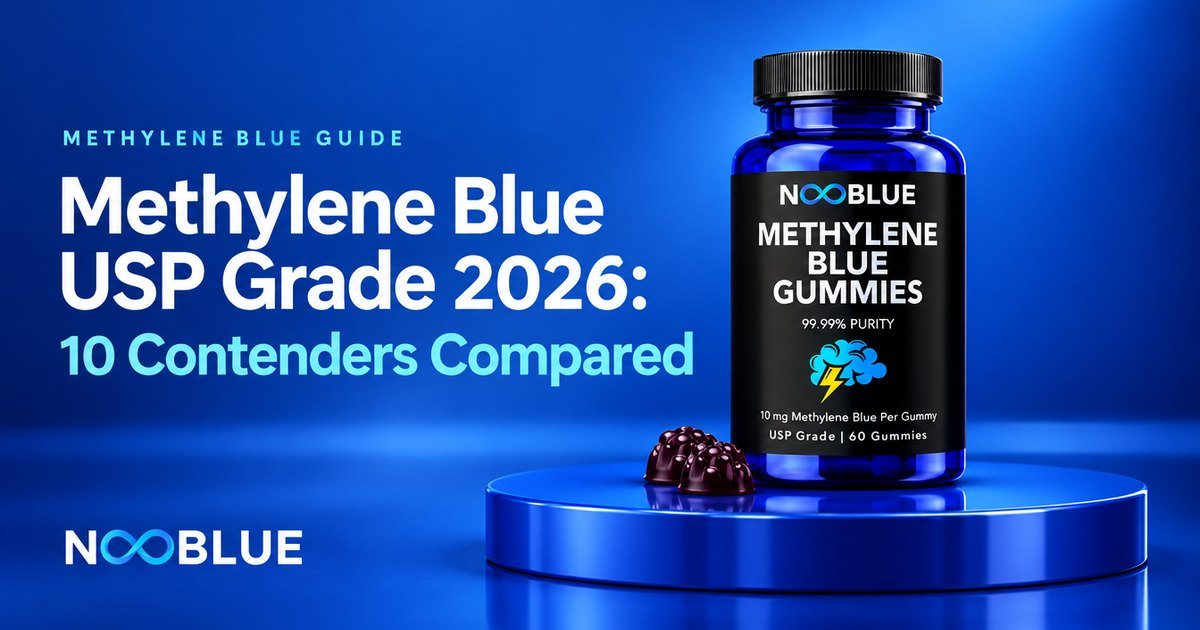
Each NooBlue methylene blue gummy contains 10 mg of USP-grade methylene blue and 25 mg of vitamin C in a Wild Blueberry pectin chew with 0 g total sugar. The label serving is one gummy daily, so a 60-gummy bottle lasts 60 days at $49.99, or $0.83 per gummy. The gummies contain vitamin C, which can shift methylene blue toward its colorless form, and separately, they don’t leave the blue mouth or tongue that liquid drops can. Urine can still turn blue or green, which is expected with any methylene blue.
On documentation, the product page links the CTLA report for the methylene blue ingredient lot 2025022801: an HPLC identity result of “Conforms” and results for arsenic, cadmium, mercury and lead. The page also states the limits of that report plainly. It covers the ingredient, not every finished batch, and it doesn’t establish a purity percentage. We would rather show a narrow document with its scope than print a number we can’t support.
- Pros: 10 mg in one chew, 0 g sugar, no blue mouth, 60-day supply, ingredient report linked with its scope explained, sold direct with 30-day returns.
- Cons: no finished-product potency report yet, and 10 mg is a fixed serving. If you want 5 mg, the capsules below fit better.
Who it suits: people who want a simple daily routine without measuring and without the blue mouth that drops cause. Our methylene blue gummies comparison covers the gummy field in more depth.
#2. NooBlue Methylene Blue Drops 1%: measuring in small steps
The NooBlue 1% drops are a USP-grade methylene blue solution in distilled water, supplied in a 50 mL bottle with a glass pipette. One drop is 0.5 mg, 10 drops are 5 mg and a full dropper (20 drops) is 10 mg, which gives about 100 servings of 5 mg. At $29.99 that is $0.60 per 10 mg, the lowest cost per milligram among the three NooBlue formats.
Drops are the only format here that lets you adjust in half-milligram steps. The trade-off is that you measure every time and the solution stains: the mouth and tongue if taken straight, and fabric or counters if spilled. Mixing it into water or juice helps. The same CTLA ingredient-lot report is linked from the drops page.
- Pros: 0.5 mg steps, about 100 servings of 5 mg, lowest cost per milligram of our range, glass bottle and pipette.
- Cons: stains the mouth and surfaces, needs measuring, less convenient to carry.
Who it suits: people who want to set their own serving within the label guidance. For a first bottle, see which bottle of methylene blue solution suits beginners, and for other liquids, our best methylene blue drops comparison.
#3. NooBlue Ultimate Methylene Blue Capsules: a fixed 5 mg serving
NooBlue Ultimate Methylene Blue Capsules contain 5 mg of USP-grade methylene blue and 10 mg of vitamin C in a cellulose capsule with rice flour. The label is one capsule daily with food, and a 60-capsule bottle is a 60-day supply at $37.99 (regular price $49.99). Do not exceed the suggested serving.
Five milligrams is the smallest fixed unit in this comparison. It is a sensible option if you want a set amount with no measuring and no taste. Per milligram it is the most expensive NooBlue format at $1.27 per 10 mg, because you are paying for a capsule around a small amount of active ingredient. It links the same ingredient-lot report.
- Pros: smallest fixed serving here, no taste, no measuring, no mouth staining, 60-day supply.
- Cons: higher cost per milligram than our drops, and a fixed 5 mg unit with no smaller step.
Who it suits: people who want a steady 5 mg serving. Our guides to pharmaceutical grade methylene blue capsules, capsules vs liquid and the best methylene blue capsules compare the capsule field.
#4. Nutricel Blue Boost: finished-product potency testing
Nutricel Blue Boost is $34.90 for 60 capsules. Each capsule has 12 mg of USP-grade methylene blue with 35 mg of vitamin C ester (ascorbyl palmitate) and 235 mg of organic cacao powder, which works out to $0.48 per 10 mg. The product text claims “99%+ purity”, and the certificates page describes the raw methylene blue as 99.4%.
Nutricel’s documentation is the strongest among the competitors here. Its certificates page links Eurofins reports for each product, and for Blue Boost the card reads “Methylene blue potency, heavy metals & microbial safety, Tested July 2025”. The page explains that methylene blue content is checked by titration against the label claim. Its safety notice is also clear: do not take it with SSRIs, SNRIs, MAOIs or any serotonergic medication, or if pregnant or nursing, and not for children. It names Benadryl as an interacting medicine and says evening use may affect sleep.
- Pros: finished-product potency, metals and microbial testing on a public page, clear safety notice, low cost per milligram.
- Cons: 12 mg is a large fixed unit with no smaller option, the cacao and vitamin C ester make it a blend, and Nutricel ships only to addresses within the United States.
Who it suits: US buyers comfortable at 12 mg who want to read a finished-product report. Our Nutricel vs NooBlue comparison goes further.
#5. Chemist Labs Methylene Blue Capsules: lowest cost per milligram
Chemist Labs Methylene Blue Capsules contain 10 mg of methylene blue per capsule, described as “99% pure USP Grade”. A 60-capsule bottle is $34.99 and a 120-capsule bottle is $44.99, which is $0.37 per 10 mg, the lowest cost per milligram in this comparison.
Chemist Labs publishes CTLA reports for finished capsule lots on a lab reports page. The report for lot 2512701 gives an FTIR identity match of 97.9%, a full microbial panel, heavy metals below or near detection limits, and methylene blue by HPLC as 3.638% of the capsule contents. Because the report doesn’t give the fill weight, you can’t turn that percentage into milligrams per capsule. The report for lot 2602801 covers microbes and heavy metals only. The product notice says not to use it with SSRIs, when pregnant or nursing, or in children, and names diphenhydramine as an interacting antihistamine.
- Pros: lowest cost per milligram here, finished-capsule reports by lot, clear SSRI warning.
- Cons: the potency result can’t be checked against the 10 mg label, and the newest lot report has no methylene blue result at all.
Who it suits: cost-focused buyers happy with a 10 mg capsule who want to see lot-level contaminant testing.
#6. Zatural Methylene Blue 1% USP Grade: raw-material assay on the page
Zatural Methylene Blue 1% is $19.99 for a 30 mL glass bottle of a 1% solution in distilled water, which is 300 mg of methylene blue and $0.67 per 10 mg. It is the lowest bottle price in this list.
The product page links both a safety data sheet and a certificate of analysis. The certificate is the most detailed raw-material document in this comparison: an Arbro Pharmaceuticals report on methylene blue trihydrate powder, batch L24MBZF24, tested to “USP-2024”, with an HPLC assay of 98.03% on a dried basis against USP limits of 97.0% to 103.0%. It tests the powder, though, not the finished solution in the bottle.
Two things on the page are worth knowing. The dosing note is given per kilogram of body weight rather than as a serving, and the page advises against long-term, consistent use, saying daily use for more than two weeks “could have harmful oxidative effects”. It also says to use the product under the guidance of a healthcare professional, but we found no mention of serotonergic medicines on the page.
- Pros: lowest bottle price, a real USP assay on the raw material, two-ingredient solution, safety data sheet linked.
- Cons: no finished-solution test, no serving on the page, and no serotonergic warning.
Who it suits: experienced buyers who want to read a raw-material certificate and will set their serving with a professional.
#7. Earth Harmony Ultimate Methylene Blue: capsule with added plant ingredients
Earth Harmony Ultimate Methylene Blue is $39.95 for 60 capsules. The site’s FAQ states 12 mg of methylene blue per capsule ($0.55 per 10 mg), alongside vitamin C and a blend of organic berberine, chlorophyllin and chlorophyll whose amounts the product text doesn’t give. The page describes the methylene blue as 99.99% USP or pharmaceutical grade and says all products undergo third-party testing, but no certificate is linked from the capsule page.
The safety box says it is not recommended during pregnancy or nursing, tells people with a known G6PD gene mutation to consult their healthcare provider, and says not to combine it with SSRIs, antidepressants or other serotonergic medicines.
- Pros: low cost per milligram, clear serotonergic warning, G6PD mentioned.
- Cons: no document to support the 99.99% figure, undisclosed amounts of the added botanicals, 12 mg fixed unit.
Who it suits: buyers who specifically want the added plant ingredients and accept testing claims without a document.
#8. Meraki Blu USP Grade Methylene Blue: weaker liquid with contaminant panels
Meraki Blu is $35.00 for 30 mL containing 150 mg of methylene blue, with 2 bottles for $65 and 3 for $89. That is a 0.5% solution, half the strength of a 1% product, and $2.33 per 10 mg at the single-bottle price. The page gives about 0.25 mg per drop and suggests starting with 1 to 3 drops.
The page shows three Light Labs certificates from 2026: heavy metals (cadmium 3.48 ppb, the others not detected), formaldehyde (below 10 ppm) and a microbial panel with no organisms detected. That is useful contaminant data. None of them measures methylene blue, and the lot field on each is blank, so they don’t support the “99.9%” purity figure on the page. The product description says “For research purposes only” while the page sells it as a supplement. Its warnings cover under-18s, pregnancy and breastfeeding, G6PD deficiency and antidepressants or SSRIs.
- Pros: three contaminant panels shown, including formaldehyde, and a broad warning list.
- Cons: highest cost per milligram among the liquids, no assay, blank lot fields, and a research-only line that sits oddly with supplement marketing.
Who it suits: people who prefer a weaker liquid for very small drops. Our Meraki methylene blue review covers the brand in depth.
#9. Troscriptions Just Blue: troche format through practitioners
Troscriptions Just Blue is a pack of 4 ingestible troches with 16 mg of methylene blue each. The pack is described as “Up to 16 Doses” because the troches are scored.
The site now says its products are available exclusively through healthcare practitioners, and the certificate of analysis is sent on request through a form rather than published. The FAQ warns that the troche will temporarily stain the mouth, including the teeth, and lists pregnancy, breastfeeding, G6PD deficiency and serotonergic medicines among the contraindications.
- Pros: a distinct troche format, clear contraindications, scored units.
- Cons: COA only on request, not openly sold to the public, and it stains the mouth and teeth.
Who it suits: people already working with a practitioner who stocks it. See our Troscriptions methylene blue review.
#10. Blue Organics Methylene Blue+ USP Grade 1%: check the documents before buying
Blue Organics Methylene Blue+ is $49.00 (shown against a $99 compare-at price) for a 30 mL bottle of a 1% solution, which is 300 mg and $1.63 per 10 mg. The specifications list purity as “≥99.9%”, while the description says “99.99% USP-grade purity”. The description also says every batch comes with a certificate verifying purity, potency and heavy metals.
The only document we found on the page is a Nexora Labs report from January 2024 on “BlueOrganics USP Grade Methylene Blue order # 8942”, tested as a powder, covering heavy metals and two microbes. It includes no methylene blue assay and doesn’t test the finished solution. The page also carries a “For personal research use only” disclaimer next to supplement marketing and a “92% Sold Out” banner. Its safety advisory is clear: adults only, and not for anyone pregnant, nursing or taking prescription medicines, especially SSRIs, MAOIs or other serotonergic drugs.
- Pros: clear safety advisory, glass bottle.
- Cons: two different purity figures, a certificate claim the linked document doesn’t support, and a high price per milligram for a 1% liquid.
Who it suits: on current information, better-documented liquids cost less. Our Blue Organics methylene blue review has more detail.
What the research on methylene blue shows
No study has tested any of these brands, so research can’t rank them. What it can do is set expectations:
- Memory and brain activity: Rodriguez and colleagues (2016, Radiology) gave 26 healthy adults aged 22 to 62 a single low oral dose or a placebo. An hour later, brain scans showed more activity during attention and short-term memory tasks, and correct answers in memory retrieval rose by 7%.
- A single large dose: Telch and colleagues (2014, American Journal of Psychiatry) gave 42 adults with a strong fear of enclosed spaces either 260 mg of methylene blue (23 people) or a placebo (19) once, after an exposure session. Contextual memory was better a month later with methylene blue, and fear results depended on how the session went.
- A result that cut the other way: Singh and colleagues (2023, Journal of Cerebral Blood Flow and Metabolism) found that intravenous methylene blue lowered brain blood flow and oxygen use in healthy volunteers, the opposite of what they expected. They suggested the doses may have been above the range where methylene blue helps.
- How long it stays in the body: Walter-Sack and colleagues (2009) gave 16 healthy volunteers a single 500 mg oral dose. Blood levels peaked after about 2.2 hours and the half-life averaged 18.3 hours, which is why labels are written for one serving a day.
None of these studies used daily supplement servings or measured energy, and none tells you which bottle to buy. That comes down to the dose on the label and the documents behind it. Our article on whether methylene blue works goes through the trials in more detail.
Safety: who should not take methylene blue
USP grade is about the ingredient, not about who can take it. Lab work on the purified human enzyme by Ramsay and colleagues (2007) found methylene blue to be a potent inhibitor of monoamine oxidase A (MAO-A), which breaks down serotonin. That is the reason for the most important rule below.
- Do not take methylene blue with an SSRI, SNRI, MAOI or any other serotonergic medicine, because of the risk of serotonin syndrome. See methylene blue and serotonin syndrome.
- Do not take it if you have G6PD deficiency.
- It is not for use during pregnancy or while breastfeeding.
- It is not for anyone under 18.
- It can color urine blue or green.
- Talk to your doctor before use if you take any prescription medicine.
Follow the label serving and do not exceed it. Our guides to how many mg of methylene blue per day and who should not take methylene blue cover the details.
The verdict
NooBlue Methylene Blue Gummies are our pick: USP-grade methylene blue at 10 mg per chew with 25 mg of vitamin C, 0 g sugar, no blue mouth, a 60-day supply and an ingredient report linked with its limits stated. If you want to measure small steps, our 1% drops give 0.5 mg per drop at the lowest cost per milligram in our range, and if you want a fixed 5 mg serving, our capsules do that.
Among the other brands, Nutricel publishes the most complete finished-product testing but ships only within the United States, Chemist Labs has the lowest cost per milligram, and Zatural shows the most detailed raw-material certificate. Across all ten, the lesson is the same: “USP grade” on a label is a starting point, and the document behind it, read carefully, is what tells you what you are buying. Free worldwide shipping applies to NooBlue orders over $100, with 30-day returns. You can read more about NooBlue, browse the NooBlue shop, or compare more brands in our best methylene blue supplements guide and top methylene blue brands comparison.
Frequently asked questions
What is methylene blue USP grade?
It is methylene blue that is claimed to meet the United States Pharmacopeia monograph, which sets tests for identity, the amount of methylene blue in the material (the assay) and limits for impurities. It describes the raw ingredient. To check the claim, look for a certificate that reports an assay result against the USP limits and names the lab and the lot.
Is USP grade the same as pharmaceutical grade?
No. USP grade refers to a specific written standard. “Pharmaceutical grade” has no fixed definition. Many brands use both phrases, so judge the document rather than the wording.
Which methylene blue brand is legit?
Look for a stated dose per unit, a clear serotonergic-medicine warning and a lab document you can open before buying, then read what that document tested. In this comparison, Nutricel and Chemist Labs publish finished-product reports, NooBlue links its ingredient-lot report with its scope stated, Zatural links a raw-material assay, and Meraki shows contaminant panels. Earth Harmony links nothing, and Troscriptions sends its certificate on request.
What is the best methylene blue USP grade product?
Our pick is NooBlue Methylene Blue Gummies: 10 mg of USP-grade methylene blue with 25 mg of vitamin C per sugar-free gummy, 60 per bottle, no blue mouth, and an ingredient report linked from the product page. If you only care about cost per milligram, Chemist Labs’ 120-count capsules were the cheapest per milligram in our list.
Is 99.9% pure methylene blue better than 99%?
Not necessarily. A percentage on a product page is a claim, and it rarely says which test produced it or which lot it applies to. A documented assay inside the USP range, such as the 98.03% on Zatural’s raw-material certificate, tells you more than an unsupported round number.
Can you buy USP grade methylene blue on Amazon?
Listings that say “USP grade” are common there, but marketplace listings rarely link a certificate and the seller may not be the brand. If you buy on a marketplace, choose a brand whose own site publishes a document you have already read. Our guide to where to find methylene blue covers the options.
How much should USP grade methylene blue cost?
In this comparison the lowest cost per 10 mg was $0.37 (Chemist Labs, 120 capsules). Compare per milligram rather than per bottle, because pack sizes range from 64 mg to 1,200 mg of methylene blue.
Is lab grade or aquarium methylene blue the same thing?
No. Microscopy stains such as Sigma-Aldrich M9140 are sold with a dye content of at least 82% and are labeled harmful if swallowed, and aquarium products such as Kordon’s state they are not for human consumption. Only take methylene blue sold as a supplement with a stated dose.
Does USP grade methylene blue stain your mouth?
Grade has nothing to do with staining. Liquid drops and troches can stain the mouth and teeth, capsules are swallowed, and NooBlue gummies don’t leave a blue mouth. Any methylene blue can turn urine blue or green.
Does USP grade mean the dose on the label is accurate?
No. USP grade is about the raw ingredient. Whether each gummy, capsule or drop contains what the label says depends on how the finished product was made, which only a finished-product potency test can show. In this comparison, Nutricel’s reports cover finished-product potency. Chemist Labs reports methylene blue as a share of the capsule contents without the fill weight needed to check the 10 mg label.
What does a methylene blue certificate of analysis include?
A useful one names the lab, the product or ingredient tested, the lot number and the dates, then reports identity, an assay of how much methylene blue is present, heavy metals such as arsenic, cadmium, lead and mercury, and microbial results, each with a method and a limit. Check the sample name first, because a raw powder, an ingredient lot and a finished product are different things.
Why do some methylene blue products say “for research use only”?
It usually means the seller is not presenting the product for human use, even if other parts of the page read like supplement marketing. Meraki and Blue Organics both carry research-only lines in this comparison. If you intend to take methylene blue, choose a product sold as a supplement with a stated serving and a serotonergic-medicine warning.
Is methylene blue safe to take every day?
Only at the label serving, and only if none of the exclusions apply: no SSRIs, SNRIs, MAOIs or other serotonergic medicines, no G6PD deficiency, not during pregnancy or breastfeeding, and not under 18. Talk to your doctor first if you take any prescription medicine.
Sources
- Brand product pages, certificates and lab reports linked in each ranked section above, read September 2026.
- Zatural certificate of analysis (Arbro Pharmaceuticals, batch L24MBZF24). PDF
- Chemist Labs capsule lot 2512701 certificate (CTLA 137333). PDF
- Sigma-Aldrich. Methylene blue USP Reference Standard 1428008. Product page
- Sigma-Aldrich. Methylene blue M9140, stain. Product page
- Kordon Methylene Blue (aquarium use). Product page
- Rodriguez P, Zhou W, Barrett DW, et al. Radiology. 2016;281(2):516-526. PubMed 27351678
- Telch MJ, Bruchey AK, Rosenfield D, et al. American Journal of Psychiatry. 2014;171(10):1091-1098. PubMed 25018057
- Singh N, MacNicol E, DiPasquale O, et al. Journal of Cerebral Blood Flow and Metabolism. 2023;43(2 suppl):95-105. PubMed 36803299
- Walter-Sack I, Rengelshausen J, Oberwittler H, et al. European Journal of Clinical Pharmacology. 2009;65(2):179-189. PubMed 18810398
- Ramsay RR, Dunford C, Gillman PK. British Journal of Pharmacology. 2007;152(6):946-951. PubMed 17721552