Quick answer
Methylene blue and methyl blue are two different dyes. Methylene blue (CAS 61-73-4) is a small, positively charged thiazine dye with a long history in medicine and research, and it is the compound sold as a supplement. Methyl blue (CAS 28983-56-4) is a much larger, negatively charged dye used to stain collagen and fungi in the lab. Trypan blue (CAS 72-57-1) is a third, unrelated dye used in cell counting and eye surgery. If you want methylene blue, check the label for the name, the CAS number 61-73-4 and a stated USP grade.
Before you take methylene blue: do not take it if you use an SSRI, SNRI, MAOI or any other serotonergic medicine, if you have G6PD deficiency, if you are pregnant or breastfeeding, or if you are under 18. Ask your doctor first if you take any prescription medicine.
NooBlue makes and sells USP grade methylene blue capsules, gummies and drops. We don’t sell methyl blue or trypan blue.
Written by the NooBlue editorial team. Chemical data on this page come from PubChem, and every study is linked in the sources at the end.
One syllable separates methylene blue from methyl blue, and that is enough to send a buyer home with the wrong bottle. The two names belong to different molecules with different charges, different jobs and very different places in a lab or a medicine cabinet. A third name, trypan blue, gets mixed into the same searches because all three are blue dyes used in science. This guide sets out how the three differ, why a mix-up matters, and how to check that a bottle sold as methylene blue really contains it.
Table of contents
- 1. Methylene Blue vs Methyl Blue vs Trypan Blue: The Core Difference
- 2. What Is Methylene Blue?
- 3. What Is Methyl Blue?
- 4. Methylene Blue vs Trypan Blue
- 5. Basic Dye vs Acid Dye: The Chemistry That Explains the Difference
- 6. Why Mixing Them Up Is a Safety Risk
- 7. How to Confirm You’re Buying Real Methylene Blue
- 8. Methylene Blue Formats From NooBlue
- 9. Safety: Read Before You Take Methylene Blue
- 10. Frequently Asked Questions
- 10.1. Is methylene blue the same as methyl blue?
- 10.2. Can you take methyl blue like methylene blue?
- 10.3. Is trypan blue the same as methylene blue?
- 10.4. Is methylthioninium chloride the same as methylene blue?
- 10.5. Which CAS number confirms a bottle is methylene blue?
- 10.6. Why do methylene blue and methyl blue sound so similar?
- 10.7. Which form of methylene blue is best?
- 10.8. Why don’t doctors recommend methylene blue?
- 11. The Bottom Line
- 12. Sources
Methylene Blue vs Methyl Blue vs Trypan Blue: The Core Difference
The table puts the three dyes side by side. Identifiers and molecular weights are from PubChem.
| Attribute | Methylene blue | Methyl blue | Trypan blue |
|---|---|---|---|
| Other names | Methylthioninium chloride, Basic Blue 9, Swiss blue | Acid Blue 93, brilliant cotton blue | Direct Blue 14 |
| CAS number | 61-73-4 | 28983-56-4 | 72-57-1 |
| Color Index number | C.I. 52015 | C.I. 42780 | C.I. 23850 |
| Dye family | Thiazine (phenothiazine) | Triarylmethane | Azo (two azo groups) |
| Formula | C16H18ClN3S | Large sodium salt with three sulfonate groups | C34H24N6Na4O14S4 |
| Molecular weight | 319.9 g/mol | About 800 g/mol | 960.8 g/mol |
| Charge of the dye | Positive (a basic dye) | Negative (an acid dye) | Negative |
| Main uses | Prescription medicine, redox research, lab staining, dietary supplements | Histology stain for collagen, fungal staining | Cell viability counts, staining in eye surgery |
| Sold as a supplement? | Yes, in USP grade | No, it is a lab reagent | No, it is a lab reagent and surgical dye |
The short version: if you want the compound that people take for cellular energy and focus support, you want methylene blue. Methyl blue and trypan blue are stains. If a seller uses the names as if they were interchangeable, treat it as a warning about how carefully they handle the rest of the product.
What Is Methylene Blue?
Methylene blue has one of the longest records of any synthetic compound in medicine. A 2016 review by Howland in the Journal of Psychosocial Nursing and Mental Health Services calls it the first synthetic drug ever used in medicine and describes it as “a cationic thiazine dye with redox-cycling properties and a selective affinity for the nervous system.” Today it is a prescription medicine, usually given by injection in hospital, as well as a common lab stain and an ingredient in dietary supplements. Our guide to what methylene blue is and where it came from tells the longer story.
The redox part is what sets it apart. Methylene blue can accept electrons and turn into colorless leucomethylene blue, then give them up and turn blue again. In cell studies, Poteet and colleagues (PLoS One, 2012) showed it can act as an alternative electron carrier in mitochondria, the parts of the cell that produce energy. That is the basis of interest in methylene blue for cellular energy support, and it is covered in more depth in what makes methylene blue so potent and leucomethylene blue explained. Cell and animal findings don’t carry over to people automatically, and human studies of supplement-sized amounts are still small.
For human use, the standard that matters is the United States Pharmacopeia monograph. USP grade methylene blue must contain 97.0% to 103.0% methylene blue on a dried basis and meet limits for impurities. Our guide to USP grade methylene blue explains what the monograph covers, and what a purity figure really means explains why a number on a label is only as good as the report behind it.
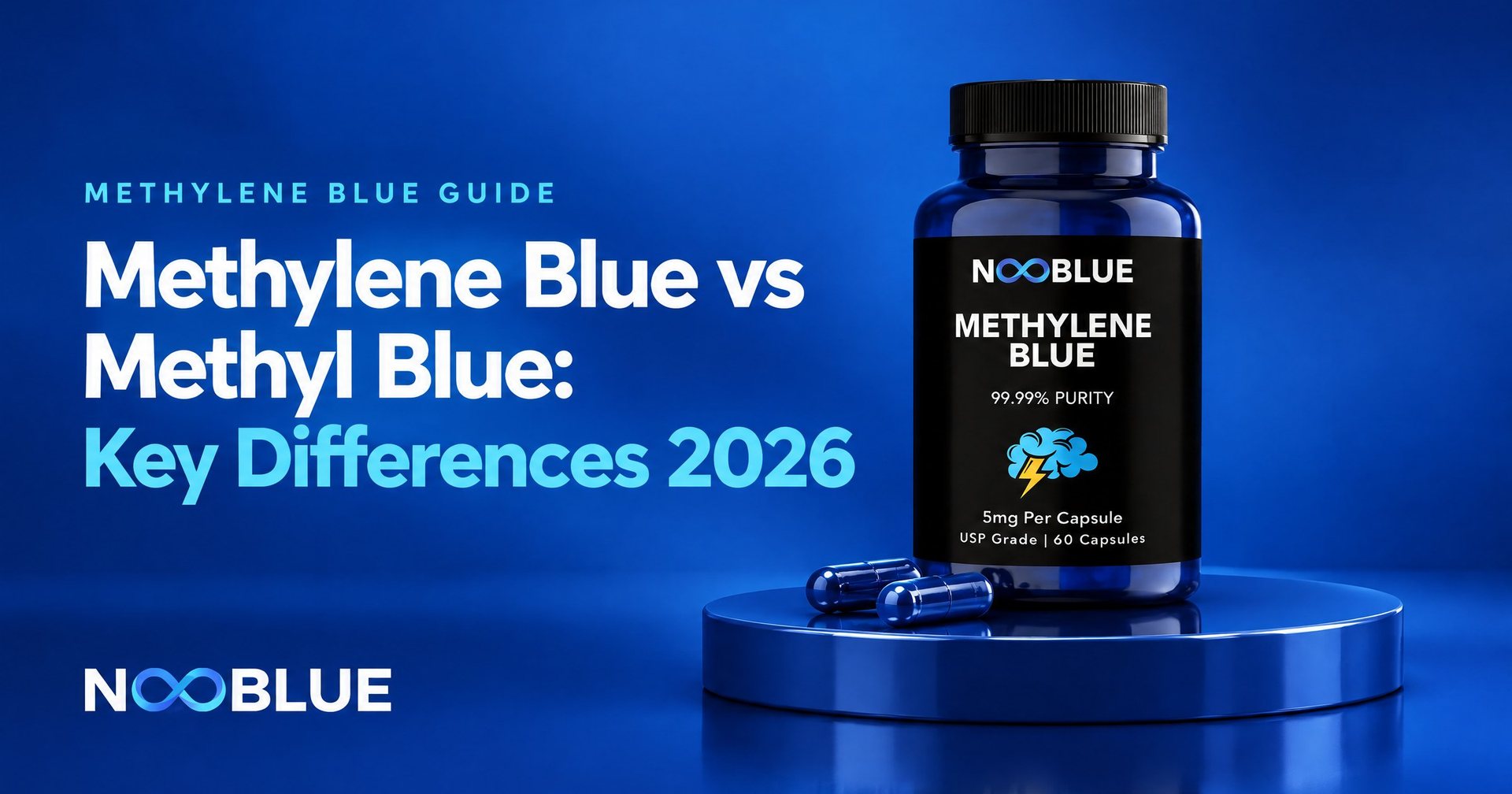
Methylene blue is dose-sensitive, so the amount per serving matters as much as the grade. Our methylene blue capsules hold 5 mg each and are taken once a day with food. The methylene blue dosage guide sets out how much people take and why more is not better.
What Is Methyl Blue?
Methyl blue is a triarylmethane dye sold as Acid Blue 93 (C.I. 42780). In histology it stains collagen blue in tissue sections and is used in trichrome methods such as Mallory’s and Gömöri’s. It also stains fungal cell walls, and it is the “cotton blue” in lactophenol cotton blue, a mounting stain used to look at fungi under a microscope. It is sometimes sold mixed with a similar dye, water blue, under the name aniline blue.
Methyl blue has no tradition of use for energy, focus or any wellness purpose, and nobody sells it as a supplement. The closest it has come to medicine is eye-surgery research. In a 2011 lab study in the Journal of Cataract and Refractive Surgery, Thaler and colleagues tested methyl blue, aniline blue, patent blue and trypan blue as capsule stains on donor cells and pig lenses. That was an in vitro test of a dye applied to tissue during surgery. It says nothing about swallowing methyl blue, and no one should.
People confuse methylene blue with other blue and violet dyes for the same reason. Our comparisons of gentian violet and methylene blue and of methylene blue and crystal violet untangle two more pairs. A related naming trap: “new methylene blue” (CAS 1934-16-3) is also a separate dye, while methylthioninium chloride is simply the formal name for methylene blue.
Methylene Blue vs Trypan Blue
Trypan blue is an azo dye, listed in PubChem as Direct Blue 14 (C.I. 23850). It is best known in two settings, and in both it does a different job from methylene blue.
In the lab: two opposite ways to tell live cells from dead ones
Trypan blue works by exclusion. Cells are suspended in a trypan blue solution, and cells with an intact membrane keep the dye out. In the standard protocol described by Strober in Current Protocols in Immunology (2015), viable cells have clear cytoplasm and nonviable cells have blue cytoplasm.
Methylene blue works the other way round, and brewers use it to check yeast. It enters all the cells. Cells with active enzymes reduce it to its colorless form, so live cells stay clear, while dead cells stay dark blue. Escarpment Laboratories, a yeast supplier, notes a known limitation: recently dead cells can stain a medium blue, which makes counts hard to read once viability drops below about 80%. So both dyes can mark dead cells blue, but trypan blue relies on the membrane barrier and methylene blue relies on the cell’s redox activity.
In eye surgery: a mix-up with real consequences
Trypan blue is also used to stain structures inside the eye during surgery. Methylene blue is not safe for that use. In a 2025 case report in the International Journal of Retina and Vitreous, Zafar and colleagues describe methylene blue injected into the eye in place of trypan blue or brilliant blue, which caused severe damage to the inner retina and profound vision loss. They call these errors “never events” and ask for standard checks and safer packaging. The lesson carries over to anyone buying blue dyes: similar-looking bottles and names get confused even by professionals, so the label and the identifiers matter.
None of this is about taking methylene blue by mouth. A dye injected into the eye is a different situation from a measured oral serving. It does show that “blue dye” is not one thing.
Basic Dye vs Acid Dye: The Chemistry That Explains the Difference
If you remember one piece of chemistry from this page, make it charge. Methylene blue is a basic (cationic) dye: the colored part of the molecule carries a positive charge, so it binds negatively charged structures such as nucleic acids. Methyl blue and trypan blue are acid (anionic) dyes: they carry negatively charged sulfonate groups, so they bind positively charged proteins instead. That is why histologists use methyl blue for collagen and methylene blue for nuclei and bacteria.
Two practical points follow. A listing that describes “methylene blue” as an acid dye, or shows sulfonate groups in its structure, is describing the wrong compound. And methyl blue can’t stand in for methylene blue at any amount, because it doesn’t have methylene blue’s reversible redox cycle.
Why Mixing Them Up Is a Safety Risk
Methyl blue and trypan blue are made and sold as reagents. Nobody makes them to a standard for swallowing, and their safety data concern lab and surgical use. A bottle sold under the wrong name gives you a compound with no supplement-grade specification at all.
The risk is higher online, where listings are copied between sellers and product photos are small. Even when the compound is correctly named, the grade can be wrong. Industrial, lab stain and aquarium versions of methylene blue exist, and they are not made to the USP standard. Our guides to aquarium grade methylene blue, lab grade vs pharmaceutical grade methylene blue and “food grade” methylene blue explain the differences, and where you can buy methylene blue covers retail and online options.
There is a quieter version of the mistake too. Some sellers stock real methylene blue but describe it loosely, using “methyl blue” and “methylene blue” in the same listing. That doesn’t prove the product is wrong. It does suggest a seller who may be just as loose about testing and dosing, so check the paperwork before you buy.
How to Confirm You’re Buying Real Methylene Blue
- Check the name and CAS number. The label or listing should say methylene blue or methylthioninium chloride, with CAS 61-73-4. CAS 28983-56-4 is methyl blue, and CAS 72-57-1 is trypan blue.
- Look for a stated grade. USP grade points to the published monograph. A listing with no grade, or one that says “for research purposes only”, is not selling a supplement.
- Read the test report and its scope. An identity test is the check that confirms the compound is methylene blue and not another dye. Note the lab, the sample and the tests. Our guide on how to read a methylene blue certificate of analysis walks through each section.
- Be wary of home tests. Simple checks can catch an obvious fake, and our page on how to test if methylene blue is real explains what they can and can’t show. They can’t confirm grade or purity. Our guide to real methylene blue vs fakes lists the warning signs we see most.
- Check the warnings. A responsible seller warns against use with serotonergic medicines, in G6PD deficiency, in pregnancy and breastfeeding, and under 18.
Here is how we apply those checks to our own products. Every NooBlue product names methylene blue USP on the label. Our published report from Contract Testing Laboratories of America (CTLA), report 135621, covers the methylene blue ingredient, lot 2025022801. It records an HPLC identity result of “Conforms”, which is the test that separates methylene blue from look-alike dyes, plus individual results for arsenic, cadmium, mercury and lead. It is an ingredient-level report. It doesn’t give a numerical purity percentage, measure finished-product potency or certify every batch. You can read it on any of our product pages. For more on how we handle testing and labeling, see our answer to whether NooBlue is legit.
Methylene Blue Formats From NooBlue
If you have decided methylene blue is what you want, the format is a question of routine. Here are ours, with label facts from each product page as of September 2026.
- Methylene Blue Gummies: 10 mg of methylene blue USP and 25 mg of vitamin C per gummy, 60 per bottle, $49.99. One a day, 0 g of total sugars, and no blue mouth or tongue.
- Methylene Blue Capsules: 5 mg of methylene blue USP and 10 mg of vitamin C per capsule, 60 per bottle, $37.99. One a day with food. Swallowed, so they skip the mouth.
- Methylene Blue Drops 1%: methylene blue USP in distilled water, 0.5 mg per drop, 50 mL for $29.99. The most control over the amount, but drops can stain the mouth and tongue.
With any format, urine can turn blue or green, which is expected. Our gummies vs capsules comparison helps you choose, and the whole range is in the NooBlue shop. For other brands, see our guide to the best methylene blue supplements.
Safety: Read Before You Take Methylene Blue
Do not take methylene blue if any of these apply to you:
- You take an SSRI, SNRI, MAOI or any other serotonergic medicine, including many antidepressants. Methylene blue strongly inhibits monoamine oxidase A (Ramsay and colleagues, 2007), and the combination can cause serotonin syndrome. Read methylene blue and serotonin syndrome.
- You have G6PD deficiency. See methylene blue and G6PD deficiency.
- You are pregnant or breastfeeding.
- You are under 18.
Talk to your doctor before use if you take any prescription medicine or have a kidney or liver condition. Methylene blue can turn urine blue or green, which is expected. Do not exceed the suggested serving on the label.
Never take methyl blue, trypan blue or any lab or aquarium dye by mouth. The full warning is in the safety section of our product pages, and our guides to who should not take methylene blue and methylene blue side effects go into detail.
Frequently Asked Questions
Is methylene blue the same as methyl blue?
No. Methylene blue (CAS 61-73-4) is a small, positively charged thiazine dye with a long medical and research history. Methyl blue (CAS 28983-56-4) is a much larger, negatively charged triarylmethane dye used to stain collagen and fungi. Only methylene blue is sold as a supplement.
Can you take methyl blue like methylene blue?
No. Methyl blue is a lab reagent, it isn’t made to any standard for swallowing, and it doesn’t have methylene blue’s redox cycle. If you want methylene blue, buy a product labeled methylene blue USP with CAS 61-73-4.
Is trypan blue the same as methylene blue?
No. Trypan blue (CAS 72-57-1) is an azo dye used to count live and dead cells and to stain tissue in eye surgery. It works by being kept out of live cells, while methylene blue enters cells and is turned colorless by live ones. The two are not interchangeable, and methylene blue must never be used in place of trypan blue inside the eye.
Is methylthioninium chloride the same as methylene blue?
Yes. Methylthioninium chloride is the formal chemical name for methylene blue. “New methylene blue” is a different dye, and methyl blue is different again.
Which CAS number confirms a bottle is methylene blue?
CAS 61-73-4. Methyl blue is 28983-56-4 and trypan blue is 72-57-1. The CAS number survives marketing names, so check it on the label or the test report, along with an identity result for the compound.
Why do methylene blue and methyl blue sound so similar?
Many old dyes carry “blue” in their common names, and “methyl” appears in the chemistry of both. The resemblance is a quirk of naming. It says nothing about the structure, which is completely different.
Which form of methylene blue is best?
For most people, our pick is NooBlue Methylene Blue Gummies: 10 mg of methylene blue USP with 25 mg of vitamin C, one a day, and no blue mouth. NooBlue capsules suit you if you want a smaller fixed 5 mg amount, and the 1% drops suit you if you want to adjust in 0.5 mg steps. Whatever the format, the grade and a named identity test matter more than the delivery method.
Why don’t doctors recommend methylene blue?
Many doctors know methylene blue as a prescription hospital medicine. As a supplement, the human research on focus and memory is small and short. It interacts with serotonergic medicines, it is unsafe with G6PD deficiency, and product quality online varies, from USP grade to lab and aquarium dyes. Take the label to your doctor and ask directly, especially if you take any prescription medicine.
The Bottom Line
Methylene blue, methyl blue and trypan blue share a color and little else. Methylene blue is a small, positively charged redox dye with a USP monograph and a place in medicine and supplements. Methyl blue is a collagen and fungal stain. Trypan blue is a cell-counting and surgical dye. When you buy, check for the name methylene blue, CAS 61-73-4, a stated USP grade and a test report that includes identity, and read the safety warnings before your first serving.
Sources
- PubChem compound records: Methylene blue (CID 6099), Methyl blue (CID 76956083), Trypan blue (CID 6296), New methylene blue (CID 73518). National Library of Medicine.
- Howland RH. Methylene blue: the long and winding road from stain to brain: part 2. Journal of Psychosocial Nursing and Mental Health Services, 2016, 54(10), 21-26. PubMed 27699422
- Poteet E, Winters A, Yan LJ, et al. Neuroprotective actions of methylene blue and its derivatives. PLoS One, 2012, 7(10), e48279. PubMed 23118969
- Strober W. Trypan blue exclusion test of cell viability. Current Protocols in Immunology, 2015, 111, A3.B.1-A3.B.3. PubMed 26529666
- Zafar S, Pulido JS, Patel SN, Yonekawa Y, Deaner JD. A case of the blue blues: the safety issue of recognizing and avoiding the retinal toxicity of methylene blue compared to brilliant blue and trypan blue. International Journal of Retina and Vitreous, 2025, 11(1), 136. PMC12679766
- Thaler S, Hofmann J, Bartz-Schmidt KU, et al. Methyl blue and aniline blue versus patent blue and trypan blue as vital dyes in cataract surgery: capsule staining properties and cytotoxicity to human cultured corneal endothelial cells. Journal of Cataract and Refractive Surgery, 2011, 37(6), 1147-1153. PubMed 21596258
- Ramsay RR, Dunford C, Gillman PK. Methylene blue and serotonin toxicity: inhibition of monoamine oxidase A (MAO A) confirms a theoretical prediction. British Journal of Pharmacology, 2007, 152(6), 946-951. PubMed 17721552
- Escarpment Laboratories. Viability assays: erythrosin B vs. methylene blue. knowledge.escarpmentlabs.com
- Methyl blue (histology uses and naming). Wikipedia
- United States Pharmacopeia. Methylene Blue monograph, USP-NF. doi.usp.org
- NooBlue product pages: Methylene Blue Gummies, Methylene Blue Capsules and Methylene Blue Drops 1% (label facts, prices and the CTLA ingredient report, read September 26, 2026).
This article is for general information and is not medical advice. Methylene blue is a potent compound. Talk to a qualified healthcare professional before you start it, especially if you take any medication or have a health condition.